

How horses communicate with each other and with us
The body language of horses always pertains to actual events, and the social status of the individual animal can be established from looking at the behaviour of others. A scientifically sound study involves observation of the behaviour of every member of the herd for many hours in a variety of situations and observes each horse in direct contact with every other member of the herd. Each horse will behave according to the situation it is in, which means that it will use its body language so that another horse can read it without misunderstanding. Particularly important spheres that involve status-related body language are the areas that have a particular social meaning among horses. These include greeting rituals, marking of territory, signals to calm situations down, as well as acting to impress mares. The variety of status-related behaviours gives horses and the watchful observer information about the complex network that exists within a group of horses.
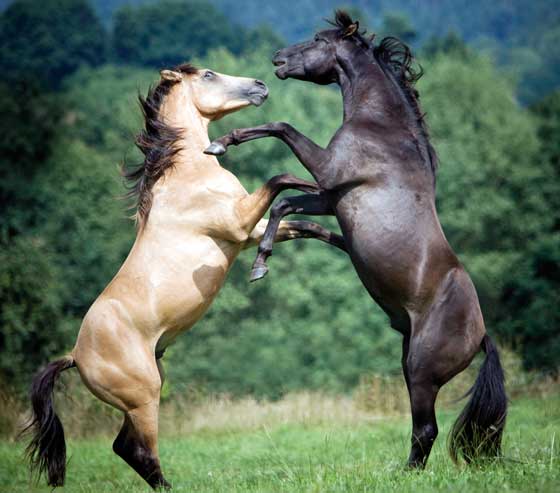
During ritualised fighting serious injury is usually avoided. The well rehearsed moves in fights such as these between animals of the same species serve to prevent harm on either side.
Horses among themselves
Aggressive behaviour amongst horses is often exhibited through a form of ritual fighting. A ritualised fight is a strictly regimented form of fighting between opponents of the same species. Two stallions usually settle differences of opinion like this. A signal from one will be followed by a responding signal from the other. The movements are so embedded in their behaviour that they serve the purpose of solving out a dispute without seriously injuring either of them. Neither of the horses intends to wound the other fatally. Particularly well known ritualised movements include circling one another, nipping the foreleg of the opponent to force him onto his knees, rearing up opposite each other and snapping at the head. The difference in status between the two horses will become clear during the ritual fight through the degree to which the various types of ‘display’ behavioural patterns are shown by the opponents.
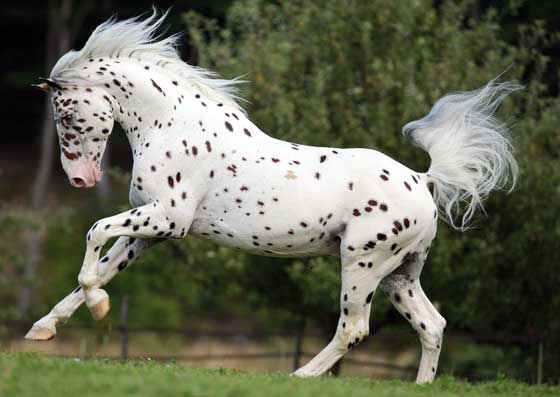
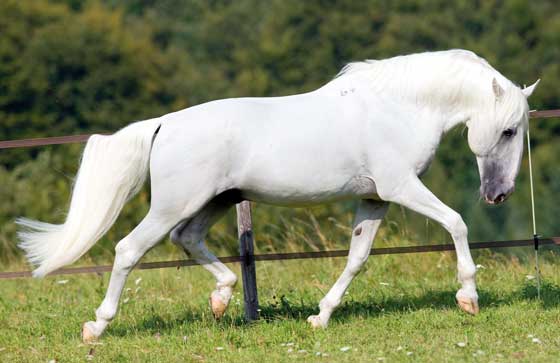
The display behaviour shown by stallions is often sexually motivated and is not necessarily a sign of dominance.
Macho stallion?
The behaviour of a horse is described as ‘display’ behaviour when it serves the purpose of showing its own strengths to another without actually having to start a fight. The opponents will assess each other and then decide whether it is worth fighting. A potential mate will base part of its decision about whether or not it is looking at an attractive partner on the sexual display behaviour shown.
The best known types of display behaviour include a stallion gathering himself up and arching his neck and the elevated passage-like trot in slow motion. How these moves are expressed and the degree to which they are developed in a horse will depend on its personality, type and breed. Some horses are more extroverted and others calmer in displaying this behaviour. Many trainers assume that stallions with a strong tendency to display these patterns of behaviour are automatically ‘dominant’ stallions. This link doesn’t exist. The display patterns of a stallion may be shown more or less strongly depending on its sexual interest, hormone status and motivation.
A stallion who shows off these ritual moves isn’t dominant per se, but is sexually interested.
Punishing a horse that shows these sexual needs can result in serious psychological problems.
Typical problem behaviour in stallions can be found when the animals are kept in poor conditions, whether the stallion is with a herd or kept as a lone individual. For this reason you should distance yourself from methods that could label a stallion as dominant and therefore dangerous, or that would punish his natural behaviour rather than trying to steer him down a better track without the use of force.
Stallion-like behaviour in geldings
The way we keep our horses means that we don’t often see stallions, or the way they behave naturally, but instead we see many more geldings. A gelding’s behaviour is usually quieter and the degree to which they show sexually motivated behaviour, both in frequency and intensity, is substantially lower. Despite this, geldings are still male animals whose sexual behaviour, depending on when castration took place, remains in a youthful stage of development. For this reason many of the insights that biologists have collected from research on wild stallions can be applied to geldings living under typical modern management systems. Groups of geldings can be compared easily to groups of bachelors in the wild. Here too there is a very fluid intertwining of rank, easy friendships and a great tendency to play around together. In mixed groups a gelding will often form a firm friendship with a mare, gently wooing her as a stallion would. Of course the display behaviour is less well developed, and covering occurs rarely, but there is little difference seen in the affection towards the mare. A gelding that was castrated late may even mark the mare’s droppings with its own. In general, the later they are castrated, the more likely a gelding is to show stallion-like behaviour.
Greeting rituals between horses
Horses greet each other in a different manner from the way in which they greet people. A horse that is introduced into a new group does not automatically know which horse has which position in the herd; it doesn’t yet understand the group’s social maze and has first of all to find its way around. The greeting ritual serves primarily to reduce the potential for violence. It avoids escalation of a delicate situation and enables the horses to get to know one another carefully. Two animals meeting for the first time will sniff each other’s nostrils. Here the individual scent of a horse is the strongest, and could almost be compared to a business card. Distance is often maintained from strange horses by squealing and stamping the foreleg. More experienced horses are often very calm and superior when meeting new horses because they don’t easily become threatened.
The reasons stallions mark their territory
For horses it is very important for their social standing that they mark their territory. Stallions and late-castrated geldings will cover the droppings of their mares with their own droppings. By doing this they are clearly demonstrating to other males their rights over these mares. As clear as this form of communication may be to other horses, for us this type of behaviour can appear strange and difficult to understand. This aspect of creating a herd’s hierarchy takes place quietly and unspectacularly and research requires a skilled observer and careful analysis of how the various piles of droppings are constituted.

Turning its gaze away is a typical calming signal for a horse.
It serves to diffuse a potentially dangerous situation.
Signs of appeasement
Of particular importance in the rank-based communication system that exists among horses are the signs of appeasement or soothing, described collectively as ‘calming signals’. Using these signals horses express their own stress and indicate their willingness for conciliation. Licking and chewing, conspicuous and frequent yawning that has nothing to do with tiredness, or a slight turning away of the entire body, are some of the best known calming signals. These signals serve to diffuse a situation and help horses to development harmonious and lasting relationships more peacefully. A horse will often show these signals towards a horse that has a higher social status, so these signs of body language can be used to work out a rough idea of the structure of a herd.
Mutually grooming their waytowards friendship
Two pair-bonded horses aren’t just caring for each other’s coats and skin when scratching each other along the mane, back and at the top of the tail. Mutual grooming is one of the most important acts for cementing the relationship between two horses and serves to deepen the peaceful nature of the community’s structure. It is an indicator of the strongest bond within an equine family – friendship. Mutual grooming expresses the affection that two horses have for each other, regardless of what rank they may have. Horses are divorced from their social status when it comes to a close friend. A horse that has higher standing in the herd than another can demand that a lower ranked horse scratches an itch for it, but there is no rule that says who starts and who finishes. It appears more to be a mutual give and take. Scratching one another creates trust and improves wellbeing. The heart rate of the horse doing the scratching slows, so the act of scratching becomes a valuable stress-relieving factor.

Independent of social status, mutual grooming is an expression of affection between two horses and creates trust and a feeling of wellbeing.
Horse and human in conversation
Communication between horses differs in several essential ways from communication between horse and human. First of all, both species have a different basis for what they want to communicate and the way they express themselves.

The best way of developing effective communication between you and your horse is by learning a mutual form of sign language.
Horses communicate with each other to exchange information, to tell others about their own feelings, to underpin the social structure and to avoid danger. To do this they have a very carefully designed repertoire of gestures, expressions and body language. Any alteration of a single part of the body has a meaning for another horse. Horses have the ability to distinguish the faintest of movements of even less than a millimetre. Even the blinking of another horse’s eye potentially means something. The more obvious parts of body language are the posture, the muscle tone (tensed or relaxed) and the position of the body, head and neck. In addition there are the various states of the body such as the breathing rate, muscle twitching and veins standing out. The subtleties of body language lie in the microscopic signs – the slightest of alterations in the expression of the eyes or the way the lips or nostrils are moved. With all the potential that its body language has, the horse is far superior in many respects to the human.
We are not in a position to move our ears around like a horse. We stand on two legs and this significantly changes the way that we can use our body to express ourselves. In addition, our eyes are positioned differently on our head and we lack a tail to show what sort of mood we are in. In short, our communication is based on a different way of expressing ourselves and our body language is human. Of course there are similarities in body language shared by human and horse. When excited or scared both species will move differently and may begin to sweat. In humans, a change in breathing is a good indication of a change in mood. However the differences are really in the detail. Horses, like people, may be able to learn some of the language of the other species, but much will still stay hidden.

At first glance this pony looks friendly with his ears pricked; however the minuscule signals shown around his mouth reveal his inner tension.
To develop a workable dialogue with horses it is important to give them, from as young an age as possible, the opportunity to learn the language of humans. However, we will always run up against our own limitations in being able to transmit what we want to say, owing to the physical impossibility of using the same sort of expressions that a horse has at its disposal. One alternative to a communication system based purely on the physical lies in developing a shared sign language. Horses are very intelligent creatures that, through the use of reward, can be encouraged to use their abilities to notice the smallest of changes. This is the key to communicating with horses.
Resource management
We are in a position to control the life and education of our horses by managing the resources
that are essential to our horses appropriately. By resources, I mean the variety of things that are essential for our horse’s existence. One resource, for example, is feed, but another important requirement could also be a mate. We control all of these resources and make them available as appropriate to the horses we look after. Horses are very skilled at recognising how to get things they want and who is responsible for providing them. In terms of feed alone, we are a significant controller of one of the most important resources. The horse will draw its own conclusions from this and will be prepared to work with us in order to access these resources. The type of resource management that is linked to certain situations in life, together with the knowledge of how a horse learns, opens up to us the possibility of utilising this learning behaviour to our ends rather than having to deal with the question of rank or hierarchy.
Peaceful coexistence
In order to be able to live in harmony with horses, we need to remind ourselves why horses exhibit hierarchical behaviour. What is their motivation? A hierarchy serves to avoid conflict and reduce aggression within a group. Horses feel better when they can determine the preferences and dislikes, and the abilities and shortcomings, of their companions. The herd can live in peace when the positions within the herd are clear.
Only when a horse knows its position within the herd or sees a particular resource put at risk will it show behaviour that is related to its status within the herd. The most important catalyst for this is competition for status within the herd. Given that the natural possibilities for feeding or for reproduction are limited, it will come down to a matter of competition with others of the same species. Horses try to secure the best conditions for themselves and their offspring, using a variety of strategies in order to be able to pass on their genes successfully to the next generation. A good social standing secures certain advantages for an individual and survival for its group.
This inevitably poses the question of whether we humans can be in competition with our horses. We don’t live within the same community but we come into it as a visitor and are usually engaged with a single horse and not with the entire group. We don’t use the same body language or express ourselves in the same way. We don’t eat the same things and we are not in competition for the same mates. Those of us who have compared how a horse greets another horse for the first time with the way it greets an unknown person will understand that horses know that we are not a horse, but something else. They obviously don’t see us as a part of their community, and therefore the rules that apply to us are different from those that govern members of a herd. By definition, a hierarchy represents the structure of a group whose members stand in competition with one another. This doesn’t apply to the combination of horse and human. Scientifically speaking it is incorrect to use the terms hierarchy, dominance or herd in relation to the relationship between horse and human. A horse can of course form a relationship with its owner or rider, but we will never be integrated into the structure of the herd and instead will have a special role assigned to us.
Nature gives every species an ecological niche that defines its preferences for its sources of food, climate, environmental conditions and surroundings. In other words it gives a species its vocation in the life cycle of the planet. As a large herbivore, the horse has an important position in relation to its forage plants, its predators and also the parasites that live off it, just as humans fulfil a different position in nature. These cycles will intersect, as it were, when a human decides to keep a horse. When living by themselves in the wild every horse has a particular role, i.e. a social niche that it occupies. In the intersection that occurs when a relationship forms between you and your horse, you must try to establish a social niche or a connection between two different living beings outside of the normal conventions of the two species.
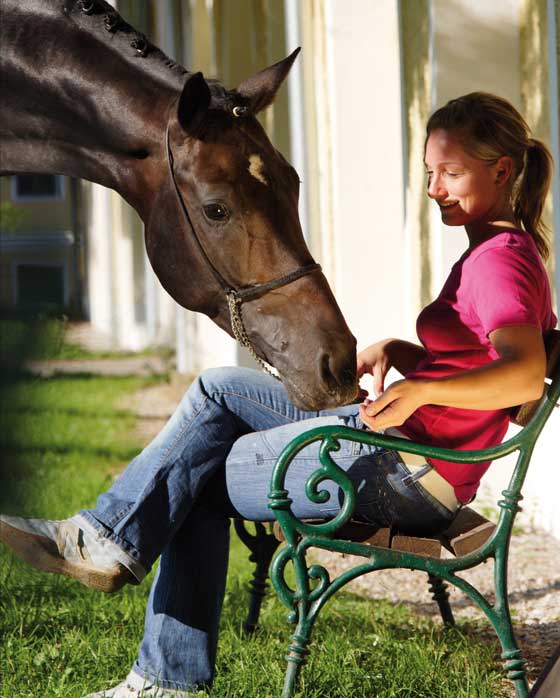
You can never become a full member of your horse’s herd because it is capable of distinguishing a horse from a human. Despite this you can still become a friend, albeit on a non-equine basis.