
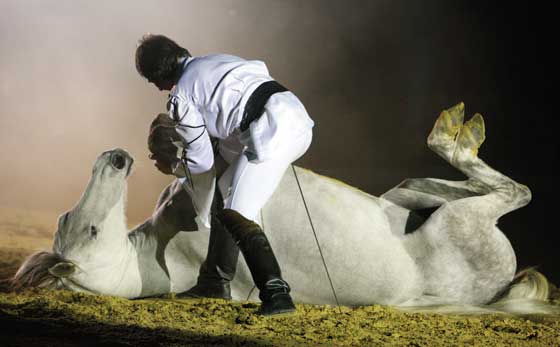
Dominance training in the light of behavioural science
Behavioural researchers discovered the first simple hierarchies in a variety of animal species at the beginning of the twentieth century. Once the same patterns of behaviour had been looked for among horses the fate of dominance theory in horse training started to run its course. Regardless of later discoveries and developing knowledge, popular methods of training were established using the principle of a herd’s social structure. Depending on the trends prevailing at the time, different models emerged: the ‘lead stallion’ model, the ‘lead mare’ principle, or a system of a dominant form of body language. All of these trends assumed that a person could take up a level of social standing within a group of horses and create respect by showing ‘dominant’ behaviour. The dominant person would make all the decisions for their horse, and in turn the horse would obey them unquestioningly. The methods used to achieve this vary, but they have certain similarities, such as the concept of pressure and release, by which the horse has to decide between two unpleasant choices – to give in to pressure or to avoid it.
Humankind – a worthy alpha animal?
Sensitive horses will quickly notice what abilities the person standing opposite them has and what they are obviously lacking.
Seeing potential dangers, for example, isn’t among the talents of most humans, because they have a limited field of vision. This is, however, a particularly important ability for someone in a position of leadership within equine society. Even if there could be a shared hierarchy between two different species, in the eyes of a horse we would be unlikely to look like a born leader, but rather because of our physical insufficiencies we would more likely be at the opposite end of the scale. Horses communicate with each other using a very clearly differentiated repertoire of body signals. We are not able to imitate any of them successfully, and so we are also unable to answer any questions relating to dominance because we can’t make ourselves understood by the horse. Even if we were somehow able to establish ourselves as the lead or alpha animal, we would not be able to exert any control over a horse. Hierarchies have nothing to do with learning or giving orders. Even if we were the king of the herd, our horse would still not be able to do better flying changes. One has nothing to do with the other. Similarly, horses will only learn in connection with their own experiences and not because of social status. In addition, horses are no less dangerous or more obedient to humans just because people behave in a dominant manner towards them. Conscious learning is always an active process that requires an understanding of the things that are being learnt. You can’t drum the required behaviour into a horse or order it to do something because you think that you are more dominant. In order to understand these general principles of learning better, we need to look more closely at how a horse learns.
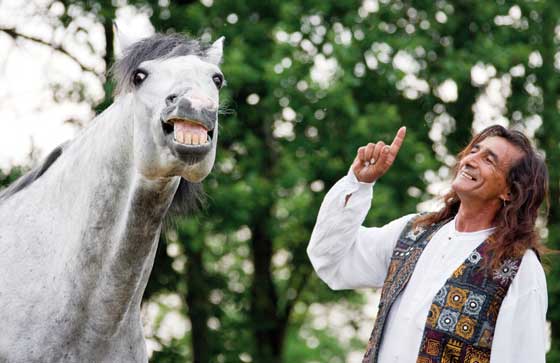
Good communication has nothing to do with social status.
Dominance training vs learning theory
The two competing camps in horse training advance two fundamentally different explanations for their theories. The followers of dominance
theory maintain that horses, once they have accepted a person as being higher ‘ranked’ than them, will henceforth follow all orders without contradiction. Followers of learning theory, on the other hand, keep to the scientific fact that good behaviour and carrying out practised exercises is down to motivation and learning.
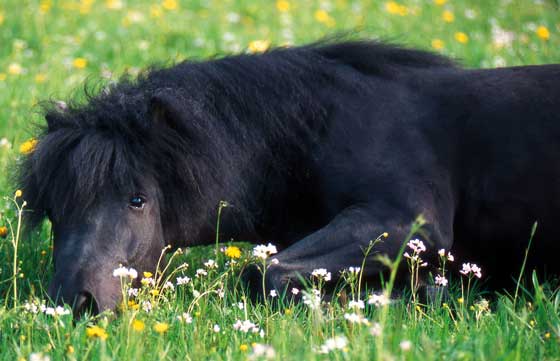
Nothing happens without motivation. A horse that is forced to do something will never do it of its own volition.
From a scientific perspective any learned behaviour is based on modern learning theory. Thus the followers of dominance theory are also drawing from this pot, it’s just that they use pressure and then dress it up with pretty-sounding descriptions. This phenomenon occurs, for example, when a trainer says during a demonstration that they are moving into a horse’s space, like a dominant mare in a herd would, ‘so that the horse learns to respect their position’. By this they mean that they are putting the horse under pressure to cause a reaction. The most important principle of learning behaviour is that learning takes place constantly and can’t be turned on and off as needed. A horse is aware of its environment and adapts itself to its circumstances. It learns especially from the consequences of its own behaviour and from the emotions derived from them. Behaviour that is worthwhile or has been rewarded in the past will be shown more often. Correspondingly, behaviour that is not worthwhile will be shown less often in the future. It is the horse that decides what is worthwhile behaviour and what is not, rather than the person.
For example, people may think that they are punishing a behaviour by shouting to discourage a horse from doing it again. From a human perspective, we don’t like being told off. A horse, on the other hand, may be looking for the attention that it then receives in plenty. Its behaviour becomes very worthwhile for it at this level and won’t be reduced, but on the contrary is likely to become more frequent. We must therefore always pay careful attention to what our horse’s motivation may be and what the reasons for a specific action are.
In order to understand a horse’s motivation and the various possibilities for learning, we must look more closely at how horses learn. There are a variety of ways in which horses learn, some of which take place in parallel and are inseparable from each other. I would like to introduce these briefly in the following section.
Habituation
Using habituation as a learning process means that nothing new is learnt, but that something is forgotten, namely the reaction to a particular sensory perception or stimulus. A horse will probably get a fright when it sees someone putting up an umbrella for the first time. If this is action is repeated often enough, and there are neither positive nor negative consequences for the horse as a result of the action, then its reaction to the umbrella is likely to get less and less until there may be no reaction at all. However, it will continue to react strongly to other scary things because its instinct to take flight will not be so easily forgotten, and for good reason.
In training for calmness, horses are habituated step by step to unusual stimuli, so that they don’t show fear.
This type of learning is commonly used in horse training. Young horses will often be put to graze in fields near busy roads so that from the safety
of their field they will have neither negative or positive experiences with vehicles. They become accustomed to the noise of the traffic insidiously. This process isn’t very effective, however, unless the stimulation (in this example the noise of traffic) takes place often enough.
If a stimulus is very strong or painful, or causes the horse to be afraid, then we get to the next learning process, sensitisation.
Sensitisation
In this type of learning the horse will become more sensitive to a specific stimulus. Many trainers, including the advocates of dominance theory, make use of this learning mechanism to, for example, get the horse to react faster to the swinging of a rope or to a person’s threatening body language. Using this method, it is intended that a horse will perceive an unaccustomed movement or the body language of the person as a threat and will react with fear to the stimulus, which it will try to get away from. The horse learns through negative experience and will become more and more sensitive to the stimulus, for example a rope. The word sensitisation sounds positive but in terms of behavioural science it has no clear positive meaning, but rather a neutral one. Although we say that the horse reacts more sensitively to a stimulus, we can’t say anything about whether they like doing so or not.
Imprinting and socialisation
Imprinting refers to a collection of learning processes that are limited to a period of time during the very sensitive phase of a foal’s early life. One example is the imprinting on the foal’s mother. The result is very fixed. However, if foals are restricted in this early learning experience, or disturbed during it, behavioural problems can result.
In addition there is a phase of socialisation in which young horses will approach new things without inhibitions and will learn to find their way about the world of the horse and human. They don’t consciously ‘learn’ to do this but do it automatically. This socialisation phase is a window that stays open for a limited period of time as set down by nature. In terms of a foal identifying itself as a horse, this lasts until the foal is approximately 43 days old, and then there is an additional window of time that lasts until the 84th day during which the foal can learn to relate to humans or to other species. A foal should therefore at this age have learned to be able to trust us as partners.
Imitation or social stimulation
By definition, learning only takes place through imitation when a horse does something purely as a result of having observed another individual doing it and without having been able to do it before. This true ‘learning from watching’ process is actually very rare and the learning is often more likely to be the result of chance.
The horse also has access to a more widespread mechanism of social learning, which is imitation. Here the foal may copy an adult horse that is grazing, without understanding why the other is dropping its head down to the ground so strangely. It is only by doing it itself that the foal learns it can eat the grass and that this is essential for survival. Horses learn many other things through watching, but researching this field of learning has proven to be extremely difficult.
Classical conditioning
Every horse owner observes this type of learning at feeding time. Horses will react with excitement to the sound of the feed bin being opened, because they associate the noise with the event of being fed. During classical conditioning, what was originally a neutral stimulus acquires a specific meaning and the horse’s brain will make an unconscious association between two events.
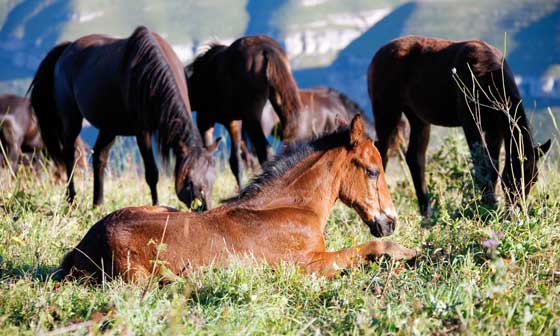
The herd is the ideal nursery during the most important phase of socialisation.
Only here can a foal really gain self-confidence.
Operant conditioning
Operant conditioning allows the modification of behaviour as a result of its consequences. In other words, it can be described as learning by trial and error. The horse tries a number of different possibilities in a new situation and, depending on the positive or negative experience, will draw its own conclusions. In this way it learns a new behaviour voluntarily and deliberately. Operant conditioning is heavily dependent on the horse’s motivation, its current mood and its individual readiness to learn. A trainer must therefore consider why a horse would want to do something at all. These reasons could include pleasure for the horse, and this may convince a horse to display a certain behaviour through gentle persuasion. The reasons could, however, be more negative in nature and more or less subtly force a horse to do something.
In principle we have four ways of influencing our horses’ behaviour:
1. We can do something our horse finds unpleasant (i.e. punish it)
2. We can stop doing something that our horse doesn’t like (end a punishment)
3. We can give the animal something it will like (give a reward)
4. We can stop doing something the horse likes (take a reward away).
In order to recognise what our own training methods are, we need to allocate them to one of these four options. The green zone (1) represents the non-forceful spectrum of learning by reward. The closer we get to the red area (4), which involves methods using pressure, then the less non-forceful the training method is.
Training options
When working with horses you have four methods to choose from. You could …
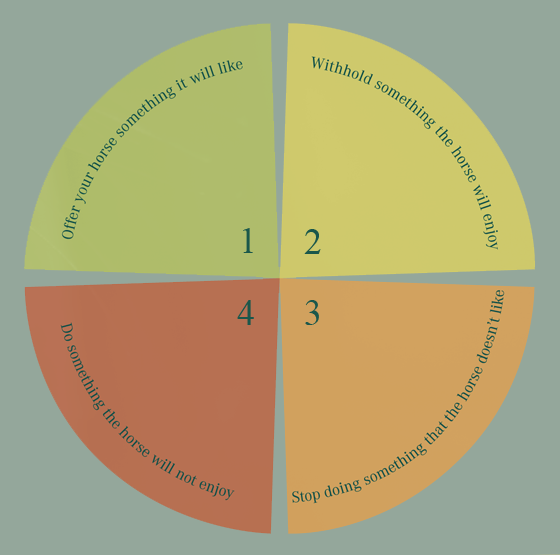
When speaking of these possibilities, they can be described as positive and negative punishment as well as positive and negative reinforcement. Regardless of the fact that, from a scientific perspective, there are four possible ways to exert an influence, the followers of the dominance theory work almost exclusively using negative reinforcement and with punishment. These trainers wait for a horse to show a certain behaviour that at that moment is not desired and correct its behaviour by using a negative response. Or they cause a horse to do something by using pressure even when the horse doesn’t really want to and doesn’t enjoy doing it.
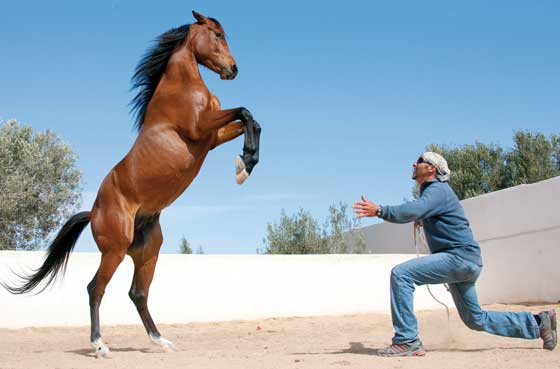
We have a choice: do we want to force a horse to do something or motivate it using a system of rewards?
Followers of the dominance theory train their horses according to the principle of pressure and release. The pressure is gradually built up until the horse shows a reaction. Then the pressure is immediately released – at least in the case of professional trainers. The release of pressure or a break is the only ‘reward’ that the horse gets.
In the case of training in a round pen the horse is rewarded by the trainer ceasing to drive the horse forwards with a rope when they show some cooperation, and the horse will be punished by being driven forwards again if it reacts too slowly. According to the definition from the field of behavioural science, there is no true reward, because the horse isn’t given something positive, but rather there is just a withdrawal of the punishment. This is a huge difference not just for the person training but also for the horse being trained. Horses trained like this don’t respond because they enjoy doing it, but rather because they are afraid of the consequences if they don’t. They choose the lesser evil and become an animal that takes orders without the ability to have its own say.
These methods are associated with a number of disadvantages. Horses trained like this actually receive only limited information about what the point of the training is. They mainly learn what they can and can’t do. This type of learning will often over a longer term cause the horse to become frustrated and its behaviour will become subdued.
The horse may appear to be well behaved and uncomplicated but it is likely to have lost any enjoyment in its work or its inter-action with people – a high price to pay for obedience. In the longer term the relationship between horse and rider can be permanently damaged. A training system that is based exclusively on negatives, with only short breaks as rewards, will cause the horse to become stressed. It is very difficult to learn when under stress, so any real progress will be very slow. As harmless as the use of psycho-pressure may sound, its effects are devastating for the psychological wellbeing of a horse.
Carrot and more stick?
Essentially, the methods described previously will only work if the trainer is fundamentally prepared to exert pressure on the horse, keep it up and if necessary increase it. Fatally for this method, a horse will get used to the degree of pressure so that gradually more and more is required in order to achieve the desired results – to a point where a trainer may sometimes be seen to lose their temper.
This poses the question of how far any of us is prepared to go in forcing a horse to do what we want. In the case of sensitive or frightened horses we may get the desired reaction by using the obligatory waving of the rope or aggressive body language. However, in the case of less sensitive horses, a lot more pressure will be needed, possibly involving hitting the horse with either a whip or the end of the rope. How are we then going to increase the pressure? Do we really want to increase the pressure further? At some time all of us will reach a point when we know that we can’t go any further. For some a slap with a whip is too much; for someone else, though, that point is only reached when they use a twitch and or a device to give the horse an electric shock.
Regardless of where someone’s individual pain barrier is, the problem lies in the principle behind the method. Anyone who has decided to use a method of training that uses negative reinforcement and phases in increased levels of pressure must be prepared to step over that line in order to increase the pressure even more. Otherwise this training method will not work. Most of us who like horses instinctively would not want to do this. Many riders might feel that these pressurising methods aren’t morally correct but will be convinced by professional instructors of their necessity. These trainers use very measured and subtle pressure and are often unscrupulous enough to raise the pressure considerably. Their horses apparently ‘function’ perfectly. This impresses many riders and convinces them to imitate the methods used by these trainers.
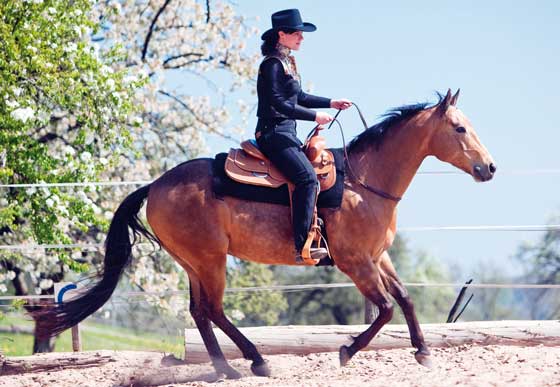
Good riding is possible without pressure! Even unspectacular horses gain greatly in expression when ridden like this.
However one look into the empty and lifeless eyes of these horses reveals at what cost this method of pressure and release works: it is at the cost of the horse’s love of life and its personality. At the same time the risks posed to the unpractised or inexperienced handler will be totally forgotten. Every animal will accept a certain degree of pressure uncomplainingly. It may work quite well for a long time, but at some stage it will look for a way out of the situation. In the best case it might not let itself be caught and brought in from the field. In the worst case it may try to strike back and become aggressive. At some stage the horse will feel that it has nothing to lose. If a horse trained in this manner is pushed into a corner, physically or mentally, by an apparently harmless command then it may literally try and fight for its life. These counter-attacks can be otally unexpected.
Many people who work according to the principle of pressure and release forget somehow that they are exerting a potentially crippling pressure with this training method. They make the pauses and the release of pressure sound positive. But the reality is that you can only stop doing something that you have at some stage started. You can’t reduce or take off pressure where there is none to start with. This gradual build-up of pressure is a punishment for the horse in behavioural science terms, no matter how little pressure there may be.
The principle itself has a negative connotation and represents a form of punishment to which a horse reacts with negative physical reactions, avoidance or evasion behaviour while showing fear, annoyance or stress. Many of the exercises promoted by supporters of the dominance theory work by the use of this mechanism of reaction. The learning process itself is a form of conditioned response that is created by largely negative effects. The horse learns how to avoid the pressure but not always much about the dominance of the trainer. There are no signs that the horse recognises the dominance of the trainer, but it is only the potential for aggression towards the horse that is revealed. According to the concept of ‘pressure and release’, the only thing that horses learn at all costs is to avoid the trainer’s gaze or their swinging rope.
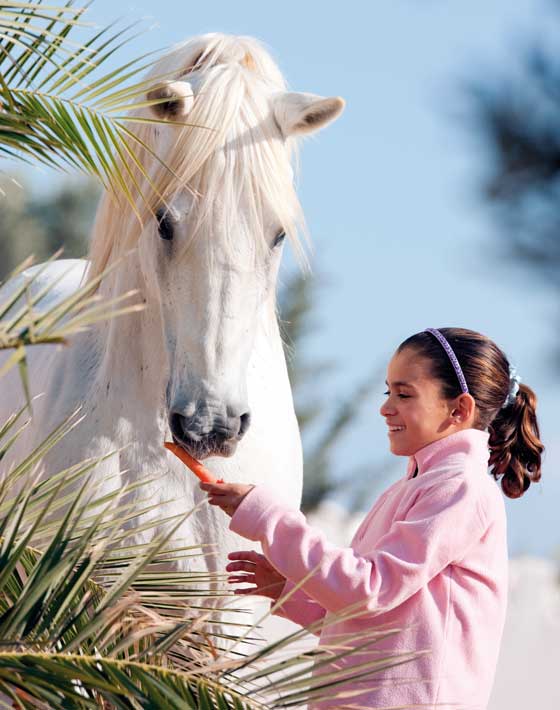
Little gifts help you stay friends!
Learning by reward
Horses can also be taught to be our reliable partners without using the methods of the supporters of dominance if you know how to motivate them positively. Here the focus is placed on behaviour shown by a horse that by chance happens to be ‘correct’ in terms of what we want. This is immediately rewarded with praise, attention, gentle rubbing or treats. Given that a horse will exhibit behaviour more when it is something that is worthwhile doing, it can be trained gradually into a happy and obedient partner. When this happens, the horse is rewarded immediately with praise, attention, petting or treats.
The use of rewards means that the horse will have more motivation to do things for you. The horse will seek out the company of people and will want to do the exercises. By using praise and rewards we are able to show clearly when something is right. We are giving clear and full instructions because the horse no longer has to try out different variations but learns from the start which reaction is being sought to earn the reward. This method is called positive reinforcement. It is used in a variety of modern training methods including the very effective clicker training, which has been developed on the basis of learning theory.
The change from dominance training to learning by reward
It is never too late for you to look for a different way of working together with your horse. Horses have the ability to learn into old age and are always able to learn new reactions or associations. A change in method can have advantages for horses. While classical dominance training can have a demotivating and restricting effect, learning by reward allows the horse to experience its own creativity and enjoyment of life, giving it the chance to work with its trainer in an environment free of stress.
Usually it is the humans that have more problems implementing this change, because they have often only ridden or trained horses using methods associated with dominance training. It requires a lot of courage and hard work to change to a different training method because we must change our attitudes and put old habits aside. However, this step from dominance training to learning by reward will lead the human–horse partnership into a new relationship based on friendship. As soon as we begin to motivate our horses positively, we will be rewarded by their enthusiasm and a new light in their eyes.
Risks and side-effects
Having outlined some of my thoughts on training methods in general, using examples from the area of dominance training, I would like to make you aware of some of the risks that can accompany these methods. I will refer to some well known methods but with the knowledge that some trainers may do it differently. I will be concentrating mainly on the behavioural aspects and question whether what happens under the guise of theory and clever terminology is really what those using pressure-related methods do in practice, or whether from a behavioural research point of view it is all just clever packaging. Furthermore I would like to mention some of the risks that many of the supporters of these methods are keen to keep quiet about and also the effects on the horse’s psychological and physical wellbeing.
Imprint training
Labelled as a pioneering method for the education of newborn foals, imprint training spread from America to Europe some years ago. According to this theory, the newborn foal should be touched all over its body immediately after birth and held until it shows no more signs of resistance. In addition, to prepare it for being ridden it is desensitised to being touched in certain important areas. This is done by touching the foal in the mouth where the bit will later be positioned, or by putting increasing pressure on the girth area until it reacts by moving away. All of this should result in a particularly obedient horse and nip any of the usual problems encountered in the bud – or that’s the theory!
In practice, however, it can be quite different. On the one hand those who advocate this method claim that the process of imprinting is a natural process. In reality though, this process can be hugely disruptive to the natural process of the foal imprinting on its mother. Holding an animal against its will is just as much a form of violence as hitting it. A flood of stimuli is also created, the danger of which we will examine in more detail later. A young horse is completely overwhelmed with impressions, and this is used by us in order to demonstrate our superiority. In doing this we are stepping between a mother and her offspring when they are at a crucial stage of forging their relationship. This can result in an imprinting error that can become an identity crisis whereby the foal doesn’t see itself as a horse. Possible results are a deep sense of insecurity, trauma or even a state of shock. This all happens in the attempt to create a perfectly functioning riding horse. Horses are not puppets, but instead have a right to develop their personality in a normal and healthy way and not have this process interfered with.
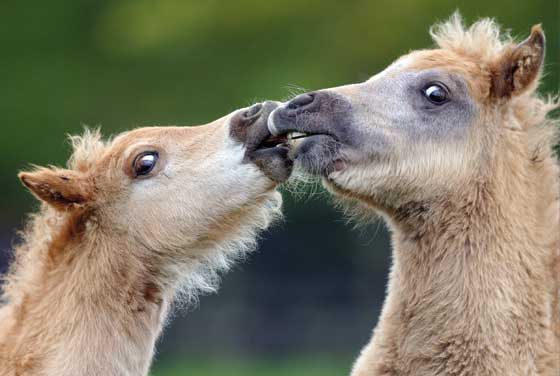
Foals need companions of the same age to play with in order to learn how to form friendships and to be able to develop a secure equine personality.
Round pen training
A well known method of training that is based on the principles of dominance theory is what is known as round pen training. This involves introducing the horse to a circular lungeing arena with a high fence, with the trainer standing in the middle asking the horse to move around him. The person in the middle secures their position of dominance and after a certain time the horse should voluntarily ‘join up’ with the person.
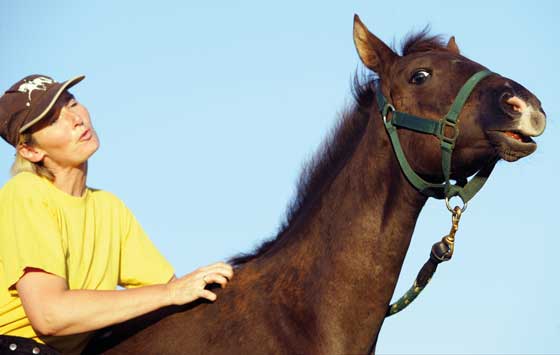
The right way to imprint: approaching a foal carefully during the sensitive early phase using gentle forms of physical contact will encourage a positive relationship with humans. Compare this with the more common method of imprinting which can overwhelm a young horse.
In reality this method also uses the principle of pressure and release. The trainer exerts more or less pressure on the horse, depending on its sensitivity, until the horse reacts by moving. Owing to the circular nature of the round pen and the high surrounding fence the horse cannot get away. Eventually it recognises that there is no escape and that it will only be left in peace when it unconditionally follows the commands given, because any other behaviour will lead to it being chased off around the arena again. There is, however, no alteration in terms of the dominance of the handler. In reality the characteristics that the trainer takes as a sign of the horse recognising their authority (dropping the head, licking and chewing) can, from a behavioural science perspective, be attributed to the stress and the powerlessness caused by the pressure during the training.
Natural horsemanship
There is a further series of methods that function according to the aforementioned principle of ‘pressure and release’ and are apparently aimed at improving the handler’s social status in the ‘herd’. They can be referred to collectively under the term ‘natural horsemanship’. Some trainers work accordingly to a well developed series of steps, with units that are built one on top of the other and use special lead ropes, halters and whips.
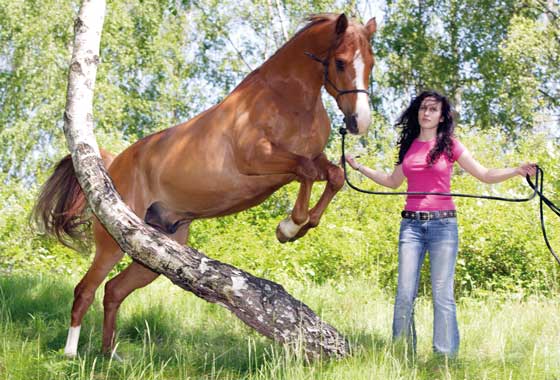
True horsemanship in the best sense of the word means cooperation without pressure or violence.
All these methods use an increase of pressure to cause the horse to react. In the case of professional trainers, when a reaction is shown the pressure is removed immediately. The horse therefore learns from negative reinforcement that doing what the handler asks is inevitable. The horse is directed by the handler’s body language or the other aids, with disobedience of a command resulting in the next stage of pressure being introduced. It learns to do what it is asked not because it trusts the trainer or because it is enjoying doing it, but rather to avoid an unpleasant stimulus. The supposed harmlessness and non-forceful nature of this method frequently appeals to the unsuspecting horse owner.
What does learnedhelplessness mean?
If a horse finds that it is subjected to excessive or inconsistent punishment, then alongside fear and aggression, a state that is known as learned helplessness may also develop. The horse will act more and more passively, and when the condition is particularly strongly developed the horse will not try to resist at all but just submit to its fate. It is similar to some forms of depression found in people.
The horse perceives that its needs are not being met and its feelings are not being respected, and that it can neither resist nor escape. A horse that has reached this state can be recognised by the absence of ear play, when the ears flick back and forth to show its attention shifting from one point to another, and by the inward-looking gaze and general lacklustre expression. Such horses are often held up by their trainers to be particularly well behaved and well trained and by many owners are seen as being absolutely normal. The horse has learned that it isn’t worth trying out anything and behaves as passively and inconspicuous as possible. In reality these poor animals are totally oppressed and live in a state of constant stress and fear. We are dealing here with animals that deserve pity, and that have in effect cut themselves off from their feelings in order to be able to survive. A horse affected like this is suffering a form of psychological torture.
It is precisely this state, however, that seems to be the desired result in many of the training systems that work using the principles of dominance theory, even if the trainer would probably not describe it like this. Only a weak-willed, obedient and well behaved horse is apparently a good one.
What is totally forgotten along the way is that a horse has a soul that can be only too easily destroyed when treated like this.
The controversial and much debated use of hyperflexion also trains the horse systematically into a state of learned helplessness.
The horse is taught that there is no point in trying to evade the rider, because the rider is superior whatever the position. In addition, the field of vision is considerably limited and so the horse is more reliant on the rider to give it direction.
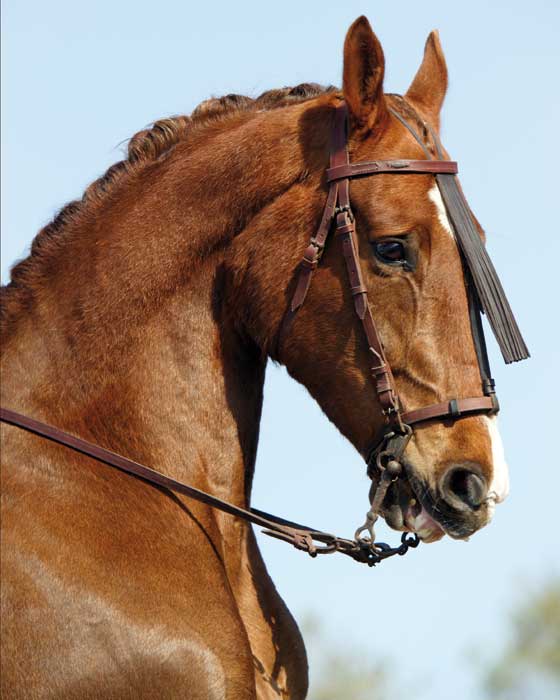
The sad eyes, the lack of ear play and the resigned expression are all clear signs of learned helplessness.
Learned helplessness and the accompanying passivity should never be considered desirable or good. On the contrary, people should pay more attention and should not use trainers whose horses give the impression of having reached a state of learned helplessness. The world of competition and its governing bodies should also pay more attention to the silent suffering of these animals. Only by working together for the good of the horse can we end this type of psychological violence.
Without force – or perhaps not?
The terms ‘without force’ and ‘without violence’ are greatly over-used in the world of training horses, and especially in the world of dominance training where they appear to be a generally recognised feature. Whether a method involves force or not is a definition set by the individual. For one person, avoiding the use of physical force may be enough; another might go one step further. In the case of many traditional riding instructors, as well as with the modern American and
Dutch systems of training, the psychological force that is used on horses should not be underestimated. What is non-violent to the trainer is not necessarily the same to the horse.
The question of what a horse feels during a training session can only be answered by the horse. We should always pay attention to whether the horse is really enjoying its work – in other words whether they show enthusiasm in their movement and a happy expression, and whether it has watchful eyes and ears that move frequently. All these will help you to decide whether a method is using force or not. A horse that appears passive or numb and shows fear or apprehension is not enjoying its work and won’t see training as enjoyable or as something that does not involve force.
It is also not necessary for a horse to be drenched in sweat or to be agitated for them to learn something new. When selecting a trainer the methods used should be seen not only at demonstrations but most especially during their day to day work, in order for you to be able to decide whether or not they rely on force and whether the methods will work for you and your horse. Horses that are put under too much pressure at home may work well in public because of the fear they have for their trainer. At moments like this many methods appear less forceful than they really are when practised at home.
As we would like to be treated ourselves ...
When choosing a training method it is always helpful to ask whether we would be happy to take the place of our horse. Before an exercise the horse doesn’t know what it is going to do or why it is doing it. Many riders are heavily influenced by the apparent tradition behind dominance theory and by its many advocates. They perceive techniques and actions as normal that an outsider would never class as such.
They way we deal with our horses is not always guided by common sense, but instead and rather too often we religiously follow the big names, the latest in fashionable training methods and the current training gurus. In return for the appropriate reimbursement, some resourceful business people promise their customers a horse that ‘works perfectly’. What you are not told is that its personality will be lost. Many of these methods don’t care about the horse but focus on the comfort and the confidence of the owner. The models these trainers use to explain what they are doing do not follow the principles of behavioural science, but rather use its vocabulary to demonstrate the apparently natural nature of the methods and to justify the negative actions with pseudo-science.
Clever terminology
Dominance training is characterised by the often flowery language used to describe the processes, the purported scientific background, the equipment, or simply the image of the method. These euphemisms are cleverly used to market the training concepts as being free of force. Terms such as ‘playing’, ‘lead mare principle’, or ‘touching’ are used to give a person a better feeling when carrying out the chosen methods. Whether these terms live up to the promises and whether they can be classified as being correct in terms of behavioural science will only be revealed by closer examination.
Many of these theories can be checked against the criteria of learning theory, by looking objectively at exactly what the trainer does and how they describe the processes they are using. In general there are only four ways, which we have already described, to train horses. Either you build up pressure and then release it, or you offer or withhold a reward. These principles of learning are universal and no trainer in the world can ignore them for the benefit of dominance training. If a horse reacts passively, fearfully, particularly nervously or is tense, then you can assume that negative reinforcement has been used in training. The way a horse behaves, its facial expressions and the overall impression the horse gives tell us how it has been or is being trained.
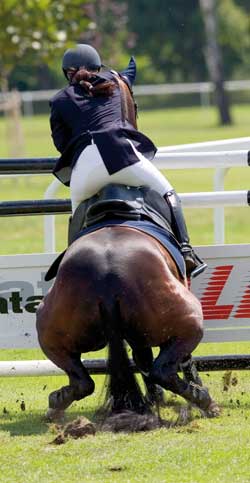
As long as people see their horses as pieces of sports equipment that have to work perfectly, they will continue only to consider performance and to rob their horses of their personalities.
You can check your own methods by cutting back on the aids used. Often certain aids or commands lose their positive meaning and have to be revealed for what they really are. Thus a supposedly harmless stick is nothing other than a type of whip that also serves to build up pressure.
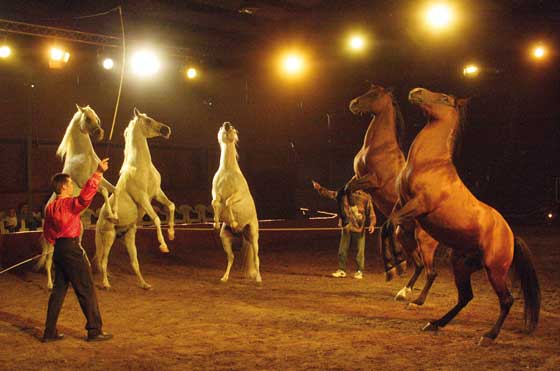
Whether in a circus or in a show, only a look behind the scenes will show the truth about the training methods used.
You must also be cautious when watching professionals during performances. Not everything that is shown or wrapped up in pretty language or clever terminology is actually free of force. Horses that work apparently at liberty, in other words without reins, whip or spurs, are often trained using methods based on negative pressure. They work well because they are conditioned to carry out the required movements, but they often fear punishment if they don’t obey. In the case of shows, the expression of the horse can be covered up by the horse’s natural excitement. It is always best to observe a trainer and their methods at home in familiar surroundings.
In the following section I would like to address some of the common terminology used by followers of dominance theory and clarify what lies behind it.
Dominance training
The use of the words ‘dominance training’ is often a misuse of a term that comes from behavioural science. It isn’t possible to create dominance through training. In a herd of horses there are no overall dominant animals. The term ‘dominant’ refers only to the difference in behaviour between two individuals within a certain context or situation. What is actually being done is dressing up a scientific term and giving it to a training programme that is based on pressure. From a behavioural science perspective the result of dominance training isn’t that the trainer reaches a position of leadership, but rather that the horse reaches a state of learned helplessness, during which it totally gives up its own initiative, stops trying things for itself and passively endures the actions of the trainer.
Everything is ‘natural’
There is an increased trend to refer collectively
to so much in horse training as being ‘natural’ in order to justify using characteristics of the horse’s own nature in the methods. Given that we turn to other aids even when using these so-called ‘natural’ methods, however, you can’t really refer to it as a truly natural type of communication. If these methods really followed natural mechanisms of communication, then we wouldn’t need ropes, sticks or round pens to reinforcement our arguments.
Numerous terms can be used – for example touching, driving, contact or tugging – all of which are supposed to justify the use of pressure under the cover of forming a new pecking order. It would be more honest to describe what is really being done: touching with a whip is and will always be hitting; driving a horse away in a round pen can also be described as chasing. It’s not what you say but the way you say it. Without the euphemisms the actions and methods used by some trainers suddenly don’t seem to be quite as harmless.
Body language
Entire books have been written about body language. Here too the use of the term in behavioural science has been undermined by definitions that can be misleading. In the herd, horses can pick up very subtle signals given through body language, which is why they could theoretically also learn to interpret human body language. This process would have to have taken place during the horse’s socialisation phase, however, and this type of learning can’t be repeated at a later stage in life. For most horses, human body language will remain a foreign language. Despite this they will show natural reactions to certain aspects of our body language. A horse may run away from us because it is scared when we give out threatening vibes, but this isn’t because, as a dominance-based trainer would maintain, you are using your body language to teach certain exercises. Horses react to pressure by moving away and react to the removal of pressure by standing still. Horses trained using dominance-based methods will step backwards not because they have understood the lesson ‘rein back’ but because they are reacting to a perceived threat coming from their trainer. They will never perform individual lessons willingly but will react like puppets having their strings pulled.
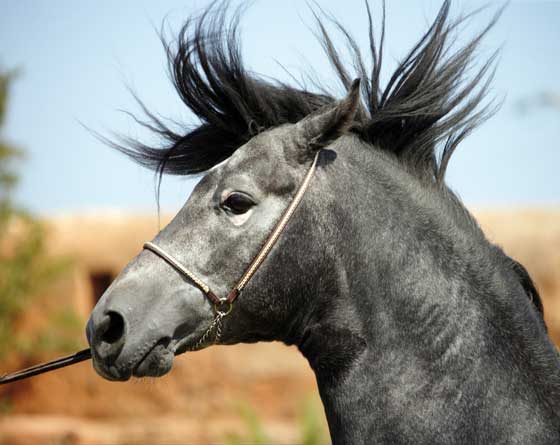
Horses that have been trained using methods involving pressure will often look scared when asked the easiest of questions.
The straightforward mechanisms of learning work in relationship to human body language as well. The horse will learn mostly negatively conditioned reactions, such as when the trainer reinforces their ‘evil eye’ by shaking the lead rope, running at the horse, or in the case of no reaction being shown at all, by hitting the horse with the rope. The horse learns that when one command is given it is followed by a further unpleasant action if it doesn’t obey immediately. For this reason, in the future it will appear to react to the body language. But this is only because the horse has learnt to be afraid of the signals through their association with other punishments and training aids. This procedure has nothing to do with a person’s empathy for their horse, but is a result of the way horses learn to behave. A horse would react to a robot placed in the middle of a round pen in the same way as it does to a trainer – even if the robot couldn’t imitate the aggressive body language shown by the trainer. As long as it was programmed to use the principles of pressure and release the same result would be achieved.
In general, then, the question has to be asked whether it is desirable that a horse learns mainly from negative and threatening body language.
At play
Terms used in excess by many dominance trainers are the words ‘play’ and ‘game’. These terms originate from scientific studies of equine behaviour, and as a result of their positive associations they are supposed to persuade you not to question the methods used. But do trainers really use play in conventional dominance training? It may be true that some people see what is done as a game.
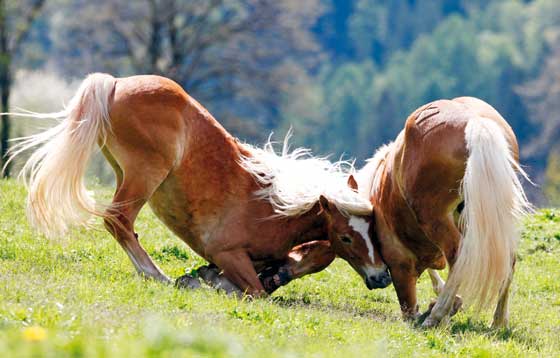
Real horse play involves mutual understanding, role changes and a lot of fun. None of these characteristics will be seen during the so called ‘play’ contained within a system of dominance-based training.
However, true play behaviour, in a behavioural science sense, is not recognisable in these games. We don’t see the usual sorts of playful faces pulled by horses at play, nor the gleam in their eyes or the types of movement they would normally show. Once again pressure is used to ask the horse to play, or rather to react. There is only one point in all of this – to demonstrate to the horse our superiority. Two equal participants are always needed to play, with the roles being swapped around and the activity being marked by fun and volition.
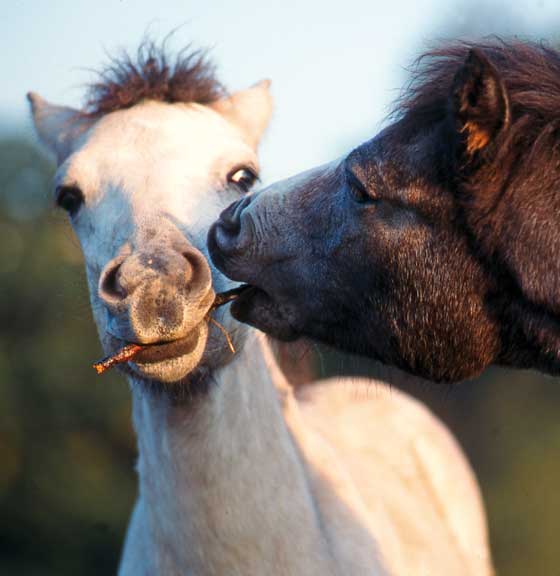
Foals make up games like ‘pass the stick’.
Under the guise of dominance training a new form of psychological pressure has become socially acceptable. It is pointless to consider whether psychological force is worse than physical, or whether how some trainers relate to their horses really represents progress – force is always force and should play no role when training a horse.
Of course, not every dominance-based trainer acts threateningly, but the methods still create a negative atmosphere and remain a demotivating form of training.