

FIVE

There stands opposed to the true history of my people, whose modern era began when the abbé de l’Epée discovered how to educate us through sign language, quite another history. It is a record of the efforts of hearing people to supplant the language of the deaf with their language, to replace signs with speech. It calls itself the history of the deaf—yet it is an account not of my people but of our hearing benefactors, who affirm that the only proper route for elevating the deaf is oral instruction. It is a false history, for I state now, and shall soon show, that although it spans three centuries and a dozen nations, not one person born deaf has ever permanently supplanted his sign with speech. Yet even as Jacob Pereire, the leading oralist of the last century, challenged the great Epée, so repeatedly in my own lifetime have the oralists attempted to deny Epée’s legacy. So they do today, these hearing benefactors who address the deaf in speech and rejoice not in our true education but in a feeble echo of their own utterances. Thus it is necessary to consider this alternative route that the deaf are urged to follow, to see where it has come from, where it has arrived—and where it promises to lead us if we choose it.
Never has this false history been presented with more authority and completeness than in the two volumes of The Education of the Congenitally Deaf, written by one of the great intellects and philanthropists in France, Baron Joseph Marie De Gérando, chairman of the governing board of our school, which solicited the work soon after the abbé Sicard’s death.1 Dozens of hearing authors are cited in the work of this brilliant man who never taught a deaf person anything, and scores of hearing authors in turn have since cited him, and criticized each other’s citations, and cited conflicting views, until all this citing of hearing people has become, for hearing people, the history of deaf people. Worse, deaf children have been led by hearing teachers to learn this so-called history, and to revere its heroes, who are, not surprisingly, other hearing teachers.
Baron De Gérando’s story of the education of the deaf presents the march of history and the steady evolution of method: a parade of noble hearing scholars filing past in the dress of many lands and ages—sixteenth-century Spain, seventeenth-century England, eighteenth-century France—each following in the footsteps of those who have gone before, all selflessly toiling to repair the wrongs of nature. But it is all myth: there is no history here, nor march, nor method. It is an account only of hearing people of high culture who attempted to give ignorant deaf children not culture but sham speech, some lipreading, perhaps written language in close association with speech, perhaps fingerspelling, that is, oral language written in the air. It is the illusion only of a march, as one generation cites the nonhistory of the generation before, the mere reiteration of prejudice. Now, I say, let those in this parade stand down who did not really educate the deaf, who merely made early mention of the deaf or who report hearsay and fantasy.
Most histories begin with the Venerable Bede. He tells us in his Ecclesiastical History2 that Bishop John of Hagulstat in Northumberland took hold of the tongue of a mute in A.D. 685, made over it the sign of the cross, and ordered him to draw his tongue back and to speak, “Yea, yea, and forthwith the ligaments of his tongue were loosened … and the Bishop then asked him to say ‘A,’ and he said ‘A,’ and to say ‘B,’ and he said ‘B,’ etc.… and he made him speak long sentences which he did.” Let Bishop John of Hagulstat stand down and with him the Venerable Bede, and all those who have tried to perform this miracle since, and especially all those who have lied and said they have succeeded. Next cited is Rudolph Bauer, alias Agricola, professor at Heidelberg,3 who merely mentioned in 1528 that he heard of a deaf man who could write. Let him stand down. Let Jérôme Cardan, physician, astrologer, gambler, withdraw: he simply affirmed that those born deaf could be taught to read without speech;4 he never tried. Let John Wilkins, secretary of the Royal Society, step to the side,5 and with him Kenelm Digby,6 intimate of the English court: interested in all manner of things, they make mention of the astonishing achievements of a seventeenth-century Spaniard, Juan Pablo Bonet,7 in teaching the deaf to speak but they do not tell how, much less repeat the feat. Let Juan Pablo Bonet step aside; he wrote the first book on teaching speech to the deaf, it is true, but he probably stole the method and he never tried it himself.8
Look at what is happening to the march of this history, how its ranks are growing thin! There are many other authorities cited in the hearing history of the deaf who never educated them: the Scot George Dalgarno, who published a book on the subject but preferred teaching the hearing at Oxford;9 the Belgian Francis Van Helmont, who wandered about Europe with a caravan of Bohemian gypsies in search of the universal language of man, whose characters would immediately be understood by the deaf;10 the Englishman George Sibscota, who in 1670 published the Deaf and Dumb Man’s Discourse, which he stole from a Dutch physician and translated;11 and his contemporary John Bulwer,12 who wrote three books about the deaf and never taught a deaf man. Let us order the plagiarists to stand down—they only give the illusion of a parade by making the same marcher appear at intervals in different uniforms. Shall we likewise order out of the ranks those who unwittingly duplicated what went before, not having bothered to read earlier works? Then our parade is over; out of all the pages and citations, we can retain the names of only two men in the history of the education of the deaf who had the genius to originate and the commitment to act: the abbé de l’Epée is one, and, as I shall prove to you, Pedro Ponce de León, a sixteenth-century Benedictine monk from the monastery of San Salvador at Oñ in Spain, is the other.
Neither history, nor march, nor method, if by method we mean a reasoned procedure that generally succeeds. How do you teach speech to those who never spoke? These hearing histories tell us: be patient; use every device you can think of. All of the methods across the ages come down to this: some observations on how we make various speech sounds, some homilies on which sounds to teach first, and some prejudices on what the deaf child should do meanwhile with his hands (hold the teacher’s throat, his jaw, his tongue, or his mirror).
Patience instead of method. A day, a week, a year count for nothing in the struggle to twist your tongue around a vowel. So much diligence is required, in fact, to make the slightest progress in articulation with the truly deaf that many writers—Epée, for example, and Dalgarno—recommend the choice of a teacher whose mind is not too active. Monks like Ponce de León also make good teachers, for they have much time and patience in worldly matters such as tongue position.
If the history of oral education of the deaf reveals nary a principle for making a successful pupil, it reveals many for making a successful teacher. Principle first: the rich need your help as well as the poor and the rich can pay for it; the history of oralism is aglitter with bejeweled aristocracy. Second, teach a few carefully chosen pupils. When a teacher depends for his income on contented parents, he must select pupils with favorable characteristics: the greater their intelligence, their age at which some hearing was lost, and their hearing remaining, the better. Deny your pupils’ unique qualities: only teachers vary in intelligence; there are no degrees of deafness nor diverse ages at which it begins—none worth noting. Disregard your pupils’ earlier teachers, and exaggerate your own accomplishments: one of your pupils can sing, another can recite the Gospel according to Mark, a third can imitate tongues he has never heard or seen uttered before. Teach few but give the impression of teaching many. Learn your pupil’s sign language: pantomime is exhausting, and you can no more abstain from signing when instructing a deaf person than you can abstain from speaking when instructing a blind person. Deny using sign language, however; your pupil is supposed to be communicating in speech. Be patient—you will be at it for years: ideally, you should live in your pupil’s home, or have him live in yours at his expense. Swear your pupils to secrecy; permit no one to observe you; the more you make your method a secret, the more people will believe in its power. Hire relatives. You must publish: intimate that you have a method; acknowledge your illustrious predecessors in this art, for that adds substance to the profession, but state that your method is wholly original and their works came into your hands after your book went to press. Obtain testimonials from your pupils—they will surely comply—and from other practitioners, who may require you to reciprocate.
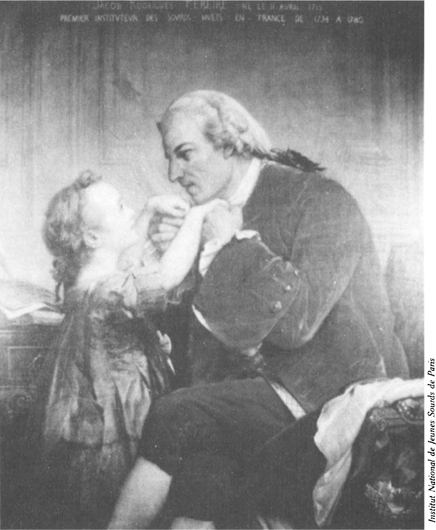
JACOB RODRIGUES PEREIRE AND MARIE MAROIS
(PAINTING BY LENEPVEU)
Am I fair to the oralists? The greatest demutiser of them all, celebrated by scientists and kings, the oralist who provoked Epée into publishing, was Jacob Rodrigues Pereire. Listen to his story as told by his pupils and biographers, my contemporaries, and decide if I am fair.13 Let Marie Marois speak first; she was his most accomplished pupil in the eyes of many, including her own: she signed her letters “Marie Marois, former deaf-mute.” I met her in her old age at her home in Orléans, and she regaled me—in sign—with her memories, which predated the Revolution.
When Joseph II, Holy Roman Emperor, came to Paris in 1777 disguised as the count of Falkenstein, and visited Epée’s school, he also asked to meet Pereire and his best pupil, and she was presented.14 Marie was twenty-eight then, her skin was fair and smooth; she wore a magnificent burgundy gown for the occasion and her hair was bedecked with feathers. She had memorized a rather cunning tribute to the emperor, which she recited aloud: “Monsieur le Comte, the fullness of my joy today has seemingly retied the strings that once held my tongue immobile until art loosened them. The more my heart swells with this happiness, sire, the less my mouth can express it.” This was expression enough for Joseph II to give Pereire a vase and a rhinoceros horn.
At that time, Marie was a masterful lipreader, a skill she had acquired on her own (the priest at the church in Orléans said she had been very ugly and had practiced lipreading with a mirror so she could know what men said about her).15 It proved impossible for her, however, to follow what the Holy Roman Emperor said and at times Pereire repeated his words by rapid fingerspelling. Although the emperor was the brother of the French queen, his parents were Austrian and his French may have been heavily accented. Even the best lipreader requires a native speaker within a few meters in a good light who moves his lips broadly, slowly, and deliberately. If the speaker turns his head, addresses someone else, reads aloud, or has an accent, it is usually hopeless.
Marie Marois was born deaf in 1749. Like Pereire’s other accomplished pupils, she had residual hearing: she could distinguish some sounds and perhaps thirty words with the aid of an ear trumpet.16 Unlike them, she was quite poor, an orphan. She was given into Pereire’s charge by the count of Saint-Florentin, on whose land she was born, near Orléans.17
Marie was only seven at the time of her presentation to Pereire but she still remembered the day—or remembered, in any event, her account of it, given so many times. She was taken first to the count’s château and outfitted for the visit in a lovely lacy dress; then she was brought by coach to the royal palace at Versailles, where she was provided with a deaf companion her own age, who became a lifelong friend, Mlle. Le Rat de Magnitot. Her friend’s uncle led the two little girls to a magnificent anteroom, where they were left rather uncomfortably, their legs dangling over the edge of spindly chairs, to wait for the count and their new teacher, who were expected any minute. The minutes stretched to an hour but even that was not enough time for Marie to take in the wonder of her new friend and the splendors of the chamber in which they waited: the walls and ceiling of carved mahogany with countless thousands of painted fleurs-de-lis in the interstices of the woodwork; the gold and crystal chandelier; the table topped in marble, with intricately carved molding and legs, flourishes of gilt, curlecues and arabesques; the two exquisite porcelain vases with handles in the shape of dragons with wings. Morning sunlight was streaming through the windows, and sparks everywhere glittered at edges of gilt and glass.
Marie sensed someone enter the room behind them and pause, but she continued whispering in sign to her friend. Pereire had to circle around in front of them, where he appeared abruptly, smiling. “Good day, ladies,” he signed. The lighthearted flourish of his greeting was a welcome note, for his appearance was somber and forbidding. He wore black breeches with striped leggings and a waistcoat under a long coat, cut away in front with tails behind, a high collar, and a wig. He appeared about forty, with a dark and pocked complexion, an eagle-beaked nose, a broad, high forehead that ruled over wide eyes, full of fire and expression, and prominent cheeks and jaw. Scarcely was there time to sort out curiosity, apprehension, and wonderment before the count arrived and the party set out for Pereire’s home in Paris, where Marie would spend the next twenty-two years.
She had so many splendid memories. Each New Year’s Day, Pereire would bring her to visit the count of Saint-Florentin at the royal palace. When she was nine and a half, she recited this New Year’s greeting: “My tongue, which owes to you the use of speech, will never cease to utter my wishes for your prosperity. Let the heavens deign to answer these prayers and fill your life with grace abundant as you have filled mine with your generosity.”18 As a child, she was introduced to the king of Poland and to Louis XVI, then the Dauphin.* When she was in her twenties, the king of Sweden asked to meet Pereire and his pupils and she was presented along with Mlle. Le Rat and one other woman.19 Each of the three pupils paid the king a little compliment aloud. This was followed by question and answer, with Pereire repeating the king’s questions on his fingers since the other deaf pupils could not lipread. Next, each pupil read aloud from a book opened at random and finally each presented the king with a written compliment in her own hand. According to Pereire’s friend La Condamine, † who had arranged the audience, the king found that of all the sights of Paris and Versailles the most striking was the performance of Pereire’s pupils.
When she came to Pereire, Marie Marois was mute, a signer. In the course of her years with him she came to speak fluently, to compose letters correctly, to read easily. The naturalist Georges Buffon20 and the philosopher Jean-Jacques Rousseau21 monitored her progress over the years. Her priest at Orléans told how she confessed: “She spoke, I listened. She looked at me, I answered her slowly and from the movement of my lips she didn’t miss a syllable of what I said.”22
How did she learn to speak? Pereire was a tireless teacher; extremely animated, he strode back and forth and circled around his pupils, manually arranged their speech organs. He gave frequent short lessons, made use of a special finger alphabet. He was a fluent signer: he used sign to give instructions, to explain words, and to converse with his pupils until they could converse orally or in writing, which he preferred.23 But how did he actually teach and what was his hand alphabet? Near the time of his death, a few years before Epée published his definitive work, Pereire made Marie Marois the repository of his secret method and swore her to reveal it only to his son, Isaac, who was then a child. It was to be his legacy.24 She refused to reveal it to Epée, who she believed had stolen some of Pereire’s ideas, and to Sicard she said, “You are the last man on earth to whom I would give the legacy that my teacher confided in me.”25
When I met her, all that was in the past. After Pereire’s death, Marie Marois returned to Orléans. She had a pension from the duchess of Penthièvre until the Revolution; thereafter, she lived in poverty with her sister. All she could find for employment was repairing and cleaning fine lace, which had returned to vogue under the Empire. She had little use for speech.26 Marie Marois had always been a dependent: first of Pereire, then of the duchess, finally of her sister. When her sister died, she was utterly alone. Mercifully, death came to her rescue in 1829. I was quite shocked when Massieu sent me the news in Hartford; Marie Marois had long since slipped from my mind, the kindly gray-haired old woman who could not be hearing and would not be deaf.
The first recorded sign of the interest in the deaf that would sustain Pereire through a teaching career of forty-four years came when he was a youth of nineteen. He wrote to thank the president of the academy of letters at Bordeaux (to which Sicard would later belong), who had sent him as promised a list of works to read on the education of the deaf. His correspondent told him about the book published in 1620 by his countryman Juan Pablo Bonet,27 about an English grammar written by William Holder fifty years later,28 and about Johann Conrad Amman’s book on teaching the deaf published in Amsterdam three decades after that.29 (Pereire later translated Amman’s work from its original Latin into French. He also knew Hebrew, Portuguese, Spanish, and Italian. In later years he was given the title of interpreter to the king.)30
What could have compelled a man to take up so young the specialized and difficult calling of teacher of the deaf? Persecution, and love. Pereire’s parents were Marranos, that is, Spanish Jews who nominally converted to Christianity but continued to hold Judaic beliefs and customs. The word is an old Spanish one, meaning “swine”;31 the practice of false conversion dates as far back as the seventh century, when all the Jews of Spain were ordered baptized under pain of banishment. Pereire’s ancestors had fled Spain to Portugal, but persecution of the Jews followed and those who secretly pursued their religion became a small closed society. Thus Abraham Rodrigues Pereire and Abigail Rebecca Pereire were wed, although cousins, and when they removed to Spain, they became New Christians, taking the names Jean and Lenor. Their son, Jacob Rodrigues Pereire, who was born in the marquisate of Berlanga, in the Spanish Estramadura in 1715, just as Louis XV ascended the French throne, was baptized Francesco-Antonio.32 The Inquisition, however, renewed its ruthless campaign against the Marranos—during the half-century reign of Philip V, over 1, 500 people were burned alive for the crime of Judaism—and as New Christians, the Pereires were suspect. Fearing for their lives, the family returned to Portugal. But in Portugal there was no refuge either; and after Pereire’s father died, his mother, now a widow with several children, was arraigned for heresy. Somehow the family managed to escape again. Finally, in 1741, they reached safety in France, in Bordeaux, where a large colony of Marranos was allowed to live openly and enjoy full rights on payment to the crown of 110, 000 livres (renewable at each royal succession). There, seven years after receiving the list of books on demutizing the deaf, Pereire opened a little school and set to work to teach speech to his first deaf pupil—his sister. Thus persecution may have been responsible twice over for Pereire’s calling. First, it may have led to the consanguineous marriage of his parents and thus the deafness of his sister; as many as one child in ten from such marriages is likely to be born deaf. Second, and more important, it taught Pereire, and his parents and grandparents, a pattern of survival: to be in a minority is painful and dangerous; try to be like the majority. His father had given him an artificial name so his name would resemble accepted names and he could live a better life. He spent much of that life giving hard-of-hearing pupils artificial speech so their way of communicating would resemble the accepted way. It is only in the last few years of his life that we find Pereire reaffirming his Judaism, negotiating with the government, for example, to establish the first Jewish cemetery in France. At the same time, he had stopped trying to convert signers into speakers.
Pereire’s second pupil was brought to him during a business visit to La Rochelle, just north of Bordeaux on the western coast. His name was Aaron Beaumarin, apprentice tailor, age thirteen; he was born profoundly deaf.33 In one hundred lessons extending over a year, Pereire taught him to articulate all the basic speech sounds plus several words and common phrases such as “hat,” “madame,” and “What do you want?” When he was displayed at the Jesuit school in 1745 no one in the audience was more interested than M. Azy d’Etavigny, a prosperous businessman34 of La Rochelle whose son, born deaf,35 had been treated by the leading physicians and surgeons of Europe to no effect. At the time he was sixteen and attending school in a Benedictine abbey in Normandy,36 where he had been for two or three years. Before that, he had spent eight years in the abbey of Saint-Jean at Amiens, and had been taught with a half dozen other deaf children by a deaf old monk.
Thus it appears that the first recorded teacher of the deaf in France, and the man surely responsible in part for Azy d’Etavigny’s achievements, which would soon bring so much credit to Pereire, was a deaf man himself. His name was Etienne Defaye,37 and he was born deaf of a noble family in 1670.38 At the age of five he became a pupil at the abbey of Saint-Jean; eventually he served as architect for the monastery buildings and as sculptor of the stalls in the abbey with their faces of canonized saints against a background of fleurs-de-lis. According to a contemporary, he knew arithmetic, geometry, mechanics, design, architecture, and secular and sacred history.39 He wrote a two-volume catalogue of the abbey’s museum and its cabinets of medals, illustrated by his own drawings; but his greatest service was no doubt to the deaf pupils in his charge, including Azy d’Etavigny.
When this deaf youth’s father heard Pereire’s pupil speak, he determined, not to put his son in Pereire’s charge, daunted perhaps by the cost or fearful of entrusting his education to a Jew, but to obtain a copy of Amman’s treatise, which Pereire had no doubt mentioned. He sent it to the prior of the abbey in Normandy where his son was attending school, with the request that it be used to make his son speak.
After a year, the prior reported no significant progress and urged M. d’Etavigny to enter into a contract with Pereire. This he became resigned to do, but at least he would take precautions: he required the teacher to leave his family and closet himself with the boy at the abbey, to work alongside the prior (who would try to uncover the method), to teach the boy a fixed number of words in a fixed time in return for a fixed payment. No teacher of the deaf since has ever had such a stringent and unfavorable contract.40
Pereire, however, went to the abbey, where he found an intelligent eighteen-year-old who could read, write, and sign, but not speak; in eight days he had the boy saying “mama” and “papa” and in a month, fifty words. In four months Pereire’s pupil had made so much progress that the prior convened the Royal Academy of Letters at Caen (of which he was a member) to bear witness.41 Pereire addressed the academy at length without revealing anything about the nature or origins of his ideas, which he called a secret. He attributed them, however, to his ignorance of science (which would have made the obstacles seem greater) and to “the conversation and affection of a deaf woman who first awoke these ideas in me.” Was Pereire, then, impelled, like so many pioneers, by the love of a woman or was he simply speaking of fraternal ties to his sister?
Next the young Azy d’Etavigny spoke, addressing the bishop, protector of the academy: “Mon-sei-gneur, je vous sou-hai-te le bon-jour.” (“Good day, Sire.”) The bishop wrote: “Father Cazeaux is good” (Cazeaux was the prior). The pupil answered, smiling: “Ou-i.” Then the bishop wrote, “Father Cazeaux is bad,” and Azy answered, frowning, “Non.” Then he was asked by gesture the name for a sword, a shirt, a hat; “E-pée; che-mi-se; cha-peau” he replied correctly.42
Pereire received the approval and encouragement of the academy and several national newspapers carried the story. The pupil continued to make progress until, after eleven months, according to a written testimonial,43 he spoke 1, 300 words that he understood, and many sentences. His speech was, however, influenced by the grammar of his sign language: he put all verbs in the infinitive and transposed word order. Shortly before the contract with Pereire was completed, Azy d’Etavigny’s father withdrew him from the abbey in Normandy and Pereire moved to Paris,44 where his reputation had preceded him. Six months later, however, the father wrote to him proposing a second contract. Without Pereire’s attendance on the youth, his son’s speech had greatly regressed. This is, alas, one of the hallmarks of the oral education of those born profoundly deaf: it must be sustained indefinitely or the speech degenerates. Early in 1748, Pereire returned to the school in Normandy, this time with his brother, to resume Azy d’Etavigny’s training. “I can only employ this method myself,” he wrote to a prospective client at about that time, “and I can be assisted only by my brother or sister for it is a secret I think I ought to keep entirely within my family and in any case cannot be easily divulged in the abstract.”45
A year later, Pereire took his pupil to Paris to live,46 and within a month had arranged to display him not before some provincial academy but before the most prestigious scholarly body in the land, counterpart to the Royal Society in Britain, the Academy of Sciences.47 In the memoir given at the presentation, he stated that Azy d’Etavigny had learned to speak distinctly but slowly, could answer questions on ordinary topics put to him in writing or fingerspelling and pose his own, recite from memory the Our Father and other prayers and the Ten Commandments, and respond intelligently to several questions from catechism. He knew some grammar, arithmetic, geography, and history. Pereire told little about his method but did mention that it included sign language and a Spanish manual alphabet (the one in Bonet’s book), which he had augmented and perfected.
The academy appointed a commission to evaluate the pupil and make a report: a professor of surgery and author of a treatise on the human voice; a physicist who had used Amman’s book with some success in motivating a deaf youth; and, notably, Georges Buffon, who was then writing his monumental Natural History of Man, in which he would insert praise of Pereire and his method.48 A month later,49 at a meeting convened by the president of the academy, the duke of Chaulnes, the commission gave their report; it appeared in several newspapers just as Buffon’s latest volume, hailing Pereire’s achievement, came from the printers. All told, the news that the deaf were being made to speak, arriving in the middle of the Enlightenment, caused rather a stir.
One of the central questions of the Enlightenment was “What makes us human?” and one of the accepted answers had been, ever since Aristotle and then Descartes, “Language.” “All that man has ever thought, wanted, done, or will do,” one eighteenth-century philosopher lyricized, “depends on the movement of a breath of air, for if this divine breath had not inspired us, and floated like a charm on our lips, we would all still be running wild in the forests.”50 Deaf children and wild children were, however, an embarrassment for this definition of man, since the deaf were thought to have no language and feral children were invariably mute (that is one reason why the Society of Observers of Man took an active interest in Massieu and in the Wild Boy of Aveyron). Now Pereire had shown, in the eyes of his contemporaries, that the deaf could be “demutized” and thus brought into the human family. No wonder the Academy of Sciences would urge the dissemination of Pereire’s methods.
The academy’s report began by acknowledging that “this curious and useful art” did not begin with Pereire; Wallis in England and Amman in Holland had practiced it with success a century earlier, as did Ramirez de Carrion51 and Pietro di Castro in Spain before them. The commissioners confirmed Pereire’s claims for Azy. They added that the boy spoke loudly or softly as well, and that he intoned questions, answers, and prayers appropriately. However, his pronunciation was slow and guttural, as if issuing from the bottom of his chest, and he did not link his syllables sufficiently. Pereire asked for grace on this point, noting that the boy’s speech organs had been inactive for sixteen years and there had not been enough time since to give them back their flexibility.
Some insight into the social condition of the deaf just a decade before the abbé de l’Epée founded the education of this class of pariahs may be had from the commissioners’ hopes for the dissemination of Pereire’s method: that the congenitally deaf might come not only to pronounce and read all sorts of words and to understand those designating visible things, but also to acquire the abstract and general notions that they lack, to relate to others in society, and to reason and act like people who have lost their hearing after reaching the age of reason.
In sum, the commission found that the art of teaching the mute to read and speak as Pereire practiced it was ingenious, very much in the public interest, and worthy of the strongest encouragement. With such acclamation, Pereire began to see his fondest hopes realized, to receive a subvention*for life from the king, to open a school and live comfortably in Paris, to leave a substantial legacy to his family so they would never again be obliged to wander over the face of Europe. Six months later, he and his pupil Azy d’Etavigny were presented to the king by one of his favorites, the duke of Chaulnes.
Pereire’s brother David has left a precious record of the audience in a letter to their mother in Bordeaux. “Let God be blessed for the marvelous ways in which he treats Jacob! I wrote you yesterday to tell you of our trip to court, where we arrived at eleven in the morning. † We found the duke of Chaulnes in his apartment. He received us as cordially as ever and … leaving us in his room, he explained that he was going to see the Dauphin and then the king, and we should wait for his return.…
“Just as we entered the [king’s] anteroom, the court was leaving the table. There was a great confusion of Knights of the Holy Ghost, ‡ pages and servants and the Dauphin prepared to go for the ladies at Versailles; but he decided to wait to see the mute. Finally, at four-thirty, the duke came to tell us that the king was coming. At which the confusion increased: ‘The King! The King!’ A column of the Knights of the Holy Ghost appeared and the king called, ‘Chaulnes! Chaulnes! Chaulnes!’ The duke ploughed through the crowd to speak with him and then, preceding the king, he approached us and said: ‘M. Pereire, His Majesty grants leave to M. d’Etavigny to speak to him.’”
I imagine d’Etavigny’s emotion at this moment. He had begun by addressing an old deaf monk in an abbey outside of Amiens in sign. Now he was addressing in speech the richest and most powerful man in the world. For this brief moment Azy was the representative of all the disinherited deaf of France, nay, of the world, for all eyes were on France, where the intellectual revolution called the Enlightenment was taking place. He must have been terrified. He said: “Sire, I am deeply appreciative of the honor of appearing before Your Majesty.”
“The king was quite pleased and smiled,” David Pereire wrote. “The duke said to him: ‘He is afraid.’ And Jacob said: ‘It is not surprising, since all of Europe trembles before His Majesty.’ Whereupon the king’s hat slipped from his hand. Since Jacob and d’Etavigny were immediately in front of the king, both leaped for it and Jacob had the honor of returning it to him, one knee on the ground. The king never spoke to Jacob but always to the duke of Chaulnes and to other lords. Because of the crowd and the noisy confusion, you could not understand his words, but his gestures and beneficent expression made clear the pleasure that he felt. The duke told Jacob to have d’Etavigny read, and the mute read from Jacob’s hand what Jacob read from a book.”
Why have Etavigny read from fingerspelling rather than from the book directly? No doubt because Pereire’s manual alphabet included handshapes for each of the vowel and consonant sounds of French, so he could present the words in their phonetic spelling and the youth would not have to know the vagaries of French spelling in order to pronounce the words correctly.
“Next, several questions posed by the duke were executed by Jacob. [Of Pereire’s pupils, only Marie Marois was good at lipreading, and this was not part of his program, so questions had to be put in sign, fingerspelling, or writing.] From time to time, the king would take a walk around the room, speaking first with this person, then that one, finally returning to listen to the mute. The duke, leaning against a large table, spoke with the king. His Majesty spoke and laughed, pushed him against the table, and, placing both hands on his paunch, made him rock backward; then he came back to the mute. The duke told him what d’Etavigny was doing and that he knew how to recite prayers. The king told him to recite the Our Father, which he did best of all. After more than a half hour, His Majesty left and many knights leaving and following the king said: ‘M. Pereire, I congratulate you. It’s marvelous. It’s marvelous. The king is full of admiration.’ The duke was thoroughly delighted and said, ‘Adieu. We will speak further in Paris.’ And there you have, Madame, the end of our visit.”52
Not quite. They were called back the next day so that the ladies of the court, whom the Dauphin had fetched from Versailles too late to catch the performance, might see the marvel of the talking mute. A few days later, the king sent Pereire an award of 800 livres* to express his pleasure. But the duke had hoped Pereire might secure the creation of a normal school to ensure the perpetuation of his art and its dissemination throughout the kingdom, or that a chair might be created for him at the Royal College where he could train disciples. Neither plan was realized. On the contrary, some years later Pereire would see his rival, the abbé de l’Epée, open the first public school for the deaf and enjoy the king’s support. The duke was, however, able to render Pereire a service of another kind: six months after the audience, he gave him what Pereire called “the most splendid gift of my life,” the charge of his godson, Saboureux de Fontenay.
Pereire would receive a few more pupils in the next ten years—De Gérando estimates he taught about a dozen during his career—but none would prove as brilliant as Saboureux, who became his outspoken exponent and even took part in a debate with the abbé de l’Epée on the merits of their respective conceptions of educating the deaf.
Saboureux was born in the same city as Epée, and for the same reason—the king’s court was at Versailles. His father was a colonel in the Royal Guards. His hearing loss was congenital and at age seven we find him in school in the south of France,53 receiving some additional instruction from a M. Lucas, a builder in the employ of the king. He had learned the manual alphabet, reading, writing, and arithmetic over some three to four years, before his godfather called him to Versailles and entrusted him to Pereire. Saboureux was twelve when he joined Azy d’Etavigny in Pereire’s home. Here is what transpired in Saboureux’s own words:
“M. Pereire, finding I was nearly thirteen, went about teaching me, consistent with the way a child learns French, common words and phrases, such as ‘Open the window. Shut the window. Open the door. Close the door. Light the fire. Put out the fire. Get a log. Set the table. Give me some bread.’ Once he saw that I was sufficiently well versed in everyday dialogues, which we fingerspelled with his enlarged and improved Spanish manual alphabet, he shunned the use of gestures. This was to get me accustomed to language, to rid me of my habitual use of my own signs, to train me in understanding sentences, to enable me to carry out all sorts of things consistent with my understanding of the language expressing the request, and to answer both easy and difficult questions. So that I might produce thoughts by myself, he had me describe everyday occurrences, to report what was said, to talk, to converse, to reason, to argue with people about various things that came to mind, to write letters to friends, to write back to people, and so on. In this way I reached a clear and automatic understanding of the meaning of pronouns, conjugations, adverbs, prepositions, conjunctions, and other parts of speech, of which M. Pereire then presented a goodly number of striking examples to get me to produce still others.”
In merely two and a half months, Saboureux was ready to appear before the Royal Academy of Sciences,54 which appointed the same commission that had evaluated Azy d’Etavigny. They found that Saboureux pronounced distinctly all the sounds of French, understood many common expressions and instructions in writing, read aloud with the intermediary of his teacher’s manual alphabet, and recited the Our Father. In sum, their report of the year preceding on Azy d’Etavigny was confirmed.
A few months later the king awarded Pereire an annual stipend of 800 livres for life. Pereire was thirty-six; he had an assured income and two successful and brilliant pupils; Chaulnes, Buffon, and La Condamine were his friends, Diderot and Rousseau would soon become so. He had invented a calculating machine approved by the Academy of Sciences and was writing a memoir on sail power soon to win its approbation. He continued to work with Saboureux, as the pupil’s autobiography describes:
“M. Pereire and my uncle enjoyed taking me to see experiments in physics, collections of scientific curiosities and so on, to visit different houses and to take walks in the country. Their main purpose was to familiarize me with everyday French, with giving appropriate answers to people’s questions, and with social customs. I took frequent advantage of my leisure time to go by myself into the houses where I knew that friends would be glad to chat and instruct me. With company I began to get the idea of figurative speech, of the elegance of expressions, of the adornment of discourse…. Finally, when I had sufficient background knowledge of grammar, Christian doctrine and the Bible, around the fourth year of my instruction, the duke of Chaulnes, my godfather and protector, who for the first three years of my instruction tested me and taught me, did me the honor of asking me to write compositions. Then M. Pereire and my uncle had me write out notebooks on subjects they had selected; they got me to identify faulty French and other mistakes in these notebooks and had me correct them. This was the way that, thanks to the Creator of all men’s minds, I managed to acquire a ready understanding of French and to express myself with ease in writing.”55
Saboureux spent five years under Pereire’s tutelage, then continued his education on his own: to French and Latin he added a command of Hebrew and Syriac and studied Arabic; he improved the elegance of his writing through “diligent reading of books written in sublime and lofty style”; he read widely on the nature of language, published his autobiography and a memoir on meteorology, and undertook the education of a deaf woman in the city of Rennes.56 “I scarcely remember being a deaf-mute,” he wrote a friend. Epée thought Saboureux did great credit to his teacher;57so did Diderot,58 who called him his friend.
Many wise and diligent people have tried to discover Pereire’s secret of successful teaching so that the legacy he wanted to leave for his family might be left for all mankind. After his death in 1780, the sources available were the letters of his pupils, his addresses to the Caen and Paris academies and their reports, his family papers, and one further memoir he wrote himself attacking a plagiarist named Ernaud, who appropriated a student of Pereire’s and then presented him to the Academy as his own, under another name.59 Since Pereire would not reveal his methods, he had difficulty proving they were different from Ernaud’s.
From these documents, Baron De Gérando concluded that Pereire’s secret was his manual alphabet. Speaking of that alphabet, Pereire stated that “each handshape designates simultaneously the position and movement of the speech organs suitable to produce the sound and also the letter or letters that normal writing requires to represent this very sound.”60 Thus, for example, there might have been a handshape for the single sound in French which is variously written s (soupe), ç (façon), ti (nation); a constant position of the articulators corresponds to that handshape. It appears that Pereire took Bonet’s manual alphabet and added his own set of handshapes, each corresponding to one sound (there were thirty), plus shapes for numbers and punctuation. Then, Saboureux explains, when Pereire spoke to him, he would accompany his articulation with this phonetic fingerspelling designating sounds, much as one hearing person addressing another accompanies his visible articulation with the sounds themselves.61
It is hard to believe that all the fuss over secrecy and the master’s accomplishments boil down to a set of handshapes. A leading German oralist, Samuel Heinicke, thought that Pereire’s secret was to use pupils who were not profoundly deaf and to obscure the fact (or minimize its importance). The distinction between those born deaf and those accidentally deafened “after the age of reason” was quite obvious to people then and had been since the Romans, whose law made separate provisions for these two classes. But the distinction—one of degree—between profound deafness and partial hearing-loss was less clear. Pereire himself tells us that Marie Marois and Saboureux de Fontenay were only hard of hearing: how much did that facilitate their acquiring speech and the pillars of their education, reading and writing?
A cynical kindred suggestion is that the secret of success is to use other people’s pupils: how formative were the eight years d’Etavigny spent as a pupil of the deaf Defaye, learning through the medium of his primary language, and the further years he spent studying at the abbey in Normandy? And those years M. Lucas devoted to Saboureux’s education—how crucial were they? This, too, is a feature of oralism: there is scarcely a pupil displayed to the credit of one teacher and method who has not first been taught by another.
Edouard Séguin, who was the first to show that you could educate the mentally retarded, speculates in his biography of Pereire, published in 1847, that his secret had come from his desire to touch and be touched by a deaf woman—she “who first awoke these ideas” in him—and that it reposed in the discovery that touch could be a channel of communication. And indeed, Pereire had said that when we are cradled in our mother’s arms and take the first step in learning to speak, we feel the vibrations of her bosom.62 The more a child is deaf, the more apt he will be to detect those effects of the voice. Put your hand in front of your mouth, he wrote, and notice that syllables can differ as much in touch as in sound.
In Pereire’s time there was a great interest in the senses, the key to understanding man. “All our knowledge comes from the senses,” affirmed Condillac. But touch had a special and formerly underrated role: “No sooner is touch trained, than it becomes the teacher of the other senses,” Condillac argued. “By themselves, the eyes would only have sensations of light and color. Touch teaches them to estimate sizes, shapes and distances. And they are taught so quickly that they seem to see without having learned.”63 And Georges Buffon wrote: “We can acquire real and complete knowledge only through touch; this sense corrects all the others, whose impressions would only be illusions … if touch did not teach us to judge.”64 Likewise when Jean-Jacques Rousseau, who was a friend and neighbor of Pereire in the rue des Plâtrières, wrote his epochal work on education, Emile, he was much influenced by Pereire’s experiments with touch. Rousseau’s was a broader program than Pereire’s: he applied to every sense the kind of training Pereire gave just to touch, and the philosopher would extend sensory education to all children, not just the deaf. But the sense of touch was pivotal: it is the one that best informs us, that we use most often, that gives us immediately the knowledge we need to survive, Rousseau argued. Moreover, touch can substitute for sight and for hearing. Saboureux de Fontenay also suggested that touch could be used with the blind as well as the deaf—a suggestion repeated by Epée and carried out by Valentin Haüy, the great champion of the blind and founder of the school, merged with ours until just before I arrived in Paris, that would make them literate and self-supporting. Haüy attended Epée’s demonstrations in the 1780s and this may have given him the germ of his idea to print with raised characters, a system replaced a few years ago by the compact alphabet of raised dots invented by a teacher at his school, Louis Braille.65
Place your hand on the body of a cello, Rousseau said. Can you not tell whether the sound is low or high, whether it comes from the A string or the C string, just by the vibrations? “Let the senses be trained in these differences. I have no doubt that with time one could become sensitive enough to be able to hear an entire melody with the fingers.” Thus you could communicate music, or speech, to the deaf through touch.66 But still, how did Pereire produce the miracle, the talking mute? I maintain the question, rather, is—did he do so at all? Pereire could not, of course, teach real speech to a deaf-mute; real speech is never taught, it is acquired natively at an early age and remains fluent for a lifetime. Did he at least endow his pupils with sham speech, whatever its flaws and fluency? It appears not. Marie Marois has us understand that she let the skill fall into disuse, having retreated from Pereire’s home into another cocoon, where a few intimates could sign with her. Saboureux de Fontenay apparently never spoke after he left Pereire; there is no mention of it in his autobiography. A linguist who met with him when he was thirty found “not a trace of his speech lessons,” and when Saboureux undertook to become a teacher of the deaf himself he gave further evidence that speech was not crucial in his eyes.67 Moreover, we have the testimony of an eyewitness, the publisher of Pierre Desloges’s book Observations of a Deaf-Mute, who reports that those of Pereire’s students who spoke the best, spoke quite poorly. Their articulation was forced, slow, broken, and painful to hear, for you sensed how painful it was to execute. Saboureux de Fontenay agrees with him. “In fact,” he says, “all mutes express the same repugnance to speech.”68
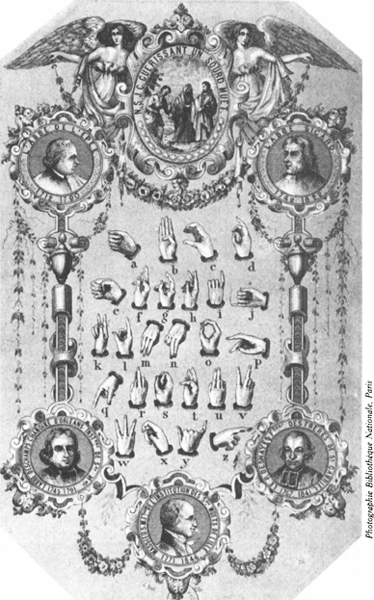
THE MANUAL ALPHABET
Perhaps Pereire had no particular secret at all. Like those of many other oralists, his method was empirical, a fine word meaning catch-as-catch-can. He took students who showed promise and had some prior education, used the senses available to them, communicated effectively in their native sign, to which he added fingerspelling and writing, and worked tirelessly at his task. Pereire’s best friend, Olinde Rodrigues (they married sisters), wrote to Marie Marois after Pereire’s death and asked her to reveal his method. She then wrote to Pereire’s son Isaac, and here is the formula she gave: “Your relative seems to think this is a matter that can be revealed in conversation and correspondence. But a lot of time, work, and study are required, in addition to a well-disposed young child whom I might teach in his presence extensively. Moreover, I would need one of my friends whose knowledge complements mine.”69 Some years later, after Pereire’s son Isaac had died, his widow again demanded the secret for the master’s grandchildren. Marie Marois responded that she was old, and scarcely remembered anything: “The best I can remember of his method, he could convey it to his children only in person, by applying it to some pupil with whom he would progressively develop it.”70 As Pereire’s family was still unsatisfied, one of the grandchildren dragged Marie Marois to Paris on her dying legs, but all she could do was hug each member of the family and go back to Orléans. Pereire had labored for forty-four years. For fifteen, his son tried half-heartedly to recover his heritage, then died. For another fifteen his grandson tried, equally without success. Doesn’t it seem that the secret was this: there was no secret. The strongbox was locked precisely because it was empty.71
I believe that there was a secret of quite another kind in Pereire’s life, one that concerned the women he loved and the origins of his method, but for that we need to return to his Spanish roots, to Juan Pablo Bonet in the seventeenth century, and earlier—to Pedro Ponce de León in the sixteenth century and the first efforts to teach the deaf.
Primarily Juan Pablo Bonet was a philologist; incidentally, he was a soldier—in the king’s secret service and the service of the captain-general of the army, Bernardino Hernandez de Velasco, the constable of Castile; accidentally, he became concerned with the education of a deaf boy—de Velasco’s younger brother, Luis. In his pioneering book he presents himself as the inventor of the art of teaching the deaf to speak and offers one simple, novel idea, which was also Pereire’s a century later: it would be easier to learn to read if each speech sound was represented by one invariant visible shape. That shape could be a hand configuration or it could be a written letter, provided that we remember that the name of the letter must generally be “reduced” to discover its constant sound value. Hence, he called his book Reductions of the Letters of the Alphabet and Method of Teaching Deaf-Mutes to Speak. To illustrate, the first consonant in the alphabet is called “bee” but its sound value is the reduced “b.” Bonet’s book contains twenty-one drawings, each showing a letter from the Castilian alphabet with an accompanying handshape, often somewhat evocative of the letter in form.
Bonet’s handshapes are used to this day by all the deaf throughout continental Europe and the Americas as a way of spelling rapidly without pencil and paper. They are Pereire’s one contribution to the true history of the deaf. For Pereire taught them to his pupils, among them Saboureux de Fontenay. Saboureux pressed a copy of Bonet’s book on Epée, who claimed that he undertook to learn enough Spanish to read it. Epée taught the manual alphabet to his pupils and disciples, including Sicard, and thus it spread throughout Europe.72 Sicard taught it to his pupils, including me, and I brought it to America.
There is a great deal of pedantic nonsense in the first part of Bonet’s book—a whole chapter is devoted to the etymology of the word “letter.” The second part of the book is supposedly about teaching the deaf and dumb to speak but actually only the first seven chapters are on this topic, the rest being a course in Spanish grammar—to be taught, I note, by means of sign language. In the section on speech, Bonet first establishes that the mute are dumb because they are deaf. He argues that sight can supplant hearing by means of the manual alphabet and sign language. He goes on to describe the positions of the vocal organs in pronouncing each “reduced” letter of the Castilian alphabet and explains that teaching these positions requires great patience and good lighting, and can be aided by a leather or paper tongue. The last chapter on teaching the deaf to speak is concerned with their combining letters to make syllables and words. Lipreading Bonet left to his pupils’ own ingenuity, as Pereire did later on.
All things considered, the book is just a simple and practical treatise on phonetics73 written in the hope that it would be useful to the constable and his brother. Even the handshapes of the manual alphabet were not Bonet’s. They appear in a book of prayers written thirty years before Bonet’s manual, by a Franciscan monk, Melchor Yebra,74 who attributed them to Saint Bonaventure. For each letter of the alphabet there was a prayer, and a person who was too ill to recite the prayer or even its first word or letter could indicate his selection by forming the proper handshape.
It was a twist of fate that called Bonet’s book to the attention of scholars throughout Europe and made it the foundation for all further efforts to make the deaf speak, the base on which rest the three pillars of oral education: Pereire, in the Romance-speaking countries, Amman in the German-speaking nations, Wallis in the British Isles. Here is what happened. Three years after the book appeared, King Charles I of England, then Prince of Wales, went to Madrid to seek the hand of the Infanta, the daughter of the Spanish king. With its vast overseas territories, Spain was then the most powerful nation in all Europe; it was also the most exciting and fashionable: court life was glittering and animated by plays, masques, pantomimes—and talking deaf-mutes! The Prince of Wales conversed with one, the brother of a Spanish dignitary, the constable of Castile.
Now in the prince’s party was the man who would tell the world of this astonishing event: Kenelm Digby, the nephew of the English ambassador. Young Digby was destined for a colorful career: this odd and gifted man, this “ornament of England,”75 appears everywhere in the period in which England emerged from medievalism—in contemporary letters, religion, medicine, court life, privateering, navigation, embryology, botany, mathematics, cookery, diplomacy. A contemporary historian called him “a compleat chevalier. He had so graceful elocution and noble address that had he been dropt out of the clouds in any part of the world he would have made himself respected.” To which the Jesuits added, “True, but then he must not stay there above six weeks.”
Some years after his visit to Spain, Digby was imprisoned by Parliament for actively taking the king’s side during the English Civil War; when King Charles I was beheaded, Digby was banished to France, where he wrote several religious and quasi-scientific books, including one on curing wounds—by rubbing a sympathetic powder on the weapon causing the wound, not on the wound itself! He was the best known of the English scientists to whom the French increasingly turned, a friend of Descartes and well received by other French philosophers. When he returned to England upon restoration of the monarchy in 1660, he became a founding member of the Royal Society, an intimate of its secretary, Robert Boyle, who ushered in the new chemistry, and of members such as the Oxford mathematician John Wallis, who claimed he founded oral education of the deaf in England.
The most successful of the books Digby published from his exile in France was Two Treatises, written to prove the soul is immortal. It went through eight editions in Paris, London, and Frankfurt, and contains experimental results, citations of authorities, anecdotes from Digby’s vast career, and impassioned religious exhortation. It also contains an account of his meeting twenty years before with Luis de Velasco, thirteen years old at the time, the talking mute brother of the constable of Castile:
“A noble man of great quality that I knew in Spaine, the younger brother of the Constable of Castile…was born deafe, [so] that if a gun were shot off close by his eare he could not heare it, and consequently he was dumbe, for, not being able to heare the sound of words, he could neither imitate nor understand them. The loveliness of his face, and especially the exceeding life and spiritfullness of his eyes, and the comeliness of his person and the whole composure of his body throughout were pregnant signes of a well-tempered mind within. And, therefore, all that knew him lamented much the want of means to cultivate and to imbue it with the notions which it seemed to be capable of.…
“At last there was a Priest who undertooke the teaching him to understand others when they spoke, and to speak himself that others might understand him, for which attempt at first he was laughed at, yet after some years he was looked upon as if he had wrought a miracle. In a word, after strange patience, constancie and paines, he brought the young lord to speak as distinctly as any man whatsoever, and to understand so perfectly what others said that he would not lose a word in a whole dayes conversation. They who have curiosity to see by what steps the master proceeds in teaching him may satisfy it by a booke which he himself hath writ in Spanish upon that subject to instruct others how to teach deafe and dumbe persons to speak.”76
Digby goes on to state that the priest “who by his booke and art, occasioned this discourse” was still alive and in the service of another deaf nobleman, Emmanuel Philibert Amedée, prince of Carignan, who was sixteen years old when Digby’s book appeared. He was of royal blood: his mother was the Infanta; his father was Prince Thomas of Savoy, a member of the royal family and of the dynasty that ruled Savoy, Piedmont, Sicily, Sardinia, and Italy in various eras; he headed the Spanish armies for five years and no doubt that is when he heard of a celebrated Spanish teacher of the deaf and engaged him to tutor his son. The teacher was not Bonet, however, but a man named Ramirez de Carrion, as several sources confirm;77 we owe to one of them a rather unflattering account of his methods:
“After trying everything, [the prince’s family] turned him over to a man who promised to make him speak and understand provided he be given so much authority over him for many years that the family would not even know what became of him. The truth is he behaved toward him like a dog trainer would or like those people who for money display trained animals that surprise you with their skill and obedience and seem to understand and explain by signs all that their master tells them. He used hunger, bastinado [beatings on the soles of the feet with a stick], deprivation of light, and reward commensurate with performance. Such was his success that the boy came to grasp everything from the movements of the lips and a few gestures, to understand everything, to read, write, and even speak, although with considerable difficulty. The boy applied himself with so much determination, intelligence, and insight, profiting from all the cruel lessons he received, that he possessed several languages, some sciences, and history perfectly. He became a good politician, even to the point of being consulted on affairs of state, and was a public figure in Turin more for his ability than his birth. There he had his little court and conducted himself with dignity all his long life, which should be considered a wonder.”78
Nine years after Bonet’s book appeared, Ramirez de Carrion published a work describing two thousand secrets of nature collected from various sources and arranged in the form of aphorisms;79 there he discusses his secret method of teaching the deaf to speak and names the pupils with whom he practiced this art. Foremost was the marquis of Priego,80 whose education had been cut short, but who could read and write and govern. Next he mentions Luis de Velasco, the brother of the constable of Castile, Bonet’s employer: in four years he taught him to read, write, speak, and converse with such success he was in the habit of saying “I am not dumb, only deaf.”81
Now if you have followed my story so far, you know this cast of characters: Pereire, who studied and followed Bonet’s book, the first on educating the deaf; Bonet, who wrote the book to be useful to the constable and his deaf brother, Luis; Digby, who reported Luis’s accomplishment far and wide; Ramirez de Carrion, who taught Luis, as well as the prince of Carignan, and his own employer, the marquis of Priego. But what is Ramirez de Carrion’s secret method of making the mute speak? And who really taught Luis, he or Bonet? Did Bonet take credit for his contemporary’s pupil? Dear reader, I pray you are not quite full of this potpourri of polymaths and mutes, for I must serve you more if we are to answer these questions and thus trace the origins of this remarkable endeavor, to teach the deaf to speak. We need the testimony first of Pietro di Castro, a Jewish physician of Avignon who lived in Italy,82 and who wrote a medical treatise in which he confirmed that Ramirez de Carrion taught the marquis of Priego, the marquis of Fresno (Luis de Velasco), and the son of Prince Thomas of Savoy (the prince of Carignan). (Their teacher was not a priest, however, so Digby had erred in that detail.) Di Castro learned the teacher’s rare secret “partly by conversation with the inventor himself, and partly by cogitating with extraordinary perseverance, and I [will] make a separate discourse on it.”83 That discourse came into the hands of the abbé de l’Epée and later was published.
The treatment consists first of drastic purgatives, if di Castro is to be believed. “Next the back of the skull is shaven over an area equal to the palm and twice daily, especially in the evening, the following salve is applied: spirits, saltpeter, or purified niter, oil of bitter almonds and naphtha in specific proportions.” Once this has taken effect and the head has been well cleaned, you may speak to the patient’s bald spot “and, amazing result, the deaf-mute hears the voice distinctly that he could not perceive at all by ear.”
Di Castro goes on to give Ramirez de Carrion’s method:
“If the deaf-mute does not know how to read, he must first be taught the alphabet; and every letter of it should be repeated several times until he can pronounce it; and then he is to proceed to acquire a knowledge of the mode of pronunciation, and thus he must persevere daily, until from the pronunciation of letters he attains to that of words, and common domestic objects are to be shown him that he may learn their names; and finally several words are to be spoken in a row, so that he may be able to join them in proper order in discourse.”84
The first part of this secret treatment is based on much the same principle as Pereire’s subsequent and more practical suggestion that if you speak to the back of the mute’s hand, some syllables can be distinguished rather well. The second part is highly reminiscent of the approach described in vastly more detail by Bonet. This is not surprising, since di Castro got it from Ramirez de Carrion, who spent three years instructing Luis de Velasco, we are now convinced, under Bonet’s very eyes. Not only do we find Bonet’s alphabetical method in Ramirez de Carrion’s work but also the latter’s publisher reports that he taught the letters by the sounds they stood for, not by their names—what Bonet called reduction of the letters—and he employed the very manual alphabet that Bonet describes, Melchor Yebra’s!85
In sum, it seems likely that Luis’s extraordinary performance, which Digby saw and later described, was the fruit of Ramirez de Carrion’s efforts, not Bonet’s.86 Was it then Ramirez de Carrion’s method that Bonet published, and Pereire, Wallis, and Amman adopted? I think not. When Ramirez de Carrion came to the house of de Velasco, possibly at Bonet’s invitation, he found a family with a long history of grappling with deafness, no doubt because of intermarriage. Two of Luis’s great-uncles and three great-aunts were deaf and had been taught to speak by the first person of record who ever educated the deaf, Pedro Ponce de Leó—a priest whose achievements in the late 1500s were celebrated in Spain and, of course, in the de Velasco family. Thus the evidence indicates that Ramirez de Carrion’s true secret was not the shaved pate, but the source of his method, Bonet, to whom he never alludes, and Bonet’s secret was that he never taught a deaf person, he merely plagiarized the methods of his predecessor, to whom he never alludes, Pedro Ponce de Leó.87
It is claimed nowadays that oralism restores the deaf to society—meaning to hearing people. The inventor of the art, however, had little use for speech or society: he spent most of his life, the better part of the sixteenth century, in silence and prayer in a monastery. Pedro Ponce de León was born about the same time his namesake began his quest for the fountain of youth in Florida and Hernando Cortez began the conquest of the Aztecs. He came from an old and noble Spanish family in the town of Sahagún, province of León. He went to the University of Salamanca, then entered the Benedictine monastery of his hometown, a center of political and religious life, one of the most famous in Spain. A few years later he was transferred to the order’s monastery of San Salvador at Oña,* where he spent the rest of his life. Much of that life was devoted to educating the deaf, as he himself reported in a document discovered long afterward in the archives at Oña by a Spanish historian, a contemporary of Pereire’s, named Feijóo. “I have pupils who were deaf and dumb from birth,” Ponce wrote, “sons of great lords and of notable people, whom I have taught to speak, read, write, and reckon; to pray, to assist at the Mass, to know the doctrines of Christianity, and to confess themselves by speech. Some of them learned Latin and some, taught Latin and Greek, learned to understand Italian. One of the latter was ordained and held office and emolument in the Church, and performed the service of the Canonic Hours; he and others learned to read and understand natural philosophy and astrology.…Some were able historians of Spanish and foreign history. Even better, they manifested, by using them, the intellectual faculties that Aristotle denied they could possess.”88
One of the monks at Oña wrote a life of Saint Benedict in which he bore witness to Ponce’s achievements, some thirty years before Bonet’s book, adding that Ponce had written a book about it, and that one of his pupils was the deaf son of the governor of Aragon.89 Further confirmation comes from the record of Ponce’s death at the monastery in 1584, which tells of his “universal renown” for teaching the deaf to speak. No wonder: it had formerly been believed that speech, which distinguishes man from the beasts, was exclusively the gift of human nature, an instinct. Moreover, Aristotle had said that, of all the senses, hearing contributes the most to intelligence and knowledge—by accident, since sound is contingently the vehicle of thought. This was alleged to prove, opposite to its import, that the deaf were incapable of intellectual instruction (which is what Ponce had in mind when he said that his pupils demonstrated abilities that Aristotle denied they could possess). Finally, the physicians claimed that dumbness was not, as Aristotle had affirmed, a mere result of deafness, but rather was caused along with deafness by a lesion of the brain where the lingual and auditory nerves arise, and this was taken as conclusive evidence that a deaf person could not be taught to articulate. Now Ponce had shown that all these beliefs about the deaf—religious, philosophical, medical—were false.90
The first hint of Ponce’s method comes from the king’s physician, Ponce’s friend,91 who recorded that the monk made the deaf speak by first teaching them the written names of visible objects, then “by prompting the movements of the tongue that correspond to the letters.” Another contemporary stated that Ponce taught about a dozen deaf pupils to speak and that their relatives were instructed to communicate with them by fingerspelling.92 The hand alphabet Ponce taught was probably the one by his contemporary Melchor Yebra, published posthumously, for the two men had close relations with the Spanish court. The king’s historian was an eyewitness to Ponce’s method: he reported that the monk taught with signs and writing and his pupils responded orally. One day, he asked Ponce how he taught speech and the monk requested one of his deaf pupils to reply aloud to the question: “I would have Your Grace know that when I was a child and knew nothing, like a stone, I began first by copying the writing samples my master gave me and then writing all the Spanish words in my own notebook. Next, with the aid of God, I devoted myself to analyzing these words and pronouncing them with great effort, although this made me drool a lot. Then I began to read histories, so that in ten years I read the histories of the whole world, and then I learned Latin.”93
This was Pedro de Velasco speaking, the deaf brother of the constable of Castile. Thus, two generations before Ramirez de Carrion educated the deaf brother of one constable, Ponce had educated the deaf brother of another—his grandfather.94 And now the reason for teaching speech comes to light. It was not primarily religion. Canon law did hold that the deaf were ineligible to celebrate the mass because they were unable to speak the words of the Eucharist required for the mystery of transubstantiation to take place. But Pedro de Velasco, and his deaf brother, Francisco, both taught by Ponce, were not destined for the priesthood, and religious instruction could be more easily conducted in sign. Nor did Ponce teach speech because he thought it was required to cultivate the mind. Ponce—indeed all Spain—knew of the king’s deaf painter, Juan Fernandez Navarette,95 called the Spanish Titian after his teacher. Navarette signed fluently, read, wrote, was well versed in history and theology, and never spoke: he was known as El Mudo, the mute. No, Ponce taught speech to one generation of de Velascos, and Ramirez de Carrion to another, because a mute was not a person at law, and if the fortune and noble title of the de Velascos passed by the rule of firstborn to a boy who was deaf-mute, the family would lose all.
Deaf-mutes have always been thus confused with another class of the dumb, the retarded; under Roman law they were given a curator. It was not until the twelfth century that they were allowed to marry: Pope Innocent III decreed that they could do so if they showed by sign that they understood the meaning of the ceremony. However, those who were deaf only but could speak—who had established their credentials in the eyes of the hearing society and knew their oral language—have always been regarded as persons at law. The division of the deaf into two classes based on speech is a legal device aimed at making a more important distinction. Those deaf who could speak were generally raised in hearing families and deafened after acquiring the national oral language and some education. In short, they belonged to society, though they had a disability. But those who could not speak were generally outcasts, considered uneducated and ineducable, and outside the privileges and obligations of the law.96 Thus Pedro de Velasco and his brother, Francisco, and their grandnephew, Luis, could under Spanish law hold a fief, head the family, and control its fortunes if they were deaf only, but if they were deaf and dumb they could do none of these.97
There is no evidence that Ponce de León ever taught any disciple the art that he had discovered. Surely, however, Bonet’s employer, Constable Bernardino, would have consulted older relatives and family records to discover Ponce’s successful methods and communicate them to Bonet to aid his brother, Luis. Moreover, Bonet had also served Bernardino’s father, the fifth constable, Juan, until he died, four years after the birth of his deaf son, Luis. Surely Juan would also have asked those deaf aunts and uncles still alive how they had been taught by Ponce.
Indeed Bonet himself states that he was moved to write his book by the immense labor of Juan’s wife “in seeking out all possible remedies to supply the defect in her son, making inquiries of different persons, sparing no expense in order that so noble a gentleman might not be left unaided.”98 It seems likely that Luis’s mother, then, would have obtained the manuscript of Ponce’s book (mentioned by his fellow monk) from the monastery of Oña, and given it to Bonet to arrange the instruction of her son. Then Bonet could have published the book, under his own name, which explains the lack of any reference to Ponce, and have hired Ramirez de Carrion to follow its procedures in instructing Luis. Of course it is possible that Ponce’s book could not be found, as De Gérando was unable to find it two centuries later, and that his method was passed to Bonet by the family. In either case, the method of teaching the deaf in Bonet’s book is consistent with what is known of Ponce’s method, including the use of Yebra’s manual alphabet.99
Bonet’s book, and Digby’s twenty years later, propagated Ponce’s method throughout Europe; Pietro di Castro obtained it through Ramirez de Carrion and spread it in Italy; Phillip Sachs played a similar role in Germany.100 In France we know that the greatest oralist of all time, Pereire, had studied Bonet’s book when but a lad of nineteen, inspired by the conversation and affection of a deaf woman. More than this, a friend of Pereire’s who wrote a sketch of his work and life101 reports that he often heard Pereire credit Ponce’s achievements directly with having launched him on his career; he had read about them in the work of Feijóo.102
But I believe there is a more direct link between Ponce and Pereire, which does not pass through Bonet or Feijóo: Pereire’s deaf love. As I mentioned earlier, Pereire was born in the marquisate of Berlanga. Now, Juan de Velasco, the father of Ponce’s pupils, was by marriage the marquis of Berlanga. Surely Pereire had heard of him and of his deaf children, taught by Ponce, and deaf great-grandchildren, taught by Ramirez de Carrion. He may even have known personally the marquis’s great-great-grandson Pedro, who became the Spanish ambassador to England. If deafness was still to be found in the house of de Velasco at this time, the deaf woman who inspired Pereire with conversation and affection may well have been a relative of Ponce’s pupils, and not Pereire’s sister after all. For if she was his sister, why did he not say so? But if the mysterious lady was a de Velasco, she could have given Pereire more than affection, she could have given him a de Velasco legacy, the oral education of the deaf. Even further, might she not have given Pereire the secret manuscript of Ponce de León?
Pereire’s last words on his art, in the final year of his life, 1780, occurred in a conversation with Pierre Desloges, the deaf man whose book I quoted earlier on the sophisticated sign language used in Paris. In the book’s preface, the publisher claims it is the first ever by a deaf author, which enraged Saboureux de Fontenay, Pereire’s renowned pupil, since he felt his several memoirs all had priority to this title.103 He had yet another complaint with Desloges, whose book aimed to defend sign language against an attack by a disciple of Pereire, the abbé Deschamps (who, a few years later, would offer his credentials in competition with Sicard to become the director of our school, on Epée’s death). Saboureux considered that Desloges’s book was also aimed at him, he wrote to the author, since “I was the first to have declared war on the practice of conversing with gestural signs.”104 Therefore, the hearing deaf man (hearing in all but audition) invited the signing mute to chat with the master of oralism; the conversation was conducted in writing.105 First, allow Pierre Desloges to introduce himself as he did to the editors of a leading journal that published a review of his book:
“There never was a writer in a situation comparable to mine: a deaf-mute from the age of seven, abandoned to myself, and without any instruction since that time, knowing only how to read and to write a little; come to Paris at the age of twenty-one, taken into apprenticeship against the wishes and advice of my parents, who considered me incapable of learning anything; obliged to seek work for my existence, without aid, without protection, without resources; reduced twice to the poorhouse for lack of employment; obliged to struggle incessantly against poverty, against the prejudices, set opinions, insults, and scoffings of my parents, friends, neighbors, and companions, who called me an animal, an imbecile, a fool pretending to more spirit and reasoning power than they but destined someday to be placed in confinement.”106
When Pereire met Desloges, he was astonished to discover that a deaf man could become so educated without speech, through sign language and reading, but he acknowledged that even the most confirmed oralist must rely extensively on sign in teaching the deaf.
“Nothing could be more natural than your unreserved total approval of signs,” Pereire told Desloges in writing, “since in your condition it would be almost impossible to find another way to explain yourself and to understand others. Undoubtedly, signs are essential for instructing not only the deaf but everyone and without them nothing could be taught or learned. Moreover, the virtuous abbé de l’Epée surely deserves great credit for having put order into signing, etc. But … there is a misunderstanding in the debate between the abbé de l’Epée and the abbé Deschamps. Could one learn anything in childhood without the aid of signs? Would it even be possible to express our great passions by speech alone? One gesture speaks a thousand times more and better than the most forceful language. To sum it all up, from what I see, the abbés are debating each other without understanding each other.… Deschamps believes as I do that signs are appropriate, useful, even essential, but you must not conclude from that that signs are the only means of instructing the deaf and mute. That would be the case if there were only deaf people in the world.”
Pereire was right about Deschamps and sign language; he did use it, much as Sicard did, to explain grammar, vocabulary, and the fields of knowledge he taught his pupils, which were, in the order he taught them, God, the stars, the earth, water, plants, animals, and man. Indeed, when the abbé de l’Epée was visiting Orléans he had explained his method at length to Deschamps, who subsequently opened his small private school for the deaf. But Deschamps’s ties to the signing tradition stopped there. He believed with some philosophers that speech had a privileged status as the vehicle for thought, and with the founder of the Germanic tradition of oralism, Johann Conrad Amman, that “voice is a living emanation of the spirit that God breathed into man when He created him a living soul.”107 In fact, Deschamps included a translation of Amman’s treatise in his own book on educating the deaf, published the same year as Desloges’s rebuttal.108 In the book, he also assails sign language, praises Pereire effusively—“Immortality is his”—claims to follow in his footsteps, and appends a manual alphabet he received from him, after inventing a bizarre one of his own that involved movements of the arms and legs.
Deschamps’s lengthy railing against sign boils down to a few basic claims, which Desloges refuted. Gestures are vague and equivocal, he said; for example, we easily understand by the spoken word “God” the ultimate being who created everything and unites all perfections. But in sign we point to the sky, where the All-Powerful lives. Who can assure us that the deaf-mute does not take the sky to be God himself, will not pray to it, and attribute to it the perfections that are God’s? I can reassure you about that, replied Desloges. When I want to designate the Supreme Being, I point to the heavens with adoration and respect, which makes my intention so clear even the abbé Deschamps would understand. When I want to designate the sky, I make the same gesture without these accessories. Thus there is no vagueness about these terms in sign language.
Signs are concrete, Deschamps argued, hence severely limited. “Could we with sign language paint all our various thoughts, develop our minds, teach others, cultivate social habits, destroy prejudices?” “Yes,” Desloges replied: “Everything can be said in sign.… There are deaf-mutes from birth, workers in Paris, who know neither reading nor writing, and who never went to the lessons of the abbé de l’Epée but who were so well instructed in religion, solely through the medium of sign, that they were judged worthy of the sacraments of the church, even of the Eucharist and of marriage. There is no event in Paris, in France, and in the four corners of the world that is not a topic of our conversations. We express ourselves on all topics with as much orderliness, precision, and speed as if we enjoyed the faculties of speech and hearing.”109
Signs are arbitrary, Deschamps said, a private code that is difficult to learn: “Who is such a devoted humanitarian,” he asked, “that he can stomach the inevitable disgust in studying sign?”110 Desloges replied first that the abbé exaggerated the difficulty—six weeks are sufficient to master the essentials. He further denied that sign is arbitrary: our language paints the proper idea of things and not the arbitrary names given them by spoken language.111 Here I disagree with my brother, who confused expressive gesture with sign, as did Pereire and even Sicard. It is true that a deaf man will weave pantomime into his narrative, as a speaker weaves gesture into his speech; no doubt it is even more important for the deaf person, as Desloges’s account of signing “God” illustrates. But sign language is not pantomime: most signs do not paint or portray so faithfully that you can guess their meaning. To serve as an instrument of facile communication signs must be rapid and easy to execute, and these requirements cannot be met by pantomime. Take an obvious example: if you were to mime “shoes” you would surely reach for your feet but the sign for “shoes” cannot be that long and awkward; instead the two fists are tapped together on their sides. De Gérando understood this and contrasted the signs of our language, which he called “reduced,” with the little skits in pantomime described in the dictionaries of Epée112 and Sicard.113
You may judge for yourself how pictorial sign language really is. Here is a sentence—what am I saying? The edge of my right hand sweeps downward past my left, half closed, palm down. Then I close my right hand, and with the thumb pointing up I graze my cheek from top to bottom, back to front, repeatedly. Next I extend my two hands in front of me, palm down, and lower them abruptly. In the final sign I close my right hand, palm up, extend it and open it. I doubt you can tell from this description, or from observing me as I execute it, that these signs, which can be labeled in English BREAD, DAILY, TODAY, GIVE, are inflected in signed movement appropriately to yield the sentence in English translation “Give us this day our daily bread.”114
The deaf derive from signs but few ideas, said Deschamps. “Reduced almost entirely to an animal existence, they have only their passions for a guide.” How then, he asked, can we count on the deaf as Christians and citizens, when their language is so limited? But it is not limited, replied Desloges, as your own book reveals, since you repeatedly use sign to teach. For example, you say, “When we come to the conjugation of verbs, there are a thousand things to explain: person, number, tenses.… It is true that here I turn to signs to make myself understood.”115 Indeed you must. The way to teach someone a language is to learn his. Like a traveler in a strange land, Epée realized that to teach the natives his own tongue he had first to learn theirs.
The greatest obstacles to learning speech, wrote Deschamps, are the bad faith and ready discouragement of the pupils! They hate my placing my fingers in their mouths as much as they despise placing theirs in mine. Only the promise of reward, great friendliness, and adroit signing can keep them at it. “It is impossible to give an idea of the patience required.” For once the adversaries agreed. Since that is so, concluded Desloges, why not adopt an easier and faster method, which has been practiced for so long and with so much success, the sign method of the abbé de l’Epée?
Actually, the abbé de l’Epée was not at all opposed to the congenitally deaf learning to speak their second language as well as read and write it, and, indeed, his pupils spoke at his public exercises, as we have seen. Shortly after he began those exercises, he asserted in a letter to a friend that it is neither hard nor painful to teach the deaf how to arrange their speech organs: three or four lessons following Bonet’s method are sufficient.116 The rest is practice, and that requires someone who lives with the pupil.117 A dozen years later Epée still held the same opinion: “To teach deaf and dumb persons to speak is an enterprise that does not require great talent but much patience.”118
Let there be no misunderstanding, however: as charmed as Epée was to hear his pupils speak, he would never allow French—spoken, fingerspelled, or written—to become the vehicle for their basic instruction. That would be to rest all on the very faculty the deaf lack, to take one of the ends of instruction as its means. When this course is followed, it takes so long to build the language skills in French that education is postponed indefinitely. If Pereire requires twelve to fifteen months, as he claims, to teach rudimentary speech to children living in his home, Epée argued, how much longer would it take me to do likewise with pupils coming to my school twice a week? Proportionately, it would take me seven years. And what would they know? Some words whose meanings were incompletely understood, and a few familiar expressions.119 “I have sixty pupils,” Epée wrote. “If I give each only ten minutes of speech instruction—for these lessons must be individual—it would take ten hours. What human being could survive that repeatedly? And how could I educate my pupils, which is my primary concern?”120 And Abbé Sicard, who followed in Epée’s footsteps in the matter of speech as well as sign, when asked why Massieu, his most intelligent student, did not speak, answered: “He might well come to speak if I had the time to teach him but it requires so much painful labor and the deaf set so little value on it and use it so rarely, that I believe it is more useful to perfect their intelligence employing methodical signs instead.”121
That concern is no more met by using French fingerspelled than by using it orally, as Epée explained. The beginning student is preoccupied with interpreting the handshapes as letters, so the fingerspelling does not convey meanings. Furthermore, since the means for teaching the pupil the second language is in the language itself, the method is as unworkable as teaching a beginner German by giving him a German text. Finally, fingerspelling is ordinarily much slower than signing, and since it portrays nothing, students generally find it boring.122 Epée acknowledged that Saboureux de Fontenay, whom he had met on several occasions, had become quite erudite under Pereire’s instruction and that Pereire relied heavily on fingerspelling. Still, Epée argued, you can make considerable progress even though starting with a defective method—and much of Saboureux’s instruction came through reading.123 Moreover, he complained, Pereire keeps his method a secret, so it is hard to know how he really educated Saboureux.
The rivalry between Pereire and Epée dated almost from the opening of Epée’s school on the rue des Moulins in the early 1760s. First, Pereire’s pupil, Saboureux, assailed education of the deaf with sign language in his autobiography, published in a major journal in 1765. He asserted that when Father Vanin instructed him with gesticulations and signs, he gave him only concrete, physical and mechanistic ideas about religion: God the father was a venerable old man in the sky, the Holy Ghost a dove surrounded by light, the Devil a hideous monster living beneath the earth. Moreover, Saboureux affirmed, pupils taught by this method simply memorize the signs for every word and word ending, thus signing or writing sentences like a trained animal, without understanding them. Clearly, Saboureux failed to distinguish between the sign language of the deaf and Epée’s system of manual French. Saboureux went on to explain and defend fingerspelling, which is “as convenient and quick as speech itself and as expressive as good writing.”124
Not long after this sally, which Epée took as a personal attack, he invited Pereire to his school to see its injustice for himself. Pereire provided a letter, which Epée started translating into manual French while a deaf pupil transcribed his sign accurately in writing. “That’s quite enough, sir,” Pereire interrupted. “I would never have believed it. So have you, then, as many signs as the Chinese have characters?”125 Epée felt his point had been made, although he saw in the Chinese characters more arbitrariness than in signs. But the gravest flaw in Pereire’s analogy eluded both hearing teachers: as long as methodical signs stand for the words of spoken language, they are like characters; but the French Sign Language of the deaf does not stand for anything else—the signs are the language and thus the counterpart not of Chinese characters but of Chinese (or French, or English) utterances.
The next volley was fired by Epée, who, as we have seen, made light of oralism in his published letters in the early 1770s. In response, Saboureux set to work on a book defending oralism, affirming that signs could give only concrete sensory ideas to the deaf, and mocking signers. He submitted a chapter to Epée, in which the kindly old abbé could read this description of himself and his pupils: “They are gesticulators who agitate their eyes, their heads, their arms, et cetera. Their signs are like gestures in a pantomime comedy, like those used farcically by the mutes of the seraglio* for the amusement of the sultan.”126
The abbé de l’Epée’s first book, in 1776, was published partly to refute these claims. In the second part of the book he republished the programs of his four public exercises with the accompanying letters critical of oralists, theologians, and other unbelievers in the efficacy of sign. The first part of the book, however, was devoted about equally to a positive statement of his own method, on the one hand, and to the attack on Pereire, speech teaching, and fingerspelling that I have described.
Pereire was beside himself. “My method has been slandered as unjustly and inappropriately as humanly possible,” he wrote to the editor of a Parisian newspaper. And speaking of Epée’s book, he continued, “It is truly a shame that such a work of piety and goodwill, which could be useful at least to the destitute deaf, who are the most numerous and hence most deserving of our commiseration, is so badly marred. I would have thought it the product of base jealousy and a wish to see me destroyed were it not for the universally recognized virtue of the author.”127 Pereire went on to promise a rebuttal, while Saboureux was already at work on one.128
But the master demutizer was isolated, old, and dying. After forty-four years of labor—ten years of preparatory studies, thirty-four years of practice—after success, setbacks, plagiarism, and criticism borne in silence, he received word that Louis XVI had given his protection—and his money—to his rival’s school. A Catholic always wins over a Jew, he thought. I have clergy on my side (the prior who taught d’Etavigny, Father Vanin, and Mlle. Le Rat’s uncle, also an abbé) but the philosophers support the apostate. During the Enlightenment, it was more important that Epée was ordained by Condillac, head of a secular religion called metaphysics, than that he was not ordained by Bishop Bossuet. Pereire copied the king’s decree longhand. Then he put it away and never said a word about the deaf again.
Thus, the language of the deaf emerged victorious from its first major battle in the new era brought about by the abbé de l’Epée. Pereire stopped teaching speech, his pupils stopped using it, and when they died nothing was left behind—nothing, that is, except a moral lesson that most continue to ignore.
The forces of oralism, however, waged the battle against signing on two other European fronts, in the German-and the English-speaking countries. Johann Conrad Amman in Holland and John Wallis in England belonged to Bonet’s epoch, the seventeenth century, each was guided by his book, and each had a prominent follower in the next century, the Prussian Samuel Heinicke in the first case, the Scot Thomas Braidwood in the second. There was no Epée in Germany or Great Britain to show the route the deaf must follow to achieve true education, and oralists in those lands were able to gain a monopoly on the instruction of the deaf as Pereire could not in France. Their efforts not only stultified the society and education of the deaf throughout much of Europe but also provided a springboard for the oralist assault begun recently in America by that great “benefactor” Samuel Gridley Howe and his associate, Horace Mann.
The “German system” these oralists urge upon us now began at the dawn of the eighteenth century with Amman, the perpetrator of a particularly evil and self-serving thesis I call the God’s breath flimflam: “The breath of life resides in the voice, transmitting enlightenment through it,” Amman wrote. “The voice is the interpreter of our hearts and expresses its affections and desires.… The voice is a living emanation of that spirit that God breathed into man when he created him a living soul.”129
What arrogance! What drivel! Am I, then, not a living soul? Did God, then, not breath his spirit into me? No, indeed, according to Amman: “What stupidity we find in most of these unfortunate deaf! How little they differ from animals!”130
I am not reading you the ravings of some deranged religious fanatic whom humanity has ignored. I am quoting from the Latin text of a Swiss doctor of medicine, a text translated twice into German, once into French, once into English, the text considered the origin of the German oralist movement, the text Deschamps published alongside his own attack on Epée.
“I will state some preliminary axioms of indisputable truth,” Amman went on, “by which it will be shown from the nature of God that creatures formed in God’s image ought of necessity to be able to speak and in this respect resemble their Creator.”131
Are not my hands in His image as well? Are they not the interpreter of my heart, do they not express its affections and desires? When I raise them in silent prayer to Him, does He not understand? “How inadequate and defective is the language of gesture and signs which the deaf must use. How little do they comprehend, even superficially, those things that concern the health of the body, the improvement of the mind, or their moral duties!” I will let you judge who is moral here and who is not. The deification of speech: Why, O God, why must we deaf slay this false god, this hideous monster of self-love, over and over again, in each of its disguises, in each generation, in each land? “Faith comes by hearing,” said the theologians (but not Our Savior), and Epée showed them wrong. “Speech is the exclusive instrument of thought,” said the philosophers (but not Aristotle), and Massieu showed them wrong. “No acts shall be legal except in words,” said the jurists (but not the law), and my pupil Berthier showed them wrong.
How did Amman become the vessel for such slander? After getting his degree from the University of Basel at the age of eighteen, he moved to Amsterdam, a city much to his liking for its charm and literary clubs. Here he encountered a wealthy businessman from Haarlem who induced him to come live in his home and instruct his daughter. “I taught Esther Kolard (a young maiden of great promise who was born deaf) not only to read but also to speak readily.”132 This took him twelve months, he relates in his book published at the close of the seventeenth century. After four years he had six pupils—all from wealthy families. If they ever erect a statue to an oralist, it must have its hands outstretched and the motto in bas relief “Money and patience.” Witness Amman: “I have often been amused,” he wrote, “by those who complain that I ask too great a fee … whereas they do not know that I am put to immense and incredible labor for a year or so in giving instruction to a single deaf-mute…. The patience necessary to the practice of my method is all but miraculous.”133
Amman was solidly in the oralist tradition of remaining silent on the sources of his ideas, but his method is much like that preached by Bonet, except that it puts all the emphasis on restoring articulation, whatever the cost in education. Speech was God’s gift to man, its loss a proof of man’s fall, its restoration redemption. What price was too great for that? When Amman revised his book, he published a letter from the distinguished English scientist John Wallis, who implied that their methods were so similar it was almost as if Amman had consulted his method, published nearly fifty years before. In fairness to Amman I should note that he and Wallis each might have independently plagiarized Bonet (that is, Ponce). Amman hastened to affirm his prior ignorance of Wallis, Bonet, Ponce, and the rest, although he must not have frequented the literary circles that attracted him to Amsterdam if he had never heard of Wallis’s published work or Bonet’s book, or Digby’s account of Luis de Velasco, or any of at least a half dozen books that cited Ponce’s amazing discovery.134
Amman died without leaving a school, disciples, or pupils, but his book became the foundation of German education of the deaf135 in the hands of Samuel Heinicke, who launched institutional education of the deaf in Germany.
“The method which I now pursue,” Heinicke wrote to Epée, “was never known to anyone besides myself and my son. The invention and arrangement of it cost me incredible labor and pains: I am not inclined to let others have the benefit of it for nothing.”136 He offered, however, to disclose something of it if Epée would go to Leipzig and live on the spot with him for half a year. Epée answered: what I can teach in two weeks, I will not spend six months to learn.
Of what does Heinicke’s method consist? Heinicke himself is obscure on all points except the terms of sale. When the abbé Storck, whom Joseph II had sent to study under Epée, asked Heinicke if he could attend his lessons, the German oralist agreed—provided the Viennese would pay him 36, 000 francs. Heinicke’s letters to Epée make it clear that his emphasis was on speech, to which, as did Amman, he attributed special powers. He was much opposed to sign, believing that its use unfitted the mind for later thought through speech. Nevertheless, he used gestural communication with his pupils and taught reading, writing, and the manual alphabet. We would think him a straightforward exponent of Amman and Pereire were it not for his insistence that he had his own secret method, which “corresponds in no way with the mode adopted by Pereire, Deschamps, and others of note.”137 As Amman said of Bonet so Heinicke said of Amman: his predecessor’s books came into his hands after his own method had crystallized, so the similarities reflect the confluence of great minds rather than an intellectual debt.
In one way, however, Heinicke resembled his rival, Epée: he founded a school for the deaf poor when he was getting on, in his fifties—though unlike Epée he waited for royal sponsorship before he began. Frederick Augustus, prince of Saxony, invited him to Leipzig for this purpose, and the first public school for the deaf in Germany opened, with nine pupils under Heinicke’s direction, in 1778—the same year Louis XVI sponsored Epée’s school. It was a remarkable achievement for a man who had begun as a farm boy and at twenty-one was a private soldier in the bodyguard of the prince. Later, he spent a year at the university in Jena, then moved to Hamburg and employment as a teacher and secretary, then Eppendorf and the duties of choirmaster. While a soldier he had given lessons to a deaf-mute boy. Then he taught the deaf son of a miller and announced in the newspapers that in six weeks he had taught the boy to respond in writing to all questions put to him. Presently three other pupils came to study. Finally he was called to Leipzig, and his fifth and last career. According to De Gérando, Heinicke was prolific and the first to write textbooks for the deaf. He had a quick temper, was easily irritated, and had brusque manners, all of which showed in his relations with his pupils and his rivals.138
When Samuel Heinicke died, shortly after Epée, the carefully guarded secret of his method came to light in a well-protected will. Here is what Storck was asked to pay 36, 000 francs for: “Sight and touch are not enough to learn the vowels; a third sense must be brought into play.” Namely, taste. Heinicke prescribed pure water for ie, sugar water for 0, olive oil for ou, absinthe for e, vinegar for a. What this cuisine would do, Heinicke explained, was “fix” the vowels, giving the pupil a guide more intimate and hence more enduring than vision.139 Even this ludicrous facet of his method seems not to have been original. Saboureux had published Heinicke’s great secret before the oralist taught his first pupil. “Easily discriminable tastes,” Saboureux wrote in his autobiographical letter, “can represent the sounds of letters and we can put them in the mouth as a means of getting ideas into the mind.”140
Various German governments sent teachers to train with Heinicke at Leipzig. Charles Frederick, duke of Baden, for example, sent a young priest named Hemeling to him (as well as to Sicard and to Storck), and on Hemeling’s return he opened a deaf school in the capital, Karlsruhe.141 Five years later, Heinicke’s first son-in-law, Eschke, founded a deaf school in Berlin.142 When the master died, his widow and Eschke succeeded him at Leipzig, to be succeeded in turn by Heinicke’s second son-in-law, Petschke, who was replaced by his third son-in-law, Reich—whose son-in-law is the current director. Thus, because nearly all schools for the deaf in Germany* proceeded directly or indirectly from this clan (Storck’s school in Vienna and a few in Bavaria were the exceptions), the Germans came to believe they had developed a German method to rival the French, though in fact they were merely promulgating part of the method of a sixteenth-century Spanish monk.
What we know of John Wallis, generally considered the first English writer in the education of the deaf, will hardly endear him more to the reader, or to history, than Samuel Heinicke. I should hasten to say that there is little doubt of his intelligence: he was a founding member of the Royal Society, he was professor of geometry and keeper of the archives at Oxford, and he published a grammar, thirty years after Bonet’s, with a preface on phonetics.143 However, Wallis’s contemporary, the Oxford historian Anthony Wood, described him as “a liver by rapine,” “a liver by perjury,” and “a taker and breaker of oaths, who could at any time make black white and white black.”144 Another contemporary historian said of him, he is “a most ill-natured man, an egregious liar and backbiter, a flatterer and a fawner … a person of real worth [who need not] be beholden to any man for fame yet so extremely greedy of glory that he steals feathers from others to adorn his own cap … puts down their notions in his notebook, and then prints it without owning the authors.”145
It was natural for Wallis to apply the section on phonetics in his grammar to the education of the deaf; he had read Digby’s book, which appeared shortly before his own, with its account of the education of Luis de Velasco. Eight years after his own publication, he wrote to Robert Boyle, secretary of the newly founded Royal Society, to announce that he was teaching a deaf and dumb person to speak and understand language.146 In a second letter, he described the education of his pupil, Daniel Whaley, son of the mayor of Northampton, who had become deaf at age five.147Whaley appeared before the Royal Society and pronounced distinctly various words put by the Fellows, who were consumed with a desire to conduct experimental philosophy. They concluded by applauding Wallis’s achievement, which led to an audience with King Charles II.148 The fact that Whaley had some residual hearing, according to Wallis, and was recovering speech, not learning it for the first time, dampened no one’s enthusiasm.
Whaley stayed with Wallis for one year, in which time, according to his teacher, he read most of the English Bible, acquired enough speech to communicate on everyday matters, and learned how to write letters. “And in the presence of many forraigners (who out of curiosity have come to see him) hath oft-times not only read English and Latin to them, but pronounced the most difficult words of their languages (even Polish itself) which they could propose to him.” As word of Wallis’s feat spread, he was approached by Admiral Popham and Lady Wharton: they were alarmed at how much their son Alexander, born deaf, had regressed when three years’ tuition under a distinguished divine and member of the Royal Society, William Holder, had ended with his teacher’s removal to some remote post. Now the boy could still write a little but he could no longer speak save for his name and a few words. Popham père was brother-in-law to the Earl of Oxford, and Wallis was quite prepared to undertake the boy’s education; he shortly restored some of his lost speech. An addendum to his letter to the Royal Society concerning Whaley also alludes to Popham—with no reference to Holder, I need scarcely add.
Holder had fallen a little behind in his reading but, when he came across Wallis’s letter eight years after publication, he dispatched a complaint to the society: the title of first English teacher of the deaf belonged to him, as Wallis well knew.149 Wallis answered Holder’s claim of precedence with an angry rebuttal impugning his truthfulness.150 His contemporaries nevertheless judged Wallis the plagiarist,151 and the Royal Society reelected Holder to its council the following year.152 There is reason to suspect that Wallis was also guided by Ponce’s methods, as Bonet described them, and made no mention of it—especially when we recall that Digby’s account of the talking mutes in Spain appeared in four London editions in the decades Wallis was teaching the deaf. In addition, Digby was a fellow member of the Royal Society and well known to Wallis, who had dedicated a book of letters on mathematics to him.153
Wallis’s instruction, in any event, had no enduring result; the Popham boy stopped speaking once again—because he couldn’t endure his teacher’s morose and pedantic personality, a contemporary at Oxford said. The famous philosopher Thomas Hobbes knew Wallis well and had this to say about his method: he who can make a deaf man hear deserves to be honored and enriched; he who can make him speak only a few words deserves nothing; but he who brags of this and cannot do it deserves to be whipped.154 Actually, it is quite common for deaf students who once spoke to relearn some speech and then lose it again, as both Popham and Whaley did. Wallis explained why: the deaf speaker, unable to correct himself, needs constant correction from someone else. Thus, Wallis stopped teaching articulation to the deaf and taught only written language to the two other deaf pupils in his career. Teaching speech to the deaf is easy, he wrote; one need only display the positions of the speech organs as I did in my book.155 But no permanent progress can be had in this way, he warned; the speech will deteriorate. So the emphasis must be on written language, but only as a means to an end, the intellectual development of the deaf child. For each grammatical category, words must be taught in logical groupings (in contrast with learning one’s native language), and Wallis also sets down a progression for teaching the parts of speech. His account does not go much beyond these rudiments, but when we put them side by side with an earlier and more extensive work on the education of the deaf by the Scot George Dalgarno, whom Wallis knew at Oxford, it appears they originated with Wallis’s predecessor, whom he never credits.156 (Incidentally, Wallis’s brother-in-law was Daniel Defoe, author of Robinson Crusoe. Defoe used the letter I am describing as the basis for a book, The Life and Adventures of Mr. Duncan Campbell, which enhanced the fame of his relative.157 In the book, Campbell was born deaf and educated by a clergyman who knew Wallis. The manual alphabet Wallis used, which he also took from Dalgarno, is shown without identifying its true source. In real life, Campbell was a charlatan who preyed on London, pretending to be deaf and dumb and able to tell fortunes.)158
Wallis’s description of his method ends by affirming that the deaf are extremely able in expressing their thoughts by signs and that the hearing must learn this language of the deaf in order to teach them their own by showing them which words correspond to which signs. The instructor would first write a few clear, simple sentences and then explain them by signs to give his pupils an understanding of simple propositions.159 “Sign language has the same role in Wallis’s system,” De Gérando wrote, “as history shows us it has generally had for teachers of the deaf, as it will always have, as it must necessarily have—an appropriate auxiliary to instruction for explaining fundamental ideas.”160
In view of the evidence that Wallis was a plagiarist, abandoned speech teaching, and used sign, it is astonishing that the whole precarious edifice of British oralism cites him as its keystone. The most successful oralist of them all, the British counterpart to Pereire, whose clan has dominated education of the deaf in Britain right up to the present day, studied Wallis’s letters to the Royal Society a century after they appeared in its Proceedings, and was inspired to seek his fortune as a teacher of the deaf. His name was Thomas Braidwood and he was engaged in teaching mathematics at a little school in Edinburgh161 when an eminent merchant from Leith brought him his son, Charles Shirreff, to educate; the boy had become deaf when he was three years old. This was 1760 and about the same time that Epée took his first pupils; both men were also entering this career in their late forties, and both found it necessary to learn sign language to communicate with their students. But the similarities stop there. Braidwood, as did Amman and Heinicke, confused the gift of speech with the gift of reason, and he taught primarily rich, hard-of-hearing pupils.
Over the course of a few years, Braidwood taught Shirreff, then fifteen, to speak again, and to read and write. Lord Monboddo visited and stated that Braidwood had taught the boy to speak and write good English. “But it is surprising what labors it costs him to teach and his scholars to learn.” First, it was difficult to get them to make any sound at all—they only breathed strongly or croaked, which reminded Monboddo of the wild girl of Sogny,* whom he had studied in France. Next, to teach the pupils the letters, Braidwood was obliged to use many distortions and grimaces, and to place and move the pupils’ speech organs properly “while the scholars themselves labor so much and bestow such pains and attention that I am really surprised that, with all the desire they have to learn, which is very great, they should be able to tolerate the drudgery.”162Shirreff chose a profession that made few demands on the speaking skill so painfully restored: he became a successful painter of miniatures.163 One writer who knew him well disputed the claim that he ever did recover much speech: “More than a hundred inhabitants of Cambridge would acknowledge,” he wrote, “that they could never understand a single sentence of Mr. Shirreff’s.”164
The progress, real or imagined, that he made with Shirreff encouraged Braidwood to accept a second pupil, John Douglas, born deaf, the son of a London physician. Shortly thereafter he placed a letter in Scots Magazine advertising that Douglas, then thirteen, had made remarkable gains in speech in just four months “owing chiefly to the superior skill which Mr. Braidwood has acquired by experience.”165 A year and a half later, a second advertisement stated that Braidwood had several deaf pupils, and would welcome more. He could also correct stuttering and other speech impediments in hearing children.166 In another two years he announced in the same way that he had been obliged to refuse more than thirty pupils, since he “can teach only a few at the same time, which of necessity renders the expense of this kind of education greater than some parents can afford.”167 He asked the nobility and gentry to consider creating a fund to encourage his invention; without such assistance only a few could benefit, and “this valuable art will probably die with him.”
Braidwood’s fame grew in Britain, but when Samuel Johnson and James Boswell put his school on their itinerary while exploring the Western Islands of Scotland they insured his reputation throughout the Continent. “The improvement of Braidwood’s pupils is wonderful,” Johnson wrote. They read, write, and speak; when addressed directly and distinctly they lipread so well “it is an expression scarcely figurative to say they hear with the eye.”168
By the time of Pereire’s death in 1780, Thomas Braidwood’s school had grown to twenty pupils and had become the primary place for speech correction in Europe; several pupils were hearing but had speech impediments. One visitor reported that pupils learned simple written words first, with their meaning and pronunciation, then lipreading. Their speech was slow and harsh, although he met one angelic creature of about thirteen who looked him through and through with her piercing eyes and conversed with him fluently. She read and wrote well and showed her understanding of what she wrote by paraphrase.169 For example, the pupil read the proverb “He becometh poor that dealeth with a slack hand, but the hand of the diligent maketh rich.” This means, she wrote, “He returneth indigent that distributeth with an untight hand, but the hand of the industrious createth wealth.” Dr. Johnson was also much impressed by this type of exercise. Another visitor, an Edinburgh historian, found that the pupils spoke distinctly but slowly. The manual alphabet was used; the period of instruction was three to six years. The female pupils were taught needlework and those from the lower classes learned to become domestic servants. The boys were given a general education unless they returned for an additional year of training in trades—tailoring or shoemaking. There were some pupils from America.170 The school was obliged to refuse over one hundred applications from the parents of deaf children who could not afford the fee, although some poor deaf pupils were accepted free.
Thomas Braidwood’s school in Edinburgh spawned many more throughout the British Isles and even one in America, all forming a tight-knit monopoly. Once again, the principle of secrecy imposed, as it did for Pereire and Heinicke, the necessity of hiring relatives to manage the growing business. First, Braidwood’s school moved to Hackney, near London, at about the time Epée published his final work. Son John and his mother ran the school until John’s death, when his wife took control.171 John’s eldest son, also named John, accepted an invitation to reopen the Edinburgh school “on his own terms,” according to a former pupil, but “took little interest in the instruction,” and left abruptly after a year for America.172 It was conjectured that he misused school funds, but the school secretary denied this. He was succeeded by Robert Kinniburgh, an evangelical minister, who was sent to the Braidwood academy at Hackney for training, then placed under a substantial bond never to enable anyone else to teach the deaf. After three years, however, he was allowed to take private pupils of his own, provided that he pay half the sum received to Braidwood.173 It was about this time that Kinniburgh refused to reveal the secret of Braidwood’s craft to Thomas Gallaudet, who had come from America to learn how to teach the deaf. It is a happy irony that Kinniburgh’s refusal sent Thomas to the abbé Sicard in Paris, and thus was indirectly the cause of my coming to America, and with me the method of the abbé de l’Epée. While the second John Braidwood was in America teaching some deaf children, the family arranged for John’s brother, Thomas (named after his grandfather), to open a school in Birmingham.174 He directed the school for a decade, but when he died his successor, recruited from Switzerland, was a proponent of Epée’s methods and he abolished oralism.
To their schools in Hackney, Birmingham, Edinburgh, and America, the Braidwood clan would add yet one more.175 The parents of a deaf boy attending a Braidwood school, dismayed by the cost of his tuition, organized a school for the indigent deaf in Bermondsey, under the direction of a local minister, John Townsend.176 So synonymous with deaf education had the name Braidwood become that when Joseph Watson, Thomas Braidwood’s nephew, offered to instruct the pupils, they hired him, and after about two decades the school moved to London, where Joseph’s son, Thomas Watson, took charge.177 Townsend, meanwhile, traveled all over England seeking funds for the school; there was no legislative or governmental provision for educating British deaf citizens—even now it is left to the vagaries of voluntary charity, and to exploitation by profit-seekers. All in all, the Braidwood monopoly on British education of the deaf lasted from the opening of Epée’s school until the death of Sicard.
There are several indications that the Braidwood clan soon became aware of the sterility of efforts to inculcate speech, as had John Wallis before them. Indeed, the report of the Edinburgh school the year of Sicard’s death affirmed: “Signs are the only language the deaf can comprehend and they must be taught by its means.”178 And several anecdotes concerning famous Braidwood pupils confirm that, whatever lasting benefits the school imparted, speech was not one of them. According to a British newspaper, when Lady Melville was expecting the visit of Lord Seaforth, governor of Barbados and a former Braidwood pupil, she was careful to invite a friend who could “converse with the fingers” so the nobleman would have someone to talk to.179 A writer attending a dinner party at Hackney with the famous English member of Parliament Charles Fox and his deaf son—“the very image of his father, having come for the occasion from Braidwood’s academy;”—recounted that Fox “confined his attention almost entirely to the boy, conversing with him by the fingers; and their eyes glistened as they looked at each other. Talleyrand remarked to me, ‘How strange it is to dine in company with the first orator in England and see him talk with his fingers!’”180 Likewise, Braidwood’s nephew, Joseph Watson, had a celebrated deaf pupil who became a barrister; it was said that a stranger might exchange several sentences with this gentleman, John William Lowe, before discovering he was totally deaf. Yet Lowe confided in my friend Harvey Peet that he used sign with his family and writing with strangers. We are reminded of Saboureux de Fontenay.181
The first American deaf child to receive a regular course of instruction was Charles Green, whose father, Francis Green, a loyalist Boston merchant banished to England during the American Revolution, sent him to Braidwood’s academy in early 1780, when he was eight years old. The boy could not speak, read, or write when he went, but when his father visited about a year later, he spoke intelligibly. In another year and a half, he had progressed in writing, mathematics, drawing, and speech. I fancy he was a rather intelligent little boy: when his father asked him why he used sign with a fellow pupil who happened by, he answered: “He is deaf.”
Francis Green was so impressed with his son’s progress that he became a lifelong advocate of deaf education, the first in America. Following his visits to the Braidwood school, he sent a letter to the first health officer of New York describing his son’s accomplishments and urging the citizens of New York to provide likewise for the education of their deaf children. Some years later the letter was published and read at the first public meeting advocating the establishment of a school for the deaf in New York.182
Charles Green was joined at Braidwood’s school by three other pupils from America, John, Thomas, and Mary Bolling, the children, born deaf, of Major Thomas Bolling of Cobbs, Virginia, and his cousin, Elizabeth Gray. The major had a fourth child, William, who was hearing and had this to say about his brothers and sister when they returned from Edinburgh in 1783: “John died about three months after his return. Thomas’s acquirements were most extraordinary. He was a ready penman of nice* discriminating judgment, of scrupulous integrity. In all his transactions, his intelligence and tact in communication were such as to attract the attention and entertain and amuse every company in which he associated, with the manners of a most finished gentleman. His articulation was so perfect that his family and friends and the servants understood him in conversation and reading aloud. My sister’s acquirements were equal to his though her voice was not so pleasant, yet she was cheerful, intelligent, entertaining and industrious.”183 It was this William Bolling who, decades later, sponsored John Braidwood in America and hired him to teach his two deaf children, William and Mary.184
In the same year that the Bolling children returned to America, Charles’s father, Francis Green, published a book in London whose title was the Latin motto of Braidwood’s academy: Vox Oculis Subjecta (the voice governed by the eye). As he had done in his letter to New York, he urged the development in England of a public institution to be supported by public subscription.185 He stated that the king was ready to contribute one hundred pounds a year (at Braidwood’s exorbitant rates that would have paid the tuition of one pupil!), and gave some hints as to Braidwood’s secret method, describing an instrument—“a small round piece of silver, a few inches long, the size of a tobacco pipe, flattened at one end, with a ball as large as a marble at the other;”—to aid in placing the pupil’s tongue in the right positions. But the Braidwoods did not take kindly to Green’s plan for extending their methods to the poor, and he was disgusted: “Far from allowing the world at large the knowledge of their advances or the benefit of their improvements, they have rather, like Pereire and Heinicke, desired to keep them in obscurity and mystery and, like the Jewish Talmudists who dealt in secret writings, to allow no one to be professed practical conjurers but the Sanhedrin themselves.”186
Francis Green eventually returned to North America, settling in Halifax, where he became high sheriff and remarried. His son joined him after graduating from Braidwood’s academy. Whether it was the Braidwoods’ secrecy that was responsible or the regression of his son’s speech after he left the academy I cannot say, but Green soon abandoned oralism in favor of the education of the deaf through sign language. He visited the abbé Sicard on two occasions and worked with Reverend Townsend to break the Braidwood monopoly with the school for the indigent deaf at Bermondsey. He published an English translation of some of the abbé de l’Epée’s letters and all of his final book, The True Manner of Educating Those Born Deaf, and publicly criticized Braidwood’s secrecy. In his autobiography, he calls his earlier 240-page book on Braidwood’s academy a hasty pamphlet and makes no mention of the academy itself. Even after his son Charles died tragically in a hunting accident, the father labored on, appealing to New England clergy in a Boston newspaper to conduct a census of the deaf “showing a sufficient number to warrant establishment of an American school for the deaf.” Alas, he died in 1808, nine years before Thomas Gallaudet and I would make his dream come true.
Nowadays, we have the word of such august authorities as Mr. Horace Mann that while the American deaf sign, in Europe the deaf learn to speak, that there are hardly any mutes there, that “substantially in all cases” deaf children can thus be restored to society. We are told by other wealthy benefactors of the deaf that oral instruction is the oldest and best established of methods for educating the deaf, that Pereire’s pupils were taught so well they had their teacher’s accent in French, that Heinicke’s school was an acclaimed success, that the one absolute requirement of oral instruction is that teacher and pupil must never use sign, that oralism gives the deaf ready intercourse with the rest of society, discourages deaf congregation and intermarriage, helps the deaf read in English while cultivating their minds, and aids in making us “as precisely as possible like other people.”187
History, however, true history, gives us a different understanding of oralism. In fact, the oralist tradition is a story of greed, plagiarism, secrecy, trickery—but not education. Its aim is speech. In the course of pursuing that evanescent goal, a few deaf scions of wealthy noblemen were also, almost fortuitously, educated. Nothing has come down to us from this tradition except one more reason to distrust those who style themselves our benefactors for their own gain. One man, a silent monk in the mid-sixteenth century, had an idea: the deaf could be taught a simulacrum of speech and thus could circumvent a law that whimsically deprived them of their birth-right. One man, one idea, an idea that was, as far as can be determined, plagiarized by Bonet, exploited by Ramirez de Carrion, expounded by Digby, copied by Pereire, Amman, and Wallis; and Pereire begat Deschamps; Amman begat Heinicke; Wallis begat Braidwood. One idea: plagiarized, published, translated, rationalized, propounded, cited, footnoted, cross-referenced, capitalized—but still, the same idea. This is the final dirty secret of the history of oralism: it is not a history at all. Should we now refuse to recognize this fact, and instead follow the exhortations of Mr. Horace Mann, we will but relive past mistakes, condemning the friends of the deaf to sterile efforts and the deaf themselves to lives of ignorance, poverty, and isolation.
*Heir to the throne.
†Charles de la Condamine (1701-1774), French mathematician.
*Subsidy.
†This was January 7, 1750, at the château of Choisy-sur-Seine, one of Louis XV’s favorite residences.
‡The chivalrous Ordre du Saint-Esprit was founded by Henri III and dissolved after the Revolution.
*I.e., francs; approximately $150.
*Near the city of Burgos, one of the ancient capitals of Castile, in the northern province of Burgos.
*Residence at Constantinople of the Ottoman sultans, where mutes served as guards.
*I.e., German-speaking states.
*A teenager, she was captured in Champagne Province in 1731, after spending some years in the wild with a companion.
* I.e., exacting.