

SIX

The oralist movement that had begun in the sixteenth century with Ponce de León ended late in the eighteenth with the deaths of its major proponents, Pereire, Heinicke, and Braidwood—or so it seemed. As I arrived at Saint-Jacques, signing communities were evolving and thriving not only in Paris and the provinces but, as Napoleon’s empire spread, throughout Europe. Carlos IV of Spain founded a school in Madrid modeled on our own. The first Swiss school was also formed on the French model. One of Sicard’s disciples had founded the deaf school in Genoa and now another grew up in Siena. Epée had long ago sent down roots in Austria but now similar schools were founded in Saxony and Prussia. As far as I know it was the principle of educating the deaf by sign, and methodical sign in particular, that was universally adopted, not the French signs themselves; the Prussians, for example, had their own sign language that could be used for instruction and modified to sign German.
Each new school for the deaf was like a planet that revolved around the sun—Saint-Jacques—yet had its own satellites, for each attracted not only deaf pupils, faculty, and staff, but also deaf adults in the community. In the nurturing atmosphere of each of these planets there evolved in time a fully developed deaf society, lettered and cultivated through the medium of its manual language. I will tell you about the fruition of the one I know best. To describe French signing society in its maturity is to introduce its luminaries, first and foremost Ferdinand Berthier. Nearly twenty years younger than I, Berthier came to our school from Mâcon in 1811. He was born deaf of hearing parents; his father was a doctor. He was my most gifted student and remained to rise rapidly through the teaching ranks: monitor at sixteen, teaching assistant at twenty-one, professor at twenty-six; nowadays, he is dean of the professors. During his long and continuing career he has published numerous articles and books recording the struggle and advancing the welfare of the deaf.1
From the start, Berthier was intent on making a name for himself. “I want to be a genius like Clerc,” he said to a professor. “What must I do?”2 Even as a young man, he revealed rare intelligence and aptitude for the ways of society. I cannot say he is handsome—he has a large head and forehead poised on a small body—but he has good taste, is witty, elegant, and humble, and always wears a smile.3 Berthier loves languages—he knows French, Latin, and Greek, but he naturally prefers his own sign language above all these. “How few men,” he wrote, “have deeply studied the immense resources hidden in this universal idiom, so clear, so positive, so reliable.”4 Berthier is a living argument for his cause. His wide knowledge, refined use of language, and sincere and lively style have won him many readers and won the deaf many friends. He is a prolific writer: his works include voluminous biographies of Epée and Sicard, a book explaining the Napoleonic Code to the deaf, and numerous encyclopedia entries and newspaper articles.
Berthier’s teaching and administrative duties at our school and his scholarly research and writing would have filled the life of the average man to overflowing, but he has been equally active socially and politically on behalf of the deaf. It was Berthier who built a bridge from the citadel of sign on the rue Saint-Jacques to the larger and more diffuse signing society in Paris, one that counts, among its more successful members, writers, publishers, painters—some with works on display at the Louvre—artisans, and businessmen. To enhance the lives of these adult deaf people through legal reform, education, and fund-raising, Berthier created the first known social organization of the deaf.5 He was also vice-president of our first welfare organization and he is a member of literary and historical societies.6 For several decades he has addressed a stream of letters to the legislature protesting laws unfair to the deaf. When I visited Paris in 1846, Berthier was working on his monumental biography of Epée while serving as dean of the faculty at the Paris school. Nationally, events were under way that would lead to universal suffrage and the declaration of the Second Republic. Sixty-nine years after Pierre Desloges wrote, “There is no event in Paris, in France, and in the four corners of the world, that is not a topic of our conversations,” the French deaf were finally enfranchised. The deaf of Paris looked to my friend and pupil Ferdinand Berthier, nominated him for the National Assembly, and pursued a vigorous campaign in his behalf. They also petitioned the provisional government to choose the instructors and administrators at the national school for the deaf by suffrage of those concerned and not by political fealty. Neither undertaking was successful but both reflect Berthier’s high status in his community. When Napoleon III visited our school, Berthier gave the official welcome. Later, he was awarded the Legion of Honor—never before conferred on any deaf person (an annual pension is attached).7
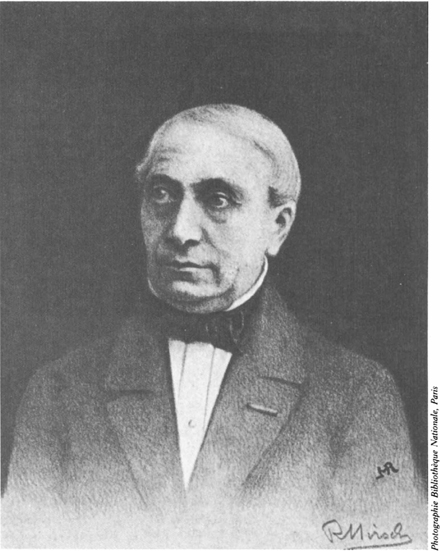
FERDINAND BERTHIER
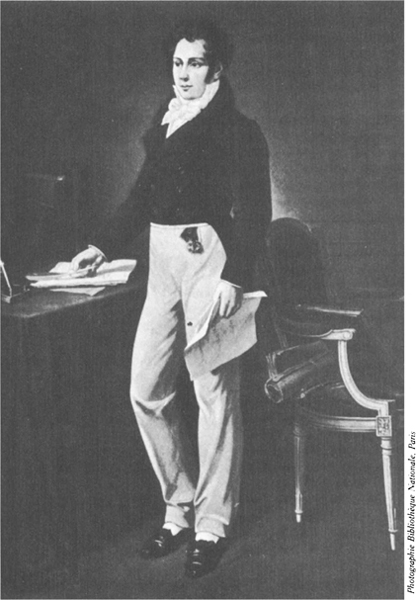
ROCH-AMBROISE BÉBIAN
Another leading deaf professor with a gift for the arts was Pierre Pélissier: in 1844 he published a collection of poems that were elegant, harmonious, and very well received. I do not mean poems in French Sign Language, quite a beautiful art-form for those who know the language but one that is transmitted viva mano, not written. I mean poems in French that contained rhyme, rhythm, and meter. Pélissier was as fluent in French as he was in French Sign Language, and a skillful poet in both languages; yet he was totally deaf from early childhood. He came to our school from Toulouse, where great efforts were made, unsuccessfully, to teach him to speak, and he spent most of his life on the rue Saint-Jacques, where he died six years ago. Despite his early training and work as a French poet, Pélissier hated oralism and loved sign. He found speech of little or no value and did not hesitate to say so.8 About a decade ago Pélissier published the first pronouncing sign dictionary of sign language. Unlike Epée’s and Sicard’s dictionaries, it recorded the “reduced signs” actually used by the deaf and did so with pictures so that the execution of the sign could be imagined. Pélissier’s name will go down in history for this achievement alone.9
Last I will single out from this intellectual circle of the deaf in the rue Saint-Jacques Claudius Forestier. Seven years younger than Berthier, Forestier was born profoundly deaf, and has several deaf brothers and sisters, one of whom he raised himself. He was the angel of the school, his behavior marked by sweetness and sound judgment.10 For a long time he studied to become a professor while he held the title of aspirant. But though he had an indisputable right to the first opening available, he was passed over several times in favor of hearing professors. With his hopes repeatedly dashed on the rocks of prejudice and finally shattered, in 1833 Forestier left the school that had been his intellectual cradle and became director of a deaf school at Lyon.11 I stopped by there about twenty years ago, when I was in nearby La Balme visiting my family. Forestier introduced me to the staff, all of whom were deaf, and took me at length through his gardens, for he is an accomplished cultivator of flowers and vegetables. Forestier has written an extensive course of instruction for the deaf12 and three other books, including a sacred history. He was also the first vice-president of the national welfare society for the deaf and remains our ardent and outspoken champion to this day.
One of the most important forces in the development of signing society in Paris and elsewhere as our current century progressed was, however, a hearing man, a true martyr for the cause of the deaf and, I am proud to say, my student and friend. In the declining years of the abbé Sicard, Roch-Ambroise Bébian rose like the sun partially dispelling the clouds. For the deaf, he holds a place next to the abbé de l’Epée.13
Bébian was born in Pointe-à-Pitre, Guadeloupe, the year Epée died.14 When eleven he was sent to Paris to be educated under his godfather, the abbé Sicard. He was lodged in the home of one of the hearing teachers,* went to the Lycée Charlemagne, and won several prizes. Then he came to our school and started attending my classes regularly; we became friends. Over the years, I helped Bébian develop a power and fluency of expression in sign language that no hearing teacher has rivaled before or since. I pride myself on my ability to tell a hearing signer from a deaf one, but Bébian would have escaped detection.15
Bébian worked his way up through the ranks: first, monitor; next, teaching assistant. At this point we almost lost him, for his father thought it undignified for him to remain in such menial posts and wanted to call him home. Sicard then had a position created just for him—he was to supervise the study-hall supervisors. Bébian was “outstanding and has best understood the spirit of my method,” he told the board. “He must be kept at all costs.”16 The ministry agreed, and Bébian was made censor of studies, responsible for discipline and good order. He was a godsend in this role, for he was the only one in the administration who could communicate fluently with the pupils.
At about this time Bébian published an essay on the deaf and their language and the prize-winning eulogy of the abbé de l’Epée in which he criticized Epée’s system of methodical signs.17 This very fervor on behalf of the deaf was too great for him to temper his remarks when he saw injustice or error, and frequently brought him into conflict with the administrative board. While Sicard was active he protected his protégé, but in the abbé’s failing years Bébian’s indiscretions cost him his job. I have mentioned earlier the disarray at the school, in instruction and in finances, as its director became feeble. Bébian could not tolerate the abuses he saw daily, the disorder of the program, the malfeasance of the board, and he complained repeatedly. His candor was initially annoying and ultimately intolerable. On the day the board expected the visit of the duchess of Berry, Bébian, who had been sent away expressly, appeared and offered her some pupils’ works. She complained that she had not met any pupils during her visit. “If the deaf do not appear before your Royal Highness,” he said, “it is because they are unclothed. For four months now they have been unable to go on walks for lack of clothing and shoes.” Two days later Bébian was forced to resign.18
The National Institution for the Deaf, the flagship for deaf schools throughout Europe, was beginning to drift as if cut loose from its moorings in a fog.19 While it had been Epée’s and then Sicard’s little school, a certain orderliness and uniformity prevailed; now the institution had grown to nearly two hundred people all told, while the director’s health had declined. The administrative board bemoaned the lack of any curriculum: students moved from one teacher to the next with each passing year but their education did not progress, since each teacher had his own agenda and methods that neither built on what had preceded nor set the stage for what followed. A common textbook was needed, but where could one be found? Neither Epée’s book nor Sicard’s provides an instructional method, they concluded: the first is an explanation of methodical signs, the second a “philosophical novel.” The methods actually followed under their leadership had never been written down; a matter of tradition, they were taught by apprenticeship. So the board turned to the one hearing man in France who could write a teaching manual, the man who had just been fired, Bébian.20
Bébian wrote a superb manual.21 For Sicard’s pompous metaphysical processes he substituted a course that was natural, simple, direct. He arranged the stages of learning the French language and the subjects of instruction in an orderly progression, so each difficulty overcome was a stepping-stone. He imparted life to every French sentence with just the right sentences in French Sign Language. “There is no more sure, direct and effective way to initiate the deaf into our written language than with sign language,” Bébian wrote.22 The administrative board applauded Bébian’s work, but I wonder how sincerely, for five years elapsed before it was published and it appeared the same year as De Gérando’s monumental history of educating the deaf, which ends opposed to using sign language.
When Bébian finished his manual, the board suggested that he write a book to accompany it containing a statement of the rules of French Sign Language and a description of the signs required to explain each example in the manual. To describe the signs, Bébian felt the need of a writing system for our language—which, in any case, would be one of the most beautiful gifts that anyone could give the deaf world. It puzzles me that linguists are prepared to develop alphabets for the unwritten languages of Africa, but not for a language of their fellow countrymen. Bébian assigned characters he invented to the distinctive hand movements, shapes, and positions of our language, and added some for facial expression, where needed for clarity of ideas. He named his method “mimography” and published it with a few illustrations, but he did not make it a working companion to his manual and it did not receive much attention.23
The disarray in organization and the discord on method at Saint-Jacques led Bébian to take another major step: in 1826 he founded a journal in which he criticized abuses with characteristic candor.24 He also sought alternative ways to educate the deaf because our school was frankly foundering: he revised his manual for use at home by parents of deaf children,25 and he opened his own little school, Boulevard Montparnasse.
Eight years after Sicard’s death, a group of deaf professors, including Berthier, formed an audacious plan to save our school by putting the case for reinstating Bébian before the new king, Louis-Philippe, who was a descendant of the duke of Penthièvre and had known Sicard and even Epée.26The plan failed, and I always suspected that De Gérando deflected the king’s wishes (he was by now a powerful figure in the Ministry of the Interior), arranging instead to offer Bébian a post in the provinces; he succeeded the recently deceased director of the deaf school at Rouen. This separation from his home and work of so many years, at a time when the National Institution needed him so desperately, did not suit Bébian at all. With the sole purpose of rescuing our ship, he published an extensive attack on the mismanagement of the school by its board and succession of new directors, an attack and a set of positive proposals that were met with stony silence.27 Frustrated, his life’s work a failure and his health failing as well, Bébian returned with his wife and son to Pointe-à-Pitre and opened a little school for the deaf there. Soon after, his son died, and then he did, at the age of forty-five. On that day, three decades ago, I lost a comrade, but all the deaf lost an innovator, a spokesman, and one of the rare hearing persons whom we could truly call our friend.
Bébian understood that many of the faults attributed to sign language, such as prolixity, were actually faults of Epée’s and Sicard’s invented sign system. He was the first instructor to use French Sign Language itself and he based his method of teaching French and his manual on it. Moreover, in virtually every book he wrote and in his journal, he lashed out at manual French, showing how it distorted our language and rendered it unmanageable. Perhaps the elaborate scaffolding on sign language erected by Epée and Sicard was already beginning to crumble under its own weight, but to Bébian goes the credit for tearing it down. When he began his work, manual French was used in teaching throughout France and in many foreign institutions.28 Within a decade he caused it to be banished from the Paris school and two decades of his labor caused it to be expelled from Bordeaux, Lyon, Toulouse, Rodez, Nancy, finally from deaf schools everywhere, including, as I have told, America,29 much to the joy of the deaf faculty and pupils.30 The year Bébian died, the annual report of the New York Institution described methodical signs as “wholly discarded.”31
Forestier’s resignation and Bébian’s dismissal and exile, however, were not isolated reversals of the fortunes of the French deaf. In fact, the abbé Sicard’s death allowed the forces of oralism to wage a new campaign on the rue Saint-Jacques itself, a campaign to undermine the mature deaf society I have just described.
The surface issue in this renewed struggle for the soul of the deaf was who should succeed Sicard as head of the National Institution for the Deaf, but the deeper question was whether benevolence confers authority on the benefactor. The natural choice to succeed Sicard was Jean Massieu, fifty, at the height of his career, a symbol throughout Europe and America of the educated deaf, extolled in scores of books and articles. Jean Massieu, Sicard’s teacher, mine, Gallaudet’s; teacher of countless deaf pupils in the thirty years he had labored at Sicard’s side. Jean Massieu, author of a vocabulary and a grammar, campaigner for the cause of the deaf, spokesman. Massieu’s pupils directed schools for the deaf in Lyon, Limoges, Besançon, Geneva, Cambray, Hartford, Mexico City. Now the parent of all these principals would direct the parent school. He was the logical choice for the administrative board to make and he was the sentimental choice: he had earned the post and he deserved it.
Years before, when Massieu was asked if a deaf man could understand an abstract concept such as gratitude, he answered yes, and gave this oft-repeated definition: gratitude is the memory of the heart. Ironically, the concept proved too abstract for the hearing, not the deaf: the administrative board did not choose Massieu. Instead it forced him to resign, to leave his home, his school, his friends, his colleagues, his pupils. He returned to the plot of land near Bordeaux where the passerby had found him as a boy tending his flock.
I saw Massieu again, about a decade after these events, when I visited France in 1835. He had been recalled from forced retirement after a year, to second the abbé Perrier, director of a small school for the deaf in Rodez, the capital of Aveyron. He was then fifty-one years old. Soon after his arrival, he was struck with the beauty and charm of a young lady of eighteen who could hear and speak and who was employed in the establishment, and it was not long before he married her. When the abbé Perrier went to Paris to direct the National Institution, Massieu became director of the Rodez school. He and his wife had one son when they moved from Rodez to Lille, a large city just south of the Belgian border, where they established the first school for the deaf in the north of France, just two years before my visit. There were about thirty pupils. Massieu was principal and his wife matron; they had lost their son but Mme. Massieu was nursing a daughter. I found Massieu quite different from what I had known him to be. He was rather gray, but polite, social, sensible, much respected and happy as could be. No doubt he was indebted to his kind wife for his total alteration.
That was our last meeting. The next few years saw his health and lucidity decline, much as Sicard’s had done toward the end, and he finally ceded place to the Brothers of Saint-Gabriel, who ever since have managed the school he founded. He bid a final goodbye to the land and the people he loved so well in his seventy-fourth year, just as I was embarking once more for France, in the summer of 1846.32
The leader of the new oralist campaign that led to Massieu’s ousting was Jean-Marc Itard, tutor of the Wild Boy of Aveyron; his fellow perpetrator and friend, the more dogmatic of the pair, was Baron Joseph Marie De Gérando, who became head of our school’s administrative board in 1814, a dozen years before he wrote his famous “history.” Why did two would-be benefactors of the deaf mount a campaign to impose oralism on the deaf, starting in the very sanctuary of sign language, a campaign to oblige all of us to relive in this century the proven errors of the past? Why would intelligent hearing people such as these, willing students of history’s lessons, devote vast effort and money to a program detested by the deaf and doomed to certain failure? The question is important because now, here in America, men of similar benevolence and erudition seek to repeat the effort yet again. Its answer lies in the motives and means of benevolence embodied in the lives of these two Frenchmen. First, Dr. Itard.
It was a day like any other at Saint-Jacques when my schoolmate, the son of General Gazan, slipped while rushing toward dinner down the sweeping marble staircase of the Oratorians, tumbled most of a flight, and lay motionless on the bottom few steps. Massieu was sent for, then Sicard. There was much hand-wringing and then I was singled out from the pupils huddled on the periphery of the scene; Massieu’s hands swooped and darted, beating an urgent staccato in the air: “Run, Clerc. Val-de-Grâce. Bring a doctor!”
Massieu had just sent me on an historic mission. It would transform the life of the young medical student I was about to encounter and launch him on a career that would earn him these titles: the first speech and hearing specialist; founder of otology; the father of oral education of the deaf in modern times; inventor of educational devices; father of the education of idiots.
Val-de-Grâce is a military hospital in a former Benedictine abbey, five breathless minutes up the rue Saint-Jacques. I ran with all the ferocity and self-importance of youth, charged across the cobblestone courtyard of the abbey, and hurtled into a vast hall, lined with beds on both sides—there must have been a hundred. At one of these a young medical student was changing bandages. He read the alarm in my eyes, the urgency in my heaving chest, and the reason in my pantomime and sprinted back with me to the school. Jean-Marc Itard, surgeon second class, twenty-five years old, pronounced his new patient’s leg broken and proceeded to bandage it. Gazan revived and was carried back up the stairs to bed. Sicard ushered the young physician into his apartment, and their lifelong friendship began. As it turned out, it was to be a propitious occasion for Itard, but a disastrous one for the deaf.
By one of those bizarre coincidences that make one wonder if history is thumbing its nose at us, the very day of Gazan’s accident another youth of about his age was involved in another signal encounter that would concern Itard, the deaf, and countless children everywhere. As Gazan slipped down the staircase of Saint-Jacques, the Wild Boy of Aveyron slipped through the doorway of the cottage belonging to the dyer Vidal, in the village of Saint-Sernin, in the south of France.33
The wild boy had been glimpsed occasionally in the three years prior as he fled naked through the woods called La Bassine. Peasants in that mountainous region sometimes lay in wait and saw him searching for acorns and roots, or, in the fields on the edge of the forest, digging up potatoes and turnips. Twice he was captured. The first time he was tied to a post and left on display in the village of Lacaune; either a kindly hand or his ferocious struggling loosened his bonds during the night and he escaped into the forest. On the second occasion, fifteen months later, in the summer of 1799, he was entrusted to the care of an old widow in the same village. This devoted guardian, one of her contemporaries recounted, dressed him in a sort of gown to hide his nakedness and offered him various foods, including raw and cooked meat, which he always refused. He did accept nuts and potatoes, sniffing them before putting them into his mouth. When not eating or sleeping, he prowled from door to door and window to window seeking to escape. After eight days he succeeded.
This time the wild boy did not return to the forest. Climbing the nearby mountains he gained a broad plateau in the department of Aveyron. Through the autumn and into a particularly cold winter he wandered over this elevated and sparsely populated region, sometimes entering farmhouses, where he was fed. When given potatoes, he threw them into the coals of the hearth, retrieving and eating them only a few minutes later. During the day he was seen swimming and drinking in streams, climbing trees, running at great speed on all fours, digging for roots and bulbs in the fields; and when the wind blew from the south he turned toward the sky and rendered up deep cries and great bursts of laughter. Finally, working his way down the mountain along the course of the Lavergne and Vernoubre rivers, he arrived on the outskirts of the village of Saint-Sernin. Encouraged perhaps by the treatment he had received from the farmers on the plateau, urged on perhaps by hunger, he approached the workshop of the dyer Vidal. It was seven o’clock in the morning, January 8, 1800. The boy stepped across the threshold into a new life, and into a new era in the education of man.
The wild boy had more than age and a moment in history in common with my fellow pupil Gazan. He was mute, and he appeared also, to the government official summoned to Vidal’s home, to be deaf: the boy sat impassively by the fire and seemed to be unaware of the commissioner’s questioning. But the similarities between the wild boy and my friend stopped there. When he was brought to our school one sweltering August day, I beheld an animal sitting on the ground in a pool of his own urine, rocking back and forth ceaselessly, his eyes staring wildly, then darting aimlessly. He growled and snapped at the pupils who came too near, and tore at the sack of cloth that had been belted around him. He had a round face with dark eyes deep-set beneath a huge head of snarled hair, which he matted with wads of saliva. His nose was long and pointed. His thin lips revealed large yellow teeth when he burst into intemperate bouts of laughter, seemingly without provocation. He was covered from head to foot with scars of all shapes and sizes. The largest was a two-inch gash across his voice box, the trace of an attempted infanticide, it was believed. There was a scar over one eyebrow, scars on each cheek, one on his chin, several on his arms and legs—and his entire body was covered with blisters from smallpox.
The look on Sicard’s face when he came into the courtyard to greet his new and celebrated pupil was yet another spectacle. Since Sicard had presented the uneducated deaf as savages, what could be more appropriate than to send this savage to Sicard? Still, the abbé’s face caved in at the sight of the creature; I don’t know what he was expecting. Commands were given, and the youth was promptly bundled off to a little locked room under the eaves.
In the days that followed, a stream of visitors made their way up the Oratorians’ staircase to that room to see the Wild Boy of Aveyron, as he was titled by the papers, which carried major stories every day. The first to come were distinguished scientists from the newly founded Society of Observers of Man.34 Under the banner “Know thyself!” this impressive gathering had joined the previous December in a comparative study of man in “all the different scenes of his life.” Now, within weeks, a seemingly ideal experiment on the nature of man had fallen into its lap—a young man who had been isolated since early childhood from all the social influences to which we are normally subjected and who could thus reveal which of our ideas, abilities, and desires we owe to society and which to our biological nature.35
How many of our innumerable discriminations, concepts, tastes, skills, fears, and desires would the savage from Aveyron lack? When Massieu was questioned about his own life, he revealed that he had observed, compared, judged, remembered, and so on without articulate language, but then he had sign language. Would the wild boy, who had no language at all, still give evidence of having lived more than an animal existence?
The wild boy—homo ferus, as Linnaeus classed such children—was as interesting for what he might become as for what he was. If our most human trait was not our appearance (wild boys and Hottentots did not look like Parisians), nor our language (wild boys had none), nor our upright gait (wild boys would run on all fours), it might be, Rousseau argued, our ability to change: man is able to leave the state of nature and in collective life to become educated. The wild boy certainly did not fit Rousseau’s description of the noble savage any more than Massieu was Condillac’s statue incarnate, but the boy might still prove to be perfectible, just as Massieu had been, and to justify the deep optimistic belief in human potentiality that motivated many of the reforms of the French Revolution.
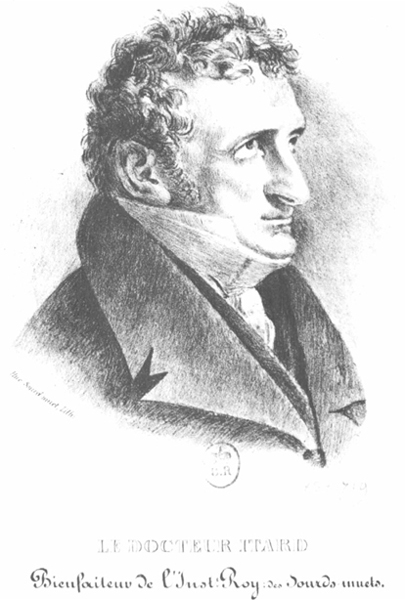
DR. JEAN-MARC ITARD
Itard was among the first to visit the boy, not only because Sicard asked him to as a physician, but especially because he was a keenly ambitious young man from the provinces who intended to seize this opportunity to make his mark on the world. He had been born twenty-six years before in southern France, the son of a master carpenter.36 He studied the classics, then science, and at age nineteen took a job at a Marseilles bank. I would never have found him treating soldiers at Val-de-Grâce if the National Convention had not decided to draft 300, 000 citizens the summer of his employment. It feared invasion by the growing monarchist coalition that had begun by attacking Verdun at the time of the king’s imprisonment, Sicard’s arrest, and the September Massacre. To avoid the draft, Itard turned to a friend of the family who directed a military hospital, and presently, although he had never before set foot in a hospital or opened a medical book, he found himself with the rank of health officer. Assigned next to the headquarters of the Army of Italy with the rank of surgeon third class, Itard was responsible for public health at some encampments. (Another energetic young man was making a meteoric rise to fame in the same theater of war: artillery captain, then brigadier general in the Army of Italy—Napoleon Bonaparte.)
Eighteen months later, the doctor who would become Napoleon’s surgeon-general, Dominique Larrey, arrived from Paris to head the medical corps of an expedition to Corsica. Before embarcation, Larrey offered courses in anatomy and pathology, which Itard followed diligently. When the expedition was canceled, Larrey returned to the military hospital in Paris, Val-de-Grâce, and Itard followed soon after. Over the next three years preceding our encounter, he took courses in medicine, especially with the physician who directed the asylum for the insane at La Salpětrière, Philippe Pinel, and he successfully presented a thesis to the faculty of medicine, securing a promotion to surgeon second class.
During his studies, Itard also read the philosopher Condillac, who inspired Pinel and indeed almost every other French thinker of that time; so when he went up to see the wild boy, he went expecting Condillac’s statue—or at least a version of it, in which socialization, language, judgment, and so on had been stripped away by prolonged isolation, leaving a kind of tabula rasa on which the message of humanity would have to be written anew. What he saw was a caged animal, a filthy naked urchin who stared blankly out the window or blankly at him, cringing.
Itard descended from the attic mopping his forehead and affirmed that the boy was only what he had to be: what could you expect of an adolescent separated since early childhood from others of his species, he asked rhetorically. “His intelligence would be concerned with his few needs,” he later wrote, “and because of isolation, it would lack all the simple and compound ideas that we receive through education and that combine in so many ways with the help of language.”37
The naturalist Pierre-Joseph Bonnaterre, who had examined the wild boy in Aveyron, had ended his essay on the savage saying that we may expect every success from his instruction with Sicard, “that philosopher-teacher who has worked such miracles in this kind of education and we may hope that… he will one day become the rival of Massieu.”38 In fact, Sicard had not the least idea what to do with a child who actually fit his fanciful description of the deaf before instruction: “a being isolated in nature, incapable of communicating with other men, reduced to a condition of stupor.”39 Here was no docile city child with a hearing loss who was fluent in sign and could be initiated into the mysteries of the Supreme Being and the even more recondite mysteries of Sicard’s metaphysics. Hence Sicard preferred Pinel’s diagnosis to Itard’s; the first psychiatrist examined the boy and concluded that he was not retarded because he had been left in the wilds; rather, he had been left in the wilds because he was retarded. Still, if Itard wanted to try to fashion the wild boy into a Massieu, on his own responsibility of course … When Itard accepted his proposal, Sicard, on the last day of the year 1800, appointed him resident physician with one of the highest salaries in the school, and a free apartment and board.40
Itard set to work, then, as the new century began. “Dare I confess that I have set myself both of these two great undertakings,” Itard wrote. First, “to deduce from what the wild boy lacks the hitherto uncalculated sum of knowledge and ideas which man owes to his education.”41 In fact, Itard’s report and that of Bonnaterre abound in examples of sensory and intellectual skills that the boy lacked, apparently because of his lack of socialization. He was living proof, it appears, of Condillac’s precept that all knowledge comes from experience, and living refutation of Rousseau’s conception of man in nature as a “noble savage.” Initially, Victor—as Itard named him—rejected clothing even in the coldest weather; did not hesitate to put his hand in the fire; reached alike for painted objects, three-dimensional objects, and virtual objects in a mirror; did not sneeze or weep; did not respond to loud noises; recognized edible food not by sight but by smell; had no emotional ties or sexual expression; did not communicate; and so on. Itard concluded that sensitivity is proportional to civilization.
Itard’s second great undertaking was “to bring to bear all the resources of … present knowledge in order to develop the boy physically and morally.” It was to be an experimental verification of Condillac’s theories.
Itard set down five principal aims for his training program, and organized his first report on Victor accordingly: to interest the wild boy in social life by rendering it more pleasant for him than the one he was then leading; to awaken his nervous sensibility; to extend the range of his ideas by giving him new needs and by increasing his social contacts; to lead him to the use of speech by imitation (Itard was convinced that the pupil was not deaf: if he responded to the sound of nuts cracked and not to the commissioner’s questions, it was because the first had significance for him and the second did not); and to make him exercise the simplest mental operations. The methods that Itard worked out to teach Victor to speak and understand speech he later attempted to apply to the semi-deaf;42 more felicitously, his disciple, Edouard Séguin, would soon apply his entire training program to the mentally retarded, to the astonishment of all Europe.
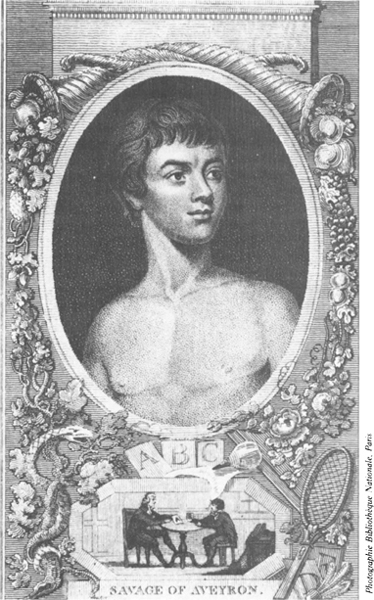
THE WILD BOY OF AVEYRON
(ENGRAVING BY JAMES CUNDEE)
Aiming to make the boy’s life in society less stressful than it had been since his capture, Itard took Victor into his apartment at Saint-Jacques and charged the housekeeper, Mme. Guérin, with his daily care. In those spacious and beautifully decorated quarters, which contrasted starkly with the dormitory in which we pupils lived, he roamed freely. The first room in Itard’s private suite was Mme. Guérin’s, with a painted bed, a stately armchair, a walnut table, silver candlesticks on the mantelpiece, and framed prints on the wall. One door led to a small kitchen, another to a sparsely furnished bedroom for Victor, which he always kept punctiliously neat. The boy ate with the Guérins, and sometimes with Itard, in a private dining room with a beechwood table and four cane and cherrywood chairs. Mme. Guérin treated him kindly and gave in to his tastes and inclinations “with all the patience of a mother and the intelligence of an enlightened teacher.” He was put to bed at dusk, provided with his favorite foods, allowed his indolence, and taken on frequent walks.
In order to awaken the boy’s “nervous sensibility by the most energetic stimulation,” Itard administered very hot baths daily, lasting two or three hours; he also clothed, bedded, and housed the boy warmly; and he gave him dry rubs of the spine and lumbar region (although he soon discontinued the latter when he found it aroused him physically as well as mentally). Three months of this treatment, which also included provoking joy and anger on occasion, resulted in a “general excitement of all the senses.” The boy would test the bath with his finger and refuse to get in if it were cool. He removed potatoes from the fire with a spoon and squeezed them to judge how well cooked they were. He dropped burning paper before the flame could reach his fingers. He liked to stroke velvet.
Itard had less success with his third aim. He tried to give the wild boy new needs, but the toys and sweets, most of the foods and beverages we love, did not interest him at all. What did interest him was freedom: when taken to the countryside he would try to escape, so his teacher restricted his outings to the gardens of our school.
That Victor could hear but not speak was a puzzle to us pupils, for we knew the two faculties went together. Massieu attributed Victor’s mutism to his having forgotten how to speak during all those solitary years in the forest, which is, I suppose, what Itard meant when he wrote that “complete absence of exercise renders our organs unfit for their functions.”43 But despite this obstacle to Victor’s acquiring speech by normal means, Itard hoped that substitute means could bring it about, specifically, inducements to imitation. He chose the word for water, eau, as his first target, since Victor could both hear and produce this simple sound* and since water was the boy’s preferred drink. But “even when his thirst was most intense, it was in vain that I held a glass of water in front of him, repeatedly crying eau, eau. When I gave the glass to someone next to him who pronounced the same word, and when I asked for it back in the same way, the poor child, tormented on all sides, waved his arms around the glass almost convulsively, producing a kind of hiss but not articulating any sound.” Switching to milk and the word lait† produced some result: Itard heard his efforts rewarded after four days when Victor pronounced the word lait, “distinctly, though rather crudely, it is true; and he repeated it almost immediately.” According to Itard’s report, Victor also picked up Madame Guérin’s habit of saying “O Dieu!” (“O God!”), and when her twelve-year-old daughter Julie was around, he would say “li, li.” Despite these good signs, however, it was clear that if Victor was to learn French by imitation, at this rate it would take several years!
Itard now undertook his final aim in the initial period of instruction, training at least some of the essential higher mental operations, with a view to preparing Victor to acquire more formal education in various branches of knowledge. He would have preferred to teach concepts orally, by dialogues with his student, just as Condillac had done with the prince of Parma. But Victor was, for the present at least, like a deaf-mute, indistinguishable in this from the rest of us, and so it was that Itard adopted the method of Sicard, beginning as Sicard had done by teaching the written names of familiar objects.
After many false starts, blind alleys, moments of despair, threats, imprecations, and ruses, Victor came to distinguish the metal letters that Itard had fashioned, to arrange them into a few simple words, and even to make them spell lait when he wanted some milk.
After a year of untiring efforts by teacher and pupil, De Gérando could write: “In a very short time, Citizen Itard has obtained extraordinary success…. Each day the child aquires some new expression; they are, it is true, only those that have some immediate relation to his needs, but such are the only terms that it is permissible for a philosopher to teach him. At last, here he is not only able to communicate with us, here he is in possession of our conventional signs.… He has broken through the barriers that separated him from our society; we are now on common ground.”44
This first phase of Itard’s work with Victor made him famous. He opened a private medical practice, taking an additional apartment for it in the heart of the city; the Russian ambassador brought him a ring in the name of his sovereign and tried unsuccessfully to induce him to carry on his work in St. Petersburg, as Joseph II had tried to win Epée to Vienna three decades before.
In the second phase of training Victor, which lasted for another four and a half years, Itard aimed at further developing the boy’s senses, intellect, and emotions. Previously he had been content merely to observe the first increases in broadened sensitivity and discrimination that the sense of hearing gained as part of Victor’s general rehabilitation. Now he undertook to train Victor’s hearing explicitly by requiring increasingly fine discriminations, much as he had done to teach visual distinctions among the letters of the alphabet. He began by providing student and teacher alike with a drum, a bell, a shovel, and a stick. Itard struck his drum; Victor did likewise. Then the boy was blindfolded. If the teacher hit the hoop, the rim, or the body of the drum, the pupil followed suit. If the teacher struck the clock’s bell or the fire shovel, the pupil did likewise.
Edging his way toward the discrimination of vowel sounds, Itard next took up the tones of a wind instrument and then different voice intonations. He no longer required imitation but only that Victor raise his hand when he heard a sound, and the pupil learned this readily, as much to his teacher’s delight as to his own. Itard took up next “the five vowels.” A was assigned to the thumb, E to the index finger and so on, and Victor was to raise the finger corresponding to the vowel uttered by his teacher. Itard reports that the first vowel Victor distinguished clearly was O. Next Aseems to have come into focus, reliably distinguished from the others. The remaining three vowels were more refractory. Removing the blindfold, putting it back on, striking the boy’s fingers when he made a mistake, persisting doggedly or, on the contrary, spacing out the lessons—none of these availed. The pupil became increasingly rowdy and the teacher lost heart. “How thoroughly did I regret ever having known this child, and fully condemn the sterile and inhuman curiosity of the men who first snatched him away from his innocent and happy life!
“Nevertheless this series of experiments on the sense of hearing was not altogether useless. Victor owes to it the fact that he can hear several one-syllable words distinctly and, above all, can distinguish quite precisely those intonations of language that express reproach, anger, sadness, contempt, and friendship, even when these various emotions are not accompanied by facial expression or by the natural pantomime that is their outward expression.”
As for the other senses, Victor practiced distinguishing letters by sight, shapes by touch (blindfolded), and foods by taste. He learned the written names of many more things through little treasure hunts around Itard’s apartment, then progressed to their qualities, fetching the little book, the largenail, and so on. Next came the verbs: “Touch the key,” Itard wrote on the board, and Victor would touch the key. “Cut the cup,” Itard wrote in a mistaken permutation and the boy promptly smashed his cup on the floor. As Victor came to understand and construct more and more sentences, his means of producing them by assembling metal letters became unwieldy and Itard taught him to form letters with chalk.
Although Victor showed no flair for distinguishing speech sounds by ear, Itard still hoped to teach him to speak by using methods designed for the deaf. He borrowed Sicard’s copies of Bonet and Amman, read Epée’s treatise on speech, and set to work. He had taught Victor to imitate his movements as a preliminary for teaching writing, so he aimed to teach articulation in the same way, beginning with gross facial expressions. Thus we have teacher and pupil seated opposite each other, grimacing, protruding their tongues, dropping their jaws, much as the abbé Margaron and I had done, but Itard found that “all I could obtain from this long series of exercises was a few unformed monosyllables, sometimes shrill, sometimes deep.”45 Finally, Itard abandoned Victor to mutism.
What to my mind is unforgivable is that Itard, blocked in restoring Victor’s spoken language, failed to allow him the only other facile means of communication, the only other natural language of man (transmitted from mother to child), sign language. In compelling the youth to return to society, Itard contracted the obligation to give him the essential skill for surviving in society—communication. Itard’s preference for restoring the boy to speaking society is understandable as he himself was a hearing person; when he concluded that this was impossible, however, it was inexcusable to exclude the boy from signing society as well. In this he was like those hearing parents who are so bitter about their children’s inability to participate in their oral society that they refuse to let them participate in the deaf society either. Then, like Victor, the deaf child is reduced to gesticulating a few simple needs to his caretakers, and his mind shrivels and dies.
It probably would not have cost Itard any effort to have Victor acquire sign. The boy was living, after all, in the midst of a signing society and might have acquired French Sign Language much as I did, the more so as gesturing was his preferred mode of communication. But Victor was prevented from associating with us; he was imprisoned in Itard’s apartment—scene of his lessons and his life.
How could Victor learn to be with people, to play, to do chores, how could he refine and temper his emotions without social experience and without communication? He could not. In the end, Victor always preferred the open country to the company of others. One night he slipped out of his prison into the gardens and woke half the staff shrieking at the moon while splashing about in the fountain. On another occasion, Victor and Itard were invited to the château of Mme. Récamier, who presided at one of the great salons of the day. Members of the English parliament and of the French government, actors, poets, scientists, and a future king were assembled for dinner. Victor was placed next to the hostess, presumably to show that even a child of nature would be dazzled by her beauty. His education had advanced far enough that he wore clothes, took his place, and waited to be served. But after gorging himself with his hands, he slipped out, during a discussion of Voltaire’s atheism, tore off his garments, climbed a tree, and leapt, stark naked, from one tree to the next, the length of the avenue that approached the château. The women gaped and fanned themselves, the men urged all to stand back, the gardener tempted Victor down with fruit, and someone lamented that Rousseau had not lived to see this proof that society is kinder to man than nature is.
Discouraged by the boy’s lack of progress, Itard spent less and less time with him. Finally, in 1810, De Gerando decided it would be better to be rid of him, and the ministry arranged to pay Mme. Guerin one hundred fifty francs a year to lodge the boy in her home down the street from the school.46 When a member of the Society of Observers of Man went to visit him there in 1817, he found him “fearful, half-wild, still unable to speak despite all the efforts that were made.”47 Victor of Aveyron died in that house, in his forties, in the year 1828.48
In the years he tended and taught the savage, Itard, the resident physician in our school, had little time left for us, though two illnesses ending in death and three fatal accidents among my schoolmates had given him as many irresistible opportunities to examine the ears of cadavers. “I derived nothing from this,” Itard wrote, “except the old finding that the ears of the deaf are free from visible lesions.”49 Now that he had abandoned the wild boy, he was able to turn his attention to his medical experiments. Without information about a lesion associated with deafness, he had no rational guide for treatment; nonetheless, he took it for granted that he should proceed. He started by applying electricity to the ears of some pupils, since an Italian surgeon had recently found that a frog’s leg would contract if touched with charged metal.50 Itard thought there was some analogy between the paralysis of the hearing organ and the paralysis of a limb. He also placed leeches on the necks of some of the pupils in the hope that local bleeding would help somehow. Six students had their eardrums pierced, but the operation was painful and fruitless, and he desisted. Not soon enough for Christian Dietz, who died following this treatment. At first, however, his ears discharged some foreign matter and he reportedly recovered some hearing and with it some speech, which led Itard to think the deaf ear might be blocked up rather than paralyzed.
It was known that the postmaster at Versailles, M. Guyot, had cured his own hearing loss by inserting a probe in his Eustachian tube, which leads from the throat to the ear, and “flushing out the lymphatic excrement.”51 The method had been widely tried by physicians and abandoned as impracticable and ineffective. Itard made improvements, or rather, he had them made by pupils working in the carpentry shop; for example, a metal headband was added to hold the probe still despite the patient’s agitated movements. Then, over a period of eleven months, one hundred twenty pupils, almost every last one in the school save for some two dozen who would not be subdued, were subjected to the treatments. Let me tell you what it was like. The band was wrapped around my forehead so that a clamp hung in front of my mouth. A long silver probe was pushed into my nose and turned and worked back and forth until it penetrated my Eustachian tube; the pain was intense and I am not ashamed to say that I cried. The end of the probe was then attached to a syringe leading to a jar with a flexible bottom containing irrigating fluid. When the liquid surged into my head I became dizzy and nauseated. After some minutes of this, the probe was removed and I was dismissed. Throughout, Itard never addressed a single word to me, since he knew no sign. After each of these treatments—there were eight—I had headaches, dizziness, and fever; my friend Berthier developed an ear inflammation and pus, to Itard’s delight. What was accomplished? Why, nothing at all. Not one pupil derived any benefit. Nevertheless Itard came to be the world’s authority on catheterizing the ear and published several articles about it; the silver shaft of pain now carries his name, the sonde d’Itard.
The reason Itard took delight in Berthier’s infection was that a M. Merle, a self-styled naturalist doctor, had applied a treatment to all twenty-six pupils at the Bordeaux school and two were reportedly cured who had first developed severe pain and running liquid from their ears. Itard hastened to write to the inventor and obtain a quantity of the secret brew, which he dispensed into the ears of a dozen pupils without effect. The doctor responded to Itard’s complaint by explaining that the potion lost its power if left standing. Itard offered to buy the recipe and prepare it himself, but the inventor said only the government could compensate him properly. When M. Merle died not long after, however, Itard obtained the prescription from his wife: ground wild ginger, 8 grams; roses of Provence, 1 pinch; wild horseradish, 4 grams; glasswort, 1 pinch; boil in white wine, reduce to half volume, strain, and add: sea salt, 8 grams. He prepared this concoction himself and put it in the ears of every pupil in the school who was not born deaf, a few drops a day for two weeks—without effect.52
A humbler man might have agreed at this point with the count of Noailles, a member of our administrative board, who said: “You wish to unstop the ears of the deaf but God does not.” Itard said no such thing; if all of these methods were failures, then more extreme methods were called for. When Claudius Forestier was a lad of thirteen, he was subjected to a regime of daily purgatives, and his outer ear was covered with a bandage soaked in a blistering agent. Within a few days, his ear lost all its skin, oozed pus, and was excruciatingly painful. When it scabbed, Itard reapplied the bandage and the wound reopened. Then Itard repeated the cycle and applied caustic soda to the skin behind Forestier’s ear. All of this was to no avail, no more for Forestier than for thirty other pupils on whom it was tried.
In desperation Itard tried fracturing the skull of a few pupils, striking the area just behind the ear with a hammer. With a dozen pupils he applied a white-hot metal button behind the ear, which led to pus and a scab in about a week. Yet another of Itard’s treatments was to thread a string through a pupil’s neck with a seton needle, which caused a suppurating wound that supposedly allowed “feculent humors” to dry up. In addition, several of the pupils in the school were badly scarred from his use of the moxa, an old Chinese remedy that involved burning a cylinder of dried leaves of the mugwort plant applied to the skin from the back of the neck to the chin. The moxa had fallen into disrepute by the time Itard was a medical student because it was so painful, generally fruitless, and sometimes fatal. But Itard was prompted to try it on a dozen of my schoolmates because one of Napoleon’s military doctors had recently reported a cure of deafness by this means.53
It was all a miserable failure. “Medicine does not work on the dead,” Itard concluded, “and as far as I am concerned the ear is dead in the deaf-mute. There is nothing for science to do about it.”54 There may be those people—hearing, no doubt—who admire Itard’s determination at our expense. To me it seems like a crazed abuse of power, so dangerous and painful were the treatments, so slight the benefits. We were clearly not Itard’s brothers but his raw materials. His successor as resident physician at our school, Prosper Meniere, said it outright: “The deaf believe that they are our equals in all respects. We should be generous and not destroy that illusion. But whatever they believe, deafness is an infirmity and we should repair it whether the person who has it is disturbed by it or not.”55 Will the day ever come when it will be unnecessary to affirm the immorality and danger of such a view? Hear it, then: the deaf are the equal of any man (perhaps better than some, for there has never been a deaf man who put out the ears of the hearing whether they wished it or not). Deafness is an infirmity for some, a source of strength for others, simply a condition of existence for most. It is my condition. I am what I am. I have done what I saw my duty to be. I have no wish to be anyone else or anything else, and I never have.
In this I am by no means unique. Of course, there are deaf people who view deafness as an infirmity and a calamity. They are generally hearing people who lost their hearing as adults. Their distress arises more from the necessity of changing their life against their will and habit—and in the first place acquiring another language—than it does from a failure to hear sounds. I have seen Frenchmen obliged to settle in America who responded with the same distress when they found their cherished tongue useless and had to learn another. Yet God made men adaptive; the best are capable of graceful change.
Here is what John Kitto, the English Bible commentator who lost his hearing when he was twelve, says about having it restored: “They poured into my tortured ears various infusions hot and cold; they bled me, they blistered me, leeched me, physicked me; and at last they gave it up as a bad case.… I have not sought any relief.… It had become a habit to me, a part of my physical nature: I have learned to acquiesce in it and to mold my habits of life accordingly. I cannot pretend to any permanent regret in connection with the absence of vocal or other sounds.”56
Massieu tried to explain all this to Itard (in writing, of course, since Itard knew no sign). Itard said, Deafness is a disease: you would not choose it, although you may be reconciled to it. Massieu said, Poverty is a disease by the same logic; in fact you could live well without sound, as without means, if only society saw no disgrace and threat in this, if only it gave deaf children and poor children access to education and thus a chance to be what they can be. Itard said, But deafness stands in the way of education and admission into society. Massieu said, The failure to use sign was the obstacle to education and there always was a deaf society.
It was hopeless. Their shared language (written French) merely allowed the two men the illusion they were communicating. Massieu had no idea what it was like to be hearing and to fear the world of deafness, and Itard had no idea what it was like to be deaf and to fear the world of hearing. Asked, about a decade later, to write the entry on deafness for the major medical dictionary of the time, Itard described us as “civilized men on the outside, barbaric and ignorant as a savage on the inside; indeed, the savage is superior if he has a spoken language, however limited.”57
In this same entry and in his Treatise on Diseases of the Ear, also published in 1821, which was the first and final word in that specialty for many years, Itard explains that we deaf are emotionally as well as intellectually primitive.58 He says we are impassive (yet I burn with rage at this slander). He says we are as credulous as savages, because the poor children entrusted to his care have limitless belief in his medicine “and turn to me for health and life even in their gravest illness.” He says that before education we cannot love and after it we cannot love deeply or know gratitude. Witness how little they love Sicard; he wrote; I wonder if this lonely bachelor also meant, Witness how little they love me. He says we are less sensitive than others; we accept surgical pain calmly and do not react to many medicines, such as purgatives. We have few friends. We cannot feel sadness or melancholy (yet all this makes me very sad and melancholic).59
Itard knew nothing of the deaf because he had lived among us only nominally.60 In his incomprehension he believed the deaf had a “frightful predicament,” and if he could not solve it with medicine, perhaps he could solve it with training. Might not the methods he developed to exercise Victor’s sense organs, long inactive through isolation, be applied with more success to those of the hard-of-hearing, long inactive through disuse?61
Previously, Itard had seen only two ways to try to transform a deaf man into a hearing one and both were failures. The first was medicine. The second was training in speech, which is “always painful, slow, and defective and yields no useful exchanges…. The deaf man cannot increase, develop, and clarify his ideas in this way, his education is unaffected, he is still a deaf-mute.”62 Now, however, Itard thought he saw a third way to restore speech—by restoring hearing, through the exercise of the deaf man’s ears. He took it for granted that when hearing was restored, speech would be, too. When the cataracts had been removed from a patient born blind, had not the man come to see shapes, colors, and depth in a few weeks without instruction?* Likewise, when the deaf boy of Chartres abruptly acquired hearing, † didn’t he soon acquire speech on his own?63
Like all those before him who had tried to teach the deaf speech, Itard worked long hours with just a handful of pupils who were predisposed to profit. He drew six from among the ten percent at our school who could discern vowels and a few consonants but nothing more. He began by improving their ability to detect sound rapidly and reliably. Originally, he had a church bell installed in their classroom, and he taught his pupils to respond to successively softer notes, which he obtained either by striking the bell with different objects or by seating the pupils farther away. Itard next employed the vibrating bell of a clock and, placing his students in a row in a long corridor, he gradually withdrew the source of sound, marking on the wall the point at which it became inaudible for each child. In this way he recorded the relative standing of each of his pupils and his day-to-day progress.
Another series of exercises concerned the perception of rhythm: Itard dragged out Victor’s old drum and tapped out a few simple marches for his pupils, “as often poorly as well,” he adds modestly. (His selections were apparently good ones, since he reports that his six pupils took to beating them out together in the classroom while awaiting his arrival.) Progressing toward speech discriminations, Itard next taught his pupils to distinguish high and low notes on the flute. They reached a point where they perfectly distinguished the re and la of the musical scale, but they still could not distinguish among the vowels. The teacher wrote the “five vowels” on a blackboard, then placed himself behind the children and pronounced them while his pupils were to point to the corresponding transcription: with practice they mastered the task.
Distinguishing the consonants proved much more difficult for his pupils and Itard says frankly that he had to use a thousand and one different devices, tailoring his instruction to each individual student. This necessity led him to reduce the group from six to three pupils and to give an hour’s lesson daily to each. After a year, or about a thousand hours of instruction, Itard’s hard-of-hearing pupils could reliably recognize all the vowels and consonants as they occurred in various simple words, and the best could understand sentences spoken directly and slowly. Yet certain confusions persisted and, most disappointing of all, the pupils spoke no better than before all this training. There were many speech sounds they heard distinctly that they could not utter distinctly. Itard attributed this to the same causes as in Victor’s case: the ability to imitate wanes with age; and speech organs that have remained long inactive require physiological training just as ears do.
So in the end Itard set to work to teach speech directly. He developed a careful progression of sounds to be taught, from the highly contrastive to the very similar, from the easily articulated to the more difficult, from the simple to the complex. Moreover, he brought vision and touch into play; he took up, he said, where Pereire’s pioneering work left off, in the tradition of Bonet, Wallis, and Amman.
Soon his pupils were able to read words and simple sentences “more or less intelligibly,” and, in 1808, Itard could parade them past the Faculty of Medicine, which had high praise for their performance.64 Itard found to his dismay, however, that they would never speak of their own accord, nor could they respond fluently to questions he was sure they understood. Despite his efforts, they were no more educated nor able to be educated orally than when he began, since they rarely used their speech and they could not hear what was said around them or even to them unless it was addressed to each directly, loudly, slowly.65
What was responsible for this failure, coming on the heels of that with Victor and with the medical treatment of deafness? An unwise undertaking? An unsuitable technique? A poor choice of pupils? Not in Itard’s eyes. Like so many oralists since, he put the blame for his failure on the language of the deaf. The deaf man has an unreasonable attachment to that language, he argued, and will always use it in preference to that of the hearing if he is permitted to get away with it. If he is allowed to sign he will have rare occasion to speak.66 When he is forced to speak, he does what everyone does who is trying to speak a foreign language he is learning: he thinks in his own language, constructs sentences in his own language, and then translates them slowly into the foreign tongue. That is why a pupil would work the answer to a question over on his fingers before stammering a reply.
It is interesting that French was a foreign language for these almost-hearing pupils: even though it was the language proffered at their mother’s breast, it was alien from the start if they were born hard-of-hearing, or rapidly became so if they lost their hearing later. In either case, thoughts sprang first to their hands, not to their lips. It is for reasons like this that we say sign language is the primary language of nearly all the deaf, whatever their hearing loss. Epée and Sicard called it their “natural language.” But Itard could not hear nature’s voice, or rather, he could not read her hands, and he arrived at a quite different conclusion. I should have isolated my pupils, he thought, as I isolated Victor. If, in addition, I could prevent them from signing among themselves, then “they would be obliged to fall back exclusively on speech to express their needs and all their thoughts.”67
Jean-Marc Itard was the physician to the deaf who never learned a sign during his forty years among them at the institution founded by Epée. Itard was the tutor who isolated the mutely gesticulating wild boy for four years rather than allow him to learn sign language. Itard was the founder of oral education who trained pupils in hearing and speech during three years without ever employing signs. Itard was the zealot who lamented that he could not perfect his pupils’ speech because he lacked authority to isolate them. How significant, then, that Jean-Marc Itard was also, finally, an apostate from the oralist camp: he came to believe that the education of hard-of-hearing children as well as those profoundly deaf should be—must be—conducted in sign language. No other means allows their full development, he wrote in his Treatise, sixteen years after the beginning of his labors; none other is so analogous with the education of the hearing child in speech; none other can offer as sign does full, facile, continual communication between the pupil and his teachers and between the pupil and his schoolmates.
What caused this about-face on the language of the deaf? I will let Itard give you his scientific reasons, but there is a personal one he does not reveal: his pupil, Eugène Allibert. Every great hearing teacher of the deaf is standing in front of a deaf man. As Pereire stood in front of Saboureux, as Sicard stood in front of Massieu, as Gallaudet stood in front of me, so Itard stood in front of and was guided by Allibert. They made a strange couple, the lonely, austere, and taciturn bachelor and the sunny, loquacious boy. Allibert had been raised in a hearing foster family; the other pupils who received Itard’s physiological training lived in the signing society of our school. Thus the comparison between his progress and the others’ was a kind of experiment, which the Academy of Medicine evaluated in 1818. “One might have thought that the nurture provided by the hearing family, its interest in and influence over its foster child, would have yielded a better result than education by signs in the institution for deaf-mutes. The contrary happened: his spoken conversation seemed to us more limited, more narrow than that of the other child.”68 Indeed, many years later Allibert wrote to the academy that, despite the five years of intensive effort Itard lavished on him, despite his own strenuous efforts to speak, which turned his hair to gray when he was only eighteen, and despite his residual hearing (he perceived noises and vowels), he could not be understood orally except by his relatives and he could not understand an oral address.69
From his inauspicious beginning under Itard, Allibert went on to a brilliant and rapid scholarly success and became a professor at our school a few years ago. That success began only after he left the oralist cocoon in which Itard had enveloped him and devoted himself to an education in sign language. And they both knew it. Itard allowed him to go daily to our school for explanations in sign language of the French texts he was studying and not comprehending under the oral method. Finally, his French was sufficient for him to explain to Itard, as well as to embody, the reasons for educating the deaf in their own language. Itard was grateful for Allibert’s friendship and guidance to his dying day, and remembered him in his will.70
A decade after his experiments with Allibert and the others, Itard wrote that he had favored oralism at first because he had seen children who had recovered a little speech, such as Allibert, or who had retained some speech after recently becoming deaf, go on to lose that speech gradually as they lived in the signing society. He had believed that exclusion of sign and instruction in speech would slow the steady erosion of their oral skills. But the sacrifices were too great, even for this special group of pupils. A well-trained teacher and an indefatigable speech therapist were needed nearly full-time for just one hard-of-hearing pupil, and even then the process was long, painful, and uncertain of success.71 Moreover, these pupils have quite imperfect hearing, so there are oral “difficulties, blockages and misunderstandings from which sign language is exempt.… It is absolutely impossible to educate these children exclusively by means of speech.”72 If oral instruction was impossible for the hard-of-hearing, it was unthinkable for the truly deaf.73
Even when the hard-of-hearing child has a teacher all to himself, that teacher must address him slowly and directly. When the teacher stops speaking, the pupil’s education stops, Itard wrote. The deaf-mute instructed and raised in a signing society, however, sees both the signs addressed to him and also all the conversations among the deaf within view. This indirect communication is instructive because “a large and seasoned institution of deaf-mutes, bringing together individuals of diverse ages and degrees of education, represents a genuine society, with its own language. This language is endowed with its own acquired ideas and traditions and it is capable, like spoken language, of communicating all intended meanings, directly or indirectly.” In sum, Itard became convinced that the deaf child absorbs knowledge from the signing society around him. He had seen children develop all sorts of knowledge and skills that were not being taught in class.
If the deaf man is to communicate with the educated men of other times and places he must learn a written language. This, says Itard, requires education using sign language. “Reading can be taught orally and with writing but this is rare and difficult, or in sign language, which is the natural language of those born deaf, whatever the degree of their hearing loss.” Once the deaf man is able to tap the inexhaustible supply of knowledge in books, he can draw off all that he lacks to complete his education. Itard then cites me as proof of his claim.74 I am flattered to be singled out and I trust I will not be accused of immodesty when I confirm Itard’s view: sign language and diligence gave me the gift of reading, which has ever been a source of pleasure and illumination.
Itard continued to believe that the hard-of-hearing who could profit from articulation training should have it, but if anyone had suggested to him even before his change of heart that all or nearly all pupils, whatever their degree of deafness, should receive articulation training, he would have considered the proposal wildly impractical: “The language of the deaf-mute is in his hands, as his hearing is in his eyes; to want to give him another language is to act directly counter to the laws of nature, and against the least contested principles of physiology and sound metaphysics. If we are proposing another means of communication, it is not at all for this class of [true] deaf-mutes but for another group of pupils which is quite distinct and which, strictly speaking, should no more be classed with the deaf than the nearsighted with the blind.”75
So all pupils had to be educated in sign but a small group could profit by ancillary articulation training. Just what Epée and Sicard thought. Even when it came to teaching speech, however, sign was necessary. In the first place, great speech teachers, from Ponce to Wallis to Pereire, have always relied on it. Indeed, how could you teach a pupil if you couldn’t communicate with him? You might start with pantomime, but its awkwardness and slowness in daily lessons soon leads the teacher to adopt his pupil’s system of manual communication. In the second place, the great aid to understanding a spoken sentence is not the imperfect ears of the pupil nor his eyes but his cultivation. Itard compared the ability to lipread of two pupils, one born hard-of-hearing, the other recently become so. The latter, with less experience lipreading but a more complete education, was much the better. “This experiment convinced me,” Itard wrote, “that when you teach the partially deaf, speech must hinge on education and not education hinge on speech as I had first planned.”76
What of Itard’s earlier belief that his hard-of-hearing pupils had to be isolated from sign because they were apparently thinking in sign, moving their hands before they spoke, then corrupting their French by importing ways of saying things in sign? Itard rescinded that judgment, perhaps because he came to know some of the more advanced students, for whom reading and writing were directly connected with ideas and feelings. Deaf people agree that there are no speech movements or signs that mediate between the written page and the idea in the fluent reader. The beginner, however, signs while he reads out the words in the text in order to remember them better, much as a hearing child, learning to read, moves his lips.77
Thus it became quite clear to Itard in the last decade of his life that classroom instruction could be intelligible only in sign, that the pupils derive much of their education from the signing society around them, that sign is the necessary vehicle for learning how to read, and finally that the one pupil in ten who can learn some speech and lipreading also requires an education in sign. It would be pointless after all to isolate these pupils, since “all the advantages I have cited would be lost while nothing would be gained. We cannot delude ourselves that such pupils left on their own with only speech as a means of communicating would use it for their mutual relations. They would create their own sign language. Thus it is not necessary to isolate this group, since sign language is as profitable for them as it is indispensable.”78
So Itard came to see a great institution for the deaf for what it really is, a society with a language of its own. He even imagined what society would have been like if it had developed so that men expressed their ideas and emotions by moving their limbs and faces rather than their tongues. In such a society, vision would be the main source of learning, and hearing and deaf people would be perfectly on a par. Writing might have been invented sooner, he decided, for it is easier to imagine representing signs than drawing sounds. Once this was accomplished, mankind would have embarked just as promptly on the glorious career that written language made possible. Suppose everyone in that society were deaf; apart from lacking a few ideas concerning sound, people there would be what speech and hearing have made them in our society. Man realizes his potentialities by dint of his genius, not by the suppleness of his organs.79
If hearing really matters so little, why are deaf people at such a disadvantage? Why obviously, Itard answers, “because our language is not visual but spoken, which deprives the deaf-mute of the first and most powerful means of perfecting the human species, the commerce of his equals.”80If you want to know how much the equal of a hearing person a deaf man can be, make everything equal. Let him be born and live among his own kind.
Our school approximated this ideal, but only in part. It was run by hearing people, not the deaf. For a long time, instruction was given in manual French, which is no one’s language. Few pupils had learned French Sign Language natively, from their parents, or had grown up surrounded by friends who also used that language. Nevertheless, there was certainly a larger, older, and more integrated deaf society by the time Itard published these thoughts in his Treatise than there had been two decades earlier, when he (and I) first came to Saint-Jacques. A pupil arriving at this later time had more signed lessons and more signed conversations with pupils already educated than I had had. Itard concluded that this growth and evolution of the signing society had made instruction easier and more effective. To prove his point he cited differences between Massieu and me:
“At that time, Massieu was a dazzling phenomenon in the midst of his unfortunate companions, who remained well behind him, still at the first stages of their education: nowadays, he is nothing more than a highly distinguished student. Instruction, powerfully assisted by tradition, has more rapidly developed and civilized his companions; one among them has equaled him, and several have come close and would have surpassed him had they not so promptly left the institution….
“Let us contrast Massieu … with Clerc, this student whom I said was his equal in instruction but who, having come quite recently to the institution, ought to have profited by all the advantages that a more advanced civilization can offer. Massieu, a profound thinker, gifted with a genius for observation and a prodigious memory, favored by the particular attention of his celebrated teacher, benefiting from an extensive education, seems nevertheless to have developed incompletely; his ways, habits, and expressions have a certain strangeness that leaves a considerable gap between him and society. Uninterested in all that motivates that society, inept at conducting its affairs, he lives alone, without desires and ambition. When he writes, we can judge even better what is lacking in his mentality: his style fits him to a tee; it is choppy, unconventional, disorderly, without transition but swarming with apt thought and flashes of brilliance.
“Clerc,” Itard continues, “with a less encompassing and towering intelligence, trained as much by the institution as by any teacher, presents a picture of much more uniform development. He is entirely a man of the world. He likes social life, and often seeks it out, and he is singled out for his polite manners and his perfect understanding of social custom and interests. He likes to be well groomed, appreciates luxury and all our contrived needs, and is not insensitive to the goads of ambition. It is ambition that snatched him from the Paris institution, where he had a worthy and comfortable existence, and led him across the seas to seek his fortune.”81

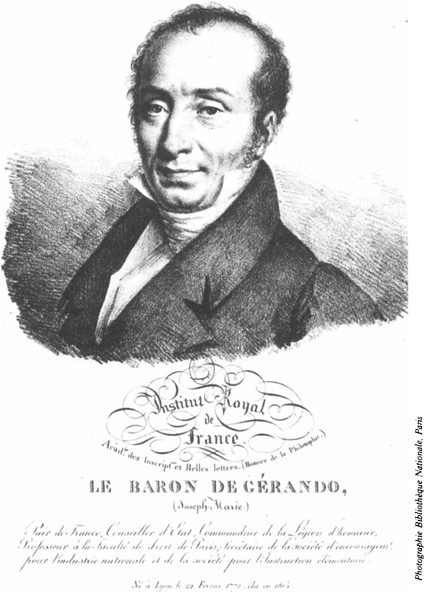
BARON JOSEPH-MARIE DE GÉRANDO
Although Jean-Marc Itard, then, had taken up the torch of oralism early in this century that Pereire had relinquished late in the eighteenth, by the time of the publication of his Treatise in 1821 he had radically changed his views; thus, when the abbé Sicard died a year later, it fell entirely to Baron De Gérando to champion the oralist cause at Saint-Jacques. If only he had read Itard’s mature work as well as he had read the early papers! But he did not, and so it was De Gérando who came to symbolize the oppression of the deaf as Jean Massieu symbolized their enlightenment.
Joseph Marie, Baron De Gérando, philosopher, administrator, historian, and philanthropist, conducted philanthropy the way generals wage war: it was organized, it was imposed by force, it was self-righteous. He conducted it in external affairs, where the “beneficiaries” called it imperialism, and he conducted it in internal affairs, where the “beneficiaries” called it paternalism. These are two sides of the same coin.
In 1806 De Gérando was sent to Milan to reorganize the administration of Lombardy, then under French dominion. Next he went to Genoa to help bring the government of the Ligurian Republic under French rule. Two years later Napoleon sent him to Florence to help rule Tuscany. As the Arno, the Tiber, the Sègre, the Weser became French rivers, De Gérando was responsible for imparting French administration to the new territories. When Napoleon incorporated the states of the Holy See into France and removed the pope by force, Catholic De Gérando accepted responsibility, despite scruples, for instituting the new French order; he was charged with Roman education, health, monuments, arts, bridges, and roads. When Napoleon conquered the vast northeast region of Spain called Catalonia and converted it into two French states, De Gérando went to administer them. He returned from Spain to witness the fall of the Napoleonic empire and the restoration of the Bourbon monarchy in France. Somehow, he kept his post—in effect, deputy minister of the interior—under this new regime, as he did when Napoleon returned and placed him in charge of the defense of the eastern states. I am reminded of Sicard’s candid avowal that he was a royalist under the king and a republican under the republic.
In a career devoted to bringing the new French order to the conquered nations of Europe, De Gérando made time for bringing it as well to the uncivilized peoples of Africa and the South Pacific. He looked down from even loftier heights on these nations, so dissimilar from the French, and, faced with their evident barbarity, he was even more organized, forceful, self-righteous. (In fairness to De Gérando, it should be said that his views were of a piece with those of most French intellectuals, who knew nothing firsthand of these remote societies and were equally disdainful of them.)82 And as for the deaf: “The deaf-mute is also a savage,” he wrote.
De Gérando had no humility, no doubts about his own culture and lan guage. He believed that the various societies existing reflected stages in human development, culminating with Western Europe. Philanthropy guided by science could raise the retarded savage to the level of his European brother. “What more touching purpose than to … meet again these ancestors separated by a long exile from the rest of the common family, than to extend the hand by which they will raise themselves to a more happy state.” What more noble activity than to go among them, “always well received, well treated, living proof of our happiness, our wealth, our superiority…. Perhaps they will call us to their midst to show them the road that can lead them to our condition. What joy! What conquest!”83 Clearly, the “love of man” in this philanthropy is self-love.
De Gérando’s philanthropy to the poor was equally flawed by his arrogance. “Let the rich man know the dignity with which he is invested,” De Gérando wrote in his Visitor to the Poor. “The rich must exercise a personal, immediate, individual patronage.… That man on the hangman’s scaffold was our brother and might have been good. He was poor.”84 And further: “It is necessary to the good order of society that the poorer classes should learn to behold the more prosperous conditions without a feeling of bitterness and to respect the distance which Providence has established between the different ranks in society. This is absolutely necessary to the repose of those who belong to the least favored conditions” (and, I might add, also soothing to members of the privileged classes). “The poor on many accounts are like children. They have want of foresight and are ignorant. They easily allow themselves to be carried away. They need to be supported, restrained, directed; they need more than a benefactor, they need an instructor.”85
In all, De Gérando spent fifty years doing good and wrote twenty-five volumes to teach others to do what he did so perfectly himself. He opened a home for fallen women, in his words, “a place of refuge and repentance where they are snatched from chaos, accustomed to work, reconciled with their families, put back on the road to honesty.” He founded a society for industrial training and another for elementary instruction. He gave a normal course for primary school teachers and wrote a two-volume work on self-education. He was one of the founders of the first savings bank. He adopted the seven orphaned children of his wife’s sister and the five his brother bequeathed him on his death.
Clearly the man was possessed by the desire to engage in benevolence, but of a certain kind. I have sought its sources in the details of his life and the traits of his character. He came from a comfortable home in Lyon—his father was an architect. His parents initially thought him dull but when he entered the college of the Oratorians he did well in his studies. At one point in those years De Gerando became seriously ill and wrote in his diary: “God, save this life and I will devote it to doing good.” When he recovered, he began to study for holy orders.
He was to become a soldier instead, first in the service of his native city when it took up arms in open rebellion against the soldiers of the new republic, and then, when the insurrection was put down (with the political agility he would reveal again later in life), in the ranks of the republican cavalry. Over the next few years he narrowly escaped death on several occasions, left the army surreptitiously to work for a wealthy relative by day while pursuing an arduous program of study by night, and finally, under a general amnesty, returned to his unit stationed near the German border. He was a simple soldier when he decided to enter a competition announced in the newspapers by the French Institute, offering five hectograms of gold for the best essay on “the influence of symbols on the development of ideas.”
In his essay De Gerando accepted Condillac’s principle that ideas arise from sensations, but he argued that the mind also embodies an active principle triggered by sensations, one that is not symbolic in itself but uses symbols. To Condillac’s aphorism “To think is to sense” he opposed his own: “Thought is to the mind what action is to a body.” Imagine the judges’ surprise when the authors of the essays were disclosed and the winner proved to be a young soldier. The all-powerful Institute had him released from the army and brought to Paris, where Lucien Bonaparte gave him a post in the Ministry of the Interior so that he could support himself and his new wife while continuing to do philosophy. The minister of finance put his chateau at his disposal and there he expanded his essay into a four-volume treatise, followed two years later by a vast comparative history of philosophical systems, which served as a model for his later history of systems for educating the deaf. Bonaparte’s successor at the Interior made it a condition of his appointment that De Gerando would be his second in command, and thus began his long and distinguished administrative career.
For much of that career, De Gerando was a member of the state council (the highest administrative body in the land), the Chamber of Peers,* the French Institute, and the faculty of law. Yet he was an inarticulate man, timid and reserved. He withdrew inside himself after his closest friend died and further yet after his wife died, quite young. In his diary, he pledged “to serve her through the children and, in doing good, become worthy of her, prepare to join her, take care of her through those who still suffer.”
What is the wellspring, then, of De Gerando’s indefatigable benevolence toward his family, his country, his continent? Is it a well-intentioned desire to leave something of permanent value as the trace of a life whose precariousness was reaffirmed at every turn—in short, a desire to escape mortality? Or is the man’s sententiousness a mask for a hesitant, shy youth trembling within, as bravado often disguises fear?
Baron De Gérando extended the same well-meaning paternalism that he had brought to conquered lands, to uncivilized peoples, and to the poor, to us, the deaf: we were his savages, his conquered people. “The deaf man scarcely knows anything other than his own physical well-being or illness,” he wrote in his essay on symbols and thought prepared the same year as his guide to studying savages.86 The deaf man does not reflect on his own destiny. He has no sense of duty. He has little control over his attention. He seems to be unaware that he can direct his own actions. And on and on. We have heard such rantings before: they remind us of Sicard’s before he met Massieu, of Itard’s before he knew Allibert. But De Gérando was at too many removes from the deaf for him to be befriended by even one, and he was too persuaded that the deaf have no language to learn ours and communicate with us directly. “The deaf-mute shows us an interesting phenomenon,” he wrote, “human society in its infancy, the first communications that our ancestors were able to have among themselves.…With only the beginnings of a language, the deaf have only limited intellectual abilities.”87
De Gérando’s biographers say that, as a high school student in his native Lyon, he made friends with a deaf boy and “learned to create a language to reach him.”88 I strongly suspect the boy’s parents were hearing, that he did not belong to the deaf community, that he had only recently become deaf. This would explain why De Gérando thought the deaf have just the beginnings of a language, why he argued that a hearing man is heir to a symbolic system shaped by successive generations whereas a deaf man is reduced to his own individual resources. He thought the language of the deaf was invented anew each time it was needed: he knew about pantomime and perhaps even home sign but not about the French Sign Language! No wonder that in his history of the deaf, he called our language “impoverished, made of disjointed scraps,” and concluded that we could not be educated by its means.
In the last days of his life De Gérando reflected on the deaf he had known, on his history of their education, and on his decades of service as head of the administrative board at Saint-Jacques, and he wrote in his diary, “Let it be said that they loved me as a father.” To his dying day he did not understand that his paternalism demeaned us. He did not understand that, though it was well-intentioned, it was self-defeating because it prolonged our inequality by promoting it. In the end its “beneficiaries” could not love him. There were no deaf at his funeral, no poor, no fallen women, no savages, no Italians or Catalonians. His eulogy was written several times by wealthy benefactors such as he—a peer, a baroness, a member of the Institute. If only he could have come to know us, a little of our language, then he could have helped Massieu shepherd the growing, evolving signing society into a golden age, an empire of the exiled deaf, a land of Pélissiers and Forestiers and Berthiers, yes, and Clercs—of poets and writers and painters and sculptors and teachers and craftsmen—a model for the world, the culmination of the vision that was given to Epée. Instead he closed the gates of Saint-Jacques behind Massieu, behind Bébian, and tried to subdue the signing society within the walls by force alone.89 Here is what happened; this was the struggle.
As we have seen, at Sicard’s death, the administrative board wanted to end the disorder of teaching methods: they commissioned Bébian’s Manual, which was to provide a uniform, graduated curriculum, and they sought a suitable director. A post occupied by two abbés successively could only be filled by another. Besides, Sicard had written to the abbé Gondelin, second in command at the Bordeaux school: “With death near, I bequeath the souls of my children to your religion, their bodies to your care, their minds to your teachings. Promise me you will fulfill this noble task and I will die in peace.”90 So Gondelin came to Paris but he lasted only six months. Then the abbé Beulé appeared briefly and withdrew, and the school drifted, leaderless, for nearly two years.91 The administrative board wanted to hear speech but speech could only be heard in Itard’s infirmary. The hearing faculty wanted to use methodical sign but the deaf faculty and pupils, encouraged by Bébian, clung to French Sign Language.92 De Gérando was then charged with preparing a comprehensive review of methods of educating the deaf and, since the robes counted more than the man, another abbé was finally called to direct the school: the abbé Perrier, vicar-general in the city of Cahors, founder of a deaf school in Aveyron. But Perrier, too, was unequal to the task; after four years he was replaced by the abbé Borel, who, although he knew nothing of the deaf, was about to found a little school for them in Normandy.
At this moment De Gérando’s survey of deaf education appeared. He had seen correctly that the signs deaf people used were not depictions as in pantomime but brief symbolic movements. He called these signs “reduced” and concluded falsely that they were therefore degenerate, imprecise, and useless for education. He urged that schools use instead fingerspelling, writing, and speaking when possible; sign language was to be banned. Faculty meetings were held to seek agreement on this innovation, but of course Berthier and the other deaf faculty refused to agree, preferring to use Bébian’s Manual De Gérando then announced that Saint-Jacques would meet its responsibility for worldwide leadership by gathering and disseminating information on educating the deaf, and he appointed his nephew, Edouard Morel, to edit and publish a series of circulars.93 The first, dated 1827, simply announced De Gérando’s wish as a reality: no more deaf faculty! Each class has a hearing teacher with a deaf teaching assistant; there is a new emphasis on lipreading and articulation. It had never happened. The abbé Borel took no interest in instruction and was overwhelmed by all the contention. Perhaps because he lacked the authority to enforce De Gérando’s will, perhaps for general incompetence, he was discharged.94 Nine years without leadership, nine years of disarray, but the worst was yet to come.
In his efforts to convert a school of the deaf into a school of the hearing, De Gérando found few allies in the institution founded by Epée and nourished by Sicard, an institution where two-thirds of the professors were deaf and all the instruction in sign. So he gathered a group of outsiders and installed them as the “academic board” of the institution,95 although they knew no more about the deaf than did the administrative board. To make matters worse, the Ministry of the Interior was even further from understanding the deaf and their education than either board: our school had come under the ministry’s division of stud farms, then that of fine arts, then that of welfare and insane asylums. Repeated appeals to assign Saint-Jacques to the Ministry of Education were unsuccessful. For the government, it was (and is) an asylum first and an educational institution second. Had not its directors all been men of the cloth, acting out of Christian charity?
Discouraged by the repeated failures of the latest men of the cloth, who knew nothing of education, the administrative board now hired as director a layman who knew nothing of the deaf. His name was Désiré Ordinaire and on the face of it he was just the man to bring about the transformation (indeed annihilation) of the deaf society that De Gérando desired. Ordinaire was born shortly before Epée’s death, became a doctor, taught natural history at the university in Besançon, was appointed its dean, then became rector of the University of Strasbourg at the German border, in Alsace. Shortly thereafter he left under a cloud: some say he was fired; if so, I don’t know the reason. Ordinaire’s brother was a member of the recently formed academic board at Saint-Jacques: perhaps De Gérando had known him from his days in Alsace or perhaps he was simply well disposed toward him since he did love that region and its people so much (his wife was Alsatian). In any case, it seems that the brother and De Gérando hatched a plan. Désiré Ordinaire would quit his retirement and go on a fact-finding tour of the deaf schools in Germany and Switzerland—which were then, as we shall see, gripped by a resurgence of oralism. He would send glowing accounts of what they were achieving to the administrative board at Saint-Jacques, which would naturally recommend him to the ministry to accomplish the same oralist revolution in Paris.96 It transpired as planned. Edouard Morel even published Ordinaire’s reports from Germany in the third circular from Saint-Jacques, accompanied by rather fulsome praise of the man as well as the system.97
Meanwhile Itard, though he no longer believed the deaf could be educated orally, had been advocating supplementary training in articulation for the hard-of-hearing. Itard sent his plea in three memoirs to the administrative board, which requested funds from the ministry to hire an articulation teacher. The ministry in turn asked the Academy of Medicine—the same that had evaluated Azy d’Etavigny eight years before—to evaluate Itard’s recommendations. After studying Itard’s reports and observing “physiological training of hearing and speech” in action with a new group of deaf-mutes, the academy concluded that combined education, sign and speech, “is possible in the case of one-tenth of the children admitted into the institution for deaf-mutes,” that oral instruction is accelerated and facilitated by sign education, and that sign language is incomplete and truncated but “indispensable in all cases of early or congenital deafness, however slight.”98 The government followed the academy’s advice and gave funds for an articulation class: one professor, Jean-Jacques Valade-Gabel, taught one hour of speech daily to those who seemed to profit.99Thus the “combined method” began.
As soon as he became director, Ordinaire advanced a cunning two-step scheme to elevate spoken French from a complement for a few to the universal principle of education for all. De Gérando had correctly seen that the deaf professors were the great obstacle, for even if all the hearing teachers taught orally, the students would still receive much instruction in sign from the deaf faculty. Therefore, in step one Ordinaire ordered that students would no longer move from teacher to teacher as they went from year to year; instead, an entering class would stay with one professor for its entire six-year term.100 This meant an end to the problem of articulating the curriculum in successive years and it also meant that students assigned to a deaf professor could get no oral French education at all. Then, in step two, he ordered that all students must get some oral education. Logically, then, the deaf teachers must be supplanted by hearing teachers. Berthier and four other professors, supported by Bébian, protested to the administrative board, but of course they were ignored, since Ordinaire was carrying out the will of the board.
In an effort to win support for his program, Ordinaire conducted demonstrations that were reportedly painful to behold. First, the few hesitant and gauche signs that he had learned the night before were greeted with open mirth by the pupils. Worse, the children appeared one after the other on the stage and performed little oral exercises under Ordinaire’s direction that had in fact been memorized before, as all the pupils knew. Their responses to apparently impromptu questions, “By the way …,” had likewise been rehearsed. The youngest pupils might have been pleased by the applause of the duped audience but the oldest pupils knew better, as did the faculty.101At one demonstration that Bébian describes, several students spoke so unintelligibly that the director had to repeat their words for the audience. Then came four who spoke rather well—but all had arrived at the school with fluent speech, having lost their hearing between six and eleven years of age. Finally, three pupils demonstrated they could lipread by writing from dictation on a blackboard; one of the three, unfortunately, skipped a sentence and wrote its successor before it had been uttered.102
Despite Ordinaire’s demonstration and orders, both the deaf and the hearing faculty continued to teach exclusively in sign. De Gérando then decided on drastic action in behalf of the deaf: he drew up a thirty-article decree spelling out the new regime for Saint-Jacques, he had the board and then the ministry approve it, and he had it sent to every professor.103 The provisions were so unrealistic they were laughable, but this was no laughing matter. Article 8 said that each professor must teach articulation, thus dispensing with deaf teachers. Article 13 said that every professor would teach every lesson first orally, then in writing. Article 14 said that all pupils must communicate among themselves and with their teachers, whether in class or play periods or on walks or in the workshops, by means of spoken French alone or by writing on little slates. What role would the deaf professors play? Articles 26 and 27 said that there could be special classes for composition, sign language, and other matters taught by auxiliary professors, who could be deaf. Of course it didn’t work. There was no way to get the pupils to write laboriously in French what they could say in a flash in their primary language—especially when in the garden! Nor were the hearing professors prepared to teach everything twice—or even once—in French when the pupils were clearly uncomprehending. Only men separated by an abyss from the deaf could ever imagine such a regime might succeed; De Gérando and his board were such men.
The effort to impose speech by force was a gross error that lasted all of three days! Resistance to the invasion of oralism was universal: pupils and teachers, hearing and deaf, banded together, determined to block the introduction of a principle that would replace education by drills in articulation and grammar.104 The only person in the school who would teach speech after that was Ordinaire; his course was a complement to the regular instruction and he required it of all first- and second-year students. Berthier’s pupils who were taking this course were asked if they wanted to learn to speak. Only a few said yes, and they were hard-of-hearing.105 Still, it was a touching sight to see the stooped, gray-haired former rector of the University of Strasbourg exhorting his deaf pupils to contort their mouths in various ways. It was apparently a touching scene to hear as well, for the director had a speech defect, according to Bébian.106
The deaf faculty appealed their demotion to the ministry, were reinstated provisionally, and resumed teaching in sign. It became a matter of record that the pupils spoke in class but a matter of fact and general knowledge that they did not.107 The reasons for this continued failure were that most students made little progress in lipreading and intelligible speech, so it was impractical to teach orally, while teaching in the written mode was equally unintelligible unless the written language was explained in sign. Therefore sign remained the vehicle for instruction in all subjects, including composition.108 Finally, De Gérando himself acknowledged that French Sign Language, the primary language of all the pupils and the native language of many, was the principal means of instruction at the school.109 Ordinaire made one last attempt, in 1836, to get the hearing faculty to do some instruction orally. Only one professor tried to obey, Léon Vaïsse. It was, likewise, proving fruitless to teach articulation to all entering students. The circular issued that year acknowledged the failure, stating that oral French had been reduced to a complement of instruction for the few. Ordinaire resigned. The academic board was dissolved.110
The oralist coup had for all purposes ended, although the occasional death rattle could still be heard. In the year that Ordinaire resigned, one of Itard’s successors as resident physician, Alexandre Blanchet, launched a program to educate the deaf in ordinary hearing schools. Over the next decade a dozen schools tried it, primarily with students who had some speech and hearing, while Blanchet published and proselytized, finally convincing the Ministry of the Interior to issue a circular envisioning the universal inclusion of deaf children in the public schools. The outcry from oralists abroad who believed no such thing possible and the dismal failure of the experiment at home shortly led the ministry to withdraw its endorsement. A commission of the French Institute visiting two integrated schools found they had disintegrated rapidly: alongside of the deaf, and by the force of the same arguments, there were the semi-deaf, the blind, stammerers, and imbeciles—but no ordinary children.111 By the time of Blanchet’s death two years ago, nothing was left of this attempt to make the deaf hearing by fiat.112
In the failing years of the Blanchet plan for placing deaf children in the public day schools, its author also urged on the government a major reform of the residential schools for the deaf, with the same oralist goals in view. On the pretext that he had improved the speech and hearing of some pupils at the Paris school by exposing them to organ music five hours a week, Blanchet proposed that the semi-mute and semi-deaf pupils be separated from the rest of the signing community in order to receive special oral instruction, presumably at his hands. The government asked the opinion of the Academy of Medicine and its physicians engaged in a prolonged and impassioned debate on an issue entirely outside their competence—the relative merits for the deaf of speech and sign.113
Berthier warned the academy against miscasting the social issues of the deaf community as a medical problem in words that should go down in history and be repeated by generations to come: “The topic that concerns you, gentlemen, rather than an ordinary medical issue is, above all, a lofty question of humanity and civilization which requires deep reflection, not only by doctors but by teachers, philosophers and scholars.”114
The academy seemed to agree on only one point: this had all been tried by Itard twenty-five years earlier. His prime student, Allibert, wrote to plead: “This action language of ours, so clear, so expressive, so accurate a reflection of our feelings and thoughts—is it not part of our very nature? No human power can take away from us what God has given us.… It is as essential for our minds as air is for our respiration.”115
Two other reversions to oralism were equally brief. The government ordered merged with Saint-Jacques a private oral class for the deaf taught by a hard-of-hearing student of Ordinaire’s named Benjamin Dubois. The class was soon terminated, however.116 A dramatic artist named Fourcade gave instruction in elocution to the nuns and pupils at the Bordeaux school—until he was dismissed summarily.117 Under Ordinaire’s successor—neither a man of the cloth nor an educator but a politician—education in our school continued in French Sign Language. The present director, Léon Vaïsse, signs superlatively; he is now committed to sign language instruction and highly critical of what he saw in Germany, where he retraced Ordinaire’s steps. He has, however, started up the articulation class again as a complement to the education of the hard-of-hearing pupils.118
In the end even De Gérando learned the lesson of his failed experiment, though it was a costly experiment for the deaf. Like Itard, he came around, with kind words for Bébian’s reforms and for sign language, “whose richness of expression and eloquence we have learned to appreciate,” he wrote shortly before he died.119
And what of Itard? He had been one of the most successful physicians of his time and yet he failed to find a medical treatment for deafness, he failed to find a way of producing speech in even that fraction of the deaf who had once spoken or had retained some hearing. Of course he knew this and died a bitter, disappointed, isolated old man. He wrote in his will: “The sad inescapable circumstances of man’s existence are to suffer and to die.”120
If only those who now urge oralism on the deaf in America, who—ignoring Berthier’s counsel—would treat our social difference as a medical infirmity, who class us with defectives, idiots, and the insane, who would block our marriages and regulate the lives of our children, who refuse to listen to our own will—if only they would learn from Itard’s failures, from De Gérando’s failures.
But surely, you will say, the mentally ill are ill, and the deaf are deaf. Yet what do these words mean? Did you know it was enough to be an albino to be interned in the asylum for the mentally ill at La Salpětrière, or an epileptic, or even, in some cases, a foundling? And the deaf: am I truly ill because I do not speak your language, or because I am more exposed than you to the danger of a runaway horse approaching from behind? There was a station on the Underground Railroad in the street where I now live, and I have learned the terrible stories of those who passed through it. (Harriet Beecher Stowe is from Hartford, you know.) Yet certain doctors said these black people were suffering from an illness that led them to slip away and flee north. This illness had a name, drapetomania; a symptom, willful flight; and a cure, published a few years ago in a medical journal: “If any one or more of them are inclined to raise their heads to a level with their master or overseer, humanity and their own good require that they should be punished until they fall into that submissive state which was intended for them to occupy…. They have only to be kept in that state and treated like children to prevent and cure them from running away.”121
Clearly, it is the doctors who warrant our concern here, not the patients! It is the hearing who are deaf, not I.
* Jean-Baptiste Jauffret, who later became head of the czarina’s school for the deaf in St. Petersburg.
* Pronounced as is the first syllable of the English “open.”
† Pronounced like “let” without a t.
*In a celebrated case reported by the British surgeon William Chesselden (1688-1752).
† At the age of twenty-three; the case was reported to the French Academy of Sciences in 1702.
*The upper house of the French legislature from 1814 to 1848.