
FOUR
Although undergraduates from Amherst still came to call and she still rode out with them or chattered sociably, although the family still fed guests and coddled dignitaries as before, Emily Dickinson was gradually, imperceptibly, absenting herself from all forms of public life. She did not welcome strangers. They inhabited a marketplace of vanity and grime: the endless clack of the dirty horsecars, the slop on the cobblestones, the poverty, the crime, the pain, the jockeying and the mealymouthed palaver of Boston that, as Austin reported after Emily’s visit, confirmed his sister’s “opinion of the hollowness & awfulness of the world.”
Home was different. “As the great world goes on and one another forsake, in whom you place your trust,” Emily told Austin, “here seems indeed to be a bit of Eden which not the sin of any can utterly destroy.” Neither gritty streets nor smutty gardens spoiled the view of the meadow from her bedroom window. No skies streaked with a mouse-colored gray, no rattling carts, no hollow, spinning world. Here was quiet, even if it was, some days, the quiet of emptiness: “And I, and Silence, some strange Race / Wrecked, solitary, here—.”
Her retirement—what else to call it, even if the word is harsh—mingled passion with conviction and impudence with dread. She possessed an originality that pleased. It made her special. Yet withdrawal also springs from fear—the fear of losing or having lost. “I’m afraid I’m growing selfish in my dear home, but I do love it so,” tellingly she warned her old school chum Jane Humphrey, “and when some pleasant friend invites me to pass a week with her, I look at my father and mother and Vinnie, and all my friends, and I say no—no, cant leave them, what if they die when I’m gone.” Dickinson clung to their physical presence; proximity was her defense against disruption, change, calamity, loss and the threat of it. When invited to visit her friend Abiah in Springfield in 1854, she again declined, carefully explaining, “I don’t go from home, unless emergency leads me by the hand, and then I do it obstinately, and draw back if I can. Should I ever leave home, which is improbable, I will with much delight, accept your invitation;…but don’t expect me. I’m so old fashioned, Darling, that all your friends would stare.”
Deliberate, gracious, and self-deprecating, Dickinson filed her renunciatory rhetoric to a razor’s edge, her weapon, words, charming and implacable. Otherwise, she darkly hinted, there were consequences. Going to church by herself, she had to rush to her seat and, terrified, wondered why she trembled so, why the aisle seemed so wide and broad, why it took almost half an hour afterward to catch her breath. Yet knowing when and how to protect herself, she managed her fear, and evidently her family cosseted her. When her father suggested they come to Washington in 1853, he did not insist that Emily join them. Instead, she stayed at home with Sue and a cousin, John Graves, who later remembered Emily improvising on the piano late at night: he was invited to sit in the next room while she mesmerizingly played.
In 1855, when Edward Dickinson was a lame-duck congressman, Emily agreed to visit him in Washington. She and Vinnie stayed at the smart new Willard Hotel on Pennsylvania Avenue, just two blocks from the White House. The sisters threaded their way through the crowded streets, wandering in new ways, as Emily put it, greeting silken ladies and high-hatted gentlemen and by all indications enjoying themselves in a city where, as a future friend would quip, “everybody knows everybody and the nobodies are the most clamorous of all.” She took it in stride, confounding a Supreme Court justice, according to family legend. When a flambé was served for dessert, she turned to him sweetly and asked, “Oh Sir, may one eat of hell fire with impunity, here?”
True to form, she refused a number of social engagements, pleading illness. Washington, Boston—it made little difference. Even Amherst grew too wide. Home was best. “I fear I grow incongruous,” she said with a shrug.
THE TIME HAD COME for the Dickinsons to reoccupy the Homestead. Measured against the grandeur, the psychological satisfaction, and the conspicuous prominence of the family mansion, the comforts of West Street—where Austin would say he had spent the best years of his life—meant nothing to Edward. Until he could regain the Homestead, it would stand—just blocks away—a souvenir of his misfortune.
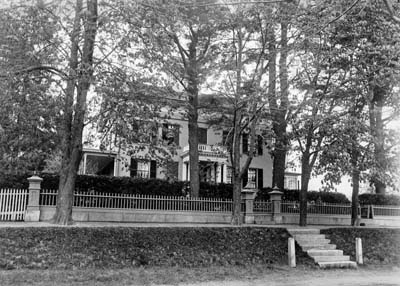
Dickinson Homestead, 1858.
In the spring of 1855, Edward paid six thousand dollars for the place—a bargain, he reckoned—and then forked over almost the same amount, it was rumored, for renovations. He needed to leave his own mark on the wainscoting and balustrades, and after overseeing six months of hauling, nailing, plastering, and painting, he had a conservatory, servants’ quarters, a cupola, and a new east wing, which opened onto a magnificent garden. To the west a veranda faced the Evergreens, the home he built, on his land, for Austin and Sue, married in July of the following year. And he planted a hedge of cedar trees to the front of the Homestead, as if to seal off the place from the street.
Though important for Edward, moving proved hard on the family. “I am out with lanterns,” Emily bleakly remarked, “looking for myself.” Displacement shook the myth of home at its very foundation. Mrs. Dickinson sank into a lingering depression and seldom left her chair for long during the next four years. “I cannot tell you how we moved,” Emily wrote, recounting the upheaval to her friend Elizabeth Holland. “I had rather not remember. I believe my ‘effects’ were brought in a bandbox, and the ‘deathless me,’ on foot, not many moments after…. It is a kind of gone-to-Kansasfeeling,” she concluded, “and if I sat in a long wagon, with my family tied behind, I should suppose without doubt I was a party of emigrants.”
For Higginson, the settlement of Kansas as a free state would be a political necessity, invigorating and imperative; for Dickinson, a horror: families dislodged, their earthly possessions crammed into packing crates, things and people displaced, confused, stranded.
She continued to withdraw.
To put this World down, like a Bundle—
And walk steady, away,
Requires Energy—possibly Agony—
’Tis the Scarlet way
Emily might tiptoe across the grass to visit Austin and Sue at the Evergreens, but if a guest should pull the bell, she would run back. “In such a porcelain life, one likes to be sure that all is well, lest one stumble upon one’s hopes in a pile of broken crockery,” she wryly noted.
With Mrs. Dickinson incapacitated, Vinnie assumed her role, offering Emily the protection she needed more than ever. “I would like more sisters,” she sighed when Vinnie left to tend an ailing aunt, “that the taking out of one, might not leave such stillness.”
To Vinnie, Emily’s withdrawal was nothing special and implied nothing morbid. Emily simply got in the habit of staying home, Vinnie later explained—“and finding the life with her books and nature so congenial, continued to live it, always seeing her chosen friends and doing her part for the happiness of others.” Perhaps Vinnie also suspected that if her sister was becoming less interested in setting foot past the front gate, she was exploring recesses of feeling, thought, and imagination—what Dickinson later called a “route of evanescence”—that made contact with the humdrum world superfluous. Emily told Abiah Root and Jane Humphrey that she was undertaking “strange things—bold things”—poems probably—and like the exceptional women of her time, mainly but not always poets (Elizabeth Whittier, Christina Rossetti, the Brontës, Margaret Fuller), she was choosing her own society, then shutting the door. That door, in fact, appears over and over in her poetry as an image of protection, solitude, and exits and entrances: “The Heart has many Doors—” but “Doom is the House without the Door—.”
And as was the case when she played the piano for John Graves, she nudged the door slightly open.
So we must meet apart—
You there—I—here—
With just the Door ajar
NO ONE KNOWS EXACTLY when Dickinson started composing poetry, especially since after 1855 the record of her daily life grows thinner. There was no need to write to Austin anymore because he lived just beyond the hedge. Ditto Sue, and overall many letters to Dickinson’s friends have not survived. And those extant few, though charged with meaning, are often disconcertingly oblique. Yet they do tell us something. “We used to think, Joseph, when I was an unsifted girl and you so scholarly,” she half-explained to Joseph Lyman, “that words were cheap & weak. Now I don’t know of anything so mighty…. Sometimes I write one, and look at his outlines till he glows as no sapphire.”
The power of words: assuming several voices, she used them to speak her life—as penitent young woman in search of divine assistance, as impenitent rebel unable to believe, as coy mistress indulging flights of fancy, as good daughter, smart-aleck sister, as lover. She traveled far, and like Virginia Woolf’s Orlando years later her personae leaped across time and sex and culture. A Valentine’s Day spoof, in a way her first publication, appeared in 1850 in a college paper, The Indicator, and it bursts with “what they call a metaphor in our country. Don’t be afraid of it, sir, it won’t bite!”
But the world is sleeping in ignorance and error, sir, and we must be crowing-cocks, and singing-larks, and a rising sun to awake her; or else we’ll pull society up to the roots, and plant it in a different place. We’ll build Alms-houses, and transcendental State prisons, and scaffolds—we will blow out the sun, and the moon, and encourage invention. Alpha shall kiss Omega—we will ride up the hill of glory—Hallelujah, all hail!
The hill of glory shall be made of metaphors far-flung, blowing out the sun. Her rhythmic sentences swing and fold, and though she did not imagine herself battering down courthouse doors, as Higginson would do, she declares that we can change the world through language.
Yet world there was, with real almshouses and scaffolds and auction blocks: while at Holyoke she had dreamed the family field had been mortgaged to the local postmaster, a Democrat derisively called a Locofoco (after the matches a group of anti-Tammany Democrats used in 1835 when the gaslights had been turned off ). “‘I should expire with mortification’ to have our rye field mortgaged, to say nothing of it’s falling into the merciless hands of a loco!!” she wrote Austin, doubtless mimicking her father. But who was the presidential candidate? she asked in mock consternation. “I have been trying to find out ever since I came here & have not yet succeeded. I don’t know anything more about affairs in the world, than if I was in a trance…. Has the Mexican war terminated yet & how? Are we beat? Do you know of any nation about to besiege South Hadley? If so do inform me of it, for I would be glad of a chance to escape.” Leaping from the stuff of the world to the stuff of fancy, from concern to comedy, Dickinson was very much aware of the political life around her. One detaches from something, after all; for it was this world, steeped in ignorance and error, that she affected to spurn but could never forget, no matter what we might like to believe about her vaunted reclusiveness.
But her real domain—her huge gift—lay elsewhere. “Write! Comrade, write!” she commanded Sue. That was in 1853. And when Austin picked up a pen, she put him straight. “I’ve been in the habit myself of writing some few things,” she swiftly told him, “and it rather appears to me that you’re getting away my patent, so you’d better be somewhat careful, or I’ll call the police!”
Writing demanded commitment. Her frolicsome Valentines anticipated the witty irreverence of her poems; she told Higginson that “Some keep the Sabbath going to Church—/ I keep it, staying at Home—/ With a Bobolink for a Chorister—/ And an Orchard, for a Dome—.” She kept the Sabbath by writing poetry, in fact, and pledged herself to a life of it: “I’m ceded—I’ve stopped being Their’s—/ The name They dropped opon my face,” she exclaimed in one of her many declarations of independence. And since poetry implied freedom as well as commitment, in one way the critic R. P. Blackmur was partially right when he said Dickinson married herself; her point of view hers alone, she played off big and small, near and far, high and low: “When we stand on the tops of Things—/ And like the Trees, look down,” she wrote, altering perspective at will and, taking up the imperative, snapping out orders: “If your Nerve, deny you—/ Go above your Nerve—.”
Poetry also offered a form of grace:
I reckon—When I count at all—
First—Poets—Then the Sun—
Then Summer—Then the Heaven of God—
And then—the List is done—
But, looking back—the First so seems
To Comprehend the Whole—
The Others look a needless Show—
So I write—Poets—All—
Sly humor, poetic declamations, and peremptory commands aside, she also worked hard to be incongruous, her analogies bold and startling and composed with the technical precision of a Donne or a Herbert or a Vaughan, her images violent, corporeal, sexual:
He fumbles at your Soul
As Players at the Keys
Before they drop full Music on—
He stuns you by degrees—
Prepares your brittle nature
For the Etherial Blow
By fainter Hammers—further heard—
Then nearer—Then so slow
Your Breath has time to straighten—
Your Brain—to bubble Cool—
Deals—One—imperial—Thunderbolt—
That scalps your naked Soul—
When Winds take Forests in their Paws—
The Universe—is still—
These were strange and wondrous lines: the musicality of “fainter Hammers—further heard” the unabashed brutality of verbs like “fumbles,” “stuns,” “scalps” the anthropomorphizing of “wind,” giving it “paws.” And these together create—with terrifying faith, angry passivity, and sheer ingenuity—a spectacularly original poem.
And while writing verse like that, she fell up on Thomas Higginson.
“Literature is attar of roses, one distilled drop from a million blossoms,” Higginson wrote in his “Letter to a Young Contributor,” words that Dickinson heeded well.
“This was a Poet—,” she wrote as if in reply,
It is That
Distills amazing sense
From Ordinary Meanings—
And Attar so immense
From the familiar species
That perished by the Door—
We wonder it was not Ourselves
Arrested it—before—
WHEN DICKINSON SHOWED SUE “Safe in their Alabaster Chambers—,” Sue criticized the second stanza. The two friends went back and forth. “Your praise is good—to me—,” Emily replied, because I know it knows—and suppose—it means—.”
If writing demanded commitment, it also required a recipient. There were Newton and other friends, like Joseph Lyman, George Gould, Perez Cowan, and Henry Vaughan Emmons, to whom she seems to have shown some of her early work; there was Sue, there was Higginson himself, who loved language and the outdoors, as she did, and whom, despite his “surgery,” she trusted. One need not understand everything.
Her most perplexing connection was to the unknown person she addressed as Master in three letters probably composed in the late 1850s. Undiscovered until her death—and they were found in draft form only—these letters contain no clues to the recipient’s identity. No one even knows if Dickinson actually mailed final copies of the letters, and as in most things Dickinson, much about their origin is guesswork. The reigning hypothesis is that the Master was the Reverend Charles Wadsworth, moody minister of Philadelphia’s Arch Street Presbyterian Church, whom Dickinson apparently met while visiting that city en route from Washington in March of 1855.
The Reverend Wadsworth, an oddball of the first order, thrilled parishioners with his overheated theatrics: he had a trapdoor cut into the pulpit floor so he might appear and disappear without having to mingle with the congregation, and a poet in his younger days, or so he had hoped, he was an ace performer, the religious thespian with brimming eyes, quivering cheeks, heaving chest, a “man of God of the old school,…a tower of strength to the wavering and distressed.” He reveled in the theology of John Calvin, calling it the single philosophical defense against blank atheism, and his sermons were said to rival Henry Beecher’s. “And the Church below, Christ’s witness unto the world, in all her ordinances and utterances, cries, ‘Come, come!’ And the Church above, with the resulting of white robes, and the sweeping of golden harps, cries, ‘Come, come!’” Though one reviewer found his published sermons florid, he admitted not having seen the eminent Wadsworth preach, which Mark Twain had. “But every now and then, with an admirable assumption of not being aware of it,” Twain reported, “he will get off a first-rate joke and then frown severely at any one who is surprised into smiling at it.”
Likely Dickinson’s visit to her Philadelphia cousins included a Sunday sermon by the preacher she later called a Man of Sorrow. Was this Man of Sorrow the Master to whom Dickinson addressed her love letters? Jay Leyda, Dickinson sleuth supreme, doubted it though he conjectured that Dickinson initiated a correspondence with Wadsworth shortly after the move to the Homestead and about the time her mother fell ill. Dickinson did contact Wadsworth about something troubling her, for he answered kindly, referring to “the affliction which has befallen, or is now befalling you.” And in 1860 he called at the Dickinson home, “Black with his Hat,” as the poet later recalled, telling her “My Life is full of dark Secrets.” We don’t know much more than this, but it does seem that Dickinson turned to Wadsworth, seeking relief for an affliction that likely had nothing to do with him. And if the affliction refers to a romance with the Master, then the Master is someone else.
Other candidates for the Master include the family friend Samuel Bowles, editor of the Springfield Republican, or someone whose identity has not yet surfaced. After her death, Austin concluded that Emily had been “several times in love, in her own way,” and years later Dickinson’s niece insisted that “my Aunt had lovers, like Browning’s roses, ‘all the way’ to the end—men of varied profession and attainment who wrote to her and came to see her, and whose letters she burnt with a chivalry not all of them requited in kind.” (The last remark is a posthumous jab at Higginson, who allowed the publication of his stash of Dickinson letters.)
The specific identity of the Master matters less than the letters she intended for him. There we overhear the “afflicted” Dickinson, alternately passive and brash, pleading and adamant, violent, poetic, secretive, and exposed. “I’ve got a cough as big as a thimble—but I don’t care for that—I’ve got a Tomahawk in my side but that don’t humor me much, Her Master stabs her more—Wont he come to her—,” she asks in the second letter, possibly written as many as two years later. Raging, scathing, self-destructive, she was very much aware of what she was writing.
Evidently the relationship had progressed, at least in her mind. “Open your life wide, and take me in forever, I will never be tired—I will never be noisy when you want to be still—I will be your best little girl—nobody else will see me, but you—but that is enough—I shall not want any more—.”
And there is the third letter, written near the date of the second (or so it seems.) Its masochism is harrowing, its initial image of violence almost vindictive:
Master.
If you saw a bullet
hit a Bird—and he told you
he was’nt shot—you might weep
at his courtesy, but you would
certainly doubt his word—
One drop more from the gash
that stains your Daisy’s
bosom—then would you believe?
….….
I am older—tonight, Master—
but the love is the same—
so are the moon and the
crescent—
….….
—but if I had the Beard on my cheek—like you—and you—had
Daisy’s petals—and you cared so for me—what would become of you?
Could you forget me in fight, or flight—or the foreign land?
Couldn’t Carlo [her dog], and you and I
walk in the meadows an hour—
and nobody care but the Bobolink—
and his—a silver scruple?
….….
I waited a long time—Master—
but I can wait more—wait
till my hazel hair is dappled—
and you carry the cane—
then I can look at my
watch—and if the Day is
too far declined—we can take
the chances for Heaven—
What would you do with me
if I came “in white”?
I want to see you more—Sir—
than all I wish for in
this world—and the wish—
altered a little—will be my
only one—for the skies—
Could you come to New England—
Would you come
to Amherst—Would you like
to come—Master?
If the master letters are aggressive, sexy, and an amalgam of fury, doubt, pride, and supplication, they also reveal a Dickinson in complete command of herself, despite protestations to the contrary.
This is how she loved.
Perhaps you think me stooping!
I’m not ashamed—of that!
Christ—stooped—until he touched the Grave!
Do those at Sacrament—
Commemorate dishonor—
Or love—annealed of love—
Until it bend—as low as Death
Re-royalized—above?
BY 1858, DICKINSON WAS FASTENING GROUPS of her poems together into small hand-sewn packets, each of which contained as many as twenty poems. She sent a number of these poems to friends; others she kept and reworked. And even after she entered them into booklets, she continued to alter them, dividing long stanzas, for instance, into quatrains, or shifting some of the punctuation, or substituting words. Later called fascicles by one of her first editors, these packets survive, all forty of them, and though they cannot be dated with precision, they reveal a self-conscious poet, never satisfied with the work at hand. “‘It is finished,’” she would say, “can never be said of us.”
Though publication was “foreign to my thought, as Firmament to Fin—,” as she had told Higginson, she obviously considered her verse, as she famously wrote, her letter to the World. Naturally she sought recognition, though that was not her primary aim. “It’s a great thing to be ‘great,’ Loo,” she told her cousin Louise Norcross, “and you and I might tug for a life, and never accomplish it, but no one can stop our looking on, and you know some cannot sing, but the orchard is full of birds, and we all can listen What if we learn, ourselves, some day!”
Yet if she could learn to be a singer, to whom would she sing? Audience is one of the great mysteries vexing Dickinson scholars, who variously infer that she devised an alternative form of publication by addressing herself mainly to family and select friends. But readers then and now also feel that she speaks to them alone; her verse is intimate, private. Higginson would classify it with what Emerson called the poetry of the portfolio, something produced without thought of publication, solely to express the writer’s own mind. But this is only partly true and reflects more of Higginson’s prejudice than Dickinson’s intention. For she spoke of her writing with increasing if comically humble confidence, hesitancy growing to assertion:
My Splendors, are Menagerie—
But their Competeless Show
Will entertain the Centuries
When I, am long ago,
An Island in dishonored Grass—
Whom none but Daisies, know—
Deliberately she defied the conventional, the sentimental, the predictable: birds gossip, roads wrinkle, suns stoop, skies pout, and daffodils untie their bonnets. Emotionally raw and intellectually dense, her poems divide nouns from verbs, past from present (“When I, am long ago, / An Island in dishonored Grass—”), only to reunite them. Ditto pronouns: they lose case or reference and yet stay what they are. Fantastically, she transforms life and death, speaking after death (“Because I could not stop for Death—”) or at the moment of its onset (“I heard a Fly buzz—when I died—”), and in many poems, with color and delight she embraces sensually the things of this world (“We like March—his Shoes are Purple—”), the change of seasons and their recurrence, as in this early example:
An altered look about the hills—
A Tyrian light the village fills—
A wider sunrise in the morn—
A deeper twilight on the lawn—
A print of a vermillion foot—
A purple finger on the slope—
A flippant fly opon the pane—
A spider at his trade again—
An added strut in Chanticleer—
A flower expected everywhere—
An axe shrill singing in the woods—
Fern odors on untravelled roads—
All this and more I cannot tell—
A furtive look you know as well—
And Nicodemus’ Mystery
Receives it’s annual reply!
She can tilt her rhyme; she’ll use an off rhyme or an eye rhyme: “Power is only Pain—/ Stranded—thro’ Discipline.” She shuns full stops: “First—Chill—then Stupor—then the letting go—.” The open-ended dash, breathless, was her pause of choice, dashes in all sizes and shapes: short, long, slant, each prying the door ajar. Nouns stand at attention, capitalized and substantive. “Narcotics cannot still the Tooth / ,” she writes, “That nibbles at the soul—.”
Invoking the Bible, blaspheming, misquoting, and subverting the expected, she tests the idea of God, rails at his distance. She suffers, she sees; she suffers because she sees:
I had some things that I called mine—
And God, that he called his—
Till recently a rival claim
Disturbed these amities.
The property, my garden,
Which having sown with care—
He claims the pretty acre—
And sends a Bailiff there.
“On subjects of which we know nothing,” she once said, “we both believe, and disbelieve a hundred times an Hour, which keeps Believing nimble.”
Some things that fly there be—
Birds—Hours—the Bumblebee—
Of these no Elegy.
Some things that stay there be—
Grief—Hills—Eternity—
Nor this behooveth me.
There are that resting, rise.
Can I expound the skies?
How still the Riddle lies!
“Can I expound the skies?” If not, why not? Though church doctrine might annoy her, she never tires of its human side: “When Jesus tells us about his Father, we distrust him. When he shows us his Home, we turn away, but when he confides to us that he is ‘acquainted with Grief,’ we listen,” she says, “for that also is an Acquaintance of our own.” Sorrow touches sorrow, offering the comfort of the unknown: “This World is not conclusion.” Like her poetry, the wounded deer leaps highest. (“I sing,” as she had told Higginson, “as the Boy does by the Burying Ground—because I am afraid.”) A poet of incalculable loss, infinite compassion, she speaks urgently, intimately, frugally, of the unspeakable. The space between us and her melts away.
She employs the common folk measure of Protestant hymns, writing in six-and eight-syllable lines, in order to unbalance it—no full stops at the end of a stanza, for instance. A miniaturist, she composes poems in brief, most of which fit on a single page. She loves shortcuts. She manages—invents—an economic phrase to express the inexpressible, raiding the unspeakable, cutting to the quick of emotion, all emotion, and dissecting it with such speed we wonder how she can possibly know what she knows:
She dealt her pretty words like Blades—
How glittering they shone—
And every One unbared a Nerve
Or wantoned with a Bone—
She never deemed—she hurt—
That—is not Steel’s Affair—
A vulgar grimace in the Flesh—
How ill the Creatures bear—
To Ache is human—not polite—
The Film opon the eye
Mortality’s old Custom—
Just locking up—to Die—
The succinct description of Hawthorne she would later send Higginson—he “appalls, entices”—refers equally to herself. Her pretty words, too, are dealt like blades:
Title divine—is mine!
The Wife—without the Sign!
Acute Degree—conferred on me—
Empress of Calvary!
Royal—all but the Crown!
Betrothed—without the swoon
God sends us Women—
Incomparably modern, the poetry is as ephemeral as experience itself. Sensual, its decided sexuality—whether directed toward the Master or Susan or Higginson or her own vocation as poet—is expressed in a language compounded of colloquialism and religious reference, aphorism and plaint, statement and plea. Direct, dense, often excruciating, her poetry lies close to the reader and one step beyond, fervently waiting: Because I could not stop.
DICKINSON DISPATCHED POEMS TO FRIENDS, her verse often accompanied by a pressed flower or a leaf. A large number went to Samuel Bowles, the close friend of Susan and Austin’s (later it was rumored that Bowles and Susan were uncommonly fond of each other), who visited Amherst often, sometimes with his wife, sometimes not. Owner and editor of the influential Springfield Republican, a conservative weekly newspaper founded by his father in 1824, Bowles converted it into a daily, working until he collapsed and then diving back into his work as soon as he recovered. But he managed to produce a newspaper respected nationally for its clarity, its pith, its independence, and its editorials. The Dickinsons were enthusiastic readers.
Liberal, generous, unhappily married, and reputed to be something of a roué as well as a supporter of women writers—his paper often printed their poetry—Bowles was also a dabbler in national as well as local politics, a diplomat, and a dynamo with real sensitivity and beautiful, seductive eyes, a modern man impatient, canny, and worldly. “His growth was by absorption,” said his biographer. “Other people were to him sponges out of which he deftly squeezed whatever knowledge they could yield.” His journalistic ear sleeplessly cocked, his politics fresh, his sentiments broad, his pen ready, he was an antislavery man who considered abolitionists to be dangerous extremists. (Most did.) He applauded Edward Dickinson’s stand against the Kansas-Nebraska bill and supported the congressman’s unsuccessful bid for reelection in 1854 (though it seems he eventually withdrew his support). In 1856 he supported the antislavery Republican John C. Frémont for the presidency, then in 1860 endorsed the rail-splitter Abraham Lincoln, whom he didn’t much like, and reluctantly supported the war, which he liked even less.
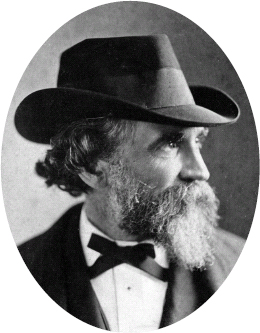
Samuel Bowles, editor of the Springfield Republican. “His nature was Future.”
Radicals like Higginson found the Republican too pessimistic for their taste, and Boston salonistas like Annie Adams Fields airily dismissed its publisher: “Mr. Bowles is quite handsome and would be altogether if he had elegance of manner to correspond with what nature has done for him in giving him fine eyes,” the Brahmin hostess recorded, “but he is an ambitious man, ambitious to be known as a literary man, but apparently mistaking popularity for fame he has learned to know almost everybody of literary celebrity, to get on the top word continually, to keep open house, to be a general good fellow, which combined with real ability has made him widely liked & given him a brilliant restless way, which makes so many Americans.” James Fields, her husband, took Bowles’s measure more crisply: heaven forbid the man should start a magazine; it would bury The Atlantic.
“His nature was Future”: Emily Dickinson grasped him best. But the future was something he never quite reached. A series of ailments, including sciatica and shingles, along with his chronic insomnia and his headaches, all wore him down, and in 1862 he sailed for Europe to rest. When he returned, he picked up exactly where he had left off. The work and the illnesses continued, and he died sixteen years later, at the age of fifty-one.
As early as 1860, Bowles and his wife, Mary, were Dickinson staples. It was Mary who gave Emily an antislavery Christmas parable by Theodore Parker, but it was Samuel, with his “vivid Face and the besetting Accents,” with whom the poet shared a special conversation, he ribbing her as “the Queen Recluse” who “has ‘overcome the world.’” Bowles appreciated and respected Dickinson’s need for solitude. “I have been in a savage, turbulent state for some time—,” he confided to Austin, “indulging in a sort of chronic disgust at everything & everybody—I guess a good deal as Emily feels.”
Emily trafficked with no movement, no group, no cabal of dogooders outside the select circle that now included Bowles, with whom she could disagree, particularly about politics. “I am much ashamed Mr. Bowles,” she jauntily apologized after one of his visits. “I misbehaved tonight. I would like to sit in the dust. I fear I am your little friend no more, but Mrs Jim Crow.” The issue seems to have been women’s rights. “I am sorry I smiled at women,” she continued. “Indeed, I revere holy ones, like Mrs Fry and Miss Nightingale.” She and Bowles treated each other as equals, and when he left for Europe, she deeply missed him. “When the Best is gone—I know that other things are not of consequence—,” she explained to his wife. “The Heart wants what it wants—or else it does not care—.”
Vinnie once observed that her sister was “always watching for the rewarding person to come.” Bowles was one such person.
“I AM SO FAR FROM LAND,” Dickinson once told Bowles. One wonders if, this time, he understood her meaning, and it seems he did. She asked him to mail some letters she did not want to post from the gossipy village of Amherst; he could be trusted to be discreet. And if he did not thoroughly understand her poems—his taste in verse hugged the shore—he published several in the Republican when his wife or Sue gave them to him: “Nobody knows this little Rose” in 1858, “I taste a liquor never brewed” in the spring of 1861; and on March 1, 1862, “Safe in their Alabaster Chambers.”
That last poem was one of the four that Dickinson chose to mail Higginson just six weeks after it had appeared the Republican. There it stood, anonymous but hers, in one of the best papers of the day. Pride of publication had nudged the door a bit more ajar, and behind it lay her query to Higginson, another special person: Is my Verse alive?
Of course she knew the answer. That was not the point.