
FIVE
Come strong.” In the drizzly spring of 1854, three years after the aborted Sims rescue, Higginson received the call from the abolitionist Samuel May Jr., Louisa May Alcott’s cousin. Come to Boston right away.
Anthony Burns, a twenty-year-old fugitive slave from Virginia, had been arrested—kidnapped, roared the Boston Vigilance Committee—and imprisoned in the same Court House that had confined the luckless Sims.
Burns had already declined the legal counsel of such patrician notables as Richard Henry Dana, for even if the abolitionists of Boston dreamed otherwise, Burns, no fool, knew where all the commotion was headed. “It is of no use,” he told Dana. “They will swear to me & get me back; and if they do, I shall fare worse if I resist.” Also aware that a legal wrangle would just delay but not prevent Burns’s reenslavement, the Vigilance Committee called for a public meeting at Faneuil Hall on Friday evening, May 26, and asked Higginson, if he could, to bring a posse of Worcester men.
“Give all the notice you can,” May had said. What he actually intended—beyond rallying public support—is unclear.
Himself prepared for battle, Higginson stepped off the train in Boston that Friday to find his fellow committee members squabbling over how best to proceed, their debate droning on until one of them, learning the slave catchers were to pass by, suggested they march outdoors and “point the finger of scorn.” The finger of scorn? Higginson’s mouth fell open. “As if Southern slave-catchers were to be combated by such weapons,” he wailed in frustration.
While the committee dithered into the late afternoon, Higginson broke away and bought a dozen hand axes. Martin Stowell, a friend from Worcester, had told him that Burns might be sprung from the Court House that same night if the abolitionist leaders could channel the anger sure to be unleashed at the rally. Someone could yell that a mob of black men was at the Court House trying to free Burns, Stowell continued, and the Faneuil Hall crowd would then surge into Court Square, where Higginson would be waiting, ready to pilot the freedom lovers toward the jail and Burns’s liberation.
It was a grand plan, bold and dangerous and so enticing that Higginson never stopped to consider its practicality: that it might be impossible, for instance, to alert the leaders of the rally to the details of the plot in the din of a roaring crowd, nearly five hundred strong (mostly men), that crushed into Faneuil Hall that night. And so the silky-tongued orator Wendell Phillips, key member of the Vigilance Committee, never heard of the scheme, and it’s not clear whether the other speakers, Samuel Gridley Howe and Theodore Parker, really understood it even if they had.
Higginson had no choice but to saunter back over to Court Square, where Stowell had stashed the axes, and affect nonchalance.
“I am a clergyman and a man of peace,” Theodore Parker’s voice meantime rang out in the packed and steamy hall. “I love peace. But there is a means, and there is an end; Liberty is the end, and sometimes peace is not the means towards it.” Still, the crowd should reconvene the next morning, he continued, for a nonviolent protest against the kidnapping. Wendell Phillips was ready to assent when someone screamed out that a group of black men were at the Court House rescuing Burns that very moment. Pandemonium. From Court Square, Higginson spied in horror a group of men hurrying up State Street: the “froth and scum of the meeting, the fringe of idlers on its edge,” he later described them, and not the men or at least not the hundreds he had expected.
Posted near the Court House, Stowell began to hammer its heavy oak door with one of the axes. Several men threw bricks. Several other men—Higginson at the front—hoisted a fourteen-foot wooden beam. Someone inside began ringing the Court House bell. The men with the battering ram shoved forward; one of the door’s hinges tore; the door tipped to the side. Higginson, at the head of the beam, elbowed his way into the room, but Lewis Hayden pressed ahead of him. Unarmed, Higginson fought bare-handed. The police were swinging swords and billy clubs, and Higginson received a cut, nothing severe, on his chin. Hayden fired his revolver. Stowell fired his. Perhaps the guards did too. For many years afterward Higginson supposed, or wanted to believe, the sheriff’s deputies would carelessly or drunkenly murder their own.
One man was killed. Special officer James Batchelder, a twenty-four-year-old teamster stationed behind the teetering door, fell backward, moaning “I am stabbed.”
Higginson didn’t hear Batchelder’s cry. Beaten back by the guards, he ran down the passageway and onto the Court House steps, where he saw that the sullen mob was dispersing. “You cowards, will you desert us now?” he shouted. For a moment the crowd didn’t move. But it was over. “That meeting at Faneuil Hall was tremendous, I never saw such enthusiasm,” Higginson later told a friend, “& (though warned that it would be so) I could not possibly believe that it wd exhale so idly as it did in Court Square.”
Just then Bronson Alcott strode up the Court House steps, cane in hand, and paused to ask Higginson why he and his men were not inside. “Because these people will not stand by us,” Higginson growled. Alcott continued up the steps, a model of transcendental courage. Another pistol shot rang out. Alcott walked back down the stairs.
With the approval of President Franklin Pierce, Nathaniel Hawthorne’s benefactor, the United States marshall in Boston called out federal troops. “The law must be executed,” he declared.
Later that night Batchelder died. No one was ever quite sure what had happened, whether Hayden or Stowell had fired the deadly shot, if in fact it was a shot that had killed Batchelder and not a wound from a saber. Unaware of this, Higginson spent the night at a friend’s and, lest he be recognized by the police the next day, tied a kerchief around his face when he ventured out. He again met with the Vigilance Committee, but since legal proceedings were now inevitable, there was nothing left for him to do but go back to Worcester on Monday, consoling himself that the rescue’s failure would provoke outrage among waffling antislavery people. And it did. “We went to bed one night old fashioned, conservative, Compromise Union Whig,” said the textile manufacturer Amos Adams Lawrence, “& waked up stark mad Abolitionists.”
The struggle against slavery was now an armed insurrection. “Massachusetts antislavery differs much from New York or Pennsylvania antislavery,” one citizen would note in dismay; “it is fanaticism & radicalism.” But Higginson was pleased. “That attack was a great thing for freedom, & will echo all over the country,” he told his mother.
As for Batchelder, Higginson informed Samuel May that the Committee should offer to assist his family, “supposing it to be so arranged as to show no contrition on our part, for a thing in which he had no responsibility, but simply to show that we have no war with women and children.” Willingly, in other words, Higginson adopted the rationalization of a radical: that the death and suffering of combatants or bystanders are the inevitable if regrettable byproduct of the greater struggle. It was a position that in later years he would disavow. For now, though, the customarily compassionate Higginson preferred to see Boston in flames rather than tolerate one person’s reenslavement, but he also chafed at the idea, then bruited about, of Burns’s being repurchased by New Englanders and set free, which would undermine his effectiveness as a symbol. As it happened, the United States district attorney, a Democratic party operative, delayed the proposed sale and then outlawed it, citing Batchelder’s death as his reason.
Not blind to the inherent cruelty of his position, Higginson brooked no qualms about the morality of force. “A revolution is begun!” he shouted in Worcester. “If you take part in politics henceforward, let it be only to bring nearer the crisis which will either save or sunder this nation—or perhaps save in sundering.”
A warrant was issued for Higginson’s arrest, indicting him for treason or what he scorned as “the crime of a gentleman.” An uncle, the businessman George J. Higginson, sent money. “It is the only way you know that we traders dare to show any sympathy,” he told Wentworth. Urged to leave the country, Wentworth refused. “My penalty cannot be very severe; & I shall consider it the highest honor ever attained by a Higginson,” he explained to his mother. Backing him fully, Mary said that the jail should open an annex for antislavery wives, and jesting only by half, Lucy Stone noted that “it would be best for the ‘cause’ if they should hang you.” Higginson granted “that months & years in jail would be well spent as a protest against slavery. The men now arrested are obscure men,” he continued; “their sufferings will be of comparatively little service; but I have a name, a profession, & the personal position which make my bonds a lesson & a stimulus to the whole country. What better things could I do for liberty?”
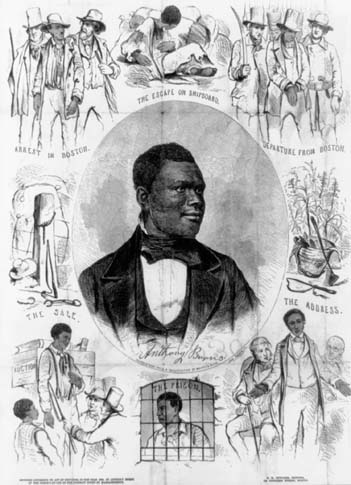
Anthony Burns: broadside depicting the former slave’s escape, capture, imprisonment, and, finally, deportation from Boston, 1855.
No doubt wishing to avoid that very showdown, the government reduced the charge to disturbing the peace, and the indictment was quashed.
Yet nothing could rub out the memory of Bad Friday, June 2,1854. Thousands of faceless troops on horseback patrolled the gray streets, shops closed their doors, women draped dark shawls from upper-story windows, and a small coffin, the word Liberty painted on it, hung on State Street. As many as fifty thousand citizens lined the streets to watch Burns, six feet tall, well dressed, and escorted by a martial entourage—the soldiers’ bayonets fixed, their swords drawn—make his way down to the docks, where the United States cutter Morris placidly waited to ferry him to Virginia.
Burns aboard, the glum crowd grew quieter, its stiff Yankee back broken.
The following Sunday in church, Higginson denounced the whole sorry affair with the resolution of one ready to amputate a gangrenous limb. Invoking the names of the revolutionary heroes of Europe, Giuseppe Mazzini and Lajos Kossuth, in a sermon he called “Massachusetts in Mourning,” he exhorted his congregation not to “conceal Fugitives and help them on, but show them and defend them. Let the Underground Railroad stop here! Say to the South that Worcester, though part of a Republic, shall be as free as if ruled by a Queen! Hear, O Richmond! and give ear, O Carolina! henceforth Worcester is Canada to the Slave!”
No longer did he believe the Fugitive Slave Act—or any of the laws supporting slavery—would be repealed. “I am glad of the discovery (no hasty thing, but gradually dawning upon me for ten years) that I live under a despotism,” he said. “I am glad to be deceived no longer.”
A revolution had begun.
“LIBERTY IS AGGRESSIVE,” Emerson wrote in his journals. “It is only they who save others, that can themselves be saved,” he added, referring to Higginson, transcendentalist in arms.
“I knew his ardor & courage,” Richard Henry Dana remarked, “but I hardly expected a married man, a clergyman, and a man of education to lead the mob.”
Thoreau also praised him as “the only Harvard Phi Beta Kappa, Unitarian minister, and master of seven languages who has led a storming party against a federal bastion with a battering ram in his hands.”
Whether or not the failure to save Burns was a national watershed, it was one for Higginson. For as a Higginson scholar commented, his action was the deliberate and strategic culmination of his years of preaching, lecturing, and working for a cause—and of his progressive disillusionment with antislavery politics. Now, as stalwart hero or fanatic or both, Higginson was a staple of New England newspapers, his sermons reprinted or quoted, especially his enraged requiem of the Burns affair. Had Emily Dickinson read those accounts—or the sermon? Doubtless both had been discussed at the Dickinson dining table. Did she know of him, too, from Amherst gossip? After all, it had been a local Baptist clergyman, the Reverend G. S. Stockwell, who, learning the whereabouts of Anthony Burns, had contacted Burns’s owner, asking to purchase him with the intention of then letting him go.
And now there was Kansas, the next battleground, where Higginson would be known as the Reverend General and preach at what he called the makeshift Church Militant, a hodgepodge of packing crates covered in buffalo robes. “Ever since the rendition of Anthony Burns, in Boston, I have been looking for men,” he said. “I have found them in Kanzas.”
After the passage of the Kansas-Nebraska Act in 1854, proslavery men and what were termed border ruffians—violent proslavery mobs mainly from the slave state of Missouri—had armed themselves to fight the antislavery homesteaders sent to the territory by New England emigrant aid societies, a Bible in one hand, a rifle in the other, according to Stephen Douglas, the author of the bill. Douglas wasn’t entirely wrong. In Worcester, for instance, Higginson’s friend Eli Thayer (a man of more brag than action, Higginson later noted) might have established the New England Emigrant Aid Company to supply Kansas-bound homesteaders with food and clothes, advertising the territory as a good place to live, but Theodore Parker shipped them rifles and six-shooters in boxes labeled “Bibles.”
With hundreds of nonregistered voters pouring into Kansas, the proslavery majority swiftly elected a proslavery legislature and passed the so-called bogus laws forbidding antislavery talk of any kind. (David Rice Atchison, proslavery senator from Missouri, encouraged Missourians in Kansas “to kill every God-damned abolitionist in the district.”) Free staters countered by setting up their own legislature in Topeka. Violence between the two groups escalated, and in the spring of 1856, a gang of fuming proslavery men mobbed the Free-Soil town of Lawrence, burned the hotel, sacked the governor’s house, and demolished two antislavery newspaper offices. Secretary of War Jefferson Davis dispatched federal troops to the territory, and the fifty-six-year-old abolitionist crusader John Brown rounded up four of his sons—he had sired twenty children—along with his son-in-law and two other men and rode out to Pottawatomie County, where they dragged five proslavery settlers from their cabins and hacked them to death with cavalry broadswords.
Appointed unofficial agent of the Massachusetts Kansas Aid Committee in the spring of 1856, Higginson had traveled west briefly to assist a band of what he called bona fide homesteaders (not like those ruffians from Missouri) and equip them with pistols, cartridges, and the cash raised in Boston. “These are times,” said Henry Ward Beecher, “when self-defense is a religious duty.” The National Kansas Committee then authorized Higginson to buy what he figured the homesteaders needed most: rifles, muskets, pistols (ninety-two of them), knives, and plenty of ammunition—fifty-nine hundred caps for the revolvers alone.
In September he returned to the Plains, hoping to help emigrants cross from Nebraska into Kansas. He found them cold, hungry, beleaguered; for breakfast they ate squash and green corn; for lunch and dinner they ate squash and green corn. In Nebraska City, Higginson purchased them cowhide boots, plaid flannel shirts, and warm blankets before setting off for Topeka, which he reached on September 24, riding with twenty-eight wagons and about 150 people. “Never before in my life,” Higginson later remembered with decided pleasure, “had I been outside the world of human law.” But he was often discouraged. Settlers herded their wagons in the opposite direction, back toward Iowa—some to avoid arrest, some to avoid starving, some with stolen horses—and in any event away from what many of them, in ignorance, had hoped would be the Promised Land.
Yet to Higginson the mission was clear, as he wrote—ghoulishly—of his Kansas trip in a series of letters to the New York Tribune. “I almost hoped to hear that some…lives had been sacrificed,” he said, “for it seems as if nothing but that would arouse the Eastern states to act. This seems a terrible thing to say, but these are terrible times.”
But late in October, back at home, Higginson slumped into a depression. Although the situation in Kansas was improving, to his mind the clear-headed John Geary, appointed by Pierce as governor of the territory, managed to bring peace only by co-opting the settlers and ignoring the larger struggle against slavery. In addition, that fall, James Buchanan, sympathetic to slaveholders, was elected president of the United States. Then came the Dred Scott decision: the Supreme Court ruled in a stunning 7–2 vote that blacks had no rights of citizenship, that slaves were property, and that all congressional acts excluding slavery from the territories were unconstitutional. Racism was pervasive, north and south. In exasperation, Higginson cried, “Colored men are thrust illegally out of cars in New York, and to take their part is Fanaticism.”
Though he continued to vote in national and local elections, he preferred to see the North secede from the South than to submit to the likes of a President Buchanan, and early in 1857 he spearheaded the Worcester Disunion Convention. “We the Undersigned invite the citizens of Massachusetts to meet in Convention at Worcester on Thursday January 15 to consider the practicality, probability and expediency of a separation between the free and slave states,” the convention circular proclaimed. “It is written in the laws of nature the two antagonistic nations cannot remain together,” Higginson exclaimed to his fretting mother. “Every year is dividing us more & more, & the sooner we see it, the better we can prepare for a perfect & dignified policy.”
But in 1857, grain prices were falling, inventories of merchandise languished in warehouses, stocks were plummeting, railroads defaulting, and the land boom collapsing. This was the first and last Disunion Convention.
And that fact made Higginson all the more susceptible to John Brown—“Weird John Brown,” as Melville would call him: a folk hero, eloquent and shrewd and already lionized far in excess of his accomplishments. Like many others, Higginson chose to ignore Brown’s role in the Pottawatomie massacre, although he later admitted that he had heard of no one who disapproved it. It had the salubrious effect, Higginson coldly added, of restraining the bloody Missourians. For, as he remarked, John Brown “swallows a Missourian whole, and says grace after the meal.”
HE DIDN’T REMEMBER SEEING BROWN in Kansas but was interested when Franklin Sanborn, a young schoolmaster in Concord whose students would include two of Henry James’s brothers, the Alcott sisters, and Nathaniel Hawthorne’s son, suggested they meet. Brown is the “best Disunion champion you can find,” Sanborn declared, “and with his hundred men, when he is put where he can use them…will do more to split the Union than a list of 5000 names for your convention—good as that is,” Sanborn hastily added.
Higginson consented to see Old Brown when the freedom fighter came to Massachusetts to solicit funds from the parlor radicals of Boston. Possessed like Melville’s Ahab with one besetting idea, the elimination of slavery, grim Brown glowed with “that religious elevation,” Higginson recalled, “which is itself a kind of refinement,—the quality one may see expressed in many a venerable Quaker face at yearly meeting.” With Kansas no longer the battle’s frontier—its newly appointed governor, Robert Walker, had allowed elections that fall, resulting in a victory for free staters—Brown would take his war elsewhere, with a plan: attack the federal arsenal in Harpers Ferry, Virginia, which in turn would lead to a rebellion of huge proportions, fugitive slaves and free blacks rushing to his side.
Frederick Douglass considered the scheme stupidly suicidal, but Higginson joined the clandestine group soon widely known as the Secret Six. It included Sanborn himself; a self-made financier, George Luther Stearns, who had struck a fortune in lead pipes; the antislavery philanthropist Gerrit Smith of upstate New York, on whose land the Brown family lived; the intransigent Theodore Parker, unfortunately ailing from congenital tuberculosis; and the Byronic Samuel Gridley Howe, founder of the Perkins Institute for the Blind, who in his younger days had fought the Turks in Greece. These men were to finance Brown’s plan and ignite, so they initially hoped, an insurrection that would eradicate slavery once and for all.
Higginson resigned from the Free Church. Action mattered. Only action mattered.
Of the Secret Six, Higginson alone would remain loyal to Brown’s plan, for good or ill, and was the one who never let fear for his own safety interfere with what he believed to be right. And though he had little cash to give Brown—he himself barely managed to make ends meet—he protested loudly any delay of the plan, correctly sensing ambivalence in two of the six. “I long to see you with adequate funds in your hands, set free from timid advisers, & able to act in your own way,” he told Brown. “Did I follow only my own inclinations, without thinking of other ties, I should join you in person if I could not in purse.” The tie to Mary—and to his mother—was too strong, particularly since Mary did not approve.
Still, he placed his faith in deeds, however violent or brazen. “The world has always more respect for those who are unwisely zealous,” he noted, “than for those who are fastidiously inactive.” As it began in blood, he said of slavery, “so to end.” He was right, although premature.
For Brown the beginning of the end came on October 16, 1859, in Harpers Ferry when he and twenty-one others, including several of his sons, stormed the federal arsenal, seized a local rifle works, and then took about sixty local citizens as hostages. But rather than strike quickly and escape to the nearby hills, Brown and his men positioned themselves near the arsenal for thirty-six hours, a tremendous strategic blunder. A local militia quickly cut off any escape route, forcing Brown and his gang to retreat into a small firehouse in the armory yard. Brown sent men to negotiate; one was arrested, the others shot. Another of Brown’s raiders, having run out of the armory, was killed, his dead body used for target practice by snipers circling the area. Lieutenant Colonel Robert E. Lee and a squadron of twelve marines offered Brown a chance to surrender unconditionally; the next day they bashed the door down. Seventeen people died, including two of Brown’s sons, two slaves, a slave owner, a marine, and three residents of Harpers Ferry. Brown, who’d been stabbed with a decorative dress sword, was taken prisoner.
Summarily tried, found guilty, and sentenced to hang, Brown was unrepentant—and he refused to reveal the names of the Six. But the United States Senate issued warrants for the arrest of several of them. Frank Sanborn hid for a night in Concord before taking off for Canada. Gerrit Smith committed himself to an insane asylum in Utica, New York, after he methodically destroyed all incriminating documents. Higginson stood his ground. Along with Howe, the attorney Samuel E. Sewall, and Ralph Waldo Emerson, he signed a circular soliciting funds for Brown’s defense and then traveled to the Adirondacks to escort Brown’s wife to Boston. He planned to accompany her all the way to Virginia, where he hoped she would urge her jailed husband to escape. This was part of Higginson’s plot to rescue Brown and his raiders, but Brown himself was unwilling, having judged himself more effective as martyr than fugitive.
The antiabolition press clamored for more than just Brown’s head. Papers had been found in Brown’s possession that pointed in the direction of the Secret Six, and with their attorney not sanguine about what they might face in court, Stearns and Howe also fled to Canada, and Sanborn, who had returned, went back. “Sanborn,” Higginson asked in disgust, “is there no such thing as honor among confederates?” Then Howe published a letter distancing himself from Brown. Higginson was appalled. “Gerrit Smith’s insanity—& your letter—,” he told Howe, “are to me the all too sad results of the whole affair.”
On December 2, 1859, the day of Brown’s execution, bells tolled in Boston. “I believe John Brown to be the representative man of this century, as Washington was of the last,” said George Stearns, who would soon testify before Congress. Emerson went further. Brown’s death, he supposedly said, “will make the gallows as glorious as the cross.” Not everyone agreed. “Nobody was ever more justly hanged,” said Emerson’s neighbor Nathaniel Hawthorne, “…if it were only in requital of his preposterous miscalculation of possibilities.”
As for Thomas Wentworth Higginson, a Vigilance Committee in Worcester rallied round him, should he be seized by the government. But civil disobedience implied an acceptance of consequences, and he was ready for them. Even eager. “Under a government which imprisons any unjustly,” Thoreau had written, “the true place for a just man is also in a prison.”
Higginson did not run. He did not burn incriminating evidence. Instead he organized an attempt (unsuccessful) to spring Aaron Stevens and Albert Hazlett, two members of Brown’s party, from the Charles Town, Virginia, jail. Aided by the former Kansas guerrilla James Montgomery, Higginson was to lead the attack, but he called it off when Montgomery learned that soldiers were swarming over Charles Town. Stevens and Hazlett were hung. Higginson stood fast. “John Brown is now beyond our reach,” he declared, “but the oppressed for whom he died still live.”
When the Senate investigated Harpers Ferry, summoning Howe and the others, Higginson was ready, proud to tell all he knew. But the government likely second-guessed his motives once again and decided that of all people, Higginson, capable of making his testimony a cause célèbre, was worth avoiding. He was never called.
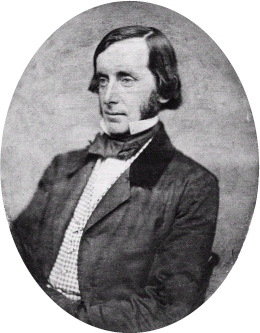
Thomas Wentworth Higginson, 1857. “He prided himself not a little on his good looks,” said Angelina Grimké Weld.
THE MINISTERIAL CLOTH was never a comfortable fit, and Higginson had left the church without regret. For though he redeemed himself in his own eyes, he had wondered if there wasn’t something unmanly about his calling. “What satirists upon religion are those parents who say of their pallid, puny, sedentary, lifeless, joyless little offspring, ‘He is born for a minister’?”
His reference to himself as the sickly, half-dead child he once had been partly accounts for his commitment to forcible political action. It also accounts for his devotion to exercise, bodybuilding, and the nonministerial physical values he touted in such early essays for The Atlantic Monthlyas “Saints and Their Bodies,” “Physical Courage,” “Letter to a Dyspeptic,” “Barbarism and Civilization,” and “Gymnastics.” Behind each article lurked Higginson’s need to prove himself as strong, fit, virile.
He also admired in fugitive slaves the quality he most desired in himself—physical valor—not because he romanticized them in a typically benighted way, though he was capable of that, but because he genuinely admired their staggering bravery. As he wrote in “Physical Courage,” one of his earliest Atlantic Monthly essays: “These men and women, who have tested their courage in the lonely swamp against the alligator and the bloodhound, who have starved on prairies, hidden in holds, clung to locomotives, ridden hundreds of miles cramped in boxes, head downward, equally near to death if discovered or deserted,—and who have then, after enduring all this, gone voluntarily back to risk it over again, for the sake of wife or child,—what are we pale faces, that we should claim a rival capacity with theirs for heroic deeds?”
The outlet for Higginson’s self-confident, radical prose had become The Atlantic Monthly. Initially conceived as an antislavery magazine in 1853, it wasn’t truly launched until 1857, when its inaugural editor, James Russell Lowell, put a drawing of Shakespeare on the frontispiece and called The Atlantic a magazine of literature, art, and politics; literature would trump current events. Lowell canvassed the historian John Lothrop Motley as well as Nathaniel Hawthorne, Harriet Beecher Stowe, Dante Gabriel Rossetti, John Ruskin, Mrs. Gaskell, and Higginson as early contributors, and Oliver Wendell Holmes (who named the magazine) appeared in the first issue, along with Emerson, Whittier, Lowell himself, and Charles Eliot Norton. Higginson published his first article, “Saints and Their Bodies,” about the weakness of civilized (white) men, in its fifth issue.
It was Lowell who reluctantly published Higginson’s “Physical Courage” in 1858 and in 1859 his satiric tour de force “Ought Women to Learn the Alphabet?” Higginson tried to push Lowell deeper into politics. “Would you like an article on the Maroons of Jamaica and Surinam, suggested by the last Virginia affair,” he queried Lowell in 1859, a week after Harpers Ferry. More hospitable to the antislavery movement than to female suffrage, Lowell acquiesced, and in all, under either Lowell or the next editor of The Atlantic, James Fields, Higginson published four essays on slave uprisings, including the tragic tale of Denmark Vesey’s failed revolt in Charleston, South Carolina, which warned readers that slaves could and would rebel, and the story of the insurrectionary slave Nat Turner, whom Higginson compared with John Brown: ordained by Providence, devoted to freedom, baptized in blood.
That Higginson respected these leaders without reservation is consistent with his increasing militancy and his conviction that slavery brutally injured the enslaved. And these pieces also demonstrate Higginson’s conviction that despite all, neither the essential humanity of the slaves nor their craving for freedom had been destroyed. Many northerners doubted that the black man would fight for freedom; their stereotype was Stowe’s reassuringly gentle Uncle Tom. Higginson laughed. “If it be the normal tendency of bondage to produce saints like Uncle Tom,” he sarcastically noted, “let us all offer ourselves at auction immediately.”
In 1860, after his unsuccessful attempt to spring two of Brown’s cohorts from jail, Higginson started keeping a small journal he called his “Field Book” and on the flyleaf scribbled “Recalled to Life” (from Dickens’s Tale of Two Cities). “I began this book on returning from an abortive expedition to Pa. in hopes of rescuing Hazlett & Stevens,” he later explained; “I had thought it likely that my life might be sacrificed.” The truth was more complicated. Documenting Higginson’s return to and love of nature in the face of recent failure, the book served as his refuge. “In these unsettled days it is perilous for a writer to commit his self to a course of systematic thought,” Higginson had commented as early as 1849, “& better to fall back upon nature.”
Inspired by Thoreau’s A Week on the Concord and Merrimack Rivers, a book he reread every year, Higginson had called on Thoreau in 1850, boarding the Concord train and arriving unannounced at the family pencil factory. There Thoreau sat, a bronzed, spare man, working. “On other days he surveys land,” Higginson reported to his mother, “both mathematically & meditatively; lays out houselots in Haverhill & in the moon.” If the man was a little dry, his scrupulous love of the natural world and of beauty, his self-containment, even his egotism, redeemed him. “He talks sententiously & originally; his manner is the most unvarying facsimile of Mr. Emerson’s, but his thoughts are quite his own,” said Higginson. “I find nobody who enjoys his book as I do (this I did not tell him).”
He subsequently followed in Thoreau’s footsteps, tentatively publishing his own nature essays in Putnam’s Monthly in 1853 and 1856. Higginson’s “Going to Mount Katahdin” was literally inspired by Thoreau’s Maine climb, although in his account Higginson pretended he was a woman, perhaps to conceal his unmanly love of things natural. No longer—Kansas had changed all that.
Just before the publication of Walden, in 1854, Thoreau presented Higginson with a copy of the book, along with his “Slavery in Massachusetts,” the lecture on the Burns affair that Higginson had admired. But Higginson had already read Walden. Fields had given him the proofs, so eager was he for Thoreau’s latest. “Thoreau camps down by Walden Pond and shows us that absolutely nothing in Nature has ever yet been described—,” Higginson unstintingly declared, “not a bird nor a berry of the woods, nor a drop of water, nor a spicula of ice, nor summer, nor winter, nor sun, nor star.”
Nothing in nature had yet been described, and yet this was the task Higginson now set himself, Thoreau as his guide. Weary and demoralized with the ways of men, he fully indulged his love of nature, swearing he would at last earn his living in the way he had long dreamed. Down the back of the activist was a large reclusive streak.
SINCE CHILDHOOD, Higginson had roamed the outdoors, attentively observing flowers and trees and the varieties of birds. And since college, when he studied natural history and entomology and recorded whatever specimens he found during botanical expeditions (today housed at Harvard’s Gray Herbarium), Higginson liked to bathe at dawn in the cold lake water near his home, or skim its surface in a small boat, or search for birds’ nests while hiking through the thick woods on long, hot summer afternoons. Animals and plants, he said, were more human than most people, more kind. “The birds are as real and absorbing to me as human beings,” he wrote in his journal. “I will trust this butterfly against all the dyspeptic theologians or atheists of the world.” He almost sounds like Dickinson.
“I need ask for nothing else when I find myself coming round again into all that old happiness in nature,” he confided to his diary, “wh my years of hard labor seemed to have stilled.” Writing about nature for The Atlantic, he burst with pride when Thoreau praised his essay “Snow.” “He was the only critic I should regard as formidable on such a subject.” But fan letters about his essays were collecting at the post office. “I had more [mail] about ‘April Days’ than about anything I have written,” he told Harriet Prescott late in 1861. “I am sure I have never come so near to Nature as during the last year,” he continued, “and therefore never so truly and deeply lived; and sometimes I feel so Exalted in this nearness that it seems as if I never could sorrow any more.”
Although these essays on nature distracted him from the public failures of Free-Soil, Thomas Sims, Anthony Burns, and Harpers Ferry, those were disappointments he still felt compelled to reverse. Yet after Fort Sumter was fired on, he turned down an offer to lead the Fourth Battalion of Infantry, partly for Mary’s sake and partly because he was skeptical of Lincoln’s commitment to antislavery. Changing his mind in the fall of 1861, he received permission from Governor Andrew to raise a division of troops—the news reached Dickinson’s Amherst by means of the Springfield Republican—but when the War Department subsequently decided not to authorize another Massachusetts regiment, he figured he was destined to be the chronicler of nature after all. And with the prestigious Atlantic beckoning, the tall ex-preacher pitched himself headlong into literature at last.
He entertained few illusions. “I do not find that my facility grows so fast as my fastidiousness,” he admitted. And yet he was determined to remake his life, to retire from the fray, to become the writer in repose he had long wanted, or thought he wanted, to be. “The more bent any man is upon action, the more profoundly he needs the calm lessons of Nature to preserve his equilibrium,” he said, speaking of himself in the lovely essay “My Out-Door Study.” “The radical himself needs nothing so much as fresh air. The world is called conservative; but it is far easier to impress a plausible thought on the complaisance of others than to retain an unfaltering faith in it for ourselves.” So he kept a place for himself in the woods, regrets suppressed, notebook in hand, and wrote his lyrical paeans to nature—and art—in “Water-Lilies,” “April Days,” “My Out-Door Study,” “Snow,” “The Life of Birds.”
We talk of literature as if it were a mere matter of rule and measurement, a series of processes long since brought to mechanical perfection: but it would be less incorrect to say that it all lies in the future; tried by the outdoor standard, there is as yet no literature, but only glimpses and guideboards; no writer has yet succeeded in sustaining, through more than some single occasional sentence, that fresh and perfect charm. If by the training of a lifetime one could succeed in producing one continuous page of perfect cadence, it would be a life well spent, and such a literary artist would fall short of Nature’s standard in quantity only, not in quality.
Perfecting that cadence and polishing the surface of his prose, eventually he would deplete its strength with prolixity and pedantry. But that was much later, after the war. And even then he was capable of a rousing call to arms or the hushed mellow resonance that stirred his reader in Amherst, for whom literature, too, was not a matter of rule and measurement but of April days and snow and perhaps even insurrection, physical courage, rebellion.
His quiet eloquence heeded by the coruscating poet of inner life—his quiet eloquence touching her—she reached out.
“My size felt small—to me—,” Emily Dickinson now told him; “I read your Chapters in the Atlantic—and experienced honor for you.” She knew who this man was.