
SEVEN
Like many others, Higginson had not expected a long war, but unlike them he was convinced that its outcome, whoever won, “must put the slavery question in a wholly new aspect.” This was the theme of his article “The Ordeal by Battle,” published in the July 1861 Atlantic. “I have never written any political article there before, because there never has been a time when I could write freely without being too radical,” he informed his mother with a certain pride, “so I thought I would use the present opportunity.”
Higginson insisted that the war be understood as a conflict between competing principles—slavery versus freedom. “Slavery is the root of the rebellion,” he declared, “and so War is proving itself an Abolitionist, whoever else is.” For slavery was a hateful institution, pure and simple. In his chilling essay “Nat Turner’s Insurrection,” he recounted not the insurrection as much as “the far greater horrors of its suppression,” and documenting the hysteria that followed the rebellion—the maiming, the burning, the killing of the black population—Higginson chronicled the brutalities without heat, noting, nonetheless, that those summarily executed were not even identified by name. So where he could, he learned their names, recording them with telltale understatement, as in the case of one woman, called Lucy, about whom we know nothing except that “she was a woman, she was a slave, and she died.” The sentence, clean and unassuming, clearly influenced Ralph Ellison’s elegy for his character Tod Clifton in Invisible Man, published almost a century later. And according to the poet Susan Howe, one of Dickinson’s most intuitive readers, Higginson’s Nat Turner essay may well have inspired the poet’s unforgettable “My Life had stood—a Loaded Gun—.”
Strangely encouraged by the Union’s rout at the First Battle of Bull Run, Higginson calculated that “but for this reverse we never should have the law of Congress emancipating slaves used in rebellion.” He referred to the Confiscation Act, passed that summer; the Union’s lawful seizure of property used for insurrection, including slaves, had effectively freed them. But this bolder antislavery policy, as Higginson called it, meant he could no longer stay at home writing essays. “No prominent anti-slavery man has yet taken a marked share in the war,” he observed in the fall, “and…there are a great many in this and other States who would like to go if I do. I have made up my mind to take part in the affair, hoping to aid in settling it the quicker.”
Perhaps inflating his own importance, Higginson never betrayed his position of the past several years: abolition or nothing. But until the summer of 1862, nothing happened: emancipation was not forthcoming; recruiting offices were temporarily closed. Then, with casualties mounting, the government called for fresh reserves, and Higginson obtained Governor Andrew’s permission to assemble a regiment. As its captain he would finally play a part in the revolution he had called for, fought for, hoped for. All the currents of his life, he hastily scribbled in his journal, had converged. (“Each Life converges to some Centre—,” as Dickinson would write.) He put down his pen. “What I could write I have written and should I never write anything more, no matter.”
Settling Mary into a parlor and a bedroom in a boardinghouse nearby—he was stationed at Camp John E. Wool, just outside Worcester—he asked Margaret Channing, their niece, to stay with her the days he was gone, Tuesday to Saturday. On Sunday he came home, and on Monday he rejoined his regiment, the Fifty-first Massachusetts, at the barracks. He could not wait to get there and in future years remembered those first heady days “as if one had learned to swim in air, and were striking out for some new planet.” The scratchy uniforms, the mindless drills, the marching, the rules—he relished all of it. A military novice, he read handbooks about formation, maneuvers, and the rules of conduct, but what counted most to him were the men; it was as if he was their father. At night he loved to hear them sing in the dark or watch when, bunks moved aside, as they square-danced, their long arms looping in huge arcs, half the men marking themselves as women by tying a handkerchief to their arm. “In each set,” he told his mother “there are mingled grim & war-worn faces, looking as old as Waterloo, with merely childish faces from school, & there is such an absorption, such a passionate delight that one would say dancing must be a reminiscence of the felicity of Adam before Eve appeared, never to be seen in its full zest while a woman mingled in it.”
Higginson so thoroughly reveled in the maleness of army life that today scholars consider him a “man of somewhat fluid gender identifications,” especially since in later years he freely admitted to loving his friend from his seminary days, the charming William H. Hurlburt of Charleston, South Carolina, a true southerner, as Higginson had excitedly told his mother, “slender & graceful, dark with raven eyes & hair,” a man charismatic and capacious, who translated South American and West Indian poets and was writing a book on Cuba. Hurlburt eventually moved to New York, where he wrote theater criticism for The World; during the Civil War, he was imprisoned as a spy by the Confederacy when he traveled south; and in later years he lived in London, where he was a lesser light in Wilde’s circle. “All that my natural fastidiousness and cautious reserve kept from others I poured on him,” Higginson would reminisce years later; “to say that I would have died for him was nothing.”
Though they drifted apart, he had loved Hurlburt without shame. And he loved male flesh, muscular and lean, whether in the gymnasium or in the barracks, also without shame. Convention allowed him this physical appreciation of men—part erotic, part aesthetic—while at the same time forbidding as salacious the mere glimpse of a woman’s ankle. And Higginson was a man of delicacy, which also means, particularly in his case, a repressed blue-blood reared to endure privation without complaint no matter how the limits of his sexual life—with whatever gender—saddened him.
Allowing himself the unself-conscious joy—part sensual, part paternal—of male company, he permitted himself the luxury of looking, watching, savoring, patronizing, and fantasizing, but he remained a spectator. As for women, he discussed them only in cerebral or political terms, though several of his female acquaintances whispered that the handsome Higginson had an eye for the ladies. He definitely liked their attention. Physically fit and slightly vain, he was no longer the gangling boy clutching a pocketful of topics for conversation.
He was, in other words, noticed. People knew of Wentworth Higginson. They recognized him (he was quite tall); they went to hear his speeches. They read his essays. They saw a limerick about him in the local papers:
There was a young curate of Worcester
Who could have a command if he’d choose ter,
But he said each recruit
Must be blacker than soot,
Or else he’d go preach where he used ter.
But it wasn’t until early November, three months after he had entered the service, that Captain Higginson received a letter from Brigadier General Rufus Saxton, military governor of the United States Volunteers in the Department of the South. (The Department of the South officially included South Carolina, Georgia, and Florida but in practical fact meant just the Sea Islands, captured seven months after Fort Sumter fell.) Promoting Higginson to the rank of colonel, Saxton invited him to lead the First South Carolina Volunteers, the first federally authorized regiment of freed slaves, its mandate issued five full months before Governor Andrew of Massachusetts received permission to recruit the Massachusetts Fifty-fourth.
Though elated, Higginson wanted to talk to Saxton in person before accepting the offer, for he was now reluctant to leave the Massachusetts Fifty-first. So he boarded the railroad to New York and then a steamer to Beaufort, South Carolina, a pretty river town about twelve miles above Hilton Head. A beachhead for Union troops after Hilton Head had been seized in the fall of 1861, Beaufort had been abandoned by its wealthy white residents, who bolted before the thick-booted blue bellies (Union men) came to carve their names on the mahogany mantels. They’d left everything: the cutlery on the table, the linens in the cupboard, the crinolines, the pianos, the livestock—and the slaves. Noisy northerners soon thronged there, mostly abolitionists and teachers intending to educate these former slaves, as well as entrepreneurs and civic minions. “The government sent agents down here, private; so too private philanthropy has sent missionaries, and while the first see that the contrabands [former slaves] earn their bread, the last teach them the alphabet,” Charles Francis Adams Jr. noted. “Between the two, I predict divers results, among which are numerous jobs for agents and missionaries, small comfort to the negroes, and heavy loss to the government.”
But Rufus Saxton, an obdurate antislavery man, was different from all those. And he was certainly unlike his flamboyant predecessor, Major General David Hunter, a man of impeccable if aggressive abolitionist leanings who on his own initiative had declared the Sea Islands slaves free. Preempting the president’s Emancipation Proclamation, Hunter had irritated Lincoln and then everyone else by pulling former slaves, terrified, out of their cabins under the cover of darkness, tearing them from their families and bullying them into uniform. But his brash behavior had one salutary effect in the North: the issue of whether to arm black men was on the table.
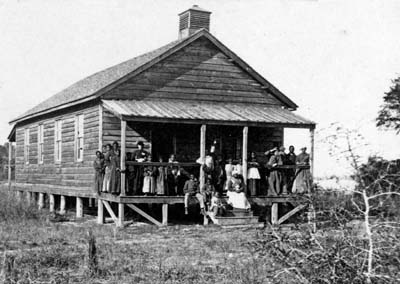
African Americans, Beaufort, South Carolina, from the collection of Rufus Saxton.
Less choleric than Hunter, Rufus Saxton was a practical idealist. Short, compact, with deep-set eyes and curly black side whiskers—and just a year younger than Higginson—he had been a maverick abolitionist among his fellow West Point graduates and so committed to the cause that the strategic-minded Higginson at first worried that he might actually “overlook means in his zeal for ends” (as Hunter had). He did not. Directed to take possession of all plantations previously occupied by rebels and to feed, employ, and govern their inhabitants, whom the army had left without shelter, clothing, provisions, or the wherewithal to buy any, he had charge of the ten thousand or more freed slaves from the Sea Island plantations, knowing that his was an anomalous position, his function straddling that of civilian and soldier, despot and benefactor.
Though Saxton was to report to Hunter, Secretary of War Edwin Stanton had also granted him authority to recruit and train volunteers of African descent as the First South Carolina Volunteers. (According to the author James Branch Cabell, a Virginian who wrote scathingly of the enterprise, the former slaves unshackled themselves “from the dull and tedious drudgery of farm work in favor of a year or two’s military service under the more noble excitements of gunfire.”) But adamantly believing, like Higginson, that the slaves would fight for their freedom—Higginson’s theme in the Denmark Vesey and Nat Turner essays—Saxton felt it would be hypocritical not to allow them to do just that. This was a minority position among the ultras, as radical abolitionists were censoriously called.
Higginson’s first conversation with Saxton assured him that he was not being snookered into “a mere plantation-guard or a day-school in uniform.” The First South Carolina was the real thing. For with conviction, stubbornness, and unprejudiced empathy, Saxton had won the respect of the African Americans, many of whom Hunter had discouraged, demoralized, and abused, and Higginson soon reported with satisfaction that Saxton could effortlessly silence those pious northerners who pestered him with their elaborate, often insulting inquiries about the freed blacks (whatever were they like?) with a terse reply: “Intensely human.”
It was settled. “I had been an abolitionist too long, and had known and loved John Brown too well,” Higginson later said, “not to feel a thrill of joy at last on finding myself in the position where he only wished to be.” It was also vindication—and action—at last.
AT NIGHT THE TANGY SMELL of roasting peanuts wafted through Camp Saxton, where Higginson and his men were billeted, four miles below Beaufort on the sumptuous grounds of the defunct Smith Plantation. The place was beautiful, Higginson thought, overgrown, luxurious, and fragrant with oleander and myrtle. Long tendrils of Spanish moss dropped from the branches of the mammoth live oaks like a misty curtain; roses bloomed in December, gangling palmettos rustled in the damp breeze. Hares and wild pigeon and quail scrambled across the long avenues leading to the ruined estate, on whose grounds 250 army tents shone pearly in the moonlight. Only the pigs running wild in the camp annoyed him.
Emerging from his tent, Higginson would stroll among his six hundred enlisted men without seeing a single white face, hearing only wild curlews, he told Mary, wailing through the night “like vexed ghosts of departed slave-lords.” There, standing in the middle of a plantation among freed slaves, hundreds of them, the eagle buttons on his new blue uniform tight and shiny, he prepared to lead their regiment and fight with them for freedom, their freedom: this was a dream come true.
“The first man who organizes & commands a successful black regiment will perform the most important service in the history of the War,” he confided to his journal. But he would need to demonstrate to a skeptical North—and a contemptuous South—that a black regiment was as good, as brave, as disciplined, and as dogged as any white one.
He did not lack certain comforts. At mealtime his adjutant, a young bookkeeper from Boston, spread newspapers over the table before serving plates of hominy, hot sweet potato, and oysters or fish. The pork was tasty, and so were those griddle cakes made from corn and pumpkin. His tent contained a bed, two chairs, two pails of water, and a small camp stove. He had a table for writing, on which he placed Hugo’s Les Misérables, and he carried a small book of Shakespeare’s sonnets wherever he went. Wooden planks covered the floor of the tent to prevent dampness. At Christmas he hung a wreath of oranges by the door, and when nights grew chilly, he snuggled beneath the prickly buffalo robe his mother had bought him. He wrote to Fields requesting books. He bathed in the nearby river. He cantered by horseback over roads made of oyster shells, one path passing by an enormous oak that not long before had doubled as a whipping post, the marks of the lash still visible.
The men of the First South, as the regiment was known, were former slaves, mainly from the rice plantations of the Sea Islands. There they had toiled long hours without adequate nourishment, medical care, education, and of course remuneration; here, at Camp Saxton, they were eager, they were free, and Higginson would be damned if they weren’t correctly trained; it was the least he could do. Waiting for his regiment to fill (a minimum of 830 was needed for assignments), he relentlessly drilled his young “barbarians,” as he affectionately called the black soldiers, while Saxton rallied the troops, telling them about Higginson’s courage during the “old dark days” and how he had tried to break Anthony Burns out of jail. You could still see the saber cut on his face.
No black soldier in Higginson’s regiment would be treated unjustly, Saxton assured them.
Higginson was pleased. “It needs but a few days to show the absurdity of doubting the equal military availability of these people, as compared with whites,” he wrote in his journal.
There is quite as much average comprehension of the need of the thing, as much courage I doubt not, as much previous knowledge of the gun, & there is a readiness of ear & of imitation which for purposes of drill counterbalances any defect of mental training. They have little to sacrifice, are better fed, housed & clothed than ever before & have few vices such as lead to insubordination. At the same time I think, as I always did, that the sort of paradisiacal innocence, attributed to them by their first teachers were founded on very imperfect observation. They are not truthful, honest or chaste. Why should they be? but they are simple, docile and affectionate. The same men who have stood a fire in open field with perfect coolness, have blubbered in the most irresistibly ludicrous manner on being transferred from one company in the regiment to another.
Though paternalistic, Higginson was more perceptive, effective, and humane than most of his peers, even the self-proclaimed enlightened ones, who still suffered from “colorphobia” (Higginson’s word): Emerson, he recalled, had squirmed when Frederick Douglass was proposed for the Town and Country Club. Few white northerners had ever interacted with blacks, free or enslaved, and very few were impatient for the chance. Fewer still were willing to put their lives on the front line for a black regiment. “He will be a marked man,” commented Whittier on hearing of Higginson’s commission; the Confederacy had vowed to hang all white officers of black troops on capture. But the abolitionist preacher Sojourner Truth, a former slave and a women’s rights crusader, declared Higginson appointed by God.
A Boston Brahmin, Higginson was also a progressive whose sense of class was not fixed. That was true of his sense of race as well. He investigated prevailing stereotypes, even his own; this was part of his task as he defined it. He forbade blacks to be called “niggers” and registered surprise if they referred to themselves that way. He observed how hard his men worked. “How absurd is the impression about these Southern blacks, growing out of a state of slavery, that they are sluggish or inefficient in labor,” he noted.
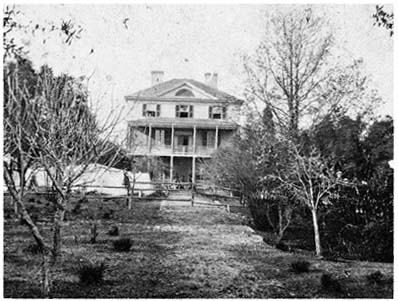
Smith Plantation, Beaufort, South Carolina, 1862.
“At first glance, in a black regiment,” he would reminisce, “the men usually looked to a newly arrived officer just alike, but it proved after a little experience that they varied as much in face as any soldiers. It was the same as to character.” He tried to learn as much about them as he could: the Wilson brothers told him about their grandmother, the mother of twenty-two, and how she organized a second escape from her plantation after her first one failed; Corporal Simon Crier said that he was going to Liberia after the war because he knew Johnny Reb would never be civilized in his lifetime. Another corporal, Robert Sutton, a meditative, intelligent, and loquacious man with an iron memory, spun out ingenious theories and asked questions well into the night until Higginson, exhausted, dropped off to sleep. “His comprehension of the whole problem of slavery was more thorough and far-reaching than that of any Abolitionist, so far as its social and military aspects went,” Higginson reflected. “In that direction I could teach him nothing, and he taught me much.”
“It is the fashion with philanthropists who come down here to be impressed with the degradation & stupidity of these people,” he observed with contempt. “I often have to tell them that I have not a stupid man in the regiment. Stupid as a man may seem if you try to make him take a thing in your way, he is commonly sharp enough if you will have patience to take him in his own.” Believing that discipline endowed them with the self-respect denied them as slaves, he worked hard, he said, “to impress on them that they do not obey officers because they are white, but because they are officers.” And as an officer himself he was sensitive to his position. When a new squad of recruits arrived—lame, frightened, wrapped in rags—and he had to assign them various captains, he said he felt like a slave driver, and he hated it. But to Charlotte Forten, a young black woman from the North come to teach the freed slaves, Higginson was an ideal officer whom his soldiers liked and admired. “And he evidently feels towards them all as if they were his children,” she said, intending a compliment.
He also tried to figure out why they had not rebelled: “it always seemed to me that, had I been a slave, my life would have been one long scheme of insurrection.” Answering his own question, he marveled at his men’s patient religious temperament—and their sense of futility: “What was the use of insurrection, where everything was against them?” Diligently he logged their remarks in his journal and devotedly collected their songs, scribbling verses in the darkness as the men sang. And when he wrote publicly of them, which he did in letters to newspapers, politicians, and The Atlantic Monthly, he praised them in terms that preserved their dignity and yet did not offend his bigoted readers; he would overcome prejudice, in other words, in increments. In a sense he would in later years use the same strategy of caution when publishing the poems of Emily Dickinson.
On New Year’s, 1863, Saxton planned a great celebration of the Emancipation Proclamation, which was to take effect that day. In a grove of live oaks near the camp, black and white congregated together among the wide trees, people arriving on foot, in carriages, on horse-or muleback: cavalry officers, black women wearing brightly colored head scarves, teachers, superintendents, and the band of the Eighth Maine. Higginson, standing on a wooden platform with the other designated speakers, introduced William Henry Brisbane, a South Carolinian planter who had earlier freed his slaves, and Brisbane read from the Proclamation: “On the first day of January, in the year of our Lord one thousand eight hundred and sixty-three, all persons held as slaves within any State or designated part of a State, the people whereof shall then be in rebellion against the United States, shall be then, thenceforward, and forever free.” The crowd roared, men tossed their hats into the air, women hugged one another. “This spontaneous outburst of love and loyalty to a country that has heretofore so terribly wronged these blacks,” noted the regiment’s physician, Seth Rogers, “was the birth of a new hope.”
The Reverend Mansfield French presented Higginson with a silk regimental flag mounted on an ebony and silver staff and embroidered with the motto “The Year of Jubilee has come!” Unbidden, an elderly man and two women, former slaves, burst into song, belting out “My Country ’Tis of Thee.” Higginson stood silent, eyes damp. “It made all other words cheap,” he wrote that evening; “it seemed the choked voice of a race, at last unloosed.”
After the ceremony the men and the officers, black and white, well-wishers and uncertain onlookers, clustered around huge square tables for a feast of ten oxen roasted whole over huge pits and, when crisp, cut with axes. Not as good as at home, recollected a young black woman, but Higginson, who loved it all—the food, the speeches, the salty-sweet taste of freedom under the trailing moss—refused to dine with other white officers and the dignitaries, preferring instead to sit with his own men. He had come south as a believer, and now all around him was something to believe in.
But clad in the bright red trousers he loathed—he could not wait to get his troops into standard army issue—when they marched into Beaufort, muskets bright, boots blackened, they were heckled from the side of the road, and there were fistfights along with the catcalls and slurs. Yet Higginson had heard praise from formerly disdainful white officers, who admitted that no other regiment in the Department outshone his.
Later that month came his first battle. General Hunter, back in Hilton Head as commander of the Department of the South, wanted to enlist fifty thousand more blacks; that was his directive, not the winning of territory or the blocking of lines, so Higginson was ordered to scout the area for recruits among the abandoned forts and plantations. For bait, Higginson carried the regimental flag and copies of the Emancipation Proclamation.
Aboard a small gunboat, the Ben de Ford, and flanked by two other vessels, Higginson and his men headed south to a Union post in Fernandina, Florida. From there they would ascend the narrow St. Mary’s River. But when he and a detachment of his men scrambled ashore at midnight near Township Landing, the air thick with the sticky scent of pine, they walked into the maw of a rebel cavalry unit. “A man fell at my elbow,” Higginson later wrote. “I felt it no more than if a tree had fallen,—I was so busy watching my own men and the enemy, and planning what to do next.” Corporal Sutton was wounded, and Higginson himself had a close call when a Confederate officer took direct aim at him—but was shot by three of Higginson’s men before he could pull the trigger.
The breathlessness of the fight, the courage of his soldiers, the smell of victory: the small skirmish became, to him, a significant event. “Nobody knows anything about these men who has not seen them in battle,” Higginson informed General Saxton. “I find that I myself knew nothing. There is a fiery energy about them beyond anything of which I have ever read.”
He and his men continued their reconnoiter up the St. Mary’s to a landing near Alberti’s Mill in Georgia, the plantation where Corporal Robert Sutton had been a slave. Finding only Mrs. Alberti on the premises, Higginson introduced himself and then presented Corporal Sutton, saying he believed the two of them had already been acquainted. The woman’s smile froze. “Ah,” she replied, measuring her words. “We called him Bob.”
Soldier and slave: “You may make a soldier out of a slave, very readily,” Higginson commented, “but you can no more make a slave out of a soldier than you can replace a bird in the egg.” Sutton walked Higginson over to the slave prison, a small outbuilding equipped with a huge rusty chain for tying down its victims. The stocks came in two sizes, one with smaller holes for women and children. Higginson conveyed three sets of these stocks, as well as shackles, chains, and keys, back to his supply ship, “good illustrations,” he informed General Saxton, “of the infernal barbarism against which we contend.”
Higginson banned looting, aware nonetheless how hard it was for the men to resist the luxuries purchased for their former masters by their own sweat. But since cotton, foodstuff, and animals were considered supplies of war, not booty, they confiscated provisions—resin, forty bushels of rice, cordage, and sheep—and loaded them onto the boats. Gun crews then stood ready. Higginson had learned that Confederates lay in wait above the river, and he indeed heard a wave of shouting sweep down from Reed’s Bluff just after he and his men had assumed they were out of danger. Bullets slammed into the side of the boat. The ship’s captain fell dead, struck in the head by a minié ball. Higginson dashed up to the gun deck from below and, dragging the captain’s body out of the line of fire, ordered his men to the hold, where the soldiers tried to shoot through the portholes while they sailed into safe waters.
It had been a small mission, a little affair, which Higginson later admitted he inflated because it was the regiment’s first battle. But it had offered him and his men a chance to test each other: “our abstract surmises were changed into positive knowledge…. No officer in this regiment now doubts that the key to the successful prosecution of this war lies in the unlimited employment of black troops,” he reported to General Saxton. “Their superiority lies simply in the fact that they know the country, while white troops do not, and, moreover, that they have peculiarities of temperament, position, and motive which belong to them alone. Instead of leaving their homes and families to fight, they are fighting for their homes and families, and they show the resolution and the sagacity which a personal purpose gives.”
Recounting Higginson’s report with condescending disbelief, the Springfield Republican conceded that it might silence the enemies of the Negro “who are bent on making him incapable of anything better than labor under a lash.” Stuffier, The New York Times scolded Higginson for putting his case so strongly “and in rather exalted language, as well as in such a way as to convince the public that the negroes will fight.” He was taking on Northern prejudice as well as rebel fire.
Two more expeditions would follow, each more unsuccessful, more demanding, more deadly than the last—except in the symbolic terms dear to Colonel Higginson.
HIGGINSON AND HIS MEN went south to Jacksonville. Union troops had abandoned the city the year before, when Hunter had decided he could not spare the five thousand necessary to hold it, but he now decided that the First South Carolina Regiment, a brigade of less than a thousand men, should use the city as a recruiting station for black soldiers. With Jacksonville secure and more soldiers in the army, the Union might take the entire state of Florida.
Sailing up the glassy St. John’s River in early March, Higginson’s troops rounded the point below the city in shining daylight. All was calm. The peach trees were in full bloom, and his men, listening in the silent heat, heard no shells or rifle shots from nearby Confederates, whom they had apparently surprised. Evidently the rebels would not bother to defend the town vigorously. A large number of the city’s three thousand residents had fled some time ago, and only five hundred, mostly poor, remained. So Jacksonville was again a federal post.
Higginson’s men were joined by the Second South Carolina Colored Volunteers, a black regiment under the leadership of Colonel James Montgomery. Formerly known in Kansas as a Jayhawker for his quick-striking raids against Missouri slave owners, and the man with whom Higginson had conspired to free John Brown’s cohorts, Montgomery was tall, thin, and brutal, with slightly stooped shoulders and a hard-bitten face. As one commentator observed, “Higginson, the romantic, had raised money to send Sharps rifles to Kansas in the fifties. Montgomery, the realist, had used them.”
At the end of March, two more infantry regiments arrived, the Sixth Connecticut and the Eighth Maine, both white. “It was the first time in the war (so far as I know),” observed Higginson, “that white and black soldiers had served together on regular duty.” He tried to mitigate friction between them by using his own troops for expeditions upstream while keeping the white troops in town on patrol: separate but equal. Yet when he stationed men outside town to reinforce the perimeter and contain rebel shelling, four black and six white companies worked side by side without demonstrable incident.
Then came the peremptory order to evacuate the city and return to Beaufort. It was a complete and demoralizing shock. Even newspaper reports of the evacuation expressed bewilderment. “A more fatal order for the place, the interests of the people, and the Government, could not have been made,” said one. “Every body was taken by surprise, and every body was exasperated, save perhaps a few who feared the negro soldiers would achieve a reputation.”
Worse, one of the regiments—a white one—set fire to the beautiful old city before leaving it. “Jacksonville is in ruins,” lamented the New York Tribune. A south wind blew the flames through mansions, houses, small cottages, churches, warehouses. Deep-rooted oaks, orange groves, tall sycamores—all were scorched and charred. Soldiers, white and black, hollered in approval. Close to tears, Higginson groped his way in the thick blue smoke to pluck one last rosebud from the sooty garden of his former headquarters.
MEN LIKE THE BLACK ACTIVIST Lewis Hayden, who, with Higginson, had tried to batter down the Boston Court House door, and the white activist George Stearns, one of the Secret Six, were recruiting free blacks for the Fifty-fourth Regiment of Massachusetts Volunteer Infantry. They labored night and day, as did Gerrit Smith, another member of the Secret Six, and the eloquent Frederick Douglass, who called “Men of Color, to Arms.” Douglass’s two sons, Charles and Lewis, enlisted. “In a struggle for freedom the race most directly interested in the achievement of freedom should be permitted to take a hand,” said Garth Wilkinson (Wilky) James, ill-fated brother of Henry, Alice, and William—and at seventeen himself a soldier in the Fifty-fourth. The time for a black regiment had finally come in Massachusetts.
Governor Andrew appointed two young abolitionists to head the “Bostons,” as the Fifty-fourth was nicknamed. Robert Gould Shaw, the fair-haired son of wealthy philanthropic Yankees and formerly a captain in the Second Massachusetts Infantry, was a veteran of Cedar Mountain and a survivor of Antietam. (That Shaw was also considered handsome—“lean as / a compass-needle,” Robert Lowell later wrote—never hurt him or his propaganda value, either in life or in death, as Higginson would shrewdly observe.) Second in command was the Philadelphia Quaker Norwood Penrose Hallowell. Hallowell would eventually lead the Massachusetts Fifty-fifth, the regiment formed after recruitment efforts overflowed the ranks of the Fifty-fourth.
The Fifty-fourth was stationed at Camp Meigs in Readville, Massachusetts, a short distance southwest of Boston, until May 18, 1863, when the men received orders to report to General Hunter in Hilton Head. On May 28, as they paraded through Boston, one thousand men strong, three thousand men and women gathered to hail the troops. It was a day quite different from the abject one in 1854 when Anthony Burns was marched to the wharves under federal guard. And though copperheads (as Southern sympathizers were called) threw stones and scuffled with the police near Battery Wharf, Governor Andrew, William Lloyd Garrison, Wendell Phillips, and Frederick Douglass reviewed the columns of young men along with Shaw’s abolitionist parents and his recent bride, who waved from the second-floor balcony of the Sturgis house on Beacon Street. Later it was said that Shaw, riding at the front of the regiment, looked up, saw them, and kissed his sword with a flourish. It was at that moment his sister Ellen knew she would never see him again.
Since the numbers of white enlistments had dropped, black regiments had become more acceptable to their detractors—and necessary to the Northern war effort. And though the much-hated federal draft, instituted in March of 1863, had set off murderous, racist riots the following summer, particularly in New York City—let black men fight for their own freedom, draftees viciously protested—the black regiments were earning respect. The capture of Port Hudson, Louisiana, by troops that included the First and Third Louisiana Native Guards and the First Louisiana Engineers inspired a backhanded compliment from one Union officer: “Our negro troops are splendid,” said he. “Who would not be a Niggadier General?”
All this meant Higginson could relax a little. “Any disaster or failure on our part would now do little harm,” he wrote to his mother, “whereas at first it might have defeated the whole thing.” Asked to make a speech before a (white) Pennsylvania regiment during the Fourth of July celebration, he said with deadpan earnestness that the First South bore this regiment no ill will, for it liked white people—as long as they behaved.
In the spring of 1863, after the Fifty-fourth arrived in South Carolina, Colonel Montgomery ordered Shaw and his men to sail to the mouth of the Altamaha River and shell plantations along the way, regardless of who might still be living there, and once they arrived in the undefended town of Darien, Georgia, he insisted that Shaw’s men load all portable goods onto their boats and burn the place to the ground. Montgomery wanted to make southerners feel “that this was a real war,” as he said, “and that they were to be swept away by the hand of God, like the Jews of old.” He put a match to the last buildings himself. “It was as abominable a job as I ever had a share in,” said Shaw.
To Higginson, Montgomery’s scorched-earth policy undermined the reputation of the black troops, undoing all the good he had done, and pleased to learn that Colonel Shaw, after Darien, was as disillusioned with Montgomery as he, Higginson reminded Charles Sumner, senator from Massachusetts, that “the colored troops as such are not responsible for the brigand habits of Montgomery. This indiscriminate burning & pillaging is savage warfare in itself—demoralizes the soldiers—& must produce reaction against arming the negroes.”
After Shaw formally protested Montgomery’s tactics, the Fifty-fourth was removed from Montgomery’s command, and General Hunter, who supported Montgomery, was temporarily relieved of his position. Furious, Hunter regarded this as public censure, but President Lincoln, who liked Hunter, suavely assured him otherwise.
Montgomery persisted. Hating slavery but caring little for the slave, as Higginson said, Montgomery had asked a black man in his regiment whom he presumed a deserter if he had anything to say in his own defense. The soldier answered “Nothing,” and Montgomery, with nonchalance, replied, “Then you die at half past nine.” “I accordingly shot and buried him at that hour,” he told Brigadier General George Crockett Strong. When Strong reported the incident to General Benjamin Butler, he concluded, “We need cool things of that kind in this climate.”
More than thirty years later, Higginson was still seething. “Montgomery had two soldiers shot for deserting after their payment had been cut down—without court martial,” he recalled. “If he had done it to white soldiers, he would have been court martialled himself.”
If Montgomery was a hooligan, the army was filled with them, pro-and antislavery men alike. “Do not think this rapid organization of colored regiments is to be an unmixed good to the negroes,” Higginson confided to Charles Norton in the early summer of 1863. “There will be much & terrible tyranny under military forms, for it is no easy thing to make their officers deal justly by them.”
Take the example of Francis Jackson Merriam, grandson of the famous Boston abolitionist Francis Jackson and formerly one of John Brown’s Harpers Ferry raiders, who fled before he was arrested. A hotheaded abolitionist with no regard for the rights of others, he bent the ear of General Hunter, “as fanatics sometimes did,” Higginson noted with disgust. Merriam requisitioned several of Higginson’s non-commissioned officers, including Corporal Sutton, for a small scouting party along the coast of Georgia. Sutton and the men knew the local terrain well, which Merriam did not; no matter. He ordered them to row to rebel-held territory on St. Simon’s Island. They did, against their better judgment, and they were almost killed. But the next night, when Merriam barked his orders, they recoiled. Not to be countermanded by black men, Merriam and another officer promptly shot two of them “without mercy,” Higginson acidly noted, “lest they should interfere with the elevation of the race!”
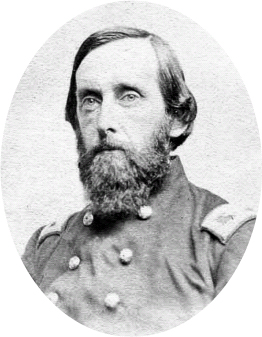
Colonel Thomas Wentworth Higginson, First South Carolina Volunteers, 38 years old, 1862.
So much for antislavery men. “The worst acts of tyranny I have known in colored regiments proceeded from those who came there as abolitionists,” Higginson declared.
Merriam wasn’t finished. He blamed Sutton for the incident—Sutton had refused to seize the guns of the miscreants—and insisted Sutton be court-martialed. Sutton was later cleared of all charges, and Merriam was promoted to captain in the Third South Carolina Colored Volunteers.
HUNTER’S REPLACEMENT WAS Brigadier General Quincy Adams Gillmore, the army engineer whose bombardment of the Georgia coast had caused the surrender of Fort Pulaski. At first he struck Higginson as fair and approachable; later Higginson would say “he is not a man of the sentiments, & if a large ‘Parrolt’ [cannon] exploded & swept away every member of his staff, he would only take out his pencil & make a note of the angle of fracture.”
Gillmore wanted Charleston and intended to take it by degrees: destroy the smaller forts around Fort Sumter safeguarding the city, then seize Sumter, then the city itself.
The first of these steps involved Higginson and his regiment. Gillmore’s plan was to cut off supplies to Charleston and its surrounding forts, weakening them, and so Higginson’s regiment was to destroy the Jacksonboro railroad bridge on the Edisto River.
On July 9 he and three hundred men set sail aboard the John Adams and two smaller boats, the Enoch Dean and a gunboat, the Governor Milton, the latter two dispatched to navigate the shallow waters beyond Wiltown Bluff. The first stage went well. The vessels pulled into Wiltown in a thick fog around four the next morning and surprised the Confederates, who hastily retreated. As the sun rose, Higginson, on board ship, watched in amazement as two hundred slaves, men, women, and children dressed in bright tatters rushed toward the marshy bank of the river, their worldly possessions wrapped in bundles and balanced on their heads. Refugees: they were the reason he had come south.
Heavy artillery fire drove the Dean and the Milton downstream, and by the time they tried to move again, they had lost the tide and the Milton had been crippled, its engines burst, the engineer killed. Though the Dean managed to continue downstream once the tide changed, in the incessant shelling two men were fatally hit, another soldier’s head shot off, and Higginson himself felt a sudden hard whack at his side. He staggered back, and though he saw neither blood nor a ripped uniform, the pain was terrible, and he fell.
When the shooting finally stopped, the Dean slid back into Wiltown Bluff and reconnoitered with the John Adams. The Milton had been scuttled—needlessly, thought Higginson.
The railway bridge had not been touched. The mission had failed.
FORTUNATELY HIGGINSON’S WOUND was superficial, and the colonel recovered quickly in the Beaufort hospital, almost proud of the purple bruise, large as two hands, that stretched along his side above the hip.
But his regiment was poorly treated, and he was angry. Decimated by pleurisy and pneumonia, black troops did not receive sufficient medical attention, and Dr. Rogers and Higginson were left to prevent scurvy without vegetables, make bread without yeast, amputate limbs without knives. The troops still suffered from the scorn of many officers, both regular and volunteer, and were begrudgingly equipped with weapons. Higginson’s and Montgomery’s regiments were told, at one point, that their firearms would be replaced with pikes.
In spite of this, and whatever the success or failure of their various expeditions, his soldiers had worked hard, behaved well, fought fearlessly. Yet they had not been paid since February. Moreover, they would not receive the promised wage of thirteen dollars; their salary had been cut to ten dollars a month. Higginson barraged the New York Tribune, The New York Times, the head of the Senate Finance Committee, the War Department, and Charles Sumner with letters: “We presume too much on the supposed ignorance of those men,” he fumed. “I have never yet found a man in my regiment so stupid as not to know when he was cheated.”
He was also furious when, later, he learned that retroactive pay would be given only to “free colored regiments”—a tacit reference to outfits like the Massachusetts Fifty-fourth—not those made up of fugitive slaves who had been “earlier in the field,” namely, his First South Carolina. The Fifty-fourth received much more publicity, causing many people to assume it was the country’s very first black regiment—they still do—and in later years Higginson would painstakingly explain that five such regiments had already existed by the year 1862.
In actual fact, Higginson’s was the first.
But the youthful, rich, and war-scarred Shaw got far more attention than Higginson. This was all the more galling since Higginson would not have minded an appointment to the Fifty-fourth. Shortly after its formation he had written Governor Andrew (in a letter subsequently published in The Liberator) bragging about the high rate of enlistment of African Americans in the First South Carolina (350 men in seven weeks). It was a great triumph, he said; so if there was difficulty raising the required number of black soldiers in the Northeast—which initially there was—he was the man for the job. The governor wasn’t interested. Shaw’s parents had donated generously to the regiment, and Hallowell, second in command, came from a similarly distinguished philanthropic family. By comparison, Higginson was inexperienced, poor, and much too radical.
A political, not a military, appointee, Higginson also knew he lacked experience. This was an issue—or was made into one, since many appointments remained political. When Shaw petitioned Governor Andrew to remove the Fifty-fourth from Montgomery’s command, he replied to the obvious question—why not advance Higginson to that position—by reminding the governor that Higginson had not been tested in battle. Andrew took Shaw’s request, almost verbatim, to Secretary of War Stanton, noting that “Higginson, the senior colonel of the brigade, although a brave and chivalrous gentleman of high culture, has never seen much service, and never any in their field until he went to South Carolina.”
That is, Higginson had proved only that black men were good enough for skirmishes; Shaw was eager to try the mettle of his black soldiers in active combat. But he would hedge his bets. “It would always be possible to put another line of [white] soldiers behind a black regiment,” Shaw allegedly said, “so as to present equal danger in either direction.” Higginson was stunned.
Though no abolitionist, Shaw was no friend to slavery, and fully grasping the symbolic importance of the Fifty-fourth, he took his position as its commander quite seriously. He also understood the hurdles the black soldier faced; every commander of a black regiment did: to each was entrusted a chance for undoing the racial prejudices that permitted slavery in the first place. But Shaw cared little about the black man, at least initially, whom he punished in order to teach. Norwood Hallowell remembered him as disciplining the unruly members of the Fifty-fourth by standing them on barrels, “bucked, gagged and, if need be, shot.” By contrast, Higginson’s training methods were based on sympathy. “In a slave regiment the harsher forms of punishment were, or ought to have been, unknown, so that every suggestion of slavery might be avoided,” Hallowell noted. “This was Colonel T.W. Higginson’s enlightened method.”
The men met in person only once, when Higginson rode over to Beaufort to visit the newly arrived troops. Afterward Shaw told his mother that “I never saw any one who put his whole soul into his work as he does. I was very much impressed with his open-heartedness & purity of character.” But as the weeks passed, Shaw himself was hardening. He even cast a more respectful eye on Montgomery.
Montgomery, Strong, Hunter, Gillmore: these were the tough, uncompromising men that war demanded, that soldiering demanded, that Shaw respected. And Higginson? He was kind. War is not kind.
Doubtless Higginson knew he was different from the rest and, like Saxton, considered too sensitive for an important command. He immovably believed that despite huge obstacles, the service of black soldiers was a stepping-stone to liberty, dignity, and full enfranchisement. While this was no doubt true, this was not soldiering.
REASSIGNED TO GENERAL STRONG’S BRIGADE, on July 16 Shaw and his men stubbornly repelled a Confederate attack on James Island, where they were encamped, and saved a white regiment’s skin, proving beyond the shadow of a doubt that a black man was a good soldier. After the battle the Fifty-fourth was sent to Cole Island, marching all night through mud and sticky swamp, and then slowly transported in groups of thirty in a small leaky boat to Folly Island.
“Folly Island gives a fair chance at Morris Island; to have Morris Island is to have Fort Sumter, & that is to have Charleston,” Higginson remarked, repeating Gillmore’s plan. On Morris Island stood the formidable Fort Wagner, a heavily armed earthwork situated near the island’s north end and just across the water from Sumter itself. (A previous attempt on Fort Wagner had ended in a rout.) Drenched from thunderstorms, thirsty, and hungry—unlike the officers, they had not eaten in two days—on the morning of July 18, Shaw’s exhausted men finally set foot on Morris Island and then marched two more bone-tiring hours.
“Well I guess we will let Strong put those d——d negroes from Massachusetts in the advance, we may as well get rid of them, one time as another,” Brigadier General Truman Seymour, who commanded Strong’s division, allegedly told Gillmore. According to Higginson, Seymour, a misanthropic man with a careless tongue, had opposed the enlistment of black troops, and Strong was a Democrat indifferent to emancipation.
On the evening of July 18 on Morris Island, Shaw reported to General Strong. Presumably Strong told Shaw that though the men of the Fifty-fourth were worn out, they could lead the column against Fort Wagner, should Shaw choose. He did.
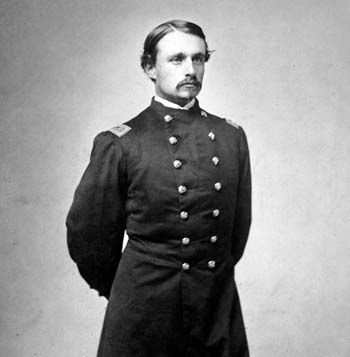
Robert Gould Shaw, leader of the famed Fifty-fourth Massachusetts, a regiment mistakenly considered the first company of African American troops, 1863. Higginson’s First South Carolina Volunteers was formed the year before.
Shaw and his men talked about the decision, and the men held hands, trying to comfort one another. They exchanged letters and pictures. Shaw gave some of his papers to his friend Edward Pierce, a journalist, and rallied the troops, telling them if the color-bearer fell, he would take the flag. Noisily the men shouted approval. Shaw’s face twitched, and he tossed aside his cigar. Thirty minutes later he cried, “Forward.”
Prepared for hand-to-hand combat, the men stole on foot across a narrow bar of sand until they were within range of the daunting earthwork fort, about one hundred yards. The hour was late, about seven forty-five, and the skies were streaked with purple rays from a fading sun. Just as the Fifty-fourth was about to rush across the ditch surrounding the fort, a sheet of fire from small arms lit the darkening night. Men lurched across the ditch, staggered, and fell. Wilky James, serving as Shaw’s adjutant, was hit in the side. Reeling, he was hit again. The column ran past him. Shaw scaled the ramparts, urging his men forward, and was shot through the heart. Undeterred, his men followed. Hand grenades flung from the parapet burst over them as they scaled the face of the fort, and for a fleeting moment one of them, Sergeant R. J. Simmons, planted their flag at its top.
Other officers tumbled to the ground, dead or mortally wounded. Higginson’s young nephew Frank guided the retreat of the battered regiment, but the path was so packed with the dead, so crammed with wounded men screaming in pain, that the soldiers could hardly move. A second regiment rushed futilely forward. There were more than fifteen hundred Union casualties.
Shaw’s body, which had fallen inside the fort, was subsequently stripped naked and placed on display before being thrown into the bottom of a large pit, the corpses of his vanquished troops tossed on top of his. “Buried with his niggers,” a victorious General Hagood presumably said, but another Confederate officer, Lieutenant Iredell Jones, said the Negroes had fought valiantly and were led by as brave an officer as ever lived. Shaw’s father instructed General Gillmore not to remove his son’s body; it should remain with his men.
Shaw and the entire Fifty-fourth Massachusetts became unassailable martyrs and heroes.
Yet it had been a slaughter. And for what? For a plan, according to Higginson, that was futile, poorly executed, ill conceived, perhaps even racist and cruel?
Thin, weak, and downcast, Higginson decided to return to Worcester on furlough. That might hasten his recuperation, for he wasn’t entirely sure what ailed him.
HIGGINSON WENT BACK to Beaufort at the end of August, when the temperature bubbled to ninety-seven degrees. But the tropical heat wasn’t the only reason his step had lost its spring. Nothing much had changed. He presided over interminable court-martials. Evenings he still liked to hear the songs of those he again, and unfortunately, called “the dear blundering dusky darlings.” But he had no taste for food, he could not sit or stand for long periods, he could not read, and at night he soaked his bedclothes in perspiration. Was this a delayed reaction to the deaths, gory, inexplicably heartless, on every side? Or was it a gnawing suspicion that those waging war in Washington were “vacillating and half proslavery”? Did he wonder whether emancipation meant the kind of enfranchisement he envisioned? Or had Montgomery’s audacity and Shaw’s martyrdom eclipsed the painstaking, committed, and compassionate abolitionism that he strenuously practiced?
He lay in the officers’ hospital early in October. Dr. Rogers guessed malaria. Mary had planned to come south, but he put her off. He suspected that he might leave the army and return north—he wanted to leave—but ambivalence kept him where he was, drilling his regiment, inhaling perfumed air, supervising pickets in the tangled cypress swamps. Charlotte Forten thought he looked thin and drawn. His eyes were hooded.
He remained in limbo, neither sick nor well. It was not that his duties had become perfunctory but rather that his faith in the military as a great equalizer was waning. “This makes me hate all arbitrary power more than ever, this military life, because I see at what a price of possible injustice its efficiency is bought.” General Gillmore devalued Saxton. Montgomery and others continued to jockey for promotions not slated for him. Dr. Rogers, himself ill, returned home, and Higginson’s regiment, plagued by smallpox, was not sent back to Jacksonville, where the Union suffered another disastrous defeat at the Battle of Olustee, again under General Seymour’s dubious command. Nor had his troops been adequately compensated, despite facile assurances from the War Department. “At a time when it required large bounties to fill the Northern regiments with their nine months men,” Higginson complained to Charles Sumner, “these men enlisted for three years without bounty, without even State aid to families relying solely on the monthly pay. For five months they received it…and then Government suddenly repudiated it and cut them down to $10.” Now they were paid seven dollars, not even the ten dollars promised. Two-thirds of the men refused to accept the pittance.
And his men seemed to need him less. “They are growing more like white men; less naïve & less grotesque,” he observed, meaning that as proven soldiers they were more independent, disciplined, sure of themselves. Perhaps his time, too, had come. He had turned forty years old.
“I feel that I hv. done my duty entirely,” he wrote Mary, but “as to these people, I feel much more clinging yet, & it will be hard to leave them & the work I feel I am doing for them—hard to leave South Carolina & [not] feel that I desert them.”
Eighteen months after taking command of the first authorized regiment of black troops in the United States, Colonel Thomas Wentworth Higginson resigned from the army and on the fourteenth of May headed north to he knew not what.