
Part Two
SIX
I enclose my name—asking you, if you please, Sir—to tell me what is true?
Emily Dickinson stops my narrative. For as the woman in white, savante and reclusive, shorn of context, place, and reference, she seems to exist outside of time, untouched by it. And that’s unnerving. No wonder we make up stories about her: about her lovers, if any, or how many or why she turned her back on ordinary life and when she knew of the enormity of her own gift (of course she knew) and how she combined words in ways we never imagined and wished we could.
And when we turn to her poems, we find that they, too, like her life, stop the narrative. Lyric outbursts, they tell no tales about who did what to whom in the habitable world. Rather, they whisper their wisdom from deep, very deep, within ourselves. And perhaps these poems plunge down so far—perhaps they unsettle us so—because Dickinson writes of experiences that we, who live in time, can barely name.
For like Hawthorne, whom she greatly admired, Dickinson spurned the overtly topical; he sneered at what he called the “damned mob of scribbling women” who wrote of social issues, not timeless truths of the human heart, and Dickinson, who shared his sense of literature’s incomparable and universal mission, took literature even further from recognizable person, place, or event. “Is it Intellect that the Patriot means when he speaks of his ‘Native Land’?” she would inquire of Higginson.
In a letter he remembered receiving in the summer of 1862, she explained warily what she was after: even if “you smile at me, I could not stop for that—,” she told him. “My Business is Circumference.” To Dickinson, circumference evidently meant both limits and the transgression of them: the soul selects its own society; the brain is wider than the sky. “St. Augustine described the nature of God as a circle whose center was everywhere and its circumference nowhere,” Emerson wrote in his 1841 essay “Circles.” “There is no outside, no inclosing wall, no circumference to us.”
And thus Dickinson braved the unknown:
I saw no Way—The Heavens were stitched—
I felt the Columns close—
The Earth reversed her Hemispheres—
I touched the Universe—
And back it slid—and I alone—
A speck opon a Ball—
Went out opon Circumference—
Beyond the Dip of Bell—
The poetic “I” is alone in the universe, intrepid though a speck upon a ball. Yet she does see a way (poetry) that extends beyond time (the “Dip of Bell”). For nothing is categorical in Dickinson, whether delight or despair or even time and death. If contentment is ragged, loneliness intolerable, her task was “To learn the Transport by the Pain—.”
More down-to-earth when writing her friends Elizabeth and Josiah Holland, she offered them, too, an explanation of her ambitions similar to the one she gave Higginson. “Perhaps you laugh at me! Perhaps the whole United States are laughing at me too!” she cried. “I can’t stop for that! My business is to love. I found a bird, this morning, down—down—on a little bush at the foot of the garden, and wherefore sing, I said, since nobody hears? One sob in the throat, one flutter of bosom—‘My business is to sing—and away she rose!’”
My business is circumference; my business is to love, my business is to sing beyond the dip of bell. By 1862 she had chosen her domain: “I dwell in Possibility—/ A fairer House than Prose—.” That year she wrote more than ever: approximately 227 poems, including some of her most frequently anthologized, such as “‘Hope’ is the thing with feathers—,” “I’m Nobody! Who are you?” and “I like to see it lap the Miles—.” The sheer quantity of her output far exceeded that of the previous year, when she composed about 88, and a year later, in 1863, she produced even more, at least 295.
Her business had thus become poetry. “Each Life converges to some Centre—,” as she wrote circa 1863,
Expressed—or still—
Exists in every Human Nature
A Goal—
Embodied scarcely to itself—it may be—
Too fair
For Credibility’s presumption
To mar—
Adored with caution—as a Brittle Heaven—
To reach
Were hopeless, as the Rainbow’s Raiment
To touch—
Yet persevered toward—surer—for the Distance—
How high—
Unto the Saints’ slow diligence—
The Sky—
Ungained—it may be—by Life’s low Venture—
But then—
Eternity enable the endeavoring
Again.
When published posthumously, this poem was titled “The Goal,” but Dickinson did not use titles; a title, as she obviously sensed, would deprive her first lines of their startling force. Take these: “He put the Belt around my life—,” “The Soul has Bandaged moments—,” “The Zeros taught Us—Phosphorus—,” “Nature—sometimes sears a Sapling—” “Remorse—is Memory—awake—,” “Doom is the House without the Door—,” “I had been hungry, all the Years—,” “One need not be a Chamber—to be Haunted—,” and “Crisis is a Hair.” One could go on and on.
And there was also, by this time, a range of tone and subject. There are poems of playful doubt—but doubt nonetheless—as in “I reason, Earth is short—.” There is the verse of pure elation: “Inebriate of air—am I—/ And Debauchee of Dew—/ Reeling—thro’ endless summer days—/ From inns of molten Blue—.” Other poems describe the numbly indescribable, as in “After great pain, a formal feeling comes—,” “There’s a certain Slant of light,” “It was not Death, for I stood up.” (Often for Dickinson, death is the mother of beauty.) Still other poems possess a lyrical certainty, lovely and austere, even pietistic after a crooked fashion, as in “God is a distant—stately Lover—.” And “The Soul selects her own Society—” would become an equivocal anthem of independence: “I’ve known her—from an ample nation—/ Choose One—/ Then—close the Valves of her attention—/ Like Stone—.”
There is the poetry of raw emotional experience, demanding ruthless gerunds to describe it: “I felt a Cleaving in my Mind—.” Parts of speech, for her, unlock the world: “Breaking in bright Orthography / On my simple sleep—/ Thundering it’s Prospective—/ Till I stir, and weep—.” She sang of extremes and fused them while keeping them distinct—light and dark, frailty and force, silence and noise blazing in gold and quenching in purple. Hers is also a poetry of mood, of change and doubt and temporary rapprochement. Art is all. Is it enough? Possibly:
The Martyr Poets—did not tell—
But wrought their Pang in syllable—
That when their mortal name be numb—
Their mortal fate—encourage Some—
DICKINSON IS ALSO A POET OF LOSS. “‘We take no note of Time, but from its loss,’” Dickinson (like her father) quoted Edward Young’s poem “Night Thoughts.” And if hyperbolic, she was also deadly earnest; even at the young age of fifteen, she lived in retrospect. Time was fleeting, yes, and a robber too. “I often part with things I fancy I have loved,—sometimes to the grave, and sometimes to an oblivion rather bitterer that [than] death—,” she would tell Sue on the occasion of Sue’s visit to family in Michigan. “Thus my heart bleeds so frequently that I shant mind the hemorrhage.”
“Of nearness to her sundered Things / The Soul has special times—,” she wrote circa 1862 in a poem of reversal that anticipates Gerard Manley Hopkins.
….….
Bright Knots of Apparitions
Salute us, with their wings—
As we—it were—that perished—
Themself—had just remained till we rejoin them—
And ’twas they, and not ourself
That mourned—
Again, a few years later: “A loss of something ever felt I—/ The first that I could recollect / Bereft I was—of what I knew not / Too young that any should suspect.” Loss, as subject, helped her outline the painful but perhaps necessary distances that separate us, person from person and person from nature. “A Light exists in Spring,” she writes, probably in 1865,
Not present on the Year
At any other period—
When March is scarcely here
A Color stands abroad
On Solitary Fields
That Science cannot overtake
But Human Nature feels.
It waits opon the Lawn,
It shows the furthest Tree
Opon the furthest Slope you know
It almost speaks to you.
Then as Horizons step
Or Noons report away
Without the Formula of sound
It passes and we stay—
A quality of loss
Affecting our Content
As Trade had suddenly encroached
Opon a Sacrament—
Loss, true. But March is her season (“Dear March—Come in—”), a time of transition and renewed hope. For even when the light of spring passes and we stay, the poet produces a vision “That Science cannot overtake / But Human Nature feels.” It almost speaks to you, as she does, without the derivative and predictable “Formula” of conventional verse—or narrative. And it happens in an instant; it’s an experience much like that of reading her poems.
Higginson felt this, and she had told him as much when she enclosed this poem in her first letter, postmarked April 15, 1862:
The nearest Dream recedes—unrealized—
The Heaven we chase—
Like the June Bee—before the School Boy—
Invites the Race—
Stoops—to an easy Clover—
Dips—evades—teazes—deploys—
Then—to the Royal Clouds
Lifts his light Pinnace—
Heedless of the Boy—
Staring—bewildered—at the mocking sky—
Homesick for steadfast Honey—
Ah—the Bee flies not
That brews that rare variety!
As the bee is to the boy, the distant “Heaven we chase” tempts, tantalizes, and finally evades us, and we, yearning for “steadfast Honey,” never quite attain the things—that paradise of perfection—we most desire (“the nearest Dream recedes—unrealized—”). Yet this is not a poem of despair—far from it, for the poet does in fact “realize” a dream, encapsulating it in a language that calls, dips, and flees from us—true—but that leaves us less alone, less aggrieved, less bereft than we were.
Higginson considered this poem one of her most exquisite.
LOSS: WE KNOW THE QUEST is futile but nonetheless rake over Dickinson’s life, hunting for the concrete experiences that might account for her obsession with it, particularly during her most prolific years. Had the birth of Sue and Austin’s son Edward (Ned) in 1861 stolen Sue’s attention; had the imminent departure of the Reverend Charles Wadsworth for a ministerial post in San Francisco scalded the poet’s heart? Is that why she told Higginson, much later, that his friendship had rescued her? Or was she thinking solely of her poems when she approached him, grateful that he responded as he did?
Or was it the war? Certainly the world outside the Homestead was besieged by narrative: each day villagers listened at the telegraph office for the ominous clicks and scanned the newspapers for names of the wounded and dead. “Sorrow seems more general than it did and not the estate of a few persons, since the war began,” Dickinson sadly observed. “They dropped like Flakes—,” she wrote in a poem Higginson later called “The Battle-Field.”
They dropped like Flakes—
They dropped like stars—
Like Petals from a Rose—
When suddenly across the June
A Wind with fingers—goes—
They perished in the seamless Grass—
No eye could find the place—
But God can summon every face
On his Repealless—List.
Men disappear into a vast indifference of “seamless Grass”—wonderful image, all the more striking because grass typically reassures; here it cannot. It does not. Frazar Stearns, the twenty-one-year-old son of the Amherst College president, was killed at the Battle of New Bern in North Carolina in March 1862. He had murmured, “My God,” Dickinson said, and asked for water twice before he died, “his big heart, shot away by a ‘minie ball.’”
“Nobody here could look on Frazar—,” she reported to her cousins, “not even his father.” The casket, drenched in spring flowers, was uncharacteristically closed, and Austin was devastated, as Emily wrote Samuel Bowles, “says—his Brain keeps saying over ‘Frazar is killed’—‘Frazer is killed,’ just as Father told it—to Him. Two or three words of lead—that dropped so deep, they keep weighing—.”
Words of lead: “This is the Hour of Lead—/ Remembered, if outlived, / As Freezing persons, recollect the Snow—/ First—Chill—then Stupor—then the letting go—.” Is the letting go resignation? A deathlike capitulation to despair? In either case, as Hawthorne bleakly wrote in the July 1862 Atlantic, “there is no remoteness of life and thought, no hermetically sealed seclusion, except, possibly, that of the grave, into which the disturbing influences of this war do not penetrate.” Yet Higginson was counseling the long view in his “Letter to a Young Contributor,” published three months earlier and just as the awful Battle of Shiloh had left twenty thousand casualties in its wake. Remember literature, Higginson wrote: “General Wolfe, on the eve of battle, said of Gray’s ‘Elegy,’ ‘Gentlemen, I would rather have written that poem than have taken Quebec.’”
Little wonder that he snagged her attention. Of course she could not know, as he then did not, that his withdrawal from the field of action was not unqualified and never could be.
But neither was hers. “I’m sorry for the Dead—Today—,” Dickinson writes in one of her poems, and to her cousins bleakly remarked, “If the anguish of others helped with one’s own, now would be many medicines.”
“I noticed that Robert Browning had made another poem,” she continued, “and was astonished—till I remembered that I, myself, in my smaller way, sang off charnel steps. Every day life feels mightier, and what we have the power to be, more stupendous.”
It dont sound so terrible—quite—as it did—
I run it over—“Dead”, Brain—“Dead”.
Put it in Latin—left of my school—
Seems it dont shriek so—under rule.
Perhaps under the rule of poetry, the shrieking will stop. “We—tell a Hurt—to cool it—,” she writes in another poem, reminding us that she told Higginson she sang to relieve a palsy. Of what she did not say. Yet anguish and bereavement paradoxically toughened her (“An actual suffering strengthens / As Sinews do, with Age—”). As did poetry. In her second letter to him, she sent “Of all the Sounds despatched abroad,” ostensibly about the wind but containing an implicit tribute to the poet, whose fingers comb the sky:
Of all the Sounds despatched abroad,
There’s not a Charge to me
Like that old measure in the Boughs—
That phraseless Melody—
The Wind does—working like a Hand,
Whose fingers Comb the Sky—
Then quiver down—with tufts of Tune—
Permitted Gods, and me—
WHAT DID HIGGINSON really think when he first read Dickinson’s poetry? “The bee himself did not evade the schoolboy more than she evaded me,” he wrote, recalling his bafflement, “and even at this day I still stand somewhat bewildered, like the boy.”
This one arrived in the summer of 1862:
A Bird, came down the Walk—
He did not know I saw—
He bit an Angle Worm in halves
And ate the fellow, raw,
And then, he drank a Dew
From a convenient Grass—
And then hopped sidewise to the Wall
To let a Beetle pass—
He glanced with rapid eyes,
That hurried all abroad—
They looked like frightened Beads, I thought,
He stirred his Velvet Head.—
Like one in danger, Cautious,
I offered him a Crumb,
And he unrolled his feathers,
And rowed him softer Home—
Than Oars divide the Ocean,
Too silver for a seam,
Or Butterflies, off Banks of Noon,
Leap, plashless as they swim.
The poem’s surface charm would not be lost on Higginson: a bird, scrupulously observed by the speaker (“rapid eyes…like frightened Beads”), takes his morning meal. But there is nothing romantic here: the bird eats the angleworm raw. And what about the off rhymes (abroad / Head, Crumb / Home)? The collective nouns (“Dew,” “Grass”) introduced by singular articles (“a Dew,” “a…Grass”)? The dashes? Certainly this looked unlike anything he had ever seen. And who is in danger, who is cautious, the speaker or the bird? Are the two of them forever separate, alien from each other, as the bird’s flight at the end of the poem, so meticulously described, suggests?
More easily comprehended, not just by Higginson but by everyone, was Julia Ward Howe’s “Battle Hymn of the Republic,” published in The Atlantic in the winter of 1862 and sung by Union troops to the tune of “John Brown’s Body.” (Said Ralph Waldo Emerson of Howe, “I could well wish she were a native of Massachusetts. We have no such poetess in New England.”) Howe delivered public poetry to an eager audience bred on the verse regularly printed in newspapers and magazines, set to music, or adapted by politicians to their ends. When the Hutchinson Family Singers included one of Whittier’s abolitionist poems in their repertoire, set to the melody of Luther’s hymn “Ein’ feste Burg ist unser Gott,” they lost their permit to give concerts because, it was alleged, the Union troops resented their radical politics. But Salmon Chase, secretary of the Treasury, read the poem during a Cabinet meeting, and Lincoln said it was just the thing he wanted the troops to hear. The ban was lifted.
Higginson’s friend Whittier was well liked, particularly after the publication of his postwar masterwork, Snow-Bound (1866), which sold a whopping twenty thousand copies within months of its appearance. And Higginson’s former teacher, the genteel Henry Longfellow, had already been selling poems by the bushel. His first volume, Voices of the Night (1839), went through three printings. Here are four lilting stanzas of iambic tetrameter from one his most beloved works, “A Psalm of Life”:
Tell me not, in mournful numbers,
Life is but an empty dream!—
For the soul is dead that slumbers,
And things are not what they seem.
Life is real! Life is earnest!
And the grave is not its goal;
Dust thou art, to dust returnest,
Was not spoken of the soul.
Not enjoyment, and not sorrow,
Is our destined end or way;
But to act, that each to-morrow
Find us farther than to-day.
Art is long, and Time is fleeting,
And our hearts, though stout and brave,
Still, like muffled drums, are beating
Funeral marches to the grave.
The fourth stanza deserves comparison with Dickinson’s “I felt a Funeral, in my Brain”:
I felt a Funeral, in my Brain,
And Mourners to and fro
Kept treading—treading—till it seemed
That Sense was breaking through—
And when they all were seated,
A Service, like a Drum—
Kept beating—beating—till I thought
My mind was going numb—
And then I heard them lift a Box
And creak across my Soul
With those same Boots of Lead, again,
Then Space—began to toll,
As all the Heavens were a Bell,
And Being, but an Ear,
And I, and Silence, some strange Race
Wrecked, solitary, here—
And then a Plank in Reason, broke,
And I dropped down, and down—
And hit a World, at every plunge—
And Finished knowing—then—
Dickinson’s sensibility—never mind her use of form—could not be more different. While the virtuosic bard, a master of several languages and author of the famous Evangeline and the equally famous Courtship of Miles Standish, stretched himself across poetic genres (ballad, pastoral, folk epic), she did not care about genre or story or about pleasing the average audience. (Longfellow would please even the queen of England, who granted him a private audience.) Where Longfellow aims toward universal uplift, Dickinson stays alone, her tenor somber, her wit quick, her rhymes dissonant, and her images (“Being, but an Ear”) typically raucous and strangely splendid. A temperate man who always looked to the horizon, Longfellow aimed to forge a national myth; Dickinson burrowed deep into the individual soul, tapping feelings often suppressed, unacknowledged, recondite, and fearsome.
Dickinson carefully read Browning and Emerson, enthusiasms she shared with Higginson (he adored Emerson’s “Days”), and Higginson recommended Browning’s Pippa Passes. Of women poets they both admired Elizabeth Barrett Browning and Emily Brontë, but Higginson was also promoting the verse of Harriet Spofford. (Spofford’s short story “Circumstance, in which a woman calms a hideous forest beast by singing to it, was the only story, said Dickinson, she could not imagine having written herself.) Sue later remembered Spofford’s “Pomegranate-Flowers” as a swatch of vivid color in those old sepia-seeming Atlantic Monthlys.
Now all the swamps are flushed with dower
Of viscid pink, where, hour by hour,
The bees swim amorous, and a shower
Reddens the stream where cardinals tower.
Far lost in fern of fragrant stir
Her fancies roam, for unto her
All Nature came in this one flower.
Despite its lush decor, the tightly wound Spofford poem is phonically tedious. Dickinson is not. She pauses where we least expect a pause, and she bunches phrases in unusual lyric clusters. Aware of her metrical innovations—and no doubt of her sensuality, too—Higginson in his first letter to her perceptively asked Dickinson what she thought of Walt Whitman. She said she avoided him, having heard he was scandalous. (She also said she’d been so haunted by “Circumstance” she now avoided its author.)
Likely she fibbed. She had told Sue she wanted to read all of Spofford’s work—and regarding Whitman, she did know that guardians of high culture like Charles Eliot Norton, a friend of Higginson’s, said he’d be sorry to learn that a woman had read beyond the title page of Leaves of Grass. “It is no discredit to Walt Whitman that he wrote Leaves of Grass,” Higginson himself would say in 1870, “only that he did not burn it afterwards.”
Higginson had met Whitman ten years earlier, having bumped into him at the Washington Street offices of the radical Boston publishers William Thayer and Charles Eldridge. Sitting on a counter, the poet had come to read proofs of the third edition of Leaves of Grass, and though handsome and burly, he did not look, as Higginson would remember, “to my gymnasium-trained eye, in really good condition for athletic work. I perhaps felt a little prejudiced against him from having read ‘Leaves of Grass’ on a voyage, in the early stages of seasickness,—a fact which doubtless increased for me the intrinsic unsavoriness of certain passages. But the personal impression made on me by the poet was not so much of manliness as of Boweriness, if I may coin the phrase.”
Yet while Whitman stood apart from the pulling and hauling of a commercial America, of all his contemporaries he best bridged the gulf between public and private—and between action and contemplation—which Higginson hoped to do. Like Dickinson, he sang, and he sang of himself, but his inclusive vision celebrated and touched, or aimed to touch, the broad expanse of people and place and preoccupation that made America. Higginson would dismiss this as rank hypocrisy. “We all looked to him as precisely the man to organize a regiment on Broadway,” he later said; but Whitman chose “the minor & safe function of a nurse.” Higginson thus resented Drum-Taps even more than Leaves of Grass—war poems written by one who had never carried a drum.
Still, here he was, in 1862, asking Dickinson if she knew of Whitman’s work. Whatever his limitations, and despite his queasiness, Higginson could spot and respond to talent.
THE DEATH OF FRAZAR STEARNS, Wadsworth’s removal to California, now Samuel Bowles’s departure for Europe and Dickinson’s unresolved relation to a mysterious Master—these were the circumstances of her life in the spring 1862, when she first wrote to Wentworth Higginson. And here, in a sense, narrative begins. Higginson is narrative. His life proceeds by it; he believes in it. For him there are beginnings and middles, and when it comes to slavery, he is focused on ends.
Yet she wrote to this man of the world not as a bereft lover or plaintive friend, not as a woman besieged by a beast in the woods, not as sister-in-law or sister, not as anything but a poet, sweetly imploring him in her next letter, “Could you tell me how to grow—or is it unconveyed—like Melody—or Witchcraft?”
Flattered by her queries and evidently floored by her poems, he offered some criticism, then worried he had been a touch too harsh. Not at all, she reassured him. She had wanted the truth: “I had rather wince, than die,” she explained. “Men do not call the surgeon, to commend—the Bone, but to set it, Sir, and fracture within, is more critical.”
In return, though, she flirtatiously promised him obedience and gratitude, intending no doubt to flatter him further. She then sent him another four poems. She had taken none of his advice. “I thanked you for your justice—,” she would tell him, “but could not drop the Bells whose jingling cooled my Tramp.”
Still, his response to her had been insightful and tender enough to please her, and in a very early letter to him, she had included the poem “Your Riches, taught me, poverty—”
Your Riches, taught me, poverty—
Myself a Millionaire—
In little wealths—as Girls could boast—
Till broad as Buenos Ayre—
You drifted your Dominions—
A different Peru—
And I esteemed all poverty—
For Life’s Estate, with you—
Of Mines, I little know, myself—
But just the names—of Gems—
The Colors of the commonest—
And scarce of Diadems—
So much—that did I meet the Queen—
Her glory—I should know—
But this—must be a different wealth—
To miss it, beggars so—
I’m sure ’tis India—all day—
To those who look on you—
Without a stint—without a blame—
Might I—but be the Jew!
I’m sure it is Golconda—
Beyond my power to deem—
To have a smile for mine, each day—
How better, than a Gem!
At least, it solaces to know—
That there exists—a Gold—
Although I prove it just in time
It’s distance—to behold!
It’s far—far Treasure to surmise—
And estimate the Pearl—
That slipped my simple fingers through—
While just a Girl at school!
She had already given Sue a version of this poem, which she may have composed in memory of Benjamin Newton; by presenting it to Higginson, she buttressed her request for his friendship: his riches, his worldliness, his fame, his gentility made him exotic, foreign, powerful. And the “Girl at school”? No droopy supplicant, drab and forlorn, she can create her own interlocutor just by imagining him, which she, in part, will do. But he will help.
She also enclosed “Success—is counted sweetest,” a poem often reproduced today and that, in this context, spoke to Higginson’s dilemma about joining the war effort, for Dickinson knew he was writing essays in Worcester, not shooting at Confederates in Virginia. He need not second-guess his decision not to enlist, she seems to suggest; victory lies in defeat, perhaps even in withdrawal.
Success—is counted sweetest
By those who ne’er succeed—
To Comprehend a Nectar—
Requires sorest need—
Not one of all the Purple Host
Who took the Flag—today—
Can tell the Definition—so clear—of Victory—
As He—defeated—dying—
On whose forbidden ear—
The distant strains of Triumph
Burst—agonized—and Clear!
As for herself, Dickinson was content, or seemed to be, with the paradox of never succeeding. Defeat was specific victory, far better than success.
HE MUST HAVE ANSWERED right away, for their correspondence begins to sound like a conversation. “You say ‘Beyond your knowledge,’” she gently chided him in the summer of 1862. “You would not jest with me, because I believe you—but Preceptor—you cannot mean it? All men say ‘What’ to me, but I thought it a fashion—.”
He was unlike all other men. Nor did she believe she was “beyond his knowledge,” or at least not completely. And if she was, then his confusion pleased her, his gallantry in the face of what he did not understand, his respect for it.
She teased him with coquettish condescending humor. “I think you called me ‘Wayward,’” she reproved him. “Will you help me improve?” She sent him a poem, “Of Tribulation—these are They,” with the note “I spelled ancle wrong” but did not correct the spelling.
Again she enclosed poems: along with “A Bird, came down the Walk—,” she sent “Before I got my eye put out—,” “I cannot dance opon my Toes—,” and, it seems, a resplendent “Dare you see a Soul at the ‘White Heat’?” Mostly about the act of creation, these poems told Higginson that even if she could not dance upon her toes—“No Man instructed me”—her poems, irreducible, are distinct, self-sufficient, and much more arresting than standard “Ballet knowledge,” however graceful or well executed. The soul burns at the white heat. Dare he look? “Are these more orderly?” she asked, tongue in cheek.
Dare you see a Soul at the “White Heat”?
Then crouch within the door—
Red—is the Fire’s common tint—
But when the vivid Ore
Has vanquished Flame’s conditions—
It quivers from the Forge
Without a color, but the Light
Of unannointed Blaze—
Least Village, boasts it’s Blacksmith—
Whose Anvil’s even ring
Stands symbol for the finer Forge
That soundless tugs—within—
Refining these impatient Ores
With Hammer, and with Blaze
Until the designated Light
Repudiate the Forge—
Dickinson had thrown down the glove, daring him to watch her perform. But poetry was more than a performance, however incandescent; it was transcendent, white-hot, volcanic. “When I try to organize—my little Force explodes,” she told him, “and leaves me bare and charred.”
Higginson wanted to meet her, this small, wrenlike correspondent with the sherry-colored eyes and exploding force. Was he conscious of the sexual innuendo? Was she? In either case he would have to wait; he had left his study to drill troops at Camp Wool, near Worcester, and prepare them for battle. She at first said nothing and then responded, “You told me in one letter, you could not come to see me ‘now,’ and I made no answer, not because I had none, but did not think myself the price that you should come so far—.”
She was definitely worth the price. About this both of them tacitly agreed, for they had begun the rare epistolary communication that seems, somehow, more real than bodily contact, with its averted eyes and fidgety hands, its blushes and shuffling feet. “A Letter always feels to me like immortality because it is the mind alone without corporeal friend,” she would tell him. “Indebted in our talk to attitude and accent, there seems a spectral power in thought that walks alone.” They were able to invent each other, at least in part, as well as speak to each other without bounds. For their link was words—their letters, her poetry, his essays. Words meant everything to her and a great deal to him.
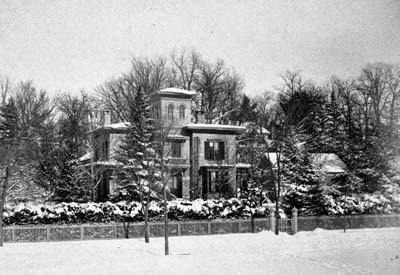
The Evergreens.
“Of our greatest acts we are ignorant—,” she told him at a later date, recollecting then what his attention, his courtesy, his comprehension offered her during their first months of correspondence. “You were not aware that you saved my Life.”
Perhaps the same was true for him. In any case, he did save almost every letter.
IT WAS A CLEAN, well-lit bedroom in the southwest corner of the Homestead. To the west it faced the Evergreens, and from a set of windows to the south Dickinson could peer across rolling meadows, their color fading from yellow in fall to the glittering bone white of winter. And there was the light: “There’s a certain Slant of light, / Winter Afternoons—.” Inside, a Franklin stove relieved the chill; her small mahogany sleigh bed was covered with a warm counterpane. Beyond it sat the bureau, in which Lavinia, years later, would find her manuscripts. And slipped into the southwest corner was the small cherry desk (only seventeen and a half inches square) on which she conducted a vast correspondence and composed almost eighteen hundred poems. “Sweet hours have perished here, / This is a timid room—,” she wrote. It was not.
No more than five feet tall, she covered her small shoulders with a paisley wool shawl of auburn and orange. Her housedress contained several pockets; supposedly she kept pencil and paper in one of them. In coming years, though, she dressed only in shades of alabaster.
It was the raw November of 1862, and the war dragged on, but the Springfield Republican trumpeted Higginson’s essay, published in the December Atlantic, “an article upon wildflowers as only T. W. Higginson can write, since no other like him explores the sylvan haunts with the foot of a child, the eye of an artist and the heart of a woman.”
The Republican was referring to Higginson’s “Procession of the Flowers,” another of his languid nature essays, which concludes, as his essays often do, with a tribute to the art he himself could not produce:
If, in the simple process of writing, one could physically impart to this page the fragrance of this spray of azalea beside me, what a wonder would it seem!—and yet one ought to be able, by the mere use of language, to supply to every reader the total of that white, honeyed, trailing sweetness, which summer insects haunt and the Spirit of the Universe loves. The defect is not in language, but in men. There is no conceivable beauty of blossom so beautiful as words,—none so graceful, none so perfumed. It is possible to dream of combinations of syllables so delicious that all the dawning and decay of summer cannot rival their perfection, nor winter’s stainless white and azure match their purity and their charm. To write them, were it possible, would be to take rank with Nature; nor is there any other method, even by music, for human art to reach so high.
Dickinson would agree with him in that trenchant, pithy way of hers: “Nature is a Haunted House—,” she informed him, “but Art—a House that tries to be haunted.”
BY THE TIME “Procession of the Flowers” appeared in The Atlantic, Higginson had already polished his rifle, packed his duffle, and dispatched a trunk to South Carolina, prompting Dickinson to remark dryly, “I trust the ‘Procession of Flowers’ was not a premonition—.”