
STEP 5
PRACTICE TEST
Answer Sheet

AP WORLD HISTORY PRACTICE TEST
Section I
Time: 1 hour, 45 minutes
Part A: Multiple-Choice Questions
Recommended Time for Part A: 55 Minutes
Directions: Each of the incomplete statements or questions below is followed by four answer choices. Choose the answer that is best and mark the letter of your choice on the answer sheet supplied.
Questions 1 to 3 refer to the passage below.
The condition of foreign states is not what it once was; they have invented the steamship, and introduced radical changes in the art of navigation. They have also built up their armies to a state of great efficiency and are possessed of war implements of great power and precision, in short have license to be formidable powers. If, therefore, we persistently cling to our antiquated systems, heaven only knows what a mighty calamity may befall our Empire.
—Adapted from a letter written by Lord Ii to Lord Tokugawa, 1847
1 . Which event or period in Japan’s history best reflects Lord Ii’s concerns?
(A) The expulsion of Christian missionaries from Japan
(B) The adoption of Chinese imperial customs in the Japanese court
(C) The annexation of Manchuria by the Japanese
(D) Commodore Perry forcing Japan to open its ports to trade
2 . How did Japan respond to the concerns raised by Lord Ii during this era?
(A) The government dismantled the Chinese-style civil service system.
(B) The government undertook a program of conquest in the Pacific.
(C) The country sent emissaries to study western democracies and industry.
(D) The country turned inward and closed its ports to all foreigners.
3 . The era in Japanese history following this passage is known as the
(A) Meiji Restoration.
(B) Heian period.
(C) Tokugawa Shogunate.
(D) Jomon period.
Questions 4 to 6 refer to the passage below.
He contains all works and desires and all perfumes and all tastes. He enfolds the whole universe and in silence is loving to all. This is the Spirit that is in my heart, this is Brahman. To him I shall come when I go beyond this life, and to him will come he who has faith and doubts not.
—The Upanishads, India, c. 1000 BCE
4 . Based on the quotation, what is true of Brahman?
(A) He is found everywhere and contained in everything.
(B) He resides in a form of paradise, like Heaven.
(C) He is found only inside the hearts of the faithful.
(D) He is a vengeful God, punishing those who sin.
5 . Based on the quotation, which statement is true of the speaker’s religion?
(A) Salvation is based on the correct completion of rituals.
(B) There is an expectation of an afterlife.
(C) Right actions and right speech earn favor with the gods.
(D) It is a polytheistic religion.
6 . To which religion does the speaker most likely belong?
(A) Hinduism
(B) Buddhism
(C) Shintoism
(D) Zoroastrianism
Questions 7 to 9 refer to the quotation below.
The invaders had brought in wheat and other Eurasian and African grains; peach, pear, orange, and lemon trees; chick-peas, grape vines, melons, onions, radishes, and much more. A Spanish nobleman come to America could require his Indians to furnish his table with the fruits of his ancestors.
—Alfred Crosby, historian, 1972
7 . The comment quoted above resulted from which of the following processes?
(A) The Green Revolution
(B) The Columbian Exchange
(C) The triangular trade
(D) The Middle Passage
8 . What was the impact of this process on Europe?
(A) The population increased due to the increased diversity of crops.
(B) The population declined as a result of imported disease.
(C) The population increased due to New World immigrants.
(D) The population declined because of famine caused by the mass export of crops.
9 . What economic practice is referred to by the phrase “his Indians” in the quote?
(A) Slavery
(B) Indentured servitude
(C) The encomienda system
(D) The apprentice system
Questions 10 to 14 refer to the image below, which shows the use of a pre-Columbian wooden foot plow.

—Felipe Guaman Poma de Ayala, 1616
10 . What can one infer from the above illustration?
(A) Farming practices relied on human labor.
(B) There was extensive use of irrigation.
(C) Farming was the exclusive purview of women.
(D) Animals were valued too highly to be used in the fields.
11 . Metal work and animal-drawn plows were essential parts of the development of complex societies in Africa and Eurasia, but not in the Americas. This would indicate which of the following?
(A) The role of religion in economic development
(B) The influence of environmental factors in patterns of development
(C) That the earliest Americans emphasized warfare at the expense of their own economic development
(D) That the earliest Americans depended primarily on trade rather than on agriculture to sustain their economies
12 . Which of the following was the major difference between the Aztecs and other early empires?
(A) The Aztecs had no writing system.
(B) The Aztecs did not use metallurgy.
(C) The Aztecs had no wheeled transportation.
(D) The Aztecs never developed overland trade networks.
13 . A historian arguing that there were limited interregional networks in the Americas might use which of the following as evidence?
(A) The llama was domesticated in Andean culture, but was not found in Mesoamerica.
(B) The Andean civilization had extensive roads and bridges, but Mesoamerica did not.
(C) There was no strong religious tradition in Andean culture, compared with the Maya.
(D) The Andeans had a system of writing, but the Maya did not.
14 . Chinampas and terraces, used in Aztec and Incan agriculture, both show which of the following?
(A) Societies adapting to their environments
(B) Cultural diffusion
(C) Efforts to reform land ownership
(D) Coercive labor systems
Questions 15 to 18 refer to the following passage.
But the decline of Rome was the natural and inevitable effect of immoderate greatness. Prosperity ripened the principle of decay; the causes of destruction multiplied with the extent of conquest; and, as soon as time or accident had removed the artificial supports, the stupendous fabric yielded to the pressure of its own weight. . . . The victorious legions, who, in distant wars, acquired the vices of strangers and mercenaries, first oppressed the freedom of the republic, and afterwards violated the majesty of the purple. The emperors, anxious for their personal safety and the public peace, were reduced to the base expedient of corrupting the discipline which rendered them alike formidable to their sovereign and to the enemy; the vigour of the military . . . was relaxed . . . ; and the Roman world was overwhelmed by a deluge of Barbarians.
—Adapted from Decline and Fall of the Roman Empire , by Edward Gibbon
15 . The reasons given in the above passage for the fall of the Roman Empire could also be applied to which other classical empires?
(A) Tang and Ottoman
(B) Ming and Aztec
(C) Han and Gupta
(D) Qin and Etruscan
16 . The decline of the Roman Empire and that of its Chinese counterpart resulted in which of the following?
(A) A decline in the appeal of religions of salvation
(B) A shift from trade along the Silk Roads to sea routes in the Indian Ocean
(C) An increased importance of the role of the father as the head of the household
(D) A decline in the rights of women
17 . Most classical empires shared which of the following traits?
(A) They required the cultural assimilation of conquered peoples to limit diversity within the empire.
(B) They provided state support of foreign religions to improve support of the government.
(C) They embarked on widespread public works projects to integrate their empires.
(D) They had government bureaucracies based on the merit principle.
18 . The author of the above passage claims: “Prosperity ripened the principle of decay; the causes of destruction multiplied with the extent of conquest.” What does he mean by this?
(A) The rulers became too rich and thus were overthrown.
(B) The empire became too large to control effectively.
(C) Decay begins the minute something begins to grow.
(D) Conquest and prosperity are mutually exclusive.
Questions 19 to 21 refer to the political cartoon below.

—Chain of Friendship, American political cartoon, 1914
19 . The above political cartoon best illustrates which political concept?
(A) Imperialism
(B) Nationalism
(C) Alliances
(D) Militarism
20 . The order of the countries shown in the cartoon—Serbia–Austria–Russia–Germany–France—supports which of the following statements?
(A) World War I was a politicians’ war.
(B) France attacked all the countries that were in front of it in line.
(C) Russia supported Serbia; France supported Russia.
(D) World War I was strictly a European war.
21 . Countries that also took part in World War I for varying amounts of time included which of the following?
(A) Poland, Denmark, and Great Britain
(B) Switzerland, Greece, and Turkey
(C) Bulgaria, Italy, and the United States
(D) Great Britain, Spain, and France
Questions 22 to 24 refer to the drawing below.

22 . One would be most likely to find the above structure useful in understanding which of the following?
(A) Religious practices in Ur in the period before 600 BCE
(B) Political organization in Central Asia in the period from 600 BCE to 600 CE
(C) Cultural diffusion in West Africa in the period from 600 CE to 1450 CE
(D) Burial practices in Egypt in the period before 600 BCE
23 . The structure depicted in the drawing represents which particular type of architecture common from the preclassical era to the present?
(A) Monumental
(B) Funereal
(C) Theatrical
(D) Hierarchical
24 . Structures that are similar in design and purpose include which of the following?
(A) Egyptian pyramids
(B) Early Chinese pagodas
(C) Meso-American pyramids
(D) The Parthenon
Questions 25 to 27 refer to the poem below.
You are the United States,
you are the future invader
of the native America that has Indian blood,
that still prays to Jesus Christ and still speaks Spanish.
. . .
you are Alexander-Nebuchadnezzar.
You think that life is fire,
that progress is eruption,
that wherever you shoot
you hit the future.
No.
. . .
But our America, that has had poets
since the ancient times of Netzahualcoyotl,
. . .
that consulted the stars, that knew Atlantis
whose resounding name comes to us from Plato,
that since the remote times of its life
has lived on light, on fire, on perfume, on love,
America of the great Montezuma, of the Inca,
the fragrant America of Christopher Columbus,
Catholic America, Spanish America,
the America in which noble Cuauhtémoc said:
“I’m not in a bed of roses”, that America
that trembles in hurricanes and lives on love,
it lives, you men of Saxon eyes and barbarous soul.
And it dreams. And it loves, and it vibrates, and it is the daughter of the sun.
Be careful. Viva Spanish America!
There are a thousand cubs loosed from the Spanish lion.
Roosevelt, one would have to be, through God himself,
the-fearful rifleman and strong hunter,
to manage to grab us in your iron claws.
And, although you count on everything, you lack one thing: God!
—Adapted from “To Roosevelt” by Ruben Dario, 1904
25 . What events might have prompted the poet to compose this piece?
(A) The discovery of the Zimmerman Telegram
(B) The embargo of Cuba after Castro’s revolution
(C) U.S. involvement in Panama’s independence
(D) U.S. involvement in the Haitian Revolution
26 . What was the poet’s purpose in discussing “our America, that has had poets since ancient times, . . . that consulted the stars”?
(A) Latin America has excelled in poetry.
(B) Latin America had made significant scientific contributions.
(C) Latin America had a prophecy regarding these events.
(D) Latin America has had a rich culture for centuries.
27 . Which statement best reflects the theme of the poem?
(A) Latin Americans are too naïve and should fight back.
(B) Latin America has survived many invaders and will endure.
(C) The Spanish have already destroyed Latin American culture.
(D) Change is necessary for progress.
Questions 28 to 31 refer to the passage below.
Bonesteel’s prime consideration was to establish a surrender zone as far north as he thought the Soviets would accept. He knew that the Russian troops could reach the southern tip of Korea before American troops could arrive. He also knew that the Russians were on the verge of moving into Korea, or were already there. The nearest American troops to Korea were on Okinawa, 600 miles away. His problem, therefore, was to compose a surrender arrangement which, while acceptable to the Russians, would at the same time prevent them from seizing all of Korea. If they refused to confine their advance to north Korea, the United States would be unable to stop them. . . . He decided to use the 38th parallel as a hypothetical line dividing the zones within which Japanese forces in Korea would surrender to appointed American and Russian authorities.
—Adapted from U.S. Army Lt. Paul C. McGrath’s account of Colonel Bonesteel’s decision in the 1940s
28 . What was the world history event occurring in the stated time frame that caused the Soviet Union to enter Korea?
(A) The Crimean War
(B) World War I
(C) World War II
(D) The Seven Years’ War
29 . Which best describes the relationship between the United States and the Soviets as depicted in the passage?
(A) Uneasy allies
(B) Comrades-in-arms
(C) Mortal enemies
(D) Distant strangers
30 . How did the events depicted here affect Koreans?
(A) They became a part of Japan’s territory.
(B) The Americans established freedom for all Koreans.
(C) The Korean economy never recovered.
(D) Korea remains divided into two nations near the 38th parallel.
31 . Which U.S. cold war policy, developed later, is consistent with the U.S. concern over limiting how much Korean territory the Soviet Union would occupy?
(A) Détente
(B) Mutual Assured Destruction
(C) Dollar Diplomacy
(D) Containment
Questions 32 to 34 refer to the passage below.
As for their men there is no sexual jealousy in them. And none of them derives his genealogy from his father but, on the contrary, from his maternal uncle. A man does not pass on inheritance except to the sons of his sister to the exclusion of his own sons. . . . They are Muslims keeping to the prayers, studying fiqh (Islamic jurisprudence) and learning the Qur’an by heart. With regard to their women, they are not modest in the presence of men; they do not veil themselves in spite of their perseverance in the prayers. He who wishes to marry among them can marry, but the women do not travel with the husband, and if one of them wanted to do that, she would be prevented by her family. The women there have friends and companions amongst men outside the prohibited degrees of marriage [i.e., other than brothers, fathers, etc.]. Likewise for the men, there are companions from amongst women outside the prohibited degrees. One of them would enter his house to find his wife with her companion and would not disapprove of that conduct.
—Adapted from an account by Ibn Battuta of his travels in Mali during the 1300s
32 . What evidence is there in the passage that the Malians take their Muslim faith seriously?
(A) The genealogy is derived from the maternal side.
(B) They study Islamic law faithfully.
(C) The men do not yield to sexual jealousy.
(D) They enjoy friendship with all, regardless of gender.
33 . What was the likely cause of women not wearing the veil?
(A) They were probably rebelling against the oppression of women in Islam.
(B) It was a continuation of a preexisting cultural pattern.
(C) As sexual objects, they were prevented from veiling themselves.
(D) The climate of Mali makes veiling women impractical.
34 . The most likely source of Islam in Mali came from
(A) wandering Berber mystics.
(B) conquering Mughal armies.
(C) contact with Muslim trade caravans.
(D) pilgrims to Islamic shrines in Ethiopia.
Questions 35 to 37 refer to the poem below.
The following poem refers to an incident in Sharpeville, South Africa, in 1960. To protest the requirement that they carry papers documenting their identity and residence, black South Africans gathered in front of police stations without their papers. Though other protests ended peacefully, in Sharpeville, police fired into the crowd.
What is important
about Sharpeville
is not that seventy died:
nor even that they were shot in the back
retreating, unarmed, defenceless
and certainty not
the heavy caliber slug
that tore through a mother’s back
and ripped through the child in her arms
killing it
Remember Sharpeville
bullet-in-the-back day
Because it epitomized oppression
and the nature of society
More clearly than anything else;
it was the classic event
Nowhere is racial dominance
more clearly defined
nowhere the will to oppress
more clearly demonstrated
What the world whispers
apartheid declares with snarling guns
the blood the rich lust after
South Africa spills dust
Remember Sharpeville
Remember bullet-in-the-back day
And remember the unquenchable will for freedom
Remember the dead
and be glad
—Dennis Brutus, 1973
35 . What does the poet mean by “what the world whispers”?
(A) The world is too afraid of South Africa to oppose apartheid.
(B) The world engages in subtler forms of discrimination.
(C) The world condemns South Africa’s discrimination.
(D) The world economy promotes South Africa’s discrimination.
36 . The discriminatory system referred to in the poem was known as
(A) Jim Crow.
(B) spheres of influence.
(C) Boer division.
(D) apartheid.
37 . What event symbolized the end of South Africa’s institutionalized discrimination?
(A) The election of F. W. de Klerk
(B) The election of Nelson Mandela
(C) The bombing of Lesotho
(D) The Boer War
Questions 38 to 40 refer to the chart below, which provides information regarding the First Fleet, the earliest British colonists in Australia.

38 . Based on the information provided, what was one of the primary purposes of the Australian colony?
(A) A place in which to exile criminals
(B) A place to create Pacific trading posts
(C) A haven for persecuted religions
(D) A base to establish military control of the Pacific
39 . Which entry date provides evidence that the colony was intended to be self-sustaining?
(A) April 1788
(B) January 1788
(C) July 1788
(D) March 1788
40 . What would a historian be most likely to use this information for?
(A) Understanding the farming practices of early Australians
(B) Determining the age and sex ratios of the early Australian colonists
(C) Researching the hardships facing the early Australian colonists
(D) Examining the medical practices of the early Australian colonists
Questions 41 to 43 refer to the map below.
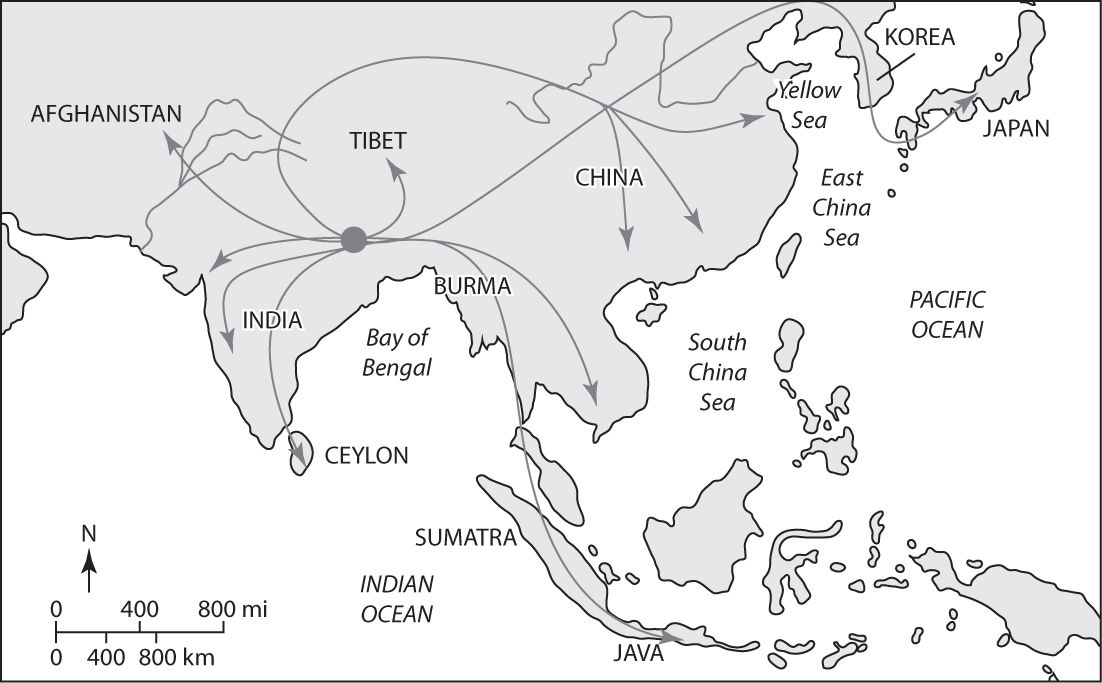
Classical Era (600 BCE–600 CE)
41 . A historian would use the above map to illustrate which of the following?
(A) Major trade routes in the classical era
(B) The spread of communism from 1900 to today
(C) One aspect of cultural diffusion
(D) The monsoonal wind patterns of Asia
42 . Which religion’s spread followed the cultural diffusion pattern shown in the map?
(A) Hinduism
(B) Buddhism
(B) Christianity
(D) Islam
43 . How did this religion primarily spread?
(A) With merchants
(B) With monks
(C) With military officers
(D) With diplomats
Questions 44 to 46 refer to the passage below.
Although in Protestant Europe, [Peter the Great] was surrounded by evidence of the new civil and political rights of individual men embodied in constitutions, bills of rights and parliaments, he did not return to Russia determined to share power with his people. On the contrary, he returned not only determined to change his country but also convinced that if Russia was to be transformed, it was he who must provide both the direction and the motive force. He would try to lead; but where education and persuasion were not enough, he could drive—and if necessary flog—the backward nation forward.
—Robert K. Massie, Peter the Great: His Life and World
44 . Based on the above passage, what kinds of reforms did Peter the Great embrace?
(A) Creation of an elected assembly
(B) Declarations of human rights
(C) Development of a constitutional monarchy
(D) Reduction of aristocratic influence
45 . What term best describes Peter the Great’s ruling style as described in the passage?
(A) Egalitarian
(B) Absolutist
(C) Republican
(D) Theocratic
46 . When Peter the Great ruled Russia, he continued the practice of which of the following?
(A) Decentralization of power
(B) Isolationism
(C) Serfdom
(D) Reform
Questions 47 to 50 refer to the passage below, which is taken from testimony before Parliament.
Joshua Drake, called in; and Examined.
You say you would prefer moderate labour and lower wages; are you pretty comfortable upon your present wages?
—I have no wages, but two days a week at present; but when I am working at some jobs we can make a little, and at others we do very poorly.
When a child gets 3s. a week, does that go much towards its subsistence?
—No, it will not keep it as it should do.
Why do you allow your children to go to work at those places where they are ill-treated or over-worked?
—Necessity compels a man that has children to let them work.
Then you would not allow your children to go to those factories under the present system, if it was not from necessity?
—No.
—Testimony given before the Sadler Committee, 1831–32
47 . Which period in history is associated with the conditions described in the passage?
(A) The Enlightenment
(B) The Green Revolution
(C) The Scientific Revolution
(D) The Industrial Revolution
48 . According to the passage, why does the witness allow his children to work in a place where they will be ill-treated?
(A) A factory owner is forcing him to do so.
(B) He doesn’t earn enough on his own.
(C) The children need discipline.
(D) Their labor is only moderately difficult.
49 . Which style of government is most associated with limited regulations on business and working conditions similar to those described in the passage?
(A) Laissez-faire
(B) Totalitarian
(C) Utilitarian
(D) Corporatist
50 . Which type of organization was partially responsible for improving the hours, wages, and working conditions of workers in this era?
(A) Guilds
(B) Joint-stock companies
(C) Labor unions
(D) Zaibatsu groups
Questions 51 to 55 refer to the image below, which shows students taking the imperial examination in China c. 960–1279 CE

51 . From which social class were the students depicted in the painting most likely to be drawn?
(A) Coastal merchants
(B) Rural peasants
(C) Conscripted military
(D) Noble families
52 . What would be the most likely content of these exams?
(A) Legal statutes
(B) Engineering principles
(C) Economic theory
(D) Confucian essays
53 . Why were Japan’s early attempts at introducing the Chinese-style imperial exam largely unsuccessful?
(A) The Japanese were unable to adapt to the Chinese style of examination.
(B) Merchants resisted, fearing that efficient administrators would lead to increased taxes.
(C) Japanese nobles feared that their power base would be weakened.
(D) Christian missionaries discouraged the adoption of pagan practices.
54 . Which social phenomenon within China during the Song and Tang dynasties resulted from the imperial examination system?
(A) Improved conditions for women
(B) Development of state-run education
(C) Integration of nomadic border tribes
(D) Opportunity for social mobility
55 . Which Chinese emperor or ruler would be most likely to disapprove of candidates who were successful on an exam like this?
(A) Mao Tse Tung
(B) Emperor Han Wudi (Han dynasty)
(C) Emperor TaiZong (Tang dynasty)
(D) Deng Xiaoping
Go on to Part B 
PART B: SHORT-ANSWER QUESTIONS
Recommended Time for Part B—50 minutes
Directions: The short-answer questions are divided into parts; some questions have parts A and B, and others have parts A, B, and C. Answer all parts of each of the questions. Each of the four questions requires you to respond with three answers, and each of these answers is worth one point. Therefore, each question is worth a total of three points. Note that short-answer questions are not essay questions—they do not require the development and support of a thesis statement.
Question 1 refers to the passage below.
The arbitrary and compulsory feudal marriage system, which is based on the superiority of man over woman and which ignores the children’s interests, shall be abolished. . . . The new democratic system, which is based on free choice of partners, on monogamy, on equal rights for both sexes, and on protection of the lawful interests of women and children, shall be put into effect. . . . Husband and wife are in duty bound to love, respect, assist, and look after each other, to live in harmony, to engage in production, to care for their children, and to strive jointly for the welfare of the family and for the building up of a new society.
—1950 Marriage Law, People’s Republic of China
1. Answer parts A and B.
A . Discuss ONE major change in the status of men or women under the new marriage law.
B . Identify TWO additional changes brought about by the Marriage Law.
Question 2 refers to the map below, which shows the progress of the Bubonic Plague, or the Black Death, during the 1340s.

2. Answer parts A and B.
A . Discuss ONE way in which the plague spread from one region to another.
B . Identify and discuss TWO effects of the plague in Europe.
3. Answer parts A and B.
A . Identify and discuss TWO examples of popular culture whose influence has spread throughout the world during the twentieth and twenty-first centuries.
B . Discuss ONE reaction that non-western societies have demonstrated when confronted with western popular culture.
4. Answer parts A and B.
A . World War I used new military technology, methods, and strategies; identify and discuss TWO technologies, methods, or strategies that were innovative.
B . Identify ONE social change in western societies that resulted from World War I.
STOP. End of Section I.
Section II
Time: 90 minutes
PART A: DOCUMENT-BASED QUESTION (DBQ)
Recommended reading time for Part A—15 minutes
Recommended writing time for Part A—40 minutes
Directions: The question is based on the documents below. The documents have been edited and adapted for this exam.
• Read the question below carefully.
• Then read all the documents.
• Begin by grouping the documents into categories that reflect the documents’ points of view, theme, or intended audience.
• Create a thesis that addresses the entire question.
• Analyze the documents that support the thesis. You must use all (or all but one of) the documents.
• Give careful attention to the purpose, point of view, source, and historical context of each document.
• Do NOT list the documents or analyze them one at a time in your essay; they should be incorporated into your argument.
• Bring in historical examples that support your argument.
• Create a persuasive essay that upholds your thesis, connects your argument to historical context, and draws conclusions.
1. Using the following documents, and your knowledge of world history, discuss in what ways the modern (twentieth-century) Olympic games have become a platform for international political disputes and how this contradicts their original purpose.
Document 1
Source: Encyclopaedia Britannica , 11th edition, 1910–1911, s.v. “Olympia”
The regular catalogue of Olympic victors begins in 776 B.C. . . . It was at Elis, in the gymnasium, that candidates from all parts of Greece were tested, before they were admitted to the athletic competitions at Olympia. To have passed through the training (usually of ten months) at Elis was regarded as the most valuable preparation. . . . The list of contests was enlarged to invest the celebration with a Panhellenic character. Exercises of a Spartan type—testing endurance and strength with an especial view to war—had almost exclusively formed the earlier programme. . . . As early as the 25th Olympiad the four-horse chariot race was added. Horse races were added later. Besides the foot race . . . there were now “long” foot races. Wrestling and boxing were combined. Leaping, quoit-throwing, javeline-throwing, running and wrestling were also added. Hellenes from all cities were to have peaceable access to the Olympian festival. . . . An expression of the Greek ideas that the body of man has a glory as well as his intellect and spirit, that body and mind should alike be disciplined.
Document 2
Source: Pierre de Coubertin, founder of the International Olympic Committee, 1894
May joy and good fellowship reign, and in this manner, may the Olympic Torch pursue its way through the ages, increasing friendly understanding among nations, for the good of a humanity always more enthusiastic, more courageous and more pure.
Document 3
Source: On This Day , BBC, October 17, 1968
Two black American athletes have made history at the Mexico Olympics by staging a silent protest against racial discrimination.
Tommie Smith and John Carlos, gold and bronze medalists in the 200m, stood with their heads bowed and a black-gloved hand raised as the American National Anthem played during the victory ceremony.
The pair both wore black socks and no shoes and Smith wore a black scarf around his neck. They were demonstrating against continuing racial discrimination of black people in the United States. Within a couple of hours the actions of the two Americans were condemned by the International Olympic Committee.
. . . Two days later, the two athletes were suspended from their national team, expelled from the Olympic village and sent home to America.
Document 4
Source: “Massacre Begins at Munich Games,” This Day in History (September 5, 1972), History (www.history.com )
During the 1972 Summer Olympics at Munich, in the early morning of September 5, a group of Palestinian terrorists stormed the Olympic Village apartment of the Israeli athletes, killing two and taking nine others hostage. The terrorists were part of a group known as Black September. In return for the release of the hostages, they demanded that Israel release over 230 Arab prisoners being held in Israeli jails and two German terrorists. In an ensuing shootout at the Munich airport, the nine Israeli hostages were killed along with five terrorists and one West German policeman. Olympic competition was suspended for 24 hours to hold memorial services for the slain athletes.
Document 5
Source: U.S. Department of State Archive, 1980
In 1980, the United States led a boycott of the Summer Olympic Games in Moscow to protest the late 1979 Soviet invasion of Afghanistan. In total, 65 nations refused to participate in the games, whereas 80 countries sent athletes to compete.
In early 1980, the movement toward either boycotting the games altogether or moving them out of the Soviet Union gained momentum. Calls for boycotts of Olympic events were not uncommon; just four years prior, most of the nations of Sub-Saharan Africa boycotted the Summer Games in Montreal to protest the attendance of New Zealand after the latter sent its rugby team to play against the team from apartheid South Africa. In 1956, several Western European governments boycotted the games in Melbourne over the Soviet invasion of Hungary that year. Although the Olympic ideal was to place sport above politics, in reality there were often political goals and messages promoted through the games.
Document 6
Source: “Track Star Jesse Owens Defiantly Bucks Hitler,” by Mike Morrison, posted on Infoplease (www.infoplease.com )
Twenty-two-year-old American Jesse Owens didn’t care much for Hitler’s politics—or any politics for that matter. He just wanted to show off his immense skills and represent his country to the best of his abilities. Just over a year earlier, on May 25, 1935, Owens recorded one of the more mind-boggling performances in track and field history. He broke three world records and tied another at the Big Ten Track and Field Championships in Michigan—in just 45 minutes! Hitler viewed African-Americans as inferior and chastised the United States for stooping to use these “non-humans.” Despite the endless racial epithets and the constant presence of the red and black swastika, Owens made Hitler eat his words with four gold medals.
Document 7
Source: Jaime Fuller, writing in the Washington Post , February 5, 2014
The United States was trying to get the Olympics moved to a permanent location to avoid “unwarranted and disruptive international politics.” (Then New Jersey Sen. Bill Bradley, who won a gold medal in the Tokyo Olympics as part of the American basketball team, recommended Greece.) But these people weren’t paying very close attention to the Olympic games if they thought this was a recent phenomenon. Politics have been an essential part of the Olympics since Thucydides was covering them.
Go on to Part B
PART B: LONG-ESSAY QUESTION
Recommended Time for Part B—35 minutes
Directions: Answer ONE of the following questions.
1. Analyze the effects of physical environment (including geography and climate) on the longevity of the Chinese imperial system and culture.
2. Analyze the effects of physical environment (including geography and climate) on the longevity of the Egyptian dynastic system and culture.
STOP. End of Section II.
 Answers and Explanations
Section I, Part A: Multiple-Choice
1 . D When Commodore Perry’s ship entered Japan’s harbor and forced the Japanese to open their ports to trade, it became clear to the Japanese that other nations had superior technology, and that this put Japan at a disadvantage, as Lord Ii described. Christian missionaries were expelled from Japan during the Tokugawa Shogunate, which led up to the time when the letter was written (A). The adoption of Chinese imperial customs occurred during the Japanese Heian period, during the 800s to 1100s, and well before the steamship was invented (B). Manchuria was annexed by Japan in the 1930s, well after the era of the letter (C).
2 . C In the 1970s, top Japanese leaders traveled to Europe and the United States to study western-style economic and political practices. Japan briefly implemented a civil service system like the Chinese during the Heian period, but it never fully developed (A). Japan had been inward-looking prior to this time. Although some Japanese argued for expansion, in the hopes that they would gain power, this did not occur until the later 1890s, and then did not occur in the Pacific (B). The turning inward happened prior to these events, during the Tokugawa Shogunate, and thus was not a response to them (D).
3 . A The Meiji Restoration refers to the period starting in 1868 with the restoration of imperial rule. It was characterized by strong centralized government, opening to the West, land reforms, and dismantling of the samurai classes. The Heian period lasted from the 800s to the 1100s and was characterized by strong Chinese influence (B). The Tokugawa Shogunate period lasted from the 1600s to 1868 and was characterized by a feudal system with a strong samurai class (C). The Jomon were a Japanese Neolithic culture.
4 . A The phrase “he enfolds the whole universe” indicates that Brahman is everywhere. There is no discussion of a specific location or place like Heaven (B). Because he is everywhere, Brahman is not found only in the hearts of the faithful, although he is found in the heart of the speaker (C). He is described as “loving to all,” and therefore is not vengeful (D).
5 . B The speaker states that he will go to Brahman after his death, indicating that he believes that there will be some form of afterlife. The speaker is probably referring to moksha , the transcendant state reached after being released from the cycle of reincarnation. There is no discussion of rituals or religious practices (A), not even proper deeds or speech (C). According to Hinduism, Hindus worship one being that has many aspects or forms, and thus they are not truly polytheistic (D).
6 . A Brahman is the supreme cosmic entity and also means the underlying reality of all things in the Hindu religion. In Buddhism, there is a cycle of rebirth until Enlightenment is achieved, but there is no concept of a supreme God (B). Shintoism, from Japan, focuses on nature deities (C). Zoroastrianism, an ancient Persian religion, has a supreme God, Ahura Mazda, and focuses on a cosmic struggle between the forces of good and evil (D).
7 . B The Columbian Exchange refers to the exchange of crops, animals, and disease between the “Old World,” meaning Europe, Africa, and Asia, and the “New World,” meaning the Americas. The Green Revolution refers to the use of agricultural science to create high-yield crops, fertilizers, and pesticides, starting in the mid-1960s (A). The triangular trade was the system of Atlantic trade networks around the 1500s (C). The Middle Passage was the part of the triangular trade network that shipped slaves from Africa to the Americas (D).
8 . A Increased diversity of crops meant a greater and more varied food supply, which in turn led to increased population in Europe. There is some speculation regarding whether any diseases entered Europe via the Columbian Exchange, but, in any event, such introductions were not sufficient to cause any significant decline in the European population (B). Immigration from the Americas to Europe was not a widespread phenomenon (C). Though Europeans brought crops to the Americas, it was not in quantities that would have caused a famine or a population decrease (D).
9 . C The encomienda system granted land and an allotment of Indians to a Spaniard. The Indians were required to work for free, and in exchange the Spaniard was supposed to protect them and provide for their Christian education. Slavery of Indians (though not of Africans) was officially banned by Spain in 1542 (A). Indentured servitude refers to the system of repaying one’s passage to the Americas by working for a specified period of time for free. It was primarily used by Europeans (B). The apprentice system is a system of learning a trade by working for a master craftsman for a specified period for low or no wages (D).
10 . A Human, not animal, labor was used to prepare the land and to plant and harvest crops. There is no evidence of irrigation in the image (B), and both men and women are at work (C). Animals were not generally used in farm work, not because they were “too valuable,” but because they fulfilled other tasks (D).
11 . B The Americas lacked horses and oxen, the animals that were most commonly used for agricultural work. And while the indigenous cultures were practiced in decorative metal work (using gold and silver especially), they did not use metals for weaponry. Religion and trade did not play substantial roles in economic development (A, D); warfare, however, did contribute to economic development (C), thanks to the resulting extensive system of tribute.
12 . C While the Aztecs used the wheel for non-essential items (toys, for example), they did not use it for transport vehicles. The Aztecs did have a system of writing (A), used metals for decorative work (B), and had significant overland trade networks (D).
13 . A There was little to no north-south traffic in the Americas, and certainly not among indigenous peoples between Mesoamerica and South America. The Andean and Mesoamerican cultures both had extensive roads and bridges (B) and strong religious cultures (C). The Maya had a system of writing (D); the Andean cultures did not.
14 . A Chinampas, or “floating gardens,” made use of the lakes and swamplands of Mesoamerica; terraces made agriculture possible in the mountainous Incan homeland. There was no overlap of agricultural techniques between the two cultures (B). Land ownership did not undergo reform (C), and coercive labor systems were not common to the two cultures (D).
15 . C The Han and Gupta were both classical empires (600 BCE to 600 CE). The Ottoman (A), Ming, Aztec (B), Tan, Qin, and Etruscan (D) were not classical empires.
16 . B The chaos and confusion following the fall of both the Roman and the Han empires interrupted overland trade routes; the imperial armies that had controlled nomadic raids fell with their empires or became involved in civil strife. Overland routes were supplanted by oceanic trade pathways. There was an increase rather than a decrease in religions of salvation (A). The role of the father (C) and women’s rights (D) saw no changes.
17 . C The Romans were famous for their public works—aqueducts, amphitheaters, baths, and especially roads—which brought the outlying parts of the empire into contact with the center. Diversity, so long as it didn’t disrupt the central government, was generally accommodated (A). States rarely supported (although they did tolerate) foreign religions (B). Merit was not a guiding principle for most imperial bureaucracies (D).
18 . B The Roman empire became too large, and the causes of destruction, including a loss of military discipline and control, led to loss of territory and, eventually, the fall of central power. Rulers became rich, which led to power rather than to their overthrow (A). Decay in Rome was not inherent (C). Conquest and prosperity are more frequently compatible than mutually exclusive (D).
19 . C Alliances, which were characteristic of the nineteenth and early twentieth centuries, constrained the allied countries to support one another and were one of the major causes of World War I. An attack on Serbia, for example, was considered an attack on Russia and its allies, France and Great Britain. Imperialism is an expansive policy of conquest and control (A). Nationalism refers to national identity (B). Militarism (D) refers to the buildup of armies and materiel.
20 . C The alliances that led to World War I were the Triple Entente (Great Britain, France, and Russia) and the Triple Alliance (Germany, Austria-Hungary, and Italy). Serbia was supported by Russia, which needed access to (winter) warm-water ports. As part of the Triple Entente, France supported Russia (B). World War I may well be known as a “politicians’ war,” but the cartoon does not show this (A). World War I is aptly named, as it involved non-European countries (D).
21 . C Bulgaria, Italy, and the United States were all engaged in World War I. Denmark (A), Switzerland (B), and Spain (D) were all neutral, although Switzerland did declare a “state of siege.”
22 . A The ziggurat was used by priests and other religious leaders to elevate and direct themselves toward the cosmos. Neither Central Asia (B) nor West Africa (C) created ziggurats. Egypt built pyramids, not ziggurats, to bury their royal dead.
23 . A Monumental architecture is characterized by sheer size (the arched doorways in the drawing give an idea of scale) and frequently serves a political, commemorative, or religious purpose. Ziggurats were not used as burial sites (B) or theaters (C). The term “hierarchical” generally refers to using contrasting sizes of humans to show their importance.
24 . C Mesoamerican pyramids were stepped and used for religious purposes and ceremonies, whereas Egyptian pyramids were cubed triangles and served as burial sites (A). Chinese pagodas (B) and the Parthenon (D) were not even vaguely pyramidal.
25 . C Theodore Roosevelt advocated intervention in Latin America when U.S. interests were at stake. The United States supported Panama’s independence from Colombia in 1903 because Colombia did not support the Panama Canal. The Zimmerman Telegram was sent to Mexico by Germany in 1917 (A), the Cuban embargo took place in 1962 (B), and the Haitian Revolution began in 1791 (D). They all occurred either substantially earlier than the writing of the poem, or after. In addition, Haiti was a French colony and would not have been considered part of Latin America.
26 . D The phrase indicates that Latin America has had both poets and civilizations that used “the stars” in its history. Answers including only poetry (A) or only science (B) are therefore insufficient. There is nothing in the passage to suggest prophecy (C).
27 . B The theme is that Latin America has survived many invaders and will continue to survive, as indicated by references to Columbus, Catholics, and Spain, and the use of phrases like “it lives” and “Viva Spanish America!” The only references to violence are in connection with the United States’ warlike actions and are critical of the violence (A). The poem refers to the rich culture of Latin America in the present tense: “it lives” (C). The poet is critical of the U.S. focus on industry and progress (“You think progress is eruption. No.”) (D).
28 . C The introduction states that the events occurred in the 1940s, which was during the World War II era. The Crimean War occurred between 1853 and 1856, and therefore is the wrong era (B). World War I occurred between 1914 and 1918, which is also the wrong era (B). The Seven Years’ War occurred in Europe, primarily between 1755 and 1763. It is therefore from the wrong era, and also occurred in a different location.
29 . A The United States was allied with the Soviet Union primarily because the Soviet Union had been invaded by Germany. There was some distrust, though, as the Soviets had earlier signed a non-aggression pact with Germany. The Soviets also felt that the United States, by refusing to open an Eastern Front to take the pressure off Soviet troops, had been lukewarm in its support. That distrust meant that the two were not exactly comrades or friends (B). They also were not enemies, because the United States was looking for a solution that was acceptable to the Soviets (C). That the Soviets’ views were considered means that they were not strangers (D).
30 . D Korea is currently separated into a Communist dictatorship in the north and a democratic, capitalist regime in the south. The Japanese have no authority over or ownership of Korea (A). The Americans established a democratic regime in the south, but North Korea limits the individual liberties of its citizens (B). Though North Korea has suffered economic hardship in the late twentieth century, South Korea has enjoyed rapid economic growth over the same period (C).
31 . D Containment refers to the policy of limiting the spread of communism by limiting the amount of territory the Communist powers occupied. Détente refers to a thawing of relations, which is incorrect given the distrust of the Soviets implied in the passage (A). Mutual Assured Destruction refers to the idea that both the Soviets and the United States would be deterred from using nuclear weapons by the fact that they would both be destroyed if they did so. The passage predates Soviet nuclear capabilities, and is therefore incorrect (B). Dollar Diplomacy emphasized the U.S. use of economic influence to achieve political ends in Latin America (C).
32 . B The people of Mali study the fiqh, which is part of Muslims’ religious law. Ibn Batutta expresses surprise that the genealogy is derived from the maternal side, indicating that this is not a common Muslim practice (A). Although he does not explicitly state that the men do not yield to sexual jealousy, it can be inferred from the fact that women had male friends and companions (C). Likewise, he is surprised at the casual acceptance of such interactions between unrelated members of opposite sexes (D).
33 . B Women wearing the veil is a cultural practice found in Southwest Asia (the Middle East) that predated the founding of Islam. Women of Africa did not have that custom, and so were less likely to adopt it as part of Islamic practice. Muslim women do not always perceive the veil to be a means of oppression, not to mention the fact that the passage did not indicate that the Muslim women of Mali were oppressed (A). That women could have male friends indicates that they were not merely sexual objects (C). The climate of Mali would be similar to that of Southwest Asia, where wearing the veil was a common practice (D).
34 . C Mali was near the trans-Saharan trade routes dominated by Muslim merchants in the 1300s. Those merchants frequently exposed local African merchants to Islam. Berbers are North African tribes, but they are not associated with any religious or mystical movement (A). The Mughal empire lasted from the mid-1500s to the mid-1800s, and so is out of period. The Mughals also were located in India and never entered Africa (B). Ethiopia was one of the earliest Christian nations in Africa, and therefore was unlikely to have many Islamic shrines (D).
35 . B By “whispering” sentiments similar to those that apartheid “declares,” the world also engages in discrimination, just in a less noticeable manner. There is no discussion of the world’s fear of South Africa (A), nor of the world’s condemnation of the policy of apartheid (B). Although “oppression” is the nature of the society, there is no discussion of its being caused by the world economy (D).
36 . D Apartheid was the policy of legal discrimination against black South Africans from 1948 to 1994. Jim Crow refers to legal segregation in the United States South from Reconstruction after the Civil War until the 1960s (A). Spheres of influence refers to the system during the late 1800s in which European powers gained trading privileges within their own region, or “sphere,” in China (B). Boer is a Dutch and Afrikaans term for farmer and is associated with South Africa, but “Boer division” is not an official term (C).
37 . B Nelson Mandela was an anti-apartheid activist and head of the African National Congress Party. He was the first black president of South Africa, elected in 1994 after years of imprisonment for his anti-apartheid activities. Even though F. W. de Klerk worked to repeal apartheid laws after his election as South Africa’s president in 1989, as he was a white politician, his presidency didn’t symbolize the end of apartheid (A). There was no major bombing of Lesotho (C). The Boer War was fought by the British and the Boers (Dutch descendants) for control of South Africa at the end of the 1800s, and is therefore out of the time period.
38 . A The information states that the settlers included marines, marine wives, and both male and female convicts. The presence of the convicts shows that Australia was intended to be a penal colony, to house convicted criminals. There is no evidence of any intention to trade or to build a trading post (B). There is no discussion of religion (C), nor of the weapons or arms that would be needed for military bases (D).
39 . B Convicts were given the afternoons to tend their own gardens, which implies that they were hoping to grow their own food eventually. April’s entry discusses illness (scurvy) (A); July’s entry discusses medical shortages and the age of some convicts (C); and March’s entry discusses food shortages (D).
40 . C The passage gives some indication concerning the hardships faced by the early Australian colonists, including famine, disease, and shortages of important supplies. There is no detailed discussion of the gardening methods used (A). Although there are mentions of age and sex, one cannot determine the ratios because no exact numbers are provided (B). Likewise, there is no information regarding any specific medical practices and procedures beyond a “salt diet,” which could apply to all colonists (D).
41 . C The spread of religion is one of the best-known examples of cultural diffusion, and the map shows the spread of Buddhism. Trade routes (e.g., the Silk Roads) in the classical era (A, D) originated in China and continued to the Mediterranean. Communism (B) is primarily a twentieth-century phenomenon that did not originate in India. The paths shown have nothing to do with weather (D).
42 . B Buddhism originated in India, although it eventually became a minority religion there and spread to other countries, incorporating or adapting to local customs and needs. Hinduism (A), Christianity (C), and Islam (D) did not begin in India.
43 . B Monks served as the leaders and missionaries for Buddhism. They gave up earthly goods in order to guide lay believers. Although merchants (A), military officers (C), and diplomats (D) all helped to transport beliefs, they did not dedicate their lives to doing so.
44 . C Peter the Great brought a great many ideas back from his travels to the West, among them those dealing with individual rights and parliamentary government; but he retained control, instituting a sort of constitutional monarchy. He did not create an elected assembly (A), make declarations of guaranteed human rights (B), or reduce aristocratic influence to any great degree (D).
45 . B By retaining control and power, Peter the Great was more absolutist than he was egalitarian (A), republican (C), or theocratic (D).
46 . C Peter the Great did not free the serfs; it took the Industrial Revolution in Russia to make that feasible. He did nothing to decentralize power—in fact, he consolidated it (A). He worked hard to reverse the isolationism (B) that had left Russia on the margins of modernization. He did not continue reform, but he initiated it in many instances (D).
47 . D The Industrial Revolution was characterized by a lack of regulation, leading to poor working conditions, long hours, and low wages, including for children. The Enlightenment was primarily a philosophical movement occurring in the seventeenth and eighteenth centuries (A). The Green Revolution used scientific methods to increase crop yields. It is also a twentieth-century phenomenon and is therefore out of the era (B). The Scientific Revolution predates this, having occurred around the sixteenth to eighteenth centuries, and refers to the prolific scientific discoveries in fields like physics, astronomy, and anatomy. (C)
48 . B The witness states that he has work only about 2 days each week, and that he needs to let his children work (necessity compels him). There is no owner forcing him. The phrase “necessity compels a man” refers to his own need for his children to work (A). There is no indication that the children need discipline (C). The phrase “moderate labour” does appear, but the speaker is saying that he would prefer reasonable hours, even if he earns less (D).
49 . A Laissez-faire (“leave it alone”) is the principle that governments should not interfere in or regulate industries, businesses, or markets. Totalitarian governments typically have total control over their economies, making “A” the better answer (B). Utilitarian philosophers advocate policies that create the greatest amount of happiness for the largest number of people. It is not a style of government per se, nor would it be consistent with systems that used child labor (C). Corporatists include interest groups (like labor and industry) in the government, and therefore provide more government involvement in the economy than laissez-faire systems (D).
50 . C Labor unions, whose workers are organized and act collectively, fought for better wages, hours, and working conditions in the 1800s and 1900s. Guilds were medieval organizations and therefore are out of the time period (A). Joint-stock companies allowed investors to purchase shares in a business. They did not advocate for workers (B). Zaibatsu groups are Japanese industrial conglomerates that controlled parts of Japan’s economy in the late 1800s and early 1900s. This answer in incorrect because they did not support improved conditions for workers and because it relates to a different region (D).
51 . D Most of the people taking the exams came from the Chinese nobility. Even though the civil service exam offered the possibility of social mobility for the lower classes, the reality was that, since the exams were so difficult and there was no public education, few peasants could afford to devote that amount of time to studying (B). Conscripted military would also have been unable to take the time to study for the exam (C). Coastal merchants would not have been a large enough group to make an impact (A).
52 . D The civil service exam was created during the Han dynasty to provide a professional bureaucracy. It was based on Confucian essays, literature, and poetry. It did not cover legal statutes (A) or engineering principles (B). It also would not have covered economic theory, especially as the Chinese tended to look down on trade and merchants (C).
53 . C Even though the civil service exams did not result in large degrees of social mobility, the Japanese nobles and Buddhist monks balked at the prospect of diluting their power. The Japanese had adopted Chinese writing and other elements of the imperial court system, so there is no reason to think that they would not have been able to adapt to that style of exam (A). Japanese merchants at this time weren’t significant enough to affect the decision (B), and Christian missionaries did not have enough influence to affect such decisions (D).
54 . D Although most of the candidates were drawn from the upper classes, the civil service exam did offer an opportunity for a few bright candidates from rural villages. Conditions for women were unchanged, as women could not take the exam (A). Candidates had to pay for their studies themselves (B). The imperial exam was unrelated to nomadic border tribes (C).
55 . A Mao Tse Tung was opposed to intellectuals, and sought to reeducate them during the Cultural Revolution. Both the Han dynasty and the Tang dynasty used and supported the imperial exam, so they would have approved of successful candidates (B, C). Deng Xiaoping is the twentieth-century Chinese leader who modernized China, improving education and opening markets. Although he might not have supported the Confucian element, the fact that he supported education means that this is not the best response (D).
Section I, Part B: Short-Answer Questions
1A . You should mention ONE of the following in your answer: men are no longer considered superior to women; women will enjoy equal rights in the marriage; men and women can now choose the person they want to marry; or men and women are constrained to be monogamous.
1B . The TWO additional changes can include any of the answers from 1A, so long as you didn’t use them to answer 1A. You can also mention the care of children or the consideration of marriage as a way to contribute to the societal good.
2A . As the map shows, the plague spread both by land and by sea. Drawing on your knowledge of world history, you might discuss merchants or crusaders as being responsible for this spread of the disease.
2B . TWO effects of the plague in Europe can include, for example, a death blow to the feudal class system caused by the loss of serf labor and the beginning of a wage labor system; a drastic decline in population; increased persecution of Jews and alleged witches, since they were considered to have been responsible for the plague; or the production of literary works (e.g., Boccaccio’s Decameron ).
3A . You may mention various styles of popular music—rock ‘n’ roll, heavy metal, or reggae, for example. Movies have become globally popular, from Italian neorealism to Hollywood to Bollywood, to name just a few forms. Food has gone global, including fast food, like McDonald’s. Jeans, jazz, and sports have all become global.
3B . While many non-westerners admire and, to some degree, emulate American cultural icons, many others resent the diffusion of American culture. As a result, citizens of non-western cultures often experience a resurrection of traditional practices in their countries. Some have gone so far as to ban the use of western language or terminology and replaced it with native terms.
4A . You have many choices here. TWO of the following should come to mind immediately: use of tanks; use of airplanes, though generally only for reconnaissance; use of chemical weapons (mustard gas); water-cooled machine guns; flame throwers; trench warfare.
4B . Of the social changes resulting from World War I, a shortage of young men led to greater work opportunities for women. There was an erosion of class distinctions, a weakening of imperial ties, and suffrage for women.
Section II, Part A: Document-Based Question
This question has two parts: in reverse order, you must decide the original purpose of the Olympic games, and the purpose of the modern games as well; then you must discuss how the modern games have deviated from that original purpose and become, frequently, political. You must sustain a thesis that takes both parts of the question into consideration. For example, you could say that the original purpose of the games was to use sport to establish or maintain peace among different peoples (Documents 1 and 2), but that with globalization, or with modern interweavings of different nations and different aspects of life, politics have crept into sports. You may decide that this is inevitable. Or you may take to heart the idea of establishing a permanent venue for the games that asks participants to check their politics at the gate (Document 7).
A good response will draw on six or seven (that is, all or all but one of the) documents to explain how the nature of the modern Olympic games has changed—not always, but frequently enough to be noteworthy. You should begin by analyzing the documents. A definition of just what the modern Olympic games represented, or their overall goal, would be to promote peace and understanding among nations (Documents 2 and 5). This is based on the Classical era’s idea that the games should be all-inclusive (Document 1).
You should incorporate further analysis of the documents, perhaps by dividing them into those that contain evidence in support of the idea of using the games as a political soapbox (Documents 3, 4, and 5) and those that present an opposing point of view (Documents 2, 3, 5, 6, and 7). There will be an obvious overlapping of documents, since many of them present both perspectives. Simply listing the characteristics of individual documents, however, does not answer the question or sustain your thesis.
Having considered the differing points of view, your task is to connect them, within a historical context, in order to show that the Olympics were never intended to be political, and that today, in an effort to remove politics from the Olympic arena, the establishment of a permanent venue has been suggested (Document 7).
There are various conclusions that can be drawn here. You may feel that globalization has made the political nature of any international event inevitable. On the other hand, you may conclude that athletes should take the moral high road and simply carry out and show off their athletic talents (Document 6). In other words, you may show that while political gamesmanship contradicts the original intent of the Olympic games, it is an unavoidable by-product of a world in which not only are nations inextricably intertwined (economically, politically, culturally), but so are the things—sports, religion, entertainment, business—that make up any given culture.
Section II, Part B: Long-Essay Question
In a strong response, you may begin by explaining what “longevity” means in the context of the question. The Chinese imperial system lasted from approximately 1500 BCE to 1912 CE, or almost 3,500 years. Egypt’s dynastic system lasted from approximately 3100 BCE until 30 BCE, or until the death of Cleopatra. (For purposes of comparison, the Western Roman Empire lasted about 500 years, and the Spanish Empire lasted about 300 years.)
In this essay, you can make the case either for or against the causal effects of physical environment on the longevity of either the Chinese or the Egyptian imperial system. Both China and Egypt controlled large land masses. In a sense, they had only one frontier to defend from invaders. The Chinese fortified their frontier with the Great Wall. Egypt enjoyed natural barriers: water on two sides, and desert on two sides. In both cases, their geography contributed to the longevity of the empire as well as to a sense of national identity. Geographic barriers kept invaders out and, to a degree, kept inhabitants in.
China’s climate is varied simply because the country covers a great deal of territory. Arable land, however, has always been relatively restricted. This geographic feature made China more inclined to cultivate trade, and thus the Silk Roads developed. Egypt has a temperate climate and a dependable river, the Nile. “Dependable” means that the Nile has followed a predictable cycle of flooding, depositing fertile soil (silt) along its banks for use in planting and harvesting. This environmental feature enabled the Egyptians to raise three crops a year.
Culturally, both China and Egypt believed that their leaders were semidivine and that continued environmental benevolence depended on maintaining harmony between the rulers of the cosmos and the terrestrial rulers. Thus, natural or environmental disasters—floods or droughts, for example—could prompt changes in rulers or even whole dynasties, although the systems remained intact.
The development of technology would make the role of the physical environment much less important. At this point, you could argue that geography and climate (including natural resources), while important to the way in which a society develops or the directions that it takes, are not THE determining factor in longevity. In early times, it was a response to the environment that partially determined the success or failure of an empire; after the Industrial Revolution, however, society could control the physical environment. In any case, in modern times, empires are no longer the dominant model of governing.
Scoring: How Did I Do?
As you evaluate how you did on the practice exam, you need to keep several things in mind.
First, look again at the chart from the first chapter of the book. This tells you how much of your score will be determined by each part of the test. The multiple-choice counts the most, but no one part of the exam will determine your final grade. The scoring chart below reflects the same percentages shown here.

An overall score of 3 (out of 5) is considered passing. However, each college or university has different policies as to the score needed and the amount of credit offered. Check the schools you’re considering to determine the score you’ll need and the credit hours awarded. You can find all this information at https://apstudent.collegeboard.org/creditandplacement/search-credit-policies?affiliateId=rdr&bannerId=apcreditpolicy .
To use the scoring chart below, you’ll have to grade your own answers for the short-answer questions, the document-based question, and the long essay. Look at the explanations and evaluate how your answers measure up. Determine the points you should probably receive for each question based on the total points possible shown on the worksheet below.
This worksheet uses a different point system from the actual test, but the result is similar. In the end, you’ll have an idea of how you performed on the practice test on the same 1–5 scale used on the actual test. The apcentral.collegeboard.com website has specific information about rubrics for the questions. Your teacher should also have this information.
Finally, keep in mind that the conversion chart below will provide only an approximation of your score. In fact, the actual conversion chart that the College Board uses varies a little each year and is determined only after the test is scored.
Scoring Worksheet
Section I, Part A Multiple Choice

Section I, Part B Short Answer

Section II, Part A Document-Based Question

Section II, Part B Long Essay

Approximate conversion from raw score to AP score:
