CHAPTER 7
IN THIS CHAPTER
Summary: As agricultural villages evolved into cities, some urban areas began to display the characteristics of civilizations (described in Chapter 5 ). The earliest civilizations in the Eastern Hemisphere arose in Mesopotamia, the Nile, the Indus, and the Huang He valleys; civilizations arose later among the Olmecs in Mesoamerica (Middle America) and the Chavín in the Andes Mountains of South America.

Key Terms
covenant*
cuneiform*
diaspora*
hieroglyphics*
jati *
mandate of heaven*
matrilineal*
monotheism*
oracle bones*
patriarchal*
pharaoh*
polytheism*
Quetzalcóatl
Ten Commandments
theocracy*
Torah*
untouchables*
Varna *
Vedas *
Yahweh*
ziggurat*
Mesopotamia
The world’s earliest civilization arose in the valley of the Tigris and Euphrates rivers in an area the Greeks called Mesopotamia (“Land Between the Rivers”). The cultural achievements of Mesopotamia represented independent innovation, achievements that it passed on to other river valley civilizations in Egypt and, especially, the Indus valley. Around 4000 BCE, the inhabitants of Mesopotamia used bronze and copper. By this time they had already invented the wheel and developed irrigation canals to farm the arid lands of their environment.
About 3500 BCE, a group of invaders called the Sumerians settled in the southernmost portion of Mesopotamia. The Sumerians developed the first example of writing. Called cuneiform , it involved pictures pressed into clay using a wedge-shaped stylus. The pictographs initially stood for objects, but later were refined to represent sounds. The Sumerians also developed a number system based on 60 and studied the movement of heavenly bodies. In architecture, the Sumerians expressed the glories of their civilization and of the many gods of nature that they worshipped by building towers called ziggurats . They are credited with relating the first epic in world history, The Epic of Gilgamesh, which includes a story of a great flood similar to that of the biblical account in Genesis.
The Tigris and Euphrates rivers were noted for their unpredictable and often violent flooding. Irrigation systems to control flooding and channel water for agricultural use required the cooperation of Mesopotamia’s settlements. This need promoted the beginnings of government. Early Mesopotamian government was in the form of city-states, with a city government also controlling surrounding territory.
A social structure headed by rulers and elite classes controlled the land, which was farmed by slaves. Slaves could sometimes purchase their freedom. Sumerian families were patriarchal , with men dominating family and public life. Men had the authority to sell their wives and children into slavery to pay their debts. By the sixteenth century BCE, Mesopotamian women had begun to wear the veil in public. In spite of these restrictions, Mesopotamian women could sometimes gain influence in the courts, serve as priestesses, or act as scribes for the government. Some worked in small businesses.
A lack of natural protective barriers made Mesopotamia vulnerable to invasion by outsiders; most cities in the region constructed defensive walls. Frequent conflicts among local Sumerian kings over water and property rights weakened the city-states. The Sumerian culture later fell to conquest by the Akkadians and the Babylonians, both of whom spread Sumerian culture. The Babylonian king Hammurabi devised a code of laws that regulated daily life and also provided harsh “an eye for an eye” punishments for criminal offenses. The Code of Hammurabi drew distinctions between social classes and genders, administering less severe punishments to elite classes over commoners and men over women for the same offense. After 900 BCE, Assyrians and Persians dominated Mesopotamia.
Egypt
About 3000 BCE, a second civilization grew up along another river valley, this time the valley of the Nile River in present-day Egypt. In contrast to the unpredictable waters of the Tigris–Euphrates, those of the Nile overflowed once annually, discharging an amount of water that usually varied little from one year to the next. As in Mesopotamia, irrigation projects to channel floodwaters led to the organization of the community and ultimately to the development of political structures. Although several major cities emerged along the Nile, most Egyptian communities were agricultural villages engaged in local trade along the Nile.
The king of Egypt, or pharaoh , wielded considerable power. About 2700 BCE, the pharaohs began the construction of huge pyramids that served as tombs for themselves and their families. These tombs were decorated with colorful paintings. Like the Sumerians, the Egyptians were polytheists , or worshippers of many gods. Their belief in an afterlife led to the practice of mummification to preserve the bodies of pharaohs and, later, those of members of lower classes.
Egyptian society was composed of a number of defined social classes. Within this social structure, however, commoners could enter government service and rise in social status. Egyptian families were patriarchal, with men dominating households and community life. Among the royalty, however, women sometimes acted as regents for young rulers or as priestesses. Other educated women worked as scribes for the Egyptian government.
The Egyptians did not acquire the use of bronze tools and weapons until long after they had reached Mesopotamia. From the Nubian kingdom of Kush, a site of the independent innovation of ironworking, the Egyptians acquired iron implements.
The Egyptians engaged in some trade with the people of Mesopotamia and later with the kingdom of Kush to the south. Some historians believe that Egyptian picture writing, or hieroglyphics , was developed from Sumerian cuneiform as a result of trade contacts with Mesopotamia. Cultural diffusion from Egypt produced a Nubian civilization that incorporated Egyptian pyramids, writing, and religion into its own culture. In addition, the Nubian kingdom of Kush invaded Egypt in the eighth century BCE and ruled the Egyptian people for about a century. Throughout most of its early history, however, surrounding deserts protected Egypt from contact with invading peoples, permitting its civilization to develop its own, unique characteristics.
Indus Valley Civilization
By 2500 BCE, another advanced civilization had emerged along the Indus River in present-day Pakistan. Like the Tigris and Euphrates rivers, the Indus River was noted for its unpredictable and often violent pattern of flooding. Among the urban centers that arose along the Indus were Harappa and Mohenjo-Daro. Streets in both cities were laid out along a precise grid, and houses boasted running water and sewage systems.
Much of what historians know about the Indus valley civilization must come from archeological discoveries, because Harappan writing has yet to be deciphered. Archeological findings of Harappan artifacts in Mesopotamia indicate active trade between the peoples of the Indus valley and Sumer by way of the Persian Gulf. Around 1500 BCE, the Harappan civilization was overtaken by a group of Indo-European peoples called Aryans. The Harappan civilization which the Aryans conquered had already declined markedly, perhaps as a result of rivers changing their course or a natural disaster such as an earthquake. The blend of the traditional culture of the Indus valley people and that of the Aryans had a profound effect on the future course of Indian history.
Backgrounds of Classical India
The roots of classical India began during the invasions of the Aryans about 1500 BCE. From their original home in Central Asia, the Aryans brought a tradition of hunting and cattle herding; after their arrival in South Asia, however, they adapted the agricultural methods of native peoples. Aryan iron tools facilitated their success in agriculture.
Although the people of the Harappan civilization of the Indus valley possessed a written language, the Aryans did not. Much of our knowledge of the Aryans comes from their oral epics, called the Vedas. The Vedas were later written down in the Sanskrit language, which remains a prominent language in India today. The influence of the Vedas is evident in the term applied to the early classical period of Indian culture, the Vedic Age (1500 to 500 BCE). The first Aryan epic, the Rig-Veda, is a collection of hymns in honor of the Aryan gods. Other epic literature which shaped Indian culture during the Epic Age (1000 to 600 BCE) includes the Ramayana , the Mahabharata (considered the greatest epic poem of India), and the Upanishads, a collection of religious epic poems.
Aryan Society
Aryan society was based on a village organization composed of families with patriarchal control. Their society was further organized along a class system. When they invaded the Indus valley, the Aryans, who were fair-complexioned compared to the native people they conquered, perceived the people of the Indus valley as inferior. Therefore, they modified the class system with which they were already familiar in their society to define the new relationship between conqueror and conquered. Society was divided into four distinct classes, or varna, based on skin color:
• Kshatriyas, or warriors and rulers
• Brahmins, or priests
• Vaisyas, or merchants and farmers
• Sudras, or common workers
The first three classes were composed of Aryans, the fourth of the Dravidians, or the native people of India whom the Aryans encountered at the time of their invasion. During the Epic Age, the first two classes reversed in order of importance. At the very bottom of the social structure was a classless group of untouchables . Members of this group were involved in occupations perceived as distasteful, such as handling waste products, carrying out the dead, or butchering animals. As the classes became hereditary they became castes, or rigid social classes that seldom permitted social mobility. Within each caste were numerous subcastes, or jati, that further defined Indian society.
The Aryans also introduced to Indian culture their own array of gods and goddesses. Part of their belief system was the veneration of some animals, particularly cattle.
The Shang
The most isolated of the four river valley civilizations was that of the Huang He valley in present-day China. Although the people of the Huang He valley dwelled in a region isolated by deserts, mountains (the Himalayas), and seas, they did engage in some trade with Southwest Asia and South Asia.
The earliest Chinese dynasty that left written records was the Shang dynasty (1766 to 1122 BCE). A key element of the Shang period was the knowledge of bronze metallurgy. This knowledge, which came to China from Southwest Asia by means of Indo-European migrations, strengthened the Shang war machine. Around 1000 BCE, the Shang also became familiar with ironworking. Shang rule was further empowered by the need for central rule to oversee irrigation and flood-control projects along the Huang He River.
During the Shang period, a number of walled cities arose. These urban areas served as cultural, military, and economic centers. Elaborate palaces and tombs were built for Shang rulers.
Examples of early Chinese writing are apparent from a custom of divination using oracle bones . When a person sought the advice of the gods on an issue, he or she would visit an oracle, who would scratch the person’s question on an animal bone or shell, then heat it. When the oracle bone cracked from the heat, the oracle read the cracks to determine the message from the gods.
Shang society was stratified, with classes of ruling elites, artisans, peasants, and slaves. Families were patriarchal, and the veneration of ancestors was common. The matrilineal society that characterized China before the rule of the Shang gradually eroded until women held positions subordinate to those of men.
The Shang dynasty eventually succumbed to the Zhou about 1122 BCE. The Zhou claimed that they overthrew the Shang by the will of the gods, which they termed the “mandate of heaven .” Under the rule of the Zhou, the tradition of central authority that first took root under the Shang continued.
Mesoamerica and Andean South America
Civilizations in the Americas rose later than the river valley civilizations. The civilizations of Mesoamerica and the early societies of the Andes Mountains of South America did not develop in the valleys of major rivers, but rather in a region of smaller rivers and streams near ocean coastlines. Furthermore, the people of the Americas did not know the use of the wheel, nor did they possess large animals to serve as beasts of burden or work animals; the llama of the Andes Mountains was the largest work animal in the Americas from the time of the earliest civilizations until the arrival of the Europeans in the fifteenth century. Human muscle accomplished physical labor in the Americas.
Early Mesoamerican people such as the Olmecs, and later the Maya, constructed lavish pyramids and temples. Like the inhabitants of the river valley civilizations, the people of the Americas were polytheistic, worshipping many gods of nature. Society was stratified, with distinctions among the elite classes of rulers and priests and those of commoners and slaves.
Early Mesoamerican societies provided numerous examples of cultural diffusion. In addition to the transmission of the cultivation of maize, terraced pyramids were commonplace. Regional inhabitants fashioned calendars, the most elaborate being that of the Mayan civilization. The Mayans also had a ball game played on a court. The societies of Mesoamerica also shared the legend of Quetzalcóatl , a god who would someday return to rule his people in peace.
In South America, geography and the lack of large pack animals largely prevented communication between the Andean societies and those of Mesoamerica. The cultivation of maize did spread to the Andes, however, while copper metallurgy traveled northward to Mesoamerica. About 900 BCE, the Chavín civilization arose in the Andean highlands of present-day Peru. Characterized by a religion that worshipped gods representing crocodiles, snakes, and jaguars, the Chavín built complex temples to honor their gods. Their civilization was located along trade routes that connected western coastal regions to the Amazon rainforest. For a few centuries, Chavín religious unity and trade connections provided a degree of cultural identity to Andean peoples. The rugged terrain of the Andes, however, prevented a central government from unifying the Andean states.
The Hebrews
Along the eastern coast of the Mediterranean Sea lived the Hebrews, another people who profoundly influenced the course of world history.
The concept of monotheism , or the worship of one god, is attributed to the Hebrews, or Jews. The Hebrews traced their origins back to Abraham, who is said to have migrated from Mesopotamia to the land of Canaan on the eastern shores of the Mediterranean about 2000 BCE. In the account recorded in the Bible, the descendants of Abraham migrated to Egypt. They later left Egypt, embarking on a journey called the Exodus under a leader named Moses. In the biblical account, the Exodus was marked by the giving of the Ten Commandments , or moral law of the Hebrews. Returning to the land of Canaan, or Palestine, they established a theocracy , or a government ruled directly by God.
The heart of Judaism was a covenant , or agreement, between God and Abraham in which Yahweh would be their god and the Jews would be his people. The history of this covenant relationship became the basis of the Torah , or the Hebrew scriptures.
After years of observing the governments of neighboring kingdoms, the Hebrews established the kingdom of Israel about 1000 BCE with is capital at Jerusalem. The kingdom eventually divided into two kingdoms. The northern kingdom of Israel fell to the Assyrians in 722 BCE. Its inhabitants were scattered throughout the far reaches of the Assyrian empire, constituting the first Jewish diaspora , or exile. The southern kingdom, called Judah, endured until 586 BCE. Conquered by the Chaldeans (from approximately the same territory as the Babylonian Empire), the people of Judah were carried off into captivity into Babylon. After Cyrus conquered the Chaldeans and allowed the Jews to return to Palestine 70 years later, Palestine remained under Persian rule until it became the province of Judea under the Roman Empire in 63 CE. In 132 CES, after they rebelled against Roman rule, the Jews were spread throughout the Roman Empire in a second diaspora.
 Rapid Review
Beginning with Sumer in Mesopotamia about 3500 BCE, civilization grew along the river valleys of the Tigris–Euphrates, Nile, Indus, and Huang He. These civilizations were characterized by community cooperation necessary to manage irrigation and flood control systems. Later their cooperative efforts were further organized to form the beginnings of political institutions. The knowledge of metallurgy led to the refinement of tools, weapons, and objects of art. Writing systems were developed, and social stratification became apparent. In the Americas, civilizations and societies made notable strides in mathematics, astronomy, and architecture.
Review Questions
1 . The Egyptian civilization was similar to the Sumerian civilization in
(A) its reliance on natural defense barriers
(B) its system of social stratification
(C) its political structure
(D) the extent to which its culture was diffused
2 . The earliest civilizations in both the Eastern and Western hemispheres were similar in
(A) their location at similar latitudes
(B) their technological knowledge
(C) their reliance on the flooding of major rivers in their midst
(D) their practice of polytheism
3 . The Indus valley civilization
(A) relied heavily on communal planning
(B) is best studied through its written records
(C) was isolated from other river valley civilizations because of surrounding mountains
(D) declined after the arrival of Aryan invaders
4 . The early civilization with the least-developed technology was
(A) Mesoamerican
(B) Harappan
(C) Egyptian
(D) Sumerian
5 . The roots of classical India included
(A) the Aryan written language, or Sanskrit
(B) the egalitarian Aryan society
(C) Aryan agricultural knowledge
(D) Vedic traditional literature
6 . Shang China
(A) left no decipherable written records
(B) was prevented by natural barriers from trading with other early civilizations
(C) contributed to the development of central government in China
(D) was less urbanized than the Nile valley civilization
7 . Early societies of South America
(A) were challenged by geographic limitations
(B) developed societies that had no knowledge of metals
(C) traded widely with regions to their north
(D) built upon Mesoamerican cultural traditions
8 . Results of cultural diffusion among early civilizations included
(A) the invention of the wheel
(B) the legend of Quetzalcóatl
(C) the cultivation of potatoes
(D) Harappan sewage systems
Answers and Explanations
1 . B Both Egypt and Sumer had societies comprising various social classes of the elite, peasants, and slaves. Whereas Egypt enjoyed natural defense barriers, Sumer did not (A). Sumer was governed by kings of local city-states, whereas the Egyptian pharaoh was the supreme ruler (C). Although the Egyptians largely developed themselves culturally, Sumerian culture was widely diffused by later conquerors (D).
2 . D All the earliest agricultural civilizations worshipped many gods. They were located in different latitudes (A) and enjoyed different levels of technology (B). The civilizations of the Western Hemisphere did not rely on the flooding of rivers (C).
3 . A The presence of granaries and well-planned street grids in the cities of the Harappan civilization of the Indus valley is evidence of considerable community planning. The writing of the Harappan civilization is so far undecipherable (B). Indus valley peoples bypassed mountain barriers and traded by sea (C). Their civilization had already declined markedly before the arrival of the Aryans (D).
4 . A Early Mesoamerican civilizations did not even have the knowledge of the wheel, whereas the other civilizations mentioned did not have to rely only on human muscle for construction or irrigation projects.
5 . D The traditions of the Vedas became an integral part of Indian society. Sanskrit, the language of the Aryans, was originally an oral language only (A). Aryan society consisted of a number of classes based on skin color, which would become the foundation of the Hindu caste system (B). Aryans were nomadic peoples who learned of agriculture from the Dravidian people of India (C).
6 . C The Shang brought the settlements of northern China under the control of a centralized government. The Shang were the first Chinese dynasty to leave written records (A). Although natural barriers lessened trade, the Shang carried out some trade with South Asia and Southwest Asia (B). A number of cities arose in China under the Shang (D).
7 . A The rugged Andean terrain hindered political unity. Early South American societies were organized into local governments (A) and knew the use of copper (B). Trade with the north was limited because of geographical barriers (C), preventing South American societies from building upon the traditions of Mesoamerica (D).
8 . B The legend of Quetzalcóatl diffused throughout early Mesoamerican cultures and civilizations. The invention of the wheel (A) was an independent contribution of the Sumerians. The cultivation of potatoes (C) was limited to the early Andean societies and civilizations. Harappan sewage systems (D) were unique to the people of the Indus valley civilization.
PERIOD 1 Summary: Technological and Environmental Transformations (to c. 600 BCE)
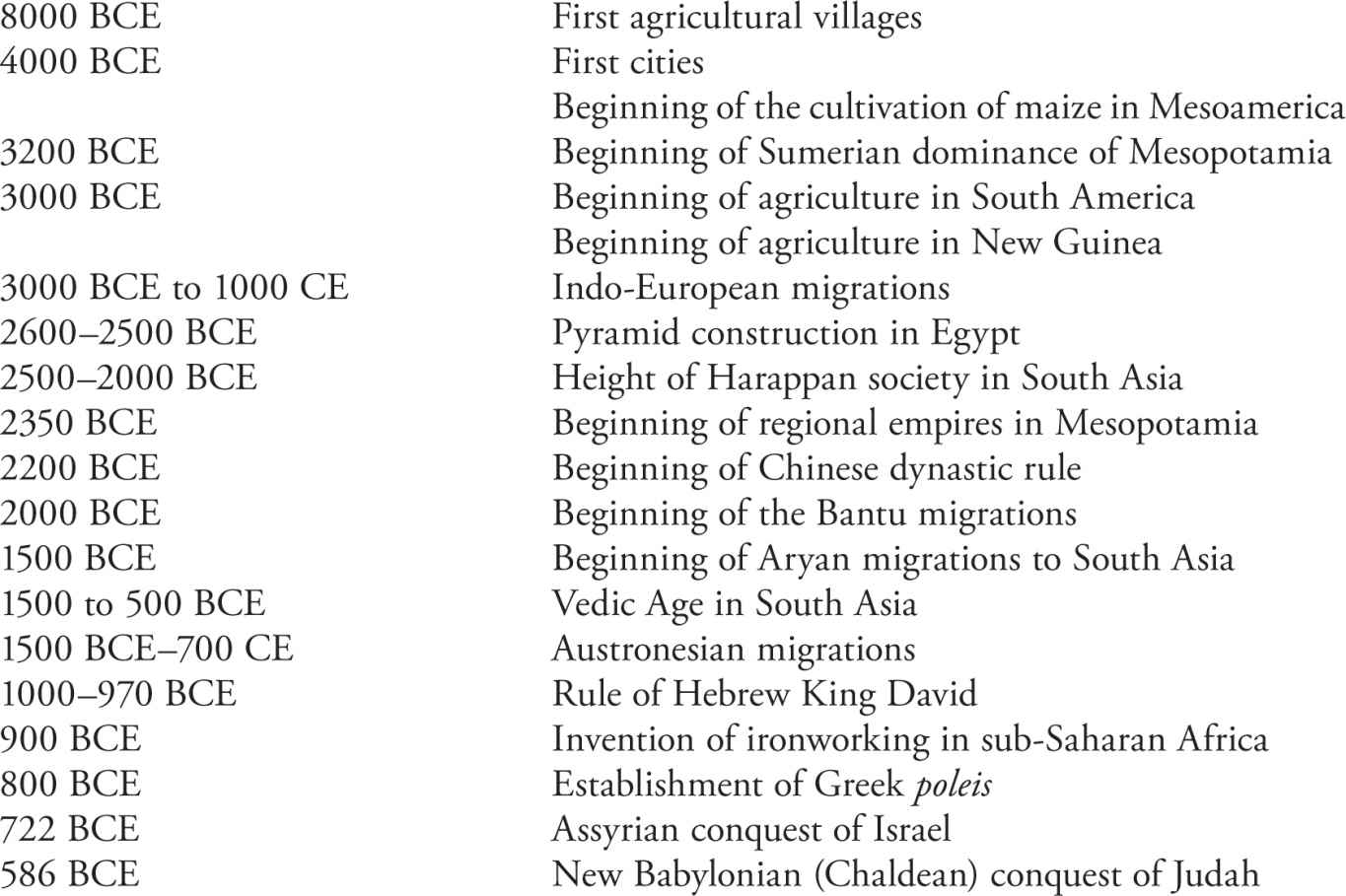
Timeline
Key Comparisons
1. Early agriculture in the Eastern Hemisphere versus the Western Hemisphere
2. Pastoral nomadism versus settled lifestyles
3. Political, economic, and social characteristics of the four river valley civilizations
4. Early civilizations of the Eastern and Western hemispheres
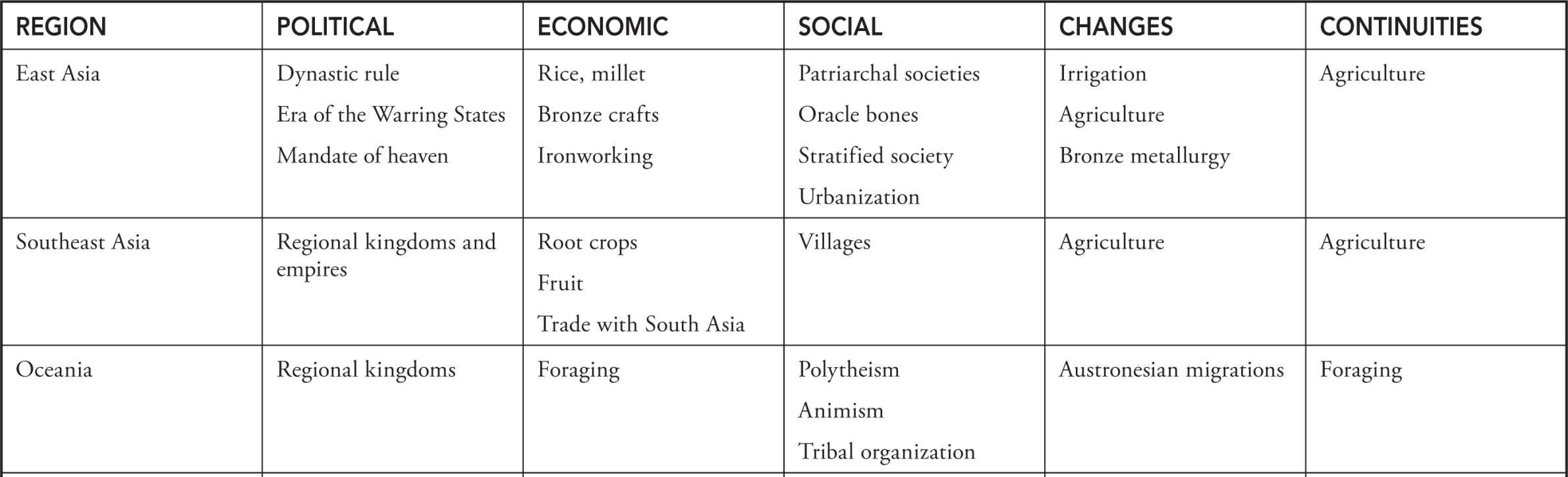
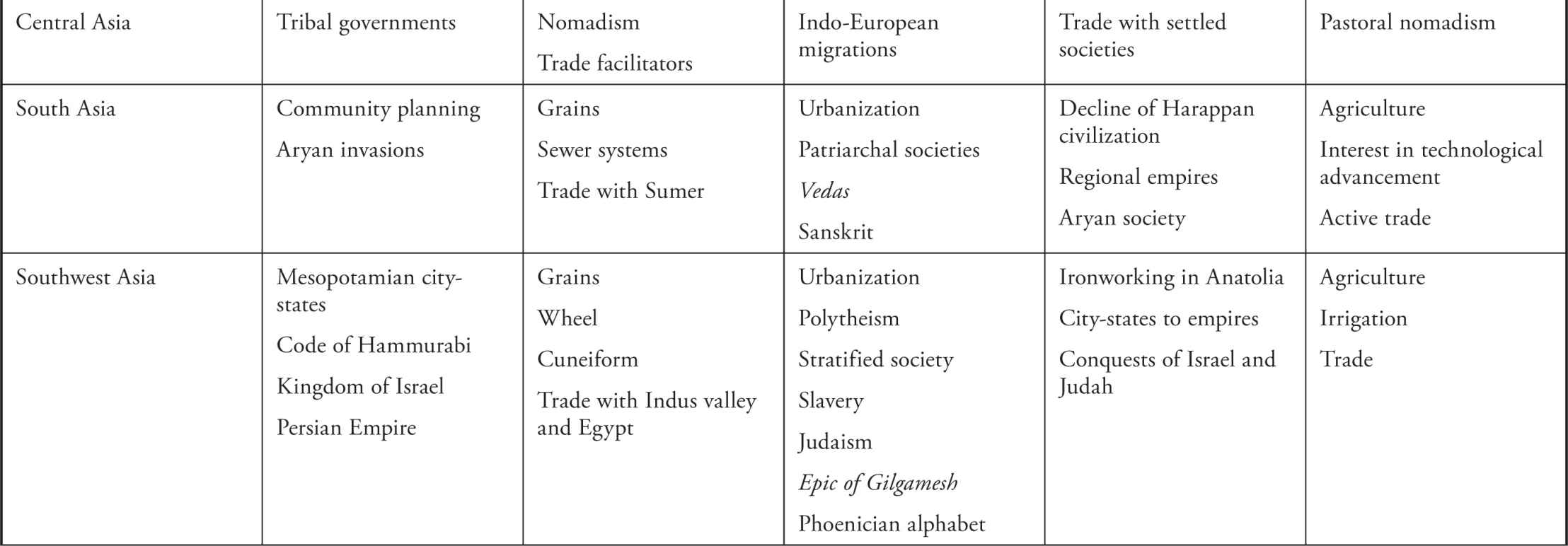
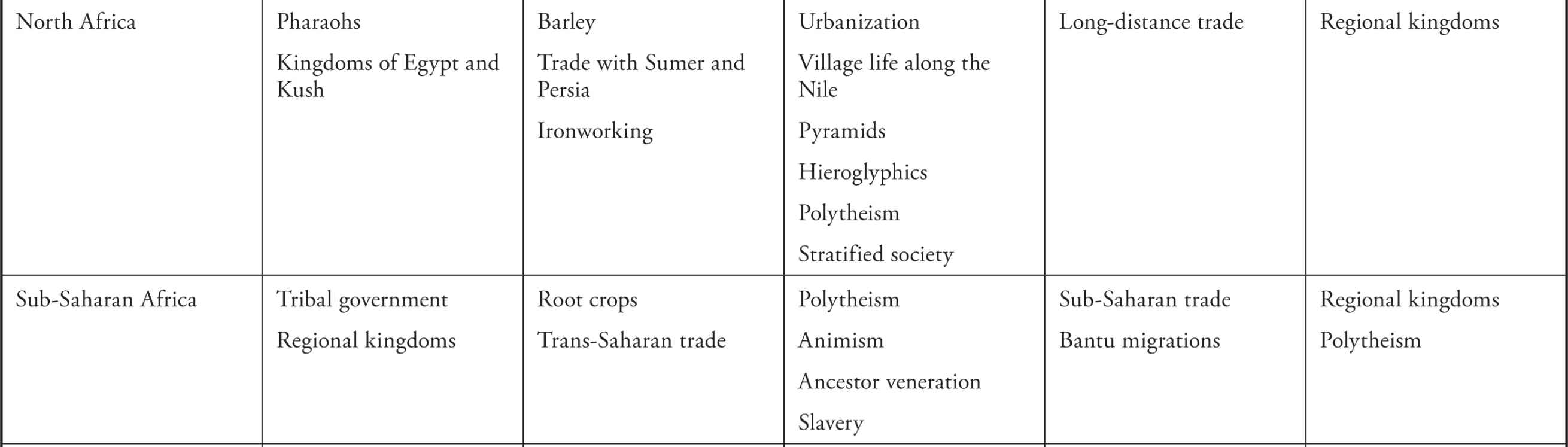
Change/Continuity Chart