
Chapter 9
In This Chapter
● Travelling with the missionaries
● Watching the Church fight itself
● Arguing about the Great East-West Schism
By the ninth century, Christianity had spread throughout Western Europe and beyond. The Church had an incredibly powerful hold on the minds and lives of the vast majority of people in the Medieval World.
Some areas, however - particularly in the eastern Mediterranean - were still independent, and the ninth century saw the first big division, or schism, between the Western Roman Church and the Greek Eastern Church of the Byzantine Empire (see Chapter 2). This break, which historians call the Photian Schism, served as a prelude to the Great East-West Schism of 1054.
In this chapter, I explore the big arguments - often about seemingly small things - that broke out between the Eastern and Western Churches.
Walking the Walk: Early Medieval Missionaries
Following the death of Jesus Christ in AD 30, Christianity spread throughout Europe. Within 300 years it was the official religion of the Roman Empire and when, less than 200 years after that the Empire fell, Christianity and the Church survived and prospered.
Pinpointing paganism
The word pagan is often confusing as it tends to conjure up ideas of worshipping bizarre ancient gods. What it really means is 'non-Christian' and with regard to the Roman Church in the Middle Ages it meant not conforming to their beliefs. Hence, people who were Christian but had slightly different views to the Papacy could be considered pagan. You can read about some of the Crusades that were targeted against these people in Chapter 16.
In the following centuries, mass conversions took place across Western Europe with previously pagan peoples turning their backs on their beliefs and way of life and embracing Christianity. This transformation is all the more remarkable when you consider the absence of television, radio or any form of mass media and the fact that the vast majority of people were illiterate. Thus, spreading the word of God involved travelling and speaking to people - lots of travelling and speaking! The people who devoted their lives to this enterprise were known as missionaries.
Being a missionary was a tough role with a lot of dangers and expectations to live up to. The ultimate example of a missionary was one of the first, St Paul, in the first century AD. After his conversion on the road to Damascus, he devoted his life to travelling and spreading the word of God, as recorded in detail in books throughout the New Testament.
During the eighth and ninth centuries, the Roman Church appointed and funded Christian missionaries who journeyed to various locations throughout Europe. They turned out to be amazingly successful. Figure 9-1 shows how much of the Medieval World became Christian by AD 850.
Although missionaries frequently travelled in small groups of 20 or fewer, their work was still incredibly dangerous. For many pagans, their religious practices defined their way of life - something these tribes were unlikely to give up easily.
Following the leader of the pack: Boniface
Probably the greatest of the early medieval missionaries was Boniface, who lived c. 680-754. Boniface was an Englishman whose father was probably an Anglo-Saxon. Known initially as Winfrid, he was educated in a Benedictine monastery before becoming a priest. In 716 he embarked on his first missionary journey to Frisia on the northern coast of Germany, a territory that was pagan at the time.
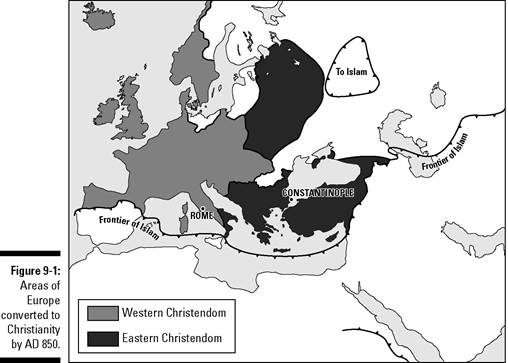
Figure 9-1: Areas of Europe converted of Christianity by AD 860
Initially, Winfrid didn’t fare well but he returned in 718 to much greater success, and soon gained the support of the Carolingian rulers of the area that we now think of as Germany (see Chapter 4 for more on the Carolingians).
One of Winfrid’s most famous acts was to chop down a tree known as ‘Thor’s Tree’ - an oak tree that local people had dedicated to the pagan god Thor, in a small town called Fritzlar (in the centre of modern-day Germany). Winfrid personally chopped it down and invited the pagan god to strike him down: Thor didn’t. The story spread rapidly and showed Winfrid as somebody who had defied the gods and survived and it gave his message a lot of credence with his audience.
Over the next 30 years, Winfrid led near continuous missions to convert the German people. He was armed with the support of Pope Gregory II, whom he visited in 730 and who made him the Church’s official legate (representative) in Germany. After receiving his title, Winfrid took the name Boniface, meaning ‘good deeds’, and used his new authority to establish churches and appoint his followers as bishops to run them.
Boniface’s correspondence with the Church survives and highlights the missionary zeal of this period. Take a look at the following extract from Pope Gregory II’s letter of introduction to the leaders of Thuringia (central Germany):
We pray also that as far as the work of our holy religion requires, you will seek consolation from this Holy Apostolic See [the jurisdiction of the pope], who is the spiritual mother of all believers, for as you are her sons and joint heirs of a kingdom that has a royal Father it is fitting that you do so. We bid you to show obedience in all things to our dearest brother Boniface, now consecrated bishop, who is well grounded in all the traditions of this Apostolic See. We send him to you to preach and instruct you in the faith and we urge you to cooperate with him in working out your salvation in the Lord.
Over the next 30 years Boniface continued to work throughout the Carolingian kingdom, seeking to convert its inhabitants. In 754, Boniface went on a final mission to Frisia. On this occasion, he was attacked and beheaded by a group of armed men who believed that he was carrying large amounts of gold in chests. (The containers actually held his books.)
Boniface was made a saint by the Church and is still the patron saint of Germany. In the years that followed Boniface’s death, Charlemagne (to whom I devote Chapter 5) forced the conversion of thousands of people to Christianity.
East is East
Missionaries ranged far and wide during the medieval period, but surely the most amazing journey undertaken was a mission to China led by a man called John of Monte Corvino towards the end of the thirteenth century. Pope Nicholas IV sent John and a group eastwards, where they were well received by the Mongol leader Kublai Khan.
The mission was a great success with John and his fellow missionaries translating the Psalms and the Gospels into the Mongol language and establishing a training school: around 6,000 people converted to Christianity. Missions continued throughout the first half of the fourteenth century, and a sizeable Christian community was established in the town of Quanzhou (now in southeast China) which had strong connections to the West through the trade in silk.
However by the middle of the fourteenth century Europe was feeling the effects of the great plague known as the Black Death (check out Chapter 20). The population of Europe was devastated by the Black Death, which also made long-distance travel even more difficult and dangerous than normal. Because they would move from place to place, missionaries came to be seen as likely carriers of the disease. Also, in China, the indigenous Chinese people revolted against Mongol control in 1368 and established a new rule - the Ming Dynasty - under which the Christians were driven out.
In an amazing story that would make a great film, the final mission sent in 1370 disappeared without trace!
Taking God on tour: Cyril and Methodius
The Roman Church in Europe wasn’t the only religious institution seeking to convert pagan peoples. The Eastern Byzantine Church was also very active in sending missionaries abroad during the eighth and ninth centuries.
In addition to religious fervour, very real practical concerns motivated the leaders in Byzantium. The territories to the north of Constantinople, or Istanbul as it is known today, (modern-day Bulgaria and beyond) were filled with nomadic warriors who had moved westwards. An obvious benefit of converting these people to Christianity was that the Byzantine emperor automatically became their overlord. As would happen many more times, Christianity and politics became usefully linked.
The two most famous and successful Byzantine missionaries were Cyril and Methodius. These brothers were born in the Greek city of Thessalonica in the first quarter of the ninth century. After the death of their father, they came under the protection of a powerful Byzantine official called Theokistos. His wealth and status afforded the brothers an excellent education in both theology and languages.
Cyril’s first experience of missionary work was some successful journeys to the Abbasid Caliph during the 850s, but in 862 he and his brother embarked on the mission for which they became famous. They were sent to the kingdom of Moravia (in the area of present-day Slovakia) following a request from Ratislav, the Prince of Moravia, for Christian missionaries.
The request was certainly odd. The Moravians were a pagan, Slavonic people, and Ratislav had previously rejected Christianity. Four years before, missionaries from the Roman Church had been violently expelled, because Ratislav was concerned that they were the beginnings of an attempt to add Moravia to the Holy Roman Empire. Ratislav’s call to the Byzantine emperor wasn’t because he suddenly wanted to embrace Christianity, but because he wanted Byzantine support against any future attempt by the Roman Empire to seize his territory!
Cyril and Methodius’s mission proved to be the first of many ‘conversions’ based purely on political necessity and serves as an example of the tensions that eventually caused the schism between the Eastern and Western Churches (see the later section ‘Splitting the Church: The Great Schism’).
The script for Scripture
Despite the fact that the origin of their mission was political, Cyril and Methodius worked hard to convert the Slavonic people of Moravia. The brothers stuck at their task for the rest of their lives and were both canonised, or made into saints, after their deaths.
One of the by-products of their efforts was that they had to find some way of transcribing the Bible from Latin into the language of the Slavs.
In the process, they developed the Glagolitic alphabet, a method of transcribing the Slavonic language. Eventually this method of transcription became known as Cyrillic, and the Cyrillic Alphabet is still used by many languages today such as Russian, Bulgarian, Macedonian and Ukrainian. This translation of the Bible into another language was one of the first, and it was very unusual. The first full Bible in English wasn't produced until 1535, hundreds of years later.
Experiencing conversion issues
The mass conversions that took place during the eighth and ninth centuries didn’t have an instant impact on the way that people lived their lives and in some cases the conversions were used for distinctly non-Christian ends. Although some people fully embraced Christianity, conversion gave others the opportunity to use the already harsh punishments available to them to enforce a new set of rules.
For instance, Mieszko I of Poland officially declared his kingdom Christian in 966 and began appointing bishops from among his own supporters. Some of the measures imposed by these new bishops were ghastly. Sources from the period report that people who broke official fasts were punished by having their teeth punched out. More severely, people accused of immorality had their genitals mutilated or sliced off altogether - a far cry from the Christian message that missionaries such as Boniface and Cyril had tried to bring to the world.
Creating Cracks in the Church: The Photian Schism
The mission of Cyril and Methodius to Moravia (see the preceding section) illustrates the increasing tension and sense of competition between the Western (Roman) and Eastern (Byzantine) Churches, as well as how religious arguments and conflicts in the Medieval World were very often based on political issues. In addition, as a result of the Muslim conquests of Europe in the seventh and eighth centuries (which I describe in detail in Chapter 7), most of the old Christian centres in what had been part of the old Byzantine
Empire (modern-day Turkey, Syria and Palestine) had declined and were ruled by Islam, racking up the potential for conflict even more.
Pitting the pope against the patriarch
By 800, the Christian world was dominated by two cities - Rome and Constantinople. The differences between these Western and Eastern cultures were wide and grew increasingly contentious.
Unsurprisingly, the biggest problem between the Church in Rome and the Church in Constantinople was the question of who was in charge:
● In Rome, the head of the Christian Church was the pope. The first pope had been St Peter the apostle, and the office of pope was considered to be that of God’s emissary on earth. The pope was considered to have a hotline to God and his job was to spread the word of God to the Christian peoples. The Roman Church maintained that anybody who disagreed with the pope or papal decisions was in effect arguing against the decisions of God - not a wise move in the Medieval World.
● In the Byzantine Empire, the situation was different. The leader of the Church here was the patriarch (effectively an archbishop) of Constantinople (see Chapter 2 for more details). The patriarch was appointed by the Byzantine emperor, whose authority was absolute.
The emperor was believed to be chosen by God and to interpret His will. Therefore, the emperor, not the patriarch, was the true rival of the pope.
Debating doctrine and dogma
In addition to the large-scale power struggles, theological arguments were always raging between and within the two Churches. Clerics and theologians were fractious people; most of them were able to start an argument in an empty room.
For example, the two Churches differed greatly in how they treated and interpreted the Gospels. The Western Church relied on the pope’s interpretation for instruction, whereas the Eastern Church took a much more academic and philosophical view. To the latter, interpretations of the Gospels were something to be discussed and debated by clerics and academics in an abstract way, rather than necessarily automatically obeyed. This approach also meant that the nature of Christian belief amongst ordinary people was much more varied and less dogmatic.
These two very different outlooks were never really going to meld together. Even now, nearly 1200 years later, massive divisions and differences still exist between the two churches. As recently as 2001, the Greek Orthodox Church refused to allow Pope John Paul II to visit Athens until he formally apologised for the years of conflict between the two Churches.
Slash and burn - Iconoclasm
The Eastern Byzantine Church experienced its own divisions over the practice of iconoclasm, literally 'image breaking' in Greek. Iconoclasm was the practice of destroying icons, images of religious figures.
During the eighth century an outbreak of iconoclasm occurred throughout the Byzantine Empire. Iconoclasts believed that creating images of Jesus or the Holy Family was unholy, because these individuals were perfect and divine and no image ever would be.
Unlike many theological arguments, iconoclasm was widespread among the common people as well as academics and theologians. Outbreaks began in the far east of the Byzantine Empire, possibly inspired by the rise of Islam nearby. Incredibly violent confrontations took place in cities with many people losing their lives. Large fights broke out between iconoclasts and iconodules, people who defended the right to make icons. The movement was finally ended by the Council of Nicaea in 787, when the Emperor Constantine VI declared:
We declare that we defend free from any innovations all the written and unwritten ecclesiastical traditions that have been entrusted to us. One of these is the production of representational art; this is quite in harmony with the history of the spread of the gospel, as it provides confirmation that the becoming man of the Word of God was real and not just imaginary.
Iconoclasm never really took hold in the Western Church, where the making and perfecting of religious images continued, and continues to this day. The sudden and violent explosion of iconoclasm on the Eastern Church, however, is more evidence of how different religious life was in the two parts of the Medieval World and the inevitability of some kind of split.
Talking different: All Greek to them
Another big difference between the two Churches was the different languages. The common language, or lingua franca, of the Western (Roman) Church was Latin. All correspondence, official business and conversation of the Eastern (Byzantine) Church, however, was carried out in Greek. The mass - the central element of Christian services - was the only aspect of Eastern Church life that wasn’t in Greek. Linguistic issues of understanding the Latin mass in Greek were at the root of many of the arguments and disputes.
Coming to a head in 863
Given the tense situation between the Western and Eastern Churches, the political forces in Rome and Constantinople looked set to explode at any moment. The explosion came in 863, quite spectacularly, in the dispute known as the Photian Schism, the first big falling out between the two Churches. The Photian Schism was eventually followed by the much more far-reaching Great East-West Schism in the eleventh century (see the later section ‘Splitting the Church: The Great Schism’).
Elevating Photios
Essential to the Photian Schism was the decision by the Byzantine emperor Michael III in 858 to appoint a man called Photios to the office of patriarch of Constantinople. Numerous problems accompanied this appointment:
● Michael III had to depose the current patriarch, a man called Ignatios.
● Photios was an extremely wise and learned academic and theologian, but he wasn’t a priest. The appointment is not unlike making the English writer and intellectual Stephen Fry Archbishop of Canterbury!
● Ignatios was treated very poorly. He was accused of treason, didn’t have a formal trial and was thrown in prison.
● Michael III didn’t ask the pope for permission.
Unsurprisingly when Pope Nicholas I heard about Michael III’s activities, he was outraged. The pope sent some of his envoys to investigate in Constantinople, but they were pressured into approving the appointment by the Byzantine emperor at a synod (a church or ecclesiastical council) in 861.
Retaliating against the pope
The tension didn’t end with the visit. When the envoys eventually returned to Rome, Nicholas I was outraged at their actions. In 863 he excommunicated Photios and demanded that Ignatios be reinstated. For his part, Photios wasn’t keen to follow orders and excommunicated the pope in return! (See the sidebar ‘Communicating excommunication’ for more on this practice.)
Photios claimed that he had excommunicated the pope for a relatively obscure theological difference known as the fillioque clause, a debate that questioned whether Jesus the Son was of equal divinity to God the Father. Typical of the relatively obscure issues that made up arguments between Eastern and Western clerics, the issue remained unsettled for the best part of 20 years.
Of course, politics and empire were also big factors in Photios’s actions. His direct challenge to the pope’s authority was symptomatic of another issue: the kingdom of Bulgaria, immediately north of Byzantium, had recently converted to Christianity. From Photios’s point of view, why should the Bulgars be loyal to the pope in Rome when the emperor (Michael III) was their next door neighbour? More importantly, to the Byzantines at least, the emperor wanted to become the Bulgars’s overlord so that Bulgaria would be an ally rather than a threat.
Resolving the dispute
The Photian Schism rumbled on for a number of years. In 879, after both Ignatios and Nicholas I had died, Photios was officially recognised by the Western Church as patriarch. In exchange, the Byzantines nominally handed religious control of Bulgaria to Rome. (But in reality, the Bulgar king, Boris I, continued to treat the Byzantine emperor as his ruler.)
The dispute was never really resolved, and theological disagreements rumbled on over the next two centuries (check out the following section ‘Splitting the Church: The Great Schism’). Although the Photian Schism wasn’t the final break between the Eastern and Western Churches, relations between pope, patriarch and emperor were never the same again.
Splitting the Church: The Great Schism
For 200 years after the Photian Schism, relations between the Western Church in Rome and the Eastern Church in Constantinople continued to be difficult and the problems unresolved. The biggest problem was that the Eastern Church continued to practise the policy of Ceasaropapism, by which the Byzantine emperor (rather than the patriarch or pope) was the dominant force in the empire and the master of the Church.
Ceasaropapism put the Church under the influence of whoever was emperor at the time (with the emperor settling all big religious questions and theological debates). The pope wasn’t happy with this policy because the Western Church believed that only the pope was able to communicate the word of God.
Of course, loads and loads of other smaller but still significant issues divided the two Churches. In addition to the fillioque issue (see the earlier section ‘Retaliating against the pope’), the Western Church used unleavened bread during communion services (the Eucharist) whereas the Eastern Church used leavened bread. Whilst Eastern priests were allowed to marry, the Roman Church discouraged priests from doing so, eventually going so far as to ban them from doing so in 1139. These differences were the cause of the biggest ever breach between the Eastern and Western Churches - the Great Schism. And everything came down to a letter.
Writing a letter with enormous impact: Michael I
In 1054 Michael I, the patriarch of Constantinople, did an extraordinary thing. He sent a letter to Pope Leo IX that kick-started the Great Schism. In the letter he addressed the pope as ‘brother’ rather than ‘father’, indicating that he saw the pope as his equal rather than his superior. Michael then openly criticised the Western Church for various things, in particular using unleavened bread in the communion service. Michael described these practices as ‘Judaistic’ and therefore not Christian.
Why all the fuss over unleavened bread? The Eastern Church insisted that unleavened bread shouldn’t be used in religious services because the Old Testament featured its use, whereas Jesus Christ in the New Testament used leavened bread. For the Eastern Church, any action of Jesus cancelled out practices featured in the Old Testament. Therefore, any practices similar to those celebrated in the Old Testament were like that of the Jewish faith, which explains the ‘Judaistic’ comment in Michael I’s letter to the pope.
Unsurprisingly Michael’s letter went down rather badly with the pope. Leo IX died soon afterwards (although probably not from shock) but only after he had made plans to denounce Michael.
Just before Leo’s death, an embassy was sent to Constantinople with the intention of settling the debate. One of Leo’s senior clerics, Cardinal Humbert, led the delegation, which arrived in Constantinople in April 1054. Michael pretty much gave the group the diplomatic cold shoulder and refused to accept their authority over him. Subsequent news of Pope Leo’s death didn’t improve the strength of Humbert’s case.
Humbert and his fellows, however, continued their efforts. After Michael refused once more to discuss the issue with them, Humbert took extraordinary action. During Mass one morning in Hagia Sophia (Byzantium’s most holy church, and now converted to a mosque that you can still visit in modern-day Istanbul), Humbert burst through the doors and marched up to the altar. Pausing a moment for dramatic effect, he planted the Papal Bull (the seal of the pope) on the altar and marched out again. The message was clear: the Eastern Church had been excommunicated.
Constantinople was in uproar, and Michael I took the popular step of a return volley, by excommunicating the Western Church (see the sidebar ‘Communicating excommunication’). From that point on, the two Churches were formally divided never to join together again. A Great Schism indeed.
Trying to heal the breach
The excommunication wasn’t like a declaration of war, and priests didn’t physically fight each other. The schism was largely a political and academic exercise; the impact on ordinary people was slight (see the earlier sidebar ‘Communicating excommunication’). The problems between the two Churches had been bubbling away for years and, regardless of Michael I’s actions, the division would have happened sooner or later.
Subsequent attempts to try and heal the breach and relations between the two Churches resulted in decidedly mixed results:
● Divisions between the two Churches were dealt a serious blow when a Frankish army attacked Constantinople in 1204 as part of the Fourth Crusade (flip to Chapter 16 for more on this episode).
● Around the time of the First Crusade, the pope and the Holy Roman Emperor came into conflict. The resulting ‘investiture dispute’ centred around who had the right to appoint bishops (more details in Chapter 13).
● The fractious Western Church actually split with itself in the fourteenth century! Excommunications flew all over the place and at one time three people claimed to be pope! Read all about this great story in Chapter 19.
Communicating excommunication
Excommunication literally means that somebody or something is denied membership of a religious community. When you're denied 'communion', you can't take part in the religious service of the same name and therefore can't share the rite of Christ that it entails.
Excommunication of a single person was a serious matter. Being denied the right to participate in religious service essentially prevented that person from entering Heaven - the most serious punishment in the Medieval World (see Chapter 2). Despite its seriousness, excommunication was not uncommon; men like Philip II of France and John I of England were excommunicated, and the Holy Roman Emperor Henry IV was excommunicated twice (see Chapter 13).
A whole Church excommunicating another means that one Church refuses to recognise the legitimacy of any part of the other Church. Therefore, any mass held by the excommunicated Eastern Church, and all its priests, became illegitimate in the eyes of the Western Church, and anybody attending those services or ministered to by those priests was similarly not legitimate.
As serious as excommunication sounds, the vast majority of medieval people in western Europe were probably unaware or unconcerned by the implications of one Church excommunicating another Church. After all, they still thought their priest was a priest!