
Chapter 21
In This Chapter
Being the first to set foot on new ground
Relaying information from around the globe
Finding passages to different parts of the world
Helping explorers find their way
Many people made history by traveling to new places. Sometimes they went for the sake of going, but more often they headed out for the sake of getting something they couldn’t get at home, such as new territory or the glory of being first. This chapter introduces you to some of the world’s greatest voyagers. You’ll notice many of them are from the fifteenth to seventeenth centuries, because restless Europeans, in particular, were discovering the rest of the world during that time.
Famous Pioneers: Arriving before Their Time
Some pioneers arrived at places that were new to them before the world was quite ready for them to get there. Getting from point A to point B is always an accomplishment, but what if no cultural influence or trade links result? Some explorers, including the following, didn’t even know what they had found:
Pythias (fourth century BC): Ancient Greeks traveled and settled just about everywhere around the Mediterranean. Pythias, born in Massilia, Gaul, went farther — much farther. Around 330 BC, he sailed from Massilia (today’s Marseilles, France) past Spain, out through the Strait of Gibraltar, and up the Atlantic coast of Europe, past Britain as he continued north. Remarkably adventurous for his time, Pythias reached the island of Thule, which he said was a six-day sail from northern Britain. He probably was somewhere in Norway, but some people think he reached Iceland. Pythias’s own account of the voyage is lost, but several later writers referred to it.
Leif Eriksson (late tenth–early eleventh centuries AD): Icelandic sagas say that around the year 1000, this tall, strong, smart, and fair-dealing son of the murderous Erik the Red (see the later section “Famous Mavericks: Taking Advantage of Opportunity”) set out from Greenland with a crew of 35 to explore land sighted in the west. He found Baffin Island, just north of the Hudson Strait; then he spied the coast of Labrador (calling it Markland) and camped on Newfoundland’s northeastern tip. Eriksson called that place Vinland, for the wild grapes or perhaps berries that grew there. (It’s now known as L’Anse aux Meadows.) The party stayed all winter before returning to Greenland. They would have gone to Vinland again if Leif’s dad, Erik, hadn’t died, making Leif head of the family back in Greenland. More Viking boats did travel from Greenland to Canada carrying other members of the clan, but they fought with the native people that they called Skraelings and also among themselves. A Norse settlement never took hold. Leif also brought Christianity to Greenland.
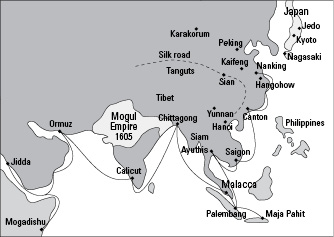
Zheng He (unknown–about 1433): A Muslim court eunuch (ouch!) in China’s royal household, Zheng He was also an admiral, sea explorer, and ambassador. From 1405–1407, Zheng commanded a 62-ship flotilla that went all the way to India. Then he led six more expeditions into the Persian Gulf and eventually to East Africa. He brought back giraffes, ostriches, and zebras, but the Chinese never used the contacts that Zheng He established with the rulers of the countries that he visited to develop trade advantages or to wield political influence abroad. (Zheng He’s name is also often written as Cheng Ho. It has to do with the different ways that Chinese names have been transcribed into Western alphabets.) Figure 21-1 shows many of Zheng He’s voyages.
Christopher Columbus (1451–1506): Some people celebrate Columbus while others vilify him for his so-called discovery of America. But the tall, red-haired, eccentric sailor died never realizing what he accomplished. Born in Genoa (then an independent Italian city-state), Columbus was a crack navigator who sailed along the Atlantic coast of Africa and probably north to Iceland. He explored the Caribbean for Spain, becoming the first European navigator to land at the Bahamas, Cuba (he thought it was Japan), Haiti, Jamaica, and Trinidad before he stumbled on the South American mainland (specifically Venezuela). Yet Columbus insisted that China, his real goal, was close by (see Chapter 7). Jealous rivals dogged his attempts to run colonial settlements. Spanish fortune hunters trumped up charges against him and hauled the Italian back to Spain in chains. Columbus’s sponsors, co-rulers Ferdinand and Isabella (see Chapter 19), set him free and gave him another expedition. On his fourth trip, Columbus caught the illness that killed him. Columbus committed at least three major career errors:
• Thinking that Asia extended a lot farther east than it does
• Figuring that the Earth’s radius is only three-fourths of what it really is
• Stubbornly refusing to re-evaluate the meaning of his discoveries
 Columbus has inspired many movies, including some very bad ones. In 1992’s Christopher Columbus: The Discovery, Tom Selleck plays King Ferdinand as Columbus searches for China and the screenwriters search for a plot. A 2007 Portuguese film, Christopher Columbus, the Enigma, is about an amateur historian in the twentieth century who’s trying to prove that the navigator was really from Portugal, not Italy.
Neil Armstrong (1930–): When he set foot on the moon in 1969, Armstrong was supposed to say, “That’s one small step for a man, one giant leap for mankind.” It came out “one small step for man,” which garbled the meaning a bit (“man” without the article “a” in those pre-feminism days often meant the whole human species), but his wording didn’t diminish the fact that somebody finally walked on the moon. Ohio-born Armstrong was a American fighter pilot and test pilot before training as an astronaut. After commanding the Gemini 8 orbiter in 1966, he was picked for Apollo 11, a moon-landing expedition.
Figure 21-1:Zheng He’s voyages made China a world leader in long-range navigation.
 On July 20, 1969, Armstrong climbed out of the landing module as spellbound earthlings watched on TV. Co-pilot Buzz Aldrin (1930–) was the second guy to step on moondust. Just as Columbus’s landing in the New World became a monumental landmark, so may the first moon landing prove to be a great turning point — after people eventually return to the moon, probably as an international venture between the United States and other nations with space programs, or venture to other planets. So far, however, the 1969 moonwalk seems to be an achievement ahead of its time. Nobody, not even the inventive people at the National Aeronautics and Space Administration (NASA), were quite sure what to do on the moon or with the moon after they set astronauts on its surface. More American Apollo missions followed, but then moon exploration dried up in favor of space shuttles, unmanned probes of other planets in the solar system, and the International Space Station.
Notable Travelers: Carrying Messages
Some historical figures traveled to spread news. Most spread the word about where they were after they returned. Either way, travelers have always been important sources of information and even inspiration.
St. Paul (about 10 AD–about 67 AD): First he was Saul, a Jew who came to Roman Judaea from his native Turkey. He became a rabbi of the strict Pharisee sect and believed in persecuting Christians, whom he saw as heretics (holders of religious beliefs that contradict official doctrine). Then, on a journey to Damascus to advise that Christians be rounded up, he said that Jesus came to him in a vision. Saul went blind for a while, and upon recovery, he was Paul, a traveling Christian apostle who wrote 13 New Testament letters. He roamed widely as a missionary and participated in debates over whether gentiles (non-Jews) could be admitted to the Church (he was in favor), and if so, how. Other religious and civil leaders, both Jewish and Roman, still held Paul’s earlier opinion that Christian ideas threatened the established order. Roman policy said those who spread Christianity should be jailed — or worse — and so Paul spent his final years as a prisoner.
Marco Polo (1254–1324): Born to a Venetian merchant family, Marco Polo tagged along with his dad and uncle on a trip to China in 1271. By Polo’s account, the Emperor Kublai Khan appointed him as an envoy and then governor of Yangzhou before the Italian went home in 1292. A soldier for Venice in a war against the Genoese, Marco Polo was captured and thrown in jail, writing The Travels of Marco Polo while imprisoned. The book was widely read and broke through the provincial consciousness of many literate Europeans. Many of Polo’s contemporaries thought the book contained lies, and many latter-day scholars also doubt Polo’s truthfulness. They think he padded his own Chinese resume, but the book’s descriptions of the East still stand as a cross-cultural milestone. (See Chapter 24 for more on Marco Polo.)
Ibn Battuta (1304–1368): Some people call this writer the Arab Marco Polo, but that fails to do Ibn Battuta justice, because he wrote about so many places. Born in Tangiers, Morocco, he spent almost three decades (from 1325–1354) covering more than 75,000 miles. Like Polo, he visited China and was well received. He also visited all the Muslim countries, writing about Mecca (in present-day Saudi Arabia), Persia (now called Iran), Mesopotamia (now Iraq), Asia Minor, Bokhara (in present-day Uzbekistan), southern Spain, and the North African city of Timbuktu, as well as India and Sumatra. He then settled in Fez, Morocco, and dictated the story of his journeys; his book, Rihlah, is a memoir of cultural, social, and political observations.
Amerigo Vespucci (1454–1512): Florentine Vespucci wrote about his 1499 voyage to Venezuela and points south. But Martin Waldseemüller (around 1470–1518), a clergyman in northeastern France, is the one who tacked the navigator’s name onto the New World. In a little publication calledCosmographiae Introductio (or Cosmo, for short), Waldseemüller spread the idea that there was a fourth part of the world beyond Europe, Asia, and Africa. He called this new mainland America, a Latinized tribute to Vespucci. The name stuck. Other mapmakers made it South America, using Vespucci’s name for North America, too.
Vespucci later became a victim of historical libel, as the charge spread that he stole credit for discovering America from Columbus or that he was the mapmaker who egotistically applied his own name to the New World. These false accusations are perhaps rooted in the irrational dislike that an American philosopher, Ralph Waldo Emerson (1803–1882), held toward Vespucci. Emerson wrote about the Italian as a “pickle vendor” and “boatswain’s mate in an expedition that never sailed.” It’s not clear where Emerson got the impression that Vespucci never traveled to the Western Hemisphere or that Vespucci was anything but a well-born and literate sailor with solid credentials in ocean navigation. Vespucci became pilot-major of Spain, the government’s top navigator, in 1505.
Trailblazing Explorers: Seeking New Routes
Many travelers left home in search of something specific — and many of these, especially in the sixteenth to the nineteenth centuries AD, were looking for sea routes between Europe and Asia.
Henry the Navigator (1394–1460): Prince Henry had a singular dream of finding a sea route to India and China. To realize that vision, this member of Portugal’s royal family founded a school of scientific navigation and sponsored expeditions along the west coast of Africa. In the same interest, he built Portugal’s first observatory to advance the science that taught sailors how to steer by the stars. Although he died before his students sailed around Africa, the prince paved the way for his country’s greatest nautical and commercial successes.
Juan Ponce de León (1460–1521): Running a Spanish plantation on the island of Hispaniola (today’s Dominican Republic and Haiti), this veteran officer (he may have been onboard Columbus’s second mission to the Caribbean) heard local Indians mention another tempting island. He sailed there, subdued the locals, and became Spanish governor of Puerto Rico. Then de León was inspired to follow another Indian story that told of an island where a spring made anyone who drank from it feel young and healthy. He never found that island or its fountain of youth, but he did land in Florida early in 1513. He died of an arrow wound suffered on his second expedition to Florida.
Meriwether Lewis (1774–1809) and William Clark (1770–1838): Better known as Lewis and Clark, these buddies crossed North America looking for the thing that so many seafarers failed to find: a northern water route between oceans. Backed by the U.S. government, Lewis and Clark wanted to find a route defined by rivers with a manageable overland stretch at the continental divide. Nobody knew how high, steep, and wide-ranging the Rocky Mountains were; the American idea of a mountain range at the time was based on the Appalachians. The Lewis and Clark expedition was supposed to reach the headwaters of the Missouri River and then portage (carry their canoes and supplies) to the nearby headwaters of a westward-flowing river, which would carry them to the Pacific. Such a route would have been a commercial boon to U.S. traders, who wanted to establish a Pacific trading post on the West Coast (despite the fact that the U.S. had no territorial claims on the West Coast at the time).
President Thomas Jefferson chose Lewis, his private secretary, to lead the expedition in 1804. Lewis took Clark along as co-commander of a party that journeyed by canoe, horse, and foot up the Missouri River and into the Rockies. In the Rockies, they found the mountain crossing to the Columbia River to be too long and rugged for commercial use. They traveled down the Columbia to the Pacific, wintered in Oregon, and returned east. Their observations of lands, people, plants, and wildlife were invaluable, although Lewis failed to publish their journals.
Lewis became governor of the Louisiana Territory in 1807. A troubled man, he killed himself while traveling through Tennessee. Clark went on to hold numerous government posts and negotiated several treaties with Indian tribes.
Sir John Franklin (1786–1847): British Naval officer Franklin fought in the Napoleonic Wars (see Chapter 9) and served as governor of Tasmania. He set out like so many sailors before him to find the Northwest Passage — a northern sea route around North America. Franklin’s expedition can’t exactly be termed a success given that he and his crew all died in their icebound ship. Yet they got so close — within a few miles — of finding the channel that Franklin gets credit for discovering the passage. Nobody successfully sailed the treacherous route until the Norwegian explorer Roald Amundsen (see “Famous Firsts” later in this chapter) did it in the early twentieth century. An ice-breaking oil tanker was the first commercial vessel to use the passage, in 1969. In the twenty-first century, as Arctic ice recedes, the Northwest Passage may at long last prove an accessible route for general navigation between Atlantic and Pacific.
Notorious Conquerors: Bad Company
Not all explorers had positive motives for seeking new worlds; some visitors, such as the following fellows, just barged in and took over:
Vasco da Gama (about 1469–1525): Check out Chapter 8 for the story of how da Gama went from Portugal to Kozhikode (or Calicut) on India’s Malabar (southwest) coast. Born in Sines, Portugal, he was one in a series of Portuguese explorers trained and dispatched for the purpose of exploring the African coast, rounding the continent’s southern tip, and establishing a trade route with the East. The first to succeed, da Gama returned to Portugal with a load of spices in 1499. Portugal followed da Gama’s success with a voyage by Pedro Alvarez Cabral (about 1467–about 1520), who accidentally touched the coast of Brazil on his way south, thus establishing Portugal’s claims in South America. Vasco da Gama returned in 1502 as an enforcer, establishing a pattern for brutal European colonialism in Asia. When Portuguese authority in India slipped in the 1520s, the government called da Gama out of retirement and sent him as a get-tough viceroy. He fell ill on that trip and died.
Francisco Pizarro (about 1478–1541): Pizarro, a soldier from Trujillo, Spain, was crafty and brutal. He used both qualities to defeat the mighty Inca Empire of South America in the 1530s, capturing King Atahualpa by trickery and killing him. (For more about the Spanish conquest of the Inca, see Chapter 8.) Pizarro also fought with his fellow conquistador, Diego de Almagro (about 1475–1538). (Conquistador is the Spanish name for the conquering commanders who took lands away from American Indians.) When Almagro, the conqueror of Chile, challenged Pizarro’s authority in Peru, the ailing Pizarro sent his brothers to capture and kill Almagro.
Hernan Cortés (1485–1547): Cortés helped his commander, Diego Velázquez de Cuéllar (1465–1524), conquer Cuba. After quarreling with Velázquez, Cortés, a proud nobleman from Medellin, Spain, accelerated his planned departure from Cuba to the mainland of Mexico, founding the port city of Vera Cruz before heading inland. Making allies of natives opposed to Aztec rule, he then marched on the Aztec capital. The Aztec king, Montezuma, welcomed Cortés as a god at first, but when the Aztecs became suspicious of the Spaniard’s motives, Cortés took Montezuma captive. Velázquez sent an expedition to bring Cortés back to Cuba, but Cortés convinced the party’s leader to join him and even burned their ships so that he couldn’t be taken back to Cuba. After an Indian rebellion, Montezuma’s death at the hands of rebels, and a brief Spanish retreat, Cortés conquered Mexico in 1521. He also tried to conquer Honduras but failed.
Famous Firsts
As Jean-Luc Picard (not a historical figure but a science fiction character) once said, the explorer aims “to go where no one has gone before.” (Yes, Star Trek fans; James T. Kirk said it first, but his gender-specific version — “where no man has gone” — sounds ironically dated now.) What’s true in the make-believe future was certainly true in the real-world past, as explorers competed to be the first person ever to conquer a geographic barrier or to slip the bonds of geography entirely. The following people fit that description, and those who survived won the bragging rights that go with the title “first.”
 If you’ve noticed that other explorers in this chapter were first to go where no one had gone before, congratulations. That means you’re paying attention. A chapter about explorers is bound to be full of firsts. But, as I explain in Chapter 3,the study of history is divided up into arbitrary categories — valid only if you have to pass a history test or as memory devices. The section titles in this chapter are just such arbitrary labels.
Ferdinand Magellan (about 1480–1521): What Columbus dreamed of doing — reaching the East by sailing west — Magellan accomplished. The Portuguese captain sailing under Spain’s colors traveled from Seville, Spain, around South America, and across the Pacific to the Philippines, where he died in a tribal dispute. His expedition, commanded by Juan Sebastian del Cano, continued, and a small, scurvy-weakened surviving crew completed the first trip all the way around the world. When Magellan first entered the new ocean west of South America, the weather stayed nice and the water calm for weeks on end, so he named the ocean the Pacific, or “peaceful.” The Pacific proved at least as violent as the Atlantic when a storm hit, but the name stuck.
Robert E. Peary (1856–1920) and Matthew A. Henson (1866–1955): Peary and Henson, credited as first to get to the North Pole, may not have touched the exact geographic pole in 1909. It was tough to tell, because there’s no actual pole to mark the North Pole and no land either — just ice floating so swiftly that a campsite drifts miles overnight. Still, Peary’s observations show that he and Henson came within 20 miles of the pole and probably closer.
A U.S. Navy officer from Pennsylvania, Peary commanded several arctic expeditions, at least four aimed at reaching the North Pole. Henson, whom Perry hired as a valet (personal servant) in 1897, was his navigator, trailbreaker, and translator. They almost lost their claim of being first to the North Pole to a former member of Peary’s expedition, Frederick A. Cook (1865–1940), who claimed to have reached the pole a year earlier. But Cook, who also said he climbed Alaska’s Mt. McKinley, had a habit of exaggerating. Peary’s other projects included a surveying expedition in Nicaragua. Henson wrote the 1912 book A Black Explorer at the North Pole.
Roald Amundsen (1872–1928): Norway’s Amundsen never finished the race for the North Pole, although he was first to locate the magnetic North Pole (not the same as the geographic North Pole, a discrepancy that caused hassles for northern navigators who used compasses, which point to the magnetic pole, not the geographic pole). When he found out that Robert Peary had beat him in the northern competition, Amundsen headed for the South Pole, reaching it in December 1911. Britain’s Robert F. Scott (1868–1912) arrived a month later, only to find he was too late; Scott and all his party died on the way back. Amundsen’s other accomplishments included sailing the Northwest Passage (see John Franklin in the section “Trailblazing Explorers: Seeking New Routes” earlier in this chapter) and flying across the North Pole in a blimp.
Yuri Gagarin (1934–1968): Gagarin, the first cosmonaut (Russian astronaut) died young, before the age of manned space exploration reached beyond its beginnings. Gagarin was a member of the Soviet air force and became the first human being to travel outside the Earth’s atmosphere when he made one trip around the planet in the Vostok spaceship in 1961. He was alive to see American John Glenn achieve sustained orbit by circling the earth three times in 1963, but Gagarin died in a plane accident the year before men first walked on the moon (see the entry for Neil Armstrong in the earlier section “Famous Pioneers: Arriving before Their Time”).
Name that explorer
To make remembering history easier, keep in mind that explorers often got things — cities, rivers, and lakes, for example — named after them. Here are a few notable examples:
Sir Francis Drake (about 1540–1596): Drake was an Englishman who fought the Spanish Armada and sailed around the world. His ports of call ranged from Virginia to the Caribbean to California, where a bay north of San Francisco bears his name.
Samuel de Champlain (1567–1635): He was France’s man in Canada — explorer, diplomat, and governor. He established French alliances with several Indian tribes and founded Quebec. The British captured Quebec in 1629 and made Champlain their prisoner until 1632. When Quebec was restored to French rule, Champlain served as its governor from 1633 until his death. Lake Champlain, which lies mostly between the states of New York and Vermont but also extends into Canada, is named for him.
Henry Hudson (unknown–around 1611): Nothing is known about this navigator’s early life, but he sailed for the Dutch and the English, making claims for both countries along the northeast coast of North America. Like France’s Cartier before him, Hudson was looking for the Northwest Passage. He explored the river (in New York), the strait (in Canada), and the bay (also in Canada) that now bear his name. Late in 1610, he found himself in Hudson Bay and decided to winter there. When the ship ran short of food, Hudson’s crew rebelled. The mutineers set their captain and eight other men adrift to die.
Renowned Guides
Some people just know how to get places. Out ahead of many a great explorer was a guide to show the way.
Ahmad Ibn Majid (early 1430s–around 1500): When Portugal’s Vasco da Gama (outlined earlier in this chapter and in Chapter 8) rounded the southern tip of Africa, sailing through the perilous waters between that continent’s east coast and the island of Madagascar, he knew he would need help to travel all the way to India. He hoped to find an Arab ship pilot to guide him. Perhaps overqualified, the man da Gama found in Malindi was Ahmed Ibn Majid, also known as “the Lion-of-the-Sea-in-Fury.” (Nobody has great nicknames like that anymore.) This greatest of Arab navigators wrote more than three dozen books about seafaring, oceanography, and geography. He specialized in the Arabian Sea, the Red Sea, and the Indian Ocean, and his knowledge was precisely what da Gama needed to open that part of the world to European sea trade. Many Arabs and other Muslims later regretted that Ibn Majid shared what he knew.
Sakagawea (unknown–1812): A rival tribe captured the young Shoshone woman from her native village (in today’s Idaho) and sold her to Toussaint Charbonneau, a Canadian fur trapper. Charbonneau married her by Indian rite and took her along when Lewis and Clark hired him as their expedition guide (refer to the earlier section “Trailblazing Explorers: Seeking New Routes” for more on Lewis and Clark). Sakagawea proved a better guide than Charbonneau, and she also served as interpreter, trader, ambassador, and quick-thinking aide, once rescuing Lewis’s priceless journal from floating down a river. Pregnant when they set out, she gave birth along the way and then carried the baby boy on her back. Her name, which means “Bird Woman,” has variant English spellings, including Sakajawea.
Famous Mavericks: Taking Advantage of Opportunity
Traveling well often means grabbing your chance when it presents itself — turning banishment into a chance to found a settlement, for example, or taking over the colony when you see an opening. The following voyagers are among many in history who broke a few rules on the way to discovery:
Erik the Red (tenth century AD): The Viking leader Erik Thorvaldson was banned from his native Norway for manslaughter. He sailed west to Iceland in 982 AD, but after settling there and killing again, he was outlawed once more. Erik moved to a peninsula reaching west from Iceland and — you guessed it — he killed somebody again; this time the sentence was three-year banishment. Where could he go but farther west? He knew there was supposed to be land out there because a sailor named Gunnbjorn had reported it after being blown off-course 50 years before. So Erik sailed and found Greenland, rich with game and grassy enough to make good pasture (it was warmer then). After his banishment was up, Erik and his crew returned to Iceland and rounded up 25 ships full of Icelanders eager for life in another new land. Erik would have commanded his son Leif Eriksson’s expedition to North America (see “Famous Pioneers: Arriving before Their Time” earlier in this chapter) if he hadn’t been thrown from a horse just before leaving and decided it was an omen against his travel plan. He told Leif to go without him.
Vasco Núñez de Balboa (1475–1519): Balboa came to Darién (now part of Panama) as a stowaway on a Spanish ship. He seized power during an insurrection and extended Spanish influence into nearby areas. Extending influence required traveling through low jungle and wetlands, but he found some high ground, too, and from atop a hill Balboa sighted what he called the Southern Ocean and claimed it for Spain. Later, the navigator Magellan called this ocean the Pacific. Despite Balboa’s industry, Spain appointed Pedro Arias Dávila (about 1440–1531) as governor of Darién. Balboa made the best of this arrangement by leading several expeditions for Dávila. But in 1519 Dávila and Balboa clashed, and the governor had Balboa beheaded.
Tracking the Centuries
Around 330 BC: Pythias of Massilia (today’s Marseilles, France) sails out through the Strait of Gibraltar and up the Atlantic coast of Europe to what may have been Norway.
First century AD: St. Paul, a former Jewish rabbi of the Pharisee sect, travels widely through southern Europe and the Middle East, spreading the new Christian faith.
1354: The scholar Ibn Battuta settles in Fez, Morocco, to dictate his book Rihlah, a memoir of 30 years of travels from Spain to Uzbekistan, China, and Timbuktu.
1804: Sakagawea helps American explorers Meriwether Lewis and William Clark find their way up the Missouri River toward the Great Divide.
1911: Roald Amundsen, a Norwegian explorer, arrives at the South Pole and is the first person to reach this frigid goal.
1969: Neil Armstrong, an American, steps out of his lunar landing module to become the first human being to set foot on the moon.