
Chapter 5
In This Chapter
Tracing the life cycle of the Roman Empire
Bringing states together in a united Indian empire
Uniting and organizing China
Establishing the Maya and other empires in the Americas
The Roman city-state’s origins are obscure and lost to history, if not to legend. But Rome’s history, as it grew into one of the greatest empires the world has ever seen, is anything but obscure. Even in 20 books this size, I probably wouldn’t be able to tell you everything that’s known about the Roman Empire and its people — let alone its pervasive legacy.
Influential Rome left such a history and a lasting mark on the world that sometimes it seems as if the Roman Empire was the only great empire of the final century BC and the early centuries AD. But the Roman Empire was far from that. Powerful empires rose and fell in the Middle East and Asia. New empires arose in China and the Americas, far away and isolated from the Roman sphere. Imperial expansion dominated much of the world. You can find out about a few of these empires and other civilizations that were contemporaries of the Roman Empire later in this chapter.
As other empires rose and fell, so did Rome’s. Also in this chapter, you uncover out how Rome grew from a city-state ruled by a king to a democratic empire and eventually deteriorated into a divided and crumbling political ruin.
Rome’s Rise and Demise
From its legendary beginnings to its fractured demise, the Roman civilization had a certain pizzazz that has captured the imagination of not just historians but everybody fascinated by human achievement, military adventure, political intrigue, and tragedy. Shakespeare was among those drawn to its stories (see more about that in the later section “Crossing the Rubicon”), and so am I.
What’s the attraction? You can look at Rome’s long ascent and descent from any number of angles and wonder at the complexity and sophistication, not to mention the cruelty and corruption of this long-lived culture. In the brief glimpses that follow, you can find clues to what fascinates so many about the Roman civilization.
Forming the Roman Republic
Roman legend says that the half-god, half-mortal Romulus, a son of the Greek war god Mars, built the city of Rome on the Tiber River in 753 BC and ruled as its first king. The legend also says that a female wolf suckled baby Romulus and his twin brother Remus. Historians tend to disagree, especially about the wolf, and put the founding of Rome a bit later, around 645 BC. (For more about Romulus and Remus, see Chapter 19.)
Although he may not have ever tasted wolf’s milk or murdered his smart-mouthed twin brother, the legendary Romulus is credited as the first of seven kings who ruled Rome as a city-state (not unlike the Greek city-states around the Mediterranean, which you can find out about in Chapter 4) until 509 BC. That was when King Tarquinius Superbus got on the wrong side of his advisory body of citizen-magistrates, the Roman Senate.
The Roman Senate gave Tarquinius Superbus the boot and set up a republican system of government designed to prevent a tyrant from ever misruling Rome again. Two consuls, elected annually, served as administrative executives under the supervision of the Roman Senate. The republic system worked, bringing the stability that Rome needed as it grew from city-state into empire. And did it grow.
 Rome borrowed freely from other cultures — a pantheon of gods from the Greeks, Athenian-style democracy, and metalworking technology from an older Italian culture, the Etruscans. Yet, the Roman civilization did so much with what it borrowed that you can’t begin to overestimate its impact both in its own time and ever since. How is Rome’s influence felt today? In all kinds of ways. For one, the Roman language, Latin, is the foundation of not just Italian, but also of French, Spanish, Portuguese, and Romanian. Latin also left a deep impression on non-Latin languages, such as English. Even after Latin fell out of everyday use, it remained the unifying language of learning, particularly medicine and science.
Earning citizenship
Romans lived in a stratified society organized by class (see the “Roman class” sidebar for more). Opportunities and employment were strictly defined by birth — just as they were in so many other cultures dominated by privileged aristocrats. Yet Roman custom also offered ways to improve your status or that of your children.
Rome allowed foreigners and slaves to become citizens. It was a highly limited opportunity by modern standards but progressive for its time. Giving the Roman Empire’s lowborn and conquered people a chance at inclusion in society helped win those people’s loyalty to Rome, which added greatly to Rome’s growth and resilience.
Democratic Athens, Greece, offered no such opportunities for outsiders (see more about Athens in Chapters 4 and 11). In a Greek city-state, a slave could be granted freedom, but the best he could hope for was lowly resident-alien status. He was unlikely to develop loyalty to a state that excluded him. (And I do mean him. Women couldn’t even dream of citizenship.) When war broke out, the resident alien was unlikely to rally to the cause.
Why so exclusive? Greeks valued Greekness, looking down on those who didn’t speak their language and worship their gods. But the exclusion was also economic. The city-states of rocky Greece were usually short of resources, especially good farmland. Granting citizenship meant increasing the number of people with a direct claim on the food supply. Making slaves citizens was too expensive and would also have meant increasing the number of voters, which may have caused unwanted power shifts.
In fertile Italy, on the other hand, food was relatively abundant, so shares weren’t such an issue. Also, blocks of votes rather than individual votes determined Roman elections, so an extra vote in a block had little potential impact.
 Rome offered slaves the real possibility of earning citizenship, but only in the lowest class of citizenship: plebeian. Plebeians, however, could hope for their children to rise to a higher class. Further, Rome united other cities to its empire by bringing conquered people into the fold. Roman officers propped up local aristocrats in newly taken provinces, making them dependent on Rome’s support. The defeated country’s men were enlisted in the next conflict and rewarded with part of the profits from the almost-inevitable conquest: Loyalty was lucrative.
Expanding the empire
By the third century BC, Rome had only one major rival for the position of top dog in the western Mediterranean: the city of Carthage, a big, rich trading port in North Africa.
Before 1000 BC, the Phoenicians sailed out of what is now Lebanon to expand trade opportunities, and they found Carthage, in present-day Tunisia, in 814 BC. Around 600 BC, Carthage became so rich and populous that it cast off Phoenician rule.
Roman class
Plebeian, which refers to a lowly person, is a word you may still run across. In Rome, the plebeian belonged to the second lowest of four classes in society. The lowest was the slave, who had no rights at all. Plebeians were a little better off in that they were free, but beyond that they had no clout. Next in the hierarchy were the equestrians, or riders. These were rich people — rich men, actually — of a class that rode horses when they were called to fight for Rome. They weren’t rich enough to have much power, though. For that, you had to be among the patricians, the nobles.Patrician is a word that still gets used, too. Now, as back then, it’s applied to people of wealthy families accustomed to having authority.
Carthage and Rome fought three Punic Wars from 264–146 BC. (Punic comes from Punicus, a Latin word for “Phoenician.”) Carthage should have quit while it was ahead. In the first of these wars, Rome won the island of Sicily, its first overseas province. In the second Punic War, Carthage lost the rest of its far-flung territories and became a dependent ally of Rome. The alliance was never sweet and soured into the third Punic War, when Rome destroyed Carthage itself.
To the east, Rome fought the Hellenistic kingdoms, which were Greek-influenced nations carved out of Alexander’s empire. Romans took Macedon, Greece, Asia Minor, and the eastern shore of the Mediterranean, eventually including Judah, founded by the Jewish leader Judas the Maccabee in 168 BC. The Romans sacked Jerusalem in 63 BC and made it the capital of Roman Judea.
The empire pushed north into Gaul, to the Rhine and the Danube Rivers, growing so big that administering the vast territory became too difficult for the republic, with its unwieldy and often contentious government. Turmoil created the opportunity for a military genius named Gaius Julius Caesar to step forward.
Crossing the Rubicon
Gaius Julius Caesar (better known as just Julius Caesar) was a Roman aristocrat from one of the republic’s old families. As a military commander, his far-flung conquests extended Rome’s growing dominion, and he was ambitious for himself as well as for his country.
In the first century BC, Rome desperately needed leadership. Decades of uneasy peace, fierce political rivalries, and widespread bitterness had followed a series of civil wars. Quarreling politicians fighting for power rendered the Roman Senate useless. In 60 BC, three leaders formed the First Triumvirate, or “rule by three,” to restore order. It was actually an unofficial arrangement that was even kept secret at first, but the triumvirate dominated Roman politics for most of a decade. The three were Marcus Licinius Crassus, Gnaeus Pompeius Magnus (widely remembered as Pompey), and Julius Caesar, the youngest. Caesar was especially feared by politicians who opposed the Triumvirate, in part because he was a nephew of the late Gaius Marius, who had served seven different times as consul, the top administrative post in the Roman government. (A consul was a bit like a mix between prime minister and attorney general.)
Caesar’s victories in the Gallic Wars (58–50 BC) pushed the empire’s borders all the way to Europe’s Atlantic seaboard. He also led Rome’s first invasion of Britain in 55 BC. While he was away, however, Crassus died, and the First Triumvirate fell apart. Pompey sought to consolidate his own power, standing as Caesar’s rival instead of his ally.
Returning home in 49 BC, Caesar started another civil war by defying a law that said Roman troops had to stay north of the Rubicon River in today’s northern Italy. The law was intended to prevent a military leader from taking over the republic by force. Caesar led his troops across the stream and fought other Roman leaders for the prize of absolute power in battles that continued until 45 BC. (Rubicon has meant “point of no return” ever since.) His rivals defeated, Caesar took the title “Dictator for Life.”
 Caesar wasn’t technically an emperor, but his reign marked the end of the Roman Republic and the beginning of an age of emperors. Rome’s ruling families didn’t take this change lightly. The dictator liked elaborate compliments and formal tributes, making his enemies think he was aiming for not just regal status but a kind of imperial divinity. Many Romans were upset at what Caesar was doing to their republic, and they still talked about Tarquinius Superbus, the last Roman king, and how the Roman Senate had kicked him out. Two senators, Brutus and Cassius, plotted Caesar’s assassination and carried it out successfully.
 England’s William Shakespeare wrote a terrific play on the subject of Caesar’s downfall 1,600 years after it happened. If you’ve ever said, “Beware the ides of March” or “Friends, Romans, countrymen, lend me your ears,” you’ve quoted Shakespeare’sJulius Caesar. Director Joseph L. Mankiewicz made a movie version of the play in 1953, with 1950s screen sensation Marlon Brando holding his own alongside Shakespearean heavyweight John Gielgud. It’s not as much fun as a top-flight stage production of the play, but the movie could be a lot worse. More recent film adaptations were made in 1970 and 1979. Don’t take Julius Caesar — the play or films — for literal truth, though. Shakespeare was a great dramatist, but he was no historian.
Many more years of civil war followed Caesar’s assassination. Caesar’s cousin and general, Marcus Antonius, or Mark Antony, was in position to emerge with supreme power. But Antony’s formidable rival, Caesar’s great-nephew and adopted son, Octavian, came out on top in 31 BC with a win over the combined forces of Antony and his wife, the Egyptian Queen Cleopatra, at Actium off the coast of Greece.
Empowering the emperor
Like his predecessor, Octavian didn’t call himself King or Emperor, although that’s what he was as the undisputed ruler of the Roman world. Instead he took the relatively modest title Principate, or “first citizen.” His modesty would have seemed sincere if he hadn’t also gotten the Senate to rename him Augustus, which means “exalted.” Augustus already bore the family name Caesar. Both Augustus and Caesar became titles handed down to successive Roman emperors.
Augustus cut back the unbridled expansionism of late republican days and set territorial limits: the Rhine and Danube Rivers in Europe and the Euphrates River in Asia. The empire was stable. It annexed no territory until taking Britain in 44 AD. Then, in 106 AD, Emperor Trajan, eager to extend his territory, took Dacia (modern Romania) and Arabia.
Roaming eastward
Emperors ran Rome for hundreds of years more as dynasties and factions rose and fell and as pressure along the far-flung borders demanded vigilance. (For more on Roman defensive strategies, see Chapter 16.) Cutting back on expansion eased conflict but didn’t stop incursions from the outside.
The hardest pressure was always at the frontier formed by the Rhine and Danube Rivers. Successive Roman emperors had to concentrate resources there, leading to more administrative focus toward the east. In the third century AD, the Emperor Diocletian built a new eastern capital, Nicomedia, far off in Asia Minor, where the Turkish city of Izmit is now. In 324 AD, the Emperor Constantine put his capital, Constantinople (today’s Istanbul, Turkey), in the east, too. He built New Rome, as Constantinople was often called, at the site of the old city of Byzantium on the Bosporus, the channel that connects the Black Sea with the Mediterranean. Completing the project in 330 AD, the emperor renamed the city after himself.
Constantine became the first Christian emperor, ending a century of persecution against those who followed the new religion. Christians were relatively few until the third century and were largely ignored, but in 235 AD, the Severan Dynasty fell apart and the Roman Empire tumbled into 50 years of chaos. Emperor Decius, looking for scapegoats, began rounding up the increasingly numerous Christians and killing them. His successor, Valerian, did much the same thing. The Goths killed Decius and the Persians captured Valerian in acts the Christians saw as divine retribution. Maybe the emperors thought so, too. Romans were highly superstitious, and bad luck could convince even an emperor that supernatural forces were against him. Persecution of Christians stopped for a while, and Christianity gained many converts.
It took Diocletian, a soldier from Croatia who became emperor in 284 AD, to get the government of the Roman Empire back on line. After accomplishing that, Diocletian started persecuting the Christians again.
How did Diocletian restore order? He split the empire in half, as follows:
The East: Diocletian took the wealthy, healthy eastern half of the Roman Empire for himself, basing his new capital in Turkey.
The West: Diocletian tapped the general in charge of Gaul, Maximian, to rule the western half of the Roman Empire.
Both Diocletian and Maximian had the title Augustus, and two more co-rulers, Constantius and Galerius received the lesser title Caesar. When Constantius died, his son, Constantine, later called Constantine the Great, succeeded him and eventually won control of the whole empire. The reunification couldn’t last, though, especially considering that Constantine based himself in the east, too. Diocletian’s split had set a precedent.
Constantine did much more for Christians than just stopping their persecution. Starting in 331 AD, he made the Church rich by
Seizing the treasures of pagan temples and spending them on magnificent new Christian churches from Italy to Turkey to Jerusalem.
Handing out huge endowments.
Authorizing bishops to draw on imperial funds as reparation for the years of enmity.
These moves helped establish the Church as a wealthy institution for many centuries to come. In 391 AD, Constantine’s successor, Theodosius I, added a final touch by prohibiting old-style Roman pagan worship.
One result of the power shift away from Rome was that the Roman Senate was sometimes relegated to the status of a city council. True, Rome was quite a city for a council to oversee, but the power was where the emperor was (or where the emperors were). Rome’s western half became less and less an empire and therefore grew more and more vulnerable to invasion by the barbarian tribes from the north — Huns, Vandals, Visigoths, Ostrogoths and more.
By 400 AD, Theodosius had a senate in Constantinople and a staff of 2,000 bureaucrats. Also around this time, Roman tax collectors couldn’t move about Europe without a military escort. The Visigoths sacked Rome in 410 AD.
Western empire fades into history
With its western territory overrun by barbarians and pirates, the Roman Empire was no longer anything like its former self. In 439 AD, Vandals advanced to Roman North Africa, capturing Carthage, the former Phoenician capital that had become one of the major cities of the Western Roman Empire. The once-mighty western empire was unable to defend this valuable trade center.
While the Western Roman Empire declined, the imperial government in Constantinople signaled the changing times by declaring Greek, rather than Latin, to be the official language of that capital city. Latin was the language of the west, of Rome. Greek was the language of the eastern Mediterranean, the new center of Roman ascendancy. As the Byzantine Empire, this eastern branch of the Roman Empire would persist for another 1,000 years. For more about that, check out Chapter 6.
Roman administration in the West struggled on until 476 AD, but without authority. When barbarian leaders closed in on the last emperor to sit on the Roman throne, a poor youngster named Romulus Augustus (a name recalling his great predecessors), they didn’t bother to kill him. Also known by the diminutive Augustulus, he wasn’t considered important enough.
Rome’s legacy pervades the Mediterranean, the Middle East, Europe, the Americas, and also far-flung places culturally affected by Europeans — a broad swath that takes in the Philippines, South Africa (and most of the rest of the African continent), Australia, and arguably the whole world.
Rome and the Roman Catholic Church
After Rome was no longer an imperial capital, its name loomed so large and for so long in people’s minds that it continued to invoke power and an aura of legitimacy. This was in part because the Church remained headquartered there, but the Church was in Rome because of what Rome had been at its political height — the center of the western world.
The Romans weren’t the first Christians. In fact, Romans fed early Christians to the lions just for the fun of it. Yet when the Roman Empire was officially converted to Christianity, it promoted, strengthened, and spread that religion in Europe, western Asia, North Africa — everywhere the empire extended. The Church rose to wealth and power under the protection of Roman emperors.
Rome became the capital of western Christianity and remains the seat of the Roman Catholic Church. Yet ironically, by the time Christianity became the official Roman religion, the Roman Empire had shifted its energies far away from Rome.
Whatever it’s called, it’s still the Church
When talking about the Christian Church in its early years, I often refer to it simply as the Church. Christianity was a huge cultural force from late Roman times onward. Before the Protestant Reformation of the sixteenth century, the Catholic Church was theChristian church in Western Europe — virtually the only one. It was rarely called the Catholic Church because catholic was still an adjective meaning “universal” rather than the name of a religious denomination. (Spelled with a lowercase c, catholic still means “universal” or “wide-ranging.”) After Rome banned pagan worship and as the old Norse and Celtic beliefs faded, virtually everybody was a Christian. Catholicism was the universal religion: Everybody was a Catholic, but they didn’t think of themselves as Catholics because there was no such thing as a Protestant. Christians always capitalized the word Churchwhen they meant the network of cathedrals, chapels, priories, and so on that looked to the pope in Rome for direction, and so do I in this chapter and in Chapters 10 and 14.
In addition to its role as root of modern Romance Languages (Italian, French, Spanish, and so on), Latin was the unifying language of the Roman Catholic Church, which to Roman and other European Christians before the sixteenth century AD was just the Church — the only church there was. (See Chapter 12 for more on early Christianity.) After the Protestant Reformation and until the middle of the twentieth century, Catholic masses worldwide were always said in Latin. (See Chapter 14 for more on the Reformation and the founding of later Christian churches.)
The Holy Roman Empire is not to be confused with the Roman Empire. The Holy Roman Empire was a much later confederation of European principalities and duchies that changed shapes and allegiances over many centuries. Yet it got its Roman name because of the regard that medieval Europeans still had for the concept of Roman power. This later empire started in 800 AD, when Pope Leo III bestowed the new title of Emperor of the West on Charlemagne, king of the Franks and the first ruler since the original Roman Empire’s demise to unite most of Western Europe under a single rule. Charlemagne’s empire, based where France is today, didn’t long survive him, but the German king Otto I put together a new Holy Roman Empire in 962 AD, the one that hung on until the nineteenth century. (For more on the Holy Roman Empire, see Chapters 6 and 14.) Aside from the pope’s blessing, this empire’s nominally united German and Austrian lands had little to do with Rome. Still, the name Romansmacked of imperial legitimacy.
Other Roman terms endured as well, especially terms for positions of authority.The Russian title czar (or tsar, as it’s often spelled) and the later German kaiser both came from the Roman title caesar. (Julius Caesar, whose name became an official Roman title, makes another appearance in Chapter 20.) The name of a powerful dynastic family, the Romanovs, who ruled Russia from 1613–1917, referred back to imperial Rome, too. Even in the Islamic world, the name Qaysar — a place name found from Afghanistan to Egypt — comes from Caesar.
Building Empires around the World
After Alexander the Great died of a sudden fever in 323 BC, his vast empire almost immediately disintegrated. Without Alexander, there was nothing to unite such widespread, dissimilar places as Macedonia, northern India, and Egypt — all among his territories. (Find more about Alexander the Great in Chapters 4 and 20.)
Yet the breakup of Alexander’s empire brought about new empires — not as big, but impressive nonetheless. Several of them were founded by Alexander’s former military governors.
Alexander was a conqueror rather than an administrator. He couldn’t personally rule all the lands he won — especially not while conducting further military campaigns — so he appointed regional viceroys to govern in his name. The word viceroy is similar to vice-president, with the -roy part meaning king. These assistant kingships went to some of Alexander’s top military commanders.
With Alexander gone, the generals were free to turn their territories, which they had been holding in trust for their boss, into personal kingdoms. (See Chapter 4 for the story of Ptolemy, Macedonian governor of conquered Egypt, who used Alexander’s funeral procession to found his own Egyptian dynasty.) Although the Roman Empire, the largest and most influential empire to emerge after Alexander, arose first as a city-state, and although the Mediterranean was sprinkled with successful Greek city-states, imperial might was the model for large-scale government in the late centuries of the BC period and the early centuries of the AD period.
Ruling Persia and Parthia
Seleuces was the Macedonian general that Alexander the Great left in charge of conquered Persia (largely what’s now Iran) in the 330s BC. The Persian Empire, at its height around 480 BC, was immensely powerful but in decline by the time Alexander added it to his collection of kingdoms. Still, there was a precedent for imperial government in Persia, and Seleuces took advantage of that by bringing Persian officers and Persian regional officials into his government of Macedonians and Greeks and by using his troops to keep order. He successfully transformed himself into a king, no longer a viceroy dependent on Alexander the Great’s might to back him up.
Seleuces’ descendants, the Seleucid Dynasty, ruled a piece of Asia that stretched from Anatolia (the Asian part of modern Turkey) to Afghanistan. Seleucid rule lasted until a powerful regional rival, the Parthians, conquered Persia in the second century BC.
The rise of the Parthians traces back to 250 BC, when the leader Arsaces, from central Asia, founded Parthia in eastern Persia. His descendant, Mithradates I, went on an empire-building campaign of his own between about 160–140 BC, assembling lands from the Persian Gulf to the Caspian Sea and eastward into India.
Mithradates’ goal was to recreate the Persian Empire ruled over by Darius I more than 300 years earlier. (Chapter 4 has more about the Persian Empire.) Alexander and his successors displaced Persian culture with Greek — a change called Hellenization because the Greeks called themselvesHellenes. Mithradates reversed Hellenization and revived all things Persian. The Parthian Empire lasted until 224 AD, when a soldier called Ardashir, a member of a noble Persian family called Sassanid, rebelled against the king and killed him. Like the Parthians, the Sassanid Dynasty was Rome’s major rival in the East, lasting until the Muslim Arabs conquered Persia in about 642. (For more about the Arabs, turn to Chapter 6.)
India’s empires
The political borders within today’s India and Pakistan shifted a few times over the centuries between 300 BC and 400 AD, a time that gave rise to both the Indian subcontinent’s first united empire — the Mauryan — and India’s golden age under the Gupta Dynasty.
Striking back at Alexander the Great
In 322 BC, a nobleman named Chandragupta Maurya (sometimes spelled Candra Gupta Maurya) overturned Alexander the Great’s Indian conquest by leading a successful revolt against Alexander’s governors in the Punjab (modern Pakistan and northwest India). He also seized Magadha, the main state in northeast India, and formed the biggest Indian political force yet, the Mauryan Empire. Seleucus, the general who became Persia’s king after Alexander died, invaded from the west in 305 BC, but Chandragupta beat him off and won a treaty from him setting an Indian border along the high Hindu Kush Mountains. (The Hindu Kush Mountains are an extension of the Himalayan range and the same barrier that Alexander had to cross when he invaded India.)
Chandragupta’s son and grandson enlarged the empire, especially to the south, but war sickened the grandson, Asoka. After early victories, he became a devout Buddhist, devoted to peace among people and nations. Instead of troops, he sent missionaries to win over Burma and Sri Lanka.
Achieving a golden age
After Asoka died in 238 BC, his successors proved less able to hold the large territory together, and the Mauryan Empire declined. An ambitious rival from the Sunga family assassinated the last Mauryan king, Birhadratha, in 185 BC, and seized power. The resultant Sunga Dynasty couldn’t prevent the subcontinent from breaking up into a number of independent kingdoms and republics, something like what happened during the medieval period that Europe would soon experience.
Then another leader, another Chandragupta, united India again about 600 years after the Mauryans did. The new power grew into the Gupta Empire, achieving great wealth through widespread trade and intelligent government and bringing about the greatest cultural flowering ever to rock India.
Known as Chandragupta I, this conqueror started in the kingdom of Magadha in 320 AD, bringing surrounding kingdoms under his influence by force and persuasion. He revived many of Asoka’s principles of humane government. Much as the Romans did, he put local leaders to work for him instead of killing or imprisoning them; he propped up regional authorities and made them dependent on his administration. This model for Indian government worked for a long time. Even the British used this model for governing India in the nineteenth century.
Chandragupta had able successors, including his son Samudragupta, who spread the Gupta territory to the north and east. Grandson Chandragupta II, a great patron of the arts, ruled from 376–415 AD, spending tax money to promote architecture, painting, and poetry. The Gupta era gave India many glorious temples and palaces, as well as sculpture, music, dance, and poetry.
The Guptas weren’t without enemies. Huns from Mongolia and northern China battered the northern frontier of India in the fifth century. In the 480s AD, after the last Gupta king died, Huns took over the North. (For more about the Huns and what they were doing to Europe around the same time, turn to Chapter 6.)
Uniting China: Seven into Qin
Divided into seven warring states, China was in turmoil from 485–221 BC. Then the king of one of those states, a place known as Qin, emerged as the dominant leader. He united China for the first time by beating his rivals and consolidating their territories into greater Qin, calling himself qin shi huangdi or Qin Shihuangdi, meaning “the First Emperor of Qin,” which suggests that he thought there would be more emperors after him. He was right. From Qin, which you also can spell Chi’in, came the name China.
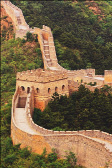
Qin Shihuangdi got things done. He may have been inspired by the great Persian road-builder Darius I, because just as Darius built a 1,500-mile highway, Qin Shihuangdi linked the various defensive walls on China’s northern border into one Great Wall. His successors continued to work on the wall until it was more than 2,500 miles long; you can see it in Figure 5-1. (Darius also inspired the Parthian empire-builder Mithradates, whom you can read about earlier in this chapter. For more on Darius, see Chapter 4.)
Qin Shihuangdi also built roads and canals with a fury, and from his northern power base, he conquered southern China. He got rid of feudalism and disarmed nobles, dividing the country into 36 military districts, each with an administrator who reported to the emperor. He was a firm believer in big government, using his clout to reform weights and measures and standardize everything from Chinese script to the length of cart axles.
The emperor looked after himself and his entourage, building a palace complex that doubled as a massive barracks sleeping many thousands. He also linked hundreds of lesser palaces by a covered road network. You may conclude from these facts that he didn’t like to be alone, and perhaps this accounts for what researchers found after they opened his tomb in 1974 — 7,000 warriors sculpted of terra cotta and standing in battle formation as if to protect their king. With painted faces and uniforms, the sculptures still hold real weapons. Terra-cotta drivers man real chariots hitched to terra-cotta horses.
Figure 5-1: Qin Shihuangdi started linking defense works that became the Great Wall.
© Adam Jones/Getty Images
There’s nary a hint of historical authenticity in the 2008 action-horror-comedy film The Mummy: Tomb of the Dragon Warrior. Still, the filmmakers seem to have been inspired by Qin Shihuangdi’s sculpted army. The film features Brendan Fraser battling 10,000 terra-cotta soldiers who answer to an evil, immortal ancient Chinese king. Hong Kong filmmaker Ching Siu Tung also used the pottery army as the premise for his 1990 adventure-comedy A Terra Cotta Warrior, about a Qin guardsman who gets turned into terra cotta but revives in the 1930s to protect the emperor from grave robbers.
The first Chinese emperor died in 210 BC, and his dynasty didn’t last long, yet the family that emerged as rulers only four years later, in 206 BC, was smart enough not to undo the Qin work. Building on Qin Shihuangdi’s reforms, the rulers of the Han Dynastyreigned until 220 AD.
Relatively late in the Han Dynasty, during a time called the Eastern Han, the Chinese invented both paper and porcelain, among other important technological advances that flourished under later dynasties such as the short-lived Sui and the succeeding Tang.
Flourishing civilizations in the Americas
During the Roman era, all the action wasn’t just in Europe. Empires formed in the Americas, too.
Sharing with the Maya
The Mayan culture took shape by about 1 AD in Central America, rising to prominence around 300 AD and enjoying what historians call its Classic Period until about 900 AD, when it went into a long decline.
In the tropical rainforests on the Yucatan Peninsula, in an area spreading over what’s now southern Mexico, Guatemala, northern Belize, and western Honduras, the Maya built on inventions and ideas developed by nearby cultures such as the Olmec (see Chapter 4). The Maya also shared aspects of their culture with the Toltec of northern Mexico, whose great city of Tula (about 40 miles north of present-day Mexico City) covered 13 square miles and was home to as many as 60,000 people. (The Toltec predated the Aztecs, who show up in Chapter 8.)
The Maya developed astronomy, a sophisticated calendar, and a writing technique similar to Egyptian hieroglyphics. They built terraced cities in neat rectangular grids and pyramid temples in ceremonial cities such as Copan, Palenque, and Tikal. Both the cities and temples are now ruins for archeologists to study and tourists to explore (and climb on).
An elite class of priests and nobles ruled over the majority, who tended fields cleared from the jungle. Modern experts haven’t settled on why the Maya ultimately abandoned their cities, although environmental decline seems to have been a factor.
Building in Peru
Farther south, a culture called the Paracas took root as early as 750 BC on a peninsula jutting from the southern coast of Peru. What’s known of the Paracas comes purely from archeological evidence. Apparently at its height from the first century BC until as late as the fourth century AD, this farming civilization built extensive canals for irrigation.
The Paracas were skilled at weaving, a fact illustrated by the beautifully embroidered textiles found wrapped around mummified bodies of their dead. Archeologists refer to a large, seaside complex of Paracas tombs as the Paracas Necropolis, meaning “city of the dead.”
In the dry river valleys inland from the south coast of Peru, the Nazca culture appears to have risen around 200 BC, perhaps as an offshoot of the Paracas. As with the Paracas, most of what’s known of the Nazca comes through interpretation of surviving artifacts such as textiles and colorful pottery.
Based on such evidence, archeologists think the Nazca reached their civilization’s height between 200 BC and 500 AD. Their huge-scale earthen etchings, designs that are most visible today from the air, are cited today as evidence of long-ago interplanetary visitors. Theorists say that the figures can’t be seen except from the air and so they could have been landing strips for alien spaceships. Archeologists who study the Nazca point out that the figures can indeed be seen from surrounding hills and that the lines of the drawings are far more likely to have been ritual paths that were part of the Nazca religion. The scientists reject the ancient astronaut theory as nonsense.
Arising a little later than the Nazca — in the first century AD — in the fertile valleys inland from the north coast of Peru, the Moche culture may have resembled that of Classical Greece in that it seems to have consisted of politically independent city-states united by a common language and religion.
Although the Maya had hieroglyphics, the Paracas, Nazca, and Moche people left no evidence of any written language.
Rounding Out the Rest of the World
Over the long stretch of time when the Roman Empire was rising and falling, other cultures around the globe experienced their own changes.
The Aksum: In northeast Africa, where Ethiopia is now, the Aksum people put together an empire that grew rich after 200 AD by trading with places as far away as India. The Aksum became Christian in the fourth century AD and spread the new religion to neighboring peoples.
The Celts: Tribal people with sophisticated metalworking skills but no written language, the Celts kept expanding their European territory from central Europe toward the west and south. By the fifth century BC, they were dominant in Gaul (modern France), England, Ireland, much of Scotland, and parts of Spain. By the third century BC, the Celts spread through the Balkans. They made beautiful golden jewelry and harness ornaments. In some places, the Celts built large forts atop hills and fought Roman legions as the empire absorbed Europe. Later the Celts clashed with the barbarians that overran their territory through the early centuries AD.
The Japanese: Discovering how to mine and smelt iron, the Japanese joined the Iron Age sometime in the third century AD. They buried emperors and other big shots with their weapons and other valuable possessions in mounds made of stone and earth.
Tracking the Centuries
753 BC: According to legend, this is the year when Romulus, the half-mortal son of a Greek-Roman war god, builds the city of Rome.
About 645 BC: According to historians, people from a number of small settlements in west-central Italy establish the city of Rome on a hilly site along the Tiber River.
509 BC: Romans rise up against King Tarquinius Superbus and drive him into exile. They establish a republic in place of the monarchy.
238 BC: Asoka, emperor of India, dies. His Mauryan Dynasty begins to decline.
221 BC: The First Emperor of Qin unites warring Chinese states.
140 BC: Mithradates I begins a campaign conquest to enlarge the Parthian Empire.
45 BC: Julius Caesar emerges victorious from Roman civil war and takes the title Dictator for Life.
27 BC: Octavian, great-nephew of the assassinated Julius Caesar, accepts the title Augustus, becoming Rome’s first emperor.
324 AD: Roman Emperor Constantine builds his new capital city, Constantinople, in Turkey, far to the east of Rome.
476 AD: Barbarian invaders remove Romulus Augustus, the last Roman emperor of the West, from his throne.