
Chapter 7
In This Chapter
Grabbing a huge swath of Asia in the name of Allah
Expanding trade with the Chinese
Pitting European invaders against Mid-East rulers: The Crusades
Following Columbus to Asia via the Americas
If you had been living around the year 1000 AD and had been asked which culture you thought would end up dominating most of the globe nine centuries later, you probably wouldn’t have picked Western Europe. With its feudal power struggles, confusing divisions between secular and spiritual authority, vulnerability to Viking raids, and backward agricultural practices, the region and its culture had a lot of growing to do.
Your other options would have been the Arabs, who transformed a huge part of the world with amazing zeal and ingenuity in the seventh and eighth centuries; and the Chinese, the most technologically advanced and best-governed civilization on earth. But both of these eastern cultures had their own character flaws, just like Western Europe. The Chinese leaders of 1,000 years ago were justly proud but complacent, sure that no other country had anything they wanted. And the original Arab Empire fractured into competing sects and contending emirates, united in their Islamic faith but less and less united in international goals.
In this chapter, you get to know these major world players — the Arab Empire, the Far East (especially China), and the countries and cultures of Western Europe — and how each approached global exploration and trade efforts up until the fifteenth century. I also talk about what made Europe eager and able to assert itself in the end.
Extending the Arab Empire and Spreading Islam
The Arabs rose to power with incredible swiftness and force in the seventh and early eighth centuries (you can read more about that rise in Chapter 6). The empire was inspired by a new religion, Islam, which gave its people not only warrior-like intensity but also brought education and intellectual advances.
Taking education and literacy to new heights
The Abbasid Caliphate, the Muslim dynasty that ruled most of the central Middle East from 750–1258 AD, achieved more widespread literacy than any other culture on earth at the time. Mohammed, founder of Islam, left his followers a book, the Koran (orQur’an), as the holy centerpiece of their faith and the guide to proper living. (You can find out more about the roots of Islam in Chapter 10 and read why the Koran is one of the most important documents in Chapter 24.) Unlike Christians of the Middle Ages, who left the reading of scripture to priests and monks, Muslims stressed that everybody could and should read the Koran. And so good Muslims had to learn to read. With this holy book as a primer, the Islamic world became a culture of learning and scholarship.
Making advances in science and technology
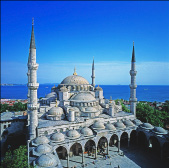
The Arabs ruled much of what had once been the Hellenized, or Greek-dominated, world and held onto much of ancient Greek literature, including the Greeks’ philosophical, scientific, and mathematical foundations. They embraced Roman engineering, which had spread to the Middle East and served the mighty Byzantine Empire of the Middle Ages. Building on those foundations, the Arabs adapted and refined Roman advances in architecture, such as the dome, to which they added the delicately distinctive Islamic minaret. You can see examples of these tall towers that adorn or adjoin mosques and from which people are called to prayer in Figure 7-1.
Great astronomers and mathematicians in their own right, the Arabs weren’t content to tend the flame of Greek and Roman learning. For example, they adopted useful new notions such as the number system (from India) and passed it down as Arabic numerals — 1, 2, 3, and so on. That the words “zero” and “algebra” come to English by way of Arabic is no coincidence, either.
Figure 7-1: The Blue Mosque boasts the distinctive Middle Eastern minarets (towers).
© Murat Taner/Getty Images
The Arabs also were way ahead of the rest of the world in medicine. For centuries, European medical textbooks were actually Persian collections of Arabic knowledge.
Mastering the Indian Ocean
Although from the desert, some Arabs took to the sea and became innovative sailors. Arabs figured out the trade winds and mastered the Indian Ocean before anybody else.
 Although no Arab made the voyage to test the theory, the great Muslim scientist Al-Biruni speculated as early as the year 1000 AD that there must be a sea route south of Africa. When Portuguese explorer Vasco da Gama found such a route and arrived in northeastern India’s port city of Kozhikode in 1498, becoming the first European to get to India by sea, he did it with Arab help. (You can find out more about da Gama in Chapter 8.) Arab sailors were especially familiar with the arm of the Indian Ocean called the Arabian Sea, which was notoriously difficult to navigate and virtually unknown to Europeans. Da Gama used the best European navigational science of the time to sail around the tip of Africa, but he may not have made it the rest of the way without the help of the greatest Arab navigator, Ibn Majid, author of the best Arab nautical directory. (You can find out more about Ibn Majid in Chapter 21.)
Assembling and disassembling an empire
The late seventh century proved a good time for the Arabs to amass their empire, but they weren’t able to hold it together in the ninth and tenth centuries.
Taking advantage of circumstances
Muslim Arabs built on the success of founding prophet Mohammed after his death in 632 AD by completing the conquest of the Arabian Peninsula, and then turning their attention to other nearby lands. Circumstances favored the Arab advances: Older Middle Eastern powers — the Byzantine (Syria) and Sassanid (Persia) Empires — were busy fighting each other and fending off barbarian invasions. The Sassanids had to worry about Huns hammering away at their frontiers, while marauding Avars and Berbers bedeviled the Byzantines. (The Berbers hadn’t yet become Islamic themselves, but would later.)
The fact that plenty of Byzantine subjects, such as the Egyptians, were fed up with taking orders from Constantinople didn’t hurt the Arabs’ efforts in growing their empire either. (See Chapter 6 and the section “Excelling in East Asia” later in this chapter to find out more about barbarian invasions.)
Growing apart
Islam remained an extremely important religious, cultural, and political force as the eleventh century began, but the Arabs’ imperial ascendancy was past its peak by that time.
 Arabs fought Arabs as early as 656 AD, when an Arab civil war resulted in the capital being moved from Mohammed’s power base at Medina (in today’s Saudi Arabia) to Damascus (in today’s Syria). In the ninth and tenth centuries, rival caliphates, or Islamic kingdoms, arose in Arab North Africa and Spain, breaking the empire into pieces that, although still united by faith, were no longer politically joined.
Although the empire fractured mostly over issues of power and local control, the Islamic world also broke into religious factions. The two major branches were Sunni and Shiite, and they persist to this day. Their differences trace to a disagreement over who’s qualified to lead the people both spiritually and politically. The Shiites, or Shia, trace their leaders to Ali, the son-in-law of the Prophet Mohammed, and limit the title of imam to descendants of Mohammed’s clan. Sunnis, who are by far the majority, take a less rigid approach to designating religious leaders.
Today, the Muslims of Saudi Arabia, Kuwait, Qatar, and Indonesia, among other countries, are largely Sunnis. Iran and Azerbaijan have Shia majorities, and in Iraq, Shia comprise about 60 percent of the Muslim population and Sunni the remaining 40 percent.
Too big, too diverse, and too multifaceted, Islamic civilization was unable to sweep the world again as a single, overwhelming force after it fractured in the ninth and tenth centuries.
Excelling in East Asia
Great in both area and cultural achievements, China was so far away and sounded so strange that medieval Europeans could hardly imagine it. Yet China was a wellspring of technological inventions, an economic marvel, and a cultural model for neighboring nations. China’s leaders, knowing they had something special, tended to be a bit smug.
Innovating the Chinese way
The 400-year Han Dynasty (206 BC–220 AD) was a wellspring of innovation and advancement. Following are some examples:
Chinese scientists invented the compass and the first accurate grid-based maps.
The Chinese didn’t always use their inventions in seemingly obvious ways. For example, instead of first using the compass as a navigational device, they found it to be a dandy tool for making sure that temples were built on the proper, sacred alignment.
They put efficient rudders on ships back when Romans and barbarians still steered by sticking a big paddle in the water at the back of the boat.
They came up with the crossbow, a serious weapons escalation for its time.
They made the world’s first paper, which may seem trivial until you consider what the world would have been like without it. (For one thing, you might be reading this book on parchment, which is tanned animal skin.)
Innovation didn’t stop when the Han Dynasty fell in 221 AD, either. Successive dynasties originated or embraced more new ideas, including the stirrup, allowing riders much more control and stability and giving Chinese horsemen the edge in warfare — for a little while, anyway.
Under the T’ang Dynasty, which took over in 618 AD, China developed beautiful things such as porcelain and ingenious things such as moveable-type printing, which didn’t make it to Europe for hundreds of years. The Chinese invented gunpowder, too, and were using it in warfare around 1000.
China’s economy and agriculture excelled. During the Han dynasty, China’s ability to feed its large population stood as a model of self-sufficiency. The climate, especially in the south, allowed two rice crops a year, which fed many and therefore permitted China’s growth to outpace that of any other region on Earth.
 By the early twentieth century, Chinese peasants were poised on the edge of starvation, but that was after a very long decline in conditions.
Traveling the Silk Road for trade and cultural exchange
Because China had so much that other parts of the world coveted, its leaders rarely cared much about the world far beyond China.
From the Han Dynasty on, the Chinese believed themselves at the center of the world — at least the part they were interested in. They certainly were at the cultural center of East Asia and had a profound influence on language, writing, government, and art from Burma to Korea to Japan.
Even if some of their rulers tended toward isolationist policies, Chinese business-people certainly traded beyond the Great Wall. From the second century onward, Chinese goods traveled west on the backs of Bactrian camels that trekked the Silk Road(sometimes called the Silk Route). The caravans followed anatural corridor from the north of China through remote central Asia, between the peaks of the Pamir Mountains and through the Taklimakan Desert to Persia (now Iran) and the Mediterranean Sea. As a result, Middle Easterners — and some people farther west, as well — experienced Chinese silk, the finest fabric in the world, along with other luxuries such as spices.
The camels carted gold back over the route to China, but the path also fostered cultural interchange. Christian missionaries from the Nestorian Church, a controversial fringe Christian sect, traveled the Silk Road to spread their faith after the Byzantine Empire exiled them in the fifth century.
Yet the Chinese hungered for little that other cultures offered. Under the early Ming Dynasty — founded by the monk-warrior Chu Yuan-chang in 1368 after he drove out the Mongol rulers of the Yuan Dynasty — China’s rulers went so far as to forbid ships from leaving coastal waters. With long voyages banned, Chinese shipbuilders stopped building big, seagoing vessels.
Breaching the wall: Invading China
China endured for such a long time that you may think it was invulnerable, but sometimes the empire succumbed to invaders.
The Chinese began the Great Wall of China as a string of defensive outposts in the third century BC and then added to this barrier over the course of many hundreds of years. But some enemies got past the wall. Around 100 BC, the Xiongnu people challenged the great Han Dynasty. More than a thousand years later, in the thirteenth century, a successful Mongol invader breached the wall again. He was Genghis Khan and his grandson, Kublai Khan, founded China’s Yuan dynasty.
Genghis Khan, whose name means “universal chief,” joined together lands from the Pacific Ocean west to the Black Sea. Before he died in 1227, Genghis Khan split his empire into four parts that he called khanates. His Chinese lands made up the easternmost khanate.
Kublai Khan was the first Chinese ruler most Europeans found out about, because the Venetian traveler Marco Polo wrote about living and working in Kublai Khan’s court (there’s more on Marco Polo later in this chapter). Kublai Khan finished what his grandpa began, making his Mongol capital in Khanbaligh (now Beijing) in 1267 and finally finishing off China’s Song (or Sung) Dynasty 12 violent years later.
Sailing away for a spell
In the early fifteenth century, Emperor Yung Lo turned outward — an unusual posture for a Chinese ruler — and sponsored impressive voyages of exploration. Zheng He (sometimes written Chung Ho or Cheng Ho), a Muslim court eunuch who was also an accomplished sea admiral, commanded the ventures. (A eunuch was a male servant, generally a slave, who had been castrated, presumably to make him more docile and to ensure that he wouldn’t be tempted by the master’s women, or they by him.) Zheng He somehow overcame his lowly status to become an important member of Yung’s court.
Zheng sailed seven large, well-financed expeditions. His ships landed in India, navigated the Persian Gulf, and anchored off East Africa. His vessels were larger and faster than Arab and European ships of the time and equipped with sophisticatedbulkheads (walls between sections of the ship’s hold), so that if one part of the ship sprung a leak or caught fire, the damage could be contained and the ship wouldn’t sink.
After Emperor Yung Lo died, the expeditions stopped and nothing much came of Zheng’s voyages — no expanded trade, no extended political influence, and no broadened military influence. But the idea had never been to subdue other parts of the world anyway. In Chinese thinking, China was not just the best state; it was the only sovereign state. The ships were, in part, a peaceful effort to broadcast the message of Chinese superiority. But to Yung Lo’s successors, the rest of the world apparently still wasn’t worth the trouble, seeing as they didn’t continue exploration efforts.
Europe Develops a Taste for Eastern Goods
Like the Arabs and many other cultures of the thirteenth through eighteenth centuries, Europeans fought amongst themselves, but their competition also took the form of a race for far-flung riches. They knew that vast wealth could be found in trade, especially trade with China. Several factors enhanced the European craving for more eastern trade; here’s a sampling:
Some Europeans got a tantalizing preview of Asian luxuries — including fine silks and spices not tasted in the West — thanks to the Crusades, which were hundreds of years of Christian military expeditions that began against Seljuk Turk-controlled Palestine in the eleventh century. (If you think spices are no big deal, imagine what European food tasted like before they had any.)
The Moors in Spain, with their eastern ties, had trade-route access to Chinese delights. And a vast, Euro-Asian Mongol Empire from the Black Sea to China opened northern trade routes, bringing eastern goods west into the German states.
The Travels of Marco Polo, a book about China written by a thirteenth-century commercial traveler from the Italian city-state of Venice, drummed up interest in the Far East, a place that sounded too incredible to be real.
Oddly enough, a terrible plague in the fourteenth century helped create a market for exotic eastern goods.
These factors added up to terrific advertising for trade between Europe and the Far East. This section examines the influence of trade-leader Venice and its native son Marco Polo and Europe’s efforts to circumvent the Ottoman Empire in order to create its own trade route east. Because of their massive scale and impact on so much more than just eastern trade, I address the Crusades in the later section “Mounting the Crusades.”
Before they could supply the growing market and interest in eastern products, the Europeans needed to get around some serious geographic obstacles. Europeans needed to find ways to bring cargo from faraway India and China. The Byzantine Empire and competing Turkish realms (Seljuk and later the powerful Ottomans) controlled land routes east, and besides, only sailing ships could carry the volume of merchandise that European dreamers had in mind. The problem was nobody in Europe knew how to reach East Asia by sea. The Europeans needed sea routes, and the search for those routes brought about a world crisscrossed by new cultural interconnections.
Orienting Venice
Venice was a city-state of ambitious traders that started out as an island refuge from barbarians in the fifth century AD. It was part of the Byzantine Empire until the ninth century, and even later, as an independent city-state, the Venetians enjoyed favored trading status with the Byzantines. This eastern connection gave Venice an economic advantage that its rulers used to build up a neat little Mediterranean empire, including the Italian cities of Padua, Verona, and Vicenza, along with the strategically placed eastern Mediterranean islands of Crete and Cypress.
Economically and militarily, Venice was oriented toward Constantinople and Asia. The word orient means “east” or “to face eastward.”
Although another seafaring Italian city-state, Genoa, gave Venice some stiff competition, Venice dominated Mediterranean trading. The wealth Venetians enjoyed because of their access to the East made the rest of Europe sit up and take notice.
Writing the first best-selling travel book
Over the Silk Road to China, shippers and wholesalers customarily traded goods only to the next trader down the way, so that no one trader or camel driver covered the entire, exhausting route. Thirteenth century-traveler Marco Polo’s father and uncle were more ambitious than most other traders in Venice: They traveled all the way from Italy to China in their quest for lucrative deals.
Marco’s elders were on their second trip to the Far East when they invited the young man (probably about 19 at the time) to tag along. The trio arrived in Beijing in 1275. According to the book that Marco Polo later wrote, he entered Emperor Kublai Khan’s diplomatic service and traveled to other Mongol capitals on official business. (Kublai Khan, though China’s emperor, was a Mongol.)
Almost two decades went by. Young Polo, not quite so young anymore, finally left China in 1292 and returned to Venice. But the rival city-states were at war, and Marco Polo was captured. He was in a Genoa prison when he wrote, or rather dictated to a fellow prisoner, the story of his fantastic years abroad, The Travels of Marco Polo.
Many of Marco Polo’s contemporaries thought he lied in his book, and some modern scholars think they were right and that Polo at least exaggerated his story. But that doesn’t undercut the impact of his descriptions. Polo’s book was about such a faraway place, and to Europeans at the turn of the fourteenth century, it was like a dispatch from outer space. At the very least, Polo’s stories spread and fed the perception that China was the trader’s mother lode. The Travels of Marco Polo was the most influential book of its time.
Fighting for economic advantage
Venice’s trade success fueled military conflicts both with the rival city-state Genoa and with more remote competitors. Venice was in there swinging when European Christendom launched the Crusades (see the section “Mounting the Crusades” later in this chapter for details).
Any military campaign against those who controlled access to the Silk Road — whether Turks or Byzantine Christians (western Crusaders sacked Constantinoplein 1204) — interested the Venetians. They were first in line among Europeans who wanted unimpeded access to the profitable thoroughfare.
Venice declined as the major trading power in the Mediterranean only after 1571’s naval Battle of Lepanto against the Ottoman Turks (successors to the Byzantines). In that conflict, the Venetians were allied with Rome and Spain in the Holy League, created by the pope. Venice won the Battle of Lepanto but lost its colony Cyprus, a crucial trade outpost, and Venice’s power slipped.
Ottomans control trade routes between Europe and the East
Turkish empire-building reached its height in the fifteenth century, when another Islamic Turkish clan, the Ottoman Turks, assembled a humongous collection of lands into the Ottoman Empire. Ottoman power lasted until the twentieth century. In its heyday, the empire made significant inroads into Eastern Europe. (Animosity between modern Islamic Bosnians and Christian Serbs is rooted in long-ago Ottoman incursions west.)
European traders who lusted after eastern riches had to take the Ottomans into account because these Turks blocked land trade routes east. Coupled with Venice’s and Genoa’s dominance in the Mediterranean, the Turkish presence made other Europeans wonder if they could find their own Silk Roads, perhaps by sea. One sailing ship could carry more cargo than camels could, anyway. The problem was that no one knew how to get from Europe to East Asia by sea.
Necessity, as the saying goes, became the mother of invention. Or maybe it was greed more than necessity. Either way, this hunger to find a new way to get the treasure of the East gave birth to a new age of European empires.
The Portuguese, Dutch, Spanish, and English wanted a piece of the Asian market and began exploring as never before. The first to risk a bold western course toward Asia, Christopher Columbus, didn’t find what he was looking for, but he did bump into the Americas, which were soon a lucrative market for slaves used to raise valuable commodities such as tobacco and sugar. (For more about Columbus, skip ahead to the section “Seeking a Way East and Finding Things to the West.”)
Mounting the Crusades
It may seem that civilization has arrived at its current global interconnectedness because of air travel and the electronics revolution of the last several decades. Yet today’s worldwide connections, as you can tell by skimming through almost any section in this chapter, really started taking shape many centuries back.
The Crusades are perhaps the earliest events that pointed forcefully toward today’s world, which is still so deeply marked by the European empires of the sixteenth to twentieth centuries. In a nutshell, the Crusades were hundreds of years of sporadic Christian military campaigns. (For more about the marks left on today’s world by Europe’s second millennium empires, see the sidebar “Putting cultural dominance in perspective” in this chapter. Don’t worry. It’s not as stuffy as that title makes it sound.)
Meeting the main players
The Crusades began in 1095, when diverse Europeans, answering a call from the pope and united in religious zeal (or so they said), tried to free the Holy Land, Palestine, from Turk rulers. They weren’t the Ottoman Turks, whose great empire would supplant the Byzantine Empire in the fifteenth century, but rather their predecessors in Middle Eastern empire-building, the Seljuk Turks.
The Seljuk Turks were a nomadic and marauding population of barbarians from wild north central Asia. Barbarians show up in Chapters 5 and 6 as well as in this chapter because they kept showing up in successive centuries — riding into lands as diverse and far-flung as China and Spain.
Like the China-conquering Mongols, the Turks called their chiefs by the title khan. In the early centuries of the first millennium, Turks were a subject people, paying tribute (sort of like taxation without representation) to another barbarian group, the Juan-Juan. But as the Arab conquests of the seventh and eighth centuries spread the religion Islam, the Turks converted and adopted the Arab fervor for empire-building.
The Seljuk ascendancy (conquering Asia Minor in the eleventh century and beating the armies of the Byzantine Empire) alarmed Christendom (the Christian world) all the way back to Rome, where the last straw for Pope Urban II was the Seljuk takeover of Palestine. Western Christians felt possessive about this land — today’s Israel and the Palestinian territories — because Jesus of Nazareth had lived and died there and it contained the holiest shrines of Christianity. Meanwhile, nobody asked the people living in Palestine if they wanted to be freed from Turkish rule.
The pope was also angered by reports that Turks were messing with pilgrims on their way to shrines in the Holy Land. As Muslims, the Seljuk rulers had little reason to protect these Christian travelers who were easy pickings for robbers. The pope got so ticked off that in 1095 he called for a war to make Jerusalem safe for Christians again. The Crusades, the answer to his call, may have started out as idealistic religious adventures, but they descended into brutal wars of hatred and greedy opportunism.
Seljuk Turks, like the Mongols, were superior horsemen; Seljuk warriors could fire accurate arrows at full gallop while standing in their stirrups. This skill helped them wreak havoc on established powers as they swept through Afghanistan and Persia in the eleventh century, taking over Jerusalem on their way to Baghdad, a declining capital of an earlier Muslim empire founded by Arabs, to conquer the Middle East.
Looking at the misguided zeal of specific Crusades
Sadly, the thousands of ordinary Europeans who set out for Palestine full of Christian fervor were the crusaders least likely to survive. They were ignorant and in no way ready for what they’d face. But well-armed nobles and skilled warriors went east, too. Here’s a rundown of some of the Crusades:
First Crusade: In 1099, the first official European force to reach Jerusalem massacred most of the people there before setting up European-ruled Latin Kingdoms, notably the Kingdom of Jerusalem, along the eastern shore of the Mediterranean.
People’s Crusade: The People’s Crusade was a ragtag part of the First Crusade led by an itinerant preacher from France, a monk called Peter the Hermit. His followers walked into a Seljuk slaughter. (For more about Peter the Hermit and his colleague Walter the Penniless, see Chapter 20.)
Second Crusade: The Second Crusade began in 1147 when crusaders surging eastward stopped along the way to slaughter Jews living in Germany’s Rhine Valley.
Third Crusade: In 1189, the expeditionary force of the Third Crusade ventured eastward to attack the Kurdish leader Saladin, who had united Syrian and Egyptian Muslim forces and captured the city of Jerusalem from its Christian rulers in 1187. Crusaders in this force included King Richard I (the Lionheart) of England, Emperor Frederick I (Barbarossa) of the Holy Roman Empire, and King Philip II of France. The emperor drowned crossing a stream.
 Set during the Third Crusade of the late twelfth century, director Ridley Scott’s 2005 film Kingdom of Heaven tells a fictional story concerning the Christian Kingdom of Jerusalem. If you find the movie on DVD, I have it on good authority that the 194-minute director’s cut is superior to the shorter version made for theatrical release.
Fourth Crusade: The Fourth Crusade of 1202–1204 may have been the ugliest of all. Christian Crusaders sacked Constantinople, a Christian city, and then briefly based another Latin Kingdom there (as if the split between the Roman Catholic and Eastern Orthodox churches wasn’t already wide enough).
Children’s Crusade: The Children’s Crusade of 1212 was the most pitiful Crusade. About 50,000 poor kids, and some poor adults, too, walked southward from France and Germany under the delusion that they could restore Palestine to Christian control yet again. Most of the tots who made it as far as Italy’s seaports succeeded only in sailing straight into the Muslim slave markets of North Africa and the Middle East. Few were ever heard from again. Some people say the story about the Pied Piper of Hamelin is based on the Children’s Crusade.
Setting a precedent for conquest
Where did Europeans of the sixteenth through the nineteenth centuries get the nerve to sail all over the world claiming chunks of other continents for their kings back home? You could argue that their attitude hearkens back to Rome’s imperial habits, or that the Europeans, many of barbarian stock (and thus perhaps Asian as much as European), were born to rapacious conquest.
You could argue that, but your argument would be a stretch. More accurately, you could reach back to the Middle Ages, the need to fight off Viking invaders, and how that need prompted feudal vassals to rally around strong leaders. This trend began to build nations such as Saxon England as it took shape under Alfred the Great. But nation building was a slow process, and Europeans didn’t think in terms of a political state based on national identity. (For more on the emergence of strong kings, such as Alfred and Charlemagne, and the beginnings of nation building, see Chapter 6.)
The Crusades shaped a European, Christian outlook on the rest of the world and taught Westerners to assert themselves beyond Europe. Rulers put their resources toward an imperial venture in a systematic way, setting a precedent for the exercise of power. Christendom became militant, confident of its ability to stomp other parts of the globe. Militant confidence served Europe’s nations well several centuries later, after navigators arrived at a reasonably accurate idea of what the globe looked like.
Growing Trade between East and West
Early in the thirteenth century, Genghis Khan and his Mongol clan conquered a huge swath of Asia stretching from the Pacific Ocean all the way to northeastern Europe above the Black Sea. For part of that century, these lands were under one rule, and even after Genghis Khan died in 1227, they remained a loose affiliation of allied Mongol powers.
The Mongol Empire cleared northern trade routes between East and West, some of them using the Volga and Dnieper Rivers that feed into the Black Sea and the Caspian Sea of the Middle East. These routes were used for centuries by Vikings and Slavs, and thanks to the Mongols, northern Europeans could take advantage of an eastern trade pipeline that flowed more freely than ever before.
As new goods filtered into northern Europe, towns grew fat. Hamburg flourished on the Elbe River, as did Lubeck on the Baltic Sea. But merchants had a problem: There was no reliable, unified German government and no source of widely recognized order to defend their shipping routes from robbers and pirates.
In 1241, businesspeople in Hamburg and Lubeck formed a hansa, an association for their mutual protection. Early in the next century, that association grew into the Hanseatic League, a commercial confederation of some 70 towns stretching from Flanders (today Belgium and part of Northern France) to Russia. Its interests were purely commercial, but the league performed some governmental functions, too. It even went to war in the middle of the fourteenth century when Danish king Waldemar IV tried to mess with its trading. In the end, Waldemar proved no match for King Commerce.
Putting cultural dominance in perspective
Europeans spent several centuries of the second millennium AD venturing out to other parts of the world, subjugating the locals and building empires. The world as you know it — with people speaking English in South Africa and Portuguese in Brazil — still bears innumerable cultural and economic marks (many people call them scars) of these adventures.
Some people, including some historians (although none recently), treat this European ascendancy as if it were inevitable, even right. This shortsighted view is called Eurocentrism, and you may think you smell it in this book. A reason for this is that European dominance has been so recent, relatively speaking, and that it continues — with the spread of Western clothing styles, the English language, Western-style economic systems, and American movies. It continues despite backlash from certain quarters, such as Islamic extremists who reject Western values. This book is partly an account of how civilization came to this particular point, so it must include the story of how Europeans (and their heirs, such as the United States) accomplished what they did.
Throughout this book, I relate how one culture or another always seems to be coming to the forefront, dominating for centuries, even a millennium, and asserting itself as superior. I also point out how great civilizations can disappear so thoroughly that nobody remembers them. (For an example, see information on the Hittites in Chapter 4.) The disappearance of today’s worldwide civilization seems inconceivable in an age of satellites and computers and the other snazzy gizmos that have transformed commerce and daily life, but any study of history shows that civilizations not only rise; they also inevitably fall.
Surviving the Black Death
Europeans in the fourteenth century were looking at the world in a new way, seeing far-off places as desirable, worth finding out about, and maybe even worth acquiring. Yet before Europeans really got out and started taking over that world, there had to be enough personal wealth back home to make a decent-sized market for foreign luxuries. Oddly, it took a horrible disease and death on a massive scale for that market to find a foothold.
The Black Death (also called the Black Plague) was a devastating epidemic of bubonic plague and its variants that probably started in the foothills of Asia’s Himalayan Mountain range. But in the fourteenth century something happened to make disease spread, and many have speculated that the culprit was the rise of trade. The disease lived in fleas carried by rats, and where people go, especially people carrying food, so go rats and their parasites.
When a rat died, the fleas jumped to another rat. When no other rat was handy, the fleas tried less desirable hosts. When those hosts were human, the people got terribly sick and most of them died quickly. The blackish bruises that appeared beneath their skin were called buboes, which is where the name bubonic plague comes from. (Think of that next time you hear a child call a bruise a “boo-boo.”) An even deadlier version of the disease, pneumonic plague, spread through the air from person to person.
Killing relentlessly
In 1333, the plague killed thousands of Chinese and spread west. By 1347, it reached Constantinople, where it was called the Great Dying, and it continued rapidly west through the Balkans, Italy, France, and Spain. Then year by year, the disease advanced northward. Within a few years the Black Death reached Russia, Scandinavia, and beyond, following the Viking trade routes to Iceland and completely wiping out Norse settlements in Greenland. (For more about the Norse in Greenland, refer to Chapter 6.)
As many as 25 million people died of the Black Plague in Europe. Maybe a third of the people in England fell. Periodic outbreaks followed for centuries after, but the Black Death had an impact even beyond the horror and sorrow it inspired. (And don’t forget the morbid fascination: Many examples of art from this time focus on disease and death.)
Doing the math: Fewer folks, more wealth
The Black Plague so drastically reduced Europe’s population that a smaller labor pool changed the economy. Ironically, this turn of events improved many Europeans’ lives by creating disposable income, which in turn spurred a demand for eastern luxuries and even eastern ideas. The intellectual and cultural result of this reduction in population and eastward focus was called the Renaissance. You can find out about the Renaissance in Chapter 13.
With so many dead, fewer people were left to work the land. A few workers had the spunk to stand up to the nobles and landowners and point out that they weren’t about to work more for the same money — not when the supply of workers had become smaller and thus more valuable. The most famous of these uprisings was led by Wat Tyler, an English rabble-rouser who got himself killed for his trouble in 1381.
Post-plague economics forced some large landholders to split their estates into smaller plots. Instead of remaining mere sharecroppers who turned over the bulk of what they grew to the landlord, some laborers actually began earning pay for their work.
Though there were fewer people overall, more people had land, income, and the potential to buy goods. This condition stimulated a rise in merchants, craftspeople, and skilled traders who could supply goods. Up until that time, you were either rich or poor — usually poor. The plague created a middle class.
Seeking a Way East and Finding Things to the West
European nations’ hunger for the luxuries possessed by China, India, Japan, Indonesia, and other eastern cultures and for the wealth that came to anyone who could import such coveted goods as silk cloth and rare spices led many adventurous sea captains of the fifteenth and sixteenth centuries in search of navigable sea routes to East Asian ports. You can read more about some of these seafarers’ journeys and their results in Chapter 8. One particular navigator stands out from the rest, however, because he was the first to sail westward in search of the lands that lay far to the east of Europe. This was Christopher Columbus.
Columbus didn’t find what he sought, but he changed world history in a fundamental way by landing upon populated islands in the Caribbean Sea and later on the mainland of South America.
Meeting the Americans who met Columbus
The Arawak and the Carib tribes both came to the islands later called the West Indies from northern South America. Before 500 AD, some Arawak migrated to the islands and farmed peacefully for hundreds of years before the Carib followed.
The Carib weren’t much for farming. Warriors and cannibals, the Carib tortured, killed, and ate the men of the tribes they conquered and turned the women into slave wives. Or so the historical record reads. Some people, including descendants of these Native Americans, take exception to this depiction, claiming Columbus and his successors made up the whole cannibalism business as an excuse for Spaniards to enslave these people.
Around the year 1000 AD, the Carib set out on their own sea journeys from Venezuela or Guyana to the islands. Raiding Arawak villages, the Carib almost wiped out the farmers on some of the islands.
Arriving in the Indies, Columbus probably met some Arawak first and then the more hostile Carib. Full of hope that he was off the coast of Asia, Columbus called them all Indians, and the name stuck.
Falling down
Folklorists dismiss the idea, but many people think the children’s rhyme “Ring around the Rosie” may be much older, and much more morbid, than most parents realize. They hear in it an echo of plague times, when the “rosie” was a rash that appeared as victims first came down with the disease. “Pocket full of posies” might then refer to the erroneous belief that flower petals were a defense against sickness, or at least against the overwhelming smell of death. “Ashes, ashes” is from the funereal “ashes to ashes, dust to dust.” And the final line, “all fall down” may originally have carried the understanding that few, if any, would get back up again. People who study oral traditions say it’s not so because there’s no written evidence that the rhyme had those particular words until more recent centuries.
Some celebrate discovery, others rue it
Christopher Columbus’s discovery of the Americas, a part of the world unknown to his European contemporaries, opened the way for colonization and trade, bringing great wealth to Spain, the nation that sponsored his four voyages to the Caribbean Sea, and to other imperial European powers. His discovery also began centuries of death and destruction to native populations and their cultures. Although many people, including traditional historians, have celebrated Columbus as a hero, other, less glowing evaluations take into account all the negatives — slavery, slaughter, disease, and displacement — that followed Columbus’s discovery in 1492.
Training and experience shaped Columbus
For his part, Columbus never sought to discover a new world and went to his grave in 1506 without admitting that he had done so.
Genoa-born in 1471 and reared at sea, Columbus read the ancient Greeks, particularly the second-century-AD astronomer Ptolemy. A Greek who lived in Alexandria, Egypt, Ptolemy envisioned the world as a globe. His influential writings were preserved by the literate Arab culture that later ruled Egypt, and they came to Europe through Arabic translations.
As a seafarer, Columbus compiled an impressive résumé of voyages, once sailing as far as Iceland, which is a long way from both Italy and Lisbon, Portugal, the port city where he made his home.
Portugal was a good base for a seafarer because it was the location of Europe’s foremost school for navigation, astronomy, and mapmaking (established by Prince Henry the Navigator in the fifteenth century). Graduates explored Africa’s west coast searching for a way around the continent to the Indies. (You can read more about Portuguese explorers’ discovery of a sea route from Europe to India in Chapter 8. Henry the Navigator appears in Chapter 21.)
Stumbling upon the West Indies
While working for the Spanish monarchs, Columbus sought a sea-lane linking Europe and India and sailed west instead of east, the direction that would have occurred to most European sailors. This crack navigator boasted a commonsensical grasp of Earth’s general shape — even if he did seriously underestimate its circumference. But Columbus never sought new continents and doggedly refused to face up to the fact that he did, indeed, find one, the one later called South America.
After his first voyage to the Caribbean, he kept going back there (it was later named after the Carib), not because he loved piña coladas and that calypso rhythm but because he couldn’t admit that what he’d found was someplace entirely new — to European navigators anyway.
Columbus wanted America to be East Asia, telling himself and anybody who would listen that these islands were just some obscure part of Indonesia, the Indies. If Cuba wasn’t part of mainland Asia, which he made his officers swear it was, then he wanted Cuba to be Japan. Who wanted a New World when an old one — China — was the sea trader’s big prize?
Smokin’
Among the most puzzling things that Columbus brought back from the West Indies were pungent leaves and seeds of a plant that the Caribbean natives prized. Dried leaves of this kind were among the first presents Native Americans offered the European visitors, who didn’t know what to do with them and threw them away. Better for the sailors’ lungs that they did, because the leaves were tobacco.
A couple of Columbus’s colleagues, Rodrigo de Jerez and Luis de Torres, saw natives in Cuba forming the leaves into the shape of a musket with a palm or corn shuck wrapper, lighting one end on fire, putting the other to their mouths, and drinking the smoke. Jerez tried it, got hooked, and took the habit back to Spain. The smoke billowing from his mouth and nose frightened his neighbors, and they reported him to the Spanish Inquisition. Jerez spent seven years in prison. And some people think today’s antismoking laws are extreme.
Tracking the Centuries
618 AD: The Tang Dynasty takes control of China, beginning a period of technological innovation that includes the invention of printing and gunpowder.
About 1000 AD: Members of the Carib tribe sail from Venezuela to islands in the Caribbean (as it would later be named). Carib people are still there when Columbus arrives 500 years later.
1071: Seljuk Turks defeat the Byzantine Empire’s army at the battle of Manzikert, capturing Emperor Romanus IV Diogenes.
1147: Christian Crusaders, on their way eastward to liberate Jerusalem from Muslim rule, pause in Germany’s Rhine Valley to massacre resident Jews.
1211: Mongol chieftain Genghis Khan invades China, adding Chinese territory to his vast Euro-Asian empire.
1212: About 50,000 poor people, most of them children, walk from France and Germany toward Italy’s seaports. These Crusaders believe they can free the Holy Land from Muslim rule. Those who don’t collapse along the way are sold in the slave markets of North Africa.
1241: Two northern European trading cities, Hamburg and Lubeck, form a hansa that eventually grows into the Hanseatic League, a commercial and quasi-governmental confederation of some 70 towns.
1275: Marco Polo, a teenage Venetian, arrives in Beijing and takes a job in the diplomatic service of the Chinese emperor.
1347: The Black Death (bubonic plague) reaches Constantinople on its march across Asia to Europe. The Byzantines call the epidemic the Great Dying.
1381: In England, Wat Tyler leads peasants in a revolt against landowners. He dies in the conflict, but the rebellion brings agrarian reforms.
1571: The commercial city-state Venice loses its island colony Cyprus to the Ottoman Empire. Without this Adriatic outpost, Venetian trade and influence begins a steep and permanent decline.