
Samuel Johnson's Dictionary (1775) defined caricature as drawings "intended as humour, satire, and comment." Political cartoons fit this bill as well. The first American-made example is credited to Benjamin Franklin. Originally produced to urge intercolonial union at the 1754 Albany Congress, this engraving of a dismembered snake emblazoned "Join, or Die" became the ubiquitous symbol of colonial unity during the Revolutionary period. Not until the ratification battle over the U.S. Constitution in the late 1780s did Americans begin to use cartoons as part of political discourse. Even though crudely drawn, these cartoons commented—at times through savagely direct dialogue, at other times by using pointed allegorical imagery, or both—on the intrigues, schemes, and decisions that shaped politics. For example, "Cong-ss embark'd on Board the Ship Constitution of America," engraved in 1790, criticized attempts to locate the new nation's capital in Philadelphia. As their ship travels from New York, a devil lures members of Congress, led by Pennsylvania senator Robert Morris, toward certain death at the foot of a waterfall located just outside Philadelphia, while an unobstructed waterway leads to the proposed Potomac River location. Another contemporary cartoon depicts Morris carrying Congressional Hall on his head to Philadelphia.
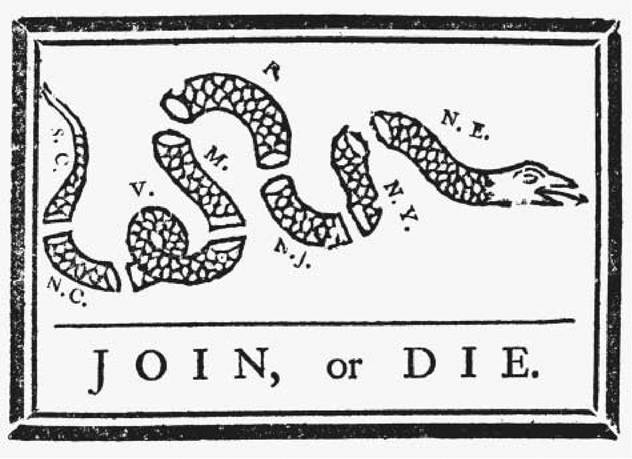
Join or Die. Benjamin Franklin's woodcut for the 9 May 1754, issue of Philadelphia's Pennsylvania Gazette became a symbol of colonial unity during the Revolutionary period.
British cartoons such as those produced by William Hogarth or, later, James Gillray clearly served as models for the American form. But it was the American tolerance for dissent that permitted political cartooning to flourish in the early nineteenth century. During the Adams, Jefferson, and Madison administrations, cartoons by the opposition grew particularly rancorous. Jefferson's alleged pro-French sentiments, for example, aroused his critics who portrayed him as a madman or worse. An illustration entitled "The Providential Detection," dating from between 1796 and 1800, shows him on his knees before a fiery "Altar to Gallic Despotism," wrestling the Constitution away from the American eagle to consign it to the flames. A flood of negative cartoons attacked both the Americans and the British during the War of 1812. William Charles, an artist who emigrated to America from Scotland in 1806 and signed his early work "Ansell" or "Argus," created as many as three dozen cartoons during the war, many of which feature the figure of John or Johnny Bull to represent the English.
Cartoons sometimes appeared in newspapers or magazines but most often were printed as separate broadsheets and distributed in bookshops or by peddlers. With the advent of lithography in the 1820s, political cartoons were created in larger numbers and enjoyed a wider distribution. Reportedly, during President Andrew Jackson's scandal-plagued second term, as many as ten thousand copies of E. W. Clay's "The Rats Leaving a Falling House" were produced in Philadelphia.
Few early cartoons survive, but examples can be found in the Library of Congress, the New York Public Library, the New-York Historical Society, the Library Company of Philadelphia, and the American Antiquarian Society.