
The Seven Years' War (1754-1763) spurred unforeseen but profoundly consequential economic changes in British North America. Supplying soldiers and citizens required infrastructure and organization on a scale never before known in the colonies. French and Spanish silver greased the exchange of goods and promoted fuller employment of townspeople, while currency finance—the emission of paper money through provincial governments—expanded the ability of colonists to conduct business on an unprecedented scale. This war was also far more expansive in its operations, and far costlier, than previous wars in North America, and so some colonial governments issued negotiable bonds and provincial Treasurers' Notes to merchants and suppliers, thereby initiating the precedent, although on a small scale, of financing the government's role in war with debt in addition to infusions of currency.
Following the Seven Years' War, wartime demand for goods and services shrank. However, the return to a postwar status quo of colonial subordination to English mercantile regulations and general commercial authority was challenged—though not unseated—in three ways by colonial economic maturation.
One way involved the expansion of the British-controlled western frontier, which created new opportunities for colonial trade among Native Americans, settlers and land companies, and towns to the east; a steadily growing population in the West and the land clearing and improvements it brought set the stage for economic development. Agricultural productivity rose rapidly, land values climbed, and settlers' demands for infrastructure to link farms to towns poured in from myriad backcountry locations. By 1775, more than a quarter-of-a-million colonists lived beyond the old fringe of settlement; nearly one-third of the southern white population inhabited the western backcountry, while streams of migrants trod well-worn roads into western New York and Pennsylvania, West Florida, and the lower Mississippi River area.
A second challenge to British control of the North American economy was evidenced in commerce. Although British merchants generously responded to pent-up colonial demand for goods and credit after the war, by then, northern colonial merchants had become more capable of shipping, warehousing, and diversifying enterprises and of distributing goods themselves. Continual shipbuilding, waterfront development, the steady influx of immigrant labor, and capital for investment in goods all enhanced profits during good times and shielded merchants from the worst downturns. In the Chesapeake regions, prices of exported tobacco tended to rise more than they fell after the 1750s, and planters had ever-larger quantities to export. In the Carolina low country, planters enjoyed a recovery of rice export prices (and higher yields) after 1763, as well as a tremendous surge in indigo production and export. By the eve of the Revolution, as much as one-fourth of colonists' disposable income was spent on imports from British and European sources, although scholars disagree about whether this proportion represented a rising standard of living for a growing number of people or simply the rising demand consonant with an increasing population. Moreover, even if colonists were indeed buying more goods per capita, import figures do not explain how much consumption came from increases in colonial shop and home production.
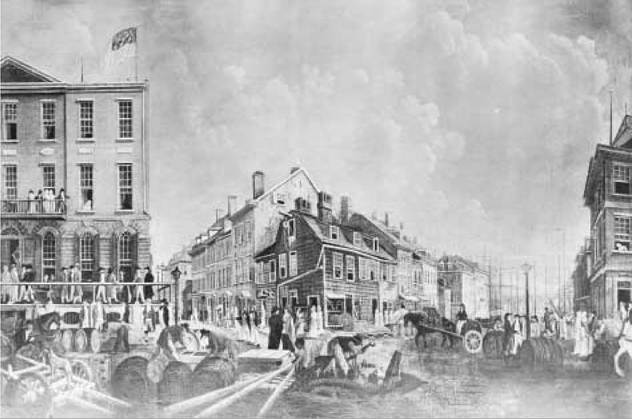
Tontine Coffee House. The Tontine Coffee House at the corner of Wall and Water Streets in lower Manhattan, shown here in a painting (c. 1797) by Francis Guy, became a central meeting place for merchants, traders, brokers, and underwriters, whose dealings eventually developed into the New York Stock Exchange.
A third challenge to British economic domination arose from colonial craftsmen; more local industries such as milling, distilling, tanning, smithing, and iron production placed more American goods in local markets. Some of the expanding production by these colonists was consumed in nearby households and in local exchange; some of it—the proportion disputed by scholars—was targeted for external markets at significant distances. In either case, most colonists experienced periods of relatively modest satisfaction of needs that were punctuated by the ability to purchase desirable comforts. Moreover, coastal merchants were increasingly dependent upon, and the beneficiaries of, diversified local economies able to support a range of skilled lesser entrepreneurs, farmers, retailers, and consumers. Despite periods of recurring depressed conditions, the northeastern and mid-Atlantic economies were maturing rapidly—internally and internationally—by the end of the colonial era.
Many Americans believed the Revolution would release tremendous economic energies to improve, produce, and consume more, thereby shaping them into virtuous citizens even in the midst of their wartime public sacrifice. To some extent these views were correct, for wartime need spurred home manufacturing, westward expansion, and exploration of new foreign markets. A few iron forges and rudimentary gun manufactories sprang up, and more sophisticated systems of distribution arose to get shirts and food to military fronts. Privateering proved lucrative to a few men even as it ruined others. But the Revolution also introduced numerous short-term disruptions to production and exchange. Many farmers abandoned the fields for the war; mills and shops closed due to scarcities of raw materials, absent workers, and inaccessible markets; armies combed through countrysides for scant supplies of food. British blockades disrupted pre-war commerce, and occupied cities suffered shortages of many necessities. Whole towns and surrounding fields lay burned by one army or the other. Immigration slowed significantly, with the effect of shrinking the available pool of free and bound white labor as well as the number of new slaves entering America.
The Continental Congress and individual new states emitted vast quantities of the popular paper money that, according to eighteenth-century wisdom, was to be retired out of circulation with taxes. But by the late 1770s, the massive sums in circulation were seldom being retired, with the inevitable result that "continentals" and state currencies plummeted in value. Public confidence declined along with the value of currencies; the complex network of debt and credit that distinguished the late colonial economy was thrown into disarray when prices more than doubled in the last four years of the war.
Once the individual colonies and states finally created a loose government under the Articles of Confederation in 1781, nationalists in Congress quickly proposed remedies for pressing difficulties concerning army supply, civilian shortages, and Revolutionary finance. Most important, days before the Articles went into effect they appointed Robert Morris, probably the wealthiest merchant in America at the time, as superintendent of finance in February 1781. By that time purchasing power was at an all-time low and Congress's paper currency was "not worth a continental." Still, seven states renewed their commitment to issuing paper money in large quantities, while in most cases keeping taxes low and thereby initiating new spirals of depreciation. Congress halted its own currency printing presses. In December 1781 Morris persuaded Congress to charter the first private commercial bank in America, the Bank of North America, in which he deposited loans of Dutch and French specie and bills of exchange, as well as large sums of his own money. He then asked Congress to authorize the printing of new continental currency, which would circulate freely with the backing of interest-bearing funds in the bank. Morris also initiated a new contract bidding system for the failing supply system, pledging the confidence and finances of Congress to back it up. Although Morris also wanted to create a national revenue based on taxing imports, which would have been the first national tariff, he failed to secure the required assent of all thirteen sovereign states.
Morris's bold measures had hardly been put into place when the war ended. Nevertheless, the fallout of wartime dislocations and disastrous Revolutionary finance would be felt for another generation. Despite the stereotype of urban merchants being wealthy beneficiaries of the wartime economy, the letters and legal records of many partnerships indicate deep indebtedness and loss of valuable commercial connections. Few knew how to interpret their dislocation—whether they should regret the loss of British mercantilism's protection and encouragement or celebrate their freedom to pursue new opportunities. In addition, per capita income levels achieved by 1775 by many groups of Americans probably did not recover until the late 1790s, and in the South great numbers of people remained indebted and impoverished even longer.
The Critical Period. Everywhere, the initial flood of cheap English goods and the easy credit of 1783 and 1784 came to an end quickly, and northern states began to raise taxes on the property of middling freeholders just as the money and credit supply contracted; as a result, debts went unpaid and investment in new lands and enterprises diminished. Moreover, Pennsylvania, New York, New Jersey, Maryland, and Virgina began to pay back, or "assume," large amounts of their state and national debts—debts which nationalists believed should be assumed by Congress in order to attach the loyalties of creditors to the Confederation government. Most of the states discriminated against each other in commerce; while some port cities invited more trade by establishing "free ports" that eliminated most import duties, others promoted their own commercial and manufacturing independence by tightening import regulations against "outsiders," who included foreigners as well as citizens of neighboring states. Newspapers printed stinging denunciations of imported "luxuries." After 1784, a deep depression settled on the cities, and within two years the portent of debtor rebel
lions rose on many rural frontiers, Shays's Rebellion in western Massachusetts being only the most conspicuous example. Nor did independence bring any immediate economic miracles to the domestic economy, for significant economic innovation and transformation were stymied for some years to come. In fact, the years 1781 to 1789 often bear the name "The Critical Period," which applies as appropriately to the new nation's economy as it does to its political turmoil during those years.
For state and national leaders, the decade's problems were due primarily to the huge debt generated from public and private loans during the Revolution. There was no national taxing and revenue-raising power; only states could tax citizens on internal wealth and services, and only states could levy port duties to raise revenue. Yet most states continued to issue currencies without levying sufficient taxes to retire depreciating paper money. Congress's securities changed hands from veterans, suppliers, and farmers to speculators in all walks of life, depreciating with each transaction. On a scale unknown in North America before this, and involving thousands of individuals, debts of the Revolutionary generation became widely exchanged in securities markets.
The Constitution of 1787 brightened some prospects for a more stable economy. The new federal government assumed the authority to end interstate quarreling over international commerce; created a steady revenue from uniform import duties that proved far greater than proceeds from the sales of western land for decades; sanctioned a single currency; shielded contracts and private property with a host of legislation; promoted more uniform business practices, patent inventions, new entrepreneurship, and money-lending practices under contractual relationships; naturalized immigrants; and more.
Trade. But in other respects, the economy developed according to the opportunities and constraints of individuals and markets during the era. Most merchants still formed small and temporary partnerships for trade, and their transatlantic ships entered and cleared ports only two times a year on average. Personal reputation still mattered immensely, and the incidence of failure was as great as it had been in the colonial period. New markets emerged within established trade networks; for example, merchants already engaged in commerce with the West Indies sent the Empress of China to Canton in 1784 with a cargo of ginseng, returning the next year with silks, porcelain wares, and eastern teas—and profits of 30 percent. Although the value of trade to new markets remained small, Cape Horn, Nootka Sound, and San Diego became familiar names in American ports. Then, from 1790 to 1807, exports and imports rose to over six times their pre-Revolutionary levels, shipbuilding revived, insurance and brokerage firms sprang up, ropewalks and cooperages lined dock streets, and carpenters and sailmakers found nearly full employment during many months of those years.
Although many new partnerships and small businesses did not survive the risks of business conditions in this era of Napoleonic Wars (1803-1815), sufficient numbers prospered to create a mood of confidence on the waterfront. Moreover, although American merchants encountered hundreds of privateers from foreign governments during the period and had to endure Thomas Jefferson's sweeping embargoes from1807 to 1809, their mid-Atlantic grain and flour often sold well in the Caribbean and Europe, and southern cotton found ready markets when captains could circumvent hostile interference. Robert Oliver, an Irish immigrant to the budding town of Baltimore in 1783, and probably America's first millionaire, noted that he owed his success not to any commercial innovations, but rather to his "calculated boldness" and his spectacular good luck in West Indian and French markets. Stephen Girard, who migrated from France to Philadelphia, New York, and CapFrançois during the years of the American Revolution, profited handsomely after 1790 by feeding flour to the starving French and Saint Dominguans during their revolutions. Girard in turn invested in a great complex of mines, canals, shipping, and charity institutions, some of his own creation. Foreign wars also hastened a shift from tobacco to grain production in the Chesapeake and spurred small producers everywhere to raise prices for meat, lumber, fish, and flour during the Napoleonic Wars. The mid-Atlantic region's West Indies merchants claimed the greatest gains, but even the ailing New England shipbuilders profited from sales of vessels.
New institutions. Within the nation, new institutional forms advanced Americans' ambitious goals for economic development before 1800. For example, corporations were chartered by the states for specific purposes, as when in 1792 the Insurance Company of North America became the first joint stock insurance company in the country. The New York Stock Exchange was also loosely organized in 1792. In a few years longer roads, deeper canals, and larger ports attracted the small investments of thousands of Americans, who collectively poured millions of dollars into projects that otherwise might have lan guished for want of capital and who also circulated companies' notes alongside banknotes as currency. The Bankruptcy Act of 1800 had a short, three-year existence but paved the way for shifting the blame for crises from individual moral failing to structural economic traumas that required taming with government intervention.
Perhaps the most spectacular institutional innovations before 1800, and possibly the most consequential for the next phase of economic development, involved the organization of a national financial system. In January 1790, Alexander Hamilton's first Report on Public Credit established the principle of Congress's obligation to repay its debts to foreign countries, American states, and private citizens; the report proposed the consolidation of state debts into one national fund of interest-bearing securities that would be backed by revenues from import duties and special excise taxes. Despite formidable opposition to Hamilton's funding and assumption plan, it won the day, and soon national securities were traded in all the major cities; this success in turn prompted states and corporations to issue local securities to promote myriad special projects.
In December 1790 Hamilton offered his proposal for the First Bank of the United States, to be capitalized at $10 million, $8 million subscribed privately at $400 a share within the first hours of being offered to the public, and $2 million held by the federal government. Its charter permitted the bank to operate for twenty years with headquarters in Philadelphia and branches in other cities. Again, there was a storm of controversy. At one extreme, advocates such as Oliver Wolcott of Connecticut defended the necessity and constitutionality of the bank, arguing that banks would be of great benefit to an enterprising elite. At the other extreme, opponents attacked banks as reservoirs of aristocratic privilege that enticed the nation's best merchants and entrepreneurs into overextending their credit, and its farmers and small producers into a morass of rising excise taxes and rising prices when public speculation got out of hand. Already in 1791 the Whiskey Tax was widely seen as an egregious imposition on American livelihoods, especially on the frontier; in 1794 opposition erupted into the Whiskey Rebellion.
Banks. Somewhere between these poles of opinion, many Americans welcomed the generous credit of state and local banks, although they also feared the periodic failures of large banks. Even Thomas Jefferson, who argued in 1791 against the constitutionality of the national bank and who divested the government's roughly two thousand bank shares after he became president, used the new financial system to double the size of the country when he paid France $11.25 million of just-printed Treasury bonds to purchase Louisiana in 1803. Napoleon in turn sold the American bonds primarily to British investors, whose capital was used to fund a war on Britain in 1812. Jefferson admitted in 1805 that notes of the bank provided a welcome supply of reliable currency for port merchants, and many Republican leaders believed rechartering the bank in 1811 would provide important regulatory functions for the nearly two hundred state and local banks that printed their own widely circulating notes. Recharter failed, but existing smaller banks dispersed paper money, gave liberal credit, and as a result, expanded public confidence in bold development projects. Foreign investors became eager buyers of securities as well, proving to some observers that international confidence in the Republic was growing, while raising concerns among others that Americans might lose control over their Republic. When it became clear by 1816 that the proliferating state banks failed to protect investors' credit by providing adequate specie reserves for their notes and that most small banks could not make large enough loans to aggressive investors, an influential group of political leaders and investors promoted and secured a charter for a new central bank, the second Bank of the United States.
National growth and transportation. Although the financial revolution of the first post-Revolutionary generation created the most controversy, other fundamental transformations were under way in those years as well. Between 1780 and 1820 the population of the United States doubled. American families were larger than European ones; American death rates were slightly lower, diets healthier, disease and epidemics less traumatic, and average farms larger than in Europe. The size of the country more than doubled during these years with the purchase, conquest, annexation, and settlement of vast areas that had been Native American country for hundreds of years as well as the contested dominion of overlapping English, Spanish, French, and African peoples. As American citizens spread across what Thomas Jefferson called their "empire for liberty," new vistas opened up for agricultural productivity, entrepreneurship, and institutional innovation; fierce warfare against thousands of Native Americans made possible the creation of five new states between 1810 and 1819. Never before or since did so many Americans move within the continent to new homes. Since labor was continually in demand, the arrival of a steady stream of immigrants—nearly a million between the Revolution and the 1820s—demonstrated America's capacity to absorb newcomers.
In 1790 the objectives of unifying the country's many regions and "taming the wilderness" seemed formidable. Traveling more than a hundred miles was likely to involve some combination of horses, wagons, flatboats, small sailing vessels, barges, or canoes. Before 1815, most commodities moved within America on small water craft and flatboats that followed the flow of main rivers or in slow-moving wagons that navigated rutted and dangerous roads. It cost as much to send a ton of goods from an American port to a point thirty miles inland as it did to bring the goods across the Atlantic. To get goods from Cincinnati to New York City, freighters maneuvered small boats down the Ohio and Mississippi Rivers, out the port of New Orleans, through the Gulf of Mexico, and finally up the coastline of the Atlantic, a trip that took seven weeks on average. Cargoes changed hands numerous times because river pilots and mule train drivers operated over only short distances; myriad local fees reminded farmers and storekeepers that their economy was far from being nationally integrated.
Yet by 1820 the astounding accomplishments of the transportation revolution unfolded everywhere. Some of the first changes resulted from merchants' efforts to integrate commerce and farming. For example, the great three-story flour mills near Wilmington, which grew up in a natural environment of fast streams and a densely populated countryside, became magnets for grain that scores of local boatmen brought from the hinterlands. Other changes represented the pooling of private and state-level resources and bold risk taking that cut new pathways into the interior. The engineering triumph of the Erie Canal, the "big ditch" between Albany and Buffalo that opened in 1825, linked New York City to all of the Great Lakes. On a much smaller scale, but proliferating everywhere, were macadamized roads, canals, widened rivers, new port construction, and bridges that were funded and maintained by boosters and projectors in every state. The National Road, although beset by interstate quarrels and periods of inadequate funding, eventually cut from the Cumberland Gap, through western Pennsylvania, to Columbus, Ohio, and finally to Vandalia, Illinois. Steamboats, known to many Native Americans as "fire canoes," slowly overcame their reputation for explosions and plodding pace to become a marvel of upriver navigation.
The consequences of these internal improvements surpassed all predictions: people and goods moved faster and more efficiently; the value of goods sent from new western settlements to external markets doubled; and farm productivity in the mid-Atlantic and the South rose exponentially between 1790 and 1820. The prices of everyday goods fell dramatically, and the differences in prices between widely separated places such as Philadelphia and Toledo, or New York and New Orleans, narrowed. Enterprising producers anticipated improved transportation that would remove natural obstacles to trade. Information itself flowed faster, too; by the 1820s eastern news reached Cincinnati, Ohio, or St. Joseph, Missouri, within days of appearing at the kiosks of Baltimore or Boston. In short, the transportation revolution helped knit distinctive local economies together in new networks of people over much greater distances. It also spurred a greater specialization of production and division of labor among farmers and craftsmen. Rather than provide a wide array of things for an intricate local community of buyers and sellers, many focused their efforts on growing or making one or two commodities for export while making their own clothing and bedding from store-bought fabric or working with ready-made tools.
Manufacturing. Americans were primarily a commercial and agricultural people until far into the nineteenth century. The wrenching effects on New England's commerce of Jefferson's embargoes from 1807 to 1809 demonstrated that region's dependence on trade. Yet commercial downturns also encouraged coastal people to turn to internal development and experiments with manufacturing. Already in the early years of the century, people and goods were more palpably integrated, institutions were taking root everywhere, and Americans became conscious of an increasingly interdependent national economy. Public discussions about banks, lotteries, work relief, and internal improvements crowded the pages of proliferating newspapers. In the northern states, leading interests began to question the value of international free trade and advocate protective tariffs.
Early American manufacturing bore little resemblance to large-scale manufacturing in industrializing England and Europe. When Hamilton presented his Report on Manufactures in 1791, most adult male workers made items by hand, with traditional tools, in small shops and alongside a master craftsman or mill owner. Farmers often did carpentry on the side, barrel makers shaved shingles when work was slow, millers ran small retail shops on the side, and most farmers exchanged labor time with neighbors to get odd jobs done. Peddlers, scavengers, and jacks-of-all-trades could be seen regularly, anywhere. Slowly, however, enterprising individuals laid the foundations for something bearing a closer resemblance to industry. Brickmaking and sawmilling sprang up throughout the countryside, and machine tool shops dotted the riverways near port cities. New towns emerged where trading, milling, and small-scale production met rural farmers' needs. In an address to Congress in 1810 that previewed his famous plan of 1824, Henry Clay made one of the first systematic arguments in America about the potential for linking commerce and agriculture to manufacturing. At the center of his vision—embraced by publishers such as Hezekiah Niles and many mid-Atlantic small manu-facturers—was not an impoverished urban proletariat, but a middling people who knew the personal and social benefits of hard work. They would work, and employ others, to produce an array of desirable goods; the middling American would consume at levels not of "excess and luxury" but of "comfort and convenience." Clay's "American System of Manufactures," presented in 1824, also articulated the benefits of extensive private credit, more private and public spending, promotion of new technologies and inventions, and a nationally integrated economy.
Long before full-scale manufacturing arose in coastal areas, the traditional putting-out system used underemployed tradesmen of cities to transport cotton, leather, timber, or flax to homes, where women and children processed the raw materials into semifinished goods and received small extra earnings for their families. Weavers in rural and urban areas earned much more than these handicraft workers, and millers or fullers still more. Around Lynn, Massachusetts, thousands of women and children earned low piecework wages by sewing together sections of shoe leather that came from area farmers who enthusiastically gave up plowing grain fields in order to graze cattle. But in Rhode Island, merchant investors Moses Brown and William Almay teamed up with the skilled mechanic Samuel Slater in 1790 to organize a centralized putting-out system for women and children to spin in a main mill, while keeping hand loom weavers nearby to turn the yarn into cloth—all still run by waterpower in a rural community along the Blackstone River. Linked to all of these changes was the rapidly rising production of cotton in the South, thanks to the rapid adaptation of Eli Whitney's cotton gin, first used in 1793, and the renewed expansion of slavery and plantation agriculture in the South. While agricultural goods flowed in from the Old Northwest, immigrants who worked at low wages and lived tightly packed in separated neighborhoods provided cheaper labor for, especially, the cotton and woolen mills that dotted waterways for miles into America's interior.
A traveler in the 1790s could also marvel at the great flour mills along the Brandywine River between Wilmington, Delaware, and Philadelphia, where Oliver Evans incorporated new mechanical devices—using only wood and leather—to move, grind, cool, sort, and bag flour at unheard-of speeds. Ships pulled up next to these three-story mills to load on flour almost entirely without the aid of manual labor. By the 1840s nearly twenty thousand new mills, many of them in developing western regions, incorporated some or all of Evans's labor-saving mechanisms, making it possible for exporters to boast about a 200 percent rise in the value of the flour they produced. By the late 1820s Eli Terry, Seth Thomas, and Chauncey Jerome mass-produced clocks in their shops for the homes of middling families. Steam engines propelled boats up and down major rivers; soon steam would be harnessed to run factory machinery. The craze for interchangeable parts, machine-produced tools, and ready-made clothing gripped the East Coast initially, but rapidly spread far into the interior; additional state regulation and rising federal tariffs, as well as accumulating merchant and manufacturing capital, promoted the proliferation of infant manufactures everywhere by 1820.
Panic of 1819. The Panic of 1819 was the first truly national depression in America, and it prompted many people to reassess whether they had become overconfident about their still-fragile economic institutions and had created "an extravagant people" of speculators and overextended developers. Americans' easy credit came to a halt in the summer of 1818; banks began to call in their loans and demand that borrowers pay in specie or cotton, and other commodity prices declined; businesses failed; unemployment rose; creditors dunned debtors; and widespread foreclosures devastated hundreds of farm families. Indeed, the Panic of 1819 struck the hardest where expansion had been the greatest, in the South and new areas of the West. A wall of protective tariffs seemed to go hand in hand with new local prohibitions on the consumption of "luxurious superfluities." Despite the return of prosperity in the 1820s for well-placed merchants and commercial farmers, the panic was a harsh reminder of the uneven benefits of America's economic development and the fragility of the Republic itself.