
An Old World ritual with a long history, dueling traveled to the New World with the early colonists. Particularly in the more densely populated northern colonies, aggrieved gentlemen sometimes resorted to duels to settle their disputes; over time, dueling became more prevalent in the South. It first gained popularity during the American Revolution, partly as a result of the militarization of American society, partly because of contact with European officers well versed in the code duello, and partly because of the wartime instability of American society. Dueling was particularly popular among young officers, who performed its scripted rituals and adhered to its rule-bound code of honor to prove themselves members of a privileged class that was superior to the masses.
Although the code duello adapted to various principals and circumstances, and although its precise details varied over time, its core rituals and logic remained constant. If a gentleman felt that his personal character had been insulted, he selected a friend to act as his second and sent his attacker a ritualized letter demanding an explanation. The attacker then selected a second to act as his intermediary, and negotiations began. Responsible for forging a compromise or an apology, a second held his friend's life in his hands. More than one duel was fought because of unskilled seconds who stumbled through the rituals and logic of the code duello. However, in most cases, seconds reached an acceptable compromise. Most honor disputes ended with the exchange of letters and little else.
Seriously aggrieved men (or men with clumsy seconds) sometimes felt compelled to go further, proving their merits by risking their lives on the field of honor. Only the literal demonstration of one's willingness to die for one's honor could dispel dishonor of the deepest kind. In such cases, the aggrieved principal sent his attacker a challenge through the channel of their seconds. Some deeply dishonored men were so desperate to redeem their names that they even provoked duels, using deliberate insults or demands for humiliating apologies. Once a challenge was accepted, the seconds then negotiated the precise terms of the impending duel: how many paces apart the principals would stand, what types of weapons they would use, where and when they would meet. (Contrary to popular belief, American duelists did not usually pace away from each other, turn, and fire; rather, they stood face to face at a prescribed distance and fired at the count of three.) In the unlikely event that one of the principals did not appear at the dueling ground at the fated hour, his second was pledged to stand in his place.
Illogical as it may seem, many duelists did not intend to kill their opponents; duelists needed to prove only their willingness to die for their honor. Often, this could be accomplished with an exchange of letters in which both men expressed their willingness to fight and then negotiated a compromise. Even if two men exchanged fire on a dueling ground, the outcome was not necessarily fatal; many duelists left the field of honor unharmed or with a leg wound. Indeed, the man who killed his opponent often did himself serious damage, opening himself to charges of brutality and murder. In many ways, the survivor of a fatal duel was the loser, failing in his battle for public opinion.
The most famous duel in American history, the 1804 duel between Vice President Aaron Burr and former Secretary of the Treasury Alexander Hamilton was the climax of a fifteen-year political rivalry. Ambitious, aggressive, and talented New Yorkers acting within the confines of a limited political stage, Burr and Hamilton seemed destined to clash. Hamilton often took the lead in their conflict, repeatedly striving to deny Burr political power. Convinced that Burr was a self-interested demagogue who would destroy the Republic by seizing power, Hamilton considered it a "religious duty" to oppose Burr's career.
Although Burr ultimately raised himself to the vice presidency under Jefferson, the Virginian distrusted him, casting him out of his administration after one term. Turning to New York State for power and prestige, Burr ran for governor but lost, in part because of Hamilton's avid opposition. Humiliated by this second political failure, Burr felt compelled to maintain his political status by challenging one of his antagonists to a duel. When a friend gave him a newspaper clipping containing one of Hamilton's many insulting comments about Burr (at a dinner party, Hamilton had said something "despicable" about Burr), Burr's course became clear. As one of Burr's followers explained after the duel, had Burr failed to redeem his reputation, his supporters would have abandoned him as a man without power and influence.
On 18 June 1804, Burr wrote Hamilton a letter demanding an explanation for Hamilton's comments. Hamilton's response was poorly planned. Eager to avoid a fight and having successfully explained his way out of a duel with Burr at least once before, Hamilton attempted to placate him with a discussion of the precise meaning of the word "despicable." Unwilling to appear cowardly, he concluded the letter with a burst of bravado, declaring himself willing to "abide the consequences" for his actions. Deeply insulted, Burr replied with an accusatory letter that outraged Hamilton in return, making it difficult, if not impossible, for either man to avoid the field of honor. Ultimately, Burr decided that nothing but an actual duel could redeem his reputation. To force Hamilton to fight, he demanded that Hamilton apologize for all of his insulting language from throughout their entire fifteen-year rivalry. When Hamilton predictably rejected Burr's humiliating demand, Burr issued Hamilton a formal challenge.
The duel took place on 11 July on the heights of Weehawken, New Jersey, a frequently used dueling ground. Each man fired at the other, but their precise intentions remain unknown. According to Hamilton's second, Nathaniel Pendleton, Hamilton had a "religious scruple" about shooting a man in cold blood and had decided not to fire his first shot at Burr, nor perhaps his second shot. Burr's second, William Van Ness, argued the opposite, alleging that Hamilton had fired directly at Burr, who had naturally returned fire. Unfortunately for Burr, Hamilton's vague insult (something "despicable") and his death at Burr's hand left Burr vulnerable to attack, and political opponents of all stripes seized the opportunity. Accusing him of being a vindictive, unprincipled murderer, they savaged his reputation. For the rest of his life, Burr would be known as the man who killed Hamilton.
Joanne B. Freeman
Duels proved a man's superior status and honor in several ways. First and most obviously, they displayed a man's gentlemanly manner: his selfcontrol, his high sense of personal honor, his courage under fire, and his willingness to die in defense of his reputation. Duels also declared a man's precise status, for only equals could duel; a man who was insulted by an inferior redeemed his reputation—and demonstrated the inferiority of his attacker—by caning him, whipping him, or "tweaking" his nose. And although dueling was eventually illegal in most states, elite duelists rarely faced legal prosecution until well into the nineteenth century. Men of questionable status who were caught dueling were usually arrested, proving their inferiority in the process.
Despite their seemingly privileged status under the law, elite duelists usually covered their tracks. They referred to their seconds as "friends." They avoided the word "challenge." On the dueling ground, attending physicians faced away from the dueling ground so they could deny witnessing anything if questioned. Often, participants destroyed written challenges and planning documents after the event, making it difficult to trace duels in the historical record. Political duels had an added wrinkle. Fought to redeem a man's reputation not only as a gentleman but as a leader, they required a certain degree of publicity to accomplish their purpose. Thus, after a duel between two well-known political figures, the two seconds often compiled a joint account of the duel's proceedings for newspaper publication, literally advertising the bravery of the participants. Not surprisingly, many such politically useful duels were bloodless. Duels were particularly common after elections, partly because of rampant mud-slinging, but also because they allowed the electoral loser to redeem his reputation. By provoking an honor dispute with the winner or one of his friends, the loser or one of his friends could attempt to reclaim his status and eligibility as a political leader and a man of power. In a sense, political duelists used the aristocratic code duello to counterbalance the personal impact of democratic politicking. Aaron Burr challenged Alexander Hamilton to a duel in 1804 for just this reason.
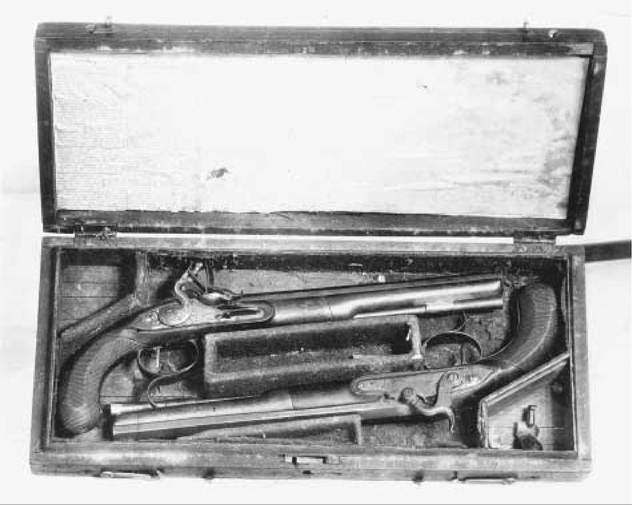
Hamilton-Burr Dueling Pistols. This set of pistols, now owned by JPMorgan Chase & Co., was used in the famous 1804 duel between Alexander Hamilton and Aaron Burr.
Although Hamilton's unfortunate fate in that duel provoked an outcry of antidueling sentiment, dueling lingered in the North for years to come, a detested but occasionally unavoidable means of dispelling dishonor among gentlemen. It remained far more entrenched in the less urbanized, more hierarchical South, where habitual violence was more endemic. Not until the 1830s was dueling outlawed in every state, and even then the practice persisted for decades to come.