
As a product of the political struggle with Great Britain during the 1760s and 1770s, the American flag reflects in its design and concept the nation's revolutionary origins. Flags had long been familiar to the American colonists, especially those used to identify imperial powers such as England and France. New Englanders even crafted their own standard sometime in the late seventeenth century. The flag adopted the red cross of St. George from England's state banner and added a pine tree, which represented one of the region's most important natural resources. It was an important precedent. Not only did the New England flag illustrate the tendency of Americans to adapt traditional English designs for their standards, but it also supplied a potential model for later American flags.
Three popular designs emerged during the American Revolution to provide possible prototypes for a national flag. In 1775 and 1776, several Massachusetts privateers and Continental naval vessels flew modified pine tree flags that often substituted St. George's Cross with the words "An Appeal to Heaven." So-called Liberty Trees, usually American elms, were becoming popular symbols of the Revolution throughout the colonies, but this Pine Tree Flag was perhaps too narrowly identified with New England to serve as a national flag. Another common motif of Revolutionary flags was the timber rattlesnake, a creature indigenous to America. Benjamin Franklin (1706-1790) had printed a segmented snake representing the colonies to persuade Americans to "Join or Die" during the French and Indian War (1754-1763), and while his efforts failed, they did establish the snake as a symbol of union in Americans' minds. The image was revived in the 1770s, appearing in newspapers as well as on numerous flags. The most enduring example is the Gadsden Flag featuring a coiled rattlesnake atop the ominous warning "Don't Tread on Me," a phrase that subsequently became embedded in the American lexicon. It was not unknown for the rattlesnake image to be superimposed upon either a Pine Tree Flag or a striped union flag, the third major design popularized by the Revolution.
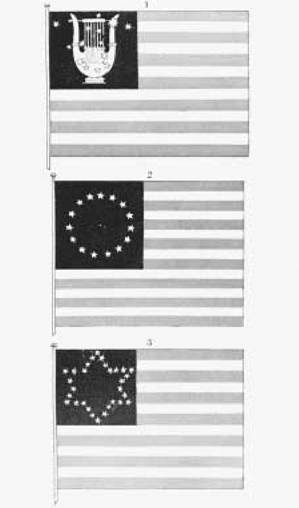
Early American Flags. Top to bottom: the flag proposed in 1777; the flag approved in 1794; and the altered flag of 1818.
The use of alternating red and white stripes, though later closely identified with the American flag, was in fact characteristic of some earlier English banners. The pattern assumed new meaning in the context of the American Revolution, when Sons of Liberty in Boston and elsewhere employed it to suggest unity among the thirteen colonies. To express continued loyalty to the crown, however, the British Union Jack often appeared in an upper corner, creating what became known as the Continental Colors. It was this flag that flew over George Washington's camp during the siege of Boston in early 1776, and it was also the first "American" flag to be recognized by some of Britain's European rivals later that year. Yet the Continental Colors—whose stripes variously appeared as red, white, blue, and even green—had no official status as a national standard.
After declaring independence in July 1776, the Continental Congress set to work fashioning the symbols of a new American nation. Its first priority was an official seal that would identify the United States as a sovereign entity. Less attention seems to have been paid to the issue of a flag until the following summer, when Congress passed a resolution on 14 June 1777 stating, "That the flag of the United States be thirteen stripes, alternate red and white; that the union be thirteen stars, white in a blue field, representing a new constellation." However, the function of the flag was as much utilitarian as it was nationalistic—to help distinguish Continental forces on land and, especially, at sea. The person generally credited with the design of the flag, which substituted a set of stars for the British Union Jack on the Continental Colors, is Francis Hopkinson (1737-1791), who served on the Continental Navy Board.
Standardization of the American flag was slow to develop. Not only did the use of rattlesnake designs and the Continental Colors continue for a time during the war, but also endless variations of the "stars and stripes" theme emerged on cloth and canvas in the following decades. The addition of new states in the 1790s touched off a debate in Congress about including them on the American flag. Although some argued that thirteen ought to be the permanent number of stars and stripes, federal legislation was passed in 1794 and in 1818 to allow for the alteration of the flag to include fifteen and then twenty stars respectively. The 1818 act also provided for the future addition of a single star for each state admitted to the Union, thus enabling the flag to keep up with the rapid growth of the nation.