
Nobody can be sure that Betsy Ross stitched the first version of the Stars and Stripes. She was accustomed to making flags, but her role regarding the initial U.S. flag was not proclaimed until 1870 and continues to be much debated. It is certain, however, that thirteen alternating white and red stripes below a blue rectangle set in the upper left-hand corner bespoke power in North America and the Malay Sea before either the United States or Malaysia was formed. Both have flags like that flown by the British East India Company's men-of-war well before the Continental Congress passed its resolution of 14 June 1777 "that the flag of the united states be 13 stripes alternate red and white, that the Union be 13 stars white in a blue field representing a new constellation." It is unclear whether they had Vermont in mind for the thirteenth state or Florida.
The first flag of the national army of the American Revolution was flown at the siege of Boston (1775-1776) but was replaced after it was mistaken for a flag of surrender. The second, bearing the impression of a serpent, had unpleasant implications for the biblically literal and was replaced in 1779. The green flag of John Houstoun McIntosh's East Florida Republic of 1811 was equally easy to misunderstand, for it depicted a bayonet-carrying Patriot wearing a tricolor hat with his pigtail flying behind his head. When the wind reversed, so did the pigtail, and the Patriot appeared to be retreating in haste.
Read from any direction, the Stars and Stripes meant Union and freedom as well. As such, it has been emulated by Uruguay, Venezuela, Chile, Taiwan, Thailand, Burma, Tonga, Western Samoa, Liberia, Togo, Greece, and the Netherlands Antilles. Single-starred emblems, on the other hand, have fis-siparous associations. The Lone Star Flag of Fulwar Skipwith's Republic of West Florida of 1810 flew for a month or two as a symbol of defiance of the federal government. It was resurrected by the secession convention of Mississippi on 9 January 1861 to became the Confederacy's famous Bonnie Blue flag. The very similar Lone Star Flag of the Texas Republic of 1836 drew the United States into the Mexican War (1846-1848), which produced the deepest divisions since President Thomas Jefferson's Embargo (1807-1809) and the War of 1812 (1812-1815). Albert Gallatin, Revolutionary War soldier and secretary of the Treasury for Presidents Jefferson and James Madison, later referred to the U.S. banner raised over Chapultepec in the war with Mexico as "slavery's flag." That was Gallatin's way, less inflammatory than that of the flag burners of a later era, of joining future president Abraham Lincoln and former president John Quincy Adams in calling upon the conscience of their fellow countrymen. Gallatin, Lincoln, and Adams regarded the Mexican War as being directed by President James K. Polk for the purpose of expanding the cotton-growing empire of his fellow planters, and they disapproved. The national flag has, therefore, been at most times the rallying point it provided George Washington's army after 1779, but at other times a symbol of sharp divisions in the American community.
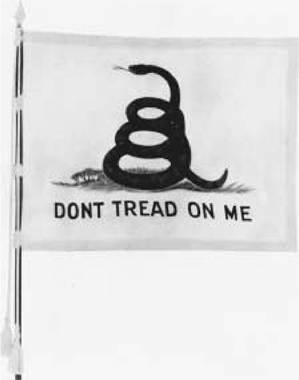
The Gadsden Flag. The timber rattlesnake, a creature indigenous to America, was a common motif on Revolutionary flags. The best-known example is the Gadsden Flag, featuring a coiled rattlesnake atop the warning "Don't Tread on Me.” Christopher Gadsden was a Revolutionary leader from South Carolina and a delegate to the Continental Congress.