
The Fourth of July, the first American holiday, began as a way of celebrating Congress's vote for independence. The vote occurred on 2 July 1776, but the announcement of the action was spread on 4 July 1776. Americans mistakenly believed that the date on the newspapers and broadsides was the date of independence.
Fourth of July festivities followed an age-old pattern of celebratory rites. Since bells were rung and cannons fired to acknowledge a royal birth, the same signals were used to mark the nation's birthday at dawn. A military muster was often the first event of the day, providing much pomp and pageantry. The soldiers would then retire to drink and eat the traditional Fourth of July dishes of turtle soup and ice cream. Most Americans gathered late in the day, especially at night. Men and women attended plays, concerts, hot-air balloon demonstrations, horse races, and fireworks exhibitions. Huge paintings depicted General George Washington and American military victories. Rowdies would occasionally set bonfires, but most activities were subdued. Rural areas did not participate.
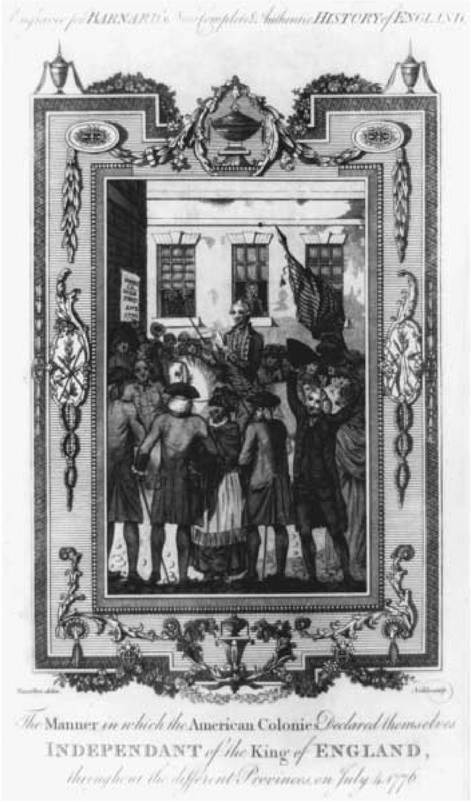
Declaring Independence. This illustration from The New, Complete, and Authentic History of England (London, c. 1783) by Edward Barnard depicts the manner in which the American colonists declared themselves independent of England: a man on horseback rides through town reading the Declaration of Independence to cheering crowds, while a notice reading "America Independent 1776" is posted on a wall.
The Fourth of July was not a benign celebration. During the Revolution, Independence Day observances inspired patriotic Americans to keep fighting and served to force out opponents of independence. British sympathizers were easily identified by their refusal to participate in toasts, parades, and other activities and were stigmatized as a result. Loyalists would typically keep their houses free of lights, and rock-throwing patriots often broke the darkened windows. In these years, when the war proceeded badly for the patriots, celebrations were muted or abandoned entirely, as was the case in 1780 and 1781.
When the Revolutionary War ended in 1783, the Fourth of July became a commemorative event. Communication and entertainment were viewed as more important than any practical result. Community after community made the day into an official holiday with barbeques, parades, and readings of the Declaration of Independence.
In the late 1780s control of Independence Day became hotly contested between political groups that attempted to direct the activities in a way which allowed them to promote their agendas. During the Adams presidency in the late 1790s, Republicans used the day to indicate their support for France and their distaste for the president. On festive occasions, American men in this era would commonly place a black rosette cockade in their hats. In response to Adams's unpopular French-aimed Alien and Sedition Acts of 1798, Republicans along the Eastern seaboard replaced the American cockade with a blue one symbolic of France. A few Federalists then physically removed the blue cockades. In the 1790s the Fourth of July became notorious for riotous behavior, and many Americans dreaded the coming of the day.
By about 1814, the Fourth of July had become a generally accepted day off from work because of politics. Prior to this time, Americans had a relatively uninterrupted work schedule with only the Sunday Sabbath as a rest day. Deprived workers were eager for a day of celebration. With both Federalists and Republicans seeing political advantages in promoting a vacation, the day became a holiday.
After the War of 1812 it was a holiday only for whites, however. African Americans were pushed out of Fourth of July celebrations by a mixture of intimidation and physical violence. Slaves typically did not possess the right to congregate freely, to be unescorted at night, or to throw fireworks. Whites saw Independence Day as a holiday for Americans only and blacks did not qualify for citizenship.
During the War of 1812, Independence Day celebrations in southern cities served to boost enthusiasm for the war effort. In Boston, a city controlled by the Federalist opponents of the war, celebrations stopped. By halting the festivities, the Federalists hoped to awaken people to the dangers of losing to foreign invaders and to Republican mismanagement of the country. As the Federalist Party collapsed in the wake of the British defeat, partisanship in Fourth of July celebrations rapidly disappeared. Parades, speeches, and fireworks continued, but the focus was now entirely on nationalism.
The end of the war brought the end of celebrating Revolutionary goals. Images of prosperity replaced images of liberty. Lengthy orations focused on love of the land as well as America's beauty, abundance, and potential for material progress. In the 1820s women joined the festivities for the first time as active participants. Dressed in calico, they marched in front of flag-draped wagons filled with the goods of local merchants. The only discordant note came when female temperance advocates began staging Independence Day rallies against the heavy drinking that had become a part of the occasion in urban areas. By 1830, the Fourth of July had emerged as a nonpartisan national holiday to celebrate America.