
Benjamin Franklin is arguably the most beloved and the most disparaged of America's founding fathers. He is perhaps the least understood as well. A jack-of-all-trades and the master of many, he is a nearly impossible man to pigeonhole. He was a scientist and inventor, printer and publicist, brother and son, father and husband, diplomat and staunch—if somewhat belated—supporter of America's War for Independence. He was the most cosmopolitan founder, and yet people think of him as the most quintessentially American.
Franklin's career spanned nearly an entire century. Born in Boston on 17 January 1706 and dying in Philadelphia on 17 April 1790, Franklin never called one place home. He fled his native Boston when he was only seventeen. In Philadelphia, he suffered a series of failures. He tried unsuccessfully to begin his own printing business, relying on the false promises of Governor William Keith for capital that never materialized. He briefly worked as a clerk in a friend's general store, but returned to printing when his benefactor died. He even briefly considered becoming a swimming instructor. He seemed to flounder, drifting aimlessly from one project to another until he married Deborah Read in 1730. Soon thereafter he began his successful printing career, setting up a thriving shop on Market Street. He had three children. William, his illegitimate son, was born in 1731 to a woman whose identity remains unknown. He and Deborah had two children of their own. Francis Folger died of smallpox in 1736 at the age of four. Sarah, his only daughter, was born in 1743.
Franklin retired at the age of forty-two and entered the public arena with ill-disguised enthusiasm. With William, he conducted his famous kite experiment in 1752. His ability to prove that lightning was a form of electricity instantly garnered him international acclaim. He also embarked upon his political career, organizing Pennsylvania's militia during King George's War (1740-1748), winning a seat in the colonial legislature in 1751, and presenting his Plan of Union to the Albany Conference in 1754. At the same time, he was a pivotal player in his colony's effort to become a royal colony.
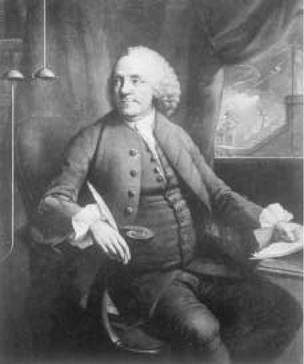
Benjamin Franklin. Franklin examines an electrical device in this eighteenth-century mezzotint by Edward Fisher after a painting Mason Chamberlin. A lightening bolt can be seen through the window at the right.
Franklin's involvement in Pennsylvania's effort to escape proprietary rule led him to spend some of his most important years on the other side of the Atlantic. He sailed to England in 1757 and again in 1764, remaining in London until 1775. No radical, he spent the decade looking for an accommodation between England and America, only gradually and reluctantly coming to the conclusion that accommodation was impossible to achieve. Thus, at the age of seventy, at a time when he had much to lose and little to gain, this once-proud member of the British Empire returned to Philadelphia determined to represent Pennsylvania in the Second Continental Congress and to persuade his compatriots to sever their ties with England. Thereafter, he was unrelenting in his efforts to secure colonial independence. He was a member of the committee that drafted what became known as the Declaration of Independence. Although Thomas Jefferson was the scribe on that committee, Franklin used his skills as an editor to tweak—gently and diplomatically—the Virginian's prose. With independence declared, he was soon in Paris, working indefatigably—and successfully—to secure French military and financial aid for the American war effort. At war's end he played a major role in negotiating his country's peace treaty with England. With the signing of the Treaty of Paris in 1783, Franklin returned to Philadelphia. There, at the age of eighty-one, he was the oldest member of the Constitutional Convention of 1787. While his substantive contributions to the body were few, he constantly drew the delegates' attention to the republican principles of 1776. Although his colleagues usually rejected his suggestions, few could simply ignore the words of a man who had helped launch America's existence as an independent nation.
The American story and Franklin's story seem to be one and the same. Beginning with his efforts to represent the colonies' interests during the Stamp Act crisis in 1765, Franklin was never far from the scene of action. His most important service to the new nation is the least celebrated. The stuff of diplomacy is not as dramatic or compelling a subject as the triumphs and sacrifices of soldiers on the field of battle. Yet America's military exploits, however valiant, would have been for naught had it not been for Franklin's endeavors. If it is true that America could not have defeated England without French military and financial aid, it is possible that such assistance would not have materialized without Franklin. He was not America's only representative in France. But no one else, not Silas Deane nor John Adams nor Arthur Lee, could do what Franklin did. Using his fame as the man who brought the lightning from the skies, taking advantage of the adulation in which the French intelligentsia already held him, he quickly became a court favorite. Judiciously balancing idealistic appeals with hard-headed arguments, cajoling, flattering, and even threatening, Franklin held his own and then some in a royal court riddled with international suspicion and intrigue. The French alliance he achieved made American independence possible, if not inevitable.
Benjamin Franklin was never the representative American that both his admirers and detractors have made him out to be. He was more at home in England and Europe than any other American—including Thomas Jefferson. Throughout the prewar years, he was more comfortable with his identity as a British American than any Patriot—and probably most Loyalists. And yet it is as a "representative American" that most people think of him. We know him best through his Autobiography, first published four years after his death, and the pithy aphorisms of Poor Richard's Almanack (1732-175 7). These two works—published, republished, analyzed, criticized, and ad-mired—have made Franklin the creator not simply of a nation, but of a national identity. His life became synonymous with the "rags to riches" story that Americans like to claim as peculiarly their own. In part because of his humble origins, he is viewed as more democratic than any of the other founders, and thus as a man who would have been happy to tear down the class, racial, and gender barriers that Americans had erected in his own lifetime. Finally, Americans see him as the ultimate pragmatist, a man who eschewed ideological arguments that troubled fuzzy-headed intellectuals and instead practiced the art of the possible with grace and good humor.
Franklin used his own life as an object lesson, implying that his life was an especially American life, that his identity was America's identity, writ small. In his hands, that life and that identity were something of which all his countrymen could be proud. His experience proved, above all else, that America was the land of opportunity. He had entered the world as the son of a humble Boston candle maker and had ended it by dining with kings. Taking advantage of opportunities that existed for anyone with the intelligence and character to recognize them for what they were, he triumphed over adversity with seeming ease. Only in America, he implied, could such a success story be told.
In part because he was a "self-made man," a persona that is at the core of American mythology, he has also been designated as his century's spokesman for the egalitarian ideals upon which the new nation's independence was based. He seemed to revel in his ability to communicate with ordinary people and enjoyed even more the opportunity to cut an aristocratic pretender down to size. He valued life's simple pleasures and was even uncomfortable with the few luxuries—a china cup, a silver spoon—that his wife insisted upon purchasing for him. In his very old age, he became a champion of the nascent antislavery cause.
Franklin's admirers also see him as pragmatic and nonideological, willing to accept half a loaf as better than none, determined to achieve the possible rather than tilt at windmills. He was unfailingly optimistic, suffused by that "can-do" spirit which Americans like to claim as an intrinsic component of their character. He put his scientific bent to practical ends, inventing a stove, a lightning rod, and bifocals, all designed to improve the everyday lives of ordinary men and women. Even at those rare moments when he failed to achieve his ends, he shrugged, made a joke—often at his own expense—and proclaimed that occasional "errata" were not such bad things. Errata could be corrected. People could learn from their mistakes.
Ironically, the attributes that have turned Franklin into the beloved founder are the very qualities that invite the most disdain from some quarters. While his detractors agree with those who see Franklin as a representative American, they see little in that characterization to admire. Intellectuals, in particular, view Franklin as the very essence of bourgeois Babbitry. In the classic lines of D. H. Lawrence, this "middle-sized, sturdy, snuff-colored Doctor Franklin" was a "dry, moral, utilitarian little democrat." If he was the "first downright American," that was no compliment—either to him or to his country (Studies in Classic American Literature, p. 21).
Smug, materialistic, and hypocritical, Franklin was, say some critics, above all the progenitor of American capitalism. His sunny disposition, his eternal optimism simply proved that he did not have the capacity to sympathize with those who failed to rise to his own level. His own determination to climb the social ladder turned him into a money-grubbing parvenu whose eye was always on the bottom line. His famous plan for self-improvement was little more than a reflection of his ledger book mentality.
Franklin was, moreover, no democrat. His own career was built on the backs of others. He drove more than one Philadelphia printer out of business and delighted in doing so. He was disdainful of the "unworthy poor" who refused to work and did not take advantage of the opportunities that at least in America beckoned at every turn. His treatment of women, especially his wife and surviving daughter, was far from admirable. No charming rogue, he was an unreconstructed womanizer who used women for his own purposes and discarded them once those purposes had been served. Far from being the one founder who recognized the evils of slavery, he was, for most of his life, peculiarly untroubled by the institution of bondage. He owned, bought, and sold slaves. He came to the antislavery cause very late in his life, and only then did so when it was politically safe.
Moreover, say some naysayers, Franklin's much vaunted pragmatism is proof that he lacked depth.
He was multifaceted. He was a chameleon. He was an actor, a shape-shifter, and a confidence man. He was all things to all people, but ultimately he had no principles, no true essence. He was all means and no end. If historians have failed to penetrate his inner core, if they find him maddeningly elusive, perhaps there is a reason for their failures. This was a man who valued appearances above reality, who skimmed the surface of things, who was reluctant—perhaps unable—to plumb the depths.
Nor was this supposedly bright and practical man an especially astute politician. Even those historians who find much to admire in Franklin are puzzled by the many missteps he made throughout his long and varied career. His personal vendetta against the Pennsylvania proprietors made him blind to the dangers that his colony would have faced had it become a royal province. He was completely blindsided by the depth of the colonists' anger at the beginning of the Stamp Act Crisis in 1765. When he first heard about the Boston Tea Party of 1774, he suggested that Massachusetts should pay for the tea that some Patriots had so unceremoniously dumped into Boston Harbor. While Franklin always seemed to land on his feet in the end, he was not an invariably prescient observer of his times.
The "real" Franklin is more complex and in some ways more admirable than the image he helped to create. He may have been the self-proclaimed exemplar of the rags to riches story, but he was not the avaricious materialist that modern observers would understand or recognize. He valued money as a means to an end, and he was bewildered by those who sought profit for its own sake. Like most Americans of his day, he craved the independence that money could bring rather than money itself. Without independence he could not serve his "public" effectively, nor could he enjoy the political career that became the central focus of his life after he retired.
Interestingly, Franklin's meteoric career did not even achieve its ultimate goal. A man of his times, he sought royal patronage with unabashed fervor and longed to be a part of the upper reaches of British society. He eventually acquired money and position, but he could never completely escape his humble past, even though he spent nearly a decade in London trying to do just that. He moved easily in aristocratic circles in France and England. He failed to understand the disgust with which John and Abigail Adams viewed the "decadent" aristocracy they encountered at the court of Louis XVI. But despite his efforts, he never managed to secure the royal favor he craved and thought he deserved.
Most important, Franklin was by no means invariably pragmatic or optimistic. He did not always walk the middle line, avoiding rigid intellectual systems and the extremists who devised those systems. He did not shrink from disputation, and many times he failed to see compromise as a worthy goal or even an acceptable option. Franklin was a passionate man who knew how to hate as well as how to smile and laugh. Not everyone in his own day found him amusing or likeable. He acquired any number of personal and political enemies throughout his life. He was a man who cared, and cared deeply, about the empire and about America's role in that empire. When he finally came to the conclusion that the colonies would be better off if they escaped English rule, he was single-minded and unrelenting in his efforts to secure independence. He could carry a grudge as well as anyone and never forgave his personal or political enemies. Franklin never even forgave his own son for remaining loyal to the king.
Partly because he lived so long, partly because he kept so much of himself to himself, historians have failed, despite their many valiant attempts, to capture Franklin's "true" identity. In an odd way, he was a tabula rasa who left it to future generations of Americans to project themselves—their darkest fears and their most cherished hopes about themselves and their nation—onto Franklin's persona. In the end, the mythical Benjamin Franklin tells us more about ourselves than he does about this quintessential eighteenth-century man.