
The eldest son and second child of John and Abigail Smith Adams of Braintree, Massachusetts, John Quincy Adams (1767-1848) had one of the longest and most diverse careers in American political history. Between 1781, when he accompanied Francis Dana on his mission to Russia, to his collapse and death in the U.S. House of Representatives in 1848, Adams served as a diplomat abroad (1794-1801, 1809-1817), Massachusetts state senator (1802-1803), a member of the U.S. Senate (1803-1808), secretary of state (1817-1824), and president of the United States (1825-1829). He was a congressman from 1831 until his death. Like his father, he received a bachelor's degree from Harvard College (1787) and was admitted to the bar in Massachusetts (1790). Adams was also a gifted rhetorician, a student of the classics, a diarist, and a scientist. He was Harvard's first Boylston Professor of Rhetoric (1806-1809), and, while serving as secretary of state, he compiled a report on weights and measures that is a classic in the field.
Adams first gained political notoriety in 1791 when he published the letters of "Publicola"—a series of essays defending his father in particular and the Federalist Party in general against Jefferson's charge of political "heresy." Publicola and subsequent writings impressed President Washington, and in 1794 he made young Adams U.S. minister to the Netherlands. Washington raved about Adams's talents, proclaiming that, "I shall be much mistaken if, in as short a period as can well be expected, he is not found at the head of the diplomatic corps, let the government be administered by whomsoever the people may choose." Adams remained in the Hague throughout the rest of Washington's tenure and served in Berlin during his father's presidency (17971801). Throughout these years Adams sought to maintain America's independent yet engaged stance in Europe.
Rather than serve under President Jefferson, Adams returned to the United States with his bride, Louisa Catherine Adams, the daughter of the American consul in London, whom he had married in 1797. (They would have three sons—George Washington Adams, John Adams II, and Charles Francis Adams.) Adams soon found his way back into politics, winning a seat in Massachusetts's state senate in 1802. Federalist Party managers had trouble with Adams, so they moved him up and out, to a seat in the U.S. Senate in 1803. Adams's term was stormy, for he was too independent to be a good partisan. He believed in a party system in the abstract but never could work within a party himself. Republicans were disinclined to trust the son of the man they had just defeated for president. Meanwhile, the growing antiUnionist sentiment in the Federalist Party dismayed Adams. The final break came in 1808 when he attended a Republican caucus to nominate a presidential candidate. Massachusetts Federalists thereupon repudiated Adams, appointing his successor before Adams had even finished his term. Facing dishonor, Adams resigned.
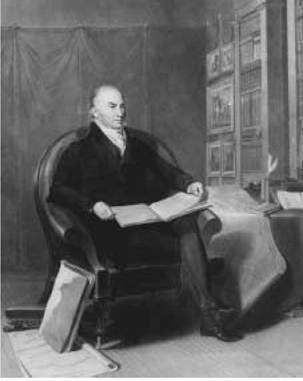
John Quincy Adams. Diplomat, congressman, and sixth president of the United States, depicted in an 1826 engraving by Asher Brown Durand, after a painting by Thomas Sully. library of congress.
President Madison named Adams the American minister to Russia in 1809. He remained there until 1814 when Madison sent him to Ghent to chair America's peace commission to negotiate an end to the War of 1812. After Adams and his colleagues signed the Treaty of Ghent on 24 December 1814, Madison sent Adams to London to serve as America's minister. While there, he began the negotiations that would culminate in the Rush-Bagot Treaty of 1817. That treaty, which removed armed ships from the Great Lakes, was a landmark in the history of disarmament.
In 1817 Adams returned home to serve as secretary of state under President Monroe. Seeing Spain's weakness in America, Adams pushed every advantage. Hence, in a negotiation that at first concerned only the Florida territory, Adams secured America's claim to land from Florida to the edge of Texas, and then across the West to the Oregon territory along the Pacific Ocean. Samuel Flagg Bemis notes that the Adams-Onis, or Transcontinental, Treaty "was the greatest diplomatic victory won by any single individual in the history of the United States."
Secretary of State Adams also played a key role in the creation of the Monroe Doctrine. He thought America should play an active role in the Western Hemisphere but a passive one outside of it. In an oration delivered on 4 July 1821, he described how the United States should respond to the Greek independence movement: America "goes not abroad in search of monsters to destroy. She is the well-wisher to the freedom and independence of all. She is the champion and vindicator only of her own."
The presidential election of 1824 was the first closely contested election since 1800. No candidate received a majority, so the decision went to Congress; after much arm-twisting by Henry Clay, Congress made Adams president, even though Andrew Jackson had a plurality of votes. Adams thereupon made Clay secretary of state. For the next four years Jackson and his allies made an issue of the "corrupt bargain." Adams was an ineffective president. Wishing to be above party politics, he kept some of Jackson's partisans in office, and they actively campaigned against him. Meanwhile, he called for an extensive plan of internal improvements, claiming that "liberty is power" to improve the nation. He wanted to use the latent powers of the federal government to integrate the nation, which he feared was too divided among North, South, and West. Even though some of Adams's specific programs were popular, his overall scheme was not, and Jackson crushed him in the election of 1828.
Adams took defeat hard. In 1837 he wrote, in a letter to Charles W. Upham, that "the great object of my life . . . as applied to the administration of the Government of the United States has failed." The American union, he feared, would be the plaything of slaveholders rather than an engine for the spread of liberty. In 1830 he entered Congress, representing his native district in Massachusetts. He held the seat until his death in 1848. Throughout these years he sought, with some success, to return the Union to its antislavery foundation. Antislavery forces would dub him "old man eloquent" for his rhetorical service in their cause.