
“What is the past, after all, but a vast sheet of darkness
in which a few moments, picked apparently at random, shine.”
John Updike (1963)1
The Substance of the Stars
Before astronomers could understand how the Sun and other stars produce their heat and light, they needed to know what they are composed of. In a brilliant doctoral dissertation, published in 1925, the American astronomer Cecilia H. Payne used observations of spectral lines to show that hydrogen is by far the most abundant element in the outer atmosphere of the Sun and many other stars.2 But she could not believe that the composition of stars differed so enormously from that of the Earth, where hydrogen is found rarely, so Cecilia mistrusted her understanding of the hydrogen atom. Prominent astronomers of the time also did not think that hydrogen could be the main ingredient of the stars, and this may have played a role in her considerations.
The Danish astronomer Bengt Strömgren, an expert on stellar interiors, next calculated the hydrogen content inside stars, assuming they are chemically homogeneous, and showed in 1932 that their observed luminosities require that the entire star, and not just its outer atmosphere, must be predominantly composed of hydrogen.3
We now know that hydrogen is the most abundant element in the Universe, and that there was nothing wrong with Miss Payne’s observations. The Earth just does not have sufficient gravity to retain hydrogen gas in its atmosphere for any length of time. It either evaporated away while the Earth was forming, or became locked into water or surface rocks at that time.
Helium, the second-most abundant element on the Sun, is so rare on the Earth that it was first discovered in the Sun, when the French astronomer Pierre Jules César (P. J. C.) Janssen found an unidentified yellow emission line in the solar spectrum observed during the solar eclipse of 18 August 1868.4
The English astronomer Joseph Norman Lockyer observed the same yellow line at about the same time and was subsequently knighted for this discovery. It was probably not until the following year that Lockyer convinced himself that the yellow line could not be identified with any known terrestrial element, and named the solar element “helium” after the Greek Sun god, Helios, who daily traveled across the sky in a chariot of fire drawn by four swift horses.5
Helium was not found on Earth until 27 years after its discovery in the Sun, when the Scottish chemist Sir William Ramsay discovered its spectral signature in a gaseous emission given off by a heated uranium mineral cleveite.6 Today, helium is used on Earth in a variety of ways, including inflating party balloons, and in its liquid state to keep sensitive electronic equipment cold. Though plentiful in the Sun, helium is almost non-existent on the Earth. It is so terrestrially rare that we are in danger of running out of helium during this century. Japanese scientists have proposed that helium may be extracted and returned from the Moon’s surface, where the terrestrially rare element has been implanted by winds from the Sun.
Altogether, 92.1 percent of the atoms of the Sun are hydrogen atoms, 7.8 percent are helium atoms, and all the other heavier atomic elements make up only 0.1 percent. In contrast, the main ingredients of the rocky Earth are the heavier elements like silicon and iron, which explains the Earth’s high mass density — about four times that of the Sun, which is about as dense as water.
It was the English astronomer and devout Quaker A. S. Eddington who noticed that the conversion of hydrogen into helium might provide stellar energy from the mass lost in the process.
A. S. Eddington, Seeking the Truth
Arthur Stanley Eddington, known as A. S. for short, was born on December 28, 1882 in Kendal, England, the second child and only son of Quaker parents, themselves from Quaker families. His father, headmaster of the Friend’s School in Kendal, died of typhoid when Arthur was only 2 years old, and his mother was left to bring up her children with little income.
The family moved to Weston-super-Mare where Arthur was educated at home before spending three years at preparatory school. In 1893 he entered the Bryn Melyn School, where he excelled in mathematics and English literature. His talents enabled him to earn a scholarship to Owens College in Manchester before he had reached the age of 16. After four years at the College, where he won all the honors it had to offer, A. S. was awarded a scholarship to Trinity College at the University of Cambridge. In 1904 he became the first ever second-year student to achieve top honors in its mathematical exams, known as the Tripos.
Two years later, at the age of 23, Eddington was appointed Chief Assistant to the Astronomer Royal at the Royal Observatory in Greenwich, England, where he investigated stellar movements and the structure of the stellar system.
Eddington was elected as Plumian Professor of Astronomy at the University of Cambridge in 1913, to replace George Darwin who had just died. The following year, as the result of another person’s demise, Eddington also became director of the Cambridge Observatory, and therefore responsible for both observational and theoretical astronomy at the University. He held these positions with great distinction for the next thirty years.
Eddington’s tenure at Cambridge did not have a happy beginning, for it coincided with the early stages of World War I (1914-1918). As a Quaker pacifist, he claimed conscientious objector status and refused to serve in the war. When called up for conscription, he publicly declared, before a Cambridge Tribunal, that his religious beliefs could not support the call to slaughter other human beings. The tribunal refused to accept his deferment, and only the timely intervention of the Astronomer Royal and other high profile figures kept Eddington out of prison and on his way to observe the total solar eclipse of 1919 described in Chapter 2.
Eddington never married, avoided romantic entanglements, and lived in Cambridge, England with his mother and sister, and later with his sister alone who survived him. They provided a home suitable to his temperament and work, and thereby helped A. S. dedicate his life to understanding the stars.
With exceptional physical insight and mathematical ability, he explained how stars move, gather together, support themselves, pulsate, curve nearby space-time, depend on mass, light up nearby space, and stay hot inside and shine.7 His elegant book entitled The Internal Constitution of the Stars summarizes his pioneering considerations of the structure, composition, energy source, and evolution of stars.8
A. S. also had his lighter side. He enjoyed solitary cycling through the English countryside in the spring and fall, and was addicted to solving the crossword puzzles in The Times and The New Statesman and Nation. He was an avid reader of mystery novels, and once likened the process of understanding stars to analyzing the clues in a crime. Eddington wrote wonderful accounts of astronomy with humor, literary allusions, analogies, metaphors, and similes that the educated public loved and still does.9
There was a continual interaction and overlap of Eddington’s scientific career and religious outlook.10 He identified himself as both a Quaker and an astronomer, and believed that seeking the truth through mystical experience is fundamental to both religion and science. There is no absolute, certain knowledge, he thought, in either realm, and he urged everyone to participate in a continued quest for truth in all ways.
In Science and the Unseen World, Eddington wrote: “In science as in religion the truth shines ahead as a beacon showing us the path; we do not ask to attain it; it is better far that we be permitted to seek it…. As truly as a mystic, the scientist is following a [pure and holy] light. … And so in the light walking and abiding, these things may be fulfilled in the Spirit, not in the letter; for the letter killeth, but the Spirit giveth life.”11
In describing why he believed in God, he declared: “The desire for truth so prominent in the quest of science is a reaching out of the spirit from its isolation to something beyond, a response to beauty in Nature and art, and [the] Inner Light of conviction and guidance.”12
And when a cry goes up from the human heart about the mystery of our existence, asking what is it all about or why do humans exist? Eddington replied that life is “about a spirit in which truth has its shrine, with potentialities of self-fulfillment in its response to beauty and right.”13 “I cannot believe that human beings exist simply in order to breed more millions of human beings,” he declared. “The human race must be aiming, in some way, at something finer.”14
Eddington dealt with the unseen worlds within stars, and he turned to another invisible world to seek truths beyond science. “For the rest,” he wrote, “the human spirit must turn to the unseen world to which it itself belongs.” It is a different, transcendental perception, and you cannot apply natural laws to it “anymore than you can extract the square root of a sonnet.”15
A. S. never supposed that he, or any other astronomer, was infallible. He viewed astronomy as an ongoing, open-ended pursuit of the truth. It is an unfinished quest, always changing, endlessly approximating, forever improving, continually moving forward, and never final. Taking part in this magnificent exploration is what mattered to Eddington, not the ultimate correctness of any given hypothesis.
When narrating the story of Daedalus and Icarus in 1920, he therefore wrote:
“In ancient days two aviators procured to themselves wings. Daedalus flew safely through the middle air across the sea, and was duly honored on his landing. Young Icarus soared upwards towards the Sun till the wax melted which bound his wings, and his flight ended in fiasco. In weighing their achievements perhaps there is something to be said for Icarus.... So, too, in Science, cautious Daedalus will apply his theories where he feels most confident they will safely go; but his excess of caution cannot bring their hidden weaknesses to light. Icarus will strain his theories to the breaking point till the weak joints gape.”16
So, lets fly on with Eddington and Icarus (Fig. 9.1) to peer within the Sun and other stars.

Figure 9.1 Icarus The mythological Icarus seems to be pushing against the downward pull of gravity, trying to break free, soar into a bright blue sky, and set the human spirit free. Icarus’ red heart symbolizes love, for: “He who loves also soars, runs and rejoices; he is free and nothing can restrain him.” [A paper-cut out by the Henri Matisse, courtesy of Succession Matisse, Paris.]
How does the Sun Shine?
As Eddington acknowledged, his investigations of the hidden interior of the Sun began with the American astronomer Jonathan Homer Lane’s realization in 1870 that gravitational compression within the Sun and other stars make them exceptionally hot inside.17 Lane was the first to investigate the Sun as a gaseous body, and he assumed that the gas pressure of hot, moving particles supports the mass of the Sun. The central temperature can be inferred by assuming equilibrium between the gas pressure and the inward gravitational pull at the star’s center, which occurs at a central temperature of 15.6 million degrees kelvin. A star that is more massive than the Sun produces greater compression at its center, and a higher central temperature is required to support it.
Eddington showed that all of the energy of any star has to be released deep down inside its high-temperature core, and that no energy is created in the cooler regions outside the core. A star is energized in its central regions and that energy is transported out to a star’s visible disk.
The power that must be produced within the Sun is just amazing. When we measure the total amount of sunlight that illuminates and warms the Earth, and extrapolate back to the Sun, we find that it is emitting an enormous power of 385.4 million, million, million, million, or 3.854 × 1026, watts. In just one second, the Sun expends more energy than humans have used since the beginning of civilization.
So what produces that prodigious energy? In the mid-nineteenth century, the German physicist Hermann von Helmholtz proposed that it is due to the Sun’s gravitational contraction. As gravity slowly pulls the solar material inward, compressing and heating it up, the hot solar gases would keep the Sun shining. As subsequently shown by the Irish physicist William Thomson, later known as Lord Kelvin, slow gravitational collapse might supply the Sun’s energy for about 100 million years.18
The astonishing thing, which was not realized at the time Thomson wrote his influential article, is the Sun’s durability. It has lasted much longer than he envisioned. Fossil evidence indicates that sunlight has been sustaining life on Earth for about 4 billion years, so the Sun has been kept hot inside and radiated away energy at its enormous rate for billions of years. Only nuclear reactions can fuel the Sun’s fire and make it shine so brightly for so long.
Moreover, as A. S. first pointed out, the situation is dramatically worse for the giant stars. In 1917, he wrote: “If contraction is the only source of energy, the giant stage of a star’s existence can scarcely exceed 100,000 years.”19 He instead proposed that hydrogen is transformed into helium inside stars, with the resultant mass difference released as energy to power them.
At the end of World War I in 1918, the chemist Francis W. Aston returned to the University of Cambridge, where he invented the mass spectrograph and used it to show that the mass of the helium nucleus is slightly less massive, by a mere 0.7 percent, than the sum of the masses of its ingredients. When a new helium nucleus is bound together, a tiny amount of mass is lost and released in the form of energy. Eddington rightly concluded that this could supply the Sun’s current luminous output for an estimated 15 billion years.
In his far-sighted 1920 essay on the internal constitution of the stars, Eddington wrote:
“Certain physical investigations in the past year make it probable to my mind that some portion of sub-atomic energy is actually being set free in the stars. F. W. Aston’s experiments seem to leave no room for doubt that all the elements are constituted out of hydrogen atoms [protons] bound together with negative electrons. The nucleus of the helium atom, for example, consists of four hydrogen atoms [protons] bound with two electrons. But Aston has further shown conclusively that the mass of the helium atom is less than the sum of the masses of the four hydrogen atoms that enter into it…. Now, mass cannot be annihilated, and the deficit can only represent the mass of the electrical energy set free in the transmutation … The total heat liberated will more than suffice for our demands, and we need look no further for the source of a star’s energy.”20
[It was subsequently found that the nucleus of the helium atom consists of two protons and two neutrons, but their combined mass is not noticeably different from that of four protons — see Chapter 3.]
Albert Einstein provided the basic idea when he showed that mass and energy are interchangeable. Every mass has an equivalent energy, just as every form of energy has an equivalent mass.21 Energy radiated may, for example, be supplied by mass lost. [Their equivalence is expressed by the single elegant equation E = mc2, where E denotes energy, m stands for mass, and c2 denotes the square of the speed of light c. Because the speed of light is a very large number, only a small amount of mass is needed to produce a large amount of nuclear energy.]
In Eddington’s view, the stars are the places where the elements are assembled by fusion. The mass of the assembled element is less than the mass of its ingredients, and the lost mass provides the energy that keeps stars hot inside and fuels their radiation. In this way, he linked some of the largest bodies in the Universe to the smallest, and joined the stars to the atoms and their nuclear constituents.
In the same article, Eddington also included the prescient statement that:
“If, indeed, the sub-atomic energy in the stars is being freely used to maintain their great furnaces, it seems to bring a little nearer to fulfillment our dream of controlling this latent power for the well being of the human race — or for its suicide.”22
So it is nuclear fusion reactions in the compact, dense, high-temperature core of a star that energizes the particles there, sustaining their heat and making them move rapidly. Once the nuclear reactions begin, the sub-atomic energy that is liberated keeps the nuclei sufficiently hot to insure the continuation of the reactions. They are termed “nuclear’ reactions because it is the interaction of atomic nuclei that powers the stars. For the Sun and the vast majority of other stars, it is protons, the nuclei of hydrogen atoms, which fuse together to make the nuclei of helium atoms.
The chains of nuclear reactions involved in transforming hydrogen into helium inside stars depend upon the mass of the star. For most stars, including the Sun, there is a direct conversion of four hydrogen nuclei, the protons, into one helium nucleus. This chain of nuclear reactions was discovered by Hans Bethe in 1938,23 immediately following a conference in Washington, D.C. organized by George Gamow to discuss the problem of stellar energy generation. For exceptionally massive stars, which are more massive than the Sun, carbon acts as a catalyst in the nuclear transformation, following the chain that was delineated by Carl Friedrich von Weizsäcker the previous year.24 [Carl’s brother Richard von Weizsäcker (1920-2015) studied at Balliol College, Oxford, returned to serve in the German Army in World War II (1939–1945), and became President of the Federal Republic of Germany from 1984 to 1994.]
Tunneling Through the Barrier
Physicists were nevertheless convinced that protons could not overcome their mutual electrical repulsion and fuse together inside the Sun. Protons are positively charged, which means they repel one another, like identical ends of two magnets. The force of repulsion between like charges becomes larger and larger as they are brought closer and closer to one another. Even in a highspeed, head-on collision at the enormous central temperature of the Sun, two protons are not moving fast enough with sufficient kinetic energy to overcome their mutual charged repulsion and come together. But A. S. was certain that nuclear energy fueled the stars, and remarked that: “The helium which we handle must have been put together at some time and some place. We do not argue with the critic who urges that the stars are not hot enough for this process; we tell him to go find a hotter place.”25
George Gamow had provided the resolution of this paradox in 1928 when he demonstrated how α particles tunnel out of the nucleus of a radioactive atom (Chapter 3). Of course, a star is not radioactive, and it is a place where elements are being synthesized instead of spontaneously decaying. But a similar tunneling process, or barrier penetration, occurs the other way around at the center of stars like the Sun. It means that a proton has a very small but finite chance of occasionally moving close enough to another proton to tunnel through or under its electrical barrier.
Only exceptionally fast protons, moving much faster than average, can merge together when they collide, and that rarely happens. Even with the help of tunneling, the average proton has to make about ten trillion trillion, or 1025, collisions before nuclear fusion can happen. That explains why the Sun does not expend all its nuclear energy at once, and shines for billions of years. If all the protons at the center of the Sun were moving fast enough to fuse together, the star would explode like a colossal hydrogen bomb.
Properties of the Stars
Eddington’s contributions to our understanding of the stars depended upon the observations of dedicated astronomers who were measuring fundamental stellar properties such as distance, mass, and luminosity.
The measurement of the distance of a nearby star, other than the Sun, involves careful scrutiny of two stars that appear close together in the sky and are not members of a binary system (Fig. 9.2). The distance of the nearer star can be determined by comparing its position to that of the more distant one when viewed from opposite sides of the Earth’s orbit, or from a separation of twice the mean distance between the Earth and the Sun, which is known as the astronomical unit and abbreviated AU. The angular change in position is known as the annual parallax, from annual for the Earth’s year-long-orbit and the Greek parallaxis, for the “value of an angle.”
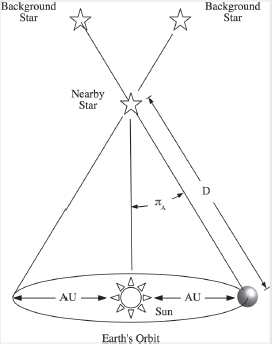
Figure 9.2 Annual parallax When a distant and nearby star are observed at six-month intervals, on opposite sides of the Earth’s orbit around the Sun, astronomers measure the angular displacement between the two stars, or 2πA, which can be used to determine the distance, D, to the star.
During the course of a year, the nearby star will seem to sway to and fro, in a sort of cosmic minuet that mirrors the Earth’s orbital motion. The nearer the star is to us, the larger the annual-parallax sways. Once this parallax angle is combined with the known value of the AU, the star’s distance can be established by triangulation, the geometry of a triangle.
To see the parallax effect, hold a finger up in front of your nose, and look at your finger with one eye open and the other closed, and then with the open eye closed and the closed one open. Any background object near to one side of your finger seems to move to the other side, making a parallax shift. When this is repeated with your finger held farther away, the angular shift is smaller. In other words, the more distant an object is, the smaller the observed parallax.
A nearby star will therefore display a larger annual parallax than a more distant one, and provided that all stars move at about the same velocity the closer ones will also exhibit the largest angular change of location in the sky over a given length of time. That is why Wilhelm Bessel choose the “flying star” 61 Cygni, of known large proper motion, to make the first measurement of a star’s annual parallax and distance in 1838.26 With amazing determination, Bessel measured the tiny angular separation between 61 Cygni and two close stars with the utmost care every clear night for fifteen months, usually repeating his observations at least sixteen times every night. Then in December 1838 he announced that 61 Cygni weaves back and forth by an amount that indicates the star is about 700,000 times farther away from us than the Sun is, which also meant that the dark spaces between the stars are exceptionally vast.
Another crucial parameter is the mass of a star. A direct measurement of stellar mass can be obtained from observations of the relative motion of two stars that are revolving about a common center. If the orbital period and the distance separating the two stars are measured, the sum of their masses can be determined from Kepler’s third law. It turned out that there is comparatively little variation in the mass of stars, or as A. S. expressed it: “There is relatively not much more diversity in the masses of new-born stars then the masses of new-born babies.”27
But don’t belittle the mass, for a little difference can become very important. A small increase in a star’s mass implies, for example, a big increase in its luminosity. Stars of lower mass have less weight pressing down on their cores, so their cores are cooler, the rates of their energy-producing nuclear reactions at these lower temperatures are slower, and the stars are dimmer. The amount of time a star shines also depends on its mass. The more massive a star is, the shorter its life. A star of greater mass is more luminous, burns its nuclear fuel at a greater rate, and uses up its available energy in a shorter time.
Eddington realized that the gas pressure of the massive, high-luminosity giant stars could not support them against the inward force of their immense gravity. If the inner temperatures of giant stars were high enough to generate a gas pressure sufficient to balance gravitation, then their luminosity would greatly exceed that actually observed. This enigma was resolved in 1917 when Eddington demonstrated that these stars are supported by radiation pressure, which increases with the fourth power of the temperature.28 In contrast, the gas pressure is just proportional to the temperature, so if you increase the central temperature enough the radiation pressure will become much larger than the gas pressure.
At a great enough mass, the star becomes so hot inside that it is blown apart. The internal radiation pressure of such an exceptionally hot star will blow away its outer atmosphere. This explains why there are no known stars with a mass greater than about 120 times the mass of the Sun.
While investigating the unseen interiors of the luminous giant stars in 1924, Eddington also came across a mass-luminosity relation, which unexpectedly applied to all stars for which mass and luminosity had been determined (Fig. 9.3).29 As he demonstrated, this correlation of mass and luminosity meant that every star could be treated as a gas sphere.
In deriving his mass-luminosity relation, Eddington abandoned the mathematical certainty of theoretical physics, and instead focused on equations that describe observations and have physical meaning. His major rival, James Jeans, routinely challenged such results at meetings of the Royal Astronomical Society, where he attacked Eddington for his sloppy lack of mathematical precision. In 1925, for instance, Jeans stated: “All Eddington’s theoretical investigations have been based on assumptions which are outside the laws of physics.”30 When stars are instead investigated with mathematical rigor, he asserted, the mass-luminosity relation disappears and vanishes from the realm of physical law.
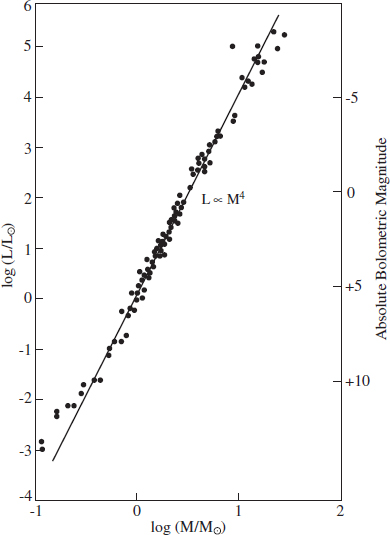
Figure 9.3 Stellar mass-luminosity relation The observed mass-luminosity relation for main-sequence stars of absolute luminosity, L, in units of the solar luminosity, L , and mass, M, in units of the Sun’s mass, M. The straight line corresponds to a luminosity that is proportional to the fourth power of the mass.
Eddington replied that mathematicians often lack the physical insight needed to understand the stars. His practical approach, rooted in observations as well as mathematics, has usually withstood the test of time, and the mass-luminosity relation is now accepted as one of the fundamental results of stellar physics. It plays an important role in our understanding of the internal source of energy that keeps stars shining.
An Inner Light and the Mystical World
Eddington also had a poetic sensibility, quoting, for example, these lines from the English poet Rupert Brooke:
“There are waters blown by changing winds to laughter
And lit by the rich skies, all day. And after,
Frost, with a gesture, stays the waves that dance
And wandering loveliness. He leaves a white
Unbroken glory, a gathered radiance,
A width, a shining peace, under the night.”31
In the same book, he quoted the English poet Arthur O’Shaughnessy:
“We are the music-makers,
And we are the dreamers of dreams,
Wandering by lone sea-breakers,
And sitting by desolate streams;
World losers and world forsakers,
On whom the pale moon gleams:
Yet we are the movers and shakers
Of the world for ever, it seems.”32
Eddington believed in the inner light of human beings, and in a mystical world outside space and time, while also becoming one of the most accomplished stellar astronomers who ever lived. When he died in November 1944, at the age of 62, the great American astronomer Henry Norris Russell wrote: “The death of Sir Arthur Eddington deprives astrophysics of its most distinguished representative.”33
Our text now turns to Russell himself, who was also a devout astronomer committed to faith and science, God and Nature, in his life and work.