
CHAPTER 9
June 30, 1933. A summer night envelops the lagoon at Orbetello where an armada of giant white seaplanes rock gently at their moorings below Monte Argentario. The commander of this famous squadron, Italo Balbo, pedals a bicycle among the spartan quarters of his hundred-strong airmen, reminding them to turn in no later than 10:00 p.m. The months of training for the air voyage to Chicago are soon to be put to the test. The success of earlier air cruises with some of these same men doesn’t lull their commander into a false sense of complacency. He knows that what they are about to do can turn deadly very quickly. Filled with nervous tension, recognizing the weight of responsibility that he is going to bear on his shoulders and his shoulders alone, Balbo can’t sleep. In the early morning hours just before dawn, the airmen are awakened and ferried by launches to their preassigned seaplanes. Each new Savoia-Marchetti S.55 X is powered by two powerful engines*affixed to the top of each monoplane’s wing, above the flight deck—one tractive, the other propulsive—generating 750 horsepower. As all fifty engines of the twenty-five seaplanes fire nearly simultaneously, the noise is deafening. The engines possess the growling, potent quality one associates with Ferraris or Bugattis. At 4:37 a.m. on July 1, Italo Balbo’s lead plane heads out into the lagoon, leaving a silvery wake as it gathers speed, and lifts into the air, headed north toward the Swiss Alps.
Twenty-four seaplanes lift into the sky behind their leader; each carries four airmen (two pilots, a radio operator, and a mechanic). The “air armada” is composed of eight squadrons of three planes each (with a single seaplane in reserve). Each squadron is identified by a star or circle painted a particular color (black, red, white, or green) on the side rudders in the rear of the seaplanes. Balbo’s lead squadron is identified by a black star.1 They gain altitude and fly over northern Italy before ascending even higher as they near the Alps. The stunning majesty of these snow-topped peaks affects all but the most jaded. Even with the engines growling in their ears, the vista speaks to them of something akin to the eternal. Two and a half miles below, Sergei Rachmaninoff is in the midst of composing his “Rhapsody on a Theme from Paganini” in his villa on Lake Lucerne. The strains of his music lift, and lift the listener into someplace, something, rarefied. That morning, Italo Balbo and his men were living what Rachmaninoff was composing. A moment of transcendence? Perhaps . . .
Beginning to drop altitude, the Alps melt away and the course of the Rhine provides a guide northwestward toward the sea. The vineyards of the famous river had begun to produce the grapes that would swell and be made into famous Riesling wine, 1933 vintage. Cologne, with the steeple of its giant Gothic cathedral reaching skyward from another age, was visible to Balbo and his airmen. They were in the heart of Europe. Thus far the cruise had been nearly idyllic, but powerful wind gusts then reminded them of the seriousness of their undertaking. They leave the Rhine to descend toward the Zuider Zee (or what remained of it),* and the first stop on their journey—the city of Rembrandt—Amsterdam.

Italo Balbo’s epic flight to the United States—again with his air armada of flying boats, as in his 1930–1931 journey to Brazil—met with Mussolini’s approval and great interest from the press in both Europe and America. This great fair had sparked something in the world, and by making Lake Michigan his destination, Italy’s foremost aviator gave his imprimatur to the proceedings. He had to go! The technical, logistical, and navigational aspects of the flight were formidable. He and his team of pilots would fly via northern Europe, then Iceland and Canada before reaching the American heartland in Illinois. The loss of life and of aircraft on the preceding mission to Brazil hung over the expedition as it took off from Orbetello on July 1. This time they were flying the upgraded Savoia-Marchetti S.55 X, and instead of twelve seaplanes there were twenty-five aircraft. Soaring above the Alps en route to Amsterdam, the armada was beautiful to behold. Unfortunately, in the Dutch capital, tragedy struck.
As the armada descended onto the Zuider Zee, the seaplane piloted by Mario Baldini, coming in at too steep of an angle, flipped over in a violent accident, injuring the crew. More tragically, the craft’s youthful radioman, Ugo Quintavalle, was trapped in the wreckage and drowned. It cast a pall over all of his former comrades. That could have been them, and they knew it. So much depended on precision. Balbo could not permit this loss to alter his course of action. That evening he met with Hugo Eckener’s “girl Friday,” Lady Grace Drummond-Hay, at the Amstel Hotel for dinner. The intrepid globetrotting journalist of course understood all too well the risks of air travel. As much as exacting training and technological innovation and competency had moved aviation forward, they were still to a large degree making this up as they went. This dissonance is what made this aviation’s golden age. The heroic aspect of Lindbergh, Balbo, Eckener, and the Piccards was that they were aware of this, yet undaunted by it. To make air travel and space exploration “normal” took exceptional people. But Ugo Quintavalle also played a role in this. He was part of something truly special, he knew it, and he lost his life in the endeavor. And there were many Ugo Quintavalles in this era. Those of us living in the twenty-first century, who have the good fortune to take so much for granted in air travel, owe them.
The next day the giant white-painted armada ascended en route to Ireland, then on to the city of Reykjavik in Iceland. The Italians would spend more than a week in this far northern outpost of European civilization. The blonde Norse maidens were a source of endless fascination for Balbo’s airmen. For their commander, planning the optimum moment for their departure occupied most of his waking hours. This was the most perilous part of the journey—a great leap over the forbidding gale-swept North Atlantic to Labrador. The distance—nearly fifteen hundred miles—the notorious fog, and the cold all presented grave challenges. And twenty-four seaplanes* had to be brought across, not just a single plane. The journey across the North Sea from Ireland to Iceland had already provided a preview of what to expect: the armada had been stuck in thick fog, and keeping formation had become a near impossible task. In the early-morning darkness of July 12, Balbo and his men bade farewell to their Icelandic hosts and pointed the noses of their aircraft west toward the New World and fame, with a whole lot of ocean below them and very little margin for error. Balbo biographer Claudio Segrè described the commander’s state of mind as he “fortified himself with coffee and an occasional nip of cognac”:
In contrast to flying over land, flying over water, he fretted, stretched on interminably. The hours, especially the last ones, dragged on like months. With nothing for the eyes to focus on his imagination roamed freely and flying became a nightmare and an obsession. . . . Outside, fog banks varied from light and white to dark and opaque, so dark that he could only see the glow from his instruments.2
Balbo would later remark in an interview that this Arctic fog was “some of the worst weather I have encountered.”3 Climbing above it up into the chillier altitudes of blue sky risked the danger of ice forming on wings. In spite of this, Balbo ordered the armada to take the risk. This was as much (or more so) for the psychological effect on the pilots as it was for the aeronautical effect on the seaplanes. Onward on a southwesterly heading, the forty-eight engines powering the Savoia-Marchettis never once misfired, a testament to Italian engineering and workmanship.4 Italy, the United States, and the world held their collective breath for news of Balbo. Then, at seven o’clock in the evening on July 12, the gleaming white phalanxes of flying boats appeared over Sandwich Bay in Labrador. To be fair, the Italian Air Force had played a supporting role for their airborne comrades by maintaining radio beacons and floating weather stations along the perilous route—but, in the end, it was the skill and discipline of the pilots and airmen that were the crucial factors in the crossing. It was no small achievement in scale. As aviation historian Robert Wohl explained: “To appreciate the magnitude of the Italians’ achievement, one must realize that before their flight, only five aircraft had succeeded in making the North Atlantic crossing from east to west. That number now rose to twenty-nine, twenty-four of them being Italian.”5
Hardy and intrepid members of the world press descended on this remote outpost located on the easternmost shores of the North American continent. Feeding the anticipation in the Windy City, the Chicago American scooped its competition by having photographs of Balbo’s seaplanes afloat at their moorings flown directly to Chicago for publication. The caption beneath the aerial photograph reads, “Safe in American Waters.”6 Labrador was then part of the Dominion of Newfoundland, not yet annexed to the larger Dominion of Canada next door. To be the focal point for so much attention must have been quite a novelty indeed for the local residents. For his part, Italo Balbo first saw to the refueling of his seaplanes before attending to diplomatic niceties. But as he had demonstrated in South America earlier in the decade, Balbo could be a charming and articulate guest, the perfect representative for a regime whose image was normally dominated in the public’s mind by a narcissistic bully frothing with bluster. Balbo showed that modern Italy could at the same time produce an urbane, intelligent man with a winning personality and genuine courage. Yet the black shirts Balbo and his men wore underneath their flight suits were a reminder of the ugly ideology they represented, if not embraced. Balbo’s achievement was fascism’s achievement, and this fact was not lost on more critical observers.
Fighting a storm as they flew southwest, Balbo’s armada entered the Dominion of Canada on the morning of July 13, landing at the port town of Shediac, New Brunswick. Once again, Balbo won the crowd. The Chicago Herald and Examiner had sent correspondent Fred Glasby to Shediac in anticipation of the Italians’ arrival. In his feature story, Glasby commented favorably on Balbo’s linguistic ability, observing him “responding in Italian, English, and French.”7 New Brunswick’s premier was on hand to welcome the aviators, and took the opportunity to “praise Mussolini’s accomplishments in rejuvenating Italy.”8 A congratulatory telegram from German Chancellor Adolf Hitler also caught up with Balbo in Shediac, signed “with admiration.” The next day the aviators were in Montreal, landing on the St Lawrence—ice free in the summer months. The population of this large and predominantly French-speaking city, built on the slopes of a promontory, enthusiastically came out to greet the visitors. And for the first time, an Italian immigrant community—replete with their own local black shirts and Fascist salutes—embraced their hero-brothers from the old country.9 By this time, Balbo had become impatient, his diplomatic skills wearing thin under the strain and general lack of sleep. He understood all along that Chicago was the main objective, the raison d’être for his entire mission. He called off a planned dinner, disappointing local notables to concentrate on what the morrow would bring . . .
The Drake Hotel on Chicago’s Gold Coast was built at the outset of the Jazz Age. When it opened its doors on New Year’s Eve, 1920, it instantly became the premier hotel of the Midwest. As it had in the city as a whole, Prohibition had the effect of stimulating high society’s social scene. This set made the Drake its preserve. In turn the Drake consciously cultivated its public image as an elite institution in the city as embodied in its Latin motto, Aquila non capit muscas.* Even today, one can absorb some of the Zeitgeist of that era in the elegantly appointed Coq d’Or located below the hotel’s lobby level. It was opened in 1933 during the time of the World’s Fair.
As Italo Balbo planned for the 870-mile journey that would have his armada “roar down on their goal, flying over Niagara Falls, skirting Toledo and Cleveland,”10 the Drake prepared for its role as the expedition’s official base of operations in the city of Chicago. The hotel was equipped with the capacity to receive radiograms from various locales on the lookout for Balbo’s seaplanes, as well as Balbo himself. The flurry of these radiograms on the day of Balbo’s arrival, documenting the seaplanes’ movements in detail, first by the hour and then by the minute, vividly demonstrates the near hysteria of anticipatory suspense the city was under. Have they left Montreal? Is the weather going to delay them? When will they get here? The Drake’s staff fed the hysteria being whipped up by the local press (five dailies locked in cutthroat competition). A sampling of these radiograms, now housed in the archives of the Chicago History Museum:
· THE FIRST BALBO PLANES HAVE PASSED PRESCOTT AT 12:33 PM E.D.T. THIS IS ABOUT 120 MILES FROM MONTREAL
· REPORT FROM GENERAL BALBO ADVISING THAT HE PASSED OVER PORTHURON AT 347PM EDT
· AT 457P CST TWELVE OF THE PLANES ARE CIRCLING OVER THE LOOP IN CHICAGO AND THE OTHER TWELVE ARE FLYING OVER THE LAKE IN A NORTHERLY DIRECTION. PERFECT FORMATION11
By the time the final radiograms were received, a crowd had gathered, described as “a seething mass of humanity” by the Chicago American. Within the fairgrounds “a hundred thousand persons were inside”; “Navy Pier was packed by more than 20,000, while all along the shore line from the far South Side other thousands gathered to witness the great spectacle.” It was a “signal to the city to give vent to pent-up emotions.”12 On Saturday, July 15, at about 5:45 p.m. Chicago time, Balbo’s brilliant white seaplanes appeared in the skies over the city. A gorgeous late afternoon on a mid-summer’s day provided an idyllic backdrop for Balbo’s crowning achievement. Adding to the splendor was the giant dirigible airship Macon, on hand to welcome the visitors, and a squadron of nearly forty U.S. army aircraft from Selfridge Field that had escorted the seaplanes after they entered American airspace earlier in the day. As the Italians descended the Americans flew in a formation above, spelling out I-T-A-L-Y for those on the ground to see.13 The message was clear from the U.S. military: Welcome! But we possess potent aviation technology and skillful pilots as well.
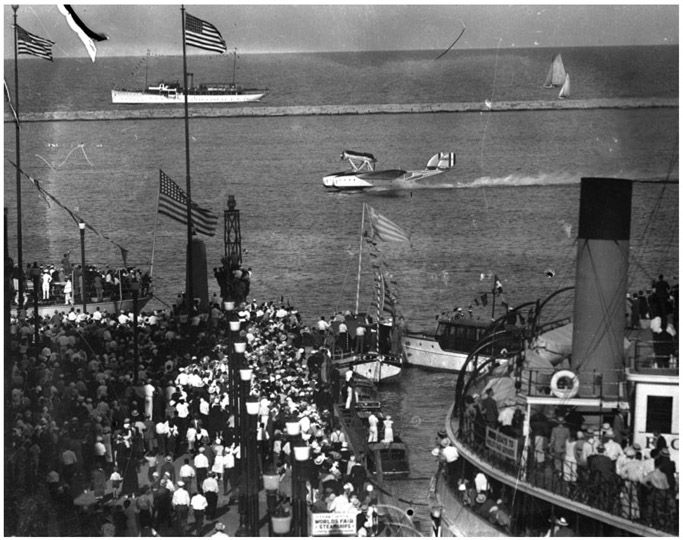
Italo Balbo’s seaplanes land flawlessly on Lake Michigan. Getty Images.
The roar of the engines and the giant propellers caught everyone’s attention. So, too, did the perfect precision with which the formations appeared above the city’s skyscrapers. It was the future coming to call in the Windy City. The enormous, expectant crowds that lined the lakefront were in for a treat. With red, white, and green Italian flags snapping to attention in the lakefront breeze, side by side with red, white, and blue American flags, the twenty-four Savoia Marchettis landed on Lake Michigan in a prearranged order meant to impress observers with the skill and discipline of the Italian pilots. Those who were there that day, whether man, woman, child, American, Italian, Fascist, or anti-Fascist, marveled at just how beautiful a spectacle it was. As Gus Lazzarini, an eyewitness, later recalled, “It moved everybody . . . people had never seen something like that.”14 College student Marie Nardulli was working as an official greeter at the fair and was similarly struck by what she witnessed: “It was noisy, you just had a lot of noise. . . . There was nothing like this, nothing like this. With the planes. I can still hear the roaring of the planes as they were coming through. It was very exciting. Very beautiful.”15
To be fair, there were other observers who saw the foreign formations overhead and felt a certain unease, not unmixed with foreboding. The Herald and Examiner saw the spectacle as a lesson to the United States:
It must have occurred to thousands yesterday to peer into the future. And it may have occurred to them to ponder a few thoughts. Suppose other planes, many more planes, would cross the sea on a mission that would be anything but goodwill. Chicago at least is air-minded now. It must realize the possibility of going from here to there, thousands of miles though the distance must be. And thus, I think, when Balbo set his ship down last evening, he completed the greatest lesson in aerial navigation that history yet records.16
Watching films of these giant seaplanes above Chicago in 1933, with their combined engines creating a very distinctive sound, one almost reflexively expects to hear next the equally distinctive whistle made by bombs descending on their targets. It’s as if we have become conditioned to associating the one sound with the other because of what we know will soon happen in Europe later in this decade. It is an uncanny sensation. Chicagoans, in 1933, weren’t preconditioned to this. Aviation’s “golden age” seemed to offer more hope than dread, a brighter future for humanity. And people wanted to believe—this is important. The thought of another world war—this one involving aircraft as powerful as Balbo’s—was simply too terrible a thought to dwell on. Better to see progress in those gleaming white seaplanes than a threat.
As Balbo emerged from his seaplane with black shirt and flying gear, he exuded a native charm that won over the crowd without even trying. But true to character, he thought first of his men and then their aircraft. There to greet him was Prince Potenziani, Italy’s commissioner to the World’s Fair, aboard the USS Wilmette (the Navy had thoughtfully sent the vessel as a staging point for the Italians to shower and change into their dress uniforms before having to face the crowds). Reporter Robert Wood, sent by the Herald and Examiner to get first impressions of the famous aviator, commented favorably on his first words to the Prince: “Before his first handshake . . . Gen. Italo Balbo wanted to know the latest word of the members of his crew who were injured in the crash of one of their planes in Amsterdam, Holland. ‘How are the comrades we left behind?’ . . . He seemed greatly relieved when told that Capt. Baldini and the enlisted men were recovering from their injuries in Rome.”17 Even before coming aboard the Wilmette, Balbo had waited: “For nearly two hours he stood on the wings of his ship, marked with a single black star, as it rode the waves in the harbor. He watched the maneuvers of

Balbo’s seaplanes flying over the fairgrounds. Courtesy of University of Illinois Chicago Special Collections.
his charges until the last plane cleaved the water with its pontoons. Only then did he leave the ship.”18
Balbo and his pilots were taken by motor launch down the shore to the Century of Progress Fairgrounds where the official reception was waiting for them near the Court of Honor of the Hall of Science. World War I ace Reed Landis had been placed in charge of the reception committee and had bungled the transfer of Balbo’s men from their seaplanes to the Wilmette,19 seemingly overmatched by the day’s events, forced by his own mistakes into having to play catch-up. But he was there near the Court of Honor at the appointed time, and so were a throng of enthusiastic local blackshirts giving Balbo the Fascist salute, which he returned.20 Harry S. New, U.S. commissioner to the World’s Fair, officially welcomed the Italians to Illinois on behalf of President Franklin D. Roosevelt, while Governor Horner and Chicago’s Mayor Kelly gushed over their visitors, with Horner comparing Balbo’s air voyage to that of Columbus in 1492 and Kelly lauding (probably with an eye on the Italian American vote) Italy’s “position in the front rank of the countries of the world, a nation of explorers, builders, scientists”21 and not just gangsters—it was left unsaid, but the implication was clear. Balbo’s speech in response was short and sweet, and carried live via radio back to Rome for Mussolini’s ears:
We have today accomplished the mission entrusted to us by our chief, Mussolini, in landing in the magic city of Chicago . . . I cannot find sufficient words to express the appreciation of myself and my men for this magnificent reception. The purpose of the flight was to bring the greeting of the new Italy to the United States. Viva Chicago! Viva America!22
The crowd went wild in a torrent of mutual adulation. Mussolini back in Rome detected the proper amount of deferential sycophancy. In time he would try to convince his countrymen, and himself, that it was he and not Balbo who had achieved international aeronautical fame in Chicago. Regarding the latter, he seems to have been successful. Balbo and his pilots, meanwhile, piled into waiting convertibles to be taken to a popular reception at adjacent Soldier Field. As the motorcade, escorted by the city’s Black Horse Troop mounted on coal-black chargers fitted with white reins,* carefully snaked its way through the mass of fairgoers, Chicago gave itself up to its new popular hero. The next day’s edition of the Herald and Examiner probably described the Zeitgeist of that moment best: “The city like a gracious hostess, had donned her Summer best and strolled down to her great front yard to greet her guests.”23
Soldier Field had been built in 1924 as the city’s great enclosed open-air space. Its name (adopted in 1925) simply referred to the city’s war dead (many of whom had perished in the recent war in Europe). Meant to hold tens of thousands of spectators and participants in public events, it features a neoclassical design that dominates the lakefront to the present day, with giant Doric columns and a portico with a triangular roof reminiscent of a Greek temple. By 1933, it had hosted millions for football games, political rallies, and cultural events. With the World’s Fair just next door and on Northerly Island, the stadium was a natural complement to its activities. In the event approximately sixty thousand Chicagoans filled the stands to greet their hero,24 none prouder than the city’s many Italian Americans. Balbo addressed the crowd in Italian. His accomplishment was their accomplishment. He was of their blood. Regardless of the blackshirts and Fascist salutes that were evident, Balbo had touched something deeper with his Italian American cousins. Ideology was superficial (as the World War II experience for Italian Americans and Italians would largely bear out), but patrie, in the historical, linguistic, and cultural—if not necessarily political—context was felt on an emotional, instinctive level. As the sun began to go down behind the prairies of eastern Illinois and the floodlights were switched on, Soldier Field provided the setting for the embodiment of this bond. It was a wonderful moment for Italian Americans. The Chicago Tribune reported on the reaction of an Italian immigrant named Phil Gardini of Winnemac Avenue, who earlier in the day had witnessed Balbo’s seaplanes landing on Lake Michigan: “he removed his hat from his graying hair. Tears were near the surface as he looked up and said with awe, ‘Balbo’s in one of those . . . planes.’”25 Not all Italian Americans, however, felt this way. A pamphlet being distributed at this time was signed “Italian Socialist Federation and Italian League for Rights of Man” and highlighted Balbo’s checkered, violent past, even implicating him in the murder and beheading of Giacomo Matteotti:
It is a disgrace that this murderer and terrorist should be received by Democratic America as the official representative of the Italian people. This man no more represents the Italian people than Kaiser Wilhelm represented the German people. There should be no place in this free country for such tyrants. This terrorism continues today and the Italian born American workers protest against this infamy in the name of Matteotti and all our other murdered comrades. WE ask the American people of all races to join us in protesting against the reception given to this murderer.26
Italian Consul General Giuseppe Castruccio countered this in an editorial written for the United Press and published in the Chicago Daily Times the day after Balbo arrived. No doubt the Socialist Federation and the League for the Rights of Man found his views laughable, if not ironic, when he claimed that Italy and the United States “form the cornerstone of protection of weak nations against the strong, the poor against the rich, and for the enforcement of a real and international justice.”27 One wonders if this is what Ethiopians thought Italy was fighting for less than two years later, when Mussolini ordered the invasion of that African nation?
Fortunately for Italo Balbo and his pilots, they did not have to face questions such as these. They left Soldier Field and went directly to the luxurious Drake Hotel where a reception put on by the Dante Alighieri Society awaited them, complete with replica seaplanes made entirely of red and white roses and green moss. To the chagrin of the Society members, who had been patiently waiting all evening, the Italian aviators “lingered only a moment or two, looked at the tea refreshments and joined six of their companions who were enjoying huge steaks in the main dining room.”28 Their commander went straight to his room to change into a fresh uniform, which included dress gloves and a natty walking stick. The Italians were, if nothing else, fashionable. The Tribune’s society editor, India Moffett, contributed a long list of who’s who in early 1930s Chicago in the next morning’s paper, but she singled out the Italian Consul’s wife, Signora Castruccio, “a tall, willowy brunette” who never appeared smarter than she did in the “red, black, and plaid gown she was wearing,” and Mrs. Howard Linn in her “simple, flowing robe of gray, with a red ribbon.”29
It was a late night, and Balbo and his men were running on fumes. In fact, two days earlier Balbo had telegrammed Castruccio from New Brunswick begging for a respite: “I ask you to give me as much peace as possible, For we need rest. Cordial greeting to you in Chicago—Italo Balbo.”30
On the other hand, the huge welcoming crowds, the “Pretty young ‘sub-debs’” asking for autographs,31 the Drake, the glittering representatives of Chicago Society, being in one of the richest, fastest, and most notorious cities in the world, must have kept the Italians going further than their normal constitutions would have allowed. But eventually the desire for sleep, precious sleep, drove them to their rooms where for nine sublime hours they had nothing to distract them except their dreams. For his part, Italo Balbo was comforted by the sight of the many plainclothes policeman outside the hotel, guaranteeing no appearances by intruders wishing him well or ill.32
Sunday, July 16, dawned sunny and bright on the shores of Lake Michigan. After being served breakfast in their rooms by the curious Drake staff, a Herald and Examiner reporter found the aviators on the eighth floor wandering around in “gay pajamas from room to room, asking each other jovially if they wanted to start back on the long return flight at once. ‘we want to see the fair first’ was the usual reply.”33 However, as good Catholics (Mussolini after all had reached an accord with the Pope in 1929), Balbo and his men first attended mass at the Holy Name Cathedral. What Balbo’s thoughts were, as a formerly ardent Republican,* are anyone’s guess. After a quick refresher back at the Drake the men then headed for the fairgrounds—ostensibly their whole reason for being in Chicago—to meet with the fair’s president, Rufus Dawes, and tour the grounds in person. More gushing praise and mutual adulation filled the day’s events—everyone, it seemed, wanted to meet the Italian visitors.
Conspicuous in their uniforms and cossetted by their attendant entourage, the Italians saw the fair from a rather patrician perch. Mussolini did not want them mixing with the plebeian throngs enjoying the Midway. Fascist supermen were supposed to be above such amusements. It couldn’t have been much fun. The welcome accorded to Balbo at the fair’s Italian Pavilion, however, did have its rewards. Two Italian American maidens (one blonde, one brunette) each presented the conquering hero with roses.34
Decades later, historian Cheryl Ganz related the story of one of these young ladies in her book on the fair:
Teresa de Falco, a resident in Chicago’s Italian immigrant neighborhood and a cigarette girl at the Italian Pavilion, was proud to be chosen as one of the young women. . . . She felt it was a beautiful, joyous occasion with all of the pilots in their dress white uniforms participating in parades and festivities. . . . She joined several crew members at one of their banquet tables and toured the city with them by car.35
That evening, the Italian American community put on a spirited reception for Balbo and his men at the imposing Stevens Hotel overlooking Michigan Avenue. As they entered the grand ballroom, many of the approximately five thousand guests gave the Fascist salute and shouted Fascist slogans. The applause lasted fifteen minutes before the cheering died away. The jingoism was replaced by something more honorable when Balbo publicly called the roll of his airmen, with Quintavalle’s name being called first; Balbo’s simple tribute: “I salute him.”36 The speech that followed was less about what he and his men had accomplished, and more about the new Italy that had made it all possible: “I give all credit to Benito Mussolini.”37 This was exactly what his chief wanted to hear—the more cringe-worthy the sycophancy, the better. But as reports of Balbo’s reception in Chicago began to filter back to him in Rome, Mussolini began to grow jealous of his younger protégé. Balbo was outshining him.* And the better Balbo did his job, the more pronounced it became. In this respect he was in an impossible position. No one back home was allowed to outshine Il Duce.

Balbo received at the Italian Pavilion, July 16, 1933. Courtesy of University of Illinois Chicago Special Collections.
The official festivities having concluded, Balbo’s pilots had the opportunity to socialize with the guests in the Stevens’ grand ballroom. Marie Nardulli, selected as a rose-bearing hostess, “danced with four or five of them”; as she later recalled, “they were very nice.”38
Monday, July 17, was the second full day of the Italians’ visit to the Fair. It proved to be probably the most eventful, unscripted, and—for lack of a better word—fun day that Balbo and his men had in the Windy City. For all of the talk of goodwill and international cooperation, there was often an earnest, stilted quality to much of the official interaction between the Italians and the Chicagoans. For Italo Balbo personally, it was the kind of day that most people fantasize about at some point in their lives, but never experience—a day when all the city was yours. And he was good-humored and enthusiastic enough to take advantage of the moment for all that it was worth.
The day began with another reception—this one at city hall—in which Mayor Kelly ceremoniously gave Balbo a golden “key to the city” and officially recognized East Seventh Street as hereafter to be known as “Balbo Avenue.” It still is.* According to Bruce Grant of the Chicago Daily Times, “a woman crashed the police lines and did what every other woman wanted to do—kissed him.”39 From city hall, Balbo was escorted to Grant Park where he paid homage to his countryman, Christopher Columbus. The Italian American community erected a monument to the famous explorer and would affix a plaque to its base explicitly linking Balbo’s air voyage with his predecessor’s sea voyage.† Back to the Drake for a luncheon, then on to the fair where the most startingly original (if somewhat awkward) ceremony Balbo was to take part in took place.
As part of the 1933 World Fair’s “cultural” exhibits, a group of Plains Indians led by Sioux Chief Blackhorn had come to the Windy City to represent Native American culture. By this time the “Cowboys and Indians” genre in popular literature and film had become ubiquitous, even back in Italy. Like most of the exhibits and cultural performances, the Sioux were viewed with a mix of curiosity, admiration, and denigration. The 1933 Fair had progressed to a certain degree beyond the blatantly racist tropes of its predecessor forty years earlier, but there was still plenty of racism evident, of both the academic and the leering varieties. And on the other side of the Atlantic, Hitler was ranting about the inherent superiority of Nordic (white) peoples. Eugenics was all the rage. Thus, the context for Balbo’s famous meeting with Blackhorn is a complicated one. Balbo arrived at the “Indian Village” late in the afternoon, dressed in a gray double-breasted suit, effecting a dapper “man about town” air. Like everyone else at the fair, the Sioux visitors had been very impressed by the landings of Balbo’s seaplanes on Lake Michigan two days before. The leader of such a magnificent mission must truly be a leader of men, one worthy of the title “Chief.” With the press mesmerized by the spectacle unfolding in front of them, Blackhorn, in full tribal regalia, approached the nervous-looking Italian and placed a full Sioux war bonnet on his head, conferring the title “Chief Flying Eagle” on Balbo for all time. What could have been an undignified and circus-like ceremony was saved by Blackhorn’s sincerity and Balbo’s genuine, almost childlike, delight in receiving this honor.40 As serious as Italo Balbo was about aviation, there was still also this “Peter Pan and the lost boys” aspect to his personality that was never more evident than on that afternoon.

Representatives of the Sioux Nation, and Chief Flying Eagle of Fascist Italy (1933). Alamy Images.
That evening, the Congress Hotel was the site of another lavish dinner, followed by a dance at the fashionable Casino Club. For Balbo, the interminable round of receptions, speeches, and dinners had begun to wear thin. He wanted to see the fair—the real life that was going on outside the Drake, the limousines, and the rostrum. Enlisting the aid of fellow pilot Reed Landis, Balbo asked if he could arrange a late-night incognito visit to the Midway for the type of entertainment Mussolini had disparaged. Landis, this time up for the job (unlike his earlier ineffectiveness when Balbo and his men first arrived), discretely put together a small group composed of William C. Boyden, Mrs. Morton Schwartz, Mrs. Harold Strotz, a Mrs. Alexander of New York, a Mrs. Maxwell, and a fifth woman whose identity was never learned.41 What Balbo and his escorts didn’t realize was that they were being trailed by an intrepid Chicago News reporter (unfortunately, one without a camera). First stop, the “Auto scooters” where Balbo and his companions took turns chasing each other around. The next stop was the “African Dodger” dunking booth, where African American sitters could be dropped in the tub with a well-aimed ball at the target (needless to say, there were distinct racist overtones to this whole unfortunate setup); next came the “shooting gallery” where Balbo impressed his American friends by “knocking down seven squirrels.”42 The night ended at the “Manhattan Beer Garden” where the Casino escapees enjoyed a beer and music by the Ernie Young Orchestra. Whether Balbo found his way to see Sally Rand perform in her “Streets of Paris” revue isn’t known.*
The final day of Balbo’s visit was taken up with more receptions and reviews, and a final dance at the Tavern Club, but a seriousness of purpose would have reentered the lives of the Italian airmen as they readied for the long flight to their next destination—New York. Balbo had received an invitation to fly separately from New York to Washington, DC to visit President Roosevelt at the White House (Roosevelt, in fact, would belatedly bestow the Navy’s Distinguished Flying Cross on Balbo for his achievement).43 The city came out for one final expression of adulation as Balbo and his pilots were slowly driven down Michigan Avenue in a farewell parade; Chicagoans stood ten to fifteen deep on either side of the city’s greatest thoroughfare. And then it was over. In New York, Balbo would be received by frenzied crowds of Italian Americans perhaps even larger in number than those that had welcomed him to Chicago. His message was simple: be proud to be Italian! The humiliation of the emigranti was at an end. Fascist Italy was ushering in a new age. That it would be a dark age, though, was clear to few at the time.
A giant rally in Madison Square Garden mixed Italian patriotism with Mussolini’s chauvinism, alternately exciting or alienating New Yorkers depending on their ethnic and political backgrounds. The Garden later would be the site of the “America First” rallies led by Balbo’s fellow aviator, Charles Lindbergh. By then, fascism could no longer claim a peaceful or progressive mantle. One had to make a choice: either to be cowed, to become an accomplice, or to resist.
In the end, Balbo’s arrival at the 1933 Chicago World’s Fair was more than just great entertainment or a propaganda coup for fascism; it was an affirmation of the human spirit and the willingness to push the frontiers of the possible a little further for all of humanity. In this, perhaps no other event captured so assuredly the ethos of the fair itself.
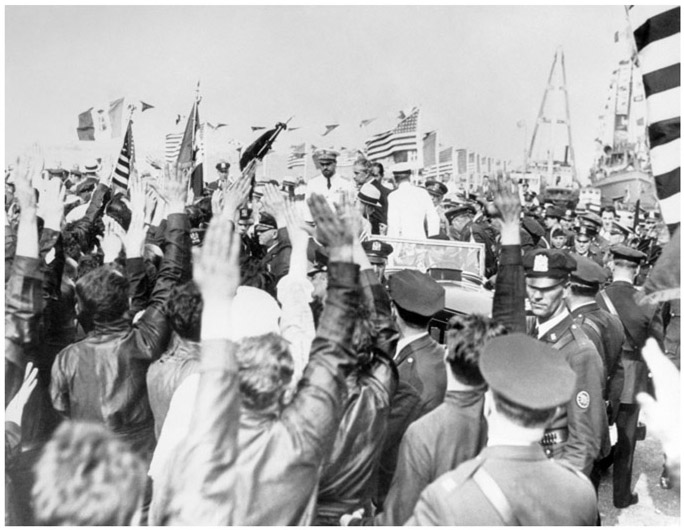
Fascist salute for Italo Balbo (center, in white uniform and cap), New York City (1933). Getty Images.
Once ashore, Balbo’s visit to Chicago took on an almost carnival-like momentum all its own, as everyone who was anyone, and many who were not, vied with each other to heap the most extravagant praise possible on the aviator. With the possible exception of the fictional Ferris Bueller, Chicago has probably never come out so spontaneously and affectionately for any single individual in its history. Parties, speeches, balls, diplomatic fetes, and a rollicking parade down Michigan Avenue awaited the man from Ferrara. For Italian Americans, the pride felt in seeing one of their own taking center stage—not because he was notorious, but because he was skilled, daring, and dignified—generated near-euphoria that was hard to describe. But there were those who recognized that beneath the impressive gloss was a system that bullied, bragged, and glorified war. America later tried to erase the images of Italian Americans giving the fascist salute en masse as Balbo’s motorcade rolled through Chicago, but it happened.
One of the endearing aspects of Balbo’s visit to the fair was his willingness to join in the fun. Perhaps the most unforgettable moment was the ceremony in which the Sioux Nation awarded Balbo a war bonnet and gave him the honorary title, “Chief Flying Eagle.” The Sioux representatives recognized something elemental and powerful in the white flying boats descending from the blue ether and landing so gracefully on Lake Michigan. And the press loved it.
Decades later, Italian aviation historian Gregory Alegi interviewed surviving members of Balbo’s 1933 Air Armada. To a man, they were proud of their aeronautical achievement, but (though they themselves never articulated it explicitly) it came with a curse of sorts. For the rest of their lives there was a certain sense of anticlimax, that nothing they could ever do would surpass the unaffected glory and adulation of those champagne-filled days in Chicago and New York.44
Footnotes
* Isotta-Fraschini Asso 750 engines.
* This inlet of the North Sea had been dammed at its mouth just the year before, and an ambitious land reclamation project had been undertaken.
* After Baldini’s craft had crashed, there was no longer a reserve.
* “The eagle hunts no flies” (i.e., a noble or important person doesn’t deal with insignificant issues).
* The “Black Horse” had no connection to the blackshirts. It was a special unit of the 106th Illinois Cavalry regiment, tasked with escorting visiting dignitaries.
* In the European, Leftist sense of the word.
* Balbo even received an honorary degree from Loyola University Chicago.
* The street runs only a short distance between State Street and the lakefront. But it’s a nice street, with a view of waves gently lapping at the sand where it ends.
† This monument would be removed in 2020 due to its glorification of a man many saw primarily as directly involved in enslaving Native Americans, and indirectly responsible for the eventual genocide of millions.
* In one day, Italo Balbo received a golden key to one of the great cities of America; had a street named after him while he was still living; was made a chief of the mightiest Indian tribe ever to ride the Great Plains; and, anticipating Audrey Hepburn’s “Princess Ann” in the film “Roman Holiday,” escaped his minders for a night on the town, riding an auto scooter with playful abandon—worth pausing to ponder.