
CHAPTER 10
Balbo’s visit thrilled Chicagoans and visitors to the fair from across the country and the world alike. And the expected fall arrival of airship captain, Doctor Hugo Eckener, and his giant zeppelin from Germany generated continued excitement and anticipation. In the spring of 1933, before Air Marshal Balbo’s famous trip to Chicago, German propaganda chief Joseph Goebbels had insisted that he go aloft in the Graf Zeppelin above Rome during its visit to the Eternal City. He understood the powerful propaganda value the giant airship possessed. In Chicago, among the fair’s organizers, this bred no small degree of anxiety. If Hitler’s poisonous ideology was able to attach itself to Eckener’s dream, it could lead to trouble. But the upside, even given the risk, was also considerable. The Graf Zeppelin, then in Brazil on duty as a passenger liner between South America and Europe, was seen by the fair’s organizers as a great prize. If the world’s most famous airship and its equally famous captain came to Chicago, it would add even greater international prestige to the event. Eckener agreed on the condition that a special postage stamp be issued in the United States, sales of which would then be used to help offset the Zeppelin Company’s costs in sending its flag-ship north to Chicago. But now, along with the traditional black, white, and red–striped German flag applied to its stabilizing fins, the airship would also include the swastika: symbol of Nazism.
For Chicago’s Jewish community, Eckener’s visit was fraught with peril. The ugly anti-Semitism loose in Germany would be seen to have official approval of a sort if the Graf Zeppelin came to the city. This generated denunciations and even violent threats. Eckener, for his part, was sensitive to this.* He had little respect for the ravings of Hitler or the thuggery of his followers. But zeppelins had become a symbol of German accomplishment and renewal, and like it or not, Adolf Hitler was now the leader of Germany. As the airship made its way inexorably north, Eckener was forced to confront his beliefs—beliefs that had no place in a country run by bullies, bigots, and psychopaths. His personal prestige was immense. But there was a limit to what Hitler would accept from the most admired German in the world. This was a moment of truth.
Eckener, of course, had previously brought the Graf to Chicago, during the final leg of his circumnavigation of the globe in 1929. Hundreds of thousands of Chicagoans had filled the lakefront and made as much noise as possible in greeting. In a city known for its civic boosterism, it was keen to out–New York, New York. Eckener recalled that “what we experienced in Chicago exceeded all our expectations and fantasies. . . . What the Chicagoans produced in the way of noise-making and other signs of enthusiasm on our appearance probably set a record that can never be beaten.”1 But that was then. Before the 1929 crash, before the Depression, and, most importantly, before Hitler.
Hitler’s rapid accession to absolute power in early 1933 had caught the United States off guard, to a certain degree. But he hadn’t come out of nowhere. Throughout 1932, Americans had been fed a steady diet in their newspapers from foreign correspondents about what was going on in Germany. Hitler and his “Brownshirts” were ugly and threatening, but at the same time clownish and seemingly out of their league politically. This was why the sudden about-face by Germany’s more traditional conservative politicians to invite Hitler into the government was so unexpected. And now with the Reichstag a smoking ruin, and Hitler’s Gestapo arresting political opponents and putting them in the new Dachau concentration camp, people were getting nervous. His rants against Jews added to the anxiety, and began to spark anger in many Americans. Who did this strutting, barking, madman think he was anyway! The mood in Chicago toward Germany had changed. That is not to say that the city’s view of the great zeppelin captain, Hugo Eckener, had changed. But navigating the line between the two increasingly required nuance: a nuance that Hitler and his propaganda chief, Joseph Goebbels (whom Eckener referred to as the “wicked fairy”2) made more and more difficult to employ. To them, Germany and the Nazis were inseparable. One was either with Nazi Germany, or was not with Germany. Very intentionally, they didn’t allow any space between the two. By dint of his well-deserved fame and the genuine esteem that so many millions of people the world over felt for him, Hugo Eckener could not be so easily brought to heel. But he was a German, and intended to remain so. This being the case, the Nazis ultimately held the trump card and, deep down, he must have recognized this on some elemental level.
What would you do if your country was highjacked by a gang of hate-filled racists? Would you leave? Could you leave? Might it not be better to just keep one’s head down and hope for better days? Would you go along to a certain degree when you thought it was in your best interest to do so? If so, to what degree? Where was that line exactly? As enthusiastic as many Germans would come to be about Nazism, as Hitler put the unemployed back to work and forced a renegotiation of Germany’s place in the world by tearing up the Versailles Treaty, it’s important to keep in mind that not all Germans bought into this. But again, what would you do? This was the situation Hugo Eckener found himself in when the idea to bring the Graf Zeppelin to Chicago for the World’s Fair was broached by Karl Eitel, the owner of the city’s elegant Bismarck Hotel, and Henry Vissering, a back-channel contact to the Zeppelin Company. Perhaps recalling the Graf’s rousing reception in 1929, Eckener agreed, and the plan was set in motion that ultimately would force those involved to show their hand, even if it was done obliquely. In this, Eckener’s visit to Chicago could be seen as the first public resistance to Hitler on the world stage (intended or not). Resisting isn’t always as clear-cut and heroic as one might like—it can be awkward, in half-pints instead of full quarts—but it has to start somewhere. And one could make the argument that it started in Chicago.

The plan was to repeat the Graf’s earlier air voyage from Brazil to the United States via the Caribbean, first pioneered in 1930. Hugo Eckener, perhaps on a certain level sensing that this might be the final trip of the old regime—that is, a better time—before the full force of Nazism was brought to bear on Germany and the zeppelin project, seemed to be in fine fettle. Adding to the buoyant mood was the presence of eleven-month-old Billy Munson and his “big” sister (herself a young child).3 Dorothea Momsen of the New York Times was aboard, and reported that over Trinidad, the passengers could clearly see sharks in the aquamarine waters below. Assessing the flight of the zeppelin from Brazil to the Caribbean, she remarked that “the technical conditions are satisfactory” and, furthermore, that the “children aboard are enjoying the trip. Even the baby looks out the window.”4 The airship skirted thunderstorms near Santo Domingo, and arrived in Miami on October 23.5 The swastikas emblazoned on its port (left) side rear stabilizing fins were a glaring propaganda symbol, and magnet for those looking to make a statement opposing Hitler’s policies, particularly those targeting Jews. In the event the Graf was moored at Opa Locka Naval Air Station, a dozen miles from the city center, under heavy security. Interest in the Graf’s return visit to Chicago were stoked by the city’s dailies. Much as they had done three months before on the eve of Italo Balbo’s arrival, the press outdid each other trying to get the inside scoop. In this, the Herald and Examiner had them all beat—hiring the mayor of Miami, E. G. Sewall (riding aboard the Zeppelin as a guest of honor) as its exclusive correspondent.6 Another paper paid to have live radio dispatches relayed to its press room, in flight.
The trip north to Akron, the home of the Goodyear Company which had formed a separate airship unit with the Zeppelin Company in 1923, took thirty-three hours as adverse weather conditions forced a less direct route. Eckener had circled above Akron in a rainstorm waiting until the weather cleared to attempt a landing in the morning. When he was queried by a Goodyear engineer about why he had waited to land, Eckener had gaily replied, “I guess we could have . . . but it would have been impossible to dock the ship. Anyway, the baby [Billy Munson] had a bath up there.”7 This elicited a round of laughter. Eckener had a jovial and witty sense of humor that he could employ to make people feel at ease, yet another asset he could—and often did—employ to further the Zeppelin cause. He wasn’t much with large crowds, but one on one or in smaller groups, his charm was unmistakable. And he enjoyed life. He couldn’t have been more different than the “new” Germans rising to prominence under the Third Reich—a largely humorless lot whose insufferable arrogance and boorish insistence on carrying their point could spoil anyone’s mood and test anyone’s patience.
Eckener had already had an unpleasant experience with these “new” Germans in Brazil. It seemed that Nazi sycophants living abroad tried even harder than their like-minded cousins back home to press their views on those who disagreed with them. Later he would address, head on, what he termed the “tensions and divisions” that the local Nazis had caused within “the German colony in Rio,” winning the gratitude of “distinguished Germans who had suffered from the terror of the local organization.”8 Thus, Hugo Eckener was under no illusions about the atmosphere that awaited him in Chicago. He’d already experienced it.
In Chicago itself, the city’s large and influential German American community had been given control of the fair’s German exhibition by the
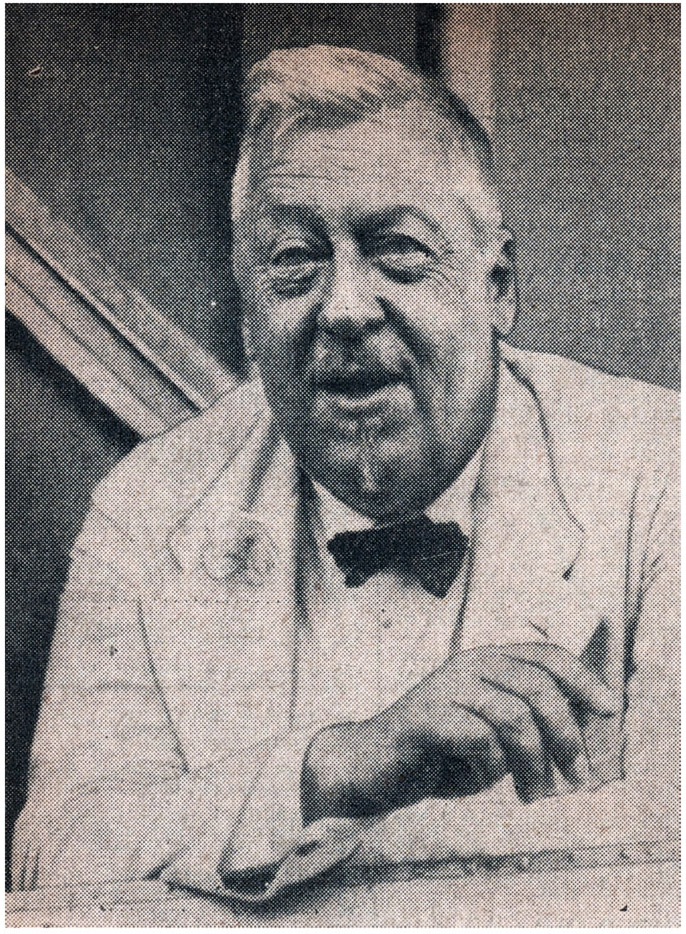
A dapper Hugo Eckener greets the public in Miami en route to the Chicago World’s Fair (1933). Courtesy of University of Illinois Chicago Special Collections.
organizers, and it had made a decision to very deliberately exclude any reference to Hitler or the Nazi regime. The swastika would not be permitted to fly over a Century of Progress. As historian Cheryl Ganz pointed out, “The German Americans viewed the fair as an opportunity to showcase German music, art, and culture as well as contributions of Germans and German Americans to the development of the United States”9 (i.e., not Hitler). It is important to keep in mind that Chicagoans of German ancestry made up approximately one-quarter of the Windy City’s population in 1933. Some Chicago historians estimate that the figure might have even been higher, but the anti-German persecution of the World War I era had convinced many German Americans to “pass” into the larger English-speaking Anglo-Saxon population. The roots of this German migration lay in the nineteenth century. These were troubled times in the German-speaking world; a time of revolution, counterrevolution, and economic upheaval. The United States offered a fresh start for those willing to put their shoulder to the wheel and make a new life in a capitalist democracy. Some Germans brought radical left-wing politics with them from the old country, most famously the leader of the “Chicago 8,” August Spies. But by and large, German Americans were thrifty, hardworking, and law abiding. They prospered, not only in Chicago, but in many other Midwestern cities (Cincinnati, Milwaukee, St. Louis). The ugly blip of World War I–era xenophobia and anti-German hysteria aside, the German American experience had largely been a successful one. German Americans were, in fact, the “model minority” of that period.
For German Chicagoans, the philosophical, scientific, and creative heritage of Kant, Hegel, Goethe, Schiller, Beethoven, Humboldt, Brahms, and Wagner represented their culture—not the Brownshirts. But the anti-Semitism of “new” Germans had antecedents in old Germans; most famously with the great composer of the Ring Cycle, Richard Wagner. Hitler, in fact, loved Wagner’s music, and saw his own rise and eventual fall as some sort of fulfilment of a Wagnerian destiny. For their part, Jewish Chicagoans were keenly aware of the fragility of the successful place they had carved out for themselves in the city. Like German immigrants, Jewish immigrants from the old country (primarily emigrating from the Russian and Habsburg Empires) and their descendants had thrived in America, rising to prominence in the arts, finance, and science. Yet the incurable disease of European anti-Semitism seemed to have crossed the Atlantic and expressed itself in coded admissions quotas to elite universities and “gentleman’s agreements” to exclude Jews from country clubs and America’s “old boy” network of white, Anglo-Saxon Protestant privilege. No group in Chicago had as much at stake in resisting the attempts by Nazis, and Nazi sympathizers, to make inroads at the fair. And no group more forcefully resisted the attempts by Nazis, and Nazi sympathizers, to highjack the World’s Fair, than Chicago’s Jewish population. Most prominent among these was the Chicago Women’s Aid, an organization that had long-standing roots in the city and whose concerns could not be easily brushed aside. According to historian Willian Toll, Chicago Women’s Aid was initially founded “to visit the Jewish sick” but then expanded to raising money “to bring Jewish nurses to Chicago.” Additionally, as “genteel American women, they formed study circles to discuss literature.”10 They threatened to withdraw from the fair’s Women’s Day, scheduled to be held just a few days after the Graf Zeppelin visited the city, if the swastika were permitted to be flown at the fairgrounds. To be sure, Marie Becker of the German American Hostess Society showed solidarity with the Chicago Women’s Aid and assured her Jewish sisters that Hitler’s hated banner would not fly at any event or installation associated with the city’s German American population.11 And good as her word, the swastika was not welcome at the fair’s German American Building. This was the only pavilion featuring German culture and themes because in the leadup to the 1933 Fair, Germany’s Weimar government felt it lacked the funds needed to put on a worthy exhibit. The Depression had forced them to prioritize spending on more immediate concerns. The Nazis simply came to power too late to put their own stamp on the 1933 Chicago Fair. But they tried.
Inside Chicago, and elsewhere in the United States with sizeable German communities, the Nazis had created a layer of organizations and activities as pro-Nazi alternatives to more established groups and institutions. These tended to have special appeal to more recent arrivals from the Fatherland and, importantly, on the young. Hitler’s unrestrained, tactless bullying excited immature minds. One of these organizations was the Friends of New Germany, whose members snatched the traditional German flag at a dedication ceremony held at the German American Building and replaced it with the swastika banner. Police were called, and the “Friends” were forced to back down, but . . . like it or not, the Nazis were now firmly in power back in Berlin. This emboldened those bent on further provocative acts. Joseph Goebbels’s propaganda machine ultimately shipped a Nazi-inspired alternate German exhibit to Chicago after the fair had already begun, but the fair’s Organizing Committee rejected its inclusion. Jewish Chicagoans had made absolutely clear how they felt. Organizing a mass rally of fifty thousand concerned citizens in Grant Park on May 10, two weeks before the fair opened, speakers and participants demanded that Goebbels not be permitted to come to the city as Germany’s official representative.12 Their message was heard:
In the ranks of the marchers were men and women who had come from every European land. Children and gray bearded men marched side by side. All professions were represented. The mass meeting was held in the plaza at Grant Park. Jewish members of the various posts of the American Legion marched in the lead behind a band. . . . Jacob Spiegel, the organizer of the protest movement and editor of the Jewish Daily Forward, was the first speaker. He called upon the Jewish people and all citizens of the city to unite against the appointment of Herr Goebbels as Germany’s representative here. . . . He declared that Chancellor Hitler’s persecution of Jews was a manifestation of militarism and a prelude to war. Of the burning of books by German authors he said that while books might be destroyed their ideals could never be seared out of Jewish minds. . . . Morris Siskind, labor editor of The Daily Forward, denounced the burning of Jewish books. “Hitler turned back history about 400 years in his burning of books of German Jews. . . . It is just like what happened when Catholics burned the books of heretics. Hitler should be destroyed.”13

The original caption in the Chicago Herald and Examiner reads, “Jews Protest Hitler Regime. A general view of the parade of Chicago Jews who marched yesterday from Ashland Blvd. and Roosevelt Road to Grant Park at Congress St., where they held a mass meeting” (May 10, 1933). Courtesy of United States Holocaust Memorial Museum.
It is perhaps worth pausing and considering whether Hugo Eckener himself was anti-Semitic. He did grow up in a society that was anti-Semitic, though not yet of the murderous variety that the Nazis embraced. On the other hand, he was very cosmopolitan. Eckener maintained professional, not to say social, relationships with a number of prominent Jews, including the renowned economist Edgar Salin,14 airship designer Karl Arnstein, and society reporter Bella From, who referred to him affectionately as her “good old gruff, upright, dry-witty bear.”15 Perhaps no other project embodied Eckener’s cosmopolitanism more than the international radio broadcasts he endorsed. Chicago’s German-language daily, the Abendpost, reported on this ambitious new concept in 1932:
The idea of organizing an International Radio Forum for the purpose of international understanding and exchange of ideas was put into practice only a few weeks ago. This ingenious application of modern technique was first made in Paris, where a Trans-Atlantic transmitting service was organized. The idea has now gained a strong foothold in Germany. . . . The International Radio Forum, of which Committees already have been formed in France and America, and which now also will be extended into other countries, is not built either on a political or a business basis, but is intended only to serve as a means of fostering mutual understanding among nations.16
A list of prominent supporters of the International Radio Forum appears in the article with Hugo Eckener’s name right next to that of Albert Einstein (one of the most famous people in the world in 1932, and also a Jew). The far right-wing German daily Völkischer Beobachtner perhaps put it the most succinctly, but derisively when it referred to Eckener as “the friend of the Jews.”17 This wasn’t intended as a compliment.
Thus, as Hugo Eckener prepared to lift off from Goodyear’s base of operations in Akron, he was headed into a potential storm as rough in its own way as any of those he’d encountered from the Arctic to the tropics. People were fired up—and justifiably so. And there was no way for him to skirt the issue. To put it bluntly: the great achievement of his life (the Graf Zeppelin) had not one, but two, twenty-foot-tall swastikas emblazoned on it. There was no way to avoid it. En route to Chicago by train that very evening from Washington, DC, was Hitler’s lickspittle ambassador to the United States, Hans Luther, and his staff. He was there to make sure that everyone (or at least everyone he could control) toed the official line from Berlin. He also could rely on those Chicagoans of German ancestry who had become intoxicated by Hitler’s nationalist agenda. On the other hand, anti-Nazi/German sentiment was running high in certain quarters and producing results, as evidenced by the spread of a citizens’ movement to boycott German-made goods. Both sides eagerly anticipated the Graf Zeppelin’s arrival and were no doubt interested to see which way Eckener would lean.
On October 26, with approximately two weeks remaining in the fair’s 1933 season, the Graf Zeppelin appeared over Lake Michigan, dwarfing the Goodyear blimp and reminding fairgoers why the great airships inspired such awe.* The famous airship had left Akron late in the evening in order to arrive in Chicago at dawn. This was three hours earlier than the announced arrival time—a cleverly employed bit of misinformation to throw off the timing of any would-be agitators.18 But Chicagoans were rising for work on a weekday, and as word would spread of the giant silver airship coming out of the lake as if from another world, eyes would turn skyward. According to an eyewitness account, Hugo Eckener anticipated this, and instead of turning to starboard and taking the most direct route north along the lakeshore to Curtiss-Reynolds Field, he continued in a wide northwesterly arc around—rather than straight over—the waking city.19 Why do this?
One of those on the flight deck of the Graf Zeppelin that morning was Willy von Meister, the Zeppelin Company’s U.S. representative. He asked the same question, “Why?” In interviews given many years later, he recalled Hugo Eckener’s response: “And let my friends in Chicago see the swastikas?”20 Ashamed of his country’s new masters, Eckener had chosen to resist by diversion. His wide, looping route to Curtiss-Reynolds ensured that in the most populous part of the city, anyone looking up at the Graf that morning would have seen either its starboard (right) side, or its belly—not the port (left) side sporting the giant swastikas. The only emblem people would have seen was the traditional black, white, and red German flag. This maneuver by Eckener was a preview of what was to come the rest of that day. Hugo Eckener spoke without saying anything. Or did he? Reporter Robert Wood, covering the story for the Chicago Herald and Examiner, wrote: “The dark shadow of the Graf first appeared out of the fog and smoke of South Chicago at 6 a.m. It followed the shore line to the Loop and swung north-westward to Glenview Airport [Curtiss-Reynolds Field].”21
Wood’s report seems to indicate a more direct route along the lakeshore, in which case the giant swastikas on the Zeppelin’s port side would have been very visible to early risers in the city. However, his remark about a swing “northwestward” would seem to indicate there was something to von Meister’s story. The Chicago News reported that the Graf appeared “before 6, coming through a stiff breeze to the air field” and that later it “pointed its nose east into a stiff wind.”22 If this was indeed the case, it would indicate that the Graf approached Curtiss-Reynolds Field from the west, not the south—again, adding further circumstantial evidence to von Meister’s later remarks. On the other hand, the weather report for October 26, 1933, in the Chicago Tribune predicted wind direction as coming from the south that day.23 Francis Healy of the Chicago Daily Times reported that the Graf came “out of the southeastern sky . . . passed over its landing field, and swung around into the south wind.”24 In the final analysis, it’s not definitive which route Eckener took that morning from Lake Michigan to Curtiss-Reynolds Field.* It partly comes down to wind direction, timing, and which eyewitness one chooses to believe. Willy von Meister was a long-time admirer and ally of Hugo Eckener, and therefore his objectivity has been questioned. But the story he told has a ring of authenticity to it—not just because he was there, but because it’s just the sort of stunt that Hugo Eckener would have pulled to show up the Nazis.† October 1933 would be the last time he would be fully a “free agent” on the world stage. From this point on, Eckener would gradually become more and more compromised, by events and by his own decisions. But that morning he was still very much his own man.
The Chicago press failed to grasp the significance of Eckener’s gesture (if it indeed occurred), instead focusing on the atmospherics of the Zeppelin’s arrival—which seemed to never fail to captivate. Francis Healy, on the story that morning for the Chicago Daily Times, wrote: “Out of the red, cloud-flecked sky at dawn today the Graf Zeppelin. Germany’s biggest dirigible which has flown 473,000 miles, came to Chicago.”25 Not to be outdone, the Chicago News had a stringer there as well: “Germany’s leviathan of the air, the Graf Zeppelin, paid a visit . . . to Chicago today. . . . Coming out of the gray dawn the big ship settled at Curtiss-Reynolds airport at 6:55 this morning.”26 The emphasis was on the fact that Hugo Eckener would remain behind. The Graf would ascend back into the skies that morning to fly over the fair and the lake, and then on back to Akron. Ernst Lehmann, who had become Eckener’s chief subordinate in piloting the Zeppelin, was given the responsibility to complete the mission. By reputation, Lehmann was a highly competent airship pilot with a bit of a daredevil streak. Later, he became a willing tool of Joseph Goebbels’s propaganda. The extent of his commitment to the Nazi cause in 1933 isn’t altogether clear—but he was certainly an opportunist. According to the Herald and Examiner and the News, Eckener had brought the Graf down with its nose facing to the east/southeast.27 When Lehmann ascended skyward, then, the logical route to take would be southeast to the lakefront and then south over the fairgrounds, before coming about and making another pass traveling north before heading east back over the lake toward Ohio. Thus, the Graf’s starboard (right) side with fins featuring the traditional German flag would be visible to the fairgoers below—not the swastika. Whether Lehmann, given his later proclivities, would have been a knowing accomplice in such a plan is highly unlikely. But Eckener’s positioning of the airship would have made any conspiracy largely unnecessary. As for Lehmann, to select any other route would have been illogical given where they were (Curtiss-Reynolds Field) and where he was going. Fortunately, the Chicago News had sent an intrepid photographer named Robert Stiewe to snap aerial shots from beside and above the Graf.28 The photograph below provides conclusive proof that the Graf’s flight path over the fair kept its offensive swastikas facing the lake. It stands to reason that when it came about, the swastikas would still have not been visible to those below attending the fair. Again, whether Lehmann was conscious of this is largely a moot point—but perhaps Hugo Eckener was. For those perceptive enough, this might be a message as to where his true feelings lay.
As the Graf flew to the lakefront to thrill fairgoers, Hugo Eckener began one of the most eventful days of his life. First to emerge from the zeppelin after it touched down, sporting a heavy brown overcoat and a white cap, he was greeted by a crowd of well-wishers, reporters, and official dignitaries. Security was tight. To ensure order, a detachment of soldiers from nearby Camp Whistler were joined by Chicago police and sheriff’s deputies in a show of force. Eckener was accustomed to this type of reception (though perhaps not the level of security), as he was famous in an age that invented celebrity. Cameramen crowded around the famed airship captain, bulbs flashing crisply in the autumn air. Playfully, Eckener said, “Just one more?” knowing full well they’d be on his tail for the next twenty-four hours. To the assembled throng, he said exactly what Chicagoans wanted to hear: “What a welcome. Compared to New York it is like a dollar to a penny. Eh, what?”29 He had previously demonstrated a willingness to disappoint the press and public in any number of cities, but not Chicago. Not today. He was banking on his personal popularity to keep Chicagoans on the side of the zeppelin project; to not let goose-stepping morons sour them on his dream.

Photograph taken of the Graf Zeppelin by Robert Stiewe (October 26, 1933). To the left is one of the Sky Ride’s giant towers and the “lagoon.” To the right is Lake Michigan. At top right is the Adler Planetarium, which still stands. Note the swastika on the upper stabilizing fin of the Zeppelin, visible from the lake but not the fairgrounds. Courtesy of University of Illinois Chicago Special Collections.
Stepping into a waiting motor car, Eckener joined the Hamburg-American Line’s representative, the German Consul, and Karl Eitel, owner of the elegant Bismarck Hotel located adjacent to the Loop in downtown Chicago. Mayor Kelly, who had given Italo Balbo a “key to the city” just a few months before, bestowed the same honor on Eckener. The two hit it off immediately:
“You talk like an Irishman” said the mayor. “Maybe it’s because of the Irish whisky,” replied Dr. Eckener, and both laughed. The Ger-

The Graf Zeppelin’s route over and around Chicago and the fairgrounds on the morning of October 26, 1933, according to Willy von Meister’s account, and according to other contemporary accounts which place the route to Curtiss-Reynolds Field north along the lakeshore, which would have led to a very visible display of the Nazi swastika. Illustration by Midori Tuzuki.
man consul put his arm around Eckener and told him that during his last visit to Chicago with the Graf in 1929, a baby was born and they called it Hugo after him. “I’m afraid I wouldn’t recognize the baby,” roared the commander. “That reminds me of a story. Stop me doctor, if you’ve heard this one before,” said Mayor Kelly. He told the commander a joke which ladies might object to—but there were no ladies.30
Eckener was a wine-drinking German,* but if he was already imbibing early in the day—and Jameson’s, no less—it is a window into his state of mind. Take the edge off, enjoy the moment, stay loose.
A noon luncheon with German Ambassador Hans Luther must have been a trying experience. Luther had been a respected member of the Weimar government who had then thrown in his lot with the Nazis, lock, stock, and barrel. What’s worse: spending the day with a fanatic, or a Judas? Next came a formal visit to the fair, and a face-to-face meeting with the dapper Rufus Dawes. The two hit it off immediately. Dawes had received plenty of forewarning about the potential hornets’ nest Eckener might be stepping into; as in a memo written by the fair’s protocol officer, Grant Smith, to Dawes two months before, it was clear that there was genuine concern:
Dr. Yaeger, Acting German consul here in Chicago . . . stated that since this air-ship flew under the auspices of the German government, it would fly the flags of the German government including the Nazi flag and the Swastika, and asked for my comments upon this situation, realizing the protest that would be raised by Jewish citizens. I said to him in a visit of this kind that the State Department would answer any inquiries as to the proprieties of such a matter.31
But in the event, the public clearly differentiated between Eckener and Luther. At first, Eckener noticed a greatly diminished reaction from the large crowd that had gathered. But he soon realized that the frosty reception was reserved for Hans Luther and not for himself. As his name was announced and he appeared before the crowd, enthusiastic fairgoers cheered and waved their arms. They had made a distinction between Hitler’s lackey and a great visionary.32 One spouted arrogance and hate; the other quietly embodied cooperation and technological skill. The contrast was absolutely striking.
In the evening, a gala dinner was held at the Union League Club in Chicago. This was a bastion of the city’s WASP old guard. Hans Luther, tone-deaf to the political atmosphere in the room, went on a nationalistic tirade in his prepared address, and much of the crowd remained stonily silent. The fair’s chief, Rufus Dawes, invited to the dinner by club vice president Carl Latham,33 leaned over to Eckener and remarked “If you were not here, they would have booed the speaker.”34 The doctor was embarrassed by his countryman’s rant, but he maintained his reserved outward demeanor.
Despite a toast by Carl Latham in which (perhaps anticipating the “America Firsters” to come) he made a “plea for a friendly approach to mutual problems”35 at a table draped with the stars and stripes and the swastika, the six-hundred-strong crowd fidgeted uncomfortably. When the “Star-Spangled Banner” was played, those in attendance sang with added emphasis on the closing line, “the land of the free.”36 The Chicago Tribune put it rather diplomatically, assessing the German Ambassador’s performance: “Delicate as some of these subjects might appear to be, Dr. Luther seemed to be following the Nazi formula of leaving no doubt as to where Herr Hitler stood.”37
Tactless, tone-deaf, insistent, and above all humorless, Hans Luther attacked the “Jewish” boycott, the League of Nations, and basically any criticism of the Nazis or their leader, Adolf Hitler.38 Rufus Dawes, asked to make a toast of his own, raised his glass to Hugo Eckener:
The weather beaten commander of the Graf smiled quizzically when Mr. Dawes paid tribute to his inventive genius and his courage, and thanked the audience haltingly when all arose in tribute to his character. He [Eckener] made no reference to political questions or the glories of Nazi-ism in his brief remarks.39
To say the dinner was awkward is an understatement. But it was the final event of the evening in front of a primarily German American crowd that would prove to be the climax of an increasingly tense visit.
The Medinah Temple was chosen as the site for a reception for the famed zeppelin commander, to be given by the city’s pro-Nazi German American organizations. According to the New York Times, only six of Chicago’s approximately five hundred German American societies chose to attend.40 As Luther and Eckener entered the hall, 150 German youths stood and saluted them with right arm outstretched, palm down, in emulation of their Fascist counterparts in the Fatherland. Luther enthusiastically returned their salute in the same manner. But Eckener, walking with a deliberate step, offered no salute in response to this highly charged gesture.41 He refused to be a part of this. Many in the large crowd kept their arms down too. Eckener’s seeming ambivalence was keenly noted by the Nazis in attendance, most importantly by Fritz Gissibi, “the right hand man of Heinz Spanknoebel of New York, reputed chief Nazi propagandist in the United States.”* The rally (because that’s what it was) took on an air of ill-concealed menace.42 This was real frothing-at-the-mouth fare. The pressure on Hugo Eckener, combined with the personal distaste he must have felt, made for a trying evening.
Decades later, historian Cheryl Ganz interviewed a Jewish American named Theodore Light, who as an enthusiastic young stamp collector had crashed the party at the Medinah Temple that night with a friend. He was hoping that he could get Hugo Eckener’s autograph on some letters that he had mailed to himself with the special Graf Zeppelin stamp. Light recalled to Ganz how they found “the ushers all in storm trooper uniforms and across the stage was the biggest flag I have ever seen and it was the swastika.”43 They were truly pilgrims in an unholy land. Thinking better of the idea, Light told his friend, “Let’s forget about autographs and get out of here.”44
For his part, when he could slip away, Eckener returned to his room at the Bismarck Hotel and a well-deserved night’s rest after the night flight from Akron and the long day in the Windy City. He had done the best he could to win the sympathy of the Americans—people he admired—for the zeppelin project. But there is no way he couldn’t have realized how far things had drifted in an antagonistic direction since those heady days of 1929. There were important exceptions (particularly among the German American Bund crowd), but generally Americans didn’t like Nazis, and there was no altering this fact, especially when their supporters and apologists in the United States behaved so boorishly. It was an uphill struggle, and it wouldn’t get any easier as the decade progressed. Eckener sent a personal note to President Franklin D. Roosevelt speaking glowingly of the “friendly shores of America” and “the friendly reception and enthusiastic interest” of the American people,45 but the times were changing.
Eckener took back command of the Graf in Akron, and set a course across the Atlantic for Seville, Spain; then home to Friedrichshafen on Lake Constance. But home wasn’t home in the way it had been before. Most of Chicago’s German American community applauded him for his behavior in their city. But back in Germany, the mood was different. His lack of enthusiasm in Chicago was noted. Hugo Eckener’s days as the undisputed leader of the Zeppelin Company were coming to an end. His new masters would continue to try to woo him to their cause, but his cooperation was elusive. Ultimately, his name would not be allowed to appear in print in his home country. Hitler was the most famous man in Germany now.
Eckener’s appearance in Chicago marked the end of an epoch. The dream of Zeppelin flight as a peaceful, world-unifying enterprise was now compromised. The giant silver airships were co-opted by a cruel regime bent on world domination and racial hierarchy. People watching these beautiful examples of aviation technology now saw the obscene swastika, not their majesty. Triumphalism was in the air after Chicago. Its consequences would be enormous.
Meanwhile back in Chicago, as Eckener exited the stage the fair welcomed its next “A list” star, the internationally renowned violinist Jascha Heifetz. It was fitting that one of the most famous Jews in the world stole the spotlight from the Nazi instigators who had tried to highjack Eckener’s visit. Heifetz’s talent was legendary. Few have ever brought forth such depth of feeling from the instrument as he did. He was also a humanitarian, one who saw the worth in all people. And he never took a performance off; whether playing his Stradivarius for a packed house of glitterati or for an audience of one—as he famously did later on, on a rainy day during a tour of the western front in World War II46—he gave his all.
Born in Russia, Heifetz began his career at the Imperial Conservatory in St. Petersburg but fled in 1917 during the revolution and came to America. The one-time “boy genius,” as the Chicago American described him, had become “one of the three or four top box-office musicians in the world.”47 Heifetz claimed he had nothing to say about politics, but earlier in the year he canceled a scheduled forty-five-date tour of Germany. The message was clear enough. Rufus Dawes personally welcomed him to the fair. But Heifetz wasn’t particularly interested in formalities, preferring to view a new exbibit of paintings at the nearby Art Institute of Chicago. But he was a celebrity, “impeccably tailored . . . with his eyebrow-brush mustache . . . and his body guard-accompanists.”48 Heifetz could not move in the city in relative anonymity. He was one of the great musical stars of his day.
For Jewish Chicagoans, Heifetz’s appearance at the fair provided a significant boost to both their civic and ethnic pride. What was happening in Germany could not be ignored—this was clear enough. But they had held the line in their city against further inroads by the Nazis and their sympathizers. Goebbels had failed in his attempt to use the World’s Fair as a platform to spread his poison. The beautiful strains from Heifetz’s Stradivarius had the last word in Chicago, at least that fall.
Footnotes
* Eckener, for instance, maintained a cordial professional relationship with the renowned Jewish economist, Edgar Salin (Eckener was, of course, himself a former economist).
* In fact, the U.S. Navy airship Macon, which was even larger than the Graf, had flown over the fair earlier in 1933.
* Though Chicago could boast five English-language dailies in October 1933, they didn’t always agree on details. For example, in the coverage of Eckener’s stay in the city, one daily had him departing that evening for Goodyear’s headquarters in Akron, by train; another had him departing by train the following morning, while a third had him catching a United Airlines flight to Akron the following morning. This provides a degree of insight into why the Graf’s flight path in the early morning of October 26, 1933, can be characterized as not definitive.
† Hugo’s grandson, Uwe Eckener, responding to a question from the author, pointed out that his grandfather had personally told him that he also had made this type of maneuver over other cities in 1933, for the same purpose.
* He also enjoyed cigars, preferring Brazilian cheroots.
* Gissibi would later serve as a high-ranking SS officer in Nazi-occupied Poland. See Jeff Nichols, “In 1939 Nazis Rallied in Chicago to Make Germany Great Again,” Daily Reader, March 11, 2016.