
Chapter 9

Master Gotama, I have heard … that once upon a time this world was in truth so crowded with people—one might think it to be the Waveless Depth—that villages, suburbs, and royal cities were close enough for a cock to walk from one to another. Pray, Master Gotama, what is the reason, what is the cause of the apparent loss and decrease of human beings? How is it that villages are not villages, suburbs no longer suburbs, towns no longer towns, and the districts are depopulated?
—Anguttara Nikāya
The interconnected processes of urbanization, commodification of the frontier, and agricultural expansion together form the standard explanatory model of the Dharma’s success across Asia.1 Scholars have documented the dynamics of this combined urbanization and commercialization from northwest India to Sri Lanka and from Indonesia to China.2 And such growth was so pronounced during the Six Dynasties period (220–589 CE), for example, that by the sixth century Jiankang (today’s Nanjing) had a population well over a million. It was the world’s most populous city with a resident population of twenty thousand to forty thousand monks and seven hundred Buddhist temples.3 Such a large urban population demanded not only an unprecedented expansion of the agricultural base but also an expansion of the network of Buddhist traders who procured and transported the commodities that made the city function.
Urbanism figures prominently in the Dharma. In fact, Buddhist scripture may be the most urban-oriented of all religious literatures.4 Of the 4,257 teaching locales mentioned in the early Buddhist canon, nearly all (96 percent) are in urban settings. And of the nearly 1,400 people mentioned in these texts, most (94 percent) are identified as residing in cities.5 Buddhism also notably lacks a vision of a preurban idyllic past, like the Garden of Eden, and the early Dharma never condemns urban life as in the biblical story of Sodom and Gomorrah. Rather, as this chapter’s epigraph attests, the idyllic past is characterized by dense urbanization. And as the Buddha’s well-known prophecy in the Cakkavatti-sihanada Sutta makes clear, the Dharma aspires toward an urbanized future:
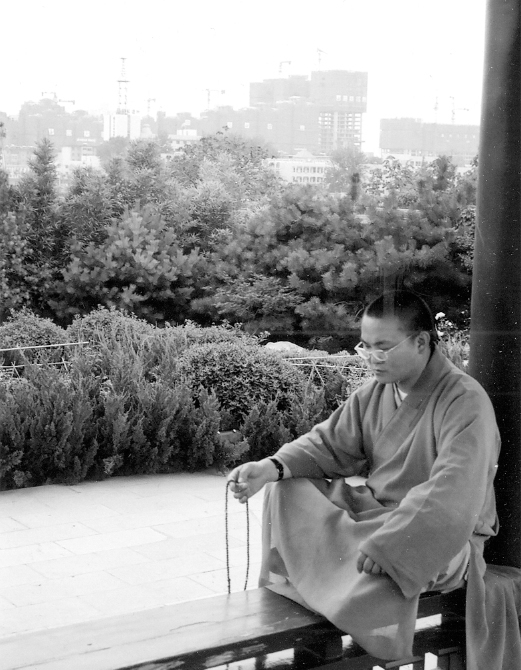
Figure 18. Monk at Big Goose Pagoda amid urban growth (Xi’an, China, 2005).
Photo by author.
Among the people with an eighty thousand-year life-span, girls will become marriageable at five hundred. And such people will know only three kinds of disease: greed, fasting, and old age. And in the time of those people this continent of Jambudīpa will be powerful and prosperous, and villages, towns and cities will be but a cock’s flight one from the next. This Jambudīpa, like Avīci, will be as thick with people as the jungle is thick with reeds and rushes. At that time the Vārāṇasi of today will be a royal city called Ketumatī, powerful and prosperous, crowded with people and well-supplied. In Jambudīpa there will be eighty-four thousand cities headed by Ketumatī as the royal capital.6
For many today, such a vision will seem dystopian, but the opposite was true for early Buddhists. The ideal worlds they envisioned, such as the paradise of Sukhavati, were highly unnatural, lacking even nonhuman animals. They were “without mountains, with quadrangular ponds, crowded with people (all looking alike), and containing trees and flowers that are not living plants, but, like the soil, made of jewels (so that they do not whither, die and decay). Hence these paradises (which seem to have parallels in medieval European thought) are clearly in accordance with the attitude glorifying civilization.”7 Thus, as I showed in Chapter 5, quite contrary to the presumptions of eco-Buddhism, the Dharma did not promote a romantic or idealized view of nature, or ecological sensitivity. Rather, the thrust of Buddhist literature was to advocate for human control and manipulation of the natural world, including, of course, urbanization.
Despite praising urban life, early Buddhist texts contain neither concrete evidence of what city life might have entailed nor critical reflection on the actual processes of urbanization. Cities were simply good and desirable. Over time, however, as cities developed in tandem with the spread of the Dharma, the new realities of urban life came to be captured in Buddhist art and literature. The famous Mahayana scripture the Vimalakirti Sutra, for example, captures the growing complexity of these new urban spaces with their government offices, law courts, various schools, and segregated rich and poor neighborhoods, as well as the inevitable gambling parlors and “houses of ill fame.”8 Buddhist art reveals that these early Indian cities had three-story houses that “were made of baked bricks, and had gabled roofs with tiles. In the pre-Kusana period, we find such refinements as large stones protecting the corners of the houses from passing vehicles, covered drains, and a combined bathroom and toilet paved with bricks and furnished with two water jars, one each for cold and hot water.”9 In other works, such as the Milindapañhā, the author compares the practice of an urban planner to that of meditation: “As, sire, a city-architect, when he wants to build a city, first has a site for the city cleared, and has it leveled when the stumps of the trees and the thorns have been removed, and builds the city after that and after he has planned the distribution of the carriage-roads, the squares and the places where three or four roads meet—even so, sire, does the earnest student of yoga, depending on moral habit and based on moral habit, develop the five controlling faculties.”10 Yet, even as Buddhists became ever more cognizant of the realities of city life,11 it seems less evident that Buddhists fully grasped that the Dharma itself, its markets and its agro-ecosystems, were actually accelerating urbanization.12
A common explanation for the human alienation from nature is the rise of cities. Environmental historian Donald Hughes has argued that the creation of large anthropogenic environments brought about what he has labeled the “Great Divorce,” namely, the conceptual separation of humans from nature.13 For Hughes, the city walls of ancient Uruk, glorified in the Epic of Gilgamesh, mark the beginning of this symbolic and literal break. This separation of culture and nature has continued to play itself out wherever cities have arisen around the world, including in early India, where the process of urbanization occurred in tandem with the formation and rise of Buddhism.
Historians in the West rarely mention that in the third century BCE the world’s largest city was in India. Based on the report of Megasthenes, emissary of Seleucus Nicator to the court of the Mauryan emperor Chandragupta, the capital of Pataliputra covered ten square miles and was surrounded by a twenty-one-mile wall that included 570 towers and sixty-four gates. This means it was three times the area of Alexandria and, with an assumed population of two hundred thousand, twice the size of imperial Rome.14 Such a city would have required upward of 50,000 tons of grain annually, which itself would have required up to 247,000 acres of cultivated land for its production. In addition, the annual cooking and heating requirements of Pataliputra would have required up to 141,000 tons of wood, or the annual output from 70,000 acres of highly managed woodland. Lastly, of course, there is the matter of human excrement. A city of two hundred thousand would have produced thousands of tons of human waste or sewage every year.15 Such figures indicate that the environmental impact of Buddhist urbanization was immense.
Although Buddhist texts do not address the practicalities of urban life directly, their pervasive theme of dominating nature is symptomatic of the urbanizing process. It would seem that Buddhism’s valorization of urban culture takes the phenomenon of the “Great Divorce” to new levels. Yet, as Mark Elvin has argued, the Great Divorce fosters not only an ideational split between the human and the natural but also blindness to the environmental consequences of human action. Due to what David Christian has termed “decisional distance,” willful ignorance of environmental destruction is itself part of the urbanization process:
the creation of the city began a decoupling between the dominant, decision-making part of the human population, now living increasingly in a built environment, and the rest of the natural world…. Where and when a decision was made less and less coincided with where and when its environmental impact was felt. Decisional distance of this sort has the dimensions of space (from the point of decision to the point of impact), time (from present to future generations), and social rank (from decision-makers to the lower classes). Increasing it has progressively lessened the awareness of and sensitivity to the environmental effects of their policies among rulers and their advisors.16
Such “decisional distance” applies in the case of Buddhism’s formative period.
One of the best places to get a sense of how Buddhist urbanization unfolded is Southeast Asia, where recent archaeological research has established the link between the rise of cities and the arrival of Buddhist traders.17 In Batujaya in West Java, for example, recent excavations have shown that in the sixth and seventh centuries CE, Buddhist traders from continental Southeast Asia fueled a massive building explosion. They built Buddhist temple complexes and adjacent markets (thirteen of which are still extant), and they did so in the foreign architectural style of the Dvaravati Kingdom (in what is now Thailand).18 Similarly, when Buddhists from the Krishna-Godavari region of India in the third and fourth centuries first arrived in Thailand, they too built Buddhist buildings in their own Amaravati style. In Batujaya, a city eventually grew up around the temples encompassing 350 acres, and a wall eventually enclosed it. This dynamic played out elsewhere, as seen in the Dvaravati city of Nakhon Pathom, which featured Buddhist artwork throughout and was surrounded by a wall stretching 2.3 miles in one direction and 1.25 in the other.19 Other Buddhist cities in Thailand also contain evidence of the dynamic by which the forces of marketization and agro-expansion fueled urbanization in relation to Buddhist monasteries. Sri Thep, for example, grew from a small village of 4,920 square feet to a city covering 2.9 square miles, after Buddhist traders from India arrived.20 Similarly, the city of Xusu had more than 2,100 residential houses and a surrounding wall with a height of 70–80 feet.21
Archaeologists and historians have amply demonstrated that Buddhist traders and institutions played a pivotal role in the urbanization of Southeast Asia, and yet we still lack the type of evidence that would give us an accurate sense of the demands such cities placed on the surrounding natural world. We do not know how many trees were felled to make everything from buildings to buckets; or to generate heat to cook food, make bricks, to blow glass, or to smelt iron for tools and precious metals for coins. We also lack hard evidence of the extent to which natural resources were extracted and sold on the international market by Buddhist traders. Even when we know that these things occurred, we lack the details.
Still, recent scholarship in both European and Asian history has made it abundantly clear that cities are resource intensive both in terms of what needs to come in (food, lumber, stone, etc.) and what needs to goes out (human and animal waste, disease, etc.).22 Richard Hoffman, for example, has argued that small medieval European cities had an environmental footprint that covered an area more than a hundred times their actual size.23 The resource demands of even small medieval European cities were immense. In terms of wood, conservative estimates suggest that each individual consumed about 1.5 cubic meters of wood a year. We can roughly estimate then that one city, such as sixth-century Jiankang, would have required about 2 million cubic meters of wood per year. If 300 cubic meters per acre is taken as an average density for hardwoods, then about 7,500 acres of woodland would have been destroyed annually solely for personal consumption.24 In terms of building construction, any Asian city would have placed intense demand on its surrounding forests.25 Such pressure would be further compounded with each change in taste or consumption patterns. For example, Buddhism brought the chair to China. With it came many changes from architecture to clothing: “The position of windows, screens and ceiling heights all underwent dramatic changes, as did clothing, gestures, and the ways in which people interacted and perceived each other indoors. Entire industries withered and died with the rise of the chair while other enterprises rose up with it.”26
Although we lack data for cities in Asia, Buddhist or otherwise, the data that we have for European cities allows us to conjecture that similar urban processes generated comparable demand.27 In famously Buddhist Tibet, the demand for wood for heating and construction led to the near disappearance of the legendary gigantic juniper forests north of Lhasa at the beginning of the second millennium.28 In turn, resource wars developed between competing tantric masters for the few remaining juniper trees because, according to Tibetan tradition, monasteries must be built of juniper.29 Beyond such scarcity conflicts, the attendant erosion and sedimentation brought on by the deforestation resulted in such ferocious sandstorms around Lhasa that the fourteenth-century ruler Monlam Dorjé (1284–1346) eventually initiated the planting of willow groves in the city to help alleviate the problem.30 In other places, however, such ameliorating projects were not possible. In Japan, the construction of buildings and temples led to the deforestation of the Kinai peninsula, and, as a result, the imperial capital had to be moved.31
In tropical regions, Buddhists created even greater environmental devastation. As Vaclav Smil explains, Asian cities wreaked special havoc when their demands led to the removal of tropical forests. Forests in these climates “use available nutrients rather inefficiently,” meaning that they require much more nitrogen to create the same amount of plant matter than does a boreal conifer forest.32 When they are cut, it creates a feedback loop that depletes the soil of nitrogen, which in turn harms the growth of not only trees but also agriculture. So, even if we lack hard evidence of how much wood a tropical city like Sri Thep consumed annually, we do know that its surrounding forests were felled to build its city walls and its buildings as well as to fire kilns, cook food, and so forth. We can also assume that the demands Buddhist urbanization placed on forests were more pronounced than those in medieval Europe cities.
In her work on the Buddhist kingdoms of Indonesia’s interior during the first millennium, for example, Jeyamalar Kathirithamby-Wells suggests that agricultural expansion and its concomitant urbanization played a role not only in their rise but also in their collapse. There, the destruction of the tropical environment led to the silting of rivers: “Apart from exploitation of the environment for building materials, [urban development] involved intensified cultivation and irrigation for the upkeep of manpower to generate labor…. Evidence of abandoned city complexes suggests the cumulative effects of unrestrained building activity and urban development on climate, irrigation systems, river navigability, health and human resources.”33 Time after time, we see that the Buddhist view of nature led Buddhists to exploit nature ruthlessly. In this case from Indonesia, these same processes in turn negatively impacted Buddhist societies.
Other research from European history might be able help us to think about how the Dharma’s urbanism shaped Asia’s environmental history. For instance, medieval Florence might help us to understand the famous city of Mathura in northern India. Mathura became a major urban trading center during the first centuries of the Common Era.34 Yet, a long-running question has been how Mathura was able to expand as much as it did given its climate. Located in a desert region that receives only twenty-one inches of rain a year, Mathura could not have been supported by the nearby land.35 So, how did Mathura develop into a city of fifty thousand, which would have required nearly 17,637 tons of grain annually? Where did they get this grain? Later, Florence would face a similar problem. Its food demands could not be met by its surrounding countryside, and it had to import 11,023 tons of foodstuffs from Apulia and Sicily.36 This movement of resources from southern Italy to Florence led Apulia and Sicily to devolve into latifundia, “vast agricultural enterprises hiring labor from peasant sharecropper families.” This imbalance created “distinctive southern landscapes” that “bore the imprint of [northern] urban consumption needs.”37 Taking this argument from Europe, we can speculate that perhaps something similar happened in northern India. If the consumption needs of Mathura and the Buddhist urban elite had been similar to those of the Florentines, could they have played a role in transforming both the surrounding landscape and society of north India? Might areas of north India also have devolved into another version of latifundia? How might India’s landscape have been transformed to satisfy Mathura’s urban consumption demands? We might consider these same questions with regard to sixth-century Jiankang, with its seven hundred Buddhist monasteries and a population of over a million.
Even if we do not yet have definitive answers to these questions, the environmental consequences of the urbanization involved in Buddhism’s spread are evident in their totality, and the processes of urbanization need to be recognized and kept in mind when conceptualizing Asian history.38 Because of Asia’s larger population and greater urban density, the environmental impact of Buddhism in Asia would have been far greater than that of Christianity in medieval Europe. Indeed, only when we recognize the scale of the economies, the population, and the urbanization of Asia—and the Dharma’s role in all three—will we begin to understand the magnitude of the Buddha’s footprint on the environmental history of Asia.