
Chapter 8

The king commanded that they turn the forest to paddy fields in every village, that they proclaim to those living in the mountains that they should come and make their paddy fields and live in the area, that their villages might have names…. They made the forest into rice fields: they built the Dun Khen, Do Non, Jaiyagrama, Krahnom, Sahbian, Trahjana, and Klon rice fields.
—The Crystal Sands: The Chronicles of Nagara Śrī Dharmarāja
In the pre-modern period, agricultural expansion was the human activity with the greatest impact on the natural environment. As environmental historian John R. McNeill writes:
Agrarian societies outcompeted all others for the most fertile and well-watered lands, continuing to push hunter-foragers, and eventually even pastoralists, to the margins. Slowly, inexorably, human numbers grew, and more and more land became field, pasture and garden. Agro-ecosystems spread. Domesticated animal populations flourished. Forest and other wild lands shrank back. This slow frontier process is the main theme of environmental history between the emergence of cities (fifty-five hundred years ago) and modern times.1
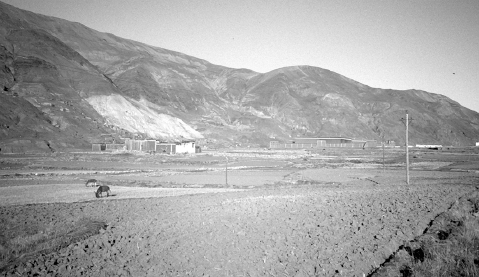
Figure 14. The barren landscape of Sakya Monastery, which was originally “thickly covered with willow.” (south central Tibet, 1992).
Photo by author.
Buddhism was part of this “frontier process,” and its success was intimately tied to agricultural expansion. Buddhists were at the forefront of monetizing Asia’s economy, and, as they did so, they fostered a world whereby Buddhists increased their wealth, status, and power through expanding agriculture. Archaeological evidence and the historical record make it clear that wherever Buddhism became established, agricultural expansion intensified.2
The Buddha himself recognized the importance of expanding agriculture. In the “Section on Robes” in the monastic code there is a story of the Buddha strolling with his disciple Ananda on the top of Mount Vaidehaka. As they look out upon the surrounding countryside, the Buddha revels in the many acres of irrigated farmland, especially the “level fields and level environs adorned with rows,” which were “particularly lovely in their divisions in arrangement.”3 His was not a reflection on the beauty of nature but rather on the beauty of the human manipulation of nature. The Buddha was indeed so taken by this agricultural landscape that he decreed that monastic robes incorporate its patterns—and they do to this day (see Figure 15). Agricultural expansion was sewn literally into the fabric of Buddhist vestments and figuratively into the fabric of Buddhist society.
References to agriculture fill the Buddhist canon. Beyond the more familiar tropes of planting seeds and ripening fruit in discussions of karma, the Buddha expounds explicitly on the practicalities of farming, especially irrigation. In one teaching, the Buddha addresses the proper clearing of the forest: “Suppose, Prince, a farmer went into the forest with a plough and seed, and, there, in an untilled place with poor soil from which the stumps had not been uprooted, were to sow seeds…. Would those seeds germinate, develop, and increase, and would the farmer get an abundant crop?”4 In another, he explicitly mentions the need for irrigation to make poor land arable: “Monks, seeds sown in a field possessing eight qualities is not very fruitful, does not ripen to great sweetness, nor is it thought a flourishing plot. How does it possess eight qualities? Consider, monks, the field that is undulating, rocky and pebbly, saltish, without depth of tilth, without (water) outlet, without inlet, with no water-course, without dyke.”5 Elsewhere, he instructs that proper irrigation is a basic responsibility of anyone working the land: “Monks, these three preliminaries are to be carried out by a yeoman farmer. What three? Herein, monks, the yeoman farmer must first of all well plough and harrow his field, and when those things are done he must sow his seed at the proper season. Having done this he lets in the water and lets it out again in proper season. These are the three preliminaries.”6 The Buddha even explains how one should make pipes for channeling water so that agriculture can expand: “Monks, suppose a man wants some waterpipes, he enters a wood with a sharp axe and taps on this and that tree with the axe handle. Then those trees which are sound and have hearts, when struck with the axehandle, resound sharply, while those rotten at the core, sodden and mouldy, when struck, give forth a hollow sound. And such he at once cuts at the root, then at the top, and when he has done so, he clears out the inside until it is thoroughly clean. Then he joins the waterpipes together.”7 The prevalence of such advice throughout the Buddhist canon shows that for the Buddha—and, by extension, Buddhists—the expansion of agriculture was a serious preoccupation.
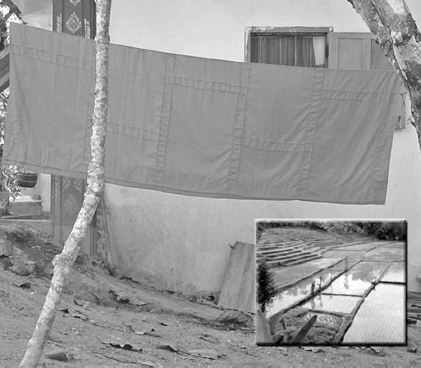
Figure 15. Fabric of a monastic robe, based on the patterns contained in irrigated fields.
Photo: Wikimedia.
By transforming the natural world, Buddhists generated material, social, and spiritual capital, and their use of natural resources was not only for subsistence but also, even more significantly, for the production of excess. Environmental historian Peter Boomgaard has examined “social production” among Buddhists in Southeast Asia for the purposes of “merit making” and “competitive feasting” to show that excess was sought by both the rich and the poor: “Even ordinary peasants, of their own free will, were increasingly producing more than was needed for subsistence requirements, not because they were interested in a higher income as such but because they wanted to show off their wealth, or at least accumulate merit in view of the afterlife. It may have been one of the reasons why agriculturalists switched from swiddens to sawahs, even if they were not being paid for it by a temple or were not unfree temple laborers.”8 In short, Buddhism encouraged Buddhists to exploit the natural world to excess for religious and social benefit.
Agro-expansion involved all members of Buddhist society: the laity, monasteries, and the state. Nearly every Buddhist monastery was established through a land grant, a form of exchange established at the time of the Buddha. King Pasendi of Kosala, for example, granted the Buddha “a populous place, full of grass, timber, water and corn.”9 This model of land grant was emulated across Asia, but the granters of land were generally not rulers of states but “merchants, craftspeople, farmers, and others, many of them women. 10
When land was granted to monasteries, it often came with slaves to clear and work the land.11 Here I list a few examples, taken from various land grant inscriptions across Asia, of people being transferred along with land. First, from medieval Thailand:
All the monks petitioned, asking to be granted true deeds to land which their monastery slaves could make into paddy fields and grow rice for monasteries…. Sri Maharaja had a register compiled of all lands on both sides of the sea and land granted to monks on which their slaves could plant gardens and fields for the Buddha image rooms and the monks…. Then Sri Maharaja and nay Sam Com distributed jungle land of the hua pak nay cam, 150 sen to the Great Reliquary … one strip of paddy land for the monasteries to eat…. These slaves of hmu Jaiya, and their sons and grandsons, being followers and temple slaves, had built up 823 pin of demarcated rice-fields.12
Another, from the Champa Kingdom (seventh to tenth centuries) in Vietnam: “King Indravarman gave these fields with their harvests, slaves of both sexes, silver, gold, brass, copper and other riches, to Cri Laksmindralokecvara, for the use of the community of monks, for the completion of the propagation of the Dharma.”13 From Wei dynasty (386–534) China: “He [the emperor] also requested that those of the people who committed grave crimes, as well as the public slaves, be constituted Buddha-households, to serve the temples as sweepers and sprinklers, and also manage the fields and transport the grain. Kao-tsu granted all these requests. Thereafter Samgha-households and Samgha-grain and temple-households were to be found everywhere in the prefectures and garrisons.”14 And, finally, one from tenth-century Tibet: “For the Buddhist community’s support, a site was established from the fields that belonged to the estate of Rum yul in accordance with what the sangha wanted, then one hundred [serfs] were legally bound to work the fields of that monastic estate. There were one hundred cattle-raising households, including nomads and their herds [to support the monastery]. Quarters for one hundred families of gold miners were established.”15 As Buddhist monasteries came to control more and more land across Asia, they expanded agro-ecosystems with the benefit of slave labor.16
In order to understand the scale of Buddhist slave labor, one must first understand the amount of land Buddhist monasteries controlled. James Watson, for example, has noted that “China had one of the largest and most comprehensive markets for the exchange of people in the world.”17 And one of the main reasons for the size and sophistication of this market was the historical use of slaves to work the land of Buddhist institutions. During the Wei dynasty (386–534 CE) in North China, for example, the nearly five hundred monasteries around the capital city of Luoyang owned up to two-thirds of the available land.18 In medieval Korea the sangha controlled one-sixth of the arable land.19 In Burma the sangha controlled 370,500 acres of land during the Pagan period (849–1297).20 Similarly, in coastal China from the tenth century to early twelfth: “Buddhist monasteries controlled anywhere from one third to one half of all common land. In Fuzhou, the average ratio of monks to land was one monk owning 160 mu of land [26.5 acres], whereas in the same geographical area, one peasant owned on average 14.5 mu [2.4 acres]. Buddhists controlled high-quality (cultivable) land in this region. By the late twelfth to the thirteenth century, although Buddhist monasteries had lost some of their land—particularly coastal land—to merchants and officials, they still controlled about one fifth of the common land. Moreover, this did not include mountain or forest land, which would raise the amount to at least almost one fourth of the total land available.”21 In thirteenth-century Quanzhou the sangha held almost a quarter of the land, which meant that seventeen laypeople sustained themselves on fifteen acres of land, while each member of the monastic community had access to the produce of one and a half times that area.22
Beyond granting large swaths of virgin land and slaves to monasteries, Buddhist states actively pushed agriculture into the frontier by offering various incentives, such as tax-free land grants with the stipulation that the land be brought under cultivation.23 In Thailand, for example, the Lan Na Kingdom “exempted newly cleared land from taxes for the first three years of cultivation.”24 Similarly, in the early eighth century when the Japanese Buddhist state wanted to expand the agricultural base by 2.5 million acres, the court issued an edict that allowed farmers to inherit land if they maintained irrigation systems on it for three generations. In 743 CE this order was changed so that “farmers acquired absolute ownership of such lands.”25
Most Buddhist states pursued their agro-expansionist agenda through conquest as well. The ancient Indian treatise of statecraft, the Arthasastra, had long advocated such a projection of colonial power into the frontier. The treatise had specifically called for the expansion of the agricultural base by moving settlers into new territory in order to clear the land.26 Buddhist states across Asia followed this earlier practice of Indian statecraft. In the case of Japan, for example, the state settled nine thousand colonists on its northeast Honshu island in the eighth century in order to cultivate the land of the “barbarian” inhabitants.27
Fundamental to the expansion of agricultural was the development of irrigation systems. The history of irrigation in Asia is a complex subject that has animated much scholarly debate, beginning with Karl Wittfogel’s 1957 “hydraulic theory of oriental despotism.”28 Wittfogel argued, to put it simply, that Asian states were essentially autocratic because, in order to maintain massive irrigation projects, the state needed to wield brutal state power.29 Wittfogel was a German immigrant working in the Cold War United States. A fierce anti-Communist, he was committed to condemning the state socialism of the Soviet Union and the People’s Republic of China.30 His vision of oriental despotism and its connection to the building and maintenance of enormous irrigation projects was as much about modern despots—Stalin and Mao—as it was about ancient ones. Because they had the resources of the modern bureaucratic state at their disposal, Stalin and Mao both utilized state power to destroy human and nonhuman life on a scale the world had never seen.31
Whether Wittfogel’s theory accurately depicts the premodern period has been disputed since its publication. One debate has concerned whether the massive irrigation systems of Asia were the initiative of the state or whether they were the work of nonstate actors.32 Today, the consensus is that both state and nonstate actors initiated these large systems and that, in the case of Buddhism, the laity, monasteries, and the state were all instrumental in building and maintaining irrigation systems across Asia. Based on the discovery of sixteen large dams around the important early Buddhist site of Sanchi in Madhya Pradesh, the archaeologists Julia Shaw and John Sutcliffe have argued that irrigation was an important element in the early propagation of the Dharma.33 They argue that monks brought irrigation techniques for maximizing rice yields into new areas and, with them, cultivated economic support for the monastery:
the sangha appears to have played a role in the management of local irrigation … not because the sangha sought to convert local populations, but rather because its effects were in harmony with the sangha’s wider economic concerns with water-harvesting and agrarian production. This hypothesis, based on the relative configuration of dams, settlements, and monasteries in the Sanchi area, as well as similar patterns in western India and Sri Lanka, forms part of an active model of religious change which suggests that monks moved into new areas with a set of incentives for locals to give their economic support to the monastery. The development of sophisticated water-harvesting systems was a means of alleviating suffering, as well as an instrument for generating patronage networks.34
Although Shaw and Sutcliffe’s argument is based largely on evidence from Sanchi, it is likely true of other places as well.
Early archaeological work in India frequently notes the presence of irrigation works in the vicinity of Buddhist temples.35 The cave complexes at Kanheri outside Bombay, for example, were built with elaborate catchment systems. As H. P. Ray has pointed out, ten of the sixty extant inscriptions mention cisterns and tanks, and several indicate that the fields around Kanheri “were under cultivation for the maintenance of Buddhist monks.”36 Similarly, recent archaeological work in Bangladesh has revealed a direct link between the spread of Buddhism and irrigation tanks.37 Several inscriptions from Gandhara also reveal that monasteries were involved in building and maintaining irrigation systems as well as wells.38 This practice was in turn transmitted to the oasis towns of the Silk Road and played a major role in establishing these cities as bastions of Buddhism in an otherwise inhospitable landscape.39
Systems of wells, tanks, and irrigation are found pretty much everywhere Buddhism became established. In Burma, for example, early royal inscriptions contain such evidence,40 and the link between the spread of Buddhism and irrigation technology was so familiar there during the Pagan period that a saying arose: “Where there’s a tank, there’s a temple.”41 When Burmese patrons began building temples in the holy land of India, such as at Bodhgaya, they perpetuated this tank-temple model: “Sacred temples were clearly viewed in integral relationship with lands, reservoirs and irrigation works whose combined produce would preserve the glory of the buildings, ceremonies and the Lord they magnified.”42
The concurrence of Buddhism, agro-expansion and irrigation systems has also been confirmed in Sri Lanka. By the second century CE, the Buddhist Sinhalese had already invented both the cistern and piston sluice.43 By controlling water flows more effectively, they were able to launch an unprecedented expansion of their irrigation systems. The embankments of the Padaviya reservoir, built during the reign of King Mogollana (531–551 CE), contained about sixteen million square feet of earthwork. Similarly, the Minneri reservoir of the late third century (274–301 CE), which covered 4,670 acres and contained three billion square feet of water, had an embankment a mile and a quarter long rising to a height of forty-four feet.44 Such large and innovative developments probably reached their apogee with the fifth-century Kala reservoir (455–473 CE), which provided water to the capital of Anuradhapura by means of a canal fifty-four miles long with a gradient of two and a half inches per mile.45
The dynamic between Buddhism and irrigation systems also occurred in northwest India, though not at the same scale. In a local legend in Gandhara, the Buddha overcomes a period of chaos by instituting various regulations about water control. As archeologist Luca Maria Olivieri has shown, communities followed the Buddha’s orders and created a “hydraulic panorama of unprecedented complexity”:
The numerous masonry walls still visible on the plain or the hillsides, such as the tanks for collecting spring water, are lined with the same technique of high-quality masonry used for the religious complexes (the most monumental example was found in Buner, at the site of Sunigram). The monasteries’ interest in water supplies in the countryside was not limited to digging and maintaining wells, cisterns and springs. Several important complexes, such as Tokar-dara 1, Najigram, and Tok-dara, were equipped with huge building works to dam, convey, collect and distribute water from streams. This infrastructure may have been used both to control flooding and torrential rainfall episodes as well as for the accumulation of water energy.46
Buddhists would later transmit the sophisticated irrigation technologies that they developed and maintained in northwest India to Tibet along with the Dharma.
In Tibet, however, the introduction of these new technologies generated political upheaval. The exact details of this historical episode are difficult to determine because so much of Tibet’s early history has been buried in a morass of Buddhist mythography. Nevertheless, based on early sources and recently discovered materials, it is clear that controlling water resources was of paramount importance for the early Tibetan state. Not only is the earliest state in Tibet referred to as the “water regime,”47 but many of the founding legends of the Tibetan state also revolve around attempts to control water.48
One such legend involves the Indian tantric master Padmasambhava, who is lauded for bringing Buddhism to Tibet, converting the demons of the land into Dharma protectors, and building Samye, the first Tibetan monastery. Most of this legend is actually a later Buddhist fabrication.49 In fact, according to an early source, the Tibetan king actually ordered Padmasambhava to be assassinated. Nonetheless, whoever Padmasambhava actually was and whatever he was doing in early Tibet, his legend indicates the early importance of irrigation to Buddhism. The recently discovered dBa’-zhed offers us some interesting clues about Padmasambhava’s role in transmitting irrigation technologies to Tibet:
The master of the mantra Padmasambhava made a number of suggestions: the sand of upper and lower Ngam should be transformed into a meadow; many springs should appear in upper and lower Grwa, Dol and gZhung and further on up to sTag la; thanks to the fields the people should have intensive farming activity for their livelihood; the rivers and lakes should be trained with gabions (sgrom bu) and crossed; the barren Tibetan land, becoming fertile, would be happy and so on. As a sign to show whether this was true or false, Padmasambhava recited mantra and celebrated a half-day-long ritual for the sandy floor of the Zur mkhar valley. Thanks to this, within one morning the sand was transformed into a meadow and a spring appeared. By meditating for one afternoon, he transformed the bottom of mTsho mo mgur and lower Blab a thsal into woods: water spurted from the arid land called Klu sdings. From the restricted assembly the ministers did not allow such activity and the practice was stopped.50
Some have interpreted this passage to be suggesting that Padmasambhava was in Tibet to introduce “the sophisticated irrigation systems used in his land of origin” (today’s Pakistan): “In northern Pakistan and in further western regions there had been a long tradition of extremely advanced irrigation technology which allowed a very efficient use of springs and even made it possible to cross great expanses of desert with covered channels. Given the political importance of control over water resources, it is not surprising that the Tibetan political leadership felt more threatened than pleased. Padmasambhava’s trip was therefore quite unsuccessful.”51 If Padmasambhava’s irrigation system threatened the state’s monopoly on the control of water resources, it might explain why the Tibetan emperor wanted him killed.
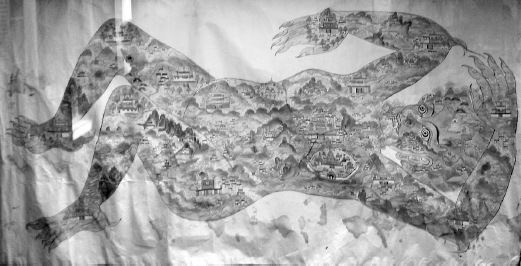
Figure 16. Tibet as demoness. Courtesy of the Rubin Museum.
Per Sørensen has recently built on this hydrological argument to reevaluate another legend about the introduction of Buddhism into Tibet. In this one, a demoness possesses the country and refuses to allow Buddhist temples to be built (Figure 16).52
On account of the Dharma’s power, however, the demoness is ultimately overcome when numerous Buddhist temples subdued her by “nailing her down.” Sørensen has suggested that this much-studied story relates to state power and the control of water.53 In particular, he argues that language such as “nailing down” and “piercing” the demoness refers to the building of monasteries and irrigation systems to control water.54 His interpretation once again draws out the important link between the spread of Buddhism and irrigation technologies across Asia.
The Buddhist transmission of irrigation technology was clearly not simply a tool of proselytization. As Shaw and Sutcliffe have shown, the main reason that Buddhist institutions built and maintained these systems was to produce the agricultural surplus necessary for their very survival. In South Asia, where 90 percent of a year’s rainfall occurs during the two to three months of the monsoon,55 control of water is essential, especially considering that it takes nine hundred tons of water to grow one ton of rice.56 Enhanced irrigation techniques were vital for the very success of the Buddhist mission, especially once monasteries grew larger in the post-Mauryan period and more diverse and sustainable models of ritual exchange between the monks and laity were required.57 The success of Buddhism depended on the surpluses that agricultural expansion enabled.
This dependence on surplus goes some way toward explaining one of the main differences between Buddhist and Christian monasticism: Christian monks produced their own food. In Europe agricultural production was too poor to sustain a large, nonproductive body of monastics. Although imperial Rome had a somewhat healthy seed-to-harvest ratio of 1:6, after the empire’s collapse farming in Europe sharply declined. By the twelfth century, France’s crop production had fallen to a devastating seed-to-harvest ratio of 1:2. In twelfth-century Thailand, on the other hand, the seed-to-harvest ratio was 1:40 and sometimes even 1:50 on account of intensive irrigation and double cropping.58 Irrigation enabled such remarkable rates of production, and rice provided greater nutrient content than grains such as wheat.59 These conditions allowed Asia to feed the large number of nonproductive Buddhist monastics. So, whereas the Buddhist monks in Asia were able to avoid actual labor, the Christian monks of Europe became specialists in horticulture because the population at large could not support them.60
Agricultural expansion of course benefited not just Buddhist monastics but the whole community. Archaeologist Janice Stargardt has shown, for example, that from the ninth century to the thirteenth, the Buddhist polity of Satingpra in southern Thailand “contrived man-made waterways over 311 square miles of land to link up with rivers, lakes and seas, thus forming a very extensive hydraulic system.”61 Stargardt conjectures that this irrigation expanded the land under cultivation from 123,553 to 321,237 acres. Such an increase would have meant an expansion of rice production from 106 million to 287 million pounds, and even 445 million pounds if there was double-cropping. With such an increase in available food Stargardt further estimates that the population of Satingpra would have increased almost fourfold.62
Such population explosions happened elsewhere in the Buddhist world as well. In his study of nine oasis cities on the Silk Road, Erik Zürcher has shown how the introduction of irrigation played a key role in population growth. In one city, for example, the number of households increased a remarkable 580 percent, from 14,311 to 83,123, during the course of a century.63 As Zürcher argues, this explosive growth—as well as the success of Buddhism as a viable institution on the Silk Road—was the result of a moral economy that promoted and enabled the expansion of agricultural production.
Even more remarkable, during the period when Buddhism became established across South Asia—the few centuries before the Common Era (400 BCE-0 CE)—the population increased from 150 million to 250 million.64 Such a demographic explosion would not happen again until the development of fossil fuel technologies in the nineteenth century.65 Although the precise role Buddhists played in this population explosion is open to debate, we can assume at the very least that their transmission of irrigation technologies and their expansion of agro-ecosystems played a significant role.
But the role that the Dharma played in the “frontier process” that transformed Asia’s environment is even more complicated than its spread of advanced irrigation technologies. Recent research shows that Buddhists were also at the forefront of transmitting four crops—rice, sugar, cotton, and tea—that changed the environmental history not only of Asia but also of the world.66
Rice was integral to early Buddhist culture: “Indirect references to paddy fields and rice cultivation in Buddhist texts, either as backdrop to particular narratives or as a metaphor for Buddhist practices, suggest that in eastern India the earliest Buddhist sangha, along with the earliest city dwellers, grew up within a predominantly rice-growing culture.”67 Buddhist texts are filled with paeans to rice and lamentations about the diseases that afflicted the crop, and Buddhist texts also show that rice had a whole range of ritual, medicinal, and economic uses.68 Buddhist folklore even claims that the Buddha and rice were born at the same time.69 When Buddhists moved into non-rice-growing areas, rice helped them to establish the Dharma on the commodity frontier.70 Indeed, as Buddhists pushed out into new areas, they brought with them both rice and irrigation technologies to such an extent that the Buddhist monastic code even came to offer advice about how to run a profit-making granary.71 This evidence suggests that the Buddhist transmission of rice was also at the root of the processes noted above: agroexpansion, population growth, marketization, and, ultimately, urbanization.
Sugarcane production was similar. Buddhists were the first to develop the technology of crystallizing sugar and subsequently spread it across Asia.72 Although this transmission is hard to trace, evidence for it can be found in works such as Wang Zhou’s A Treatise on Crystallized Sugar, which recounts how the monk Zou taught the Chinese how to make sugar.73 Moreover, as documents from Dunhuang and elsewhere reveal, Buddhists were instrumental in making sugar a part of the Chinese culinary, ritual, economic, and agricultural worlds.74 And much like the later transatlantic slave-sugar-cotton trade, Buddhists promoted the spread of the ecologically destabilizing sugarcane plant as part and parcel of their own institutionalization across Asia.
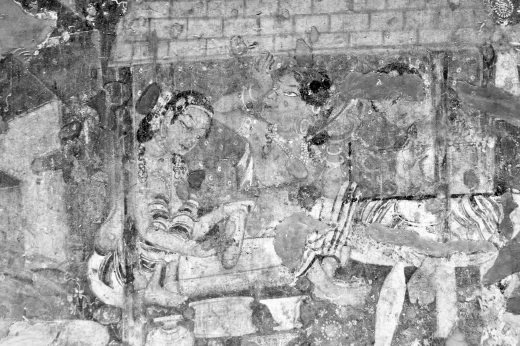
Figure 17. Spinning cotton in Ajanta mural.
Photo: Naomichi Yaguchi.
Moreover, just like the later Europeans and Americans, Buddhists were also key players in the early Eurasian cotton trade.75 Buddhist monastic codes required monks to act as cotton cloth merchants in order to raise funds for the monastery,76 and Richard Bulliet has recently argued that the sudden “cotton boom” of ninth-century Iran, which ushered in the global cotton trade of the early modern period, was a legacy of Buddhist trade in the commodity.77 Indeed, we know from numerous sources that Buddhist merchants and monks were heavily involved in the cotton trade across South Asia to such an extent that in the earliest texts of the Buddhist canon the Buddha advises women to help their husbands with it.78 In the famous murals at the cave temple of Ajanta, where the process of cleaning and spinning cotton is presented in a mural tableau, it appears that Buddhist men and women took this lesson to heart (Figure 17).
Another lesson Buddhists to took heart, just as later Europeans would, was the drinking of tea. Buddhists brought this plant and the tradition of drinking its leaves to China, where it became wildly popular during the Tang dynasty (618–907 CE). From there, both the plant and the tradition of tea drinking spread to East Asia along with the Dharma.79 Tea culture not only transformed whole cultures but also radically altered the landscape.
Because of Buddhism’s role in spreading these four crops—rice, sugar, cotton, and tea—we may well want to think about a “Buddhist exchange” that precedes, but parallels, the better known and more recent Columbian Exchange.80 The transmission of these crops, fostered by the inter-Asian Buddhist ecumene, had just as many “earth-shattering environmental consequences” as the transmission of crops and diseases did in the early modern period.81 Indeed, if we are to better understand the environmental history of Asia, we need to seriously consider the role Buddhists played in all aspects of agricultural expansion, including the spread of novel crops.