
PART I

Chapter 1
The wise man trained and disciplined
Shines out like a beacon-fire.
He gathers wealth just as a bee
Gathers honey, and it grows.
Like an ant-hill higher yet.
With wealth so gained the layman can
Devote it to his people’s good.
He should divide his wealth in four.
One part he may enjoy at will,
Two parts he should put to work,
The fourth he should set aside,
A reserve in times of need.
—Sigälaka Sutta, Digha Nikäya
The story of the Buddha has been told in various media—from texts to statues, paintings, and film—for almost two and a half millennia.1 He was born Siddhartha Gautama, the son of a king who ruled a territory in southern Nepal. His birth involved several miracles, and so his father summoned his priests to interpret their meaning. The priests declared the child would become either a great religious teacher and renouncer or a powerful king and world conqueror. Fearful that his son would not continue in the family business of politics, the king ordered Siddhartha never to leave the palace, while spoiling him with every worldly thing he could want as he grew up. But Siddhartha was curious, so one night, with the help of his manservant, he snuck out of the palace and was shocked to see a sick man, an old man, and a dead man. He realized that illness, aging, and death was everyone’s fate, and he wondered what could be done about it. Siddhartha also met a renouncer, who was trying to answer the same question.
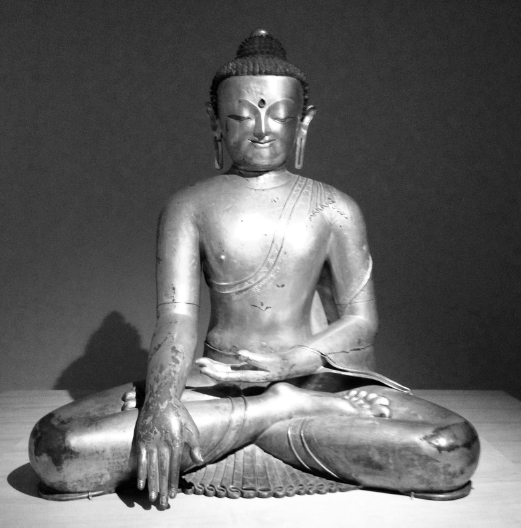
Figure 2. Fifteenth-century Buddha statue from Tibet (University of California, Berkeley Art Museum and Pacific Film Archive, 2016).
Photo by author.
Later, Siddhartha decided to follow the religious path. Abandoning his father’s palace (and his pregnant wife), Siddhartha went to study with various teachers over the next several years, but none could answer his biggest question: What is the meaning of life? He then decided to go it alone, and one day, while sitting in meditation under a large banyan tree, he had three visions. The first revealed the nature of time in all his previous births. The second revealed the nature of space in the six realms of existence (gods, demigods, humans, animals, hungry ghosts, hell). In the third, he saw the ultimate realization of enlightenment: no-self (anatman). These three visions came together in the fundamental insight that everything in the never-ending cycle of birth and death is always changing and impermanent and thereby imbued with dukkha, or “unsatisfactoriness.” Based on this insight, one’s goal in life should be to escape this cycle of suffering by achieving nirvana. He encapsulated these ideas into the Four Noble Truths:
1. There is suffering.
2. Suffering comes from desire.
3. Nirvana is the solution.
4. Nirvana can be achieved by means of the Eightfold Path.
These realizations made Siddhartha into the Buddha (the “Awakened One”), and he preached the Dharma until his death.
The life of the Buddha is a wonderful story, but in fact we know little for certain about the historical Buddha, not even when he lived.2 Attempts to date his life range between 623 and 383 BCE.3 The earliest corpus of Buddhist teachings, the Pali Canon, was not written down until the first century before the Common Era, and far away in Sri Lanka, so that what we know about the Buddha comes from material compiled several centuries after he lived and more than a thousand miles away from where he lived.4 As a result, some scholars go so far as to claim that we cannot know anything about early Buddhism.5
The biography of the Buddha is best thought of not as history but as myth, and thus the lack of evidence does not diminish its significance. Quite the opposite. By means of parables and metaphors, the Buddha’s biography contains the entirety of his teaching: its cosmology, doctrines, and communal structures. For example, the prophecy of the two paths that Siddhartha could take in life corresponds to the two interdependent components of the Buddhist community: the religious specialists who renounce the world (the sangha), and those who live in the world and support them (the laity). And Siddhartha’s life as a debauched young man in his father’s palace is a parable of desire, the material world, and the cycle of samsara that enlightenment enables one to transcend.
Over time, the Buddha’s biography has been altered to suit changing sensibilities.6 His abandonment of his pregnant wife, for example, did not sit well with later Buddhists. Although they could not change that key component of the story, they could reinterpret it. In their version, the Buddha still leaves his wife, but he does so in a loving and compassionate way. The child she carries also remains in her womb until the moment of the Buddha’s enlightenment, thereby tying the birth of his son to the Dharma.7
That we do not know when exactly the Buddha lived hinders our ability to understand his precise concerns or what specifically he was seeking to challenge with his teachings. As Sheldon Pollock has soberly put it: “An adequately detailed and historically sensitive account of just what the critique enunciated by early Buddhism meant within the larger intellectual and cultural history of the subcontinent remains an important desideratum for Indological scholarship.”8 That said, we are not wholly ignorant of the broad historical context in which the Dharma was formulated. Most significantly, we know that the possible range of his lifetime (600–300 BCE) occurred during the so-called Axial Age, when India was undergoing enormous political, economic, cultural, and technological changes.9 These intertwined developments had a profound impact not only on the structure and nature of Indian society but also on how people understood themselves and the world around them. It was within this changing milieu that the Buddha and others like him, such as the Hindu Upanishadic thinkers and the Jains, were trying to answer big questions about the meaning of life.
The Buddha’s fundamental idea that everything is impermanent captured the tenor of the times. One significant change going on around him involved political structures. As seen in the Buddha’s biography, India was at the time divided into small lineage-based republics, like that of his father’s kingdom (Map 2).10
These small republics were gradually being absorbed into more complex kingdoms. Although families still ruled their own smaller kingdoms, the larger entities that absorbed them inevitably became more genealogically diffuse. As a result, these new protostates required more abstract ideologies of legitimacy than the earlier clan-based political structures.11 In order to maintain their power, the ruling elites needed not only ideological innovations but also a greater resource base with which to finance the structures that sustained them, such as burgeoning bureaucracies and armies.
Changing political structures coincided with the introduction of iron technology into India, which fueled two major innovations: the iron plow and improved weaponry. The plow allowed for expanded rice cultivation, which in turn propelled a shift from nomadic pastoralism to settled farming. Settled farming led to population growth and to the rise of cities.12 Ur banization brought with it other large-scale changes, including the rise of trade, a merchant class, and a stratified social structure. These new cities and complex economies required protection as well as administration, which fostered the development of centralizing states. On account of agricultural surplus and increasing financial transactions, states established a regular system of taxation that could in turn pay for both an educated bureaucracy and a standing army. Iron, of course, made far better weapons.13 All of these intertwined technological, social, economic, and political developments came together during the formation of first the Nanda Kingdom (345–321 BCE), and then the Mauryan Empire (322–185 BCE), which controlled the largest territorial expanse of India until the British Empire colonized the entire subcontinent (Map 3).
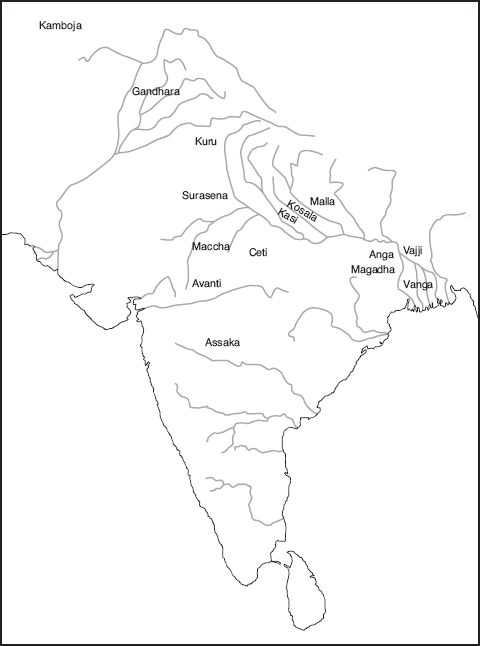
Map 2. India at the time of the Buddha.
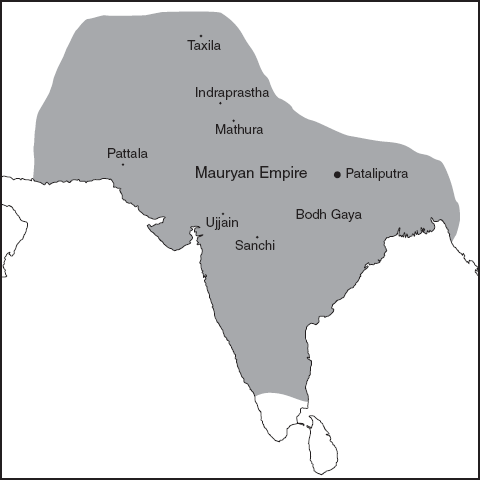
Map 3. The Mauryan Empire.
Forging such an empire depended on many changes, one of which was the creation and circulation of wealth in the form of money. Wherever it occurs, monetization profoundly affects a society, well beyond matters of trade, because the introduction of money puts everything, whether an avocado, a day’s labor, or a person, on the same plane and makes them comparable. Money introduces new levels of abstraction, especially through usury, that fundamentally challenge the human perception of the world. As a result, people search for explanations. It is not a coincidence that Greek philosophy flourished shortly after the minting of coins in the Mediterranean.14 Nor is it surprising that, as historian Jonathan Berkey has noted, “two of the more memorable episodes from the accounts of Jesus’ life—his encounter with the moneychangers in the Jerusalem temple, and his remark about rendering unto Caesar that which was Caesar’s—involved coins.”15 The leveling and abstraction that come with the introduction of money reformulate the concepts and moral values that undergird the existing social order, and the Dharma was formulated amid these profound disruptions.
The Dharma not only reflected these transformations but also interpreted them. The Buddha has often been imagined as a “radical” or a “progressive” who criticized the caste system or who anticipated Marxism. I agree that he was a radical and a progressive but in a much different way from these popular impressions. The Buddha supported the new market economy and what it entailed: urbanization, trade, wealth production, familial reordering, individualism, free will, and new political structures. Rather than appeal to an idealized or romantic notion of the past, he urged his followers to move forward and embrace the new economic and social transformations. Even if this meant giving up nomadic pastoralism and the familiarity that went with it, he urged his followers do so.16 According to the Buddha, the best plan of action was to leave the farm, the family, and the old traditions behind, to move into the city, and to create a new religious identity within the world of commerce. That was his radical progressivism.
The Dharma thrived within the urban world of trade, and it is no surprise that the Buddha’s teachings are filled with references to such commerce. Early Buddhist scriptures contain rates of currency conversion,17 and debt and trade appear throughout as similes and as the basis of parables about spiritual obstacles. Because wealth is a sign of goodness and poverty a sign of moral failure,18 Buddhist texts feature rapt descriptions of the laity’s wealth and their ostentatious possessions, such as this one: “A wealthy businessman or his son has a house with a gabled roof, plastered inside and outside with well-fitting doors and casements. Therein a couch is spread with a costly skin of antelope, having a canopy overhead and a scarlet cushion at each end. Here is a lamp burning and four wives wait upon him with all their charms.”19 Making money and being rich was not a problem for the Buddha—quite the opposite—and the production of wealth came to fundamentally shape Buddhist doctrine and practice.
The new world of trade that flourished during the monetized Mauryan Empire appears throughout Buddhist literature and art as well. Take the example of the traveling monk. The Buddha had originally decreed that all monks must stay in one place during the rainy season, which gave rise to the monastic institution. However, the Buddha later allowed monks to violate this rule if they traveled with a merchant caravan or trading vessel.20 Over time the Buddha himself came to be portrayed in art and literature as a merchant caravaneer.21 Stories abound of him saving merchants lost at sea or in the desert.22 These stories and many others make it clear that the Buddha (or, more precisely, the disciples who later codified his teachings) was acutely aware of the socioeconomic changes unfolding at the time.
The Buddha, however, differed importantly from other thinkers of the Axial Age. Hindu philosophers in India and the Confucians in China, for example, were both profoundly wary of a monetized economy and its social implications, and they wanted to prevent the massive social transformations it would inevitably bring. Both Hinduism and Confucianism clung conservatively to the past. They feared that new developments threatened the moral order of well-established social hierarchies and resisted the market economy. Confucian thinkers created an idealized fourfold hierarchy of society with merchants at the bottom.23 Hindu law codes did the same. The Brahmins condemned activities essential for business, such as international travel, and strictly regulated the new merchant class. For good measure, Hindu codes grouped businessmen along with drunkards, sadists, and lepers.24
The Dharma took a different view. Although it ultimately presents a critique of the material world, it also recognizes that the world of trade and money—or, as Gustavo Benavides puts it, “the processes that underlie need and desire, production and work, giving and taking, hierarchy and equality, coming into being and dissolution”—cannot be entirely rejected.25 The Buddha and his disciples realized that a monetized economy and its new business elite were the future. The story of Trapussa and Bhallika, the Buddha’s first lay disciples, makes this clear. Trapussa and Bhallika were businessmen. Unlike the Buddha’s former mendicant colleagues, who upon hearing his first sermon decided to become monks, Trapussa and Bhallika did not want to give up the comforts of everyday life or their families. In return for a donation, the Buddha offered them a list of deities who, if prayed to, would protect them while traveling on business. This exchange established the social and ritual dynamic between the monastics and the laity that is central to the Buddhist community even today.
The Buddha went even further and incorporated wealth creation into Buddhist doctrine and practice. In his view the best way to generate positive karma was through the production of wealth, since it could be used to support the Dharma and to generate merit. Making money is nothing to be ashamed of as it is essential to creating merit and thus a fundamental part of being Buddhist.26 Take the example of the Milindapañhá, a Buddhist text from the first centuries of the Common Era that recounts a dialogue between the Buddhist sage Nägasena and the Indo-Greek king Menander. It includes the story of a prostitute who has acquired so much merit, and thus power, that she can make the Ganges River flow backward. The famous Buddhist king Asoka is so astounded at this display of power that he wants to know how it was done. She explains that it was through the transmutation of wealth into merit, but the most remarkable detail of the story is how she earned her wealth. As she tells Asoka: “Whoever, sire, gives me wealth, whether he be a noble or a Brahman or a merchant or a worker or anyone else, I minister to each in the same manner not thinking there is any special elegance in a noble or anything contemptible in a worker. I serve each lord of wealth without approval or repugnance.”27 She treated all her customers the same, regardless of caste or class. With this story, the Dharma is challenging the caste system on economic not moral grounds, as is often claimed: “receiving services is not conditioned by one’s position in the status hierarchy, but on one’s ability to pay for services.”28 The story expresses the Buddha’s regard for social mobility in the market economy of early India, where one’s position in the world is no longer predetermined. Indeed, in Buddhist Asia one’s status came to be defined solely by one’s wealth.
Even though the Dharma was an early form of prosperity theology, it also recognized the harsh realities that a market economy unleashes. Early Buddhist texts depict not only the realities of economic specialization but also the inevitable disparities in wealth they generated.29 The early Buddhist canon, for example, recognizes six classes of financial being: very wealthy, wealthy, faring well, faring poorly, poor, and destitute,30 and the Dharma addressed itself to these inequalities and the suffering that the market system created. Still, the Buddha recognized that the material world of wealth was a necessary evil until the final utopia of universal nirvana could be achieved. Wealth played a crucial role in Buddhism, as the laity took on the duty of acquiring it in order to support the nonproductive monks and nuns.
In sum, the Dharma finessed the legitimacy of wealth creation, and, as a result, the teachings of the Buddha came to resonate with the merchant classes of early India. It continues to resonate with metropolitan elites around the globe today for similar reasons.