
Chapter 2

Any kind of feeling whatever … Any kind of perception whatever … Any kind of formations whatever … Any kind of consciousness whatever… all consciousness should be seen as it actually is with proper wisdom thus: “This is not mine, this I am not, this is not my self.”
—Mahapunnama Sutta (Nikaya Buddhism)
If, once I have attained Buddhahood, any among the throng of living beings in the ten regions of the universe should single-mindedly desire to be reborn in my land with joy, with confidence, and gladness, [it will happen] if they should bring to mind this aspiration for even ten moments of thought.
—Sukhāvatīvyūha Sūtra (Pure Land Buddhism)
A certain distinguished monk named Ting came to the Master for an interview and asked, “What is the basic meaning of Buddhism?” The Master got down from his chair, grabbed hold of him and gave him a slap…. As Ting was making a formal bow, he suddenly had a great enlightenment.
—Linji chanshi yülu (Zen Buddhism)
Imagine in one’s navel a white eight-petalled lotus. In the centre of this white lotus is a lunar disc. Upon this disk there are the forms of Vajra-sattva and His spouse in close embrace, the Mantra Hum being in their hearts. Then imagine that rays of light issue from the “Hum” in all directions.
—Śrī Cakrasamvaratantra (Tantric Buddhism)
The Buddhist tradition has been conventionally divided into three yanas or “vehicles”: the Hinayana (the Small Vehicle, but better known today as the Nikaya, or mainstream Buddhism), the Mahayana (the Great Vehicle), and the Vajrayana (the Diamond Vehicle, or Tantric Buddhism). The respective traditions, captured in the epigraphs above, differ greatly in terms of philosophy, doctrine, and ritual.1 What Buddhism means and what it means to be a Buddhist have varied widely over time and place, but this chapter explains what, ultimately, has unified Buddhism over time.
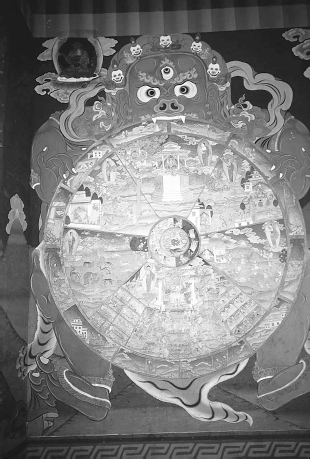
Figure 3. The Wheel of Life, Simtokha Dzong (Bhutan, 1991).
Photo by author.
The earliest tradition is the Hinayana. The later Mahayana tradition held that these Buddhists had misunderstood the Buddha’s true teaching and hence the belittling name “small vehicle.” The two traditions differ over the ultimate goal of Buddhism, or what one should do after achieving enlightenment. According to the Nikaya traditions, the goal of Buddhism was to realize no-self—to become an arhat—which would in turn enable an individual to transcend the bonds of karma and achieve nirvana. These early Buddhists saw nirvana as a state of nothingness that was beyond the cycle of birth and death, and thus the only reality without suffering. As we saw in the preceding chapter, the Buddha’s original quest was to figure out how to overcome the suffering of old age, sickness, and death. According to the Nikaya schools, one overcame suffering by realizing the Buddha’s ultimate realization—the reality of no-self—after which one would no longer produce karma, bringing an end to the cycle of reincarnation. In short, for early Buddhists, the ultimate goal was to cease being reborn.
Mahayana thinkers, who retained the same goal of ending suffering through enlightenment, found this abandonment of the world to be selfish because it left others to suffer. For them, the idea of achieving enlightenment and then abandoning the world for nirvana was the antithesis of the Buddha’s message. In particular, it violated the idea of compassion, which they captured in the figure of the bodhisattva: an enlightened being who keeps active in this world so as to help all others achieve enlightenment. Only then, when everyone else has overcome suffering by achieving enlightenment, will they enter the realm of nirvana.
This difference accounts for the theological chasm between these two earlier branches of the Buddhist tradition: in the Nikaya traditions Buddha is a man, and in the Mahayana he is a god. Indeed, some scholars have argued that the differences are so great that we should speak of Buddhisms rather than one Buddhism. Yet, as with Christianity and its centuries of theological discord, sufficient continuity within Buddhism justifies conceptualizing the Dharma as a singular tradition.
As with any religious tradition, one needs to understand its historical development in order to understand it fully. Mainstream Buddhism developed during the transformative era of the Axial Age, as discussed in the preceding chapter. Society was becoming more complex economically, politically, and socially, and a range of thinkers known as the sramanas, “renouncers,” were asking the big question of the day: What is the meaning of life? As the clan-based republics of early India gave way to larger states with fully monetized economies and increasing urbanization, old family-based certitudes began to wither and new models of life were needed. The sramana revolution emerged at this conjuncture, and it changed forever the religious history of Asia.
Numerous schools of thought that arose during this time shared a world-view grounded on the new idea of reincarnation, and they later developed into Hinduism, Jainism, and Buddhism.2 They all posited that we are born again and again in the cycle of samsara, based on the cause and effect principle of karma. They generally agreed that dukkha permeated the endless cycle of rebirth—or, more accurately, re-death. Dukkha is often translated as “suffering,” but it is better understood as “unsatisfactoriness.” On account of this general view of life as unsatisfactory, these schools of thought believed that the ultimate goal of humans should be liberation from the cycle of samsara. Hindus call this liberation moksha, and Buddhists call it nirvana.
The question of how one achieves such liberation came to distinguish one sramana group from another. Yet, even though their worldviews and practices came to differ radically, these groups held a common vision of the divine. They all agreed that, although the world was filled with many kinds of gods, those gods could not help individuals with ultimate liberation or in any way save them. Individuals had to break the bonds of samsara themselves.
The Axial Age in India, therefore, saw a rise in individualism. Mirroring the new urbanizing market economy, in which everyone had to find their way, religious thinkers made clear that individuals were responsible for their own liberation. This radical turn to individual responsibility did not mean, however, that the gods went away, or that, as many have claimed, Buddhism was somehow atheistic. On the contrary, all of these traditions recognized the existence and power of the gods to bring rain, secure a male heir, or to cope with the trials and tribulations of daily life. They could not, however, help you with the ultimate liberation from samsara.
According to the Buddha, in order to achieve liberation from samsara one must meditate and realize enlightenment oneself, just as he had once done under a large banyan tree. This teaching is captured in the Wheel of Life, which the Buddha told his followers to paint on the walls of monasteries so that it could be used as a teaching device (Figure 3).3 The demon Mara, who tried but failed to dissuade the Buddha from achieving enlightenment, holds the wheel, which contains various depictions of samsara. At the center of the wheel are a pig, a rooster, and a snake, representing the three poisons—ignorance, greed, and hatred—that drive samsara. Around that center are the six realms of existence: the heaven, hell, human, animal, hungry ghost, and demigod realms. All beings are reborn into one of these realms, based on their karma. But, because karma can be earned and spent (like money), no realm is permanent. Rather, everyone moves from one to the other endlessly, and, since each realm has its own distinctive forms of suffering, the goal is to escape being reborn into any of them. Rather, one needs to escape samsara altogether by realizing enlightenment and achieving nirvana.
The Buddhist theory of anatman is a critique of the Hindu notion of atman, which states that we all have an eternal soul that migrates from life to life. The Buddhist theory of anatman thus repudiates the karma theory that says one’s actions (karma) will dictate the future rebirth of one’s soul (atman). Although this is the most popular understanding of karma, it is important to point out that it is Hindu not Buddhist. Such a theory justifies existing social hierarchies by explaining that you are a street sweeper because of past misdeeds or that you are a Brahmin priest because of previous good deeds. This mechanistic cause-and-effect understanding of karma came not only to justify the caste system but also to hamper the possibility of free will. Because social hierarchy trumped individual action, unrestricted free will would endanger the very logic of the caste system.4 The Hindu theory of karma was built on the idea of a permanent soul (the atman) that transmigrates from life to life based on one’s own personal actions within the mandates of caste obligations.
Against this idea of an unchanging soul, the Buddha argued that there actually is no soul. There is nothing—no soul, no self, no me—that will be reborn on account of “my” actions in this life. By definition, “I” am therefore not the direct consequence of anything that “I” did in the past. “I” did not exist then, nor do “I” exist now. Thinking “I exist” is itself the fundamental problem. For the Buddha, the “I” is a concatenation of mental and physical constituents and karmic forces that were set into motion in the past both by the individual and by others. Karma is created because humans inherently believe that they exist—that is, have a soul or a self (atman)—and thus they build a life in order to satisfy their desires. This ontological mistake, which produces karma, will have consequences, including the birth of future beings. We are, therefore, the product of the ontological mistake of others, and, if we continue to make the same mistake of thinking that we have a self and, on that basis, act to satisfy our individual desires, we will continue to create karma that produces more future beings, who will once again suffer the unsatisfactoriness of samsara.
If the ultimate goal is to end suffering, the solution is to stop beings from being born. One’s ultimate goal cannot be to save “oneself” because no such self exists and so cannot be saved. Rather, the ultimate goal is to bring an end to the suffering of others by bringing an end to the creation of the karmic stream emanating out of the misguided notion of self, and its attendant will to satisfy its own desires. The Buddha asked adherents to have the compassion to want to prevent the suffering of future beings.5 If they did, he advocated the realization of no-self—enlightenment—because it is only from that selflessness that they will no longer produce karma, and only when karma stops being produced will no future beings be born and suffering end. Thus if nirvana—which literally means “extinction” in Sanskrit—is taken to its logical conclusion, it would mean the extinction of the human species.
Clearly, the Buddha’s teaching of no-self was radical.6 It was also so difficult to achieve that some texts calculated that it could take nine million lifetimes to realize nirvana. Because of this difficulty, nirvana became the preserve of an elite few: the monastics. Only they retreated from everyday life to conduct the extreme meditation practices that could lead to enlightenment. The remaining majority of Buddhists were obligated to address the karmic side of the equation; namely, they were to live their everyday lives morally by having appropriate jobs that minimize the production of negative karma, to support the monks financially, and to perform rituals that generated positive karma.
This practice of giving (dana) between the monastics and the laity was at the heart of Buddhist communities across Asia. Not purely financial, the relationship was governed by the logic referred to in Buddhist sources as “field of merit.” By living according to the strict rules of the Vinaya, the monastic code, monks not only became suitable recipients of donations but they also functioned as vehicles for the production of merit, or good karma.7 By following the Vinaya, monks became individuals with spiritual—or, more specifically, karmic—power. By supporting them, the laity ensures not only that monks can do the hard work of achieving enlightenment but also that they themselves can receive karmic blessings from the monks. What this means in theory is that giving money to a leper would not be equivalent, karmically, to giving money to a monk because the leper is not a field of merit. Only monks, who adhere to the monastic code and live like the Buddha, can be mediums of karmic transference. The importance of this relationship to Buddhist communities across Asia cannot be underestimated.
Because this relationship is the cornerstone of the ritualized social structure of the Buddhist community, it is essential that both monks and the laity properly fulfill their roles. To that end, the main ritual of monastic life, the poṣadha ceremony, ensures that monks are living righteously and are thereby worthy of lay donations. The poṣadha involves the monastic community reciting the key regulations of the Vinaya publicly every two weeks and the monks confessing any transgressions they may have committed.8 The ritual not only publicly ensures the moral rectitude of the monastic community but also makes sure that the monks are indeed a “field of merit” and thereby worthy of receiving offerings. Only by demonstrating moral purity can the monastic community operate as a field of merit and thereby generate merit for the lay donors.
The Vinaya’s legalistic parsing of what monks and nuns can and cannot do occupies an important place in the history of Buddhism. Take the question of whether monks were allowed to use salt. Some monks supported the use of salt; others did not. The latter feared that, with salt to preserve food, monks would no longer need to beg for food on a daily basis and that would deprive them of the opportunity for ritual transactions with the laity. This dispute prompted the fragmentation of early Buddhism into what became, over time, sixteen distinct schools of thought, each with different interpretations of the monastic code (and more).9 These early Buddhist schools formed the Nikaya tradition (which literally means “schools”), which I mentioned at the beginning of this chapter as the first of three “vehicles” that compose the Buddhist tradition. Of these sixteen competing early Buddhist schools, only one, the Theravada, survives and can today be found across Southeast Asia and in Sri Lanka.
The later Mahayana tradition interpreted the word of the Buddha differently. The origins of this tradition are obscure, occurring somewhere between the first century BCE to the fifth century CE.10 Some claim it arose in India’s northwest; others, the southeast. An old theory that the Mahayana developed among the laity has recently been challenged by new evidence that it was a puritanical monastic movement,11 and that the wealthy women of the Gupta age (ca. 320–550 CE) supported it.12 Whatever its origins, it turned the Nikaya schools upside down by taking the Buddha’s central idea of no-self and extending it to conclude that everything lacks a permanent or inherent essence. One early school of thinkers in particular, the Madhyamika, came to this conclusion based on their logical argument about the nature of cause and effect.13 In particular, Nagarjuna, who founded this school, used a traditional fourfold argument of Indian logic to argue that although causality can be observed, none of the traditional theories of causality can explain it:
1. x is y, “self-production”: if an effect arises from a cause that is the same as itself that means that it is just the same, which is not possible;
2. x is non-y, “other production”: if an effect arises from a cause inherently other than its own nature, that is illogical since cause is only in relation to effect;
3. x is both y and non-y, “self-production and other production”: is not logical since the cause cannot be both the same and different from the effect;
4. x is neither y nor non-y, “neither self-production nor other production”: would mean that there were spontaneous effects without causes and thus no order, or basically chaos, which again is not logical.
On the basis of this formalized system of logical argumentation, the Madhyamika thinkers came to believe that since no “thing” can be found to originate from some other “thing,” everything is not only empty (śūnyatā) but also interdependent on everything else.14
This universalizing extrapolation of the no-self principle profoundly influenced the course of Buddhist history, but the central problem in both the Nikaya and the Mahayana traditions remained the same: people do not understand the nature of reality and thus desire things, which leads them to worldly action and the production of karma. Mahayana thinkers came to refer, on the one hand, to “conventional reality” (our lives of action and desire that produce karma) and on the other to “ultimate reality” (the emptiness that lies beneath it all and that makes cause and effect possible). The goal of a Mahayana monk’s meditation was thus not to realize no-self but to perceive ultimate reality, which is the emptiness that underlies everything. With knowledge of ultimate reality, one could transcend conventional reality and become a bodhisattva, who not only tends to the worldly needs of others but also helps them to realize the true nature of reality. The Mahayana therefore did not fundamentally challenge the early Buddhist teaching about impermanence, or that humans misperceive themselves and thereby perpetuate suffering, but redefined its underlying logic.
The Mahayana developed within the larger context of India in the first centuries of the Common Era, amid a new religious movement focused on the power of the gods to save the individual. The Indian epics, the Mahabharata and Ramayana, had developed the tradition of bhakti, or devotion, to particular deities, who through grace and compassion could save you from the cycle of samsara. During the first millennium, scriptures known as the Puranas developed this Hindu theism more fully as it became institutionalized in temples built by rulers across the subcontinent. Amid this Hinduization and its focus on salvific gods, the Mahayana developed, perhaps unsurprisingly, in a monist direction. The early Madhyamika philosophers had used the theory of emptiness as a tool of logical argumentation, and yet that emptiness was in turn transformed into a divine reality. As the underlying nature of reality, emptiness was not precisely “empty” (as a negative or lack). Rather, emptiness was the ultimate reality, and that ultimate reality was none other than the Buddha, or Buddha-nature (tathāgathagarbha).
The Mahayana had the profound effect of turning the Buddha into an eternal and powerful entity—a god, if you will—in contradistinction to the earlier Nikaya belief that the Buddha was simply a man. In the Mahayana tradition, new doctrines arose that built on the deified conceptualization of emptiness, including a new pantheon of “Celestial Buddhas” and “Saviour Bodhisattvas,” who could intercede in human affairs through prayer.15 The branch of Mahayana Buddhism that most clearly reflects this new idea of divine intercession is the Pure Land tradition. It focused on the Buddha Amitabha, who saves his devotees from the cycle of samsara by having them be reborn in his Western Paradise of Sukhavati. These notions of emptiness developed outwardly, into a world of supplication and grace based on the theory of “other power.” But others would develop inwardly, such as the notion of “own power” in Chan meditation. Chan meditation led to sudden enlightenment, which was a new development, since in the early Buddhist tradition the experience of enlightenment was the culmination of a long and arduous ordeal.16 Yet, if enlightenment had become not the quest to fathom the reality of no-self but the experience of one’s own Buddha-nature, the right koan—or slap to the face—might be enough to unsettle one’s habits of mind and to expose the hidden, ultimate truth inside oneself. (Of course, Chan meditation in China and Pure Land devotion in East Asia arose much later than, and far away from, the rise of the Mahayana in India during the first centuries of the Common Era.)
Even so, how the Mahayana arose in relation to the social, economic, and political environment of India is not fully understood,17 but the rise of large monasteries and the granting of extensive landholdings to them by the monied Buddhist elite make it clear that the Dharma was benefiting from the general economic expansion of the Gupta period from the late third to the mid sixth century.18 Scholars have tried to link these socioeconomic developments to the theological innovations of the Mahayana. Xinriu Liu, for example, has observed that the rise of emptiness and its accompanying claim that material realities are without meaning coincide, ironically, with the new-found wealth of monasteries and a generally exploding global economy.19 Liu has also argued that the appearance of the “Seven Jewels” (gold, silver, lapis lazuli, crystal, pearl, red coral, agate) in Mahayana literature coincided with the rise of new consumption patterns and an increase in Sino-Indian trade in these luxury commodities.20 Yet, although there was certainly both an increase in trade and a deep Buddhist impact on Chinese material culture at this time,21 the majority of trade across Buddhist Asia was actually in nonreligious and bulk items, such as tin from Southeast Asia.22 Gustavo Benavides has asked whether the Mahayana moved away from the individualism and “open market” of early Buddhism and toward “reliance on grace and saviors” in order to reify the “patronage and hierarchy” of Gupta society.23 This is plausible, but there were likely many other reasons why both monastics and the laity adopted the ideas espoused by the Mahayana.
During the Gupta period, the Mahayana would be transmitted to East Asia, where it developed in new and interesting ways, but in India itself the Mahayana would be eclipsed by the third vehicle of Buddhism: the Vajrayana or Tantric Buddhism. The origins of tantra have been much debated, but it appears to have emerged from within a distinct subculture of yogis, in which meditative and ritual practices focused on the acquisition of power that “often involved the transgression of social mores and rules of purity.”24 These transgressive practices involved, most notably, the ritual use of the “five forbidden M’s”: meat (mamsa), fish (matsya), wine (madya), parched grain (mudra), and sexual intercourse (maithuna). Because of its ostensible transgressions, tantra has long been declared an abomination.25 One scholar has referred to practitioners of tantra as “the Hell’s Angels of medieval India.”26 But unlike Sonny Barger and his acolytes, the tantrikas were welcomed by the powers that be, the royal courts of India, because they had something to offer, since through their ritual practices they could control all the forces within the mandala of the king’s domains and thereby ensure both his legitimacy and reign. In this way the adoption of tantra was intimately interwoven with the social and political breakdown of post-Gupta India (Map 4).27
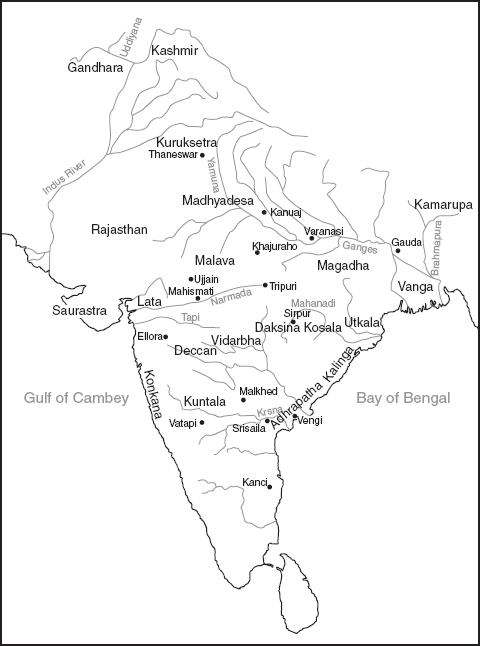
Map 4. Post–Gupta dynasty India (seventh–ninth centuries).
The goal of tantra was not simply to realize no-self, or emptiness, but to transform oneself into a Buddha. How to achieve this goal varied widely across the various tantric schools that developed. One of the most common techniques was the practice of visualization, which used most often a mandala, or cosmic diagram of the universe. Thus to overcome conventional reality and its misperceptions, a guru initiates a tantric practitioner into a particular mandala, with which the practitioner visualizes him or herself inside that sacred space. The goal is to transform oneself so as to perceive ultimate reality as a Buddha would. In short, one comes to see and act as a Buddha.
The mythologies, doctrines, rituals, practices, and art of Tantric Buddhism differ greatly from the two earlier traditions. The fundamental problem of overcoming suffering, however, remains. And, as with Nikaya and Mahayana Buddhism, the fundamental social structure in Tantric Buddhism is the same: the laity maintain the economy and support the monks in their quest for enlightenment. Thus, even though the Buddhist traditions differ widely in their goals and in their actions in relation to those goals, the ritualized social relationship between the laity and monastics unifies them as a pan-Asian religion. This ritual relationship is foundational to the social architecture of Buddhism across Asia, and, as I will show, it drove the Buddhist laity to exploit the natural world for economic gain. So, even though there were many Buddhisms across Asia, how Buddhists acted in relation to the natural world was generally the same: they exploited it in service to the Dharma.