
Chapter 4

Wealth is desirable…. Sloth and non-exertion is an obstacle to wealth … Monks, by increasing in ten growths the Aryan disciple grows in the Aryan growth, takes hold of the essential, takes hold of the best for his person. What ten? He grows in landed property, in wealth and granary, in child and wife, in slaves and folk who work for him, in four-footed beasts, he grows in faith and virtue, generosity and wisdom.
—Anguttara Nikāya
Max Weber famously argued that Protestant theology—especially the uncertainty inherent in Calvin’s theory of predestination—drove northern Europeans to develop modern capitalism and, with its help, to conquer the world.1 In making his argument, Weber had to show that other world religions lacked the specific attributes of Protestant Christianity.2 In the case of Buddhism, he claimed that its “lack of economic rationalism and rational life methodology” made it “apolitical” and “otherworldly.”3 The Weberian view of Buddhism matches much of the modern and popular understanding of the Dharma, and it undergirds the eco-Buddhist paradigm.4 Indeed, Buddhism’s presumed “otherworldly” disinterest in material power is the reason it is taken to be a “good” religion. But, as one environmental historian of China has succinctly put it, Weber was “ludicrously wrong.”5
Scholars of Buddhism have pushed back against Weber’s misrepresentation for decades. Scholarship has shown how intimately Buddhism has been involved with political power across Asia.6 And, since the 1956 publication of Jacques Gernet’s groundbreaking work Buddhism in Chinese Society: An Economic History from the Fifth to the Tenth Centuries, scholars of Buddhism have explored the deep interconnections between the Dharma, economic expansion, and integration across Asia.7 Today, these interconnections are fundamental to the scholarly understanding of how Buddhism came to be such a remarkably successful missionary religion.8
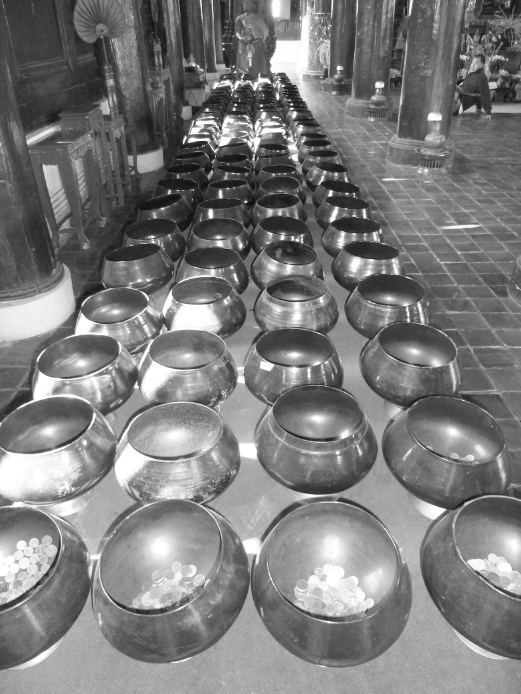
Figure 6. Buddhist begging bowls filled with money (Chiang Mai, Thailand, 2010).
Photo by author.
An archaeologist, for example, explains the success of Buddhism in early northwest India based on recently discovered urban settlements with monastic sites and irrigation systems: “The social implications of these discoveries are fundamental for explaining the diffusion of Buddhism in a region which several sources suggest had long been predominantly Brahmanical. They prove that in Gandhara, the Buddhists could rely on the urban environment, more favourable to the merchant classes and the diffusion of new beliefs.”9 In another example, a scholar of Buddhism explains the establishment of Buddhism in eastern India: “Not only were these developments conducive to the growth of brisk trade relations, but also to the formation of a complex form of government, a government that needed to protect the interests of various professions while providing safety and security from outside invasions by maintaining a standing army…. All this occurred simultaneously with the introduction of Buddhist religious culture.”10 Regarding Buddhism and an urban economy in south China, a historian makes a similar argument: “The prospects of accumulating wealth and the presence of Buddhist monasteries in the region attracted Chinese immigrants from the north and triggered the process of urbanization and commercialization of Guangzhou.”11 These scholars of different disciplinary stripes, and writing about different regions of Asia, confirm the intimate link between Buddhism and economic activity.
In order to more fully understand Buddhism’s worldliness, I will take up my earlier observation that the Dharma is a prosperity theology. With this term, I refer to the Buddhist conviction that wealth is good. The Buddha instructed both his lay followers and the monastics to acquire wealth.12 Wealth indicates moral standing and good karma, and poverty indicates moral failure and bad karma.13 This distinction applies not solely to the laity but also to the monastics, since monasteries become appropriate “fields of merit” only by being wealthy.14 Giving to a wealthy monastery earns more karmic return, and thus the economic cycle feeds itself.
Because of this emphasis on wealth, the monastic code (Vinaya) came to regulate a wide range of monastic economic activity, such as landholding, lending and borrowing on credit, investment of perpetual endowments, dealing in commodities, and even the ownership of servants and slaves.15 The Vinaya eventually came to mandate that monks were forbidden to appear in public as menial laborers—or even to engage in menial labor out of public view—because that would by definition diminish the moral standing of the monastic community within the community.16 From all of their economic activity, Buddhist monasteries became incredibly wealthy and “one of the most powerful economic forces in society.”17

Figure 7. Photo still from Werner Herzog’s Lo and Behold, Reveries of the Connected World (Netscout, www.loandbeholdfilm.com, 2016).
Unfortunately, little of this scholarship has percolated down into popular understanding, where Buddhists, especially Buddhist monks, retain their apolitical and otherworldly aura. Because people perceive Buddhist monks to be divorced from common social and economic realities, they are shocked when Buddhists exert political power, such as linking xenophobic nationalist rhetoric to the Dharma, as is happening across Asia today. Some even make the tautological argument that these monks are not “real Buddhists,” since real Buddhists could not possibly promote ethnic cleansing. In other situations, the sight of Buddhist monks enmeshed in the contemporary world garners special attention. A group of monks from Wat Thai made it into the pages of National Geographic for eating at a Denny’s restaurant in Los Angeles,18 and because Theravada monks in Chicago used cellphones, the filmmaker Werner Herzog was compelled to ask: “Have the monks stopped meditating? They all seem to be tweeting.”
Yet perhaps nothing confounds the Western stereotype about Buddhism more than when monks reveal their deep entanglements with money, wealth production, and status. A few years ago, for example, a video of some Thai monks flying on a private jet, wearing designer sunglasses, and carrying Louis Vuitton bags went viral. The “scandal” became known as “Buddhist Bling,” and several major media outlets covered it.19 The angle of the press coverage implied that these monks were somehow contradicting the teaching of the Buddha. The implication was that Buddhism eschews wealth and crass displays of conspicuous consumption.
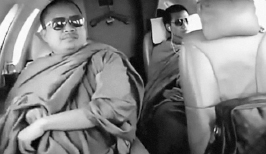
Figure 8. Photo still from “Buddhist Bling” video (http://www.youtube.co/watch?v=sANFgwoJeic&feature).
Such suspiciousness about the worldliness of Buddhist monks is centuries old because wealth has always been central to Buddhism. Already in medieval Indian dramas, the wealthy and lascivious Buddhist monk was a stock figure of ridicule. In Kṛṣṇamiśra’s tenth-century play Prabhodhacandrodaya, a Buddhist monk introduces himself with a verse: “Oh, excellent is this teaching of the Sugata [Buddha], which combines comfort and salvation! For: We live in splendid buildings, we are surrounded by the wives of merchants eager to serve, we have delicious food at any time and our beds have soft spreads. Our full moon nights are passed in the company of most devout women, playfully prepared to do anything.”20
During this time, monasteries in India were becoming so large and rich that Buddhist jurists had to find legal loopholes to allow the monastic community to accept and keep ever grander gifts, such as mansions with slaves, fields, and cattle (all of which could be rented out at profit), but also “goods and objects of extraordinary value … such as ships, dams, irrigation tanks, parks and fields.”21 By following the Dharma’s prosperity theology, some among the Buddhist laity became very rich, and their wealth flowed into Buddhist monasteries in the form of gifts. As one Chinese source records, the wealthy gave to Buddhist monks “as generously as if they were slipping shoes off their feet. The people and wealthy families parted with their treasure as easily as with forgotten rubbish. As a result, Buddhist temples were built side by side, and stupas rose up in row and row.”22 Now as then, the notion that Buddhism or Buddhists are divorced from the economic world is, indeed, “ludicrous.”
Building on Weber’s insight that religion is crucial to any economic system, scholars have recently shown how modern Protestantism, especially in the United States, has been an essential factor in the institutionalization of neoliberal ideology.23 Many scholars consider neoliberalism the reigning ideology of our time, according to which the free market is an ethic “‘capable of acting as a guide for all human action.’”24 Indeed, Christianity has been adept at absorbing the values of different economic systems since it began. As Peter Brown has shown, early Christian doctrine transformed so as to accord with the Roman Empire’s increased wealth and market ideologies.25 In the medieval period, Christians similarly adapted to increased urbanization and trade by “engaging in money-lending (despite prohibitions against usury), and offering critiques of moral problems associated with avarice.”26 Today’s preachers of the prosperity gospel are therefore following a long-established Christian tradition.27
I bring up Christianity’s relation with neoliberalism to draw a historical parallel between today and Axial Age India. As so much today is understood in terms of its market value—be it education, the role of the state, or our individual lives—something similar was going on in ancient India, when much of society came to be conceived in terms of the market.28 My aim is not to equate these two periods, two and a half millennia apart, or to argue that capitalism or neoliberal thought began in ancient India. Rather, my point in juxtaposing the marketization in Axial Age Indian society with neo-liberalism today is to help us understand the distinctiveness of Buddhism.
With marketization and the introduction of money in Axial Age India, major economic, political, and social transformations ensued. As I discussed in Chapter 1, before the axial turn, India was divided into small, clan- or lineage-based polities that survived on farming and nomadic pastoralism, and money had not yet been introduced. Social cohesion was achieved through the elaborate rituals of Vedic religion, which, resembling the potlatch of North America’s Northwest Indians, both destroyed and distributed wealth. Yet the changes wrought by the Axial Age made this system no longer viable. Indeed, the development of all the renouncing traditions at this time, such as Buddhism and Jainism, actually reflect this transformation to a market economy, since a religious system based on householders and mendicants required a market economy in which the laity could make money and in turn financially support its renouncers. Marketization became so central that even the ethical system of Axial Age India, the theory of karma, is premised on the metaphor of the bank account.29 Karma is like money: you earn it, save it, store it, lose it.30
Schools of thought in the Axial Age can be distinguished by how they responded to the social transformations going on around them. Philosophers were coming to terms with the breakdown of the communal bonds that Vedic ritual had formerly maintained. The Hindu response was a religio-ethical system of social stratification. This system was divinely ordained and immutable such that one’s social standing, and very often one’s occupation, was justified on the ontological grounds of karma. The Buddha roundly rejected this system.
Many scholars therefore assume that the Buddha’s critique of the Hindu caste system and Buddhism’s attendant prosperity theology are sufficient to explain why the merchant class was so receptive to the Dharma. Indeed, the notion that Buddhists were the urbane, cosmopolitan merchant elite of the ancient world and that Hindus were the rural conservatives clinging to social structures at odds with an urban market economy has become so engrained that historians use it today to explain economic cycles of Indian history.31 André Wink’s study of eighth- to twelfth-century Malabar is a good example. Wink argues that because Hinduism imposed restrictions on maritime travel and social interaction, the burgeoning market came to be controlled by Buddhists, Jains, Muslims, and Jews, whose status and social ranks derived not from the caste system but from “the tradition of physical mobility and participation in trade.”32 Which is absolutely true; however, where analyses such as Wink’s fall short is in their neglect of the Buddhist theory of anatman—the key conceptual difference between Hinduism and Buddhism—and how it relates to the broader social, economic, and political realities of the Axial Age.33
As they came to terms with the breakdown of communal bonds, Axial Age Hindu philosophers developed the idea of the atman (soul or self), but the Buddha roundly rejected and negated this concept with the concept of anatman.34 I introduced anatman in Chapter 2, but here I want to show how anatman radically challenged both the standing social order, which Hindu thought had institutionalized, and the possibility of wealth production.
Hindu atman theory held that all humans have a soul that is reborn in life after life, in higher or lower forms, in accord with the theories of reincarnation and karma. Good deeds are rewarded in the next life with a better rebirth, and bad deeds result in a worse life. Hindu atman theory therefore not only promotes a system of ethics but also establishes and theologically justifies social stratification as immutable from birth to death according to the mandates of dharma. According to Hindu thought, one’s dharma (“code of conduct”), or “duty,” is to live according to the obligations of one’s particular social group at birth, which is, of course, the result of one’s karma. If my karma has caused me to be reborn as a low-caste individual, then it is my duty to live righteously within the dharmic obligations of that particular group for the course of my life. I cannot try to change my social position since that would violate my dharma, which in turn would produce further bad karma, leading to yet another bad rebirth. According to Hindu thought, only by living according to the dharma dictated by one’s birth can an individual improve his or her karma and be rewarded with a better life in the next rebirth. This whole cycle will continue indefinitely until one achieves liberation (moksha) from the entire cycle of birth and death. In short, Hindu thought was premised on maintaining the social order, or what Louis Dumont termed Homo hierarchichus.35
The question of karma as the engine of samsara was at the intellectual heart of India’s Axial Age.36 The founder of the Jain tradition, Mahavira, postulated that karma (or actions in the world) produced something akin to a physical reality that stuck to your soul—a cosmic cholesterol, if you will—and thereby pulled you down from the ethereal heavenly realm into our debased material world.37 To release the soul from this debased world of birth and death, Mahavira argued that all karmic production must cease because only when there is no karma burdening the soul will it ascend beyond samsara. For this reason, Jain monks today wear surgical masks to avoid inhaling (and thereby killing) insects. Similarly, they also carry a broom to sweep away bugs in their path, because stepping on a bug would produce karma, causing the soul to remain mired in the material world of suffering. In one branch of the Jain tradition, the ultimate monastic ritual is starvation, since only by ceasing all activity, including eating, can the karma that encumbers one’s soul be burned off. Refraining from all action will prevent karma from being produced, and only then will the unclogged soul be liberated from the cycle of samsara. The Buddha, however, rejected this Jain theory of karma as well. In his view, karma is not a physical reality, and it is produced only if an action is consciously or intentionally undertaken. Thus, according to Buddhist thought—as we saw in the case of killing animals for food—stepping on a bug accidentally does not have a negative karmic consequence, but doing so intentionally does.
Today’s popular understanding of karma—that one’s actions, or karma, will dictate future rebirth—is Hindu in origin not Buddhist. In the Axial Age, it justified social stability, and, as Wink and others have argued, it hindered mobility and social transformation in a market economy. It also undermined the possibility of free will on account of dharmic duty. Buddhist teaching, in contrast, holds that there is no essential, permanent self. This means that humans make a fundamental ontological mistake when we assume that we have a soul, a self, or an ego, and believe that we exist as permanent beings. In fact, it is the very concept of the self (atman) that leads us to want to satisfy our particular desires, whereby we act in the world and produce karma. This karma then brings about more births and perpetuates the cycle of suffering. Buddhist theory is grounded in impermanence and constant change and thus enshrines the possibility of change and individual actualization.
According to anatman theory and the view of karma as being defined by intentionality, the individual is neither bound by the past nor constrained by the future. If not bound by either caste or fate, one is able to do or become anything. Of course, karma shapes one’s circumstances—say, if one were born as a man or a woman. But, within the confines of one’s “bag of skin with nine holes in it”—as the Buddha so eloquently put it—the Buddhist idea of anatman or no-self promoted the possibility of everyone acting as free agents in the new market economy. So, whereas the Hindu atman concept was at odds with the larger world of social mobility unleashed by the monetizing, commodifying, and urbanizing world of Axial Age India, the Buddha embraced the social transformations of the time through the concept of anatman.
Much like Socrates pushed against Greek notions of fate, the Buddha pushed against fatalistic karma theory, placing free will and individual actualization at the center of his thought. With the theory of no-self, the Buddha opposed the Hindus, who bound everyone’s fate to the duty obligations of one’s birth; the Jains who imagined all humans to be bound by the iron laws of karma; and the Ajivikas as well, who saw karma as simply an unspooling thread of fate that nothing could be done to change. Instead, the Buddha taught that nothing essentially defines us. Our place and condition of birth are not the result of anything we specifically did in the past, and the circumstances of our birth cannot and should not bind us. The past, the present, and the future are not predetermined. By extension, he taught that one’s status or social rank at birth is, by definition, unearned,38 so that being born to Brahmin status, for instance, is not admirable in itself, because nothing was done to achieve it.39 Indeed, the Buddha continually mocked Brahmins for thinking they were special by virtue of their birth.40
The Buddha’s theory of anatman and karmic intentionality provided ideological justification for a social system whereby social and moral worth arose not from birth, blood, or karma, but from wealth. As they are today, social status and moral value were confirmed by one’s success in the market economy. The Buddha therefore not only institutionalized the monastic-laity social order but also embedded wealth creation centrally in Buddhist doctrine and practice. The Buddha and those who codified his teachings embraced the monetized economy and its new merchant elite, and the merchant elite embraced the Dharma because the Buddha gave theological ballast to the new social realities of Axial Age India.
Buddhist texts are therefore preoccupied with how wealth can be attained, or lost. A recurring figure is the wealthy son who squanders, or is unable to maintain, the family fortune.41 Another figure that reflects the new market-driven world is the anxious parent who, much like many parents today, frets over their child choosing a career that will ensure a secure financial future.42 Juxtapositions of extreme poverty and wealth can be found throughout the Buddhist canon, as in the story about the monk Sudinna. Sudinna witnesses a famine in the cities of Verañja and Vajjian and reflects: “In Vesali my relations are rich, with great resources and possessions, having immense (supplies of) gold and silver, immense means and immense resources in corn.”43 Yet at no point does Sudinna consider using this wealth to alleviate the famine. Rather, the implication is that the famine was the fault of the local residents and they need to overcome it themselves.
These and many other examples from the early Buddhist canon illustrate that Buddhism developed in response to the new market economy of Axial Age India and that the Dharma embraced the creative destruction that these processes unleashed. As Christian prosperity theology today legitimates the neoliberal order, the Dharma legitimated the marketization of society in early India through the concept of anatman. And as the Dharma spread, these market-based ideas were institutionalized across Asia.
The connection between Buddhism and the market deepened with the later Mahayana theory of emptiness, since, as noted above, the rise of emptiness and its rhetorical claims of the meaninglessness of material realities, including money, coincided ironically with the expanding global economy.44 This dynamic is well borne out by the central Mahayana text the Lotus Sutra, which promotes both the doctrine of emptiness and its “worldly benefits … gained from devotional practice as well as the pious performance of secular occupations, including those related to merchant activity.”45
Thus in all Buddhist traditions, wealth and social status confer moral and social value in place of birth, blood, or karma. Because market activity was part and parcel of the Buddhist teachings, both the laity and monastic institutions unsurprisingly found themselves at the forefront of monetizing Asia’s economy. The dynamic that the Dharma’s prosperity theology put in motion made Buddhism a successful religion across Asia. The wealth and the status that it conferred mattered profoundly to Buddhists, and, as the next chapter begins to explore, that wealth was largely produced by transforming the natural world.