
CHAPTER 1
For fans of everything spooky, Pennsylvania has a reputation as an unmitigated disappointment. Massachusetts has its witch trials; New Jersey has its Jersey Devil; North Carolina has an armada of ghostly shipwrecks; and sixteenth-century Virginia mysteriously lost the entire colony of Roanoke.1 By comparison, the Quaker State seems positively dull—until you take a look beneath the surface. The relationship that early Pennsylvanians had with the metaphysical was notable, not because of the extremity of it, but because of the eerie banality of it. Because of the way the colony developed, Pennsylvanians had a much different approach to the unexplainable than their counterparts in the other 13 colonies.
For most people, the top of the supernatural pyramid is, and has always been, witches. Any study of witchcraft and magic in Chester and Delaware Counties must start with England, from which a majority of Pennsylvania’s early residents hailed. During the reign of Elizabeth I (1533–1603), the English view of witchcraft was surprisingly ambivalent, especially given the horrors burning their way across parts of Europe and Scotland during the same period. Granted, England had just emerged from an era of religious tumult that resulted in the first reigning Queen of England gaining the moniker “Bloody Mary” for burning over 300 religious dissenters at the stake during her five-year reign, so perhaps a time of relative quiet was in order.
Queen Elizabeth I executed her fair share of religious dissenters, make no mistake—but her target was Catholics, who she felt were actively trying to overthrow her government. The savvy Elizabeth charged these dissenters with treason, thus shifting the context of their crimes from religious to civic. Since witches were evidently uninterested in overthrowing the government, they managed to avoid much persecution during the reign of The Virgin Queen, and even when they were convicted for practicing witchcraft, their treatment tended to be more relaxed. Capital punishment was usually reserved for accused witches whose actions resulted in serious injury or death to another human being, as opposed to more benign activities like bewitching cows, flying on brooms, and appearing in spectral form. In addition, the English were unlike other European countries in that they banned the use of torture to extort a confession—at least for witchcraft. Again, suspicion of treason was another matter entirely and extracting information through torture was the accepted practice.
In Scotland, the occult landscape was much different. England’s northern neighbor underwent a bloody religious revolution in 1560, converting from a Catholic country that hated witches into a rabidly Presbyterian country that turned hating witches into a gruesome art.
Although King James (1566–1625) had his disagreements with the Presbyterians (namely, their dislike of being ruled by a monarch) they could at least agree on the treatment of witches within Scottish borders. When the journey to Scotland of James’ intended bride, Anne of Denmark, was beset by storms that pummeled her fleet and forced her to take refuge in Norway in 1589, both James and the Presbyterian government agreed that the catastrophe was clearly the work of witches. In 1590, James imprisoned more than 70 people on the charge of raising the storms that almost succeeded in killing Scotland’s new queen, and most confessed under torture. Nine years later, James became the first monarch in history to write a treatise on witchcraft, which he called Daemonologie. In 1603, he inherited the throne of England, and he brought the brutal Scottish approach to witch-hunting with him. Where England had only executed witches whose acts had resulted in physical harm to a victim, James’ government deemed the practice of any form of witchcraft a cause for execution. Simply having the “devil’s mark,” which could be any mole, freckle, scar, or imperfection anywhere on an accused witch’s body, might result in a death sentence.

James I of England (c. 1605) and his Queen, Anne of Denmark. (Wikimedia Commons)
James died in 1625, after years of increasingly debilitating arthritis, gout, and kidney stones that rendered him a pathetic figure in his own court and resulted in a serious stroke that finally took his life. During his decline, the rise of intellectualism and scientific inquiry dampened the public’s enthusiasm for witch-hunting, and England entered a brief period of calm. The relief was short-lived as his son Charles I ignited an internecine conflict that began the moment he ascended the throne and escalated in the 1640s into a civil war. England was already primed for witch fever when a man named Matthew Hopkins, a self-appointed “Witchfinder General,” appeared in East Anglia in 1645 and promptly set off the worst period of demonic hysteria in England’s history.

Title page of Daemonologie by King James I, published in 1603. (Wellcome Library, London. Wellcome Images images@wellcome.ac.uk http://wellcomeimages.org.Wikimedia)
The eastern part of England was home at the time to a population of rabid Puritans for whom even the faintest whiff of heresy threatened their entire community, and due to the civil war there were no royal officials with enough power to keep them in check. Hopkins preyed on the Puritanical fears of hellfire and brimstone, using such “evidence” as moles, warts, or even fleabites as proof of congress with the devil. In Bury St. Edmunds alone, no fewer than 68 people were put to death for witchcraft; the citizens of Chelmsford hanged 19 people in a single day.
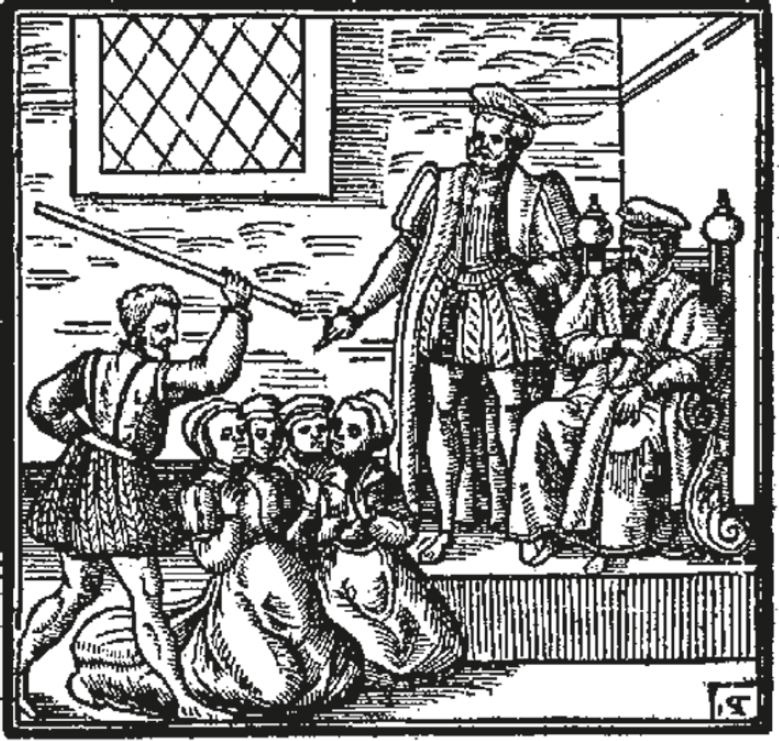
Illustration of witches, perhaps being tortured before James I, from his Daemonologie. (Wikimedia)
Hopkins’ reign of terror even made its way to the New World, as his witch-hunting manual, The Discovery of Witches, was first published in 1647 and shipped overseas. Almost immediately the Massachusetts Bay Colony copied his techniques in the trial of Margaret Jones in 1648—the first woman executed in that colony for witchcraft. In a perhaps wishful revisionist history of Hopkins’ death, a story developed that Hopkins was subjected to his own swimming test and executed as a witch by the same Puritans for whom he’d acted as firebrand. Sadly, this is untrue—he died in 1647 at his home in Manningtree, Essex of pleural tuberculosis and was buried at the Church of St. Mary at Mistley Heath.
While England was going up in flames (both proverbial and literal) the French took a somewhat more whimsical view of witchcraft as a technical but generally harmless evil. The court of Louis XIV became famous for its use of fortune tellers, seances, and other naughty metaphysical diversions. The fun and games of the court’s mystical obsessions provided a glossy veneer for its sinister underbelly, in which people were dying in the name of demonic power. In 1675, a French aristocrat named Madame de Brinvilliers was brought to trial for the poisoning of her father and two brothers in order to inherit their estates. She was found guilty, beheaded, and her body burned. In the following years French police, led by Nicholas de la Reynie, uncovered witchcraft, black masses, and an entire upper class of French society rife with accusations of poisoning and murder. The Chambre Ardente (“Burning Court”) executed at least 36 people for witchcraft and/or poisoning, while five were sentenced to the galleys, 23 were exiled and at least 65 men and women were sentenced to prison for life.2 The whole debacle only ended in 1682 when accusations involving Louis XIV’s official mistress led to embarrassing questions about the Sun King himself. He silenced the entire affair with a lettre de cachet, essentially an early French gag order.
So it was that William Penn, on the heels of the French witchcraft hysteria and after 40 years of religious upheaval in England, arrived in the New World bearing title to the lands now known as Pennsylvania and Delaware. Penn was an avowed Quaker, which rendered him part of a religious minority that had been persecuted in England with imprisonment, mutilation, and execution. Quakers believed that all men and women were equal in the sight of God and could be touched by His divine light without the aid of a religious leader. They also maintained that the Bible should not be interpreted literally, and opposed any form of religious dogma. This outlook was anathema to Puritans, who valued a literal treatment of the Bible and very strict behavioral parameters. Even in New England, purportedly founded by the Puritans in the spirit of religious freedom, laws against the practice of Quakerism included punishments like having one’s ear cut off or having one’s tongue bored through with a hot iron. When five Quaker women left the safety of the relatively free-thinking Rhode Island to support their comrades in Boston, officials immediately arrested them and had them checked for witch’s marks. In the Puritan mind, being a Quaker was almost as bad as being a witch. Mother England was concerned enough about the actions of the Boston Puritans that it released a charter that required them to make a vow to protect all Christian sects—except, of course, the Catholics.

The Quaker Mary Dyer being led to her execution on Boston Common on June 1, 1660. She was hanged for repeatedly defying a law banning Quakers from the Massachusetts Bay Colony. (Wikimedia)
With persecution fresh in his mind, William Penn determined that his new colony would be a home for religious freedom. Though Penn heavily recruited from amongst his own population of English Quakers, he also appealed to hardworking emigrants from all over Europe. Penn had a prodigious task ahead of him, because establishing religious liberty was one thing—enforcing it was quite another. Penn would have to navigate all the dangerous waters surrounding religion—who constituted a majority? A minority? What rights could they each expect? What were the limits of a government that legislated based on morality? What property rights and privileges could churches and clergy enjoy? Penn also knew that these questions might not be answered in his own lifetime—he had to lay a proper foundation for his colony without knowing how the final product would mature, and without any successful examples to light his path.3
Penn began by celebrating the many ways that the various Christian sects agreed, instead of how they differed. He argued that property and liberty of conscience were natural rights, and that by attacking property in the name of religion the government committed a violation of its central and sacred purpose. He even managed to include England’s largely despised Roman Catholics in the Christian fold by sagely observing that “we must give the liberty we ask, and cannot be false to our principles … for we would have none suffer for a truly sober and conscientious dissent on any hand.”4
There was, however, a limit to Penn’s religious liberty—his basic tenet required a belief in God in some form. Historian J. William Frost noted that:
Any individual living in the province who shall “Confess and acknowledge one Almighty God to be the Creator and Upholder and Ruler of the World” and who “Professeth him or herself Obliged in Conscience to live Peaceable and Justly under the Civil Government” shall not be molested for “his or her Conscientious Perswasion or Practice” or obliged to support a place of worship or minister against his persuasion ….5
Lest anyone miss the point, Penn went on to specifically state that his insistence on religious liberty was not intended to allow “looseness irreligion and atheism.”6 Because anyone holding official positions had to profess a belief in the divinity of Christ and the Old and New Testaments, Jews were among those excluded from positions of power.
England’s legacy of persecution and suspicion provided a test for Penn’s colony within two years after his arrival in October 1682. The controversy revolved around Margaret Mattson, who had arrived in Pennsylvania in 1654 with her husband Nils and a wave of early Swedish immigrant settlers. In 1670, the Mattsons settled on a 100-acre parcel of land located near Ridley Creek in what is now Eddystone, Delaware County, where Mattson developed a reputation as a practitioner of a Finnish form of healing folk magic.
In 1683, Margaret Mattson was accused by several members of her community—and even her daughter-in-law—of crimes including making threats against neighbors, causing cows to give little milk, bewitching and killing livestock, and appearing to witnesses in spectral form (a female neighbor named Gertro [or Yeshro] Hendrickson was also accused of similar crimes). With the horrors of the English witch trials fresh in his memory, Penn prepared to face this new challenge to harmony in his colony. Penn was in a sticky situation, because his colony still fell under English common law, and James I’s strident Witchcraft Act of 1604 brought the penalty of death to suspected witches. In order to walk the fine line between English law and his own law, he was going to have to get creative.
Penn took charge of the case himself, selecting a jury of 12 men and appointing an interpreter for Mattson and Hendrickson, who spoke no English. Penn barred the use of prosecution and defense lawyers and he alone conducted the questioning. Folk history maintains that at one point during the trial, Penn asked Mattson whether she had ever ridden through the air on a broom, as witnesses had claimed. Mattson misunderstood the question and answered in the affirmative, and the audience gasped. After a moment of contemplation, Penn announced to the crowd that he was not aware of a specific law against the riding of brooms. This anecdote is not supported by the historical record, but does demonstrate the kind of tightrope-walking Penn had to do.
After the end of testimony, Penn made a closing statement and reminded the jurors of the letter of the law. To our great loss, this statement went unrecorded, because the verdict was quite a mind-blower. The jury found that Mattson was “guilty of having the common fame of a witch, but not guilty in the manner and form as she stands indicted.”7 Essentially, Mattson was guilty of giving cause her for neighbors to believe she was a witch, but that she was not guilty of having committed specific acts of witchcraft. She was given a fine and returned to her farm.
This unusual verdict accomplished everything and nothing at the same time, for it did not address the legality or illegality of practicing witchcraft directly, only that the jury could not prove that she had committed the specific injuries of which she’d been accused. She could be thought a witch, and she might actually be a witch, but she hadn’t injured anyone. But for William Penn, he had dodged a proverbial bullet that could have killed his great experiment in its infancy.
Mattson’s trial was the first, but not the last time Quakers had to address what it meant to practice witchcraft in Pennsylvania. Even outside of the question of whether it was evil, most Quakers just didn’t see the point of being a witch or of prosecuting suspected witches. According to historian David Fischer, “Quakers had no need of the devil to explain the existence of evil in the world, nor any use for geomancy to predict the future. Few believing Christians of any faith have ever shown so little interest in the black arts. Quakers commonly regarded the wrongs of the world as the work of man rather than the Devil—and especially the product of carelessness, ignorance, and human error.”8 To Quakers, why use witchcraft when you should be able to discover truth using your own inner light?
In 1695, the Concord Monthly Meeting had to address the questions of what constituted witchcraft and if they were in a position to punish it. In the autumn of that year, the monthly meeting met to discuss the activities of Philip and Robert Roman, and in their minutes recorded the following: “Some friends having a concern upon them concerning some young men who came amongst friends to their meetings and following some arts which friends thought not fit for such as profess truth to follow, viz., astrology and other sciences, as Geomancy and Chiromancy and Necromancy, etc. It was debated and the sense of this meeting is that the study of these sciences brings a vail over the understanding and a death upon the life.” The meeting then assigned two Friends to discuss the matter with the Romans, whose response was to challenge the meeting to prove to them that what they practiced was wrong, and they would desist.9

Concord Monthly Meeting Building. (Author)
Finally, the grand jury of Chester County charged Robert Roman for “practising Geomancy According to hidon and Divineng by A sticke.”10 The punishment for practicing the dark arts in this case was a fine of five pounds and a warning to behave better in the future. In addition, three of Roman’s books, including Hidon’s Temple of Wisdom, which taught geomancy, Reginald Scot’s The Discoverie of Witchcraft, and material by Heinrich Cornelius Agrippa, which explained necromancy, were confiscated and burned. Roman evidently complied with the jury’s instruction because he doesn’t appear in future records.
Concern about witchcraft in Pennsylvania petered out after 1700. An accusation of witchcraft was brought to the attention of the Council in 1701 but dismissed as trifling.11 In 1719, the justices of Chester County (which then included Delaware County) inquired into “witchcrafts, enchantments, sorceries, and magic arts,” but it does not appear that it was precipitated by a specific incident—more just a general reminder to the public to avoid being witchy.12
While witchcraft wasn’t officially punished in Pennsylvania, at least one Delaware Countian considered it better to be safe than sorry. In 1976, while excavating in Governor Printz State Park in Essington, workers uncovered an unusual artifact. They found, buried upside down in a small hole, a dark, olive-colored bottle with a gold patina and a hand-whittled wooden plug. Placed under the shoulders of the bottle were a long, thin bone thought to be from a bird, and a redware rim sherd that appeared to come from a small, black-glazed bowl. Stranger still, found inside the bottle were six round-headed pins. Archeologist Marshall Becker concluded that this particular find was the first known example of a “witch bottle” found in America.13

The Essington witch bottle. (Marshall J. Becker)
Other archeological examples of witch bottles had been uncovered in England, so Becker knew what he was dealing with. English witch bottles contained ingredients as complex and varied as nails, human hair, fingernails, blood, urine, wine, rosemary, and even felt cut into the shape of a heart. The bottles themselves could be made of glass, terracotta, or stone. Witch bottles represented a sort of “white magic” that could either serve as a prophylactic to prevent the general working of magical mischief against the household, or in response to a specific attack. In the case of the former, the bottle would be buried during construction of the house, typically under the hearth or threshold where it would remain undisturbed and unbroken. In the case of the latter, the bottle might be buried outdoors or thrown into a river. The inverted position of the bottle was meant to reverse whatever ill effects the victim suffered back onto the practitioner.

Sealed with a carved wooden plug (center), the Essington witch bottle contained pins (left), a piece of pottery and a bird bone (right). (Marshall J. Becker)
Workers discovered the Essington witch bottle while excavating the Printzhof, the original residence of the Swedish colonial governor Johan Printz, who lived in the colony between 1643 and 1653. The bottle itself was discovered outside of the confines of any known structure, leading Becker to assume that it had been buried to deflect a direct magical attack. Experts dated the bottle’s manufacture to around 1740, meaning that it was probably buried by the Taylor family, who lived in the house around that time and hailed from England. What precipitated the burial of the bottle is nearly impossible to guess, but Becker hypothesized that the pins, and the possible presence of urine in the bottle, might indicate that the Taylors thought it could cure bladder stones or some other common urinary ailment, sometimes thought to be caused by witches.14
Witch bottle ingredients like nail clippings, hair, and urine indicate a reliance upon the idea of “sympathetic magic,” or that a person can be magically affected by a physical representation of their body, like sticking a pin into a voodoo doll. The widespread acceptance of sympathetic magic in the eighteenth century bridged the gap between the supernatural and the scientific in an astonishing way—the field of “sympathetic medicine.” The main difference was that rather than using a symbolic representation of the human body, the afflicted ingested parts of the human body in very specific ways.
Proven examples of “medicinal cannibalism” are sparse in the New World but given their prevalence in Europe—and especially England—at the time, it is reasonable to assume that the practice continued in America. Prescriptions using sympathetic medicine could include almost any part of the human body, including blood, bones, fat, and sweat, and were compounded into forms as diverse as teas, tinctures, salves, lotions, and inhalants. A common remedy for migraines might include powdered human skull, just as nosebleeds called for human blood. Animal parts were not considered as effective, since animals lacked the spirit and healing strength imbued by Almighty God.
In an era before germ theory, physicians embraced sympathetic medicine as a reasonable response to diseases otherwise beyond their control. In Galenic medicine, blood was one of the four essential humors, and so it stood to reason that blood was the solution for a depletion or imbalance in that particular area. Even those who did not subscribe to humoral theory touted the benefits of blood; Galen’s biggest critic, Paracelsus, believed that drinking blood on certain days and times of the year could cure epilepsy.15 Sir Theodore Turquet de Mayerne (1573–1655), a physician to no fewer than three English kings (James I, Charles I, and Charles II) and one Protector of the Realm (Oliver Cromwell) published his recipes for popular use. For James I’s gout, de Mayerne prescribed “an arthritic powder composed of scrapings of an unburied human skull” with herbs and white wine. He recommended a painkilling plaster made with opium, hemlock, and human fat, and promoted other remedies including the lungs of a man who had died a violent death and the placenta of a woman who has born a male child.16
The special healing properties of dead bodies went beyond the mere physical—there also existed a belief in the transmutation of the life force from a deceased individual to a living sufferer through the power of simple touch.17 An April 19, 1758 issue of Gentleman’s Magazine reported:
James White, aged 23, and Walter White, his brother, aged 21, were executed at Kennington Common, for breaking open and robbing the dwelling house of farmer Vincent of Crawley. They acknowledged the justice of their sentence, but laid their ruin to an accomplice, who, they declared, decoyed them from their labouring work, by telling them how easily money was to be got by thieving. While the unhappy wretches were hanging, a child about nine months old was put into the hands of the executioner, who nine times, with one of the hands of each of the dead bodies, stroked the child over the face. It seems the child had a wen on one of its cheeks, and that superstitious notion, which has long prevailed, of being touched as before mentioned, is looked on as a cure.18
“Stroking,” or being healed by the touch of a deceased individual, was thought to transfer healing energy that remained in the body immediately after death, especially in those for whom life had been cut short far ahead of their natural time—like executed criminals. Since newspapers published the planned dates and times for executions, the suffering could make plans to be as close as possible when the deed was done, as it was well known that healing energy began to wane immediately after death.
Much of what we know today about medicinal cannibalism and “the gallows touch” came from newspaper reports of the day. While common sense dictates that a people of English extraction most likely brought English beliefs with them, it is difficult to determine if this was true of Pennsylvania’s early Quakers. Scant evidence appears in colonial newspapers to substantiate arguments in either direction. Pennsylvania’s early criminal code called for execution for only two crimes—treason and murder—as opposed to the over two hundred crimes punishable by death in England, so actual examples of hanged criminals were much fewer. The resulting lack of executed criminals, paired with fewer early newspapers to report on them, has contributed to an unclear picture of the gallows touch and corpse medicine in early Chester and Delaware Counties.
We do, however, have access to examples of “stroking” in Pennsylvania among settlers of German extraction, though the emphasis was less on the hanged man and more on the ordinary deceased and the objects surrounding their demise. Wayland D. Hand, in his analysis of folk medical curing among the Pennsylvania Germans, cited examples in which the hangman’s rope was used for curing “fits” in Pennsylvania, and people suffering headaches could be cured by tying around their head “the halter wherewith a person had been hanged.” The rope utilized by someone to commit suicide was thought to treat epileptics. More frequently, early Pennsylvanians would have visited houses where the recently deceased were laid out, or even gone straight to the undertaker’s, in order to cure complaints like goiters and wens by rubbing a dead man’s hand over the affected area.19

Executioner holding a baby to be “stroked” by a dead man’s hand. (Mike Sharp)
All of the preceding serves to show that early Pennsylvanians experienced an intimate and everyday relationship with the supernatural. They could be the victims of perceived magical attack, but they also believed in their ability to proactively defend themselves using “white magic.” Due to the colony’s Quaker beginnings, the presence of the unknown in their lives seems to have been perceived less as an evil outer force that they must endure, and more as a fact of everyday life for which they had a ready response. This allowed Pennsylvanians a level of agency and control in the supernatural world that other American colonists did not enjoy.
Notes
1To be fair, Pennsylvania and Delaware (both part of William Penn’s original land grant) do have examples of shipwrecks, werewolves and lost colonies, but are outside of the scope of this particular analysis.
2Anne Somerset, The Affair of the Poisons: Murder, Infanticide and Satanism at the Court of Louis XIV (New York: St. Martin’s Press, 2003), 310
3J. William Frost, “Religious Liberty in Early Pennsylvania,” The Pennsylvania Magazine of History and Biography, Vol. 105, No. 4 (Oct. 1981), 419–451.
4Ibid., 423.
5Ibid., 425–426.
6Ibid., 426.
7John Fanning Watson, Annals of Philadelphia and Pennsylvania in the Olden Time; Being a Collection of Memoirs, Anecdotes, and Incidents of the City and its Inhabitants… (Philadelphia: Published by the Author, 1844), 265.
8David Hacket Fischer, Albion’s Seed: Four British Folkways in America (Oxford: Oxford University Press, 1989), 528–529.
9Ibid., 528.
10Frank Bruckerl, “The Quaker Cunning Folk: The Astrology, Magic, and Divination of Philip Roman and Sons in Colonial Chester County, Pennsylvania,” Pennsylvania History: A Journal of Mid-Atlantic Studies, Vol. 80, No. 4 (Autumn 2013), 484.
11William H. Lloyd, The Early Courts of Pennsylvania (Boston: The Boston Book Company, 1910), 67–68.
12Fischer, 527–528. Although officials failed to act on suspected witches, Pennsylvanians sometimes took matters into their own hands. In 1749 a Philadelphia crowd rioted when the court refused to punish a man accused of wizardry; in the same city in 1787, an old woman was dragged from her house by a mob of young people and stoned to death in the street. Fortune tellers and witch doctors were not unknown amongst the settlers of Germantown, either.
13M. J. Becker, “An American Witch Bottle,” Archaeology, Vol.33, No. 2 (March/ April 1980), 18–23.
14Ibid., 20.
15Owen Davies and Francesca Matteoni, Executing Magic in the Modern Era: Criminal Bodies and the Gallows in Popular Medicine (London: Palgrave Macmillan, 2017), 29–52.
16Richard Sugg, Mummies, Cannibals, and Vampires: The History of Corpse Medicine from the Renaissance to the Victorians (Milton Park, UK: Routledge, 2011), 35.
17Owen Davies and Francesca Matteoni, “‘A virtue beyond all medicine’: The Hanged Man’s Hand, Gallows Tradition and Healing in Eighteenth- and Nineteenth-century England,” Social History of Medicine, Vol. 28, No. 4, 686–705.
18Ibid., 686.
19Wayland D. Hand, “Hangmen, the Gallows, and the Dead Man’s Hand in American Folk Medicine,” Medieval Literature and Folklore Studies: Essays in Honor of Francis Lee Utley, ed. Jerome Mandel and Bruce A. Rosenberg (New Brunswick, NJ: Rutgers University Press, 1970), 323–387.