
CHAPTER 2
When we think about colonial Pennsylvania, we typically envisage Philadelphia—its quaint cobblestone streets, cozy Georgian townhomes, market stalls with fruits and vegetables, and men in powdered wigs and knee breeches strolling arm-in-arm with women in enormous silk petticoats. Or maybe you imagine those same cobblestone streets, but with harried-looking women dumping overfilled chamber pots into the gutters. Both would be correct, depending on which part of Philadelphia you’re imagining. But even in 1720, the population of Philadelphia proper only stretched for roughly eight city blocks, and the farther afield you traveled from the banks of the Delaware River, the more you realized how far outside of civilization you were.
While Concord Township at the turn of the eighteenth century wouldn’t quite classify as the “frontier,” you probably couldn’t convince city dwellers of that. Between 1680 and 1699, the township only had five roads. Even by 1735, when Nathaniel Newlin Jr. began wooing Esther Metcalf of Darby, her horrified parents expressed concerns about their daughter living in the backwoods of Concord “where bears abounded.”1 The residents of Concord Township, though, recognized that their little corner of Pennsylvania had everything it needed to become a center of commerce—plentiful waterways for mills, lush and fertile farmland, timber for building, and a location close enough to Philadelphia to be attractive to incoming immigrants, but far enough away to avoid the stink, filth, and overcrowding typical of a colonial city. It was a natural waystation for wagoners moving goods from the hinterland to the ports of Philadelphia, Chester, and Wilmington, which meant that travelers of all shapes and sizes might wander through their little village in the near future.
Between 1700 and 1719, leading Concordians initiated a flurry of roadbuilding. Farmers cleared land for wheat (soon to become southeastern Pennsylvania’s major cash crop), and enterprising individuals invested in grist and sawmills along the Chester and Brandywine creeks. By 1720, southeastern Pennsylvania was well on its way to becoming a breadbasket of the colonies, but a major obstacle stood in the way—all of this required backbreaking labor, and they just didn’t have enough warm bodies to accomplish it.
The labor shortage wasn’t from lack of immigration into the area, but from lack of incentive to remain in service to someone else. In the early 1700s land was so cheap and plentiful that most immigrants coming over from Europe could either purchase land outright, or only needed to work a short amount of time before they could afford to buy their own homestead. Without the hands needed to do the work, it didn’t matter how much acreage you owned. In the 1680s a prominent Quaker named Rowland Ellis received 700 acres from William Penn that he called “Bryn Mawr,” later known as Harriton. By the 1690s, Ellis wrote to a relative that he had only managed to cultivate 15 of his 700 acres, which was barely enough to support his family. It was estimated at the time that a successful farm, providing enough food for family use and for sale, needed to have about 60 acres under cultivation. Add in the extra hands necessary to help in the mills and taverns, and the shortage of labor in the countryside became a critical stumbling block to Concord Township’s dream of growth.
The eighteenth-century landowner or businessman had a few options to bolster his workforce. First, he could get married and set about raising a hard-working brood—condemning his wife to a cycle of pregnancy and childbirth that could occupy more than 20 solid years of her life. But even the most exuberant of couples still needed to wait at least six or seven years for their firstborn to be of useful working age. To bridge the gap, the landowner might hire wage laborers who often “came to stay” for set periods of time. Many of these wage laborers were women (often extended family or near neighbors) who rendered domestic services like spinning, laundering, and butter-making in exchange for pay. Alternatively, the landowner might consider investing in unfree labor. However, while slavery certainly existed in early Pennsylvania, it never gained the traction that it did in other colonies. This had less to do with any ethical qualms than with economic practicality. Wheat grew well and plentifully in the Delaware River Valley, but it only required around 28 days per year of labor. Most early Pennsylvania farmers couldn’t justify the year-round expense of keeping and maintaining an enslaved work force when they really only needed labor three or four times per season. The larger and more diversified farms may have had more demand for year-round workers, but that demand paled in comparison to the backbreaking daily toil required by tobacco- and cotton-producing plantations to the south.
The obvious solution for Pennsylvania farmers was the indentured servant. An indentured servant was typically a man, woman, or sometimes entire family, that wished to emigrate to America but did not have the financial wherewithal to pay for their voyage. In this case, the individual could contract with a ship’s captain, who would provide passage in return for the permission to “sell” the individual’s labor contract once they reached the port. Depending on the skills of the individual, this contract typically lasted from four to seven years. At the end of the contract the individual received a parting gift like land, sets of clothes, or farming tools (as stipulated in the original agreement). For farmers just starting out with small children too young to work, or needing to clear land before planting could begin, investing in an indentured servant for a specified amount of time provided a much-needed labor cushion.
It wasn’t just farms that needed a little extra help. Every growing community needed an inn at which drovers and wagoners could stop for an evening, get a good meal, and have a roof over their head. Once Concord Township was connected by road to the bustling ports and markets of Philadelphia, Chester, and Wilmington, John Hannum saw an opportunity. He and his wife Margery had farmed their 100 acres of land since their marriage in 1690. In the 15 years following their wedding, Margery—poor thing—bore at least 12 children. Having a nest of young children required someone to help with the growing needs of the family and the farm, and in 1696 John bought the services of an indentured boy named Sandy Hunter for five years. The Hannums must have been doing well, because in 1705 John purchased 100 additional acres to the south of his original property, and when the Concord–Chester Road running past his house became a well-traveled thoroughfare, he enlarged his house and turned part of it into an inn.

The home of John Hannum in Concord Township. (Author)
In 1720, Hannum decided to invest in another servant. We don’t know if he needed help on the farm, or in the inn, or possibly a little of both. Most of his children were grown and likely out of the house by this time. We also don’t know the process by which Hannum acquired his indentured servants. It was typical in the late seventeenth and early eighteenth century to have some form of pre-existing acquaintanceship between master and servant, either directly or through family or other connections. Contracts were often oral, so few historical records exist about these early labor relationships. As a result, whether John Hannum knew William Batten before the boy arrived on American soil, or if he had any inkling about the tragic consequences that would follow, remains a mystery. William Batten, to put it lightly, came with some baggage.
William was the son of William and Alice Marten Batten of Whiteparish in Wiltshire, England. Both the Battens and the Martens had deep agricultural roots in Wiltshire that went back several generations, which is notable considering that a number of emigrants to Concord Township and neighboring Bethel Township also came from the Wiltshire area. From an early age William’s behavior troubled his parents; he lied compulsively and stole from neighbors, family, and perfect strangers. In his later confession, he claimed that he heard the voice of the Devil, who urged him to misbehave. These petty crimes resulted in him having to abscond from authorities for extended periods of time, leaving his family to make excuses for his behavior. As an adolescent he was imprisoned on multiple occasions for theft. We can conjecture that William’s family must have made reparations for his crimes, because he always managed to get out of trouble—that is until 1721, when William was 16, and he found himself on a boat bound for America.2
It is unclear how William ended up as an indentured servant. There are three possibilities: first, that he went willingly; second, that he was “spirited” or kidnapped into indentured servitude; and third, that he was sent as punishment for his crimes or in order to avoid more severe retribution in an English court. In his later confession, William stated that, “My Father feeling that there was not any Good like to come of me ordered me to be brought over a Servant into this Province of Pennsylvania.”3 This seems to indicate that it was certainly not William’s idea; it also tells us that he wasn’t shipped off by the English courts as a convict. It is possible that William agreed in response to pressure from his family, or that his father arranged for him to be “spirited” against his will.
Spiriting was a real and pervasive blight on the whole process of indenture in its early days, made worse by the early lack of contracts and proper record-keeping. A “spirit” typically used force or deceit to trick some unsuspecting victim into indentured servitude. This could include drugging the person or plying them with alcohol to the point where they were rendered senseless. When they regained their faculties, they found themselves aboard ship and already on the way to the West Indies or to the colonies, without the finances to get back home. In 1671 a spirit named William Haverland turned King’s Evidence when he was convicted of kidnapping, and he in turn identified a number of his fellow spirits. One of the men that Haverland incriminated was John Stewart, who had been spiriting for 12 years and had kidnapped an estimated 6,000 victims. Stewart maintained a well-oiled network of accomplices including strong-arm men, dealers in stolen goods, ship’s captains, merchants, and corrupt officials on both sides of the Atlantic. Stewart’s men (and sometimes women) would find likely victims and sell them to Stewart for 25 shillings, and then Stewart would re-sell them to a ship’s captain or merchant for 40 shillings apiece.4 In a port like Philadelphia, a ship’s captain could sell an indentured servant—willing or otherwise—for nine pounds or more depending on the condition and skills of the servant.5 Every transaction along the line earned the spirits and their accomplices a profit, which made it very attractive, and very difficult to abolish.
Lest you think that kidnapping people and selling them off was a new concept in Britain, you should know that the British government itself had set the precedent that made it acceptable. In 1617, councillors from 100 parishes met at St. Paul’s to discuss the overwhelming numbers of poor and orphaned children roaming the streets of London. Their solution was this: the city would pay the Virginia Company five pounds a head to take these vagrant children to Virginia as “apprentices,” under the guise that the abductees would be taught a trade and one day granted land. But the agreement with the city allowed the Virginia Company itself to decide the best future for each child, and unsurprisingly most wound up as simple laborers in the tobacco fields. Constables in London were ordered to walk the streets and apprehend vagrant boys and girls, then lock them up at Bridewell Prison until they had enough to fill a ship. Unsurprisingly this work soon had to be conducted with stealth, as Londoners frequently responded to these round-ups of their children “with swords and cudgels.” In the spring of 1619, 74 boys and 33 girls were shipped to the Americas for the Virginia Company, which promptly placed another order for more children to be delivered the following year. These children would experience an intense, if brief, period of suffering—of the 300 children shipped between 1619 and 1622, only 12 were still alive in 1624.6
While English law had taken steps to eliminate spiriting by the time William Penn arrived in Pennsylvania in 1682, it did still happen occasionally. A 1725 letter from Edward Busby to the deputy Governor of Pennsylvania claimed that Busby’s 14-year-old son had been kidnapped by Captain Sparkes of Bristol and sold to David Evans in Philadelphia for 16 pounds of paper money.7 It is unknown whether the boy was ever returned to his father.
While most of the victims of spiriting were vulnerable in some way—either transients, orphans, or beggars—they didn’t rouse in early Pennsylvanians the amount of resentment that the importation of convicts did. While most convict servants ended up in the southern tobacco colonies, some did land at the port of Philadelphia. Americans got the distinct sense—and they were correct—that England was dumping its unwanted troublemakers on the backwater colonies. A year after William Batten’s arrival in the New World, the Pennsylvania Assembly passed a series of laws meant to limit the importation of convicts, including a five-pound duty on each convict servant and a 50-pound bond to be posted by the importer to ensure each servant’s good behavior. Crafty transporters, who got kickbacks from the British government, evaded the fees by smuggling criminals into Pennsylvania from other colonies.8
While we don’t know exactly how William Batten got to Philadelphia, we know from his confession that he lingered at the port—most likely still aboard ship—for “seven or eight days.” Batten’s experiences in traveling to America were probably similar to those documented by Gottlieb Mittelberger in 1750. In his travel memoir, Mittelberger reported that each indentured servant was permitted a personal space approximately two feet wide and six feet long. He reported the conditions as such:
There is on board these ships terrible misery, stench, fumes, horror, vomiting, many kinds of sea-sickness, fever, dysentery, headache, heat, constipation, boils, scurvy, cancer, mouth rot, and the like, all of which come from old and sharply salted food and meat, also from very bad and foul water, so that many die miserably …. Children from 1 to 7 years rarely survive the voyage.9
The long wait of “seven or eight days” seems to indicate that there wasn’t a pre-existing contract or agreement between Batten and Hannum. When a vessel bearing servants arrived in port, typically the inmates were kept aboard the filthy and stinking ship while agents and potential masters surveyed the offerings and negotiated deals. If Batten was healthy, his age and condition would have made him a desirable prospect. Either Hannum or an agent acting on his behalf purchased Batten’s indenture and transported him to Concord Township. Since the indenture documents either never existed or haven’t survived, we don’t know the terms or length of the indenture. By Batten’s own account he started lying and running away within three months, and after one year Hannum sold him to Joseph Pyle of neighboring Bethel Township.
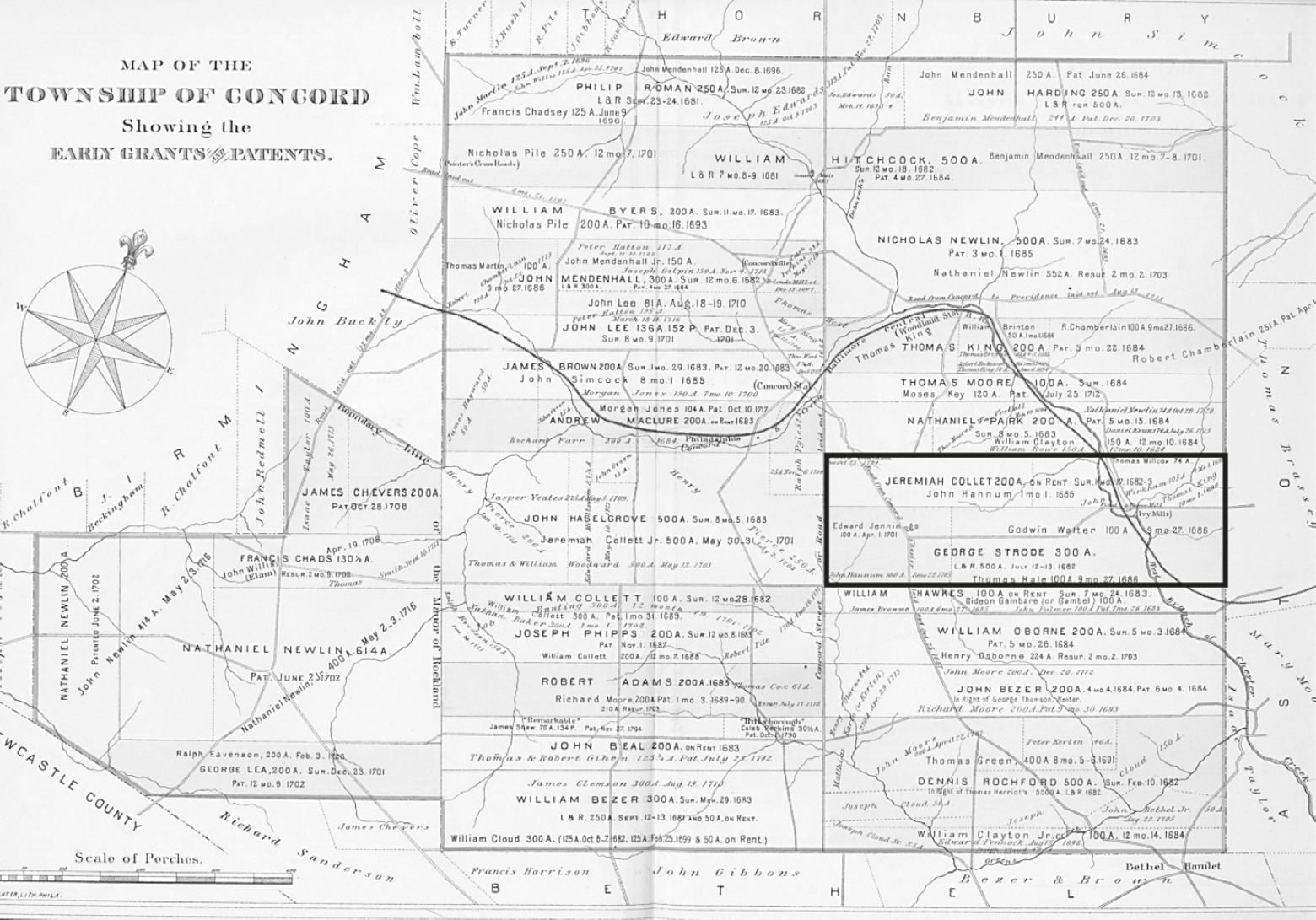
Original patent holders of Concord Township with John Hannum’s property in box. Bethel Township is directly south. (Delaware County Historical Society)
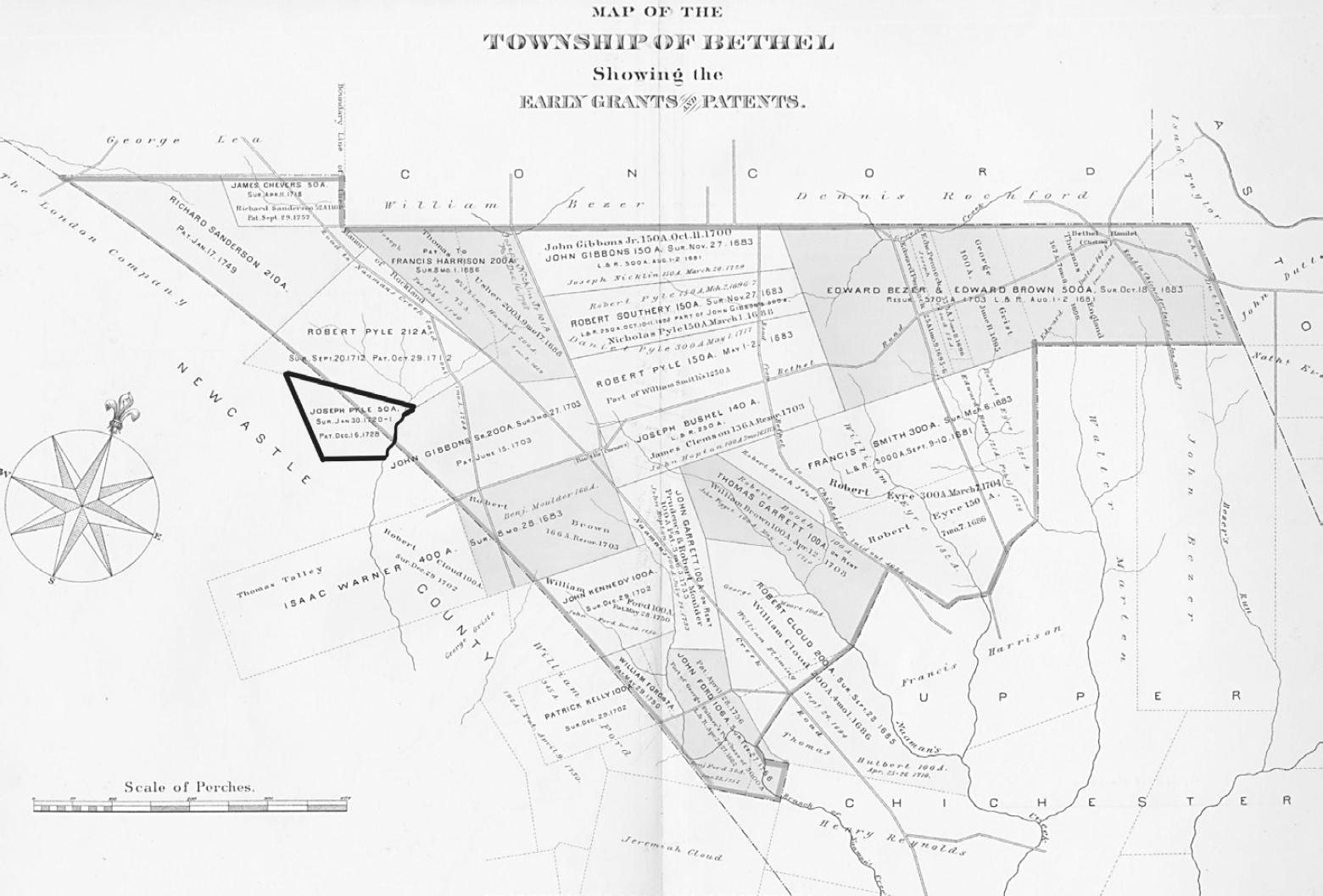
Original patent holders of Bethel Township, with Joseph Pyle’s property in box. Concord Township is directly north. (Delaware County Historical Society)
Doubtless Hannum and Pyle knew each other; the Hannums and Pyles were both prominent Quaker families in neighboring townships (though John Hannum left the Friends after 1702). John Hannum’s wife Margery grew up on a property adjoining the Pyles, and they also had mutual friends in the Newlin family, who held extensive property in both townships and had married into both the Pyle and Hannum families. What is uncertain is how much Joseph Pyle knew or understood about William’s behavior prior to John Hannum selling him. But by 1722, the Hannums of Concord Township had delivered a devil into the Pyle home.
Joseph Pyle was born in 1692 to Robert Pyle and Ann Stovey Pyle in Bethel Township, Delaware County. In 1715, Joseph married Sarah Dix, and they lived on a sizable piece of farmland not far from his father’s, straddling the Delaware state line. Not long after, Joseph and Sarah welcomed their first child, Robert, followed by Joseph Jr. in 1718 and finally little Ralph around 1720.
Starting your farming family with three sons was a run of good luck, but by 1722 Robert was still only six years old, and the Pyles needed a stronger back to help with the endless requirements of an eighteenth-century farm. At some point Joseph agreed to purchase the indenture of John Hannum’s troublesome servant, William Batten, and the 17-year-old Batten moved into the Pyle house. If Joseph was aware of William’s misbehavior, one must wonder why he agreed to take on the challenge, especially with three young children in the house. Did Joseph think he could reform William, either through peaceful or violent means? Abuse of servants was a commonplace occurrence in eighteenth-century America, and there was little legal recourse for servants to make complaint of abusive masters. Or did John Hannum manage to hide the behavior of his troublesome servant in order to offload him without losing his investment? Either way, the choices of both men led the Pyle family into disaster.
After arriving in the Pyle household, William began to hear the voice of the Devil again. On a warm summer night in 1722, Joseph and Sarah left for the evening to visit the home of Nathaniel Newlin, about a mile and a half away. William stayed behind, and about an hour later put the children to bed. After six-year-old Robert and four-year-old Joseph were tucked away in the room they shared, with little two-year-old Ralph in another room, William went up into the attic, using the light of a candle, where the apples and flax were stored to dry. As he gathered apples, he suddenly had the impulse to set the house on fire. He later claimed that it was the voice of the Devil, convincing him that he could burn the house down and everyone would suspect he’d died in the fire, leaving him free to run away. He set the candle to the dried flax and watched the flames spread.
In his confession, William claimed that he had a change of heart and ran downstairs to get water, and when he came back, he was able to douse the flames. Thinking the fire extinguished, he went downstairs and laid down by the hearth, where he fell asleep, only to be awoken by “a great noise like the firing of a gun.”10 When he ran back to the attic to find the source of the noise, the flames had already consumed much of the roof. There was no stopping the conflagration.
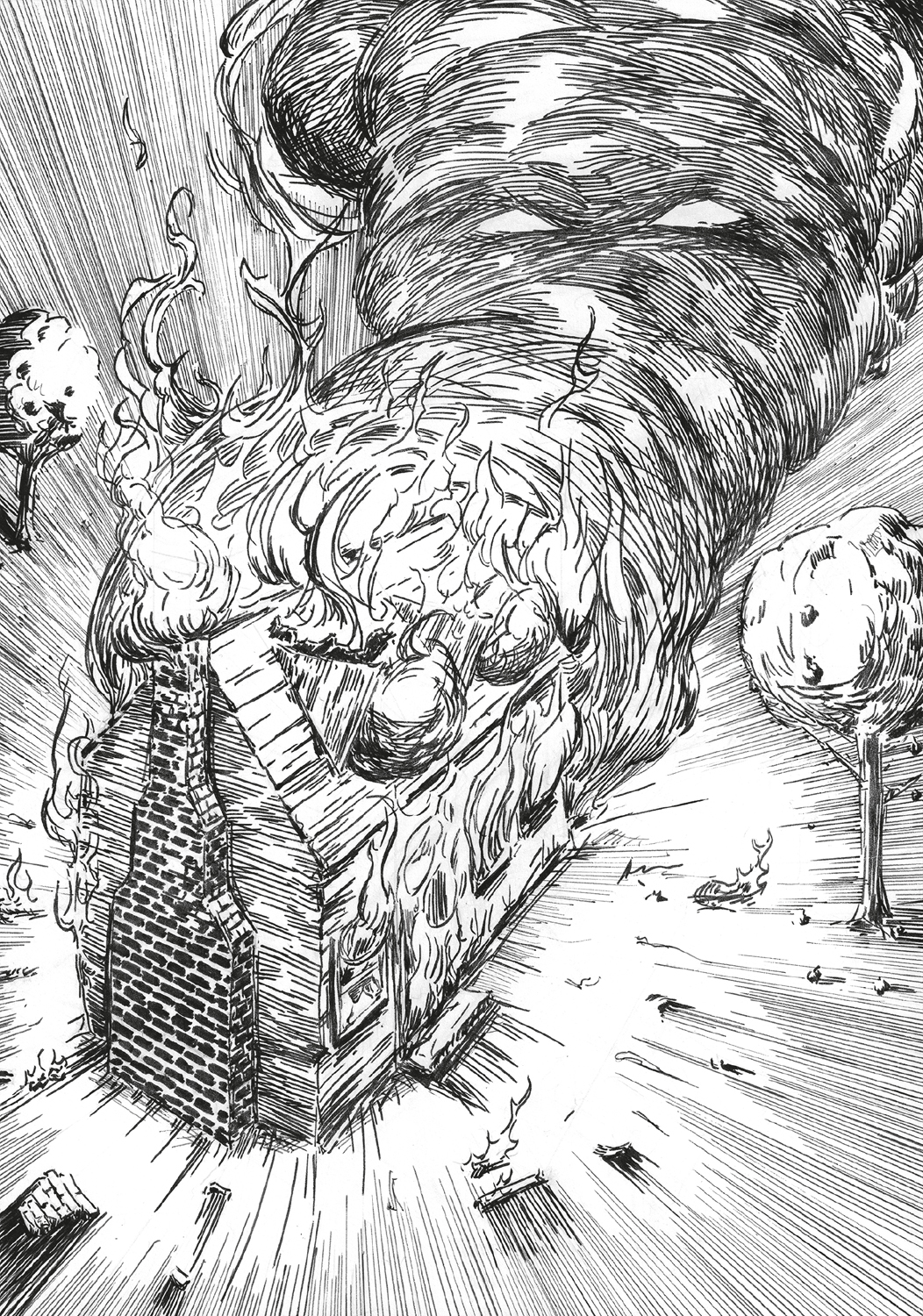
Artist rendering of the Pyle house fire. (Mike Sharp)
He fled the attic, and in running downstairs saw that Ralph had woken. William asked why the boy was awake, and Ralph responded that he wanted his mother. Instead of saving the boy, William gave him a slap and put him back to bed, claiming that the Devil had put it into his mind that he didn’t care whether the children lived or died.
At that point, William could have run away. He later argued that he realized he wouldn’t have gotten far and would have been recaptured. Going back into the house to save the children did not seem to have occurred to him. Instead, William ran to the Newlins’ house and alerted the Pyles of what had happened. When Joseph and Sarah asked where the children were, William lied and told them they had escaped the blaze. The Pyles probably felt a mix of grief for their house and relief that their children were safe. We can only imagine what they experienced when they reached home and realized the truth—their children had died in the fire.
Naturally, suspicion immediately fell upon William. He maintained his innocence all through the later questioning and trial at the courthouse in Chester, and only in the days leading up to his execution did he finally confess to the crime. In the early eighteenth century it was common for a condemned man or woman to put in writing a “penitent confession” which could be read aloud at the hanging and published in the newspaper. This confession was not required for a sentence to be carried out, but—like executions being conducted in public—served as an additional warning for spectators against committing similar crimes.
This didn’t mean that the condemned always confessed, or even seemed at all penitent about the state of affairs that brought them to the gallows. Historian Michael Meranze argued that “It was this realm of freedom—to speak or not to speak, to question or not to question—that made the confession such a crucial moment in the ritual…. The speech of the condemned functioned first of all as a means of reinforcing or denying the legitimacy of punishment and, by extension, the state itself.”11 In his confession, William hit all of the expected talking points: he spoke about what had brought his evil behavior about, admitted his guilt, asked God for forgiveness, and assured the assembled spectators that he’d received a fair trial. Finally, he provided the masterstroke of a great penitent confession—a warning to all children to obey their parents:
I greatly desire all youth may take Example by me, and have a Care how they disobey their Parents; which if I had not done, I should not have been here this Day, nor brought to this untimely end. I now declare, in the face of the World, my hearty Abhorrence and Detestation of my Sins; and I trust in God, of his Infinite Mercy, through Jesus Christ who died for me, that he will pardon my Transgression. I also crave forgiveness of my Master and Mistress, whom I have greatly injured, by being Instrumental to the Death of their poor Children; and of others whom I have offended.12
William was hanged on August 15, 1722—but that’s not where his punishment ended. For one of the only times in its history, the court ordered that the body be gibbeted, encasing it in an iron framework and hanging it in public view until it had decayed to the point where it fell apart. While commonplace in England (at least until 1834, when it was abolished), gibbeting or “hanging in chains” was rarer in America. The convict was almost always dead prior to being gibbeted; only one instance of a live gibbeting has been recorded in the colonies, and that was in 1712 in New York when an enslaved man named Robin was convicted of taking part in a conspiracy against his enslaver.13 In Pennsylvania, the punishment was exceedingly rare; William was one of only three men sentenced to gibbeting, and one of only two where the sentence was thought to have been carried out—Thomas Wilkinson, a convicted pirate, received a stay of execution and no further record exists of the sentence being carried out. The alleged unused gibbet constructed for Wilkinson’s execution still exists in the collection of the Philadelphia History Museum.14
The most disturbing aspect of this story is that it is almost entirely unmentioned in Delaware County history. The only account we have of the affair is William’s confession, printed in the American Weekly Mercury on Thursday, August 16, 1722. There are no other existing historical resources to provide any insight—other than the murderer’s—on what happened to the Pyle children that day, or what happened to the Hannums, Pyles, and Newlins in the aftermath. We know that Sarah Dix Pyle, the mother, must have died in the 1730s, but only because Joseph Pyle remarried and went on to have at least eight more children (two of whom were named Robert and Joseph, presumably after their deceased older brothers). Joseph Pyle eventually moved out of Bethel Township and the entire tragic affair seems to have been forgotten.

The gibbet iron allegedly made for pirate Thomas Wilkinson, c. 1780. (Philadelphia History Museum at the Atwater Kent © Philadelphia History Museum at the Atwater Kent/Bridgeman Images. Bridgeman Images)
What provoked William into murdering three innocent children? Although he was known as a liar and a thief, nothing in William’s confession indicated a previous history of violent crime. Was it the hopelessness of condemnation to the Pennsylvania frontier that escalated his behavior? Abandonment by his family? Abuse from his masters? Or was it, as William claimed, simply the handiwork of the Devil?
Notes
1Robert P. Case, and Virginia M. DeNenno, Concord Township: Progress and Prosperity in the Nineteenth Century (United States: Concord Township Historical Society, 1998), 36.
2“The Speech of the Boy Hang’d at Chester,” The American Weekly Mercury, August 16–August 23, 1722, 98–99.
3Ibid., 98–99.
4Don Jordan and Michael Walsh, White Cargo: The Forgotten History of Britain’s White Slaves in America (New York: New York University Press, 2007), 129.
5Sharon V. Salinger, To Serve Well and Faithfully: Labor and Indentured Servants in Pennsylvania 1682–1800 (Bowie, MD: Heritage Books, Inc., 2000), 78.
6Jordan and Walsh, 78–85.
7Salinger, 79.
8Ibid., 78.
9Jordan and Walsh, 222–223.
10“The Speech of the Boy Hang’d at Chester,” The American Weekly Mercury, 99.
11Michael Meranze, Laboratories of Virtue: Punishment, Revolution, and Authority in Philadelphia, 1760–1835 (Chapel Hill: University of North Carolina Press, 1996), 37.
12“The Speech of the Boy Hang’d at Chester,” The American Weekly Mercury, 99.
13Thorsten Sellin, “The Philadelphia Gibbet Iron,” The Journal of Criminal Law, Vol. 46, No. 1 (May–June 1955), 18
14Ibid., 23.