
CHAPTER 4
One of the most oft-told tales in southeastern Pennsylvania history is that of Elizabeth Wilson, who met a controversial end at the gallows in 1786. Convicted in 1785 of murdering her twin infants, she gave a last-minute confession that the father of her children committed the crime. Her eleventh-hour revelation spurred a race against time for her brother to acquire a stay of execution and evidence that might exonerate her—tragically coming minutes too late to save her. Her hanging and the subsequent furor over her guilt or innocence resulted in the effective abolishment of executions for infanticide in Pennsylvania. Her story provides all of the necessary ingredients for an A-list Hollywood tragedy: innocence, unrequited love, murder, and a cliffhanger attempt at rescue, made all the more grotesquely romantic by dint of the near miss at salvation. You couldn’t write a more suspenseful and heart-rending tale.
But true, it is not. At least not entirely. Like all great melodramas, the facts have been embroidered over time to suit the sentiments of a changing—and changeable—public. Softening the facts does a disservice not just to the modern reader, but to Elizabeth Wilson herself, whose story was shaped and manipulated over time until she became barely recognizable. Historian Meredith Tufts tackled the mythology of Elizabeth Wilson head-on with her 2007 journal article “A Matter of Context: Elizabeth Wilson Revisited,” which revealed the cracks in the facade of Elizabeth’s glamorized history. Tufts argued that not only was Elizabeth not the tragic hero of her own story, but she was probably the villain.1
Let’s start with the known facts. Elizabeth Wilson was born in 1758 to poor Quakers John and Elizabeth Wilson in East Marlborough Township, Chester County. According to her later confession they were “honest, sober parents” although historical records seem to paint a slightly different picture. In 1743, a complaint was lodged about John Wilson “drinking strong liquor to excess,” and a similar offense occurred three years later. After four months of counseling by fellow Quakers failed to improve the situation, the New Garden Monthly Meeting disowned him. John’s disownment did not affect the status of his wife and children, of which there were four—John Jr., William, Ephraim, and Elizabeth. The Wilsons led a hardscrabble existence made all the harder by their father’s drinking. There would be no land for the sons to inherit, and no dowry for Elizabeth. Without a dowry, Elizabeth’s prospects were dismal.2
In 1775 Elizabeth requested removal from New Garden Monthly Meeting to nearby Bradford Monthly Meeting in East Bradford Township, Chester County. At 17 years of age, with her mother likely dead by this time and her older brothers out of the house, we cannot be sure what precipitated the move, but it would have an impact on her later life. It was in East Bradford that she met Josiah Wilkinson, presumably to work for him as a domestic laborer. Just eight months later she was back in East Marlborough and was a witness at her brother Ephraim’s marriage in October 1776 (Ephraim was the only one of the four children who would get married and continue life within the Quaker fold).3
By 1779, life had begun to disintegrate for Elizabeth. At age 21, Elizabeth gave birth to the first of her four illegitimate children. The New Garden Women’s Monthly Meeting reported on 2nd Day, 1st Month that she “hath so far given way to Temptation as to be guilty of Fornication, which is Manifest by her bearing a Bastard Child.” Four members of the meeting were assigned to counsel her, but their attempts were half-hearted. Elizabeth’s family was notorious in New Garden, and Elizabeth found herself disowned after only three months. Tellingly, she declined to appeal the disownment. Meredith Tufts posits that Elizabeth may not have protested her disownment because she might have felt that she’d done nothing wrong.4
There is certainly some evidence to support such an idea. Contrary to popular belief, bearing a bastard child in late-eighteenth-century Pennsylvania was not necessarily the pearl-clutching scenario we tend to envisage through twenty-first-century glasses. Based on records kept by Philadelphia’s Overseers of the Poor from 1767–76, approximately one in every 38 adults was parent to an illegitimate child, and sexual relations outside of marriage were fairly commonplace.5 This liberal outlook did not predominate in every locale, though—Chester County appears to have prosecuted more cases of fornication than many surrounding counties. Prosecution does not, however, reflect actual occurrences, just the stringency with which county officials addressed the problem.6 Elizabeth’s own outlook on life might have been at odds with her more conservative community. In any case, if Elizabeth’s marriage prospects among the Quakers was dubious before, they were made negligible after bearing a child out of wedlock. If she had a hope of getting married and securing her future, it would have to be outside of the Quaker fold, in a place where her family’s reputation wouldn’t pre-determine how she herself would be viewed. Elizabeth decided to make her fortune in Philadelphia.
As the second largest city in the British Empire, Philadelphia offered a cosmopolitan alternative to staid Chester County. By the post-Revolution era, the Quaker disdain for gaudiness and entertainment had lost influence, and Philadelphians in the last quarter of the eighteenth century enjoyed music, theater, literature, sports—and even boasted a celebrated trade in “women of ill fame.” Prostitution played a central role in Philadelphia’s development as early as the 1760s—which we know because it was a popular topic of the city’s broadsides, pamphlets, and plays. Where some cities had red light districts where prostitution could be contained, Philadelphia’s brothels seemingly set up shop wherever they pleased. Bawdyhouses existed in Society Hill, on Front Street in Southwark, on High Street near the city center, and in Northern Liberties at the British Barracks.7 There was even a brothel located near the home of esteemed diarist and prominent Quaker Elizabeth Drinker on Fourth Street.
Despite starring in almanac tales, songs, theater shows, plays, and broadsides throughout the 1760s and 1770s, women were rarely arrested for prostitution. According to historian Clare Lyons, only three women were prosecuted for prostitution from 1759 until the Revolution, and all three for operating a bawdyhouse (not for simply working in one). At the same time crimes against property, like burglary and robbery, frequently appeared in reports. Clearly Philadelphians paid little attention to prostitution in their city as long as it didn’t lead to other, more serious crimes.8
This was the world in which Elizabeth found herself after 1779. While sex work paid well and allowed the most freedom for women in eighteenth-century Philadelphia, there is no evidence that Elizabeth ever plied the sex trade. The most popular work for unmarried women at the time was in domestic service, though the hours were long, the pay low, and the future outlook uncertain. Elizabeth found a job at the Cross Keys Inn at Third and Chestnut Streets, which—given its location so near to the city’s rowdy docks—was likely not the most genteel of establishments. Taverns that catered to the laboring classes quickly developed a reputation for raucousness and the unseemly allowance of men and women to socialize together. Such places tended to relax its guests’ ethical and moral restraints, and likely encouraged sexual abuse against patrons and servers. Whether consensual or a result of sexual abuse, Elizabeth became pregnant again in 1783. The fates of her firstborn child and the one that followed are unknown, but in 1784 she conceived again—this time with twins, which was much harder to hide than a single pregnancy. Even in a disorderly house like the Cross Keys Inn, an obviously pregnant server was embarrassing, and she was asked to leave. With little money and few contacts in the city on which she could depend, Elizabeth found shelter at the home of her old employer, Josiah Wilkinson of East Bradford. On October 1, 1784, she gave birth to twin daughters.
Elizabeth only stayed with Wilkinson for about two months. Four weeks after the birth she went to Philadelphia for a brief visit, leaving the twins at home, and at the end of November she announced to Wilkinson that she was returning to the city permanently. She left with her babies and her belongings and was spotted a short time later suckling her infants by the side of the road.
Elizabeth made it to Philadelphia—but her babies did not. In late December, their small, naked, mangled bodies were found in a grove not far from Wilkinson’s home, laying in a shallow depression and covered over with leaves. Elizabeth was found in Philadelphia and arrested on suspicion of having committed the murder of her children. At her arraignment she claimed that she had abandoned her children by the side of the road in the hope that someone would take care of them but protested that she had not killed them.
Elizabeth wallowed in jail for six months before she was indicted for murder and sentenced to stand trial in October 1785. During that time, she maintained that she had abandoned her infants but that she was innocent of murder, and said very little else. She refused to waver from her given story, even when prompted by visiting clergymen on several occasions.
Elizabeth’s trial began in October, ten months after her infants were found dead, and the same month in which the unfortunate children had been born one year earlier. The 12-man jury was overwhelmingly Quaker, including four men from her meetings in New Garden and East Bradford who would have known her, or at least been familiar with her and her family. Others either owned property in neighboring townships or were connected by blood or marriage to Elizabeth. As a result, the jury was far from unbiased. They would have been well aware of the drunkenness of her father and her own past indiscretions, including one bastard child born in Chester County and another born in Philadelphia. Furthermore, because Pennsylvania law allowed for legal representation but did not provide it, Elizabeth faced this jury and trial officials alone. She could not afford a lawyer to represent her. Not even her father or brothers appeared in her defense, though they all presumably still lived in Chester County at the time. In his autobiography, Charles Biddle stated that not only was her brother William aware of the charges against her, but that he fully believed she was guilty of killing her babies.9
Elizabeth had other hurdles to overcome, for which a lawyer might have come in handy. The laws regarding infanticide in Pennsylvania at the time were an almost impossible tangle for any woman to escape, all of which stemmed from a decree called the “Concealment Statute.” The law basically argued that the repercussions of having a child out of wedlock were so terrible that an unmarried woman who found herself pregnant would naturally wish to conceal the pregnancy and dispose of the resulting child before anyone could discover her transgression. Prosecution under the Concealment Statute only required that the court prove four circumstances: that the dead child belonged to that mother; that it was illegitimate; that it had died; and that the mother had attempted to conceal the death. To refute any of those charges, the woman needed to provide witnesses. If she could not, she was considered guilty until proven innocent.
The relative ease of conviction under the Concealment Statute was often balanced by the fact that most jurists found the law to be unfair at the outset and tended to exhibit leniency with regard to conviction. A woman who was open about her pregnancy, prepared for the birth of her child, or enlisted help in the birthing process could evade the charge of concealment, even if her child died. In addition to Elizabeth, the years between 1768 and 1785 witnessed 21 women charged under the Concealment Statute—but only four were convicted.10 So though it seemed the odds were stacked against her, Elizabeth had good reason to hope that the jury would take pity on her.
Elizabeth had some evidence in her favor. Josiah Wilkinson and his son John testified that Elizabeth had given birth at their home, thus she had not attempted to hide the delivery. Another witness testified to driving Elizabeth in his wagon toward Philadelphia and leaving her by the side of the road to nurse her children—thus demonstrating that she had cared for their needs. She had obviously provided food and clothing for her babies, which was often evidence enough in the hands of a sympathetic jury to overturn the Concealment Statute.
All of the positive evidence of Elizabeth’s love for her children was, however, counterbalanced by the state in which they were found. The witnesses who discovered the bodies testified that they had been found unclothed and “brutalized.” While animals might have done the mauling, the fact that they were unclothed indicated an intent to expose them to the elements—a distinctly unmotherly and murderous act. To save her own life, Elizabeth would have to persuade the jury of her maternal love or produce witnesses that could testify that the infants died of natural causes.11 Since she herself testified that she had left them by the road, she would have no way to produce a witness to testify how they died. She also had an uphill battle to fight with jurors who were already predisposed to disapprove of her and her behavior. The jury not only believed her capable of committing murder, but of killing her own children in a particularly cruel and grotesque way. She was convicted and sentenced to hang by the neck.
Elizabeth still had one remaining hope that the Supreme Executive Council, which had to issue the death warrant, might grant her clemency. Of the four women found guilty under the Concealment Statue, the Supreme Executive Council had pardoned two of them. The Council sat on Elizabeth’s trial transcript for a month, while she wrote three different statements begging for forgiveness and leniency. The Council finally—and probably to the surprise of many—issued a death warrant for Elizabeth’s execution for December 7, 1785.12 For those that found the Concealment Statue unfair, or believed even a morsel of Elizabeth’s testimony, this decision to uphold her execution was truly shocking.
It was on the day before her scheduled execution that Elizabeth’s brother William finally visited her, and she “confessed” to an entirely different course of events. She told William that her lover had actually killed the children. Armed with this new information, William rode to Philadelphia to seek a stay of execution. That night, Elizabeth dictated her final confession, in which she claims a man named Joseph Deshong seduced her with promises of marriage and abandoned her when she told him she was pregnant. With nowhere else to go, and apparently such a fraught relationship with her father that she was either unwilling or unable to return to his house, she sought refuge with Wilkinson for whom she had worked years before.
That brief trip back to the city after the birth of her twins was to seek Deshong out; she asked him for child support and threatened to take him to court if he refused. The courts in Philadelphia were very sympathetic toward unmarried women seeking financial support from the fathers of their children. In Philadelphia, an agency called the Overseers of the Poor assisted those in need, including abandoned wives, unmarried mothers, and bastard children. The Overseers took responsibility for regulating child support, thus ensuring that women did not have to bear the burdens of sexual misbehavior alone, and that the onus of child support only fell upon the community at large if the father did not have the financial wherewithal. Even in Chester County, where Elizabeth had borne her children, courts after the Revolution were more interested in pursuing the men accused of fathering bastard children than in charging the women with fornication. The central concern seemed to be keeping these women and children off of the public dole.13 Deshong would have been well aware that the law was on Elizabeth’s side in this matter, and it was highly unlikely he would escape without his reputation–and finances—being dragged along for the ride.
According to her second confession, Deshong responded to Elizabeth’s threat by promising to give her money if she kept his name out of the courts and he agreed to meet up with her at a later date to deliver the funds. One presumes that this was the day that Elizabeth told Wilkinson she was returning to Philadelphia permanently. Elizabeth claimed that Deshong intercepted her on the road before the arranged meeting point, dismounted, and convinced her to walk with him in a nearby field. When they entered a grove of trees, Deshong and Elizabeth sat down on a log and Deshong took the infants from her, placing them on the ground. He asked what she planned to do for them; she replied that it was his responsibility to “do for them.”14
Elizabeth claimed that Deshong took a pistol from his belt, leveled it at her chest, and ordered her to kill the babies. She refused—at which point Deshong then stomped the children to death and directed her to remove their clothing, which she did out of fear. He then scraped a shallow hole in the ground, placed the babies inside with a token covering of dirt, and ordered her to never reveal what he’d done.
On the merits of this story, William was able to negotiate a stay of execution for his sister until January 3, 1786, which gave him 30 days to collect new evidence that would support Elizabeth’s story. Over the next few weeks, he managed to discover that Elizabeth’s alleged lover was a sheriff of Sussex County, New Jersey. He also found a witness that could place Deshong at the Cross Keys Inn. Whatever else William might have been able to discover, we will never know, because he suddenly fell seriously ill—so ill that he was delirious and unable to travel. By the time he regained consciousness, the date of his sister’s execution was imminent. Fearing to waste any time, William raced directly to the home of Benjamin Franklin, the President of the Supreme Executive Council, to get a second stay of execution. When Franklin turned him away, he sought the rest of the council but found only Council Vice President Charles Biddle remaining, who hastily scrawled a note to the Chester County sheriff to postpone the execution until he received further instructions.15
Armed with this new stay of execution, William somehow had to cross the 15 miles between Philadelphia and Chester before his sister’s scheduled time. In the meantime, Elizabeth met with her supporters that morning and spent time in religious devotion, waiting to see if William would return. When her time arrived with no sign of reprieve, Elizabeth accepted the news quietly. She was escorted to an old cherry tree at the corner of Providence and Edgmont Streets, where the gathered crowd heard sermons and prayers, and Elizabeth asked that her confession—her second confession, featuring Deshong—be read aloud. The reading of a penitent confession at the site of an execution was quite common in the eighteenth century, and Elizabeth’s confession hit all the expected points—she affirmed that what she confessed was the truth, she prayed that others might learn from her sorry end, she forgave all that had injured her and asked forgiveness for her sins.16
The execution had been delayed as long as possible to give William time to return with the pardon, but at some point, Elizabeth was told her time had come. According to the report of her execution:
In her last moment she appeared perfectly calm and resigned; took an affectionate leave of the minister, no longer able to bear the sight, and said “she hoped to meet him in a better world.” The moment before she was to be turned off the sheriff asked her if with her dying breath she sealed the confession she had made? When she understood who spoke to her, she moved her hand and said: “I do, for it is the truth.”And in a moment was turned off, and quickly left the world, in exchange, we hope, for a better. But here we must drop a tear! What heart so hard, as not to melt at human woe!17
Twenty-three minutes later, William raced into the intersection with the stay of execution in his hand, but it was far too late to save his sister. The next day she was interred, reportedly in an unmarked grave, but attended by a large number of mourners.
The great question remains: did she, or didn’t she? Meredith Tufts argued that Elizabeth’s eleventh-hour change of story featuring an entirely new narrative, a mystery lover, an alias, and promises of marriage, was a desperate bid to save a guilty woman from the hangman’s noose.18 But it was almost immediately clear that her story resonated with a post-Revolutionary public that distrusted the Concealment Statute and operated under a romantic belief in the inherent compassion and maternal inclinations of womanhood.
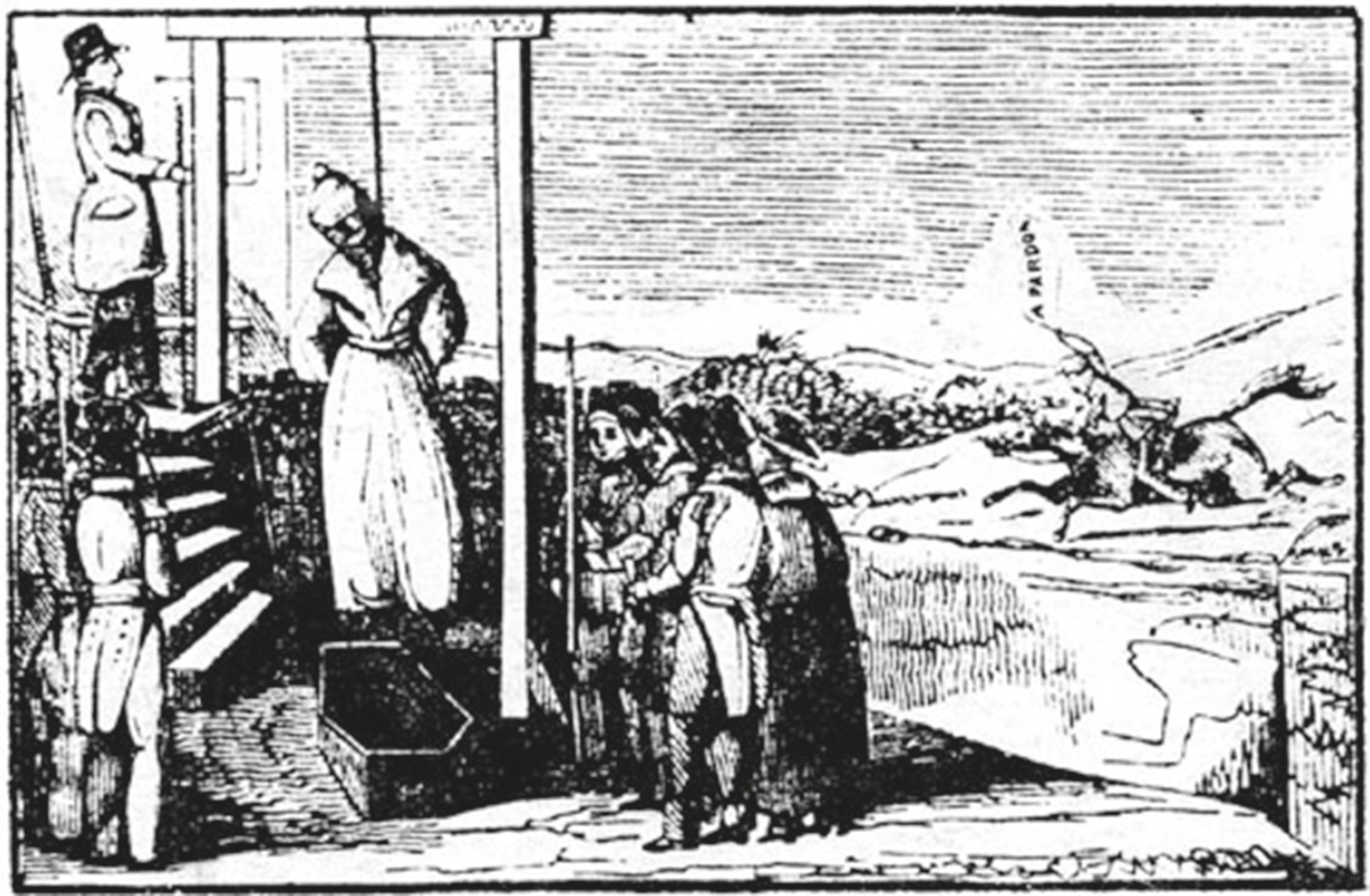
Title page artwork from the first edition of The Pennsylvania Hermit, c. 1838. William can be seen on horseback calling “A pardon!” (Wikimedia)
To understand the dichotomy between the two faces of Elizabeth Wilson, we must understand the story that has come down the generations. Although arguments over her guilt or innocence began almost immediately after her execution, the most popular versions of her story emerged in the nineteenth century. Among the first were articles published in the Delaware County Republican (first in 1854 and again in 1877) which painted her as a virtuous young beauty whose mother had died when she was young, leaving her without the much-needed maternal hand to guide her own behavior. In this version, she fell victim at the age of 17 to an unscrupulous seducer who left her pregnant and abandoned, and who later endured the trauma of a stillborn child. She fled to Philadelphia with her reputation in ruins, only to suffer the ill fortune of falling for another deceitful suitor.19
In 1884, Henry Graham Ashmead took up Elizabeth’s banner and borrowed heavily from the Delaware County Republican stories to craft his own narrative. In Ashmead’s version, Elizabeth’s father was a poor, but esteemed, member of the community and her mother died when she was a child. Ashmead whitewashed Elizabeth’s earlier sexual misadventures and the children that resulted from them and led the reader to assume she fell victim to a single devious seducer—he even informs the reader that she was as a child an adherent of the Baptist clergyman named Elder Fleeson. Ashmead embroidered her tragic tale by having her return home to her family to bear her children and wove in an immense piety and love for her newborns. Instead of pleading her case in jail and during her trial, Ashmead told the reader that she was mute and wallowing in her own sorrow, unable to even summon the energy to defend herself, and that Judge Atlee “knowing that to proceed meant conviction for the prisoner, in the goodness of his heart ordered that the trial should go over to the following term.”20 Elizabeth’s response to any question put to her was “weep[ing] passionately,” “weeping violently,” or an “outburst of tears, which would continue for hours,” interspersed with “constant prayer.”21 Even the gender of her babies changed from female to male, as though the murder of boys is somehow a far greater loss. In his recounting of William’s race to save his sister’s life, Ashmead described with great relish how, when faced with an ice-choked Schuylkill River and no way to ferry across, he drove his horse into the freezing waters—and when the horse drowned, he swam the remaining distance. As a result, William is given a Christlike aspect against Elizabeth’s virginal innocence. Ashmead even alludes to that other beneficiary of nineteenth-century romanticism by noting that Elizabeth was taken to “a white cherry-tree on ‘Hangman’s Lot,’ at the intersection of Edgmont and Providence Avenues … whereon a little over seven years previously James Fitzpatrick had met his fate.”22
Elizabeth’s narrative took on a life of its own after her execution, growing and changing at the whim of whichever society retold it. In an America fresh out of battles for independence and justice, outrage centered around an unpopular law that citizens of Philadelphia had long believed to be unfair, which had not given Elizabeth the proper time to prove her innocence. The question wasn’t about what kind of person Elizabeth was, but whether she had been treated fairly by the courts. Over time Elizabeth herself began to change until she arrived in the Victorian era as naive, pious, and obedient to men, no matter what station they held in her life. In these later accounts William became her only source of earthly salvation, as her real-life testimony was swept under a rug of “womanly” silence, in which she sat suffering in her own quiet misery in jail for months rather than speaking out in her own defense. Even the jurors and judge are robbed of their agency by being assigned roles in which they believed and supported Elizabeth but were hamstrung by the rigidness of Pennsylvania laws and the unforgiving Philadelphia weather—neither of which any mere man is expected to conquer, thus removing responsibility for any action in this narrative from anyone, really. The hanging of Elizabeth Wilson became a sad moral tale in which nothing was anyone’s fault, except maybe for that nebulous seducer, Joseph Deshong—who, as far as anyone can tell, was never given the chance to tell his story, either.
It may be of interest to the reader to know what life was like for William after his failure to save his sister’s life. Ashmead reported that when he saw his sister dead, William lost consciousness, and when he was resuscitated his dark hair had turned entirely white from the shock.23 He could not bear to be among civilized people anymore and removed himself to Dauphin County to live as a hermit in the caves in Hummelstown. Today known as Indian Echo Caverns, William’s cave was particularly large, with a natural ledge reputed to have been William’s bed and a recess in the floor he used as a fire pit. William wrote extensively on religion, and made grindstones which he sold to a local farmer in exchange for goods and supplies. He died in October 1821, and himself became the subject of folklore. Shortly after his death a manuscript called The Pennsylvania Hermit: A Narrative of the Extraordinary Life of Amos Wilson was published, purportedly by a “friend” who visited Wilson the night before he died. The question of why William’s name was changed to Amos for this publication remains unexplained, and obviously casts doubt on the work itself. The first part contains numerous errors, including listing Elizabeth’s birth year as 1776 (which would have made her nine years old when she died). The second part, called The Sweets of Solitude, was alleged to have been written by William himself and contains admonitions to live a life of blessed righteousness:
Religion is the balm that heals those wounds; it was this that preserved me and prevented my committing violence on myself … when doomed to witness the melancholly fate of an affectionate and only sister, the companion of my youth, torn from the bosom of her fond parents, and for many months confined within the thick walls of a gloomy prison, and from thence conveyed (at the very moment that a pardon was obtained for her) to the gallows, there to suffer like one of the greatest monsters of human depravity, an ignominious death!—to view her lifeless corpse suspended in the air, surrounded by a throng of spectators!—but alas! It was the will of God to which we must submit—it was at this trying moment that he sent Religion and reason to my aid, and bid me no longer grieve for her who I could not and ought not wish to recall to this troublesome world—for her whom I had just reason to believe had gone to the regions of eternal day, above the reaches of sorrow, vice, and pain.24
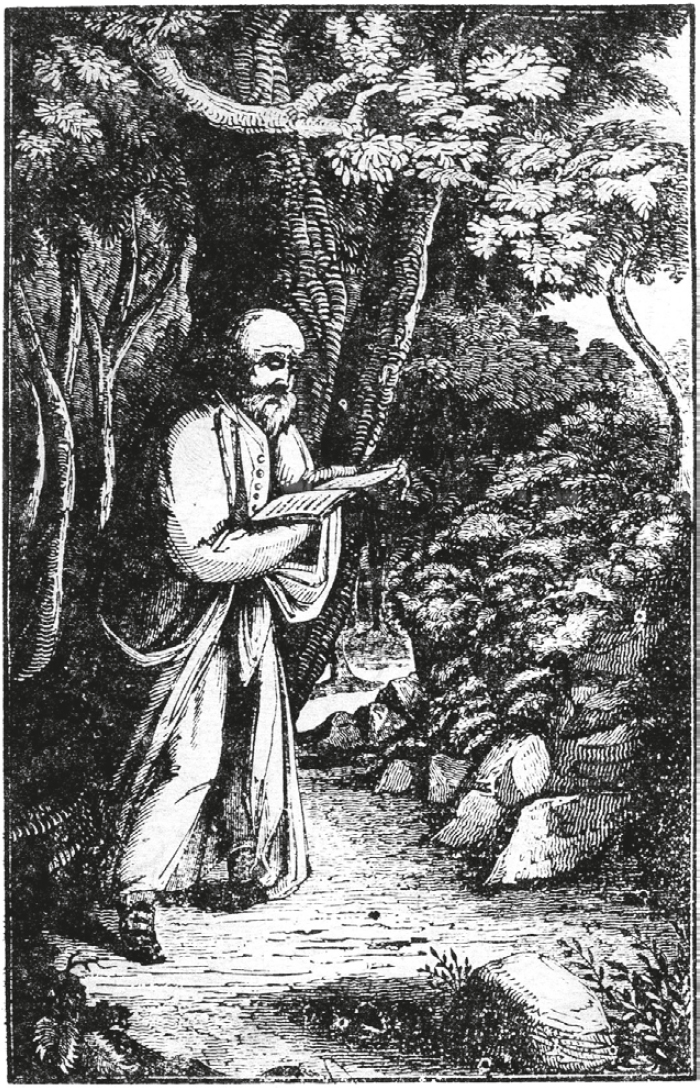
William Wilson as depicted in an illustration from the first edition of The Pennsylvania Hermit, c. 1838. (Wikimedia)
Visitors to Indian Echo Caverns can still tour “Wilson Cave” and see where William spent the last 19 years of his lonely life.
Notes
1Meredith Peterson Tufts, “A Matter of Context: Elizabeth Wilson Revisited,” The Pennsylvania Magazine of History and Biography, Vol. 131, No. 2 (April 2007), 149–176.
2Ibid., 156–157.
3Ibid., 156.
4Ibid., 158.
5Clare A. Lyons, Sex Among the Rabble: An Intimate History of Gender and Power in the Age of Revolution, Philadelphia, 1730–1830 (Chapel Hill, NC: University of North Carolina Press, 2006), 64.
6G.S. Rowe, “Infanticide, Its Judicial Resolution, and Criminal Code Revision in Early Pennsylvania,” Proceedings of the American Philosophical Society, Vol. 135, No. 2 (June 1991), 347.
7Lyons, 110.
8Ibid., 107–109.
9Tufts, 165, 169.
10Ibid., 166.
11Ibid., 168–9.
12Ibid., 168–9.
13Rowe, 353.
14Tufts, 170.
15Ibid., 171–2.
16“A Faithful narrative of Elizabeth Wilson; who was executed at Chester, January 3d, 1786. Charged with the murder of her twin infants. Containing some account of her dying sayings; with some serious reflections: Drawn up at the request of a friend unconnected with the deceased,” 1786. Available from https://quod.lib.umich.edu/e/evans/N15436.0001.001/1:2?rgn=div1;view=fulltext;q1=Hymns.
17“A Faithful Narrative…,” 6.
18Tufts, 174–175.
19Ibid., 151–2.
20Henry Graham Ashmead, History of Delaware County, Pennsylvania (Philadelphia: L. H. Everts & Co., 1884), 173.
21Ibid., 172–3.
22Ibid., 175.
23Ibid., 175.
24Amos Wilson, The Sweets of Solitude! Or Directions to Mankind How They May Be Happy in a ‘Miserable World!’ Available online at http://seclusion.com/the-sweets-of-solitude/the-sweets-of-solitude-the-manuscript/.