
CHAPTER 3
Since the first stirrings of European settlement, political and moral conflict have dogged the American Experiment. In hindsight it could not have played out any other way; the New World was always intended to be a place of freedom for many, and the definition of freedom was just as diverse as the backgrounds from which these immigrants escaped. One extreme example was in Massachusetts. The idea of religious liberty for Boston’s Puritans meant that only their beliefs were allowed, to the extent that they executed four Quakers in 1659–61 for refusing to leave the colony.1 In Pennsylvania, William Penn’s vision for an open and free society, where all were ostensibly welcome, caused its own kind of tension as disparate ethnic groups struggled to live peacefully alongside each other. Penn could not have envisioned the strife that his policies of openness would provoke within a century of his colony’s foundation.
Between 1682—when Penn landed on the shores of New Castle, Delaware at the vanguard of ships of immigrants from England and Wales—and 1717, the trickle of arrivals into the new colony was small and, above all, familiar. Most of the newcomers were culturally similar to those who had arrived before them. The summer of 1717, however, brought some travelers to Philadelphia who not only didn’t speak English, but also included convicted criminals foisted upon Pennsylvania from an England relieved to see them gone. These new colonists included the Scots-Irish and Germans, and colonial administrators struggled to monitor and stem the tide in those first few years. In the late 1720s, the deluge became utterly uncontrollable. In 1727, 1,000 Scots-Irish arrived, followed by 3,000 in 1728 and almost 6,000 in 1729. In addition, over 2,000 German-speakers arrived in the same three years.2
The first Quaker settlers in the area mistrusted the immigrants for a variety of reasons. First, the Scots-Irish and Germans didn’t subscribe to the modesty that Quakers prized. They engaged in behaviors like singing, dancing, gambling, and drinking, and the profanity and lewdness of some of the immigrants shocked and dismayed the Friends. Worse, these Scots-Irish hailed from famously violent areas, and they had developed a reputation among the peace-loving Friends for settling disputes with their fists. These were men and women from the border region between northern England and Scotland, a wild place that until the 1745 Jacobite rebellion hadn’t known more than 50 consecutive years of peace in the last 500. The Scots-Irish had, over the centuries, developed their own system of law and order, which sometimes clashed spectacularly with the Quaker one. While the Germans eventually earned the respect of the Quakers by being industrious and hardworking (and above all, abiding the laws established by Penn’s heirs), the Scots-Irish fought—in every sense of the word—for representation and recognition.3 Mix the Scots-Irish with what was possibly the largest population of nonviolent people in North America at the time, and Pennsylvanians were sitting on a political and cultural powder keg.
This was the Pennsylvania into which James Fitzpatrick was born—bubbling with ethnic tensions and on the verge of the greatest political revolution in history. Fitzpatrick grew up in a tenant house on the farm of John Passmore in Doe Run, between Kennett Square and Coatesville. He shared the house with his mother, though the identity of his father is unknown. He started learning the blacksmith trade under Passmore’s guidance, and grew into a tall, muscular, and handsome young man.4 He was later described as having a body like Hercules and a face like Apollo, with sandy red hair and a charming and gregarious nature.
Fitzpatrick was in his late twenties when the Revolutionary War broke out; like many of his Scots-Irish neighbors he was a strong supporter of the rebellion and immediately volunteered for Pennsylvania’s militia. By the summer of 1776, his militia unit were in Long Island to assist Washington’s army. By some accounts he sustained a minor wound in action, and when asked to conduct some menial task before he was fully healed, he refused. His punishment was flogging; he was so incensed by the humiliating treatment—he was a volunteer, after all—that he deserted, swimming across the Hudson River and heading back toward Chester County. He made it as far as Philadelphia before he was recognized and imprisoned in the Walnut Street jail; he was released after he promised to rejoin the army, which was hemorrhaging soldiers due to desertion. Instead of following through on his promise, he made his way back to Passmore’s farm, where in the summer of 1777 a militia discovered him working in the fields and apprehended him again. He agreed to go with them but asked that he be allowed to say goodbye to his mother and pack some belongings first. Instead of bidding farewell to his family, he grabbed a rifle and threatened to shoot his captors if they didn’t leave him alone. This threat apparently worked; they retreated and by September 1777 Fitzpatrick had switched sides and was serving as a guide for the British at the battle of Brandywine.
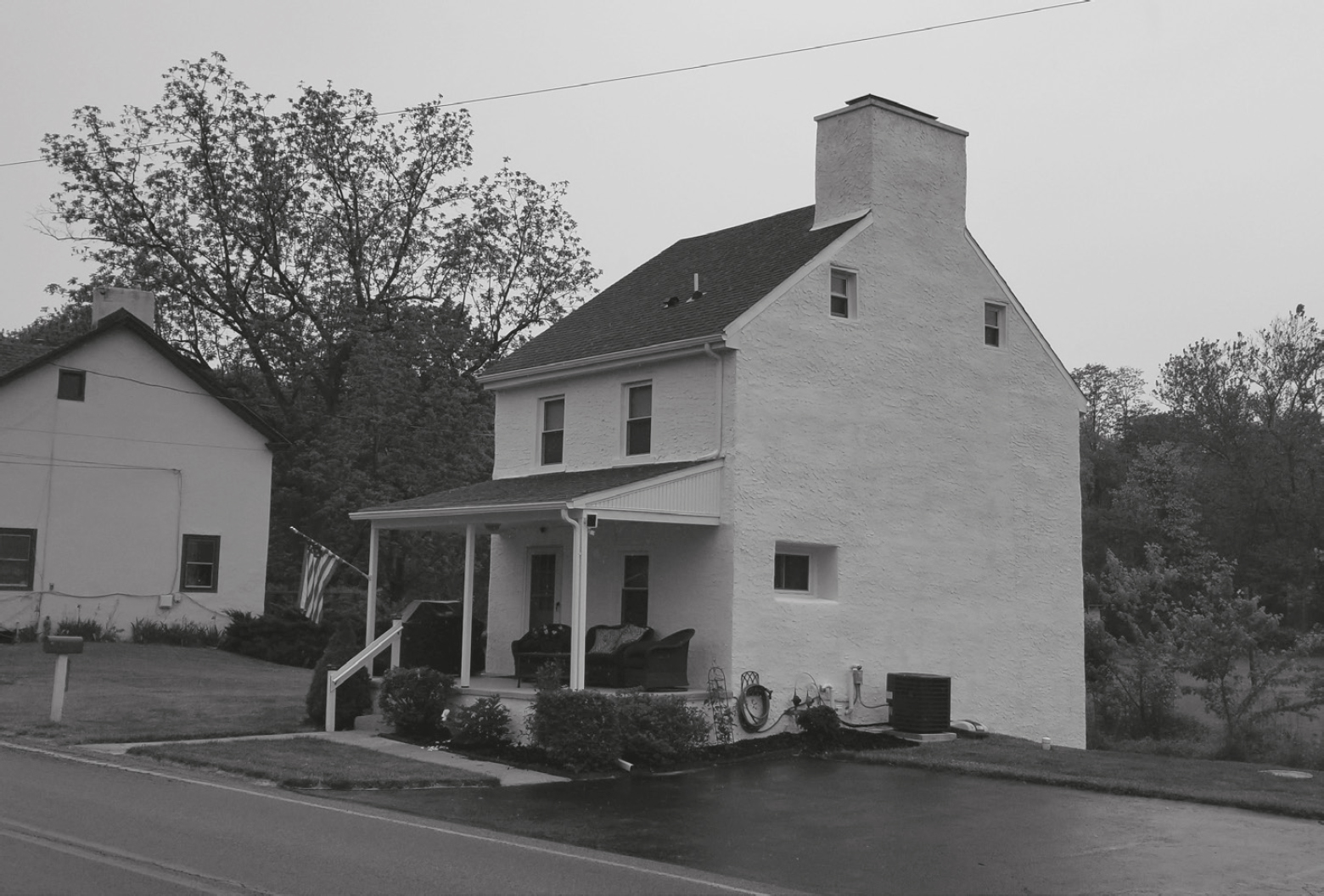
The tenant house on the property of John Passmore in Doe Run, alleged to have been the childhood home of James Fitzpatrick. (Author)
The complete turnaround from avid patriot in 1776 to angry loyalist in 1777 might come as a surprise, but Fitzpatrick was a man of strong passions, and he lived in the perfect location for such an about-face. There were few places in the colony where a loyalist could find more support than Chester County. Forty percent of the county was Quaker, who for the most part were avowed pacifists who would not support the war effort in any way, either by fighting or by paying taxes. A large percentage of the rest of the county were active loyalists, small farmers and artisans who secretly—or not so secretly—aided the British and harassed their patriot neighbors. The prospects for recruiting for the American armies in Chester County was so dismal that a disgusted General Anthony Wayne suggested that he stop recruiting there altogether and shift his focus to more successful efforts in Berks, Lancaster, and York counties. The strongest center of support for the rebel cause was actually among Fitzpatrick’s own people—the Scots-Irish—but he soon found he was able to travel quite freely around Chester County and find support and comfort from loyalists.5
After the battle of Brandywine on September 11, 1777, Fitzpatrick embarked on a short but dazzling career as a highwayman and general thorn in the side of the patriot cause. His main targets were tax collectors, which also seemed to bolster his reputation in the eyes of even non-loyalist factions. Tax collectors were roundly hated in Chester County by all walks of life, which should come as no surprise to a reader familiar with a little act of tax defiance called the Boston Tea Party. After the Revolution, Pennsylvanians expressed their disdain for taxation even more eloquently with the Whiskey Rebellion (1794) and the Fries Rebellion (1799).6 In addition to collecting taxes, constables in early Pennsylvania were responsible for a dizzying array of tasks: attending the courts, serving warrants, apprehending indicted persons, assessing property or seizing it for debts owed, and maintaining the peace were just a few. They were expected to report on the number of bonded servants, “baseborn children,” illegal stills, deer killed out of season, and women suffering from “the rising of their apron.”7 Essentially, they were expected to rat out their neighbors, who in many instances responded poorly to the perceived betrayal. In 1697, a Chester County constable investigated reports of a woman who had given birth and then murdered the child, only to be met at the door by the knife-wielding woman and her equally armed brothers and sisters. In 1789, a man named George Varner owed a debt of about £2 and when constable William Griffith tried to seize his cow as payment, Varner rounded up two friends and all three men attacked the constable and took the cow back. When Sheriff John Owen tried to arrest Charley Hickinbotom, the lady of the house threw scalding hot broth at him and struck him with a stone.8 Unsurprisingly, few men were keen to fill official positions like sheriff and constable—when nominated, many tried to wriggle out of it by claiming hardship, sending substitutes to serve in their place, or simply skipping town. Refusal to serve meant a fine to pay, which likely was the less egregious of the two options presented to the eighteenth-century Pennsylvanian.
James Fitzpatrick delivered his share of physical punishment to Chester County’s constables and militia recruiters, but one fact bears remembering—there is no historical evidence that Fitzpatrick ever killed anyone. In a tip of his hat to the flogging he received at the hands of the American army, his favorite method of punishment came at the end of a whip, preferably accompanied by a healthy dose of humiliation. The extent to which he toyed with patriots seems unbelievably reckless to modern readers. In one instance, he visited the Unicorn Tavern in Kennett Square, which was famous for being a center of patriot activity (and was later burned down by loyalists) and ordered a drink at the bar. A crowd filled the tavern, getting inebriated and bragging about what they would do to Fitzpatrick if they were ever to catch him. Fitzpatrick stayed at the bar quaffing his drink until he was recognized, at which point he backed out of the tavern, keeping the shocked gaggle at bay with his pistol, and then escaped into the woods. On another occasion, Fitzpatrick joined a couple of tax collectors who were walking down a country road and engaged them in conversation. When they boasted that they were not afraid of “the Fitz,” and that they wouldn’t let him escape, Fitzpatrick suddenly turned around, disarmed them of their muskets, and robbed them. He then tied the two collectors to a tree and flogged them. Knowing that one of them, Captain McGowan, was especially proud of his long hair, he relieved the man of his sword, his pistols, his watch—and his ponytail. When McGowan protested that the watch was a family heirloom, though, Fitzpatrick gallantly returned it.9
Fitzpatrick demonstrated his unusual sense of honor again when he encountered an elderly woman in East Caln taking a basket of eggs to market. He initially robbed her of the eggs, but when the old woman told him she was poor and needed to sell them, he gave them back. In another instance, when his horse threw a shoe, he stopped at a blacksmith shop in Newtown Square and found it manned by an apprentice named Shillingford. When Shillingford offered to craft a new horseshoe, Fitzpatrick turned him down, saying he would do it himself. As he worked, Fitzpatrick mentioned that a certain highwayman was reported to be in the area, to which the young man responded that he had never met the Fitz but had heard him described. Fitzpatrick then asked Shillingford if he looked like the outlaw, to which the boy replied, “I don’t know that you do.” At that, Fitzpatrick told the young man who he was, tossed him a coin to pay for the shoe, and left. Later, at the time of his hanging, Fitzpatrick reportedly recognized Shillingford in the crowd gathered around the gallows and shook his hand with a hearty “How are you, brother Chip?”10
Fitzpatrick’s career burned hot, and therefore it surprised no one—including him—that it flamed out so spectacularly. Since the battle of Brandywine in the fall of 1777, the British had occupied Philadelphia and dominated the surrounding counties, giving Fitzpatrick even more liberty to harass and rob local patriots because he knew the dominant political power would look kindly on his activities. When the British retreated in the summer of 1778, though, Fitzpatrick had to make a choice—go with the British army or stay in Chester County. He elected to stay, and along with a childhood friend named Mordecai Dougherty began committing robberies along the Lancaster Road, which originally connected Philadelphia with Lancaster. Two years of banditry had brought him full circle.
On August 23, 1778, Fitzpatrick showed up at the front door of the McAfee home in Newtown Square, almost directly across the street from one of his reported hideouts in Castle Rock. Modern historians can only conjecture what inspired Fitzpatrick to attack a home so near to the place where literally everyone knew him to hang out, but as we’ve shown, Fitzpatrick already possessed a reputation for almost suicidal recklessness. An additional boon to the crime was that Robert McAfee was a militia captain, one of Fitzpatrick’s favorite targets. McAfee was taking tea with his elderly parents and a hired girl named Rachel Walker when Fitzpatrick stormed in with rifle, sword, and pistols at the ready. He demanded McAfee’s watch and the buckles from his shoes and clothing, whereupon McAfee reported the following:
[H]e order[ed] my father and mother (both old and infirm) and a girl belonging to the house, who had just then entered the room, all before him up stairs to a bedchamber, where I told him my money lay. Upon entering the room and arranging his prisoners (as he thought safe) he set one foot on the side of a bed to adjust something amiss about his shoe with one hand, and held a pistol in the other directed to me; upon which I cast a look to the girl, signifying I was going to attack, and immediately sprung at him, secured the pistol, and a scuffle ensued, which lasted some minutes before I could bring him to the floor.11
If Fitzpatrick was hard to catch, he proved even harder to keep. After the McAfees tied him up and sent for the local militia, he managed to loosen the ropes and nearly made his escape. Later at the jail in Chester he almost succeeded in filing off his irons. Moved to the Walnut Street Jail (from which he’d already escaped once two years prior) he accomplished the unlikely feat of filing off his handcuffs twice in one night. How he managed this series of near escapes is unknown, though he benefitted from strong support throughout the county. All of McAfee’s neighbors, for instance, were Tories sympathetic to Fitzpatrick’s cause. It was even rumored that McAfee’s own sister was the one who had loosened Fitzpatrick’s ropes.12
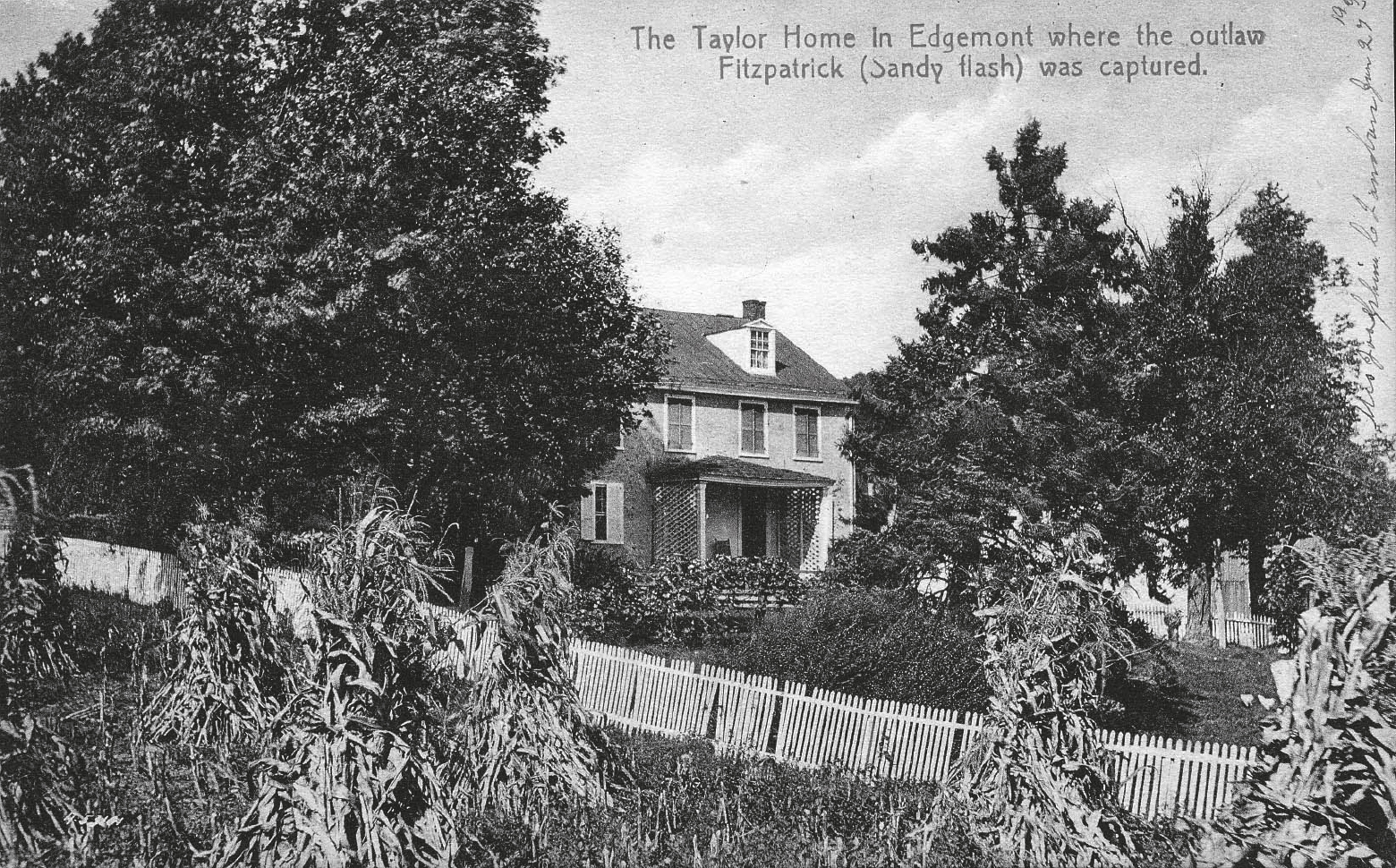
A popular postcard of the Taylor/McAfee home where James Fitzpatrick was allegedly captured. The home has since been demolished. (Keith Lockhart)
Whether Fitzpatrick had much of a trial is unclear, though it’s hard to exaggerate the complete shambles that was the Chester County legal system in 1778. When the Revolution began in May 1776, Pennsylvania’s rebels quickly moved to eradicate Tory influence in government. On June 3, 1776, the Philadelphia Committee of Inspection and Observation demanded that the justices of the quarter sessions of Philadelphia cease all operations of the courts until their new government could be instituted. Many officials of the pre-Revolution government resigned rather than try to reason with or work within the radical new leadership. The Committee took until September 1776 to publish its new frame of government, but the resignations of so many public officials and the refusal of many attorneys to work in the courts left a vacuum in the legal system. The ups and downs of drafting new laws and a new constitution left many Pennsylvanians either confused—or disgusted—by what the rebels devised. James Allen, the son of the former Chief Justice William Allen, complained that “not one of the Laws of the Assembly are regarded … No courts open … [and] no justice [is] administered.”13 No courts were actually held in Chester county from May 1776 to August 1777, and then were suppressed again during the British occupation from September 1777 until the summer of 1778 when the British left Philadelphia.14 The courts didn’t resume business in a somewhat normal fashion until August 1778—the month James Fitzpatrick was captured.
After a year of British occupation, Chester County’s patriot leaders were more than ready to start punishing those who had made that occupation possible. The fall of 1778 witnessed six hangings for “desertion to the enemy” or treason. On November 4, 1778, six weeks after James Fitzpatrick met his end, two men went to the gallows in Philadelphia for “aiding the enemy.” One was John Roberts, a miller from Lower Merion, and the other was Abraham Carlisle, a house carpenter, who were both accused of having enlisted with, or otherwise assisted, the British military. Both men were Friends, and their arrests sent shockwaves through the Tory and Quaker populations around Philadelphia and ignited a very real worry that the reinstatement of American control would mean a bloodbath for suspected loyalists. Twelve men of the grand jury and ten of the petit jury pleaded for mercy, and 387 Philadelphians presented evidence that Carlisle had actually interceded on behalf of prisoners and protected them from cruelty on the part of the British.15 The Supreme Council was unmoved; the two men were hanged, and their property seized, against a backdrop of accusations of bloodthirstiness.
The legal system that James Fitzpatrick entered in August 1778 was fractured, vengeful, and explosive. Worse for him, there was no doubt whatsoever that he was guilty of his crimes—he had boasted and toyed with authorities for years and openly assisted the British at the battle of Brandywine. However, officials charged him not with treason, but with larceny and robbery. Perhaps they felt that a charge of “treason” in an already fractious Pennsylvania might cause too many arguments about what constituted treason in a county that had been under the control of the British. They wanted Fitzpatrick to swing, so they chose two charges for which there could be no argument. Fitzpatrick confessed to the crimes, and on September 15, 1777 the court sentenced him to be hanged, a sentence that would be carried out on September 26, 1777. It was during this interim that his three spectacular escape attempts—one from the county jail and twice in one night from the Walnut Street Jail—occurred. These escape attempts likely did not endear him to his captors, which makes what happened next a little more suspicious.
In 1778, most executions were public events, and could draw many thousands of spectators. We know that the young blacksmith Shillingford was in the crowd the day that Fitzpatrick hanged. There were no gallows with a trap door; criminals sentenced to hang were subject to what was then called “swinging off,”which meant that the accused would stand on a chair, a ladder, or in a wagon, which would then be drawn from beneath them, causing them to slowly suffocate to death. But when Fitzpatrick was swung off, his incredible height left his toes touching the ground, and he was able to ease the pressure on his neck. The executioner had to jump onto Fitzpatrick’s back to force the man’s heels down and in fact strangled him to death while Fitzpatrick’s feet were actually touching the ground. Whether the executioner accidentally used a rope that was too long, or whether some intentional vengeance was involved, we may never know.
Certainly, botched executions weren’t a novel concept in 1778, and they would continue to provide support for abolishing the death penalty throughout the nineteenth century. The hemp ropes used to hang men and women in the eighteenth and nineteenth centuries were generally supposed to be new, but this didn’t prevent them from occasionally breaking. At the hanging of William Seeley Hopkins in Centre County in 1890 the rope broke not once, but twice. In 1802, a condemned man named Dan Byers experienced his hanging rope break and then had to wait while a second noose was strung up. On May 15, 1867, the execution of Robert Fogler in Washington County was horrifically blundered in a similar way, when his toes touched the ground. In this instance, several men mounted the scaffold and took the rope into their hands and “actually held the quivering lump of flesh suspended some one foot from the ground while the sheriff and his deputies prepared the tackle to run it up again. For several minutes the body underwent severe contortions and death was far from being an easy one.”16
In the aftermath of Fitzpatrick’s bungled hanging, those involved with his capture experienced their own highs and lows. Fitzpatrick’s sympathizers burned the McAfees’ stacks of oats and hay and maimed their horses. Later, William McAfee (Robert’s father) claimed these losses as part of the British and loyalist predation of the area and was compensated. At the time of Fitzpatrick’s capture there had been a £1,000 reward, which Robert McAfee and Rachel Walker split. After splitting the reward, they each walked away with the modern-day equivalent of about $60,000.
With such salacious and romantic facts to work with, it didn’t take long for journalists and novelists to broadcast his story as far and wide as the burgeoning newspaper industry allowed. In a rabidly patriotic new Republic eager for stories of war heroes, Fitzpatrick’s image received a makeover. The Robin Hood-esque aspects of his career moved front and center, and his good looks and charm grew as his quick temper and brutality were set aside. His true transformation wouldn’t happen until 1866, when Chester County novelist Bayard Taylor used him as inspiration for the highwayman Sandy Flash in The Story of Kennett, published in 1866. Taylor was born in Kennett Square, and many of the folktales of his childhood made their way into his novels. Taylor had already earned some success as a journalist and writer of travel books; his friends had last names like Whittier and Longfellow. In 1861, he turned his attention to fiction, and had two popular novels under his belt when he began The Story of Kennett, a pastoral ode to his childhood home. In the novel, hero Gilbert Potter struggles with the uncertainty of his parentage, which is keeping him from winning the hand of his true love, Martha, who is of a higher social station than he. When the notorious Sandy Flash robs the townspeople in the local tavern, Gilbert is present and is told by the highwayman that he had nothing to fear, which instills a suspicion in Gilbert that Sandy Flash may be his father. Meanwhile, it turns out that the town’s hard-drinking Deb Smith is Sandy Flash’s mistress, and in revenge for a slight against her, she betrays him to the authorities. Before he dies, Sandy Flash gives Gilbert the location of some stolen money and admits that he’s not Gilbert’s father.17 Taylor’s version of James Fitzpatrick was so popular and convincing that a new mythos developed around the criminal. The very nickname “Sandy Flash” gradually overtook the man’s real name in popularity—there currently exist two roads in southeastern Pennsylvania named after “Sandy Flash.” The Story of Kennett reinforced the already popular idea that Fitzpatrick hid a treasure somewhere in Chester County, and that he was romantically betrayed by a lover rather than being foiled by his own carelessness during an act of robbery.
As the twentieth century rolled around, the newly minted Sandy Flash appeared in 1922 in a novel called Sandy Flash: The Highwayman of Castle Rock by Captain Clifton Lisle, wherein the author connected Fitzpatrick with the infamous Doan Gang, which spied for the British and robbed the county treasury in 1781. The Doan connection is another bit of fictional embroidery to the Fitzpatrick tale—although they operated around the same time and area, there is no evidence to suggest they ever worked together. Another legendary Chester County figure, “Indian” Hannah Freeman, also makes an appearance in the novel as a healer with her famous herb salve. Hannah Freeman was thought to be the last member of the Lenni Lenape Tribe in Chester County when she died in 1802.18 Eleven years after the publication of The Highwayman of Castle Rock, Bayard Taylor’s novel The Story of Kennett was adapted into a pageant for a welcoming audience in Kennett Square, and the legend continues to outpace the man.
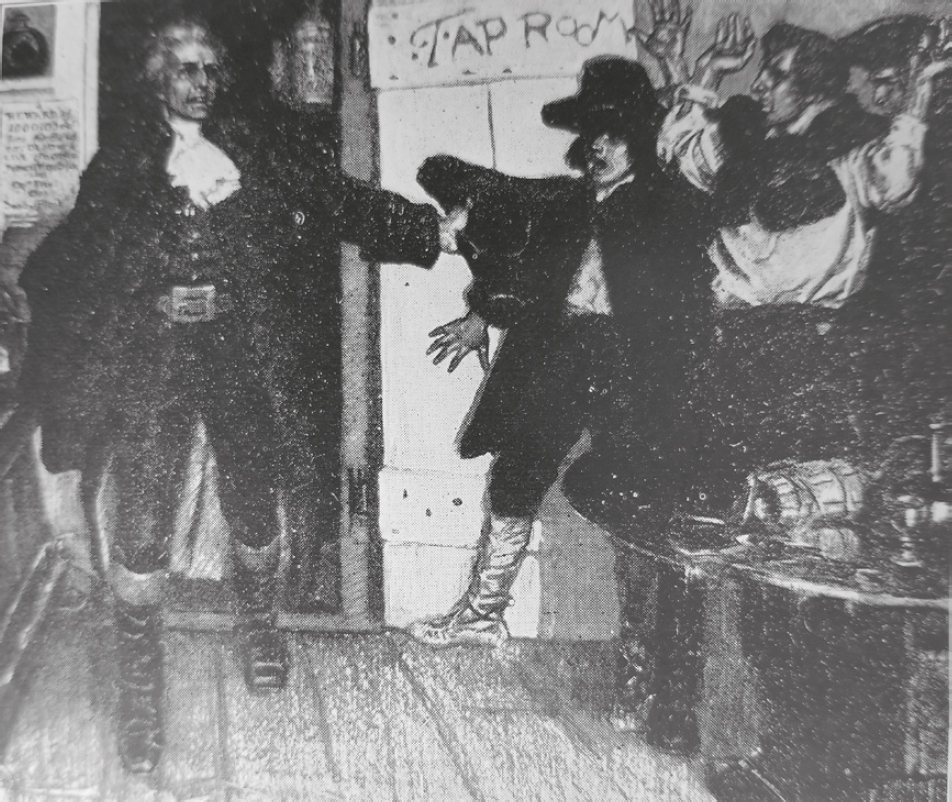
Illustration from Sandy Flash: The Highwayman of Castle Rock (1922) by Captain Clifton Lisle, presumably recreating Fitzpatrick’s episode in the Unicorn Tavern in Kennett Square. (Author)
Notes
1The Massachusetts legislature passed a law in 1658 that any Quaker living within the colony would be subject to imprisonment and banishment. Any Quaker refusing to leave the colony, or returning to the colony after banishment, was sentenced to death. This resulted in the hanging deaths of the “Boston martyrs” Mary Dyer, Marmaduke Stephenson, William Robinson and William Leddra.
2Marietta, Troubled Experiment, 64.
3Marietta, Troubled Experiment, 69.
4Rosemary S. Warden, “‘The Infamous Fitch’: The Tory Bandit, James Fitzpatrick of Chester County,” Pennsylvania History, Vol. 62, No. 3 (July 1995), 376.
5Ibid., 380.
6The Whiskey Rebellion was a three-year uprising against the tax on all distilled spirits imposed by the federal government to pay off debts incurred during the Revolutionary War. The Fries Rebellion, fomented by an itinerant Pennsylvania auctioneer named John Fries, erupted over a federal tax on dwelling houses and land.
7Marietta, Troubled Experiment, 129.
8Ibid., 129–130.
9Warden, 378.
10Ibid., 381.
11Ibid., 384.
12Ibid., 384.
13Marietta, Troubled Experiment, 181.
14Ibid., 181.
15Dr. Negley K. Teeters, Scaffold and Chair: A Compilation of Their Use in Pennsylvania 1682–1962 (Philadelphia: The Philadelphia Prison Society, 1963), 19.
16Ibid., 23.
17Bayard Taylor, The Story of Kennett, ed. C. W. La Salle II (New Haven: College & University Press, 1973), 280–281.
18Capt. Clifton Lisle, Sandy Flash: The Highwayman of Castle Rock (New York: Harcourt, Brace and Company, 1922).