
10
Alexander Hamilton always faced east, toward Europe. By contrast, Thomas Jefferson faced west, toward the trans-Appalachian territory and even the lands beyond the Mississippi. Although Jefferson himself never traveled beyond the Blue Ridge Mountains, he was obsessed with the West. He always had, as he said in 1781, “a peculiar confidence in the men from the Western side of the mountains.”1 Only by moving westward, Jefferson believed, could Americans maintain their republican society of independent yeoman farmers and avoid the miseries of the concentrated urban working classes of Europe. Indeed, an expansive West was capable of redeeming the nation if its Eastern sections should ever become corrupt. “By enlarging the empire of liberty,” said Jefferson, “we multiply its auxiliaries, and provide new sources of renovation, should its principles at any time degenerate in those portions of our country which gave them birth.”2
Jefferson was the most expansion-minded president in American history, a firm believer in what might be called demographic imperialism. As early as 1786 he thought the United States might become “the nest from which all America, North and South, is to be peopled,” creating what he referred to more than once as an “empire of liberty.” “Empire” for him did not mean the coercive domination of alien peoples; instead, it meant a nation of citizens spread over vast tracts of land. Yet the British Empire had given enough ambiguity to the term to lend some irony to Jefferson’s use of it.3
Although the United States was by 1801 hemmed in by Britain and Spain on America’s northern and southern frontiers and by Indians in the West, “it was impossible,” Jefferson told Governor James Monroe of Virginia in 1801, “not to look forward to distant times, when our rapid multiplication will expand itself beyond those limits, and cover the whole northern, if not the southern continent, with a people by similar laws.”4 The vision was not just Jefferson’s. The inhabitants of this empire, wrote Thomas Hutchins, America’s first geographer, in 1784, “far from being in the least danger from the attacks of any other quarter of the globe, will have it in their power to engross the whole commerce of it, and to reign not only lords of America, but to possess, in the utmost security, the dominion of seas throughout the world, which their ancestors enjoyed before them.”5
Foreign observers could only shake their heads in amazement at the numbers and the speed of the Americans migrating to the West. “Old America,” said the recent English immigrant Morris Birkbeck, “seems to be breaking up and moving westward.”6 The settlers created a great triangular wedge of settlement reaching to the Mississippi River. Its northern side ran from New York along the Ohio River, its southern side from east Georgia through Tennessee, and the sides met at the apex, St. Louis. Within this huge triangle of settlement people distributed themselves haphazardly, with huge pockets remaining virtually vacant or sparsely inhabited by Indians.7
National leaders expected American westward migration, but not the way it was happening. The carefully drawn plans of the 1780s for the orderly surveying and settlement of the West were simply overwhelmed by the massive and chaotic movement of people. “We rush like a comet into infinite space,” declared a despairing Fisher Ames. “In our wild career, we may jostle some other world out of its orbit, but we shall, in every event, quench the light of our own.”8
Many settlers ignored land ordinances and titles, squatted on the land, and claimed preemptive rights to it. From 1800 on Congress steadily lowered the price of Western land, reduced the size of purchasable tracts, and relaxed the terms of credit for settlers in ever more desperate efforts to bring the land laws into line with the speed with which the lands were being settled. People moved into the area the Indians had ceded in the Treaty of Greenville and then spread north from the Ohio Valley into the valleys of Indiana and Illinois. Congress created new territories in Indiana (1800), Michigan (1805), and Illinois (1809). In the South people in the Mississippi Territory (created in 1798) moved along the river from Vicksburg toward Spanish-held New Orleans.
ALTHOUGH BOTH THE RAPIDLY SETTLED NORTHWEST and the Southwest territories were overwhelmingly Jeffersonian Republican in their politics, they tended to create very different kinds of places from one another. That difference essentially flowed from the existence of slavery in one area and not in the other.9
But not immediately. Most of the early migrants that initially spilled over the Appalachian Mountains to the West, whether from the North or the South, traveled with only the labor of their families to help them get on their feet. The first waves of ordinary settlers to the frontier, whether to Kentucky and Tennessee or to Ohio and Indiana, generally began by building a small lean-to house before they turned to the crucially important tasks of clearing the land and planting crops. They felled some trees with axes and killed others by girdling them. They burned so much brush and scrub that smoky hazes often hung over the land for months or even years on end. While the women saw to all the gardening, cooking, sewing, and housekeeping, the men plowed the land and planted the marketable crops, in the Northwest, mainly corn and wheat, with whiskey a major by-product; in the Southwest, corn, tobacco, and eventually cotton were the major crops. For both areas hogs and cattle were the principal livestock.
With crops planted, the pioneers began building more substantial houses—usually cabins built of notched logs designed to shelter households that averaged five to seven persons. The roofs of these primitive homes were clapboard, and the floors were dirt, which meant that vermin and the lack of cleanliness were taken for granted—a sure sign in the eyes of Eastern observers that the occupants weren’t quite civilized.10 Diets were limited, with lots of hominy. Coffee and tea were available in Pittsburgh in 1807 but were very expensive. What the new settlers most wanted was access to rivers and the laying out of roads so they could market some of their produce.11
In the Old Northwest the early settlers resisted the claims of absentee speculators and landlords and were remarkably successful in establishing their small independent farms throughout the region. But the situation in the Old Southwest was different. The early pioneers there were soon overwhelmed by substantial planters who came west with slaves in ever increasing numbers. As early as 1795 slaves had come to constitute more than 20 percent of the population of Middle Tennessee. Since these slaveholding settlers were men of means, they quickly bought out those who had preceded them or purchased new land in the most accessible and desirable areas. By 1802 slaveholders had already established large plantations in the rich valleys of the Cumberland in Middle Tennessee. With the development of cotton as the major staple of the Southwest, slavery flourished. But where the growing season was too short for cotton, as in the northern counties of West Tennessee, the number of slaves remained small. Since slavery and cotton went together, the big slaveholding cotton planters dominated both the economy and government. In both the Southwest and the Northwest, however, the top political positions tended to be captured by those who had initially achieved some military glory, like William Henry Harrison and Andrew Jackson.12
Although slavery and the society and economy it bred were what ultimately separated the Southwest from the Northwest, it was not obvious at the outset that the Northwest would remain free of slaves—despite the declaration in the Northwest Ordinance that “there shall be neither slavery nor involuntary servitude” in the territory.13
Many of the migrants to the area immediately north of the Ohio River were from the Upper South and were eager to introduce slavery to the Northwest Territory. William Henry Harrison, the son of a prominent slaveholding Virginia family, was the most influential of these advocates for bringing slavery to the Northwest. In 1791 at age nineteen Harrison abandoned a career in medicine and received a commission in the army. He proved invaluable as an aide to General Anthony Wayne at the battle of Fallen Timbers in 1794, and a year later he married the daughter of the speculator John Cleves Symmes. In 1798 he became registrar of the Land Office in Cincinnati, and, using his influence with his friend Robert Goodloe Harper of South Carolina, the Federalist chairman of the House Committee on Ways and Means, he was soon appointed secretary of the Northwest Territory by President John Adams. Within a year Harrison had won election as the territory’s delegate to Congress. In 1800 the Northwest Territory was divided into two parts, the territory of Ohio and the Indiana Territory, of which the twenty-eight-year-old Harrison was appointed governor. He accepted, but only after receiving assurances that if Thomas Jefferson became president, he would be retained in office. No one in the West was more assiduous in cultivating patrons and moving up in the governmental hierarchy than Harrison.14
In 1803 Harrison and his pro-slavery allies in Indiana petitioned Congress to waive the ordinance’s prohibition against slavery for at least ten years. When Congress tabled the petition, Indiana’s pro-slavery settlers circumvented the restriction; and after the territory acquired its legislature in 1804, it passed laws that sustained a de facto form of black slavery. By 1810 there were 630 blacks in Indiana, most of whom were indentured servants serving for long terms or for life.15
But many settlers in the Indiana Territory were opposed to both Harrison and slavery; they argued that slavery made men haughty and proud and that the institution not only sustained a leisured aristocracy but also inhibited the immigration of non-slaveholders. In 1809 the territory of Indiana was divided in two, and Illinois Territory was created. This reduced Harrison’s influence in Indiana and allowed the anti-slave forces under the leadership of populist Jonathan Jennings to gain strength in the territory. In 1809 the New Jersey–born Jennings, who liked to campaign as the common man, sometimes stopping and helping pioneers repair their cabins or cut wood, defeated Harrison’s candidate, Thomas Randolph, the territorial attorney general, in a close contest for territorial delegate to Congress.
In Washington, where he served three terms, Jennings fought to eliminate property qualifications for voting and to do away with the arbitrary and “monarchical” system of territorial government that had been established by the Northwest Ordinance of 1787, a system, said Jennings, that was “little reconcilable to the principles which governed the institutions of the different States of the Union.” By seeking at every turn to undermine Harrison’s influence in Indiana Territory, Jennings provoked Harrison into labeling him as that “poor animal who represents us.” When Jennings’s allies finally took control of the territorial legislature in 1810, they revoked the laws that maintained de facto slavery in the territory and repudiated the closed system of patronage politics that Harrison and his cronies had used to maintain their power. By exploiting democratic and anti-aristocratic rhetoric, Jennings in 1816 became Indiana’s first state governor.16
Among the most effective arguments the anti-slave forces in Indiana invoked was the example of the incredibly speedy settlement of Ohio. Ohio’s rapid growth convinced many leaders that prohibiting slavery was the best means of enticing the proper kinds of non-aristocratic settlers to migrate westward. Indeed, the area north of the Ohio River was settled largely by swarming numbers of anti-slave Yankees from New England. Many of them came to Ohio via New York and continued to push westward into the northern parts of Indiana and Illinois, bringing their communal spirit and their place names with them; towns named Cambridge, Lexington, Springfield, and Hartford were scattered throughout the states of New York, Ohio, Indiana, Illinois, and Michigan.
Because most of the settlers in the Northwest Territory were small farmers, their society tended to be more democratic and egalitarian than the society of the Southwest, dominated as it was by slaveholding planters. To be sure, landholding in Ohio could be just as oligarchic as that in the South and Southwest: the top 1 percent of Ohio landowners, for example, owned 23 percent of the land.17 But, unlike in the South and Southwest, social and economic authority in the Northwest did not automatically translate into political authority.
Ohio’s first congressman, Jeremiah Morrow, who served as a Republican in the House from 1803 to 1813, was not one of the state’s great landowners. Unlike those Federalist magnates who possessed five-thousand-acre spreads, Morrow had a mere 385 acres, which, to the amazement of foreign visitors, he worked himself when he was back home from Congress. The large landowners in Ohio tended to be speculators who were in control of neither the economy nor the government. Because of competition, these speculators usually were forced to sell their lands not only as quickly as possible but also much more cheaply than they wished. These Ohio grandees were always vulnerable to having their unimproved lands taxed and to being challenged by other parvenu speculators; and, unlike the planters of the Southwest, they did not have dozens of slaves to set themselves off from the other landowners in the state.
But perhaps more important, not everyone in Ohio was a farmer. Indeed, the hundreds of multiplying small towns in the Northwest created a dizzying variety of occupations that made farming, and the growing of corn and wheat, seem to be an avocation rather than the basis for the economy. Newspapers proliferated in the Northwest in a way they did not in the Southwest, or even in the Old South. Before any state had been formed in the Northwest Territory, the area already had thirteen newspapers. By contrast, North Carolina, although over a century older than the Northwest Territory and with a population of nearly half a million, had only four newspapers. By the second decade of the nineteenth century Ohio had more than twice as many newspapers per capita as Georgia.18
Most of the capital in the Old Southwest was tied up in slaves and not, as in the Old Northwest, in land or manufacturing or other businesses; and those planters with the most human capital were the ones most able to move to the choice lands in the West and most capable of dominating the commercial life of the area. The slave economy of the Old Southwest produced a single staple crop, cotton, whose credit and marketing systems tended to breed hierarchical structures of authority. Since small cotton farmers needed the patronage of the large planters with access to capital and markets, they inevitably deferred to them both socially and politically. The early nineteenth-century Southwest frontier, in other words, was not all that different from the Old South of the eighteenth century. Like tobacco in the eighteenth-century Upper South, cotton was a non-perishable product with a limited number of markets, mostly overseas. Since cotton did not need elaborate storage and handling facilities, marketing it did not produce towns or other distribution centers.19 Consequently, life in the Old Southwest did not revolve around towns or villages, as in the Old Northwest, but around plantations.20
By contrast, the economy of Ohio in the Old Northwest was diverse, with a variety of markets and no simple distribution system for the region’s many products, resulting in a proliferation of towns. Ohio’s political structure also differed from that of the territories and states of the Old Southwest. Unlike the county courts of the South and Southwest, the county commissions in Ohio were not self-perpetuating bodies but were under the elective control of local people. In addition, they shared authority with a hodgepodge of overlapping jurisdictions of towns, school districts, and other subdivisions, all of which produced a profusion of elective offices.21 In fact, with so many political offices available, everyone seemed to run for one of them at one time or another. One hundred sixteen men ran for Hamilton County’s seven seats in Ohio’s third territorial assembly, and ninety-nine men ran for its ten seats in the constitutional convention of 1802. In 1803 twenty-two candidates ran for the office of the first state governor. No wonder the Federalists complained that “few Constitutions were ever so bepeopled . . . throughout” as was the Ohio constitution of 1802.22
STILL, THE SOUTHWEST WAS HARDLY STATIC, and despite the hierarchical influence of slavery on the society, many thought the region was anything but stable. People in the Southwest were on the move, many of them in the 1790s pushing down the Mississippi toward the Spanish-held port city of New Orleans, which was becoming increasingly important to all Western Americans. Of course, New Orleans had always been on the mind of any American concerned about the West. Even Hamilton in 1790 thought that when the United States grew stronger and the American people were able to make good “our pretensions,” we would not “leave in the possession of any foreign power the territories at the mouth of the Mississippi, which are to be regarded as the key to it.”23 In the Treaty of San Lorenzo in 1795 the Americans had secured from Spain the right of depositing their goods in New Orleans and thus access to the larger commercial world through the Gulf of Mexico.
With this treaty Spain was trying to prevent an American takeover of its empire, but perhaps it was only postponing the inevitable. Jefferson and other Americans believed that Spain’s hold on its North American empire was so weak that it was only a matter of time before the various pieces of that empire—New Orleans, East and West Florida, maybe even Cuba—fell like ripe fruit “piece by piece” into American hands.24 As early as 1784 James Madison predicted that the safety of Spain’s “possessions in this quarter of the globe must depend more upon our peaceableness than her own power.”25 America need only wait and let its phenomenal demographic growth and movement take care of things.
Because of Spain’s weakness, its possessions on the continent were no problem for Jefferson; but the dynamic nation of England was a different matter altogether. Jefferson could not tolerate any additional English presence on the continent. During the Nootka Sound controversy in 1790, when an incident between England and Spain off the west coast of Vancouver Island threatened a war between the two European powers that bordered the United States, the Washington administration was deeply disturbed. By attempting to set up a base in Nootka Sound, the British had encroached on territory on the Pacific coast that the Spanish had regarded for centuries as exclusively theirs. When the Spanish seized and arrested the British intruders, Great Britain was prepared to retaliate. The U.S. government and especially Secretary of State Jefferson were apprehensive that Britain might use the conflict to seize all the Spanish possessions in North America, which would pose a danger to the security and even the independence of the new Republic.
What if the British requested permission to cross American territory to engage the Spanish in the West? What should the American response be? These were the questions that President Washington asked of his advisors. Washington was also worried that if war broke out between Spain and Britain, Spain’s ally France might get involved. Despite America’s alliance with France, Secretary of State Jefferson was willing to use American neutrality in the conflict between Spain and Britain to bargain for either Britain’s withdrawal from the Northwest posts or Spain’s opening up the Mississippi to American commerce. He expressed a willingness to go to war with Spain to acquire Florida and the rights to the Mississippi or, more important, even with Britain to prevent the former mother country from taking over Spain’s possessions.
In the end further conflict was averted. When France, preoccupied with its Revolution, declined to help Spain, the Spanish government backed down and in the Nootka Sound Convention of 1790 agreed to recognize the right of England to trade and settle in the unoccupied territory that it had formerly claimed was exclusively Spanish. When in 1819 Spain ceded its rights to the Oregon Country to the United States, the stage was set for a competition between the two English-speaking nations for control of this far northwest piece of the continent. Partly as a result of the Nootka Sound controversy, Great Britain came to realize that having an accredited minister in the United States capital might be in its interest after all, and it sent George Hammond, who arrived in October 1791.
Spanish officials were well aware of America’s demographic growth and became more and more fearful of American encroachment. Suddenly in October 1800 Spain decided, under pressure from Napoleon, who was now in charge of the French Republic, to cede Louisiana back to France in the secret Treaty of San Ildefonso. Spain believed that France, as the dominant European power, would be better able to maintain a barrier between the Americans and the silver mines of Mexico.
In the meantime, France, under Napoleon’s leadership, had developed a renewed interest in its lost North American empire. Not only could French possession of Louisiana counter British ambitions in Canada, but, more important, Louisiana could become a dumping ground for French malcontents and a source for provisioning the lucrative French sugar islands in the Caribbean—Martinique, Guadeloupe, and especially Saint-Domingue.
Sugar was important to France. Processed in France and sold throughout Europe, sugar accounted for nearly 20 percent of France’s exports. And 70 percent of France’s sugar supply came from the single colony of Saint-Domingue. Napoleon knew that if France’s imperial ambitions were to be realized, the slave rebellion in Saint-Domingue led by Toussaint L’Ouverture would have to be put down and the island recovered for France. In 1801 Napoleon sent his brother-in-law General Charles Victor Emmanuel Leclerc with an enormous force of forty thousand troops to recover Saint-Domingue and reinstate the ancien régime slave system that had made the island so profitable for France.
It was one of the greatest mistakes Napoleon ever made, as he himself later admitted. By 1802 most of the French troops had been killed or had succumbed to yellow fever, including Leclerc himself, and only two thousand remained healthy. Before the rebellion that had begun in 1791 ended in 1803 followed by the declaration of Haitian independence on January 1, 1804, some three hundred fifty thousand Haitians of all colors had died along with as many as sixty thousand French soldiers. Since Louisiana was supposed to supply goods to Saint-Domingue, the loss of that rich island suddenly made Louisiana dispensable. Already Napoleon was turning his eyes back toward Europe and to a renewal of the war with Great Britain, for which he needed money.
But Americans did not yet know of this turn of events. In 1802 all they heard were rumors that Napoleon had induced Spain to retrocede Louisiana to France, including, as many thought, both East and West Florida. For the Americans, and especially for President Jefferson, nothing could have been more alarming. It was one thing for a feeble and decrepit Spain to hold Louisiana; “her possession of the place,” said Jefferson, “would hardly be felt by us.” But it was quite another for a vigorous and powerful France to control what Jefferson called “the one single spot” on the globe, “the possessor of which is our natural and habitual enemy.” Since that one single spot, New Orleans, was fast becoming the outlet for the produce of more than half of America’s inhabitants, in French hands, said Jefferson, it would become “a point of eternal friction with us.” Indeed, Jefferson told the American minister in France, Robert R. Livingston, “the day that France takes possession of New Orleans . . . seals the union of two nations, who, in conjunction, can maintain exclusive possession of the ocean. From that moment, we must marry ourselves to the British fleet and nation.”26
For someone like Jefferson who hated the British with a passion matched by no other American, this was an extraordinary statement, but one that he knew Livingston would pass on to Napoleon and French officials. Probably Jefferson was never serious about an Anglo-American military alliance but hoped that Napoleon would see the light and realize that such an alliance was not in the interest of either France or the United States.27 If France insisted on taking possession of Louisiana, however, “she might perhaps be willing to look about for arrangements which might reconcile it to our interests. If anything could do this,” the crafty president told Livingston in April 1802, “it would be the ceding to us the island of New Orleans and the Floridas.” He thought France might be willing to sell these territories for $6 million, and he sent his good and trusted friend James Monroe to Paris to help Livingston clinch the deal.28
Only Monroe had enough confidence in his intimacy with his fellow Virginians, President Jefferson and Secretary of State James Madison, to allow him and Livingston to exceed their instructions and pay $ 15 million for all of Louisiana, some nine hundred thousand square miles of Western land.
When he learned of the acquisition Jefferson was ecstatic. “It is something larger than the whole U.S.,” he exclaimed, “probably containing 500 million acres.” Not only did the acquisition of Louisiana fulfill the president’s greatest dream of having sufficient land for generations to come of his yeoman farmers, his “chosen people of God,” but, he said, it also “removes from us the greatest source of danger to our peace.” Neither France nor Britain could now threaten New Orleans and America’s Mississippi outlet to the sea. The fact that East and West Florida remained with Spain was of little concern, “because,” said Jefferson, “we think they cannot fail to fall in our hands.”29
The purchase of Louisiana was the most popular and momentous event of Jefferson’s presidency. Not only did it end the long struggle for control of the Mississippi’s outlet to the sea, but it also, as Jefferson exulted, freed America from Europe’s colonial entanglements and prepared the way for the eventual dominance of the United States in the Western Hemisphere.
Most Federalists saw it differently; indeed, they were aghast at the purchase. Louisiana, declared Fisher Ames of Massachusetts, was “a great waste, a wilderness unpeopled with any beings except wolves and wandering Indians.” He thought the deal was a disaster. “We are to spend money of which we have too little for land of which we already have too much.” It was simply a device by which “Imperial Virginia” could spread its slaveholding population westward in order to remain “arbitress” of the whole nation.
Although Alexander Hamilton favored the purchase, without granting Jefferson any credit for it, he was worried about what the addition of such a great extent of territory would mean for the integrity of the United States. Could the people of Louisiana, with such differences of culture, religion, and ethnicity, be made “an integral part of the United States,” or would the territory have to remain a permanent colony of the United States?30
Many Federalists fretted that this expansion of the nation would enhance the slaveholding South at the expense of the Northeast. “The Virginia faction,” observed Stephen Higginson of Massachusetts, “have certainly formed a deliberate plan to govern and depress New England; and this eagerness to extend our territory and create new States is an essential part of it.”31 Some of these Federalists, led by former secretary of state Timothy Pickering and Connecticut’s Roger Griswold, revived the 1780s idea of breaking away and forming a separate confederacy of New England and New York. Hamilton’s adamant opposition to such a scheme, however, essentially killed it, at least for the time being. “Dismemberment of our Empire,” Hamilton told one prominent New England Federalist the night before his fatal duel with Aaron Burr in July 1804, offered “no relief to our real Disease; which is DEMOCRACY.”32
With their conception of the United States as a loosely bound confederation of states, the Democratic-Republicans had no problem with the addition of this huge expanse of territory. “Who can limit the extent to which the federative principle may operate effectively?” asked Jefferson in his second inaugural address in March 1805. Jefferson’s “empire of liberty” was always one of like principles, not of like boundaries. As long as Americans believed in certain ideals, he said, they remained Americans, regardless of the territory they happened to occupy.33
In 1799, for example, the famous pioneer Daniel Boone moved his extended family from Kentucky to Missouri—into Spanish territory!—without any sense that he had become less American. The Spanish government had simply promised ample portions of cheap land for him and his family, and that was enough, not just for him but for countless other Americans who moved into Spanish-owned territory, including Texas, in search of cheap land. Boone later said that he would never have settled outside the United States “had he not firmly believed it would become a portion of the American republic.” Maybe so: Jefferson certainly welcomed this movement of Americans into lands owned by Spain, since “it may be the means of delivering to us peaceably what may otherwise cost us a war.”34
The president often expressed a strange idea of the American nation. At times he was remarkably indifferent to the possibility that a Western confederacy might break away from the Eastern United States. What did it matter? he asked in 1804. “Those of the western confederacy will be as much our children & descendents as those of the eastern.”35 This relaxed attitude toward a precisely bounded territory as a source of nationhood was different from that of the European nations. For Jefferson and many other Republicans, this peculiar conception of nationhood made ideology a more important determinant of America’s identity than occupying a particular geographical space.
Despite Jefferson’s great enthusiasm for the purchase, he hesitated to send the treaty to the Senate for ratification. Being a firm believer in limited government and strict construction of the Constitution, Jefferson doubted that the federal government had the constitutional right either to acquire foreign territory or, more important, to incorporate it into the Union. For seven weeks he worried about the issue and tinkered with the idea of amending the Constitution. Only when Livingston and Monroe informed him in August 1803 that Napoleon was having second thoughts about the deal did he reluctantly agree to send the treaty to the Senate without mentioning his constitutional misgivings. Better to pass over them in silence, he said, than to attempt to justify the purchase by invoking a broad construction of the Constitution.
The Senate complied with Jefferson’s wishes, but the more unruly and rambunctious House of Representatives, which had to implement the treaty financially, opened up the constitutional issues that Jefferson had hoped to avoid. Although they remained firm believers in states’ rights and strict construction, many House Republicans were forced to invoke, as Hamilton had in the 1790s, the “necessary and proper” clause of the Constitution to justify the government’s acquisition of Louisiana. Even though the Republicans enjoyed a three-to-one majority in the House, the supporters of the purchase were able to carry their first procedural bill by a margin of only two votes, fifty-nine to fifty-seven.
It was certainly ironic that some Republicans talked like Federalists, but too much can be made of that. More impressive is the seriousness with which Jefferson and the other Republicans took their constitutional scruples. Although they wanted this addition of Western territory in the worst way, they nevertheless worried and hesitated to the point where they almost lost it.
In Article III of the treaty the United States committed itself to incorporating the inhabitants of the ceded territory into the Union “as soon as possible.” But most Americans believed that this would not be easy, either constitutionally or culturally. Like the Federalists, Jefferson knew that this new territory was composed of people who were quite different from those of the United States, in religion, race, and ethnicity. Because these former subjects of France and Spain were accustomed to authoritarian rule and unfamiliar with self-government, “the approach of such a people to liberty,” the Republicans said, “must be gradual.” Consequently, the administration thought that until the people of Louisiana were ready for democracy America might have to continue to rule them arbitrarily. The president was given far more power to rule in Louisiana than was the case in the other territories, leading some critics to charge that the administration had created in Louisiana “a government about as despotic as that of Turkey in Asia.”36
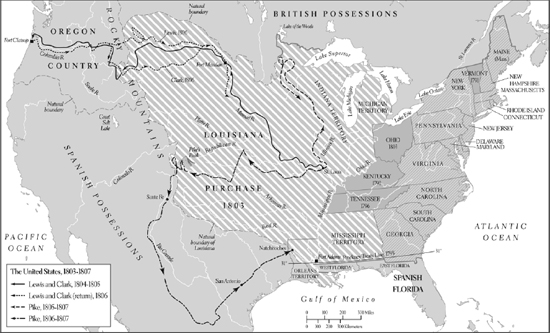
In March 1804 Congress divided the Louisiana Purchase by a line that is now the northern border of the present state of Louisiana. While the vast and little-known region to the north became the District of Louisiana with St. Louis as its capital and with the notorious General James Wilkinson as its governor, the southern part became the Territory of Orleans with New Orleans as its capital.37 The borders with Spanish territory were unclear, and although a buffer zone between Louisiana and Texas was created, boundary disputes between the Americans and the Spanish were both inevitable and exploitable by adventurers, runaway slaves, and troublemakers of all sorts.
The first governor of the Territory of Orleans was twenty-nine-year-old William Claiborne, who at twenty-one had been a judge of the Tennessee state supreme court and most recently was governor of the Mississippi Territory. Because of doubts about the capacity of the French and Spanish people of Orleans for self-rule, Claiborne was given nearly dictatorial powers over them, even though he did not speak their languages, share their religion, or comprehend their customs and society. Not surprisingly, Claiborne found dealing with the diversity of the new territory to be his “principal difficulty.”38
Since Claiborne, like nearly all white Americans, was used to a black-white, slave-free dichotomy, he found it especially difficult to understand the division of Louisiana society into at least three castes—black, free colored, and white. Could the free colored population be armed and participate in the militia? Could they become citizens? Fisher Ames’s warning that Louisiana society was simply a “Gallo-Hispano-Indian omnium gatherum of savages and adventurers” whose morals could never be “expected to sustain and glorify our republic” frightened many Americans.39
Not only did the large numbers of Americans moving into Orleans have to adapt their common law to the European civil law, but they had to make their way into a multi-racial, multi-ethnic, and Catholic-dominated society unlike anyplace else in the United States. Fearing the unruly slaves being brought from the rebellious colony of Saint-Domingue, Congress in 1804 forbade the importation of slaves from abroad into Orleans. This restriction assumed that the domestic slave trade could supply the territory’s needs and thereby offset the influence of the French and Spanish slaves and what the Americans believed were the pernicious racial attitudes of the French and Spanish residents.
Franco-Spanish slavery was different from Anglo-American slavery. Manumission and the slave’s right to self-purchase were easier; indeed, to the consternation of many white Americans, between 1804 and 1806 nearly two hundred slaves in Orleans purchased their own freedom. By 1810 free blacks composed about 20 percent of the population of the city of New Orleans.40 Consequently, the numbers of free blacks, interracial marriages and unions, and people of mixed race were much greater than elsewhere in the American South. Despite these differences, however, the territory of Orleans, or what became Louisiana, gained statehood in 1812, less than a decade after the Louisiana Purchase.
Over the decades following 1803, Americans tried with mixed success to bring this polyglot society and its permissive interracial mixing into line with the binary racial culture prevailing throughout the rest of America. In the nineteenth century most Americans retained an image of New Orleans as an exotic place of loose morals and rampant miscegenation, and thus they learned little or nothing from this remarkable multicultural and multi-racial addition to the United States.
JEFFERSON WAS EAGER to take advantage of the hazy boundaries of the Louisiana Territory. He thought that the western border went all the way to the Rio Grande and was convinced that West Florida on the eastern border was part of the Louisiana Purchase. The American negotiators, Livingston and Monroe, certainly had argued that Louisiana extended eastward to the Perdido River (the present western boundary of Florida), and they had backed up their argument by showing that France had claimed such a border for Louisiana prior to 1763.41 When Livingston asked the French foreign minister about the “East bounds of the Territory ceded to us,” the wily Talleyrand replied, “I can give you no direction; you have made a noble bargain for yourselves and I suppose you will make the most of it.”42
They did make the most of it—at the expense of Spain. The Republicans’ policy was simple: Claim West Florida as part of Louisiana (pointing out that that was how France had defined it) and then offer to forgo the use of force if Spain would sell both East and West Florida to the United States. Since, as Monroe pointed out, in what was conventional wisdom among most American leaders, America was “a rising and Spain a declining power,” the Floridas were sooner or later going to fall to the United States anyhow; thus it was in Spain’s interest to sell them now. In 1804 Congress passed the Mobile Act that extended the federal revenue laws to all territory ceded by France, including West Florida, which Spain considered to be its territory. The act vested the president with discretionary authority to take possession of the Mobile area “whenever he shall deem it expedient.”43
Spain called this act an “atrocious libel” and sought French backing for its position. Although Monroe and others recommended that the United States simply seize the disputed territory, Jefferson reluctantly decided to wait for circumstances to ripen. Yet at the same time he was eager to “correct the dangerous error that we are a people whom no injuries can provoke to war,” and in his December 1805 message to the Congress he came close to calling for a declaration of war against Spain. To the amazement of foreign observers, the aggressive young country with little or no military establishment seemed to have no doubt that it was destined, in the words of a French diplomat, “to devour the whole of North America.”44
It seemed as if America could not acquire territory fast enough. When in early 1806 Jefferson requested $ 2 million from Congress to help obtain the Floridas, Senator Stephen Bradley of Vermont proposed an amendment to give the president authority to acquire not only West and East Florida but also Canada and Nova Scotia, by purchase or “otherwise,” by which he meant military means. The amendment gained some support but was defeated. The “Two Million Dollar Act,” as it was called, was bitterly opposed by John Randolph, the Virginia spokesman for the States’ Rights Principles of 1798, largely because the money was to be paid to France, which presumably would influence Spain to surrender the Floridas. Randolph “considered it a base prostration of the national character, to excite one nation by money to bully another out of its property,” and he used this incident to break decisively with Jefferson.45
Although Randolph was not opposed to American expansion but only to the administration’s unbecoming and secret maneuvering, others were being made uneasy by the constant pressure for acquiring territory. Senator Samuel Mitchill of New York said the United States was caught up in “a land mania.” First it was Louisiana, “a world without bounds, without limits.” Now “we must buy more—we must have the Floridas. What next?” he asked. “Why all the Globe—why this rage—Have we an inhabitant for every acre?”46
After several years of rumors, plots, and threats of war, a group of American settlers in the summer of 1810 rebelled against what remained of Spanish rule in West Florida. Believing they were justified by Napoleon’s takeover of the Bourbon regime in Spain, the rebels marched on the fort at Baton Rouge, declared themselves to be the independent Republic of West Florida, and requested annexation by the United States. Despite protests from the European powers, the Madison administration proclaimed the annexation of West Florida and then made the region part of the Territory of Orleans, defending its controversial actions as the delayed carrying out of the purchase of Louisiana. Three years later, in 1813, American troops occupied the last remaining piece of West Florida, the Mobile district that ran to the Perdido River.
From the outset Jefferson had had his eye on not only all the rest of the Floridas but also Cuba, Mexico’s provinces, and Canada. When all of these territories became part of the United States, he said, “we should have such an empire for liberty as she has never surveyed since the creation.” It was America’s destiny. He was “persuaded no constitution was ever before so well calculated as ours for extensive empire and self government.”47
JEFFERSON HAD BEEN FASCINATED with expansion into the West from an early age. He had read everything he could about the region and was probably the best-informed American on the territory beyond the Mississippi. When the Revolutionary War ended in 1783, he was already dreaming of explorations to the Pacific. In 1783 he asked the Revolutionary War hero George Rogers Clark to lead a privately sponsored expedition to explore the West, but Clark declined. When Jefferson was minister to France he encouraged the extravagant and ill-fated hopes of Connecticut-born John Ledyard to cross Siberia and reach the western coast of North America; from there Ledyard was supposed to travel east across the continent to the Atlantic. Ledyard reached Siberia but was arrested by Catherine the Great in 1788, brought back to Moscow, and expelled from the country. While in Egypt, he continued to write Jefferson about the value of travel in correcting the errors of historians; he died during a voyage up the Nile in 1789 at age thirty-seven.48
Later as secretary of state in the Washington administration Jefferson supported several plans for expeditions up the Missouri, including backing the plans of the French immigrant and naturalist André Michaux to journey to the Pacific; these went nowhere when Michaux got caught up in Citizen Genet’s shenanigans. In 1792 an American sea trader from Rhode Island, Captain Robert Gray, discovered and named the Columbia River, and after the Nootka Sound controversy Captain George Vancouver of the British navy and the Canadian trader Alexander Mackenzie began staking British claims to the northwest portion of the continent and threatening to take complete control of the fur trade in the Columbia River area. In 1792–1793 Mackenzie in fact made the first crossing of the continent north of Mexico, at least by a white man.
Mackenzie’s account of his expedition published in 1801 was apparently what jogged President Jefferson into action. Well before he had any inkling that America would purchase the whole Louisiana Territory, the president laid plans for an ostensibly scientific but also a covert military and commercial expedition into the Spanish-held trans-Mississippi West. “The idea that you are going to explore the Mississippi has been generally given out,” Jefferson informed the leader of the expedition. “It satisfies public curiosity and masks sufficiently the real destination,” which was the Pacific.49
To lead this Western expedition, Jefferson in 1802 selected his private secretary, Meriwether Lewis, an army veteran. Lewis had volunteered for a Jefferson-planned expedition of 1793 that never came off and undoubtedly had conveyed to Jefferson in numerous conversations his desire to explore the West. It was an excellent choice. As Jefferson explained to Dr. Benjamin Rush, “Capt. Lewis is brave, prudent, habituated to the woods, & familiar with Indian manners & character.” Although Lewis was “not regularly educated,” he knew enough about nature to select and describe flora and fauna that were new. And what he did not know he could learn. Jefferson sent Lewis off to Philadelphia for crash courses in astronomy, natural history, medicine, map-making, lunar navigation, and ethnology with several scientific experts. He was told to learn all he could about the Indians, from their sexual habits to their feelings of melancholy and tendencies to suicide.50
Lewis wanted a co-commander and selected his old army friend William Clark, younger brother of the Indian fighter George Rogers Clark, who had declined Jefferson’s earlier request to lead an expedition. Clark was four years older than Lewis and had been Lewis’s immediate superior for a time, but in 1796 he had resigned his captain’s commission and was engaged in family business in the Ohio Valley when he received Lewis’s invitation. Since the army regulations for the expedition provided for only a lieutenant as the second officer, Clark did not get his captain’s commission back. But Lewis was determined that Clark be treated as his equal and kept the lieutenancy a secret from the men of the expedition.51
Having co-commanders was an extraordinary experiment in cooperation, in violation of all army ideas of chain of command, but it worked. Lewis and Clark seem never to have quarreled and only rarely disagreed with one another. They complemented each other beautifully. Clark had been a company commander and had explored the Mississippi. He knew how to handle enlisted men and was a better surveyor, map-maker, and waterman than Lewis. Where Lewis was apt to be moody and sometimes wander off alone, Clark was always tough, steady, and reliable. Best of all, the two captains were writers: they wrote continually, describing in often vivid and sharp prose much of what they encountered—plants, animals, people, weather, geography, and unusual experiences.
So much about the land beyond the Mississippi remained unknown or wrongly understood that no one could prepare fully for what lay ahead. Although Jefferson had the most extensive library in the world on the geography, cartography, natural history, and ethnology of the American West, he nevertheless assumed in 1800 that the Rockies were no higher than the Blue Ridge Mountains, that mammoths and other prehistoric creatures still roamed along the upper Missouri among active volcanoes, that a huge mile-long mountain of pure salt lay somewhere on the Great Plains, that the Western Indians may have been the lost tribes of Israel or wandering Welshmen, and, most important, that there was a water route, linked by a low portage across the mountains, that led to the Pacific—the long-sought northwest passage.
Lewis and Clark set out from St. Louis on May 14, 1804, with forty or so men, including Clark’s black slave, York. They traveled up the Missouri and by October reached the villages of the Mandan Indians, in present-day North Dakota, where they decided to spend the winter of 1804–1805.
Since fur traders had penetrated this far up the Missouri, the expedition had not yet covered completely unknown ground. Lewis and Clark spent time during this first stage of the journey dealing with some disciplinary problems and the death of a sergeant from appendicitis—the only member of the company to die on the journey. Although they had a nearly violent confrontation with the Teton Sioux in present-day South Dakota, most of the time the captains left the Indians they met more bewildered than angry.
The translation problems were immense. The Indians would speak to an Indian in the expedition who then spoke to someone who could only speak French who then passed on what he heard to someone who understood French but also spoke English. Only then could Lewis and Clark finally find out what the Indians had originally said. Their reply, of course, had to repeat the process in reverse. Laborious as conversation with the Indians was, Lewis and Clark worked out an elaborate ceremony for all the Indian tribes they encountered, informing them that the United States had taken over the territory and that their new father, “the great Chief the President,” was “the only friend to whom you can now look for protection, or from whom you can ask favours, or receive good counciles, and he will take care to serve you, & and not deceive you.”52 After what became the standard speech to the Indians, the captains distributed presents—beads, brass buttons, tomahawks, axes, moccasin awls, scissors, and mirrors, as well as U.S. flags and medals with Jefferson’s visage.
The Corps of Discovery, as the expedition was called, spent the winter of 1804–1805 in a fort it constructed near the Mandan villages. In April 1805 Lewis and Clark sent back their heavy keelboat and some enlisted men to St. Louis along with a written report, a map, and some botanical, mineral, and animal specimens to be delivered to President Jefferson. Joining the party now was the Shoshone woman Sacagawea with her husband, Toussaint Charbonneau, a French-Canadian river man, and their infant son. Sacagawea and Charbonneau were to prove invaluable as translators during the next stages of the journey. In addition, the presence of Sacagawea and her baby was a sign to the Indians met by the Corps that the explorers came in peace.
In six canoes and two pirogues the Corps of thirty-three set out on April 7, 1805, to proceed up the Missouri to the Rockies. Even though Lewis, as he wrote in his journal, was about “to penetrate a country at least two thousand miles in width, on which the foot of civillized man had never trodden, the good or evil it had in store for us was for experiment yet to determine,” he could not have been happier. “This little fleet,” he said, “altho’ not quite so rispectable as those of Columbus or Capt. Cook, were still viewed by us with as much pleasure as those deservedly famed adventurers ever beheld theirs; and I dare say with quite as much anxiety for their safety and preservation.”53
Despite his happiness in getting his expedition going once again in April 1805, Lewis scarcely realized how arduous the rest of the journey to the Pacific would be. It took the party four months just to get to the Rockies, including a monthlong portage around the Great Falls of the Missouri. The men suffered badly from eating their virtually all-meat diet. Lewis tended to give the ailing soldiers some of the fifty dozen pills that Dr. Benjamin Rush had prescribed for the journey. Generally referred to as “Thunderclappers,” the pills were composed of a variety of drugs, each of which was a powerful purgative.
By the time the party reached the Continental Divide on the present Montana–Idaho border in August 1805, Lewis (who turned thirty-one on August 18) realized that there would be no simple portage to the waters of the Columbia. Although the commanders did not know it, they could scarcely have picked a more difficult place to cross the Rockies. From Sacagawea’s Shoshone tribe the expedition got guides and horses for the journey across what one sergeant called “the most terrible mountains I ever beheld.”54 The crossing of Lolo Pass in the Bitterroots was the expedition’s worst experience. Beset by snow and hail, exhausted and half-starved, the men killed their horses and drank melted snow for nourishment. Yet the expedition made 160 miles in eleven days, an incredible feat.
On September 22, 1805, the party finally reached the country of the Nez Percé Indians on the Clearwater River in Idaho, where it built canoes for the trip down the Clearwater, the Snake, and the Columbia to the Pacific. On November 7, 1805, though the group was still in the estuary of the Columbia, Clark described what he saw: “Ocian in view ! O! the joy! . . . Ocian 4142 Miles from the Mouth of Missouri R.”55
The men built Fort Clatsop on the south side of the Columbia estuary, where the captains spent a long wet winter writing descriptions of nature and the Indians and making a map. In March 1806 they began their return, and spent a month with the Nez Percé waiting for the snow to melt in the Rockies. After crossing the mountains, Lewis and Clark separated. Lewis explored the Marias River in present Montana while Clark traveled down the Yellowstone River. On their trip Lewis and his men ran into a party of Blackfoot Indians, who tried to steal their horses. In the only real violence of the expedition, Lewis and his men killed two of the Indians and were lucky to escape with their lives.
Reunited in North Dakota, the captains revisited the Mandan villages where they had wintered in 1804–1805. They left Sacagawea and her husband and child with the Mandans and moved rapidly down the Missouri to St. Louis, arriving on September 23, 1806. From the time they had originally set out from St. Louis, they had been gone two years and four months. Nearly everyone had given them up for lost—except Jefferson.
The Lewis and Clark expedition was the greatest adventure of exploration in American history. But it was more than that. In addition to opening up a fur-trading empire in the West and strengthening America’s claim to the Oregon Country, the explorers had brought back a wealth of scientific information. They had discovered and described 178 new plants and 122 species and subspecies of animals. By systematically recording all they had seen, they introduced new approaches to exploration that affected all future expeditions. Their marvelous journals influenced all subsequent writing on the American West.
Unfortunately, however, the explorers were unable to get their manuscripts ready for publication. Lewis, who was appointed governor of the Louisiana Territory, became involved in establishing a fur company and other get-rich schemes and apparently began drinking heavily, taking drugs, and running up debts. He was so deeply depressed that on a trip back from St. Louis to Washington in 1809 he committed suicide. He was thirty-five.
Clark tried to pick up the pieces, and he persuaded Nicholas Biddle, a precocious young Philadelphian, to edit the journals. In 1814 Biddle, the future president of the Second Bank of the United States, published a narrative account of the journey that omitted most of the material on the flora and fauna. Because Biddle’s History of the Expedition Under the Commands of Captains Lewis and Clark was for the next ninety years the only printed account of the expedition based on the journals, Lewis and Clark received no credit for most of their discoveries in nature. Others renamed the plants, animals, birds, and rivers that they had discovered and named, and these later names, not Lewis’s and Clark’s, were the ones that have survived.56
One person who hoped to benefit from the expedition was the fur trader and businessman John Jacob Astor. In 1808 Astor established a trans-continental fur company that aimed to control all the Indian trade from the Northwest. He set up routes from upstate New York through the Great Lakes, up the Missouri River, and across the Rocky Mountains to a northwestern post on the Pacific Ocean. He named the post Astoria, and in 1811 it became the first American settlement in the Oregon Country. Although the conflict with Great Britain culminating in the War of 1812 undid many of Astor’s plans, his ventures did help to maintain American interests in the Northwest while Astor himself turned his attention to New York real estate.
Once the Lewis and Clark expedition had tracked the Northwest, the Southwest of the continent remained to be explored, even though much of it was Spanish territory. Several American expeditions in 1804 and 1805 looked for the elusive source of the Red River and created trouble with the Spanish. After having explored the Mississippi to its source in 1805, Lieutenant Zebulon Pike in 1806 led an expedition up the Arkansas River into what is now Colorado. Pike tried but was unable to reach the summit of the fourteen-thousand-foot peak that bears his name. His party was eventually captured by Spanish troops and brought to Santa Fe and then Chihuahua in Mexico before being sent under guard through Mexico to an American border post at Natchitoches in the northwest corner of present-day Louisiana.57
Since Pike’s expeditions had been ordered by General James Wilkinson, governor of the Louisiana Territory and commander-in-chief of the United States Army, Pike’s fame was tainted by Wilkinson’s reputation for intrigue and shady dealing. Indeed, the borders of the new Louisiana Territory were so vague, Spain’s hold on the East and West Florida and Texas was so weak, and the rough and unruly frontier inhabitants were so captivated by dreams of America’s inevitable expansion that adventurers, filibustering expeditions, and rumors of plots and conspiracies flourished throughout Orleans and the Southwest.
THE MOST GRANDIOSE of these schemes was that of 1806–1807 involving Aaron Burr, Jefferson’s former vice-president, and General Wilkinson. Wilkinson’s involvement is explicable: he was a notorious schemer and plotter and was rumored, correctly, to be in the pay of the Spanish government. It is Burr’s participation that is astonishing, and it has captivated the imagination of Americans for over two hundred years. Indeed, Burr has become the most romanticized and vilified historical character in American literature. He has been the subject of countless poems, songs, sermons, and semi-fictional popular biographies, and the central figure in nearly three dozen plays and more than four dozen novels. Despite all his hustling and scheming, however, it is doubtful that Burr would ever have become embroiled in his mysterious adventures in the West if he had not become alienated from the Jefferson administration and had not killed Alexander Hamilton in a duel.
Because of his passive behavior during the electoral deadlock in 1801, Vice-President Burr at once created doubts about his loyalty to the Jefferson administration. Jefferson did not ask his opinion on appointments to the cabinet and instead turned to Governor George Clinton of New York for advice and then appointed few of Burr’s followers to offices. Burr in turn began to defend Federalist policies and, to the consternation of Republican leaders, even participated in a Federalist celebration of Washington’s birthday.
As Burr’s ties to the administration eroded, the Republicans in New York divided between the Burrites and the supporters of Governor Clinton and his nephew DeWitt Clinton. In 1802 the leading Republican journalist in the state, James Cheetham, a convert to the Clintonians, accused Burr of conniving to win the presidency for himself in the election of 1800. The charges had a devastating effect on Burr’s reputation among Republicans everywhere. By 1804 the Republican congressional caucus gave him not a single vote as the vice-presidential candidate on the ticket and replaced him with George Clinton.
After a long and futile interview with Jefferson in January 1804, in which Burr apparently asked for an appointment, Burr decided to run for governor of New York against the Republican candidate backed by the Clinton and Livingston families. Frustrated at losing the race despite some Federalist support, Burr, according to one of his close friends, was “determined to call out the first man of any respectability concerned in the infamous publications concerning him.”58 Hamilton had opposed Burr’s candidacy, and he became that man. According to an Albany physician, Hamilton at a dinner party had expressed “a still more despicable opinion” of Burr than simply saying that he was “a dangerous man.”59 When Hamilton passed up an opportunity to disown this particular incident with some evasive remarks, the exchanges between the two men got out of hand. Finally, his anger fully aroused, Burr “required a General disavowal of any intention on the part of Genl Hamilton in his various conversations to convey impressions derogatory to the honor of M. Burr.” When Hamilton refused to make this sort of blanket denial, Burr challenged him to a duel.60
Hamilton reluctantly accepted Burr’s challenge, and the two men met in Weehawken, New Jersey, on July 11, 1804. Hamilton’s death from his wounds the next day released an outpouring of mourning, and Burr, shocked by the response to Hamilton’s death, was forced to flee New York to the island home of Pierce Butler off the coast of Georgia. With warrants out for his arrest, the vice-president had become a fugitive from justice.
Already Burr was thinking of some exploit in the West that might recoup his reputation and his fortune. As war between the United States and Spain became more and more likely and the uproar in New York died down, Burr met with General Wilkinson many times in Washington during the winter of 1804–1805 and pored over maps of the Floridas and Texas. He seemed to think that the military officers in the West were so estranged from the Republican administration that they could be recruited to do most anything. In December 1804 General John Adair, a Kentucky speculator, wrote Wilkinson that his Kentuckians were “full of enterprise” and ready to move. “Mexico glitters in our Eyes—the word is all we wait for.”61 At the same time, Burr was trying to get British financial and naval backing for his schemes—support which the British refused to give. In the spring of 1805 he traveled down the Ohio and Mississippi and conferred with friends and others, including Andrew Jackson in Nashville and Wilkinson in St. Louis. Although the war with Spain never broke out, Burr in the summer of 1806 led sixty or so men and half a dozen flat-boats down the Mississippi toward New Orleans.
Since Burr said so many different things to so many different people, his ultimate aim has never been entirely clear. Did he simply intend to lead Americans in a filibustering expedition to take over West Florida or Texas from Spain? Or did he actually mean to separate the West from the Union and create his own empire? As conflicting rumors flew about, federal officials in Kentucky in the late fall of 1806 charged Burr with plotting a military expedition against Mexico, but a sympathetic grand jury refused to indict him. With the Jefferson administration becoming more and more concerned with Burr’s activities in the West, Wilkinson decided to save himself by betraying Burr. In November 1806 he warned President Jefferson of “a deep, dark, and wide-spread conspiracy” and ordered Burr arrested.62 Constitutionally scrupulous as always, Jefferson worried about whether the president had the authority to call out the regular armed forces to put down a domestic attempt to dismember the Union, so he asked Congress for legislation giving him that authority.
After being arrested, Burr was paroled. He then sought to flee to Spanish territory but was seized and brought to Virginia. In 1807 he was indicted for treason and brought to trial in the U.S. Circuit Court in Richmond, Virginia, with Chief Justice John Marshall as the presiding judge. Unfortunately for Burr, Jefferson had already told Congress that Burr’s “guilt is placed beyond question.”63 Earlier Jefferson had been rather casual about the separation of the West from the Union; but in those cases he had assumed that the Western areas, namely Kentucky and Tennessee, were full of Americans who believed in American principles and therefore were citizens not much tempted by disunionist schemes. But Burr threatened the separation of New Orleans, which was not yet filled with Americans, and that made a difference.
Determined to see Burr found guilty of treason, Jefferson worked hard for his conviction.64 Marshall’s decisions during the trial and his strict definition of treason frustrated Jefferson. Burr was eventually found not guilty, but his political career was ruined. He fled the country in disgrace, only returning years later to live out the remainder of his life in obscurity.
JEFFERSON’S WEST WAS, of course, still inhabited by Indians, who were as fascinating to him as the West itself. Although Jefferson has been much criticized for his lack of modern ethnographic sympathy, he was actually a more sensitive ethnographer than most of his contemporaries. No other president in American history was as interested in the indigenous people as Jefferson. He collected every scrap of information about them—their bodies, their orations, their habits, their languages; in fact, he spent most of his life collecting and studying Indian vocabularies.65
Jefferson’s obsession with the Indians was shared by most of his fellow Americans. Indeed, never before in American history had the Indian become so central to the hopes and dreams of educated white Americans. And never before was the Indian so admired and celebrated as he was by Jefferson’s generation. Since this was the generation that essentially destroyed the society and culture of those Indians living east of the Mississippi, this fixation becomes all the more curious and ironic. It actually grew out of the Americans’ nervousness over their New World habitat. Americans of the early Republic were informed by the best scientific authorities of the Western world that the American natural environment was deleterious to all animal life. There was in fact something terribly wrong—something inherent in nature itself—that made the climate of the New World harmful to all living creatures, including the Indians, who were the only humans native to the New World.66
This was not the conclusion of a few crackpots or of some fanatic European aristocrats eager to malign American republicanism. It was the conclusion of the greatest naturalist of the Western world, the French scientist George Louis Leclerc, comte de Buffon. In the rambling thirty-six volumes of his Natural History published between 1749 and 1800, Buffon presented a profoundly pessimistic but scientifically grounded picture of the American environment. There was in the New World, Buffon wrote, “some combination of elements and other physical causes, something that opposes the amplification of animated Nature.”67
The American continents, said Buffon, were newer than those of the Old World. They had, it seemed, only recently emerged from the flood and had not as yet properly dried out. The American air was more humid than that of the older continents. Its topography was more irregular, its weather more variable, its forests and miasmic swamps more extensive. In short, America had an unhealthy climate in which to live.
Animals in the New World, said Buffon, were underdeveloped—smaller than those of the Old World. America did not have any lions. The American puma was scarcely a real lion; it did not even have a mane, and “it is also much smaller, weaker, and more cowardly than the reallion.” The New World had no elephants; in fact, no American wildlife could be compared to the elephant in size or shape. The best that America had, Buffon wrote sarcastically, was the tapir of Brazil, but “this elephant of the New World” was not bigger than “a six-month-old calf.” All the American animals were “four, six, eight, and ten times” smaller than those of the older continents. Even the domestic animals introduced to America from Europe tended to shrink and dwindle under the influence of the New World’s climate.68
Buffon’s conclusion about the environment was stark and frightening. “Living nature,” he wrote, “is thus much less active there, much less varied, and we may even say, less strong.” To learn that the peculiar American habitat had affected animal life was unsettling, but to learn that the environment of the New World was also unhealthy for humans was truly alarming. Buffon claimed that the American environment was responsible for the apparently retarded development of the native Indians, who seemed to be wandering savages stuck in the first stage of social development without any structured society. The Indians, Buffon said, were like reptiles; they were cold-blooded. Their “organs of generation are small and feeble.” The natives of the New World had no hair, no beards, no ardor for their females. Their social bonds were weak; they had very few children and paid little attention to those they had. In some way this strange, moist climate of the New World had devastatingly affected the physical and social character of the only humans native to it. The outlook for humans of the Old World transplanted to this forbidding environment was therefore not a happy one.69
It is difficult to appreciate the extent of European ignorance about the Western Hemisphere, even as late as the eighteenth century. Since Alexander von Humboldt had not yet made his journeys and published his findings, even educated Europeans had strange ideas about the New World. Of course, at the beginning Europeans had expected the climate of America to be similar to that of the Old World. Indeed, “climate” was described, as, for example, in Jedidiah Morse’s American Geography (1796), as a belt of the earth’s surface between two given parallels of latitude. People assumed that places that were the same distance from the poles or the equator would have the same climate and were surprised to find the contrary. The latitude of London was north of Newfoundland; that of Rome was nearly the same as New York City. Yet the climates of these places on the same latitude were very different. It was out of this sense of difference between the Old and New Worlds and the hearsay it generated that Buffon fabricated his scientific conclusions.70
The great naturalist’s theories about the New World were taken up by others, including Corneille de Pauw, the Abbé Raynal, and the Scottish historian William Robertson, and through such writers they entered the popular thinking about America in the late eighteenth century.71 Naturally those Americans who became aware of Buffon’s findings were alarmed. If Buffon’s scientific claims were true, then the chances for the success of the new American republican experiment were not good, and the predictions of pessimistic Europeans about the future of the New World would be proved correct. For many eighteenth-century Englishmen and Europeans the term “American” often had conjured up images ofunrefined if not barbarous persons, degenerate and racially debased mongrels living amidst African slaves and Indian savages thousands of miles from civilization. Hessian soldiers arriving in New York in 1776 had been surprised to find that there were actually many white people in the New World.72 Now the best scientific theories of the day seemed to reinforce these popular European images of the degeneracy of the New World.
Of course, most Americans in the generation following the Revolution did not let these English and European charges seriously dampen their optimism and enthusiasm for the future. Instead, they reacted with indignant dismissal, exaggerated boasting, or extensive scientific comparison. Perhaps it was true, conceded Jefferson, that America had twice as much rain as Europe, but in America, he said, it fell “in half the time.”73
Yet some Americans seemed to have an underlying anxiety that the European critics might be right after all. There did seem to be something peculiar about America’s climate. The same regions with temperatures well below zero in winter could swelter in heat close to one hundred degrees Fahrenheit in the summer; also, swings of forty degrees Fahrenheit in twenty-four hours were not uncommon. No place in Europe had these sorts of radical variations in temperature. The American climate did seem to have more moisture. Humidity was often high, and heavy rainfall alternated with an unusual number of sunny cloudless days. Some speculated that these peculiarities were due to the existence of so much uncultivated land with so many dense forests in America. Europe’s climate had once been like America’s, it was thought, but once most of its trees had been cut down, its climate had changed.
The devastating epidemics of yellow fever that erupted in American cities during this period, beginning with the catastrophe in Philadelphia in 1793 (which killed 10 percent of the population), were not duplicated elsewhere in the Western world. This led some Americans, including Jefferson, to conclude that the disease was indeed “peculiar to our country.” Because the sun rarely shone in the middle and northern parts of Europe, the Europeans could “safely build cities in solid blocks without generating disease.” But America’s unusual atmosphere—the cloudless skies and the intense heat and humidity—fermented the garbage and filth in America’s cities, creating putrefaction that released effluvia and morbific fluids that bred disease; thus in America, said Jefferson, “men cannot be piled on one another with impunity.” He hoped that some good might come out of these epidemics of yellow fever: Americans might be inhibited from building the sorts of huge sprawling cities that existed in Europe.74
Although America’s cities were scarcely crowded or dirty by European standards, many Americans decided that their unusual climate required their cities to be designed differently from those in the Old World. Urban renewal in the early Republic was born out of these concerns. Jefferson was especially worried about New Orleans, which promised to become “the greatest city the world had ever seen. There is no spot on the globe,” he said, “to which the produce of so great an extent of fertile country must necessarily come.” But unfortunately at the same time “there is no spot where yellow fever is so much to be apprehended.” He decided that New Orleans and other American cities had “to take the chequer board” for a plan, with “the white squares open and unbuilt for ever, and planted with trees.”75
Not just Jefferson but many other leading intellectuals of the day, such as Benjamin Rush, Noah Webster, Samuel L. Mitchill, and Benjamin Latrobe, also concocted plans for cleaning and renovating America’s cities. But Dr. Charles Caldwell, a Philadelphia physician, was the one who drew up the most elaborate plans for urban renewal to deal with the effluvia that presumably caused yellow fever. Caldwell thought all of America’s cities, which were simply “vast factories of this febrile poison,” would have to be rebuilt in accord with the country’s unusual climate—requiring lofty buildings, lots of squares, and many trees, especially Lombardy poplars, which were the best kind of tree for soaking up the miasma and emitting vital air.
Caldwell seems to have conceded that the Europeans were correct in their judgment about America’s climate. Instead of denying the Europeans’ charges, he turned them around by claiming that America’s climate was simply more stupendous than any other. “Nature,” he said in an oration in 1802, “was more gigantic in her operations” in America. “Compared to our own, how humble are the mountains, rivers, lakes, and cataracts of the Old World.” It stood to reason, he said, that America had bigger and more powerful diseases than other places. “Our diseases are not only more frequent but aspire to the same scale of greatness with our other phenomena.”76
Americans’ preoccupation with the climate that was causing these diseases grew out of their Enlightenment assumption that people were the products of experience and external circumstances. Since, as most people believed, humans had all sprung from the same origin, as recorded in Genesis, only the effects of the environment through time could account for the obvious differences among them. Even skin color was explained in environmental terms. Many believed that the Negro’s blackness came from the intense African sun—that somehow the African’s skin had become scorched. In the peculiar climate of America, some Americans thought, the African Americans’ skin would gradually become lighter, perhaps eventually white. The South Carolina historian David Ramsay, who believed that “all mankind [was] originally the same and only diversified by accidental circumstances,” claimed that “in a few centuries the negroes will lose their black color. I think now they are less black in Jersey than Carolina.”77
All this emphasis on the power of climate had ominous implications for Americans. If the climate of the New World were powerful enough to create peculiar American diseases or to affect the color of people’s skins, then Buffon’s charges were very serious indeed. In fact, they lay behind the only book Thomas Jefferson ever wrote.
In his Notes on the State of Virginia (first published in a French edition in 1785; the first American edition appeared in 1787, with two more in 1800 and five new editions in 1801), Jefferson systematically attempted to answer the famous theories of Buffon; in fact, he requested that one of the first copies of his book be delivered directly to the great naturalist. The parts of the book that today are often skipped over or eliminated entirely in modern abbreviated editions—the tables and statistics about animals that Jefferson compiled in Query VI—are precisely those parts that Jefferson considered central to his work.
Side by side in order of volume Jefferson listed the animals of the Old and New Worlds, accompanied by the weights of each in pounds and ounces. In almost every case the American animal is bigger. If the European cow weighed 763 pounds, the American cow was 2, 500 pounds. If the European bear weighed 153.7 pounds, then the American bear weighed 410 pounds. As Jefferson described the various American animals—the moose, the beaver, the weasel, the fox—and found them all equaling or bettering their European counterparts, he got carried away with excitement and even brought in the prehistoric mammoth to offset the Old World elephant. He even matched Buffon’s sarcastic reference to the tapir, “the elephant of America,” being but the size of a small cow. “To preserve our comparison, I will add that the wild boar, the elephant of Europe, is little more than half that size.”
Jefferson scarcely hid his anger at Buffon’s charges, and he raised question after question about the sources of the famous naturalist’s data. Who were those European travelers who supplied the information about America’s animals? Were they real scientists? Was natural history the object of their travels? Did they measure or weigh the animals they speak of? Did they really know anything at all about animals? Jefferson’s conclusion was clear: Buffon and the other European intellectuals did not know what they were talking about.78
Jefferson was not someone who liked personal confrontations, but when he went to France in the 1780s as American minister he prepared himself for his first meeting with Buffon by taking with him “an uncommonly large panther skin.” He was introduced to Buffon, the curator of King Louis XVI’s cabinet of natural history, as someone who had combated several of Buffon’s theories. Jefferson did not hesitate in pressing Buffon about his ignorance of American animals. He especially stressed the great size of the American moose and told Buffon that it was so big that a European reindeer could walk under its belly. Finally, in exasperation, the eminent European naturalist promised that if Jefferson could produce a single specimen of the moose with foot-long antlers, “he would give up the question.”79
That was all Jefferson needed, and he went busily to work, writing friends in America, imploring them to send him all the skins, bones, and horns they could find, or better still, entire stuffed animals. Governor John Sullivan of New Hampshire took the most trouble of anyone, for he was commissioned to get the moose that was to demolish Buffon’s theories once and for all. Sullivan sent a virtual army into the northern wilderness of New Hampshire and even cut a twenty-mile road through the woods to drag it out. By the time the specimen arrived in Portsmouth to be readied for its transit across the Atlantic, it was half rotten and had lost all its hair and head bones. So Sullivan sent along to Paris the horns of some other animal, blithely explaining to Jefferson that “they are not the horns of this Moose but may be fixed on at pleasure.”80
Understandably, Jefferson was not entirely happy with the impression his bones and skins were making on Buffon. Although he asked his correspondents in America to send him the biggest specimens they could find, he continually apologized to Buffon for their smallness. Apparently, however, the specimens convinced Buffon of his errors, for according to Jefferson, the French naturalist promised to set these things right in his next volume; but he died before he could do so.81
Jefferson continued to be interested in the size of American animals. In 1789 he urged the president of Harvard to encourage the study of America’s natural history in order “to do justice to our country, it’s productions, and it’s genius.” In the mid-1790s on the basis of some fossil remains, probably belonging to a prehistoric sloth, he concocted the existence of a huge super-lion, three times bigger than the African lion, and presented his imagined beast to the scientific world as the Megalonyx, “the great claw.”82
The most exciting scientific find of the period was Charles Willson Peale’s exhumation in 1801 near Newburgh, New York, of the bones of the mastodon, or mammoth. Peale displayed his mammoth in his celebrated museum and in 1806 painted a marvelous picture of what was perhaps the first organized scientific exhumation in American history. Peale’s discovery electrified the country and put the word “mammoth” on everybody’s lips. A Philadelphia baker advertised the sale of “mammoth bread.” In Washington a “mammoth eater” ate forty-two eggs in ten minutes. And under the leadership of the Baptist preacher John Leland, the ladies of Cheshire, Massachusetts, late in 1801 sent to President Jefferson a “mammoth cheese,” six feet in diameter and nearly two feet thick and weighing 1,230 pounds. The cheese was produced from the milk of nine hundred cows at a single milking, with no Federalist cows being allowed to participate. The president welcomed this gift from the heart of Federalism as “an ebullition of the passion of republicanism in a state where it has been under heavy persecution.”83
Others besides Jefferson wrestled with the problem of America’s environment. Indeed, at times it seemed as if the entire American intellectual community was involved in examining the creatures and the soil and climate of America. The Scottish-born self-made naturalist Alexander Wilson filled his remarkable nine-volume American Ornithology (1808–1814) with corrections of Buffon, who, said Wilson, committed error after error “with equal eloquence and absurdity.”84 Calls went out everywhere for information about the American habitat. Was the climate really wetter than that of Europe, and if so, could anything be done about it? Charles Brockden Brown abandoned his novel-writing career in order to devote his energies to translating the comte de Volney’s disparaging Tableau du climat et du sol des États-Unis d’Amérique (A View of the Soil and Climate of the United States of America), even though a London translation was readily available. In his notes to his new translation Brown wanted to refute Volney’s claim that America’s climate was responsible for America’s inability to produce a decent artist or writer.85
Clergymen in such obscure places as Mason, New Hampshire, faithfully compiled meteorological and demographic records, and otherwise exclusively literary journals such as the Columbia Magazine and the North American Review published periodic weather charts sent from distant correspondents in Brunswick, Maine, and Albany, New York. Indeed, temperature-taking became everyone’s way of participating in the fact-gathering of enlightened science. Between 1763 and 1795 Ezra Stiles, president of Yale, filled six volumes with his daily temperature and weather readings. Every intellectual felt the need to present a paper to some philosophical society on the subject of America’s climate. The Transactions of the American Philosophical Society for the single year of 1799 contained no less than six articles on the topic.
All these writings and all this temperature-taking showed that Americans were actually changing their climate. By cutting down forests and filling in swamps, they were moderating the extreme temperatures that had existed decades earlier. If Americans could change the weather, then they could change anything, or so they hoped.
AMIDST ALL THE DISCUSSION and debate, the issue finally came back to the Indian. Had America’s climate actually retarded the development of the only people native to the New World? Jefferson’s lifelong defense of the prowess and virtue of the Indian grew out of this passionate desire to protect the American environment against European aspersions. Buffon was wrong, he wrote; the Indian “is neither more defective in ardor, nor more impotent with his female, than the white reduced to the same diet and exercise.” The difference between the native peoples of America and Europeans was “not a difference of nature, but of circum stance.” There were good reasons why Indian women bore fewer children than whites, why the Indians’ hands and wrists were small, why they had less hair on their bodies; and those reasons, said Jefferson, had nothing to do with America’s soil or climate. For Jefferson the Indian had to be “in body and mind the equal of the white man.” He could readily doubt the capacities of blacks, who after all came from Africa, but he could never admit any inferiority in the red men, who were products of the very soil and climate that would mold the people of the United States.86
The Reverend James Madison, president of the College of William and Mary and a second cousin of the famous Founder, had much more hope for the assimilation of the Indian than of the African into white society. He told Jefferson of reports of an Indian near Albany who had gradually whitened in the past two years. But he knew of no African changing color. “It seems as if Nature had absolutely denied to him the Possibility of ever acquiring the Complexion of the White.”87 (Of course, Jefferson might have reminded the Reverend Madison of all those slave children who were becoming whiter as a consequence of what Jefferson called “the perpetual exercise of the most boisterous [meaning coarse or savage] passions” between the white planters and their African slaves.)88
The Indian, admitted Jefferson, was at an earlier stage—the hunting and gathering stage of development; but this was not from a lack of native genius, only a lack of cultivation. Yet what if the American environment were strong enough to prevent that process of cultivation and refinement from operating? What if the environmental conditions that kept the native peoples from advancing worked to make the transplanted whites more Indian-like? Instead of progressing along through the successive stages of civilization, Americans might degenerate to a cruder and more savage state.
Some Americans thought that such a regression was actually taking place in the frontier areas—where whites responded to brutal Indian atrocities with even more bloody atrocities of their own. Tales were told of “white savages” who bashed Indian children and cut off the limbs and severed the heads of their Indian victims. Americans had long been fearfully fascinated with stories of these “white savages,” of white men apparently abandoning civilization and adopting scalping and other violent Indian ways. In the early Republic this fascination took on a heightened importance. Was America advancing from rudeness to refinement, as the Revolutionaries had hoped, or was the move westward actually turning the civilizing process around?89
“The manner in which the population is spreading over this continent has no parallel in history,” declared an anxious New England analyst of what was taking place in early nineteenth-century America. Usually the first settlers of any country were barbarians who gradually in time became cultivated and civilized. “The progress has been from ignorance to knowledge, from the rudeness of savage life to the refinements of polished society. But in the settlement of North America the case is reversed. The tendency is from civilization to barbarism.” By moving to the West, cultivated Easterners were losing their politeness and refinement. “The tendency of the American character is then to degenerate, and to degenerate rapidly; and that not from any peculiar vice in the American people, but from the very nature of a spreading population. The population of the country is out-growing its institutions.”90
Jefferson himself realized that the West was more barbaric than the East; in fact, he thought that the United States contained within itself all the stages of social development, “from the infancy of creation to the present day. . . . Let a philosophic observer,” he said,
commence a journey from the savages of the Rocky Mountains, eastwardly towards our sea-coast. These he would observe in the earliest stage of association living under no law but that of nature, subscribing and covering themselves with the flesh and skins of wild beasts. He would next find those on our frontiers in the pastoral state, raising domestic animals to supply the defects of hunting. Then succeed our own semi-barbarous citizens, the pioneers of the advance of civilization, and so in his progress he would meet the gradual shades of improving man until he would reach his, as yet, most improved state in our seaport towns.91
Still, was the fact that the Indian remained in the earliest stage of social development the fault of the natural environment? Was the New World’s climate destined to turn white Americans into Indians, or at least prevent them from progressing? These sorts of nervous questions underlay the extraordinary concern that Jefferson and other educated Americans had for the fate of the Indian in the early Republic. If the Indian could not be civilized, that is, assimilated and turned into something resembling white farmers, then perhaps the natural environment of the New World was too strong and too impervious to cultural and social reform, suggesting that white men living in such a powerful natural habitat could not become fully civilized either. This unease that Buffon and his followers might be proved right after all lent a sense of urgency to the Jeffersonians’ philanthropic efforts to civilize the Indian.
Of course, these efforts, like those of the Washington administration, gave no recognition whatsoever to the worth or integrity of the Indians’ own existing culture. In the minds of many early nineteenth-century whites, enlightened civilization was still too recent, too precarious, for them to treat it as simply an alternative culture or lifestyle. Only later, only when the Indians’ culture had been virtually destroyed, could white Americans begin to try to redeem the tragedy that had occurred.
Jefferson, like Secretary of War Henry Knox before him, had no doubt of the superiority of white agricultural society to the “savage” state of the native peoples of America. In his first annual message to Congress in December 1801 Jefferson made clear that he would continue what he took to be the successful efforts of his predecessors to introduce among “our Indian neighbors . . . the implements and the practice of husbandry, and of the household arts.” The Indians, he said, were “becoming more and more sensible of the superiority of this dependence [on husbandry] for clothing and subsistence over the precarious resources of hunting and fishing.” Some Indians, he added, were even experiencing “an increase in population.”92
Jefferson, of course, never questioned that the Indians might not want to become civilized and participate in the progressive course of history. In his mind and in the minds of most enlightened Americans, his intentions were always pure. “We will never do an unjust act towards you,” he told a visiting delegation of Northwestern Indians in 1809 just before he left the presidency. “On the contrary we wish you to live in peace, to increase in numbers, to learn to labor as we do, and furnish food for your ever increasing numbers, when the game shall have left you. We wish to see you possessed of property and protecting it by regular laws. In time you will be as we are; you will become one people with us. Your blood will mix with ours; and will spread, with ours, over this great land.”93
Jefferson’s policy toward the Indians was tragically simple: let the natural demographic growth and movement of white Americans take their course. The dynamic white settlers would surround the Indians and circumscribe their hunting grounds and thus pressure them into taking up farming, which would not require large tracts of land. Therefore the remainder of their hunting grounds could be ceded piecemeal to the United States. But even before the assimilation and incorporation of the Indians had taken place, Jefferson jumped at every opportunity to get the land that was destined to belong to American farmers. He and his successor, President James Madison, negotiated fifty-three treaties of land cession with various tribes.
Although the Cherokees in the Southwest made extraordinary progress in developing white ways—living in houses and relying on agriculture and not game for their food—for the most part the Jeffersonian program of Indian acculturation was a disaster. Indian society and culture tended to disintegrate as they came in contact with white civilization. Commerce with the whites, especially the trade in liquor, corrupted the Indians and destroyed their independence; and diseases, especially smallpox, were devastating. In 1802 three-quarters of the tribes along the Mississippi and Missouri Rivers perished from disease.
So confident were Jefferson and other enlightened Americans in the capacity of people to reinvent themselves and become civilized that none of them had any capacity whatsoever to comprehend the terrible human cost involved in destroying a way of life. They always thought they were acting in the best long-run interests of the native peoples.
Before long many of the philanthropists most concerned for the fate of the Indians were urging that removing them from immediate proximity to the whites and slowing down the process of assimilation were the only means of saving them from extinction. Thus the way was prepared for the wholesale removal of the Indians that took place under President Andrew Jackson—lending a humanitarian justification for what most white settlers wanted anyhow: to get rid of the Indians and take their lands.94
The encounter between the two incompatible cultures was a tragedy from beginning to end. Although Jefferson and other Americans continued to talk about incorporating the Indian into mainstream American life, in their hearts they knew better; and much of their writing about the Indians took on an elegiac tone, as if they realized that the native peoples were already doomed. They knew that the Indians represented much of what they themselves valued—a respect for human dignity and a passion for human freedom. These were values that Americans also came to identify with the West. Americans never lost the sense that the Indian and America’s West were inextricably bound together.