
17
The United States was born amidst a world at war. From 1792 to 1815, except for some brief armistices, Europe was torn apart by a ferocious struggle for dominance between revolutionary and later Napoleonic France and her many European enemies, especially Great Britain. It became the longest sustained global war in modern history. Before it was over, it had killed or maimed more than two million persons, overthrown numerous governments, and transformed boundaries throughout Europe. Fighting took place in nearly every part of Europe and in various regions of the world, including the Middle East, South Africa, the Indian Ocean, the West Indies, and Latin America. Almost every European country was involved at one time or another, either in alliance or at war with Britain or France.
For the new French republic the war was total. The French revolutionary leaders enlisted their entire society on behalf of the republican cause, which they said would be brought to all of Europe. With the execution of Louis XVI, exulted the radical Jacobin Georges Jacques Danton, France was flinging at the feet of monarchs “the head of a King.” The French revolutionary leaders drafted their citizens and turned them into the world’s first mass conscript army. By the end of 1794 the French army had grown to over a million men—not only the largest army the world had ever seen but one inspired by the most extraordinary revolutionary zeal. “No more maneuvers, no more military art, but fire, steel, and patriotism,” declared Lazare Carnot, the organizer of the French revolutionary armies. “We must exterminate! Exterminate to the bitter end!”1
Against such revolutionary fervor, the British realized that this struggle would be different from the many previous clashes with their ancient enemy. The day in 1793 that Great Britain declared war on revolutionary France, the thirty-three-year-old prime minister, William Pitt, the brilliant son of the great minister who had won the Seven Years’ War a generation earlier, told Parliament that Britons were fighting not merely for a traditional balance of power in Europe but for their monarchy and their way of life, indeed, for “the happiness of the whole of the human race.” The French, said Pitt, wish to bring their brand of liberty “to every nation, and if they will not accept of it voluntarily, they compel them. They take every opportunity to destroy every institution that is most sacred and most valuable in every nation where their armies have their appearance; and under the name of liberty, they have resolved to make every country in substance, if not in form, a province dependent on themselves.” The cost in British blood and treasure of the nearly two and a half decades of war was astonishing—nearly three hundred thousand killed and over a billion pounds in money.2
Although the war took place in all parts of the world, it was not a single continuous war like the world wars of the twentieth century; instead, it was a series of wars, most of them very short and distinct. Every one of the great Continental powers—Austria, Prussia, and Russia—formed and dissolved coalitions against France in accordance with their particular interests. Being often more fearful of one another than of France, they were as willing to ally with Napoleon as to wage war against him. Only Britain, except for a year of peace in 1802–1803, remained continually at war with France throughout the period.
The Treaty of Amiens that Britain signed with France in 1802 left France in control of Belgium, Holland, the left bank of the Rhine, and Italy. This peace could not last, for it was no more acceptable to Britain than it was to Napoleon, who began to extend his sway over more and more parts of Europe. Britain declared war against France in 1803 and formed the Third Coalition with Austria and Russia against France. Napoleon crowned himself emperor in 1804 and made plans to invade England. In October 1805 the British navy under the command of Admiral Horatio Lord Nelson defeated the combined French and Spanish fleets off Cape Trafalgar. Nelson’s victory destroyed Napoleon’s plans for invading England and guaranteed Britain’s control of the seas. Then at the end of 1805 Napoleon defeated the combined Austrian and Russian armies at Austerlitz (located in the present-day Czech Republic), which led to the collapse of the Third Coalition the British had mounted against the French.
President Jefferson saw at once the implications of Napoleon’s victory at Austerlitz. “What an awful spectacle does the world exhibit at this instant,” he wrote in January 1806, “one man bestriding the continent of Europe like a Colossus, and another roaming unbridled on the ocean.”3America was caught between these two leviathans, which, involved as they were in a life-or-death struggle for supremacy, could scarcely pay much attention to the concerns of the awkward young republic three thousand miles away. Napoleon thought that it would take at least two or three centuries before the United States could pose a military threat to Europe.
Americans, however, never fully appreciated this European disdain for their country’s power. They had an extraordinary emotional need to exaggerate their importance in the world—a need that lay behind their efforts to turn their diplomacy into a major means of defining their national identity.
JEFFERSON AND THE REPUBLICANS, in control of the national government for the first time since the European war began, put forth a peculiar conception of the United States and its role in the world. Like the Federalists, they believed that the United States had to remain neutral amid Europe’s quarrels. But more than the Federalists, they insisted, to the point of threatening war, on the right of the United States to trade with the European belligerents without restraint or restrictions. They held that free ships made free goods, which meant that neutrals had the right to carry non-contraband goods into the ports of a belligerent without their being seized by its opponent. They believed that the list of contraband articles—articles subject to seizure by the belligerents, including those owned by neutral nations—should be narrowly defined and not include, for example, provisions and naval stores. In addition, the Republicans believed that blockades of belligerent ports should be backed up by naval power and not simply declared on paper.
With the outbreak of war in the early 1790s and Britain in control of the seas, France and Spain found it much too risky to use their own ships to carry goods between their islands in the West Indies and Europe. Consequently, they had had thrown open their hitherto closed ports in the Caribbean to American commerce. American merchants as neutrals had begun developing a profitable carrying trade between the French and Spanish West Indies and the home countries in Europe, taking sugar, for example, from the French West Indies to France and returning with manufactured goods. By September 1794 Americans had completely absorbed all the foreign trade with the West Indies—British, French, and Dutch combined.4
As the European wars continued, this re-export or carrying trade became even more profitable, increasing in value from $500,000 in 1790 to nearly $ 60 million by 1807. Between 1793 and 1807 the total value of all American re-exports was $ 493million, an average of nearly $ 33 million a year.5
Not only did American merchants, especially New Englanders, dominate the re-export trade between the West Indies and Europe, but these shippers were also major re-exporters of goods from Asia. Sailing by way of Cape Horn, American merchants brought home products from Canton, China, and ports in the Indian Ocean, including teas, coffee, chi-naware, spices, and silks, before shipping them on to Europe, especially to markets in the Netherlands as well as those in France, Italy, and Spain. In fact, between 1795 and 1805 American trade with India was greater than that of all the European nations combined.6 At the same time, Americans imported the manufactured goods of Europe and Great Britain and re-exported most of them to the West Indies, South America, and elsewhere. During the crucial war years of 1798–1800 and 1805–1807 the value of goods in America’s re-export trade exceeded the value of American-made goods sent abroad.
Many of the merchants involved in this re-export trade made fortunes, including William Gray, Elias Hasket Derby, and Joseph Peabody of Salem, Nicholas Brown II and Thomas P. Ives of Providence, John Jacob Astor and Archibald Gracie of New York, and Stephen Girard of Philadelphia. At the height of his business in 1807 Gray was worth over $ 3million; he reputedly owned 115vessels, annually employed three hundred seaman, and, as his obituary said in 1825, was “probably . . . engaged in a more extensive commercial enterprise than any man who has lived on this continent in any period of its history.”7
All of this re-export trade turned the United States into the largest neutral carrier of goods in the world. In 1790 American ships had carried only about 40 percent of the value of all goods involved in America’s foreign trade; by 1807 American ships were carrying 92 percent of a much larger volume—from combined imports and exports of $ 43 million in 1790 to $ 246 million in 1807. Between 1793 and 1807, the value of American imports and exports increased nearly sixfold, and American ship tonnage tripled. Even accounting for a price inflation of 26 percent between 1790 and 1807, these were impressive figures.8
With so much of its income and wealth involved in overseas trade, it was not surprising that the United States government vigorously supported freedom for neutral commerce on the high seas in wartime. Great Britain, as a strong naval power, however, never agreed with the liberal principles of wartime commerce that were so dear to the Americans. Since the British navy controlled the seas, the British government quite understandably thought that the American carrying trade between the French and Spanish West Indies and Europe was actually French and Spanish trade covered by the American flag. The British protested that this trade violated what they called the Rule of 1756, which stipulated that commerce prohibited in time of peace was also prohibited in time of war. This rule, which the British had first set forth during the Seven Years’ War, thus enabled British prize courts (courts that judged the legitimacy of the seizure of enemy ships or enemy goods on neutral ships) to deny the right of neutral nations in wartime to trade with ports in belligerent countries that had been closed to them in peacetime—which had been the case for the Americans with the French and Spanish empires. Britain was especially eager to prevent the neutral United States from carrying goods between the Caribbean colonies of France and Spain and ports in Europe. The British denied that “free ships made free goods” and declared that they would take enemy property wherever they could find it, even from neutral ships on the high seas.
In order to comply with the British Rule of 1756 American shippers developed the legal fiction of the “broken voyage.” By carrying goods from the French and Spanish colonies to ports in the United States, unloading and paying duties on them, and then reloading and receiving rebates on most of the duties before re-exporting them to France and Spain as presumably American and therefore neutral goods, American traders technically conformed to the British Rule of 1756. At first tacitly and then officially, as determined by a British admiralty court in 1800 in the case of the Polly, British authorities had accepted this practice of the “broken voyage,” ruling that enemy goods became neutral property if imported into the United States before being re-exported. The American re-export trade thrived, and the Republicans became its great defenders.
The situation was bizarre. The Republicans in the Congress were those most determined to promote the neutral rights of Americans to carry belligerent goods throughout the world in wartime without fear of their vessels and crew being seized by the belligerents. Yet curiously nearly all the congressional Republicans came from areas in the South and West that supplied few if any of the ships and sailors that were being taken by the belligerents. By contrast, the section of the country, Federalist New England, that did supply the bulk of the ships and sailors for America’s overseas commerce was the section most opposed to the Republicans’ policy of defending America’s neutral rights on the high seas. Republicans seemed obsessed with overseas trade even though most of them or their constituents were not directly engaged in it; they even carried their promotion of neutral rights to the point of wanting to prohibit America’s participation in the very international trade that made a defense of neutral rights necessary. It seemed as if many Republicans really did not like overseas commerce yet were eager to defend the rights of Americans to engage in it.
In fact, many Republicans did dislike much of the overseas commerce they were defending, believing that there was something fraudulent about the commercial riches that the European wars were bringing to America. Merchants involved in the carrying trade, especially New England merchants, who were mostly Federalists, seemed to be prospering simply from America’s neutrality. John Randolph objected strongly to having “this great agricultural nation” governed by urban merchants. He called the carrying trade—”this mushroom, this fungus of war”—utterly dishonest and wanted no part in defending it.9
Although Jefferson knew the re-export trade was lucrative, he too was not happy with a commerce that tended to get America involved in Europe’s wars, especially with American ships’ carrying the goods of belligerents. He believed that “a steady application to agriculture with just trade enough to take off its superfluities is our wisest course.” By contrast, he said, the carrying trade fed on the evils of war and encouraged “a spirit of gambling” and the desire to make money without labor. Those merchants engaged in the wartime re-export trade produced nothing of their own and only profited from the work done by others. By becoming merely neutral carriers of goods, Americans, Jefferson concluded despairingly, were launched “into the ocean of speculation, led to over trade ourselves, tempted to become robbers under French colors, and to quit the pursuit of Agriculture the surest road to affluence and the best preservative of morals.”10 Not only did Jefferson, aristocratic Southern planter that he was, express disdain for what he thought were the low pecuniary motives of merchants, but he hated and thought “absurd” the fact that commerce was “converting this great agricultural country into a city of Amsterdam,—a mere headquarters for carrying on the commerce of all nations.”11
Despite this contempt for America’s neutral carrying trade, which he thought benefited mostly his Federalist enemies, Jefferson as president devoted most of his diplomatic energies to defending it. As a result, he not only quarreled with Britain but nearly went to war with the former mother country, a war that above all he wanted to avoid. In trying to implement his policy, he ended up completely stopping the flow of all American overseas trade and at the same time repressing his fellow citizens to a degree rarely duplicated in the entire history of the United States. Jefferson’s extraordinary efforts to defend the rights of neutrals to trade freely drove the country into a deep depression and severely damaged his presidency. He ended up violating much of what he and his party stood for.
NOT ONLY DID JEFFERSON and the Republicans have unusual ideas about America’s political economy, but, more important, they possessed a radical appreciation of the role of commerce in international affairs and an inspired vision of what the world might be.
Jefferson’s foreign policy grew out of his hopes for America’s domestic economy. Unlike the Federalists, who anticipated the United States even-tually—maybe in a half century or less—developing a diversified and balanced manufacturing economy like that of Great Britain, Jefferson and the other Republican leaders, but not many of their Northern followers, wanted the United States to remain predominantly rural and agricultural. Jefferson and Madison certainly did not want or expect America to become more like commercially developed Europe, at least not in the foreseeable future. Madison in the Constitutional Convention had warned of a time in the distant future when “a great majority of the people will not only be without landed, but any other sort of property,” and reminded his colleagues that “we see in the populous Countries in Europe now what we shall be hereafter.”12 But he and many other Republicans hoped that that depressing future might be put off—for at least a century or two—by the prevalence of free land in America and by the fact that most Americans remained independent farmers. Believing in the same four-stage theory of social development as the Federalists, the Republican leaders had a vested interest in freezing time and holding America back from becoming sophisticated and luxury-loving like the nations of the Old World. And from the evidence of the seemingly unchanging rural and farming character of American society in the early nineteenth century, they were increasingly confident that the nation was pretty firmly fixed in the agricultural stage of development.
While most Federalists were disappointed that the society was not becoming more urban, more complicated, and more hierarchical, the Republican leaders welcomed America’s social stasis. They celebrated the dominance of farming and the absence of the large-scale urban manufacturing that was characteristic of the poverty and decadence that afflicted the Old World. Jefferson in his Notes on the State of Virginia had argued that no people in their right minds would ever voluntarily turn to manufacturing. The British and French had begun industrializing only because they had run out of land and their farmers had been forced to migrate to the cities and become dependent laborers working in houses of industry turning out gewgaws and other superfluities that no one actually needed. But Americans, said Jefferson, were not in that situation. “We have an immensity of land courting the industry of the husbandman.” The more farmers the healthier the society, said Jefferson. “While we have land to labour then, let us never wish to see our citizens occupied at a work-bench, or twirling a distaff. . . . Let our work-shops remain in Europe.”13
Although the Southern Republican leaders were opposed to European-style urban manufacturing, they were not opposed to commerce. Quite the contrary: overseas commerce was essential to preventing the development of large-scale manufacturing. Although Jefferson in the 1780s had talked wistfully of having America “stand with respect to Europe precisely on the footing of China,” practicing “neither commerce nor navigation,” so that “we should thus avoid wars, and all our citizens would be husbandmen,” he realized this was “theory only, and a theory which the servants of America are not at liberty to follow.” The American people had “a decided taste for navigation and commerce,” and the country’s political leaders had to take this taste into account. The best way to promote international trade was “by throwing open all the doors of commerce and knocking off its shackles.”14
Opening up trade abroad became crucial for the Republican leaders. Desiring as they did the United States to remain predominantly rural and agricultural, they were confronted with the problem of ensuring sufficient markets for the agricultural surpluses of America’s many hardworking and productive farmers. Since the Southern Republicans did not want America to develop huge urban centers, they could not assume the existence of a large domestic market for the surpluses of farm goods. If the farmers were unable to sell their produce somewhere, they would stagnate, slip into mere subsistence farming, and become idle and lazy and eventually morally unfit for republican government. Hence developing markets abroad for America’s agricultural produce became essential for sustaining America’s experiment in republicanism. The Federalists, declared Jefferson, could not have been more wrong in thinking him “an enemy of commerce. They admit me a friend of agriculture, and suppose me an enemy to the only means of disposing of its produce.”15
But since the European states would not open up their markets voluntarily, Jefferson and other Republican leaders thought that the only recourse America had was to “adopt a system which may shackle them in our ports as they do us in theirs.” The English especially were pig-headed in resisting the liberalization of their commerce. Jefferson had concluded as early as the 1780s that “nothing will bring them to reason but physical obstruction, applied to their bodily senses.” “We must shew them,” he said, “that we are capable of foregoing commerce with them, before they will be capable of consenting to an equal commerce.”16 America had to create its own navigation system and use commercial retaliation against the European states, especially Great Britain, in order to compel them to free up their international trade.
The Republicans were confident of America’s ability to bring economic pressure on Great Britain because they believed that it was more commercially dependent on the United States than the other way round. Although Britain was the chief purchaser of American exports, which the Republicans regarded as “necessaries,” it was also selling America more goods than any other country. Because Britain supplied nearly 80 percent of America’s imports, it seemed to the Republicans to be particularly dependent on American markets for its industries. And because the former mother country sent to America mostly manufactured “luxuries” or “superfluities,” Britain seemed particularly vulnerable to American commercial coercion.17
Although Americans always overestimated the effectiveness of the non-importation agreements of the 1760s and 1770s, many continued to see them as America’s special weapon against Great Britain. “It is universally agreed,” wrote the well-known merchant William Bingham in 1784, “that no country is more dependent on foreign demand, for the superfluous produce of art and industry [than England];—and that the luxury and extravagance of her inhabitants, have already advanced to the ultimate point of abuse, and cannot be so increased, as to augment the home consumption, in proportion to the decrease that will take place on a diminution of foreign trade.”18
In other words, if the Americans restricted their purchases of English luxury goods, there being no market elsewhere for them, the manufacturing poor in England would be thrown out of work, leading to hunger and rioting, which would force the government to change its policies. The possibility of taking advantage of England’s susceptibility to this kind of economic coercion had been undermined by Jay’s Treaty of 1795, which is why the Republicans hated it so much.
IN 1801 THE REPUBLICANS were at long last in control of the national government and in a position to bring pressure to bear on the British to break up their navigation system as soon as Jay’s Treaty lapsed in 1803. Yet as important as this need for markets for America’s agricultural produce was to the Republicans, it would be a mistake to see the foreign policy of the administrations of Jefferson and Madison as simply designed to compel Great Britain to open up more of its markets to American goods. The quarrel the Republicans had with Britain was much more political than economic. They did not want merely to change Britain’s navigation policies; they wanted to change its monarchical regime.
The Republicans had never been happy with the foreign policy of the Federalist administrations, which they thought were decidedly biased toward the British. They especially resented British dominance over American commerce. By restricting the commerce of the former mother country, they believed, they could thrust a dagger into the heart of Britain’s power.
Despite America’s best efforts to establish trade with other nations in the aftermath of the Revolution, the country had not been able to throw off the hammerlock Britain had over American commerce. Never mind that much of America’s prosperity rested on this commerce. They wanted to restrict it in order to enlarge it, or so they said publicly; actually they wanted much more.
The Republican leaders had multiple motives for their actions. They were actually less concerned with the country’s commercial prosperity than they were with America’s status in the world. They resented Europe’s and especially Britain’s view of the United States as a lesser nation. Not only did the Republicans dream of creating a new kind of world politics that would preclude the traditional resort to war, but, more important, as citizens of a fledgling republic they wanted international acknowledgment of their nation’s independence and identity, particularly from the former mother country. Since a nation’s ability to exchange goods with other states in the world, along with its capacity to wage war, was a principal measure of its equal status as a sovereign state, the Republicans believed that resorting to economic coercion against Great Britain would be a fitting reminder that the United States had actually won the War of Independence.19
The Republicans came to power in 1801 very much committed to the liberal principles of international commerce that Americans had first sought to implement in the model treaty of 1776. Their ultimate aim, confused and confusing as it often was, was truly grandiose.
Although these liberal principles involved establishing free trade throughout the world, their purpose was not merely to promote commercial prosperity everywhere but to promote peace everywhere. If all nations treated foreign ships and goods as they treated their own ships and goods, commerce among nations would flow freely and dissolve the artificial mercantilist barriers the monarchies of Europe had erected. This free flow of commerce, many Republicans hoped, would tie nations together peacefully and change the way international politics had traditionally been conducted. The exchanges of commerce would substitute for the political rivalries of military-minded monarchical governments and create the possibilities for a universal peace. The secret was to get rid of monarchy and establish republics everywhere, which was why many Republicans clung so desperately to the idea of the French Republic, even when the reality of the Napoleonic dictatorship made that faith increasingly untenable.
The Republicans believed that republics were naturally peace-loving, while monarchies thrived on war-making. “Of all the enemies to public liberty,” Madison had written in 1795, “war is, perhaps, the most to be dreaded, because it comprises and develops the germ of every other [enemy].” As “the parent of armies,” not only did war promote “debts and taxes,” but, he said, it also meant that “the discretionary power of the Executive is extended; its influence in dealing out offices, honors, and emoluments is multiplied; and all the means of seducing the minds, are added to those of subduing the force, of the people.”20 In 1806 the old radical Thomas Paine was still echoing these liberal sentiments. Precisely because Great Britain was a monarchy, Paine thought it would never make peace. The British government was “committed in a war system,” he told a visitor to his lodgings in New York, “and would prosecute it as long as it had the means.”21 In contrast to the Federalists, who believed that the only way to prepare for war was to build up the government and armed forces in a European manner, Republicans thought that the United States as a republic neither needed nor could safely afford a traditional army and navy and a bloated war-making government. “Our constitution is a peace establishment—it is not calculated for war,” declared President Jefferson. “War would endanger its existence.”22
It was just this sort of thinking that lay behind the Democratic-Republicans’ excitement over the undersea warfare inventions of Robert Fulton. Fulton, who spent two decades abroad between 1787 and 1806 mingling with radicals like Thomas Paine and Joel Barlow, became convinced that submarines and torpedoes could revolutionize naval warfare. By being able to destroy warships “by means so new, so secret, and so incalculable,” submarines, said Fulton, would render conventional naval warfare impossible. Not knowing where the underwater attacks would come from, sailors would be demoralized and fleets would be “rendered worthless.” Without navies, nations, in particular Great Britain, would be compelled to liberalize their trade and practice the freedom of the seas that Americans had long advocated. This in turn would lead to the universal and perpetual peace that every enlightened person, but especially Americans, yearned for. Fulton built a prototype of a submarine and called it Nautilus . Although he knew his submarine was but an infant, he saw in it “an Infant hercules which at one grasp will Strangle the Serpents which poison and convulse the American Constitution.”23
Fulton returned to the United States eager to demonstrate his new invention. In 1807 he used one of his torpedoes, which were actually mines, to blow up a brig in New York Harbor, an experiment that Washington Irving’s Salmagundi mocked as the destruction of the British fleet in effigy. Nevertheless, the Republicans were excited. In a Fourth of July address in 1809 his friend and patron Joel Barlow declared that Fulton’s submarine project “carries in itself the eventual destruction of naval tyranny” and the possibility of freeing “mankind from the scourge of naval wars.”24
With this kind of support from a leading Republican intellectual and with the publication of his Torpedo War and Submarine Explosions in 1810, Fulton was invited to address the Congress and to conduct further tests of his underwater devices. The Republican Congress, despite its reputation for penny-pinching, even appropriated five thousand dollars to fund his experiments. Although Fulton had many doubters, especially in the navy and among the Federalists, Jefferson had nothing but praise for his devices. In April 1810 the former president told Fulton that he hoped that “the torpedo may go the whole length you expect of putting down navies.” Indeed, he wished the scheme to succeed “too much not to become an easy convert & to give it all my prayers & interest. . . . That the Tories should be against you is in character, because it will curtail the power of their idol, England.” Although most of Fulton’s torpedo experiments were unsuccessful, the Jeffersonian Republican dream of creating the conditions for a universal peace did not die.25
When some Republicans urged that all diplomatic missions be replaced with consuls, which were all that was required to handle international trade, foreign observers were stunned. “They are singular, these people,” declared the new Russian chargé in Washington. “They want commercial ties without political ties. It seems to me however that the one necessarily depends on the other.” This may have been true for the old monarchical world, but not, in the eyes of the Jeffersonians, for the new republican world.26
Although Hamilton had thought Jefferson and Madison utopian dreamers, the Republican leaders were not completely naïve about the world. They feared, as Madison had written in 1792, that “a universal and perpetual peace . . . will never exist but in the imaginations of visionary philosophers, or in the breasts of benevolent enthusiasts.” Nevertheless, because war was so foolish as well as wicked, the Republican leaders still hoped that the progress of reason might eventually end war; “and if anything is to be hoped,” Madison had said, “every thing ought to be tried.”27This deep desire to avoid a conventional war if at all possible became the driving force of Republican policy over the entire period.
The Republicans did concede that even republics might occasionally have to go to war. But if wars were declared solely by the authority of the people, and, more important, if the costs of these wars were borne directly and solely by the generation that declared them, then, Madison had written in 1795, “ample reward would accrue to the state.” All “wars of folly” would be avoided, and only brief “wars of necessity and defence” would remain, and even these might disappear. “If all nations were to follow [this] example,” said Madison, “the reward would be doubled to each, and the temple of Janus might be shut, never to be opened again.”28 This was an aspect of the liberal dream of a universal peace shared by the enlightened everywhere.
In a world of monarchies, however, the Republicans concluded that the best hope for the United States to avoid war was to create some sort of peaceful republican alternative to it. “War is not the best engine for us to resort to,” said Jefferson; “nature has given us one in our commerce, which, if properly managed, will be a better instrument for obliging the interested nations of Europe to treat us with justice.”29 Peaceful coercions, using commercial discrimination against foreign enemies and backed ultimately by the withholding of American commerce, were, said Madison, “the most likely means of obtaining our objects without war.”30 In other words, most Republican leaders, especially Jefferson and Madison, believed in the use of economic sanctions—something that even today is often invoked as an alternative to the direct use of military force.
BEFORE JEFFERSON COULD ATTEMPT to use this powerful weapon against the former mother country, however, he needed to deal with the long-standing problem with the Barbary pirates.31 In Jefferson’s mind this was linked to the main problem with England itself, and that linkage made him much more eager to resort to military force in dealing with the Barbary States than he otherwise might have been.
Actually, when it came to promoting American interests, Jefferson was quite willing to put aside his most deep-rooted prejudices. In the summer of 1805 he even toyed with the possibility of forming an alliance with Britain in order to show both France and Spain (the latter had declared war on Britain in December 1804) that the United States could not be pushed around, especially on the issue of America’s expansive boundaries of Louisiana. It was unlikely that he ever would have gone that far. But dealing with the Barbary States was another matter. Since neither he nor Madison wanted the European states to take advantage of “the presumed aversion of this Country to war,” the Republican leaders were certainly not going to let the “petty” tyrants of North Africa get away with anything.32
By the end of the eighteenth century the Barbary States of North Africa—Morocco, Algiers, Tunis, and Tripoli—had lost much of their former power in the Mediterranean world. They were no longer a threat to the great powers of Britain and France, which simply bought them off with annual tributes and used them to rid the Mediterranean of smaller rival trading peoples, such as the Danes or the Italian city-states. These smaller nations, without powerful navies or the resources to buy off the North African pirates, were vulnerable to having their ships and sailors seized and thus tended to leave the bulk of the Mediterranean trade to the great powers. The newly independent United States found itself in this vulnerable position.
As long as the American merchantmen had remained colonists of Great Britain, they had been protected by the British flag. But with independence, America’s merchant ships became easy prey for these Barbary pirates, or privateers, which is the legal status most Europeans gave to the Muslim raiders. (Privateers had commissions from their governments and presumably only attacked ships belonging to states against which their governments had declared war.) The British government was delighted that commercial competition from the United States would be thwarted. “It is not probable the American states will have a very free trade in the Mediterranean,” declared Lord Sheffield in 1784 on behalf of the British ministry; “it will not be in the interest of any of the great maritime powers to protect them there from the Barbary States.”33
In 1784 Morocco captured an American ship but did not enslave its sailors; instead, in 1786 it signed a peace treaty with the United States, which still exists, making it the longest-standing treaty in American diplomatic history.34 In 1785Algiers, encouraged by Great Britain, captured two American ships and did enslave their crews. Lacking any resources, financial or otherwise, to retaliate, the Confederation Congress remained helpless, angered by the belief, as one American newspaper reported, that “those Barbarians are countenanced in their Depredations upon our Commerce by the British Court.” Americans were convinced that the British government had the ultimate aim of making British ships the “Carriers of all the Property imported and exported between Britain and America.”35 Not only did this humiliation at the hands of these Muslim pirates contribute to the Americans’ willingness to create a much stronger national government in 1787, but it intensified the rage many Americans felt toward the former mother country.
Throughout the 1780s Jefferson took a hard line against the Barbary States. He believed that they were so caught up in Islamic fatalism and Ottoman tyranny that their backward and indolent societies were beyond reform. He concluded that military force might be the only way to deal with these Muslim pirates. Offer them commercial treaties on the basis of equality and reciprocity, he said, and if they refuse and demand tribute, then “go to war with them.”36 John Adams disagreed. He thought it would be cheaper to pay tribute to these North African states than to go to war with them. “For an Annual Interest of 30,000 pounds sterling then and perhaps for 15,000 or 10,000 we can have Peace, when a War would sink us annually ten times as much.” Jefferson countered with his own costs and calculations, including the creation of a “fleet of 150guns, the one half of which shall be in constant cruise,” all pointing to the advantages of fighting instead of paying tribute.37 As these two ministers, one in Paris, the other in London, engaged in their debate over how best to deal with the Barbary States during the 1780s, they came to realize that the Confederation government was in no position either to go to war or to pay tributes.
Although the United States had ratified the liberal commercial treaty with Morocco in 1787, the Republic, even under the new federal Constitution, could not so easily deal with Algiers. In 1793, before the Washington administration could straighten out its policy toward the North African states and negotiate treaties with them, Algiers captured eleven more American ships and 105sailors, who were enslaved along with the earlier captured sailors. These seizures finally goaded Congress into action. In 1794 it voted one million dollars to purchase a peace and ransom the American prisoners and another million to build a naval force of six frigates, marking the beginning of the U.S. Navy under the Constitution.
The growing split between Federalists and Republicans in Congress complicated matters. Being no longer part of the administration, Jefferson took a somewhat different view of the use of force. In fact, Jefferson’s advocacy of military might in any circumstances was always limited. Force was sometimes justified, but never if it resulted in an expansion of executive power and the sacrifice of republican values. He and other Republicans saw the Federalist military buildup against Algiers as a ploy to enhance presidential power at the expense of liberty. Congressman William Branch Giles of Virginia joined a number of other Republicans in declaring that navies were “very foolish things” that could only lead to heavy taxes and a bloated office-laden European-type government. Better than building frigates at a horrendous expense, the United States should forget about the Mediterranean and protect America’s coastline with some relatively inexpensive gunboats.38
The Federalists controlled Congress, however, and pushed on with negotiations and the building of the six frigates, some of which ended up being used against the French in the Quasi-War. In 1795 the United States agreed to a humiliating treaty with Algiers that cost a million dollars in tributes and ransoms—an amount equal to 16 percent of federal revenue for the year. The government realized that the frigates would not be ready for several years and that the country stood to gain more from trade in the Mediterranean than the peace treaty cost. As soon as the treaty was ratified in 1796, Congress, confident that there would be no more seizures of American ships, cut back the number of warships to three. The government opened negotiations with Tunis and Tripoli, which had begun seizing American merchantmen. By the end of the decade the United States had treaties with all the Barbary States, but the cost was exorbitant, $1. 25million, over 20 percent of the federal government’s annual budget.39
Unfortunately, the Barbary States regarded treaties simply as a means of extracting more tributes and presents, and the threats and demands for more money, and the humiliations, continued. Tripoli felt it was not being treated equally with Algiers, and early in March 1801 it declared war on the United States and began seizing American merchant ships.
President Jefferson came to office several weeks later apparently determined to change American policy. “Nothing will stop the eternal increase of demand from these pirates,” he told Secretary of State Madison in 1801, “but the presence of an armed force, and it will be more economical and more honorable to use the same means at once for suppressing their insolencies.”40 Yet Jefferson’s strict construction of the Constitution made him reluctant to engage the pirates offensively without a formal congressional declaration of war.
The Federalists, led by Hamilton in the press, pounced on this reluctance and forced the Republican Congress in 1802 to grant the president authority to use all means necessary to defeat the Tripolitan pirates. But the American blockade of Tripoli proved ineffective, mainly because the frigates could not maneuver in the shallow waters of Tripoli’s harbor. At the same time, Secretary of the Treasury Gallatin and the Republicans in the Congress were concerned with the rising cost of maintaining a naval force in the Mediterranean. They feared the possibility of “increasing taxes, encroaching government, temptations to offensive wars, &c,” more than the Barbary pirates.41
Still, the administration was determined to act, even if only with a minimum expenditure of funds and what President Jefferson referred to as “the smallest force competent” to the mission.42 In 1803 it appointed a new experienced commander for the Mediterranean squadron, Commodore Edward Preble, and sent several small gunboats to the Mediterranean. Before Preble could deploy his new force, the frigate USS Philadelphia and its three-hundred man crew, commanded by twenty-nine-year-old William Bainbridge, was accidentally beached in Tripoli’s harbor and had to surrender to an array of Tripolitan gunboats. The Pasha Yussef Karamanli of Tripoli set his initial demand for ransoming the newly captured American slaves at $1,690,000, more than the entire military budget of the United States.43
United States naval officers were determined to do something. On February 16, 1804, twenty-five-year-old Lieutenant Stephen Decatur and his seventy-man crew entered Tripoli’s harbor under cover of darkness in a disguised vessel with the intention of burning the Philadelphia, thus preventing its being used as a Tripolitan raider. Since the American ship was deep in Tripoli’s harbor, surrounded by a dozen other armed vessels and under the castle’s heavy batteries, it was a dangerous, even foolhardy, mission; but it succeeded admirably, without the single loss of an American. This action, which Lord Nelson called “the most bold and daring act of the age,” turned Decatur into an instant celebrity and inspired extraordinary outbursts of American patriotism. At age twenty-five Decatur became the youngest man commissioned a captain in U.S. naval history.44
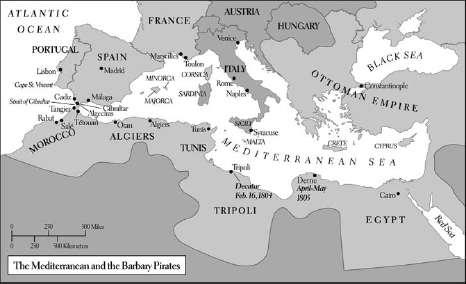
Emboldened by this success, Jefferson sent an even larger squadron to the Mediterranean under the command of Preble’s senior, Samuel Barron, with the aim of punishing Tripoli. The expedition was to be paid for by a special tax on merchants trading in the Mediterranean, which the Federalists charged was an underhanded scheme to get the New England merchants to pay for the purchase of Louisiana. Following the advice of William Eaton, an ex-army captain and former consul to Tunis, the United States government authorized a loose alliance with the pasha of Tripoli’s elder brother, Hamet Karamanli, who hoped to regain the throne his younger brother Yussef had taken from him. According to one historian, this was the U.S. government’s “first overseas covert operation.”45
In 1805 while the naval squadron besieged Tripoli, Eaton, who had an ambiguous status as an agent of the navy, and the pasha’s brother Hamet marched west from Egypt five hundred miles across the Libyan Desert with a motley force of five hundred Greek, Albanian, and Arab mercenaries and a handful of marines. Their goal was to join up with Captain Isaac Hull and three American cruisers at Derne, the strategic Tripolitan port east of Tripoli. After a successful bombardment, Eaton’s and Hull’s marines took the fort at Derne. (This action later inspired the refrain of the U.S. Marine Corps hymn, “to the shores of Tripoli.”) Before Eaton could move his force against Tripoli, however, he learned that in June 1805 Tobias Lear, consul-general at Algiers, had signed a peace and commercial treaty with Tripoli ending the undeclared war.
Eaton felt betrayed by the U.S. government, and the war and what Eaton believed was its premature ending became caught up in partisan politics. The Federalists took every opportunity to chastise the Jefferson administration for its hesitancy in going to war against the Barbary States without a congressional declaration of war and for its ill-timed peace. Hamet did not get his throne back, but his family held in hostage was restored to him. The United States refused to pay any tribute to Tripoli, but it did pay a small ransom of sixty thousand dollars in order to get its imprisoned sailors released. Although the cynical European powers played down America’s victory in this Tripolitan war, believing quite correctly that the pirates would ignore any treaty and would soon be back in business, many Americans celebrated it as a vindication of their policy of spreading free trade around the world and as a great victory for liberty over tyranny.
At the same time, however, many Americans could not ignore the contradiction between the Barbary States’ enslaving seven hundred white sailors and their own country’s enslaving hundreds of thousands of black Africans. As early as 1790 Benjamin Franklin had satirized this hypocrisy, and poets and playwrights juxtaposed the two forms of servitude in their works. Connecticut-born and Dartmouth-educated William Eaton had at once seen the contradiction upon his arrival in Tunis in 1799 as American consul. “Barbary is hell—,” he wrote in his journal. “So, alas, is all America south of Pennsylvania; for oppression, and slavery, and misery, are there.”46
BUT THIS CONTEST with the Barbary States was just a sideshow; the main act always involved America’s relationship with Great Britain. Getting the British, however, to sign a liberal free trade treaty similar to that with Tripoli was highly unlikely. Not only would such a treaty be difficult to achieve, but it was not something that Jefferson really wanted, as events in 1805–1806 revealed.
Jefferson knew that America’s prosperous trans-Atlantic carrying trade of French and Spanish colonial goods would require governmental protection once war between Britain and France resumed, as it did in 1803. At first Britain seemed more or less willing to continue accepting the legal fiction of the “broken voyage” and America’s carrying trade continued to flourish even though occasional seizures of American ships took place.
Suddenly in the summer of 1805 the Royal Navy began seizing scores of American merchant ships that assumed they were complying with the principle of the “broken voyage.” Although Britain did not warn the United States of any change in policy, it had been contemplating tightening its treatment of the neutral carrying trade for some time. In the Essex decision in the spring of 1805 a British admiralty appeals court endorsed a change of policy and re-invoked the Rule of 1756 that had forbidden neutrals in time of war from trading within a mercantile empire closed to them in time of peace. By the new doctrine of the “continuous voyage,” American merchants would now have to prove that they actually intended their voyages from the belligerent ports to terminate in the United States; otherwise the enemy goods they carried were liable to seizure.
This single decision undercut the lucrative trade that had gone on for years with only minor interruptions. By September 1805 Secretary of State Madison reported that America’s merchants were “much alarmed” by the apparent change in British policy, for they had “several millions of property . . . afloat, subject to capture under the doctrine now enforced.” Insurance rates quadrupled, and American merchants faced heavy losses. During the latter half of 1805 merchants in Philadelphia complained of over a hundred seizures, valued at $500,000.47
Many of the belligerents’ vice-admiralty courts, which passed on the legality of the seizures, were remarkably impartial, but not all. Some of the British prize courts in the West Indies were corrupt and incompetent, and many of their decisions that went against American ship owners were later reversed by the High Court of Appeals in England. Because of these reversals, the actual number of condemnations was perhaps no more than 10 or 20 percent of the number of seizures. James Monroe, America’s minister in London, told Secretary of State Madison in September 1805 that Britain “seeks to tranquillize us by dismissing our vessels in every case that she possibly can.” But the appeals took time, usually four or five years, all the while the seized American ships were tied up in British ports.48
It was not the actual number of seizures that most irritated Americans; rather it was the British presumption that His Majesty’s government had the right to decide just what American trade should be permitted or not permitted. It seemed to reduce America once again to the status of a colonial dependent. This was the fundamental issue that underlay America’s turbulent relationship with Britain through the entire period of the European wars. Aurora editor William Duane went to the heart of the matter when in March 1807 he asked his readers, “Will you abandon your rights? Will you abandon your independence? Are you willing to become colonies of Great Britain?”49
From the 1790s through 1815 it was the Republicans alone who celebrated the Declaration of Independence and toasted as its author their leader, whom Joel Barlow called “the immortal Jefferson.” The Republicans honored the Declaration, however, not for its promotion of individual rights and equality, as would be the case for all political parties after 1815, but for its denunciation of the British monarchy and its assertion that the new nation had assumed a “separate and equal Station . . . among the Powers of the Earth”—something the Republicans thought the Anglophilic Federalists were reluctant to acknowledge. Indeed, as late as 1823 Jefferson was still fulminating over the way the Federalists treated the Declaration, seeing it, he said, “as being a libel on the government of England . . . [that] should now be buried in utter oblivion to spare the feelings of our English friends and Angloman fellow citizens.”50
The most humiliating grievance for Americans, the one that made them seem still under the thumb of the former mother country, was the British impressment of American seamen, a practice that John Quincy Adams labeled an “authorized system of kidnapping upon the ocean.”51 British captains of warships often stopped and inspected American commercial vessels even in American waters to see if there were any British subjects among the sailors. Such actions, said Jefferson, threatened American sovereignty. “We cannot be respected by France as a neutral nation, nor by the world ourselves as an independent one,” he told Madison in 1804, “if we do not take effectual measures to support, at every risk, our authority in our own harbors.”52 The actual numbers of sailors that Britain impressed from American ships over this war period are unknown, the British admitting to more than three thousand, the Americans claiming at least double that figure.
The issue was serious and seemingly beyond compromise as long as Britain was in its life-or-death struggle with France. Since the Royal Navy needed to recruit at least thirty thousand to forty thousand new seamen every year, it relied heavily on impressing not only British subjects in their own seaports but also those who had deserted to the American merchant marine—a not insignificant number. According to estimates made by Secretary of the Treasury Gallatin, nine thousand of the twenty-four thousand sailors on American ships were actually British subjects—a figure, admitted Gallatin, that “was larger than we had figured.”53 With the Royal Navy seeming to be the sole obstacle to Napoleon’s invasion of the British Isles, the British government naturally sought to get these sailors back and to discourage future deserters. It thus authorized its naval officers to board American merchant ships and impress into the British navy seamen who they believed were His Majesty’s subjects and who lacked documents proving they were American citizens.
The British never claimed the right to impress American citizens, but since British and American sailors looked and sounded so much alike, aggressive British naval officers often made mistakes that might take years to correct. Although the United States did not employ press gangs to supply seamen for its navy, it never denied the right of the Royal Navy to impress British sailors on American ships in British ports. It did, however, deny Britain’s authority to board American ships to impress men on the high seas. For their part, the British never admitted the right of the United States to do to them what they did to the United States; they never conceded the right of American naval officers to board British ships to impress American deserters—not that there were many of them. This discrepancy is what made impressment seem to the Americans to be an act of British neocolonialism.
The problem grew out of the British denial of the right of British subjects to expatriate and become citizens of another country. But, of course, despite the feelings of some Republicans that “man is born free” and “may remove out of the limits of these United States” at will, some Americans, especially in the judiciary, were not all that clear about the right of American citizens to expatriate either.54 But the United States did offer immigrants a relatively easy route to naturalized citizenship—inconsistent as that may have been with some judges’ denial of the right of expatriation. Consequently, both nations often claimed the same persons as their own legitimate subjects or citizens.55
Neither Britain nor the United States could give way on the issue. It is easy to explain the British need to maintain impressment, which had become vital to Britain’s security in its titanic struggle with Napoleon. But the Americans’ fixation on impressment is not as easily explained. However brutal, the practice did not endanger the Americans’ national security nor did the loss of even several thousand sailors threaten the existence of their navy or their merchant fleet. Since Americans did not deny the right of the British to search American ships for contraband goods, why, it was argued, could they not allow a search for British deserters—especially since, as Gallatin pointed out, over a third of American sailors were in fact British subjects?
Yet for most Americans, though not for most Federalists, none of this mattered. Impressment remained for most Republicans the rawest and most contentious issue dividing the United States and Britain. It was always first on the list of American complaints against British practices, and its abolition was always the sine quanon in negotiations with Britain. Although after 1808 the Republican leaders tended to place impressment behind neutral rights as a source of grievance, in the end they made it the most important of the reasons Americans went to war in 1812 against the former mother country.
Since most Americans, so British in heritage, language, and looks, could never be sure of their own national identity, they were acutely sensitive to any effort to blur the distinction between themselves and the British—something the Federalists were increasingly doing. The Federalist Monthly Anthology denied that there was any such thing as Americanness. Benjamin Rush in 1805 thought that most of the Federalists in Pennsylvania, “a majority of the old and wealthy native citizens,” were “still Englishmen in their hearts.” Indeed, Rush went so far as to say that Americans had “no national character, and however much we may boast of it, there are very few true Americans in the United States.”56
Since a suffocating trans-Atlantic Englishness existed everywhere in the Americans’ culture, it is not surprising that the Republicans came to see the British impressment of American sailors as a glaring example of America’s lack of independence as a nation. The practice aroused so much anger precisely because it threw into the faces of the Americans the ambiguous and fluid nature of their national identity.
With both impressments of sailors and seizures of American ships increasing during the summer of 1805, Jefferson stopped talking of an alliance with Britain, and the American rapprochement with the former mother country that had begun with Jay’s Treaty a decade earlier now came to an end. In his warlike message to Congress in December 1805 Jefferson called for the fortification of seaport towns, a substantial increase in the number of gunboats, the construction of six seventy-four-gun ships of the line, the creation of a naval militia reserve, and reorganization of the militia. Although he considered Britain’s violation of neutral rights a greater “enormity” than Spanish intransigence over the Louisiana borders, he lumped them together as “injuries” that were “of a nature to be met by force only.” If there were to be a war, he wanted it somehow to result in the acquisition of the Floridas.57
In response to the British injuries Congress considered cutting off all trade with the former mother country. Finally, however, in the spring of 1806 it passed a much milder Non-Importation Act, while rejecting the proposal to build the six ships of the line. Although the Non-Importation Act ignored the most important imports from Britain and prohibited only those British imports that Americans themselves could produce, the Republicans in Congress, fearful not only of spending money but of creating a military despotism, much preferred some sort of non-importation to building expensive ships. Furthermore, this bland measure was to be suspended until November 1806, provoking John Randolph’s sneering (and prophetic) comment that it was “a milk and water bill, a dose of chicken broth to be taken nine months hence . . . too contemptible to be the object of consideration or to excite the feelings of the pettiest state in Europe.”58
This Non-Importation Act and its suspension for nine months were designed to put pressure on the British and to give time for a special commission to Britain, composed of America’s minister in London, James Monroe, and a Baltimore lawyer and former Federalist, William Pinkney, to seek a redress of America’s grievances concerning impressment and neutral rights. Because the British violations of neutral rights and seizures of American ships resembled the situation that existed prior to the negotiation of the Jay Treaty, many thought that Monroe’s and Pinkney’s main mission was to negotiate a replacement for that treaty, which had expired in 1803.
Although American trade had flourished under the Jay Treaty, Jefferson and the Republicans had never liked the treaty, which had barred the United States from passing retaliatory commercial legislation. Jefferson called it “a millstone around our necks,” and he had rejected British proposals to renew its commercial clauses when they had expired. If he had had his way, Monroe and Pinkney would have been authorized to deal with issues of neutral rights only, and not with issues of commerce. Jefferson, like many other Republicans, did not want to surrender the country’s right to impose commercial sanctions against Great Britain, which it had yielded under the Jay Treaty. But pressure from Congress forced Jefferson to allow the Monroe-Pinkney mission to negotiate a whole host of issues between the two nations, including those concerning Anglo-American trade.59
Given Jefferson’s feelings about the use of economic sanctions, the outlook for the treaty that Monroe and Pinkney sent back to the United States early in 1807 was not good. Since the treaty itself mentioned nothing about impressment on the high seas, Jefferson found it unacceptable and refused to send it to the Senate. “To tell you the truth,” he supposedly said to a friend, “I do not wish any treaty with Great Britain.” But since the British went out of their way to conciliate the Americans on the issue of impressment, informally promising to observe “the greatest caution” in impressing their sailors on American ships and to offer “immediate and promptredress” to any American mistakenly impressed, Jefferson felt pressured to find other objections to the treaty.60 What he particularly wanted to preserve was the right of the United States to retaliate commercially against Great Britain, the very thing the treaty was designed to avoid. “We will never tie our hands by treaty,” he declared, “from the right of passing a non-importation or non-intercourse act, to make it in her interest to become just.”61 Although the commercial clauses gave Americans more advantages than they had had under the Jay Treaty, the unwillingness of Jefferson and many other Republicans to give up the weapon of commercial warfare probably doomed any treaty from the start.
With Napoleon’s hopes of invading England shattered by Nelson’s victory at Trafalgar in October 1805, the recently crowned French emperor turned to the weapon many Americans had been resorting to on and off for decades—economic sanctions against Great Britain. Napoleon thus launched what came to be called the Continental System. In a series of decrees, beginning with the Berlin Decree in November 1806, issued five weeks after he had defeated the Prussians at Jena and Auerstädt and gained control of the ports on the North and Baltic seas, Napoleon believed he was in a position to stifle the British economy. He forbade all trade with the British Isles, ordered the confiscation of all goods coming from England or its colonies even when owned by neutrals, and made liable to seizure not only every British ship but any ship that had landed in England or its colonies. The British responded with a series of orders-in-council that proclaimed a blockade of all ports from which British goods were excluded and required neutral ships that wished to trade with these ports to stop in England and pay transit duties first. In December 1807 Napoleon answered with his Milan Decree, declaring that any neutral ship submitting to British trade regulations or even allowing a British search party to board was liable to seizure.
The net effect of all these regulations by the warring parties was to render all neutral commerce illegal and liable to seizure by one power or the other. Although by 1807 the French were seizing American ships in European ports, Britain’s greater ability to capture Americans vessels (in 1805 and 1806 it was plundering about one of every eight American ships that put to sea) and its humiliating practice of impressment made Britain appear the greater culprit in American eyes. Indeed, it was difficult for many Republicans to think of France as the same kind of enemy as Great Britain.62
Fortunately for American trade, the economic sanctions imposed by both empires were never intended to starve their opponents into submission. Instead, they were exaggerated applications of traditional mercantilist principles designed to wreck each belligerent’s commerce and to drain each other’s specie. The British, for example, were happy to carry on trade with Napoleon as long as it was British goods in British ships. As the British prime minister declared, “The object of the Orders was not to destroy the trade of the Continent, but to force the Continent to trade with us.”63Consequently, there were violations and loopholes everywhere, and trade continued to flourish. Still, the British and French trade restrictions did have some cost. Between 1803 and 1812 Britain and France and their allies seized nearly fifteen hundred American ships, with Britain taking 917 to France’s 558.64
THESE SEIZURES BY THE BELLIGERENTS, however, did not do as much damage to American commerce in this period as the United States eventually did to itself. In a desperate attempt to break the stranglehold that Britain and France had on American trade, the United States launched what Jefferson called a “candid and liberal experiment” in “peaceful coercion”—an embargo that forbade all Americans from sending any of their ships and goods abroad.65 Perhaps never in history has a trading nation of America’s size engaged in such an act of self-immolation with so little reward. Not only did this experiment fail to stop the belligerents’ abuses of America’s neutral rights, but the embargo ended up seriously injuring the American economy and all but destroying the Jeffersonian principle of limited government and states’ rights.
Although the origins of this experiment in economic sanctions went back to the use of economic sanctions against the British in the 1760s and 1770s, the immediate precipitant of the embargo was the Leopard-Chesapeake affair.
On June 22, 1807, the American frigate USS Chesapeake sailed from Norfolk en route to the Mediterranean as part of a squadron sent to deal with the Barbary pirates. Not far out from Chesapeake Bay the fifty-gun HMS Leopard ordered the Chesapeake to allow a boarding party to search for British deserters. When the Chesapeake refused, the Leopard fired on the American warship, killing three American seamen, wounding eighteen others, and forcing it to lower its colors. The British boarded the American frigate and impressed four seamen as British deserters, only one of whom was actually a British subject.
Most Americans were outraged by this attack on an American warship. “This country,” President Jefferson observed, “has never been in such a state of excitement since the battle of Lexington.”66 The president looked for some honorable way of redressing the attack peacefully but made some preparations for war in case it came. He issued a proclamation barring all British warships from American ports unless the ships were on diplomatic missions or in distress. He recalled all of America’s ships from abroad, beefed up the country’s harbor defenses, recommended building more gunboats, secretly made plans for the invasion of Canada, requested the state governors to mobilize one hundred thousand militiamen, and convened a special session of Congress for October 1807. He declared the British ships to be “enemies,” who should be treated as such. By contrast, the French ships were “friends,” who should be extended every courtesy.67
Still, the president was anxious to avoid war with Britain and worried, with good reason, that his proclamation would not satisfy the patriotic ardor of his fellow citizens. He knew only too well that the United States was not ready for a war with Britain in 1807, but if a war had to come, he preferred it to be directed against England’s newly found and incongruous ally, Spain. In August 1807 he told Madison “our southern defensive force can take the Floridas, volunteers for a Mexican army will flock to our standard, and rich pabulum will be offered to our privateers in the plunder of their commerce and coasts. Perhaps Cuba would add itself to our confederation.”68
The British government did not want war either. Since the British government had never clearly claimed the right to impress from neutral warships, they disavowed the attack on the Chesapeake and recalled the naval commander who ordered it—though he was given another command. The British government offered to pay reparations and to return three of the four deserters, who were Americans; the fourth, who was a British subject, was summarily hanged, thus allowing the British government, Madison complained, to avoid “the humiliation of restoring a British subject” to America along with the other three seamen.69
Yet Jefferson wanted the British to disavow both the attack on the Chesapeake and the policy of impressment in general, and he thus considered the British response to be “unfriendly, proud, and harsh” and full of quibbles.70 Because he remained deeply suspicious of British intentions, he could not help but welcome Napoleon’s smashing victories over the armies of the British-led coalition that left the French emperor in complete control of the Continent. The President said in August 1807 that he had never expected to be “wishing success to Buonaparte,” whose assumption of an imperial crown had ended once and for all the fiction that France was still a republic. But the English were as “tyrannical at sea as he is on land, and that tyranny bearing on us in every point of either honor or interest, I say, ‘down with England.’ “The warnings by the British-loving Federalists of what Napoleon might do to Americans were about “a future hypothetical” evil; we were now, he said, experiencing at the hands of the English “a certain present evil.”71
That evil was revealed in a number of new British actions. These included instigating Indian threats in the Northwest, the brutal seizure of the neutral Danish fleet in Copenhagen (which seemed to make every neutral navy vulnerable to British confiscation), and the tightening up of the policy of impressment by allowing for impressments on neutral warships and by denying the validity of naturalization papers. The British duties now required on American goods bound for Europe seemed especially humiliating; they could only remind Americans of the former colonial regulations that they thought they had thrown off with the Declaration of Independence. William Cobbett, the irascible ex-Federalist journalist who had returned to England to become a vitriolic critic of the United States, summed up the hard-line position the British government was now taking: “Our power upon the waves enable us to dictate the terms, upon which ships of all nations shall navigate. . . . Not a sail should be hoisted, except by stealth, without paying a tribute.”72
With the international situation worsening, few Republicans wanted outright war, but at the same time they wanted to do something to deal with the hostility of the monarchical Old World toward the neutral American Republic. The Republicans were increasingly anxious that not only was America’s national independence at stake but their republican desire for a universal peace and their aversion to war’s horrors and expenses were creating a false impression among the European powers—an impression, as Jefferson put it, that “our government is entirely in Quaker principles, and will turn the left cheek when the right has been smitten.” This impression, he said in 1806, “must be corrected when just occasion arises, or we shall become the plunder of all nations.”73
With the Non-Importation Act of 1806 in effect after a long delay, the president on December 18, 1807, announced a new policy, which eventually became an expanded version of economic retaliation—perhaps, with the exception of Prohibition, the greatest example in American history of ideology brought to bear on a matter of public policy.
In his brief message to Congress Jefferson recommended an embargo to protect the “essential resources” of “our merchandise, our vessels and our seamen,” which were threatened by “great and increasing danger . . . on the high seas and elsewhere from the belligerent powers of Europe.”74Although Jefferson had not fully explained to the Congress why the embargo was necessary, Congress acted immediately and in four days at the end of December 1807 passed the Embargo Act, which prohibited the departure of all American ships in international trade. Although the act did not prohibit foreign ships, including British ships, from bringing imports to America, it forbade these foreign ships from taking on American exports, thus forcing them to sail away in ballast.
It was a very strange act, as self-contradictory as the Republican party itself. Although American thinking about the British vulnerability to economic sanctions had always emphasized the British need to sell their manufactured luxuries abroad, the embargo actually deprived the British of America’s exports, which was much less harmful to the British economy than the loss of markets for their manufactured goods would have been. Of course, the embargo was accompanied by the implementation of the long-suspended Non-Importation Act, but this act only restricted some British imports, not all; exempt from prohibition were such items as Jamaican rum, coarse woolens, salt, and Birmingham hardware.75 Throughout the life of the embargo Americans continued to import many British goods, which totaled at least half the volume of those they had imported in 1807 before the Republicans had invoked the NonImportation Act. Although the Republicans never fully explained America’s continued importation of British goods (carried on British ships, no less), Gallatin and others apparently felt that the federal government was so dependent on customs duties on its imports that cutting off all imports would have bankrupted it.
Barring American ships and goods from all overseas trade was a drastic act, but curiously neither Jefferson nor Republicans in the Congress made much of an effort to justify it to the country. This extraordinary measure went through Congress rapidly and with little debate. As Jefferson said, the choices were limited: it was either “war, Embargo, or nothing,” and war and nothing were not really acceptable alternatives.76 Certainly, the Republican supporters of the bill, knowing they had the votes, made little effort to defend the embargo; instead they kept calling for the question. The final vote in the House was eighty-two to forty-four. Jefferson said that half the opposition consisted of Federalists, the other half a mixture of the followers of the eccentric John Randolph, who thought the embargo was dictated by Napoleon and aimed at only Britain, and of “republicans happening to take up mistaken views of the subject.”77
Secretary of the Treasury Gallatin in the cabinet may not have had a mistaken view of the embargo, but he certainly had doubts about it. Because he sensed the possible consequences of the embargo—“privations, sufferings, revenue, effect on the enemy, politics at home, &c.”—he wanted it to be temporary and designed only to recall America’s ships and get them safely into port; indeed, if the embargo were to be permanent, he preferred going to war. Perhaps because of his sophisticated understanding of how economies worked, an understanding not shared by Jefferson or Madison, he realized that momentous actions by governments often had unanticipated consequences. He warned Jefferson that “governmental prohibitions do always more mischief than had been calculated; and it is not without much hesitation that a statesman should hazard to regulate the concerns of individuals as if he could do it better than themselves.”78 This was good Republican advice, but Jefferson ignored it.
It is not clear that Jefferson and Madison, who were the architects of the embargo, had thought through its implications. Although Madison was the more enthusiastic supporter of the measure, Jefferson certainly shared the Republican faith that almost anything was preferable to war, especially if that war had to be fought against a vigorous and powerful enemy and not a feeble Spain or a petty Barbary rogue-state. “As we cannot meet the British with an equality of physical force,” as Jefferson later put it, “we must supply it by other devices”—whether those devices were Robert Fulton’s submarine torpedoes or the withholding of America’s exports.79 With the belligerents’ orders and decrees putting America’s neutral commerce in an impossible situation, he thought that the embargo might buy time for something to be worked out diplomatically.
Instead of the president himself explaining to the country and the Congress the rationale for such an extreme act, Secretary of State Madison took on the task in three anonymous articles published in the Washington National Intelligencer, a pro-administration paper, several days after the enactment of the embargo. The embargo, Madison wrote, was “a measure of peace and precaution,” without “a shadow of a pretext to make it a cause of war.” It was a kind of test of America’s republican character amidst a world of hostile monarchies. “Let the example teach the world that our firmness equals our moderation; that having resorted to a measure just in itself, and adequate to its object, we will flinch from no sacrifices which the honor and good of our nation demand from virtuous and faithful citizens.” Relying on his Republican understanding of the contrasting political economies of America and Britain, Madison argued that while an embargo would deny Americans some British-made “superfluities,” the British “will feel the want of necessaries.” America was blessed. It did not have to choose, as other injured nations did, “between graceful submission or war.” With the embargo, a benign providence had given to America “a happy recourse for avoiding both.” This experiment might even bring about a commercial world that Americans had dreamed about ever since the model treaty of 1776. The “embargo,” said Madison, “whilst it guards our essential resources, will have the collateral effect of making it to the interest of all nations to change the system which has driven our commerce from the ocean.” Madison, in other words, seems to have envisioned the embargo as an opportunity to initiate the enlightened dream of transforming the character of international relations.80
Although Jefferson eventually came to share Madison’s grand vision, he initially saw the embargo as little more than a defensive device to prevent the capture of American ships, cargoes, and seamen. “The great objects of the embargo,” he told the governor of Virginia in March 1808, “are keeping our ships and seamen out of harm’s way.”81 He thought that an embargo for a certain length of time was “a less evil than war. But after a time it will not be so.”82 In the meantime, however, he believed that the withholding of American trade might bring pressure on the two belligerents, Britain and France, to negotiate “a retraction of the obnoxious decrees.” The United States would prepare for war with the one that refused to withdraw its restrictions on American trade—though Jefferson and Madison knew only too well that the embargo hurt Britain more than France and that it would be Britain they would fight if the United States went to war.83 To get ready for this possibility of war, Congress appropriated $ 4 million for eight new regiments for the U.S. Army, bringing it to about ten thousand men, new weapons for the militia, 188 additional gunboats, and harbor fortifications for the ports.
This military buildup created painful problems for Republican congressmen who had vowed never to vote for raising an army in time of peace. John Randolph urged delay and mocked his colleagues for their inconsistencies and contradictions. “We had just navy enough to bait the war-trap,” he jeered, “to bring us into difficulties, not to carry us through them.” The government was building gunboats to protect the harbors, and erecting forts in the harbors to protect the gunboats. The eight new regiments seemed to have no purpose—except as “a cause for laying taxes, which ruined those in public opinion who imposed them.” If war were expected, then, said Randolph, the embargo made no sense at all. It was supposedly designed for peace, “at least such were the arguments adduced in its favor—that it would save all the expense of armies; that the annual millions otherwise to be thrown away upon armies would be saved; that we should keep close house and there would be no danger.” The embargo, which Randolph derided as the great American tortoise drawing in its head, a system of “withdrawing from every contest, quitting the arena, flying the pit,” was, he said, totally incompatible with the raising of troops and the building of fleets. “If war be expected, you must raise the embargo, arm your merchantmen, and scuffle for commerce and revenue as well as you can.”84
In the end the Republicans’ long-standing fears of standing armies and a militarized government led them to label their measure, “an act to raise for a time an additional military force.”85 The act was in fact more than many Republicans had wanted or expected. Of course, passing an act was one thing, implementing it was quite another, and the army never attained its authorized strength during Jefferson’s presidency. As a consequence, the British government could scarcely develop much respect for whatever military force the Americans were mustering.
At the same time, Congress enacted legislation closing loopholes in the embargo, including requiring bonds from vessels in the coastwise trade and forbidding the export of goods out of the country by land as well as by sea—which suggested that the policy was becoming much more than a defensive device to protect the capture of ships and seamen. The system leaked everywhere, but particularly in the Maine and the Lake Champlain borders with Canada. Ultimately Gallatin’s Treasury Department, which administered the embargo, was authorized to use armed ships to search and detain vessels suspected of violating the embargo, especially those vessels engaged in the coastwise trade. Earlier exemptions were eliminated, new licenses and bonds were required, and licensed vessels had to be loaded under the supervision of revenue officers. In its heyday the British navigation system regulating the trade of the eighteenth-century colonies had never been so burdensome.
Jefferson finally had to proclaim the Canadian–New York border area in a state of insurrection, and he ordered all civil and military officers to put down the rebels. “I think it so important in example to crush these audacious proceedings, and to make the offenders feel the consequences of individuals daring to oppose a law by force,” he told the governor of New York, “that no effort should be spared to compass the object.”86 Hamilton could not have put it better. In using armed force to enforce the embargo, including dispatching some army regulars, Jefferson was violating all of his beliefs in minimal government. That he did so was a measure of how crucially important the embargo had become to him in what he called this “age of affliction, to which the history of nations presents no parallel.”87
In April 1808 Congress authorized the president to withdraw the embargo against one or both of the belligerents if, in the judgment of the president, one or both suspended hostilities during the congressional recess.
During the summer and fall of 1808Jefferson, confused and sometimes desperate, began emphasizing the experimental character of the embargo—that it was a trial in peaceful coercion. Perhaps under the influence of Madison, the embargo now became less a defensive and protective device and more an offensive and coercive measure to compel the belligerents to remove their trade restrictions. Indeed, Jefferson now saw it as a means of “starving our enemies,” by which he meant the British.88
Jefferson seems to have had an exaggerated idea of America’s international clout. He continued to think, for example, that he could use the European war to acquire the Floridas. When he learned of Napoleon’s troubles with Spain in the summer of 1808, he told his secretary of the navy, Robert Smith of Maryland, that this might be the moment for the United States to take possession of “our territory held by Spain, and so much more as may make a proper reprisal for her spoliations.” A few months later he thought that if Napoleon succeeded in Spain, the French emperor would be so gratified to have America’s neutral carrying trade with the Spanish colonies that he would repeal most of his restrictive decrees, “with perhaps the Floridas thrown into the bargain.”89
Given Jefferson’s evolving belief that a grand experiment in peaceful coercion was being tried, the stakes could not have been higher, and inevitably he became obsessed with its enforcement. He would tolerate no violations, and, as he said, “I set down the exercise of commerce, merely for profit, as nothing when it carries with it the danger of defeating the objects of the embargo.”90 He thought the real needs of the American citizens must not become “a cover for the crimes against their country, which unprincipled adventurers are in the habit of committing.”91
The New England Federalists were furious. With their region bearing the brunt of the enforcement, they urged resistance and civil disobedience. The Republican clergyman William Bentley of Salem, Massachusetts, was astonished to see several Boston papers taking “a decided part against our own Country in favour of the British.”92 During the summer and fall of 1808 a number of New England towns flooded the president with petitions calling for the suspension of the embargo, so much so that Jefferson later recalled that he had “felt the foundations of the government shaken under my feet by the New England townships.”93 The towns complained that their ships were lying idle in the harbors and that thousands of sailors, dock workers, and others employed in mercantile activities were out of work. The inhabitants of the little border town of St. Albans, Vermont, told the president that they could not understand how stopping their trade with Canada could possibly help the United States if it hurt the people of St. Albans. “Exchanging their surplus production for many of the conveniences, and even necessaries, of life,” they said, was what the townsmen did; it was the source of their daily existence.94
The commercial losses were substantial. During the first year of the embargo the Massachusetts fleet, which comprised nearly 40 percent of the nation’s total tonnage, lost over $ 15 million in freight revenues alone, a sum equal to the entire income of the federal government in 1806. During 1808 American exports declined nearly 80 percent (from $103,343,000 to $22,431,000) and imports declined nearly 60 percent (from $144,740,000 to $58,101,000).95 Most of the decline in exports took place in the last three-quarters of 1808, as stricter enforcement of the embargo steadily took effect.
As a measure of the extent to which ideology trumped commercial interests, the Republican legislatures of the Mississippi and Orleans territories supported the embargo even as the Southwestern cotton planters suffered severe losses. The value of exports from New Orleans and Mobile fell precipitously and would not return to preembargo levels until 1815. The house of representatives of the Mississippi Territory told Congress that “our produce lies unsold and unsaleable in our Barns.” Still, as good Republicans most of the cotton planters blamed Britain and Europe, and not the Jefferson administration, for their plight.96
Although administration officials may have exaggerated the extent of smuggling, they became determined to tighten up the system even more. Congress called for the closing of all ports to the armed vessels of both France and Great Britain and for the prohibition of all imports from both belligerents. During the summer of 1808 Gallatin told the president that “Congress must either vest the Executive with the most arbitrary powers and sufficient force to carry the embargo into effect, or give it up altogether.”97 Faced with these choices, the administration opted to enforce the embargo even more harshly, and early in January 1809 Congress passed and Jefferson signed an extremely draconian enforcement act.
This act closed all additional loopholes and granted the president extraordinary powers to capture and punish any violators, including powers that were clearly contrary to the search-and-seizure provisions of the Fourth Amendment. Almost nothing could be loaded onto vessels or moved in oceanic commerce without a permit or license, usually backed by a large bond; and the federal authorities were granted enormous discretion in deciding who was to be permitted to trade. “This was regulatory authority of astonishing breadth and administrative discretion of breathtaking scope,” concludes a modern historian of administrative law.98 The United States government was virtually at war with its own people, especially those in Massachusetts, whose opposition to the embargo, said Jefferson, “amounted almost to rebellion and treason.”99 For their part, “the people of Massachusetts,” declared the state’s senate, “will not willingly become the victims of a fruitless experiment.”100
The embargo revived the fortunes of the Federalist party in New England, New York, and Maryland, but not as much as the Federalists had expected. By 1808, for example, the fourteen Federalist congressmen that the South had sent to Washington in 1800 had diminished to seven.101Nevertheless, the Federalists taunted the Republicans with hypocrisy and inconsistency and mocked the Jeffersonians’ pretensions to limited government and their earlier fears of executive power. As the parties reversed their traditional positions, everything was turned upside-down. The Massachusetts legislature condemned the enforcement measures as “unjust, oppressive, and unconstitutional and not legally binding on the citizens of this state.” In language reminiscent of the Virginia and Kentucky resolutions of 1798, the Connecticut governor declared that the state legislatures had the right and duty “to interpose their protecting shield between the right and liberty of the people, and the assumed power of the general government.”102 The Republicans responded with a Hamilton-like defense of their actions. They were not trying to establish a military despotism, declared Senator William Branch Giles of Virginia; instead, they were merely seeking the means “necessary and proper for carrying into effect a great national and Constitutional object . . . and thus to make a last effort to preserve the peace of the nation.”103
The pressure to repeal the embargo mounted, especially among Republican congressmen from the Northeast. With the unity of the Republican party that had sustained the embargo for over a year finally disintegrating, Congress voted to end this liberal experiment in peaceful coercion.
Both Republican leaders, Jefferson and Madison, were opposed to the repeal of the embargo; they thought that a few more months of enforcement might have succeeded in compelling Britain to relax its commercial restrictions.104 Both Republican leaders believed that a great opportunity to teach the world a new way of dealing with international conflicts had been lost. “There never has been a situation of the world before in which such endeavors as we had made would not have secured our peace,” Jefferson lamented. “It is probable there never will be such another.” He was filled with regret that this grand and enlightened experiment had failed; it had been “made on motives which all mankind must approve.”105
The embargo was ended on March 4, 1809, on the day the new president, James Madison, took office. In its place Congress substituted non-intercourse with both Britain and France; that is, it retained the embargo with these two nations but now permitted trade with all other nations. At the same time, it authorized the incoming president to reopen trade with whichever nation ended its violations of America’s neutral rights. Three years later President Madison called for a declaration of war against Great Britain; yet because the Republicans were still in charge of the Congress and the presidency, it was to be a war like no other.