
Antonella Perin and John Alexander
One often conceives of the bishop as the leading religious authority in a diocese. Indeed, the edicts of the Council of Trent (1545–63) entrusted most of the reforms to the bishop, empowering him to be the agent for change in the Catholic Church. However, in the sixteenth century, the bishop’s ideal power and autonomy were often sharply curtailed by other ecclesiastical entities, by local political bodies, or by the nobility. The decades immediately following the conclusion of the Council of Trent were filled with conflict among the competing parties, as reflected in the architectural and urbanistic developments in Tortona. While the council gave the local bishop responsibility for churches in his diocese, the project for the new cathedral, episcopal palace, and cathedral square in that northern Italian city pitted the bishop against a variety of secular and ecclesiastical authorities who eventually overruled him. Interestingly, the bishop did not support those projects, which brings this history into marked contrast with other, perhaps more typical examples in which the local bishop inaugurated and promoted projects to renovate or construct ex novo cathedrals. While the historical trend was clearly toward greater episcopal control over cathedrals, the story of Tortona’s ecclesiastical center complicates that seemingly clear pattern but allows for greater nuance in understanding the Tridentine era.
Tortona was a small city in northwestern Italy, located where the northern edge of the Ligurian Apennines flattens into the Po valley. It was an ancient Roman foundation that—in the mid-sixteenth century—was in the Spanish-ruled duchy of Milan. However, it had an unfortunate location on the political [64] map: it was near the frontiers with the territorial states of Genoa, Monferrato, and Turin, and on a major highway between Milan and Genoa. Consequently it had been overrun more than once during the Italian wars and, not surprisingly, was both underpopulated and desperately poor. It was also an ancient diocese within the ecclesiastical province of Milan, and thus under the jurisdiction of Carlo Borromeo (1538–84), the reforming archbishop of Milan.1 The historic part of the town occupied a hilltop, which is where the medieval fortress, cathedral, and episcopal palace were located. At the base of the hill, a late-medieval urban area had expanded the city onto the plain (fig. 1). The ruling Spanish authorities had requisitioned all of the hilltop in the 1540s with the goal of expanding the fortifications to consolidate military control of the territory. Construction eventually encompassed the old cathedral and episcopal palace, and in 1557 the bishop found himself without a seat.2 He subsequently officiated in a series of existing churches provisionally designated to serve as the cathedral. By the end of the century, however, Tortona had a new ecclesiastical center, in the center of the lower city and along its main road, consisting of a new cathedral (figs. 2–4), an episcopal palace formed from preexisting buildings (fig. 5), and a regular urban space created in a previously occupied area (fig. 6).3 These developments involved a whole series of individuals, but the bishop did not inaugurate the project.
The bishop of Tortona was Cesare Gambara (1516–91). He was the scion of a minor branch of a noble Brescian family that had achieved renown for the cultural achievements of some members, and the ecclesiastical careers of others.4 He began a career in the administration of the Catholic Church, obtaining diplomatic missions and governmental positions. He was invested with the diocese of Tortona in 1548 when his cousin Uberto Gambara (1489–1549) renounced the see in his favor. His career in the temporal governance of the church did not advance, and so he chose to reside in Tortona from 1551. However Cesare Gambara’s career received new impulse during the reign of Pope Pius IV Medici (r. 1559–65), with whom he shared Lombard origins and family connections. Gambara was nominated vice-legate to the march of Ancona for a brief period, during which time [65] he promoted the newly founded Jesuit college at Macerata. He also participated briefly in one of the last sessions of the Council of Trent, but spent most of the rest of his life in Tortona, with extended sojourns at his family’s seat.5

Perin and Alexander, Figure 1. Seventeenth-century view of Tortona. The Romanesque cathedral had been on the hilltop (in the area englobed by the outer extent of new bastions). The provisional cathedral—S. Stefano—is to the far right of the view, within the city walls. The new cathedral is in the center of the view, towards the bottom, within the city walls and presenting its apse and belfry to the viewer. Engraving from P. Bertelli, Teatro della città d’Italia (Vicenza, 1616), fol. 115. Property of Dr. Guiseppe de Carlini. Used with permission.

Perin and Alexander, Figure 2. Exterior of the cathedral of Tortona, showing the current façade, which dates to the nineteenth century. Photo by John Alexander.
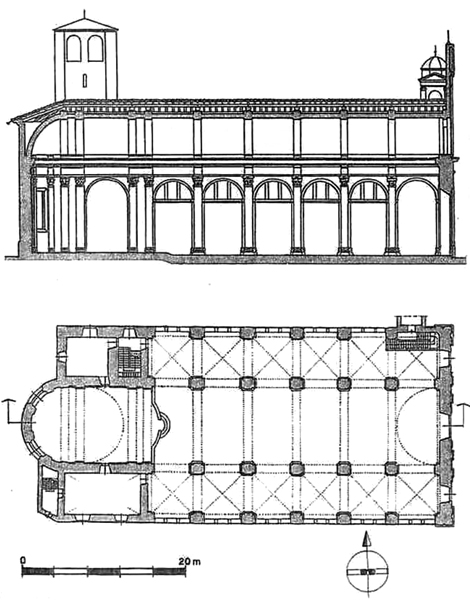
Perin and Alexander, Figure 3. Plan and section of the cathedral. Drawing by Antonella Perin.
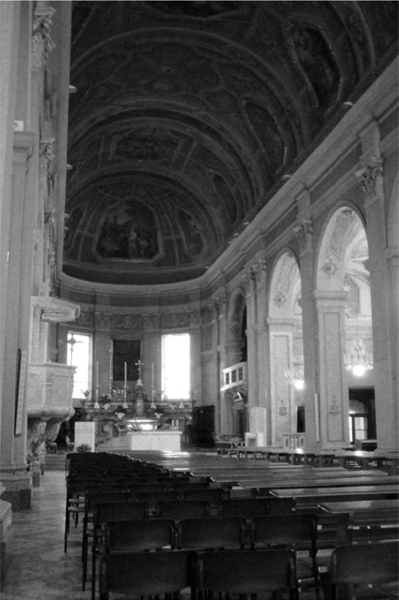
Perin and Alexander, Figure 4. Interior of the cathedral. Photo by John Alexander.

Perin and Alexander, Figure 5. Exterior of the episcopal palace of Tortona. Photo by John Alexander.

Perin and Alexander, Figure 6. Historical property map of Tortona, showing the location of the cathedral on an urban space that opens off of the main road through the city. The episcopal palace is on the lot numbered 4787. Detail of map no. 55 of the tax survey of 1720–1726, Archivio di Stato di Torino, Catasti, Tortona, allegato A. pf. 116. Used with permission.
In Tortona, Gambara was constantly frustrated by jurisdictional conflicts over the diocese’s land holdings and a chronic lack of income.6 Despite these and other hardships, he was still attentive to his duties. He resided and was active in an [68] insignificant diocese during a period in which many noble prelates still neglected their duties, regardless of papal or conciliar decrees that required more assiduous fulfillment of responsibilities. Even before the Tridentine decrees demanded that bishops conduct pastoral visits to evaluate parishes and religious institutions throughout their dioceses, Gambara held a round of visitations in 1554. He (or a vicar) occasionally repeated the process during the following years. There is evidence that Gambara organized at least one diocesan synod (although the exact date remains a mystery). He also founded a diocesan seminary for the education and training of priests, which opened in December of 1565. This fulfilled one of the decrees from the recently concluded Council of Trent; indeed, it was among the earliest Tridentine seminaries in Italy, although it remained underfunded and achieved only modest results during the sixteenth century.7 In many ways, Gambara could be considered a better bishop than many of his peers. One would have [69] thought that this would have recommended him to the young, energetic archbishop of Milan, Carlo Borromeo, but that was not the case.
Borromeo’s biography is so well known as to make any in-depth discussion unnecessary. For the purposes of this article, it is important to note that he developed administrative skills in the Curia of his maternal uncle Pope Pius IV; as papal secretary he followed the discussions at the last sessions of Trent (1562–63) and learned of the decisions and decrees. Given his connections and his abilities, he could certainly have had a long and important career in ecclesiastical administration in Rome. However, he believed that he had a vocation as a reforming bishop and wanted to fulfill his responsibilities in Milan by enacting the Tridentine decrees. Pius’s death in 1565 liberated Borromeo from his duties in the Curia, and following the conclave that elected Pope Pius V Ghislieri (r. 1566–72), Borromeo moved to his archdiocesan see. As archbishop, he demanded strict observance of religious duties and responsibilities, founded a number of seminaries, and served the sick and dying during the plague of 1575/76. His episcopacy was characterized by bold decisions (many aimed at asserting the authority of the bishop) that often led to jurisdictional disputes with the laity, the Spanish authorities, and religious orders.8
Borromeo fulfilled his duties as the leading authority in the Milanese ecclesiastical province by holding regular provincial councils and conducting pastoral visits (either personally or through an authorized vicar) of dioceses under his jurisdiction. Executing Tridentine decrees, following personal interests, and exploiting architecture’s potential to inspire people, he evaluated the churches in his archdiocese and provided instructions for the renovation of the building fabric, the design of additions, and the furnishing of interiors. The culmination of years of practical experience was a publication written by him and his assistants, Instructionum Fabbricae et Suppellectilis Ecclesiasticae (Milan, 1577). A guide for the design or renovation of churches, it sought to establish an appropriate setting for the sacraments (especially the Eucharist) with a standardized set of furnishings organized in recognizable configurations of spaces.9
Considering the state of the Catholic Church and all that Borromeo had to accomplish, one would have thought that he might have been relieved to have Gambara in Tortona: Gambara actually resided in his diocese, made efforts to [70] fulfill Tridentine decrees, and—like Borromeo—promoted clerical education. Gambara’s accomplishments paled in comparison to those of his younger, more ardent superior, but he faced great difficulties with few resources. However, the correspondence between the two demonstrates that, over the years, Borromeo lost faith in Gambara’s ability or willingness to fulfill his responsibilities with adequate zeal. Gambara was closely tied to his family and, to assist them in the noble business of obtaining lucrative posts and contracting advantageous marriages (if not to enjoy a reprieve from the duties and deprivations of Tortona), he returned to Brescian territory almost annually and for considerable lengths of time. Borromeo reminded Gambara more than once of his responsibilities in Tortona and was only begrudgingly satisfied with the bishop’s claim to have received papal permission to absent himself from his diocese. In 1580, after years of enduring his subordinate’s lack of religious ardor, Borromeo lost patience:
Confesso che vederei volentieri V[ostra] S[ignoria] staccata dal troppo affetto et sollecitudine che ha de quei suoi nipoti, el che fa ch’ella molte volte sia lontana dalla sua Chiesa; et sopraggiungono poi le pioggie, le febbri et altri mali che la tengono absente per buoni pezzi né occorrería quest’altro inconveniente di ammalarsi fuori della sua Diocesi o che le impedisse di aiutar la sua Chiesa in quelle parti, che stanno in particolare pericolo et hanno bisogno di più continua sollecitudine et vigilanza. È necessario che V[ostra] S[ignoria] procuri et mi esibisca il rimedio che le ricordai intorno all’assenza degli anni passati perché altrimenti sarebbe necesssario che io osservassi quello che mi comanda il Concilio Tridentino in questa materia.
[I confess that I would happily see Your Grace detached from the excessive affection for and willingness to serve your nephews, which leads you to be absent from your diocese. Then the rains make the roads impassable, or fevers or other sicknesses delay your departure, keeping you away for significant periods. The misfortune of falling ill outside your diocese impedes you from helping your flock in areas under your jurisdiction, where people are in noteworthy danger and require greater care and watchfulness. Your Grace will have to obtain and show me the permission for past absences that you have told me about; otherwise I will be required to fulfill the Council of Trent’s demands for such matters.]10
[71] Gambara’s ties to his family and his lengthy absences obscured any of his accomplishments in Borromeo’s eyes. Rumors spread that Gambara might ask to resign from his episcopal duties (which, in the end, did not occur) and Borromeo opined that appointing a bishop more dedicated to reform would be preferable to keeping Gambara in his office.11
A major difficulty that Gambara encountered was the lack of both a cathedral and an episcopal palace. Although Gambara had petitioned the Spanish authorities for financial compensation, it seems that the full amount never materialized.12 Existing churches served temporarily as the cathedral, and finally Pius V designated a monastic church in Tortona (S. Stefano) as the cathedral.13 Gambara felt that the matter was resolved, but in the early 1570s, Cardinal Gian Paolo Della Chiesa (1521–75) embarked on a program to provide Tortona with a new cathedral on a new and regular urban space that would serve as the ecclesiastical center of the city. Della Chiesa was a native of Tortona and a legal prodigy. His skills landed him positions in the secular government of Milan and those responsibilities brought him into conflict with Borromeo. Shortly after his return to Milan, Borromeo began to exert historical but unutilized prerogatives of the archbishop, including arming an ecclesiastical police force, and arresting and imprisoning individuals who violated the religious or moral code of the Catholic Church. The citizens and Spanish authorities objected to such measures, and in 1567 a delegation from the Milanese Senate went to Rome to argue against them before the pope. Della Chiesa led that effort but was unsuccessful in obtaining a papal decision against Borromeo.
When Della Chiesa’s wife died prematurely, the young lawyer opted for a career in the church. In 1568 he received a cardinalate from Pius V, who hailed from the diocese of Tortona and was purportedly a kinsman of Della Chiesa.14 Yet the cardinal’s role in that protracted, highly polemical, and even embarrassing jurisdictional dispute could hardly have been forgotten by Borromeo. The two men had apparently known each other from their early years, for prior to Della Chiesa’s mission, Borromeo had asked him to serve as his proxy at a baptism noting [72] “la memoria gioconda et grata dell’amicitia havuto seco” and “il n[ost]ro antico amore.”15 However strained their relationship might have become, correspondence from the late 1560s and early 1570s demonstrates collaboration on a variety of issues that Della Chiesa—then in Rome—could assist with or resolve on Borromeo’s behalf.16 Della Chiesa was often carefully deferential in the correspondence, yet the two men shared common goals, at least in some specific matters.17
The cardinal returned to Tortona for extended periods in the early 1570s and involved himself deeply in the urban and architectural development of the city. Della Chiesa’s most far-reaching project was for the new ecclesiastical center. It is not known whether he approached Gambara on this matter or not, but he obtained the consensus of the cathedral chapter and the civic authorities. Della Chiesa requisitioned a few of the preexisting buildings (including the small church of S. Quirino) on the extensive site and obtained the services of a local master mason to begin construction on the cathedral in 1574.
It is not known who designed the building, but Pellegrino Tibaldi (1527–96), the preferred architect of Archbishop Borromeo, was involved in some capacity. He had inaugurated construction on the Collegio Borromeo in Pavia in 1564, while Della Chiesa served as podestà of that city on behalf of the Milanese Senate. Della Chiesa must have become acquainted with Tibaldi at that time: he resolved property disputes in favor of the Collegio and he attended the ceremonial inauguration of construction. It is entirely possible that years later Della Chiesa would turn to Tibaldi for the design of Tortona’s new cathedral. Documents indicate that Tibaldi traveled to Tortona in 1572 specifically “per visitare la cattedrale di Tortona”18 and was paid for a drawing in 1579. While these notices may document Tibaldi’s architectural design of the building, the evidence is not conclusive. S. Stefano still served as the cathedral in 1572, and it is possible that Tibaldi supplied advice about that church (and not a design for a new building). In 1578, as construction on Della Chiesa’s church proceeded, Borromeo sent a copy of his recently published Instructionum to Tortona and Gambara assured him that he would employ it for the new cathedral. It is possible that Tibaldi’s [73] drawing of 1579 provided a design for the liturgical furnishings of the new church, in conformity with Borromeo’s norms. Such a hypothesis corresponds with the construction history of the building, for the apse was completed by the end of 1582 and was outfitted for the liturgical rites in 1584. Whoever designed the church, construction proceeded for a few months before Della Chiesa died unexpectedly in 1575. His daughter donated the family silver to fund continued construction on the new cathedral, but the death of this crucial patron brought the completion of the entire project into question.19
Gambara had been officiating in S. Stefano since the late 1560s20 and when it came to the new cathedral, he was less than enthusiastic. Archbishop Borromeo had been conducting pastoral visits of dioceses within his ecclesiastical province and had obtained the services of another bishop, Gerolamo Ragazzoni (1536–92), to conduct them in the dioceses to the southwest of Milan. Ragazzoni’s visit to Tortona was imminent, and he would surely report on the state of the cathedral project.21 Acting preemptively, Bishop Gambara wrote a Memoriale to Borromeo (dated 13 January 1576) explaining his views on the project.
Io credo che V[ostra] S[ignoria] sia informata che fra questi della città e me nasce differenza circa il luogo della chiesa cathedrale cioè se si deve fabbricare nel luogo dove il cardinale [Della] Chiesa la principiò, . . . ovvero se si deve lasciare nel luogo dove è.
[I believe that Your Excellency has been informed that a difference of opinion has arisen between me and certain people in Tortona about the cathedral church, specifically whether it should be built where Cardinal Della Chiesa began new construction, . . . or it should be left where it currently is.]
Noting that he would not have adequate space at the new cathedral for the canonry, he continued:
mi è parso di darle parte di questo fatto con mandarle le ragioni per le quali la Cathedrale si deve di necessità mantenere nell’Abbatia di San Stefano.
[74] [It occurred to me to communicate these facts while informing you about the reasons why the cathedral must necessarily remain in the abbey church of S. Stefano.]22
[L]a chiesa di San Stefano [fù] per cathedrale assegnata da Pio V Pontefice di felice memoria come n’appare Bolla authentica e dell’accettatione di tal chiesa in Cathedrale, fatta da noi e dal Capitolo, n’è rogato pubblic instromento. Essendo adunque il luogo già fermato per la cathedrale di Torthona per S[ua] S[antità], non si è validamente venuto a nuova elettione del luogo di San Quirino per cathedrale di Torthona.
[The church of S. Stefano had been designated to serve as the cathedral by Pope Pius V of blessed memory, as documented by a papal bull and by the official, notarized document by which we and the chapter of canons accepted it as such. Thus, His Holiness established the location of the cathedral of Tortona, and no contravening document has selected the location of S. Quirino for the new cathedral of Tortona.]23
Gambara felt that S. Stefano had much to recommend it. The monastic complex could easily be adapted to serve the cathedral, bishop, and chapter of canons, and the urban setting was ideal; future needs could be accommodated by adjacent buildings. The location of the new cathedral, on the other hand, had none of these benefits. The costs of property and new construction required to accommodate the necessary administrative and residential buildings would render the project impossible to realize, especially after the death of its primary (and wealthy) proponent. Gambara commented that it was an error “di metter il studio e l’opera sua in cose impossibili ad eseguirsi o difficili a riuscirne da onde ne viene poi che si dice non essersi fatto ben conto e che si è cominciato a edificare e non s’è potuto finire.” [“to put one’s attention and effort into things that are impossible to execute or difficult to realize, which would lead others to say that one did not adequately study the matter yet began to build what one could not finish”].24
In the document and the letter accompanying it, Gambara took a number of swipes at the people who promoted the project: he claimed that Della Chiesa [75] had been pressured by people in Tortona to found the new cathedral. This is not entirely credible because Della Chiesa appears as the predominant actor in the acts of the city council, the contracts, and the foundation ceremony for the new church.25 Gambara claimed that the cardinal misused papal approval for funding work on the cathedral, which should have gone to S. Stefano (and not a new church). He also stated that Della Chiesa laid the foundation stone for the building when Gambara was absent and gravely ill, all of which may have been correct. He noted the extreme poverty of the city and doubted whether the city officials, or any other authority, could or would provide the necessary money.26
It fell to Borromeo’s authorized vicar, Gerolamo Ragazzoni, to decide. From a Bergamasca family, Ragazzoni was a Venetian who had entered the church and briefly attended the final sessions of the Council of Trent. In 1561 he was named coadjutor bishop of Famagosta, a city on Cyprus that was wrested from the Venetians by the Ottoman Empire in 1571. Somehow (either by selection or by appointment) he had become Borromeo’s vicar for pastoral visits to a number of dioceses in the Milanese ecclesiastical province. Borromeo understood that various religious houses and churches could claim exemptions from episcopal control, and prior to conducting visitations he was always careful to obtain authority from the pope to override those privileges. He sought similar authorization for his vicars. A papal bull of 15 May 1575 invested Ragazzoni with wide-ranging and irrefutable powers for a number of dioceses in the Milanese province; in technical terms, he had been nominated a visitor apostolic. Ragazzoni attended a provincial council in Milan and then began conducting the visitation of the diocese of Tortona, probably in early June 1576. He consigned decrees for the early portion of the visitations to Gambara on 29 October 1576. Because of the outbreak of the plague, with subsequent quarantines and diversions to avoid affected areas, Ragazzoni’s visitation was prolonged. He finished in 1577 and provided Gambara with another set of decrees on 2 December 1577. While conducting these visitations for Borromeo, Ragazzoni had been named bishop of Novara, but in 1577, he accepted the diocese of Bergamo in its stead. In all of his efforts, Ragazzoni proved himself to be a faithful collaborator of Borromeo; the two men [76] seemed to share common conceptions about their offices and the reforms necessary for the Catholic Church.27
It appears that Tortona’s long-standing lack of a cathedral, and the disagreements over Della Chiesa’s project, had come to the attention of Pope Gregory XIII Boncompagni (r. 1572–85). By the summer of 1576—or just shortly after the visitation of Tortona began—papal funding had already been set aside for the cathedral and episcopal palace. On 14 August 1576 Ragazzoni wrote,
N[ostro] S[ignore] rimette a me l’elettione del sito per far la fabbrica della Cathedrale in Tortona, la quale fu già cominciata dal cardinale Dalla Chiesa in un luogo che si chiama S. Quirino, il qual luogo a me pare, et così a tutta la città, molto a proposito ma non così a monsignor Vescovo il quale, se bene acconsentì allora che vi si gettassero i fondamenti, anzi ve li gettò esso stesso, si è poi, non so per che causa, mutato in tal proposito, et applicato l’animo alla chiesa di S. Stefano.
[His Holiness has invested me with the authority to decide about the project for the cathedral in Tortona, which Cardinal Della Chiesa had begun on a site called S. Quirino. In my opinion, and that of everyone in the city, that site appears to be well suited to the purpose. However, it does not appear so to the bishop, even though he agreed to it when they laid the foundation stone (indeed, he laid it himself!). For some unknown reason, he has since changed his mind and insists upon staying at S. Stefano.]28
Ragazzoni’s report contradicts Gambara’s statements and the official records of the foundation ceremony, but the visitor decided in favor of Della Chiesa’s project. In early November money was about to be transferred, and Gambara relented: he participated in negotiations to obtain properties next to the cathedral, and then oversaw their radical renovation into the new episcopal residence. The pace of construction on the church increased, probably following the initial design.29
[77] Other buildings in the proximity without doubt varied in design and quality, but they surrounded an area in front of the cathedral that was destined to be the new piazza. However the completion of that square—requisitioning the buildings, demolishing them and paving the open area—had been delayed by Della Chiesa’s death. This unsatisfactory state elicited the involvement of yet another patron, Cristierna of Denmark (1521–90), daughter of King Christian II of Denmark (1481–1559) and niece of Holy Roman Emperor Charles V (1500–58). In 1534 she had become the young bride of the last duke of Milan and then (after only seventeen months of marriage) his young widow. One part of the marriage negotiations had given her the city of Tortona and its territory. She maintained her rights to the city, even though she later married the duke of Lorraine and spent over forty years north of the Alps. Political vicissitudes made Cristierna’s presence in Lorraine incommodious, and the northern climate proved unhealthy for her, so she returned to Italy late in life and took up residence in Tortona from the summer of 1579 until her death in September of 1590.
Throughout her life, Cristierna was a pawn in the international politics of the Habsburg dynasty. While she occupied the highest ranks of European nobility, her position was fundamentally compromised when her father was deposed from the Danish throne. Her status was then dependent upon her utility in serving the diplomatic needs of Charles V; her hand in marriage became a tool in solidifying the adhesion of peripheral or contested territories to the Holy Roman Empire. Following the death of her first husband (Francesco Maria Sforza, 1495–1535), the duchy of Milan was absorbed into Habsburg lands, and eventually passed to Charles’s son Philip II of Spain (1527–98). Despite Cristierna’s marriage to Duke Francis I of Lorraine (1517–45), the Habsburg goals were not achieved: the duke’s untimely death provided an opportunity for France to exert its influence and bring the duchy more firmly into French orbit. Cristierna had to negotiate a difficult situation with little assistance from the Habsburgs. Her retreat to Tortona late in life demonstrates both her loss of status in Lorraine and her attempts to maintain some autonomy. Her later years included regular attempts to acquire funding from her cousin Philip II and to establish her rights as a fief-holder from the Spanish Crown.30 There is little documentation to indicate how the male protagonists in this story regarded her, but Borromeo’s letters always addressed her in a respectful manner.
While in Tortona, Cristierna commissioned a discrete number of projects and she attended to the new piazza. Because that project dragged on, she appeared [78] at a meeting of the city council in the first half of 1588 to urge its completion. Some councilors walked out in protest, but the rest unanimously agreed to find a way to bring it to completion. Nevertheless, nothing happened and a few months later—in July of 1588—Cristierna had to attend another meeting to shame the councilors into acting. She was preparing to leave for her annual vacation and threatened not to return to Tortona if the obstructive buildings were not requisitioned and demolished. That was all the warning the councilors needed: they moved forward with the project, although the inevitable delays soon cropped up and the piazza was only completed years later.31
The history of this project reveals that a number of different patrons and promoters acted sequentially, but not always in concert. Even brief biographical studies reveal the great diversity in background, viewpoint, and motivation among them, rendering truly surprising their consensus on the buildings and urban space that Tortona required as a diocesan see. However, the bishop’s opposition and the politics of the process require further investigation. Gambara stated his opposition to the project because Pope Pius V had designated S. Stefano as the cathedral and there was no contravening decision or order. However, considering the frequency with which Gambara left his responsibilities in Tortona to attend to family matters, suddenly having qualms about such a point of ecclesiastical order seems out of character. One imagines that if he had sincerely wanted to transfer the cathedral, he would have found a way to do so. His opinion that after the death of Della Chiesa, the project’s influential and wealthy proponent, the new church would never be finished may have reflected years of hard experience. Tortona was, by all accounts, desperately poor, and the Spanish authorities had yet to make good on their promises of compensation for requisitioning the old cathedral and episcopal palace. With no other funding sources available, Gambara was just being practical.
Gambara also suggested that the citizens of Tortona had pressured Della Chiesa into promoting the project. However, that is consistent with neither the documentary evidence nor Della Chiesa’s numerous plans for the city. Della Chiesa had attempted to manipulate religious institutions and the urban form of Tortona, sometimes to his own benefit. One clear example was his plan for the convent of S. Eufemia. Located close to the city walls and the newly expanded fortress, it was vulnerable to attack and lacked the impregnable visual enclosure required for the convent’s complete clausura. As a solution, Della Chiesa proposed to move the nuns [79] into existing monastic buildings in the lower town, take possession of the convent, and develop it as his own villa suburbana.32 With less self-interest, he also proposed to extend Tortona’s city walls to incorporate the extramural friary and church of S. Francesco, thereby enlarging the urban fabric of the lower town. So the new cathedral and its square appear to be consistent with Della Chiesa’s more magnanimous goals for Tortona: even though he was not the constituted religious authority, his project would beautify the city, bring greater glory to God, augment the prestige of the Catholic Church, and serve the bishop whether Gambara liked it or not.
The discrepancies between Gambara’s statements and the reality of the situation suggest a hidden agenda; one senses umbrage over disregarded authority and perhaps also a political divide. Della Chiesa had clearly marginalized the bishop by forming a coalition with the cathedral’s canons and civic officers to support the project. In effect, he usurped the bishop’s prerogatives, and his energetic initiatives for the city may also have rankled Gambara, who found himself economically and politically hamstrung in so many ways. Yet the citizens of Tortona may have seen in Della Chiesa’s efforts a unique opportunity to develop the city. Neither they nor the bishop had the wherewithal to accomplish such sweeping changes to the urban form, and they may have welcomed such a munificent patron, regardless of the finer points of ecclesiastical authority.
For their part, the canons of the cathedral may have believed that it was their prerogative to make crucial decisions about the cathedral. Always an important corporate body, a cathedral’s chapter in many cases was the preeminent ecclesiastical authority in a diocese because of the power vacuum left by a nonresident bishop. Canons had typically accumulated rights and privileges over the years through the absence of an effective bishop, the decisions of ecclesiastical authorities, or time-honored practice, and this extended to the building fabric of the cathedral. Trent overturned that: the conciliar decrees placed many of the practical matters for the reform of the Catholic Church in the hands of the local bishop. They demanded that bishops reside in their episcopal sees, conduct themselves like men with a religious vocation, carry out traditional sacramental roles and administrative responsibilities, and shoulder some new tasks such as the foundation of seminaries.33 In addition, the bishop was given responsibility for the [80] churches in his diocese, including the sacred images and relics found in them.34 Considered contextually, this amounted to a restoration of the office;35 it assumed that a bishop would have authority over the canons and take responsibility for a number of tasks that they may have traditionally executed. Not surprisingly, this led to conflict between bishops and the cathedral chapters.
In his scholarship on the cathedrals in Vercelli and Bologna, T. Barton Thurber has demonstrated how these conflicting privileges and authorities extended to the church buildings. He convincingly argued that the canons saw the old cathedrals with their hallowed walls and traditional spaces as appropriate settings for the old liturgies; they understood the accumulated inscriptions, memorials, and chapels to be physical manifestations of their constituted and time-honored roles within the government and spiritual life of the Catholic Church. The bishops of Vercelli and Bologna desired new cathedrals for the reformed liturgies. They believed that the new buildings—in both cases inspired by Roman architecture—would represent the restored authority of the bishop and hierarchical organization of the church, with a papally appointed bishop governing the clergy and laity in his diocese. Interestingly, Pellegrino Tibaldi was involved in both projects. He produced a design for the new cathedral in Vercelli, although only the eastern sections were completed according to his scheme. His brother, Domenico (1541–83), had responsibility for the cathedral in Bologna, and Pellegrino collaborated with him on it. That design, too, was only partially completed.36
There was also discord between canons and bishop in Tortona,37 and it is easy to imagine that many of the motives for antagonism seen in other dioceses also affected relations there. With regard to the cathedral project, however, the different camps found themselves in positions that were atypical: the canons did [81] want the new cathedral, but the bishop did not. Gambara was well aware of rank; he clearly felt that the decision to build a new cathedral had been made by others whose ecclesiastical authority was inferior to his own. His Memoriale, sent to Archbishop Borromeo, attempted to convince his superior with all manner of arguments, from practical considerations and ecclesiastical process to innuendo, about the motivation for the project. Faced with the papal authority Ragazzoni wielded to decide that matter, Gambara had no option but to concede.
Beyond these conflicts, the loss of the ancient cathedral could well have affected the religious sentiments of the people and clergy of Tortona. That building, probably dating to the ninth century, was a basilican-plan church with rows of monolithic columns and apses at the end of each nave. The origins of the church were obscure, and to the Tortonesi it may have seemed to reach back to the very origins of Christian belief in their city. As the building fabric of cathedrals had layers of significance beyond the mere shelter that they provided for worship, so Tortona’s cathedral served as a sacred symbol of the religious and civic identity of the community. With the expansion of the Spanish fortifications on the hilltop, the cathedral—deconsecrated, inaccessible, and turned into a powder magazine (and consequently blown up by a lightning strike in 1609)38—no longer fulfilled that role. How to best fill that void and repair the fabric of religious continuity in Tortona must have been a consideration in the minds of all of the Tortonesi. S. Stefano could suffice, but almost everyone agreed that the new cathedral would be better.
Into this fray stepped Borromeo and his representative, Ragazzoni. When considering Tortona, Borromeo surely considered issues about authority and jurisdiction. In his own archdiocese, he appears to have had some difficulties in reorganizing and reforming the diocesan clergy, but his conflicts with the religious orders were legendary, culminating in an attempt on Borromeo’s life by a former friar of the Humiliati order. Similarly, he skirmished with the laity and nobility in Milan about customs and burial practices, and his ongoing conflicts with the Spanish authorities were never fully resolved in his lifetime.39 In the conflicts in Tortona, one would expect Borromeo to have sided with the local bishop out of principle, and bow to Pius V’s decision about the cathedral, which had been neither superseded nor countermanded. For his part, Ragazzoni must have been keenly aware of the divide between a bishop’s ideal authority and the contemporary state of ecclesiastical affairs. However, Borromeo had authority over Tortona, and the pope had charged Ragazzoni with making decisions about the [82] cathedral and disbursing papal funds. With Ragazzoni’s advice, Borromeo agreed to support the project for the new cathedral and the new ecclesiastical center. He appears to have decided that they would benefit the Catholic Church in the long run, regardless of the precedent set by the particulars of the project’s history.
When Ragazzoni and Borromeo decided in favor of Della Chiesa’s project, Gambara had no option but to capitulate. The bishop had to acquiesce to a coalition of religious and civic officers who had succeeded in usurping his own rights and responsibilities because higher ecclesiastical authorities decided in their favor. The fact that Ragazzoni brought papal funding for the cathedral project should have assuaged at least some of Gambara’s opposition to it. In the end, the bishop participated in the project, notably overseeing the continued construction of the cathedral, its furnishing and consecration; he also supervised the acquisition of property for the palace and its renovation.
This history demonstrates that many people—often with diverse backgrounds or on opposite sides of ecclesiastical debates—held common conceptions about what a city required in terms of architecture and urbanism in order to serve as a diocesan see. In the case of Tortona, the proponents of Della Chiesa’s project agreed that a cathedral ought to be located in the principal public space in the center of town, forming an ecclesiastical center with the episcopal palace (if not other ecclesiastical buildings). Some of those conceptions were traditional; many northern Italian cities had ecclesiastical centers focused on the cathedral and bishop’s palace. Yet medieval cathedrals in Italy were sometimes on the edge of what had been the ancient city, on a site hallowed by the patronage of saints and continuous worship. Such had been the case for Milan’s principal church, although the city expanded around the cathedral in the post-antique period so that it came to be in the center of the sixteenth-century city.40 Tortona’s new cathedral was in the center of the inhabited town by design; it was freestanding and at the far end (with respect to the major points of entry) of a large, regular rectangular piazza.
Obviously the proponents of Tortona’s new ecclesiastical center considered its combination of monumental architecture and ideal space to be appropriate for a cathedral. Considered in terms of Renaissance theory, the new center can be interpreted as proclaiming an ecclesiastical basis for the structure of the city. In his treatise De Re Aedificatoria, Leon Battista Alberti (1404–72) had proposed that [83] architecture (and urban form) could describe the organization of a city, and in one specific passage he advocated establishing churches as fulcrum points for urban districts. He actually allowed for a variety of specific locations for “temples,” but among his suggestions are the qualities found in Tortona’s new piazza: the cathedral was in the center of the city, on a busy and principle square, freestanding and visible.41 Alberti’s text continued to be a reference point for sixteenth-century architects, as evidenced by both the 1565 translation that Cosimo Bartoli (1503–72) published, and the unfinished theoretical work of Pellegrino Tibaldi. At the end of his career, Tibaldi worked on a commentary of Alberti, preceded by his own prescriptions for urban design and architecture. He described the city as a series of piazze, the most important of which presented churches as civic monuments, both functional and symbolic. Given Tibaldi’s role in Borromeo’s architectural program and in various northern Italian cathedral projects (Milan, Vercelli, Bologna, and, in some capacity, Tortona), his writings may be considered to record the contemporary ideal. Tortona’s new ecclesiastical center proclaimed the city a diocesan see; it is an example of descriptive, Renaissance urban form utilized for the needs of the Tridentine Catholic Church.42
Historically, political authorities were often the patrons of cathedrals, paying for and making decisions about the buildings. Again, the examples of Florence’s and Milan’s cathedrals (whose initial construction was funded and directed by the civic government and the Visconti dukes, respectively) demonstrate that reality in the thirteenth and fourteenth centuries. However, the situation appears to have changed after the Council of Trent. As seen in the cases of the contemporary projects for the cathedrals in Vercelli and Bologna, the bishop ideally made the decisions about his cathedral, yet reality sometimes contravened. In Vercelli, opposition by the canons was so vociferous and support for the new project so weak as to delay the project significantly. In Bologna, civic attention to the church of S. Petronio left the canons without the support of the city government, and the bishops were able to achieve their plans for the cathedral, albeit slowly and cautiously. The history of Tortona contrasts with that pattern, suggesting that in the complicated world of real versus ideal, alliances and funding made all the difference.
Surprisingly, the cathedral in Tortona also differed from the other cathedrals in the speed of its completion. At Vercelli, only the eastern end of the new design [84] was completed in 1581, but the rest of the old cathedral remained in an incongruous conjunction with the new for over a century. The project to complete the building proceeded according to a new design that turned Tibaldi’s centralized plan into a composite plan, with domed crossing and nave. At Bologna, the crossing and choir were completed within nine years, or in 1584. Apparently the new construction compromised the vaulting in the rest of the church, and reconstruction of the nave and chapels began in 1605 with plans that differed significantly from the Tibaldi brothers’ original design. Construction continued up to 1622, but the façade was only completed in the 1740s.43
At Tortona, construction continued until the cathedral’s completion, unevenly but without an extended hiatus. By the end of 1584, the building was half complete, however the chancel was outfitted with the necessary furnishings and Bishop Gambara was officiating in it. By the end of the century, the brick structure of the façade was completed and finishes on the interior surfaces were well underway. The architectural articulation of the original facade was begun in 1602, and the final bays of vaulting were completed soon after 1610.44 Thus it was Tortona’s cathedral, initially unwanted by its bishop, that was finished more rapidly than other contemporary examples.
The example of Tortona may be unique in Tridentine Italy because of the specific combination of forces that promoted the cathedral without (or perhaps even in spite of) the bishop. The great diversity among its proponents renders their common approval of the urbanism and architecture of the new ecclesiastical center unexpected, or even surprising. Nevertheless Tortona teaches important lessons about Tridentine bishops in northern Italy: 1) they did not immediately enjoy the ideal autonomy and authority imagined by the church fathers gathered at Trent; and 2) they were not the only patrons who understood the nature of architecture and urbanism required to serve the church, and even represent it, in the context of a reformed Catholicism.
Works Cited
Archives
Archivio di Stato di Alessandria. Notarile Tortona.
Archivio di Stato di Torini. Catasti, Tortona.
Archivio storico diocesano di Milano. Carteggio “Extraprovinciali.”
Biblioteca Ambrosiana, Milan. Manuscript codices.
Printed Primary Sources
Alberti, Leon Battistia. L’Architectura di Leon Batista Alberti, tradotta in lingua fiorentina da Cosimo Bartoli gentil’huomo & accademico fiorentino. Con l’aggiunta de disegni. Et altri diversi trattati del medesimo autore. Edited by Cosimo Bartoli. Monteregale: Leonardo Torrentino, 1565.
——— . On the Art of Building in Ten Books. Translated by Joseph Rykwert, Neil Leach, and Robert Tavernor. Cambridge, MA: MIT Press, 1988.
Annuali della Fabbrica del Duomo di Milano. Milan, 1881.
Cammarata, Italo. Lettere da Tortona: La storia della città nella corrispondenza dei vescovi bresciani Gambara con Carlo e Federico Borromeo. Voghera: Edo-Edizioni Oltrepò, 2003.
Decrees of the Ecumenical Councils. 2 vols. Edited by Norman P. Tanner. London: Sheed and Ward, 1990.
Montemerlo, Niccolò. Raccoglimento di Nuova Historia dell’Antica città di Tortona. Tortona: N. Viola, 1618. Reprinted, Bologna: Forni, 1973.
Pellegrini, Pellegrino. L’Architettura. Edited by Giorgio Panizza. Trattati di architettura 7. Milan: Il Polifilo, 1990.
Vera relatione del successo dell’archibuggiata tirata a S. Carlo Borromeo, arcivescovo di Milano (N.d.) Edited by Giulia Bologna. Milan: La Vita Felice, 1995.
Secondary Sources
Alexander, John. From Renaissance to Counter-Reformation: The Architectural Patronage of Carlo Borromeo during the Reign of Pius IV. Fonti e Studi 7. Rome: Bulzoni, 2007.
Bendiscioli, Mario.“Politica, amministrazione e religione nell’età dei Borromei.” In Storia di Milano, 10:200–35. Milan: Fondazione Traccani degli Alfieri, 1957.
Baroni, Costantino. Il Collegio Borromeo. Pavia: Tipografia già Cooperativa, 1937.
Berruti, Aldo. Tortona insigne: Un millennaio di storia delle famiglie tortonesi. Tortona: Cassa di Risparmio di Tortona, 1978.
Bottani, Tarcisio. Girolamo Ragazzoni, vescovo di Bergamo. Bergamo: Editrice Corponove, 1994.
Buratti Mazzotta, Adele. “L’ufficio per le fabbriche ecclesiastiche e i suoi disegni di progetto e di restauro nella riforma di Carlo e Federico Borromeo.” In Studi in onore di Mons. Angelo Majo, per il suo 70o compleanno, edited by Fausto Ruggeri and Angelo Majo, 149–61. Milan: NED, 1996.
Cammarata, Italo. Alla corte di Cristierna: Quando Tortona aveva una regina. Voghera: Edo-Edizione Oltrepò, 2009.
Cartasegna, Roberto. Una città fortificata di confine: Tortona nei secoli. Tortona: Litocoop Srl, 2009.
Ceresa Mori, Anna. “L’isolata in età romana.” In Domus Ambrosii: Il complesso monumentale dell’Arcivescovado, edited by Adele Buratti Mazzotta, 21–34. Milan: Silvana, 1994.
Cortemiglia, Gian Camillo. “Le porte urbiche e le cinte murarie difensive nella storia dell’insediamento abitativo di Tortona.” Iulia Dertona ser. 2, 54.94 (2006): 15–54.
De Carlini, Giuseppe. “I Gambara: Testimonianze a Tortona e in diocesi.” In Fasti e splendore dei Gambara: L’apice della potente famiglia bresciana in età rinascimentale e barocca, edited by Dezio Paoletti, 215–19. Brescia: Grafo, 2010.
——— . “Note di demografia storica tortonese (sec. XV–XIX).” Iulia Dertona ser. 2, 44.74 (1996): 5–25.
——— . “Per la storia del Palazzo Vescovile.” Iulia Dertona ser. 2, 55.95 (2007): 71–92.
Giordano, S. “Gambara, Cesare.” In Dizionario biografico degli italiani, 52:37–38. Rome: Istituto della Enciclopedia italiana fondata da Giovanni Treccani, 1999.
Miotti, Fausto. “Annotazioni storiche sul colle Ronchetto tra i secoli XVI e XVII.” Iulia Dertona ser. 2, 50.85 (2002): 21–23.
Mols, Roger. “Charles Borromée, (Saint), cardinal, archevêque de Milan (2 oct. 1538–†3 nov. 1584).” In Dictionnaire d’histoire et géographie ecclesiastiques, edited by Alfred Baudrillart et al., 12:486–534. Paris: Letousey et Ané, 1953.
Mullet, Michael A. The Catholic Reformation. London: Routledge, 1999.
Pagano, Sergio. Il cardinale Uberto Gambara, vescovo di Tortona. Florence: Leo S. Olschki, 1995.
Perin, Antonella. “Appunti di ricerca sulla sistemazione cinquecentesca di piazza del Duomo.” In Storia, arte e restuaro nel tortonese: Il palazzetto medioevale dipinti e sculture, edited by Pierluigi Giussani, 23–25. Tortona: Cassa di Risparmio di Tortona, 1993.
——— . “Architettura tra Controriforma e Barocco nel tortonese.” Undergraduate thesis, Politecnico di Torino, 1988–89.
——— . La cattedrale di Tortona. Alessandria: Edizioni dell’Orso, 1992.
——— . “La città e il forte nel XVI secolo.” In Tortona e il suo castello dal dominio spagnolo al periodo postunitartio, edited by Vera Comoli Mandracci and Anna Marotta, 53–56. Alessandria: Cassa di Risparmio di Alessandria, 1995.
——— . “Nuovi documenti sulla costruzione del forte spagnolo di Tortona.” In La difesa della Lombardia spagnola, edited by Graziella Colmuto Zanella and Lucaino Roncai, 297–303. Cremona: Ronca editore, 2004.
Rozzo, Ugo. “Appunti per una storia urbana di Tortona fino al primo Ottocento.” In Storia urbana di Tortona, 5–26. Quaderini della Biblioteca civica 5. Tortona: N.p., 1983.
——— . “Della Chiesa (Chiesa), Gian Paolo.” In Dizionario biografico degli italiani, 36:751–53. Rome: Istituto della Enciclopedia italiana, 1988.
Serangeli, Sergio, and Raffaella Zambuto. “Sui rapporti tra Gesuiti e Università di Macerata: una fonte male intesa.” Annali di Storia delle Università italiane 9 (2005): unpaginated (http://www.cisui.unibo.it/annali/09/testi/18Serangeli-Zambuto_frameset.htm).
Simoncini, Giorgio. “Umanesimo, religiosità e scienze della natura nella concezione architettonica di Pellegrino Tibaldi.” In “L’Architettura” di Leon Battista Alberti nel commento di Pellegrino Tibaldi, edited by Giorgio Simoncini, 11–43. Rome: De Luca Edizioni d’Arte, 1988.
Tacchella, Lorenzo. “Cesare Gambara Vescovo di Tortona e riformatore.” Iulia Dertona ser. 2, 23/24/25 (1975–77): 6–12.
——— . La riforma tridentina nella diocesi di Tortona. Genoa: Mario Bozzi, 1966.
Tellechea Idígoras, J. “El obispo ideal segùn el Concilio de Trento.” In I tempi del Concilio: Religione, cultura e società nell’Europe tridentina, edited by Cesare Mozzarelli and Danilo Zardin, 207–20. Rome: Bulzoni, 1997.
Thurber, T. Barton. “Architecture and Civic Identity in Late Sixteenth-Century Bologna: Domenico and Pellegrino Tibaldi’s Projects for the Rebuilding of the Cathedral of San Pietro and Andrea Palladio’s Designs for the Façade of the Basilica of San Petronio.” Renaissance Studies 13 (1999): 455–66.
——— . “Architecture and Religious Conflict in Late Sixteenth-Century Italy: Pellegrino Tibaldi’s Planned Reconstruction of the Vercelli Cathedral.” PhD diss., Harvard University, 1994.
——— . “L’architettura religiosa nell’arcidiocesi di Carlo Borromeo.” In Il secondo Cinquecento: Storia dell’architettura italiana, edited by Claudia Conforti and Richard J. Tuttle, 390–405. Milan: Electa, 2001.
——— . “Pellegrino Tibaldi and the Rebuilding of Cathedrals in Post Tridentine Italy: The Planned Reconstruction of the Duomo di Vercelli.” Studia Borromaica 11 (1997): 153–66.
Vigo, Giovanni. “La città di Cristierna: Un’immagine dell’economia di Tortona alla fine del Cinquecento.” Rivista milanese di economia 69–70 (1999): 149–61.
Viscardi, Bruna. Pralboino, Milzano e Verolanuova, feudo dei Gambara. Brescia: N.p., 1994.