
Jennifer Mara DeSilva
In a treatise of 1513 delineating targets of reform within the church, the Camaldolese monks Paolo Giustiniani and Pietro Quirini established the bishop as the foundation of a pious and orthodox, well-organized and well-behaved community. Describing the bishop as “the attentive observer” (l’attento osservatore),1 Giustiniani and Quirini emphatically argued that his physical presence was the key to his pastoral success. As the mediator between elite prelates and local clergy, the bishop was responsible for the supervision, education, and reform of the members of his diocese, and could only achieve this by offering himself as a model for correct behaviour. Thus the early modern ideal bishop became a “living example” (vivum exemplum) in piety, morality, discipline, and community involvement.2 Through the sixteenth century, as more voices called for ecclesiastical reform and self-described “reformed” churches grew, the Catholic elite clung to Giustiniani and Quirini’s identification of the bishop as the linchpin for pastoral success. When the Council of Trent (1545–63) proposed strategies for combating the Protestant threat, the episcopate carried the burden of responsibility for action. The sixth session (January 1547) promulgated Decretum de residentia [89] episcoporum et aliorum inferiorum, elevating Giustiniani and Quirini’s model of episcopal residence to nearly a Tridentine commandment.3 While the decretum acknowledged that prelates might also undertake administrative or diplomatic tasks that kept them away from their diocese, the Tridentine fathers mandated that extended and unnecessary absences could incur the pain of interdict.4 In the world of Catholic renewal, establishing a bulwark against Protestant expansion by protecting the diocese from ignorance and heresy was more important than the church’s need for competent administrators based in Rome.
Only decades earlier, when Martin Luther first became known to Pope Leo X de’ Medici (r. 1513–21), the situation had been reversed. The rapidly expanding papal court necessitated educated clergy to fill secretarial, juridical, and diplomatic roles in the church administration.5 While the many attractions of employment in Rome made episcopal absenteeism a common practice, through the early sixteenth century, criticism of nonresident bishops grew. In a treatise entitled The Office of the Bishop (1517) Gasparo Contarini (1483–1542), the Venetian diplomat, future cardinal, and friend of the Camaldolese reformers, called the practice “the disaster of our times,” disparaging those men who “think they are performing their duty well enough if they shall have handed over the city’s management to a procurator, while they take over the income.”6 Contarini’s words echo the distaste of Francesco Guicciardini, another sixteenth-century lay diplomat whose intimate interactions with the church resulted in contempt and criticism in his History of Italy (1537–40). The words of both Guicciardini and Contarini have had an immense effect on the historical judgment of the early modern church and both its need and desire to be reformed. Where Contarini saw episcopal behavior in black and white, many contemporary clergy practiced various shades of light and dark.
[90] Until recently, the intricacies and the reality of episcopal absenteeism have attracted few scholars. Perhaps this is due to the complexities of defining abuse, collecting evidence across many dioceses and episcopates, and weighing the real costs and benefits to the bureaucratic church and the Catholic faithful.7 Yet, as Paul V. Murphy has shown in his study of Cardinal Ercole Gonzaga (bp. of Mantova, 1521–63), a more profitable historical focus examines interactions across ecclesiastical offices and the lay-clerical divide in order to banish the bipolar spectrum of corruption and reformation, and investigate a plethora of intermediary positions.8 In pursuit of similar variegated shades and practices, this essay seeks to uncover the connections that a single bishop, Paris de’ Grassi, established with his diocese in an effort to fulfill the contemporary call to reform the local church while managing his own absenteeism.
Throughout his tenure as the bishop of Pesaro (1513–28), Paris de’ Grassi also served as the master of ceremonies at the papal court (1504–28), which prevented his continuous residence in his bishopric.9 Nonetheless, he maintained a relationship with his diocese that involved several visits made over the fifteen years of his episcopate.10 While none of the visits lasted more than three months, during these brief periods de’ Grassi modeled his behavior on the contemporary reform ideals known to Contarini, Giustiniani, and Quirini, and discussed at the Fifth Lateran Council (1512–17). As a participant in its sessions and as the liturgical director of the Council,11 de’ Grassi had intimate knowledge of the tension between the popular ideal of the pastoral bishop resident in his diocese and the commonality of episcopal absenteeism. During his episcopate, de’ Grassi carried out an examination and reform of the cathedral chapter, established himself as a [91] patron of the local community, built connections with local spiritual protectors, and cultivated good spiritual models for the laity. Moreover, de’ Grassi’s absenteeism encouraged him to cooperate with the institutions already established, including confraternities, in order to direct reform and pastoral care to the widest audience most efficiently. His contributions to Pesaro, while intermittent, were a combination of architectural, liturgical, and charitable projects that emphasized utility, both earthly and spiritual, to assist a community just emerging from a period of political and military strife.
Pesaro and the Bishop de’ Grassi
As Giuseppe Alberigo has shown, Giustiniani and Quirini wrote that the bishop should reform his subjects by observing four rules: legitimate election, a virtuous life, exemplary relations with preachers and ecclesiastical institutions, and cultivation of the life of the good shepherd.12 In the same vein, Contarini maintained the importance of episcopal residence, theological knowledge, virtue, and activity, but avoided specifying how to implement these attributes beyond episcopal visitations and “employing all diligence and effort in governing his flock.”13 While these strategies might have inspired a reputation for holiness and commitment to the community, it was hardly radical theology or a particularly detailed plan for leadership. There is little discussion of how to build the virtuous city beyond traditional modeling of personal sanctity and supervision. What is absent from the contemporary discussion of reform of the early modern episcopacy is a practical plan for bishops who wished to emulate this ideal but could commit only intermittent residence to their see. These men needed a clear vision of how to work in tandem with local institutions in order to maximize their resources, establish an authoritative presence, and use their time most effectively.
While the scattered nature of episcopal records prevents collecting a complete understanding of the early modern episcopal experience, Paris de’ Grassi’s connection to the papal court, the heart of reform discussions, and his repeated visits to Pesaro suggest him as a realistic model of episcopal action in the pre-Tridentine age. While it is likely that de’ Grassi considered himself to be as pious, learned, and eager as the good shepherd enjoined by Quirini and Giustiniani, his general inaccessibility ruled out the model of the “attentive observer.” Instead, de’ Grassi combined the personal virtue described by contemporary reformers [92] with an emphasis on contributions to local institutions that reformers implied but did not describe in detail. An examination of de’ Grassi’s interactions with the Pesaresi and his initiatives suggest his adoption of a custodial model that incorporated both spiritual and physical needs. In the period from 1500 to 1523, characterized by political change and military threat, the city and citizens of Pesaro needed a more practical model of care than one that hinged on dispelling ignorance and modeling virtue. Although the image of the good shepherd is traditionally invoked to symbolize spiritual and emotional guidance, de’ Grassi’s custodial model focused on renovating public ecclesiastical spaces, revitalizing the bishop’s interactions with lay confraternities, and establishing strong connections between the city and its spiritual intercessors. Through these goals, de’ Grassi took responsibility for the fabric, the souls, and the protectors of his diocese with the intention of renewing Pesaro’s faith, the episcopal throne, and the city itself.
Between his provision in April 1513 and his death in June 1528, de’ Grassi made at least three working visits to Pesaro. The distinction of “working visit” is important since de’ Grassi had no intention of residing permanently in Pesaro. The brevity of these visits, which mixed both administrative (ecclesiastical) and liturgical (public) events, coupled with the high rate of activity leads to the belief that de’ Grassi envisioned his role in Pesaro as one of active contribution, rather than passive observation or silent and implicit modeling. Compared to his colleague bishops at the papal court, who spent little time in their dioceses as episcopal leaders, de’ Grassi’s activity suggests both interest and enthusiasm for the pastoral responsibilities of the episcopacy at a time when Pesaro desperately needed a protector.14
The city’s period of political and economic instability began in October 1500 when Cesare Borgia’s army approached Pesaro, causing a division among the citizens between defending their lord Giovanni Sforza and supporting the pope.15 Borgia and his army entered the city, publicly embraced cooperative government with Il Popolo and set fire to many of the public buildings and archives as a destructive sign of the change in leadership.16 On 3 September 1503, following [93] the death of Pope Alexander VI and the arrest of Cesare, Giovanni returned to Pesaro, prompting the remains of Borgia’s army to fortify themselves within the Rocca and turn its artillery on the city, severely damaging parts of the bell towers of the cathedral and the church of San Francesco as well as other buildings. Citizens who had supported the pope fled, and their neighbors sacked the abandoned houses and set fire a second time to the books and records of the fallen regime.17 On 3 June 1516, war returned to Pesaro as Francesco Maria della Rovere, the duke of Urbino, met the Medici army in battle outside the city.18 Many armed citizens assembled in the Piazza Persino while the gates of the city stood open and “tutti andati con Dio.” The arrival of the Medici army in the contado resulted in a scarcity of food and the maltreatment of locals by billeted soldiers.19 On 1 July 1516, Pope Leo X invested Lorenzo de’ Medici with the lordship of Pesaro in consistory at Rome, while a correspondent of the Venetian Signoria wrote that the territory “had been so ruined that he was unable to describe the great damage.”20
Only a few months later, Francesco Maria returned and the city experienced an even more damaging attack that returned de facto control, if not de iure control, of Pesaro to the former duke.21 On 6 February 1517, he entered Urbino with seven hundred men and at mid-month had driven the papal garrison into the Rocca under bombardment. By the end of February, della Rovere’s men had sacked the town of Fano and another castello between Fano and Pesaro. In response to these signs of strength, the pope made plans to strike by sea in order to intercept the ships that carried provisions to Pesaro and to eject della Rovere’s troops from the countryside.22 On 4 March in Pesaro, a mix of mercenaries, hired but not yet paid by the pope, attacked the Palazzo del Podestà, destroyed many of its records, and stole provisions. Witnesses declared that the papal commander [94] Signor Renzo Orsini had allowed his soldiers to wreak great destruction on the city.23 When the pope finally made a truce with Francesco Maria, the treaty grew out of the pope’s inability to continue funding the war rather than an acknowledgement of local exhaustion or Francesco Maria’s greater strength or prior claim to the duchy.24
As Antonio Carile has argued, Pesaro’s strained economic resources did not justify the effort expended by papal dynasts,25 whose interest in the city was just a small part of strategies designed to appropriate a permanent place in the Italian peninsula and signori.26 Nonetheless, their attacks on the city and its government established a fragile and exigent environment that undoubtedly influenced de’ Grassi’s model of the bishop as a custodian of both physical and spiritual health. Where Contarini and the Camaldolese monks privileged observation as a tool for monitoring orthodox belief and moral living, de’ Grassi focused on the practical issues of rebuilding spaces for worship, participating in lay religious rituals, and patronizing local cults. Moreover, the instability of Pesaro’s secular leadership implicitly put a greater emphasis on the permanence and dependability of episcopal leadership. De’ Grassi’s absence from the city was mitigated somewhat by his willingness to aid local institutions with episcopal money and his public interactions with members of his diocese. The bishop’s initiatives were neither silent nor emanating from a distant and unknown authority, as on each visit he publicized his custodial leadership through events and contributions that fortified Pesaro’s clergy, institutions, and spiritual protectors.
While de’ Grassi received provision to the bishopric of Pesaro in April 1513 and wasted no time in being consecrated at Pentecost,27 he did not hurry to visit his diocese. Only in January 1515 could de’ Grassi spare three months away from Rome to visit Pesaro, returning in time to participate in the tenth session of the [95] Fifth Lateran Council (4 May 1515).28 In contrast to his episcopal predecessor, Albertino della Rovere (bp. 1508–13), who never visited Pesaro,29 all of de’ Grassi’s visits were a whirlwind of organized activities.30 The chief intent of this first visit was to establish his personal connection and authority as bishop through the ritual of episcopal possession (28 February 1515).31 Once established in his see, de’ Grassi’s first acts focused on physical and spiritual reconstruction, reflecting the episcopal custodian’s responsibility for both the body and soul of the individual and the community. Thus, de’ Grassi immediately hired an architect to rebuild the cathedral’s bell tower. Inside the church, he engaged a sculptor to build a marble chest (arca) that would enclose the remains of San Terenzio (il Protettore), offering the saint greater protection and prestige, and the community hope for the future.32 Assuredly, there were no more public monuments to the church and its dependents than the city’s patron saint and the campanile, whose presence and assistance were simultaneously spiritual, patriotic, and constant.
In order to repair the damage done to the Pesarese population, on this first visit the new bishop declared that on the feast of the Assumption of the Virgin (15 August) dowries would be provided to twelve honorable and poor virgins.33 The donation of dowries was a popular form of charity that sought to create new households that functioned as building blocks of the local economy, microcosms of the Christian community, and purposefully encouraged population growth.34 Dowry provision was simultaneously a spiritual and social act that could not fail [96] to show de’ Grassi’s desire to restore Pesaro’s congregation. Through these very public initiatives, both the provision of dowries and the rebuilding of the cathedral, de’ Grassi established himself as interested in the community’s health and prepared to use episcopal resources for its maintenance.
Beyond these expensive and public projects, de’ Grassi turned his attention to the state of the Pesarese clergy. Supposedly, during his first visit he conducted a visitation of all the churches within the diocese.35 As Adriano Prosperi has noted, the episcopal visitation was “a particularly solemn ritual moment in which the clergy exhibits the signs of its power and of its social function to control and to discipline.”36 The energy required to do this was substantial, and reinforced de’ Grassi’s reputation as a bishop determined to uphold ecclesiastical standards and his authority as an investigator and evaluator. Although Quirini and Giustiniani encouraged their readers to conduct annual visitation tours, coupled with provincial synods, there were few bishops who did so in the early sixteenth century.37 In addition to the visitation, de’ Grassi reviewed the constitutiones of the cathedral chapter. In 1512, under the authority of Bishop Albertino della Rovere, a synod took place that reviewed and published the constitutiones in a fine manuscript approved by the cathedral canons, the vicar, and the absentee bishop.38 The extant manuscript shows de’ Grassi’s own exceedingly brief notes highlighting important issues in the relationship between the bishop and the canons. Although in the ensuing decades both Bishops Giacomo Simonetta (1530) and Giulio Simonetta (1564) examined the cathedral constitutiones, leaving collections in print (1531) and in manuscript (1576), the historical process of intervention and the individual bishop’s goals remain frustratingly vague.39
Excluding these notes, generally there are few documents extant that reveal the details of de’ Grassi’s interactions with the clergy of Pesaro.40 If, as Angelo [97] Turchini has noted, the results of the visitation tour were troubling, as he found parishes and monastic houses showing poor behavior and ramshackle buildings,41 for the new and energetic bishop this was an opportunity to articulate more fully the clerical ideal of personal piety and proper ecclesiastical management. Not surprisingly, de’ Grassi’s desire to review the diocesan clergy quickly brought him into conflict with the cathedral chapter’s praepositus, Giovanni Francesco Soperchi. Known in Rome as Filomuso, Soperchi was not only a long-standing member of the chapter (praepositus, 1502–35) but also a poet in the circle of Pope Leo’s secretary Pietro Bembo.42 Evidently, de’ Grassi reprimanded Soperchi’s behavior, which the praepositus challenged, for the situation was only resolved when the pope issued a bull supporting the new bishop. The bull ordered Soperchi on pain of interdict to reform his behavior toward other canons, respect the property of the church, and wear the tonsure, “all of which is fitting for the true and good Pastor.”43 De’ Grassi’s willingness to oppose Soperchi and the swiftness with which this situation was resolved shows the bishop’s drive and the pope’s support of his reforming energy. Yet, simultaneously de’ Grassi exhibits a paradoxical desire to extirpate abuse and reform clerical behavior while managing his own identity as a nonresident bishop.44
The dates of de’ Grassi’s second visit depend on his diary, which reveals that de’ Grassi left Rome for Pesaro on 23 May 1519, following the burial of Lorenzo di Piero de’ Medici, the duke of Urbino. He returned sometime before 29 June, for a record of the papal court’s celebration of the feast of SS. Peter and Paul occupies the next diary entry.45 Based on the brevity of this visit one must assume that it was the result of long planning rather than sympathy for the ruinous effects of the War of Urbino as his diary stated. Following the completion of the episcopal visitation and confirmation of the cathedral statutes in 1515, an organizing bishop would logically seek to establish an understanding on important issues [98] across the entire diocese and investigate the progress of his reforms. The spontaneity described by de’ Grassi’s diary is incompatible with the convocation of a diocesan synod, which necessitated substantial planning and was the main event of his second visit.
The tenth session of the Fifth Lateran Council (May 1515) had discussed the importance of episcopal visitations and synods in maintaining orthodoxy and authority over the diocese. The resulting bull, entitled Regimini universalis Ecclesiae, encouraged bishops to hold provincial synods every three years in emulation of the apostolic church.46 For the absentee bishop de’ Grassi, the synod was a rare opportunity to reinforce his authority as leader of all the Pesaresi clergy and survey the pastoral standard. While there are no records extant that reflect the discussions of de’ Grassi’s synod, historians agree that the bishop led the synod instead of his vicar, further establishing de’ Grassi as a bishop who valued personal contact with his diocese, if only intermittently.
In addition to the synod on 16 June,47 during his 1519 visit de’ Grassi supervised the translation of San Terenzio’s remains from a fifteenth-century wooden urn to the new arca that he commissioned in 1515.48 This act allowed de’ Grassi to bring publicly an expensive and important project to completion, align himself with the city’s patron saint, and emphasize his role as the physical and spiritual custodian of Pesaro. Symbolically, by providing a new and secure home for San Terenzio’s remains (see fig. 1), as well as vestments and cloths,49 the bishop asserted his own ability to care for his congregation. Sara Benvenuti, who has written the definitive work on San Terenzio, sees in this event a deeper significance than merely episcopal patronage. She argues that the translation was a tangible sign of the community’s will to rebuild following the political fracture and physical deprivation that began with Cesare Borgia’s conquest and ended only weeks before with the death of the heirless Medici duke of Urbino.50 De’ Grassi’s [99] contributions to San Terenzio and the wider diocese have convinced Benvenuti that he was an active and resolute force, providing both encouragement and authority that was simultaneously local and concrete.51
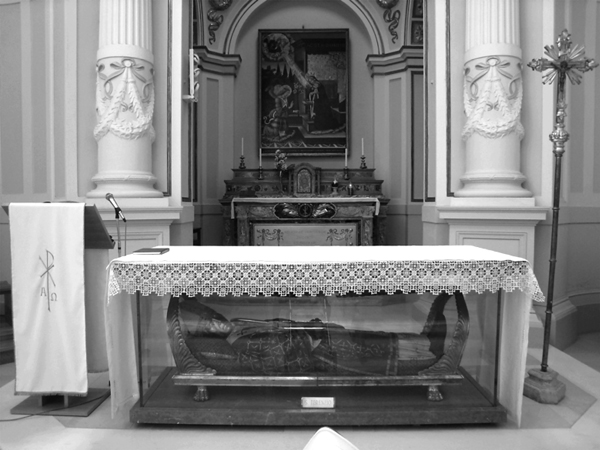
DeSilva, Figure 1. The modern Chapel of San Terenzio in the cathedral of Pesaro, showing the saint’s remains. Photo by Jennifer Mara DeSilva.
Sometime between 1520 and 1522, de’ Grassi made a third visit to Pesaro, during which he wrapped up more extensive renovations to the cathedral (fig. 2), specifically to the choir and cappella magna. He also showed his concern for his historical reputation by erecting public monuments to his reconstruction of the cathedral. Two inscriptions document firstly the bishop’s general renovations (1522)52 [100] and secondly his role in San Terenzio’s translation (1519).53 The renovations initiated by de’ Grassi increased both Terenzio and Pesaro’s spiritual prestige and reinforced the bishop’s custodial identity with bricks and mortar, presenting him again as simultaneously the cultivator and servant of the city’s patron saint. As well, one can imagine that in a small way these public inscriptions were intended to mitigate the bishop’s physical absence.
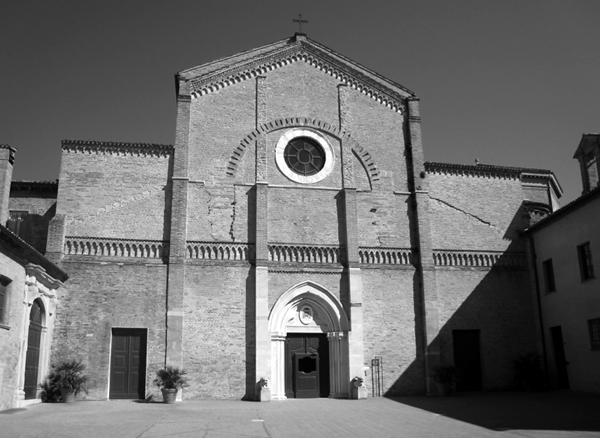
DeSilva, Figure 2. Exterior of the cathedral of Pesaro. Photo by Jennifer Mara DeSilva.
Perhaps on this third visit or on a fourth visit dated to Pentecost 1522,54 de’ Grassi turned his focus to another group in Pesaro. Scholars of early modern Italy have already shown the importance of confraternities to the urban social fabric [101] as a source of spiritual encouragement and social assistance.55 When de’ Grassi became bishop in 1513, there was already an active community of confraternities in Pesaro.56 Edward Muir has noted the importance of cooperation between church authorities and the laity, particularly through confraternal participation in civic religion as one method of channeling lay piety into church-regulated religious practices.57 In Rome, as archpriest of the church of SS. Celso and Giuliano, de’ Grassi facilitated the activities of the Society of S. Giuliano,58 while in his hometown of Bologna the beatified bishop Niccolò Albergati (bp. 1417–43) had used confraternities very successfully as a vehicle for doctrinal education, spiritual development, and entrenching a civic cult.59 Albergati’s episcopal energy resulted in the foundation of four confraternities, the reform of six others, and a general concern for clerical and lay spiritual development seen in his three diocesan visitation tours.60 By participating in confraternal events, de’ Grassi could assert his role as the city’s ecclesiastical authority, while joining his congregation in liturgical praise as a fellow worshipper. Moreover, a close relationship between the absentee bishop and the local confraternal leaders might mitigate the absence of one authority by establishing other local nodes of activity and supervision.61 Although contemporary reformers say little about episcopal relations with confraternities, the connections forged could be powerful both in accessing spiritual intercessors and ensuring that the local liturgical activities consistently reinforced the episcopal-sanctioned civic cult.
On the feast of Pentecost, 8 June 1522,62 accompanied by members of Pesaro’s popular Fraternity of the Annunciation, de’ Grassi processed through the [102] city in order to translate the miraculous image of the Madonna del Popolo to its new position in the confraternity’s church. The image moved from an exterior wall of the Church of the Annunciation to a new protected position inside, establishing greater parity with the city’s more famous image, the Madonna delle Grazie.63 The confraternity’s printed statutes of 1575 record de’ Grassi’s participation and insinuate that the holy image had a role in the bishop’s recovery from a life-threatening illness sometime before Pentecost.64 The popularity of Marian devotion in Pesaro provides a link with de’ Grassi’s youth in Bologna,65 as does the number of Marian images that inspired liturgical processions during his episcopate. The eighteenth-century historian Domenico Bonamini noted that de’ Grassi donated an ex voto to the cathedral in the form of an image of the Virgin, supposedly after his recovery from illness.66 This image joined the two images noted above and a third image in the church of S. Agostino that de’ Grassi’s vicar investigated in 1526 for reportedly weeping continuously for eight days.67 De’ Grassi’s illness provided a spiritual platform for establishing a closer relationship as bishop with important intercessors and lay organizations in Pesaro. Following San Terenzio, the Virgin Mary and the Fraternity of the Annunciation’s holy founders Beato Cecco (†1350) and Beata Michelina (†1356) stood as emblems of devotion and guardians of the Pesaresi, offering inspiration and assistance just as the bishop should. De’ Grassi’s participation in the translation of the Madonna del Popolo allowed him the opportunity to express his gratitude and devotion as a recipient of the Virgin’s grace and as the active episcopal custodian, while following the proven pastoral strategies of the Bolognese bishop Albergati.68 Through the Pentecost procession, de’ Grassi followed in Beato Cecco’s footsteps, [103] modeling both the role of the pastoral leader and the devout Christian to the city surrounding him.
Episcopal Examples and Accord
Most likely de’ Grassi died in 1528 satisfied with his episcopal contribution to the city of Pesaro. Compared to many of his colleague bishops at the papal court, he had spent a great deal of time in residence in his diocese. As the bishop of Belluno (bp. 1536–42), Contarini himself spent only two months resident in his diocese.69 Unless the city had the added attraction of being one’s home town or a center of papal government, few bishops followed the residential example set by Pietro Barozzi in Padua (bp. 1487–1507). Nonetheless, in Pesaro de’ Grassi’s activities reflected the contemporary emphasis on instilling piety and reform in both clerical and lay populations, including the review of the cathedral chapter, a diocesan synod, and a diocesan visitation. Unlike some other bishops, de’ Grassi presided personally at these events, rather than delegating the authority to his vicar as Giulio de’ Medici, Ercole Gonzaga, Jacopo Sadoleto, and Robert Giubé did.70 The fact that de’ Grassi ignored the injunction to convene these labor-intensive events annually is not unusual. In his long tenure as bishop of Parma (1509–34), Alessandro Farnese seniore only conducted a pastoral visitation of Parma in 1516 and celebrated a diocesan synod in 1519. A brief examination of the sources suggests that those bishops that convened a synod (many only once) were more likely to do so in the early years of their episcopacy, which sometimes coincided with taking possession of the see. In 1488 Pietro Barozzi took possession of Padua, called a synod, and immediately after began diocesan visitations. Albergati arrived in Bologna as bishop in 1417 and convened a synod of the Bolognese clergy in 1418. Melchior von Meckau (bp. Brixen 1489–1509) followed the same course, holding a diocesan synod in 1489 only five months after accepting the bishopric. Determining whether this custom was a sign of efficiency or the enthusiasm of the newly elevated demands deeper research, yet this [104] cohort clearly shows that de’ Grassi’s level of involvement reflected the practice of certain contemporaries, several of whom were also absentee bishops. Very few pre-Tridentine bishops held annual or frequent synods or diocesan visitations in the fashion of the archbishop of Canterbury, Thomas Bourchier, or the bishop of Brixen, Nicholas of Cusa.71 Just as there is ample evidence that some bishops never visited their dioceses, clearly there is evidence for episcopal activity that falls between the poles of pastoral idealism and absenteeism and that did not depend upon permanent episcopal residence.
Other episcopal activities are variously more challenging to establish with certainty. A bishop’s building campaigns tend to be written in stone, or at least memorialized through inscriptions or local historians. Building campaigns were a popular method of establishing one’s presence in the community, even if the builder was wholly or most frequently absent. Oliviero Carafa provides an important example of absentee patronage in Naples (archbp. 1458–84, 1503–05), where he built the extravagant Succorpo Chapel beneath the cathedral. As the archbishop of Avignon (1475–1503), Giuliano della Rovere financed repairs to the cathedral building and within it the creation of a boys’ school for plainchant.72 Evidence of interactions with local confraternities and sacred cults tend to be more scattered and [105] thus more challenging to judge with great conviction. The presence of the bishop facilitated these connections, but even an infrequent visitor could initiate and encourage local organizations. Although Francesco Soderini spent little time in his see of Volterra (bp. 1478–1509), he was involved in the creation of the Monte di Pietà and the re-establishment of the Fraternità, a charitable association that funded four young men at university and provided dowries to four young women.73 Unfortunately few bishops described the extent of their involvements with local lay organizations or wrote guidelines for their diocese in the manner of Gian Matteo Giberti’s Capitoli Ordinati (1540). The scarcity of specific prescriptive evidence on this topic from bishops or reformers suggests that in the pre-Tridentine period there was an implicit understanding of the bishop’s role as a sponsor of lay piety, which was traditional but also extemporaneous, and thus more challenging to qualify textually.74 Pre-Tridentine reformers’ focus on the episcopal virtues of accessibility, ascetic morality, and charity suggests that a bishop bearing these virtues would reside in his see, and that once the appropriate model was in residence all else would follow.
In 1516, three years after Giustiniani and Quirini wrote to Pope Leo X, Desiderius Erasmus urged ecclesiastical and secular authorities to teach what he called “the philosophy of Christ.” Within the preface to his edition of the Novum Testamentum, Erasmus emphasized the role of princes, bishops, and teachers, the people principally tasked with “renewing or advancing the Christian religion,” to instill a deeper understanding of, enthusiasm for, and peace within Christianity. Although it is unlikely that de’ Grassi saw Pesaro’s spiritual and physical health centered exclusively on individuals reading the New Testament, as Erasmus’ preface urged, as bishop he had worked diligently to cultivate a strong and active community. Principally he worked through existing institutions and with confraternities in order to emphasize right practice, the importance of local spiritual protectors, and episcopal involvement. Using the existing Pesaresi cults and lay organizations, de’ Grassi followed examples set by other successful bishops who sought to establish episcopal authority while facilitating greater spiritual activity in their diocese.
The model of episcopal behavior described by Quirini and Giustiniani belied the experiences of many prelates at the papal court through the fifteenth and sixteenth centuries. For a variety of reasons, including penury, professional ambition, and administrative need, the ecclesiastical bureaucracy housed in Rome had become a magnet for highly literate clergy, many of whom were also bishops. Yet their residence in Rome did not mean that absentee bishops could not fashion a model distinct from the “attentive observer” that reenvisioned the bishop’s pastoral role. The disruption and instability experienced by the diocese of Pesaro through the early sixteenth century, coupled with limited availability, encouraged de’ Grassi to eschew Giustiniani and Quirini’s model of the attentive observer for a more flexible yet equally giving custodial model. Over the course of his fifteen-year episcopate, de’ Grassi’s visits to Pesaro reflected his concern for the city’s physical and spiritual restoration. By investing in the buildings and people, while establishing links with local holy intercessors and a confraternity, de’ Grassi cultivated an image as a custodian of the Pesarese Church and its people. Through his [106] visitations and synod, de’ Grassi strove to observe and evaluate ecclesiastical structures just as reformers directed.75 There is no doubt that de’ Grassi supported Erasmus and Contarini’s elevation of the episcopal office as “a far greater dignity than the prince’s” since the bishop was charged by God “to educate the city entrusted to him in Christian teaching and divine laws and to keep it to its duty.”76 In 1517 their only disagreement concerned how that teaching should proceed.
Works Cited
Archives
ASCP = Archivio Storico Comunale, Pesaro
Fabbrica di S. Terenzio, cassetta 7
ASDPs = Archivio Storico Diocesano di Pesaro
Archivio del Capitolo, Raccoglitori, Constitutiones antiquae Reverendissimi Capituli Pisaurensis Episcopi Domino Albertino de Ruvere MDXII.
Teofilo Betti, Cronica vescovile paesarese sino al MDCC.
ASV = Archivio Storico del Vicariato, Vatican City
Capitolario SS Celso e Giuliano, Istrumenti 200.
BAV = Biblioteca Apostolica Vaticana, Vatican City
ms. Vat. lat. 12275, Paridis de Grassi, Diarium ceremoniarum (1513–21).
ms. Vat. lat. 12276, Biagio Martinelli, Diaria caeremoniarum Blasii Baronii de Martinellis, (1518–32).
BOP = Biblioteca Oliveriana, Pesaro
ms. 380, vol. III, Memorie di Pesaro.
ms. 457, vol. II, fasc. LXII, Porzione di sinodo di mons. Giulio Simonetta Vescovo di Pesaro.
ms. 937, vol. XII, squarcio BM, C. B. Almerici, Memorie.
ms. 961, Teofilo Betti, Cronica Vescovile Pesarese.
ms. 966, vol. III, Domenico Bonamini, Cronaca della Città di Pesaro da Cav. Domenico Bonamini.
ms. 968, Domenico Bonamini, Memorie ecclesiastiche pesaresi con la diligente notizia dei vescovi di Pesaro.
ms. 1663, vol. II, Salvatore Ortolani, Della Chiesa Pesarese incominciando dalla sua origine fino al 1860.
Printed Primary Sources
Bullarum diplomatum et privilegiorum sanctorum romanorum pontificium Taurinensis editio.Vol. 5. Turin: Seb. Franco et Henrico Dalmazzo editoribus, 1857.
The Canons and Decrees of the Sacred and Œcumenical Council of Trent. Edited and translated by James Waterworth. London: Dolman, 1848.
Capitoli dell Fraternita dell Nuntiata. Pesaro: Girolamo Concordia, 1575.
Conciliorum Œcumenicorum Decreta. Bologna: Herder, 1962.
Contarini, Gasparo. The Office of a Bishop. Introduced, edited, and translated by John Patrick Donnelly. Reformation Texts with Translation, 1350–1650. Milwaukee, WI: Marquette University Press, 2002.
Giovio, Paolo. An Italian Portrait Gallery. Edited and translated by Florence Alden Gragg. Boston: Chapman & Grimes, 1935.
Giustiniani, Paolo, and Pietro Quirini. Lettere al Papa: Libellus ad Leonem X. Edited by Geminiano Bianchini. Modena: Artioli Editore, 1995.
Lettere di Galeazzo Sforza al fratello Giovanni Signore di Pesaro, ottobre–novembre MDII. Edited by Bernardino Feliciangeli. Sanseverino-Marche: 1915.
Sanudo, Marino. I diarii di Marino Sanuto. Vols. 22–24. Venice: F. Visentini, 1879–1903.
Statuta civitatis pisauri. Noviter impressa. Pesaro: Baldassar Francisci de Carthularis, 1531.
Secondary Sources
Alberigo, Giuseppe. “The Reform of the Episcopate in the Libellus to Leo X by the Camaldolese hermits Vincenzo Querini and Tommaso Giustiniani.” In Reforming the Church before Modernity, edited by Christopher M. Bellitto and Louis I. Hamilton, 139–52. Aldershot, UK: Ashgate, 2005.
Bassett, William W. “The Office of Episcopal Vicar.” The Jurist 30 (1970): 285–313.
Benvenuti, Sara. San Terenzio patrono di Pesaro: Il culto patronale a Pesaro dalle origini al settecento. Pesaro: Walter Stafoggia, 2005.
Bertuccioli, Luigi. Mutamenti governativi nella città di Pesaro. Pesaro: A. Nobili, 1853.
Black, Christopher F. Italian Confraternities in the Sixteenth Century. Cambridge: Cambridge University Press, 1989.
Brancati, Adele. “La confraternita e la Chiesa dell’Annunziata: vicende storiche.” In La Confraternita e la Chiesa dell’Annunziata di Pesaro: Il fenomeno confraternale in Italia, edited by Angelo Brancati, 77–205. Pesaro: Fondazione Cassa di Risparmio di Pesaro, 2005.
Calegari, Grazia. “Chiesa dell’Annunziata: sette secoli d’arte.” In La Confraternita e la Chiesa dell’Annunziata di Pesaro: Il fenomeno confraternale in Italia, edited by Angelo Brancati, 215–71. Pesaro: Fondazione Cassa di Risparmio di Pesaro, 2005.
Cambrini, Sara. “Le Constitutiones Antiquae del Capitolo della cattedrale di Pesaro (1512).” Frammenti 4 (1999): 59–112.
Carile, Antonio. “Pesaro nel Medioveo: Problemi di storia delle instituzioni e della società.” In Pesaro tra Medioevo e Rinascimento (Historica Pisaurensia), edited by Scevola Mariotti, 3–54. Venice: Marsilio Editori, 1989.
Cesareo, Francesco C. “The Episcopacy in Sixteenth-Century Italy.” In Early Modern Catholicism: Essays in Honour of John W. O’Malley, edited by Kathleen M. Comerford and Hilmar M. Pabel, 67–83. Toronto: University of Toronto Press, 2001.
Chambers, D. S. “A Defence of Non-Residence in the later Fifteenth Century: Cardinal Francesco Gonzaga and the Mantuan Clergy.” Journal of Ecclesiastical History 36 (1985): 605–33.
D’Amico, John F. Renaissance Humanism in Papal Rome: Humanists and Churchmen on the Eve of the Reformation. Baltimore: Johns Hopkins University Press, 1983.
DeSilva, Jennifer Mara. “Appropriating Sacred Space: Private Chapel Patronage and Institutional Identity in Sixteenth-century Rome—The Case of the Office of Ceremonies.” Catholic Historical Review 97 (2011): 653–78.
——— . “Ritual Negotiations: Paris de’ Grassi and the Office of Ceremonies under Pope Julius II & Leo X (1504–1521).” PhD diss., University of Toronto, 2007.
Douglas, Richard M. Jacopo Sadoleto, 1477–1547: Humanist and Reformer. Cambridge, MA: Harvard University Press, 1959.
Dykmans, Marc. L’oeuvre de Patrizi Piccolomini, ou, Le Cérémonial papal de la première Renaissance. Vol. 2. Vatican City: Biblioteca Apostolica Vaticana, 1980–82.
Esposito, Anna. “Men and Women in Roman Confraternities in the Fifteenth and Sixteenth Centuries: Roles, Functions, Expectations.” In The Politics of Ritual Kinship: Confraternities and Social Order in Early Modern Italy, edited by Nicholas Terpstra, 82–97. Cambridge: Cambridge University Press 2000.
Fanti, Mario. “La cattedrale di san Pietro dal IX al XV secolo e il suo Battistero: Lineamenti di una storia complessa.” In La cattedrale scolpita: Il romanico in San Pietro a Bologna, edited by Massimo Medica and Silvia Battistini, 19–48. Bologna: Edisai, 2003.
Gleason, Elisabeth G. Gasparo Contarini: Venice, Rome and Reform. Berkeley: University of California Press, 1993.
Hay, Denys. The Church in Italy in the Fifteenth Century: The Birkbeck Lectures, 1971. Cambridge: Cambridge University Press, 1977.
Lowe, K. J. P. Church and Politics in Renaissance Italy: The Life and Career of Cardinal Francesco Soderini (1453–1524). Cambridge: Cambridge University Press, 1993.
Luchetti, Marcello. “Il ‘Sinodo’ di Leale Malatesta vescovo di Pesaro (1373).” Frammenti 2 (1997): 37–44.
Minnich, Nelson H. “Paride de Grassi’s Diary of the Fifth Lateran Council.” Annuarium Historiae Conciliorum 14 (1982): 370–460.
Muir, Edward. Ritual in Early Modern Europe. Cambridge: Cambridge University Press, 1997.
Murphy, Paul V. Ruling Peacefully: Cardinal Ercole Gonzaga and Patrician Reform in Sixteenth-century Italy. Washington, DC: Catholic University of America Press, 2007.
——— . “A Worldly Reform: Honor and Pastoral Practice in the Career of Cardinal Ercole Gonzaga (1505–63).” Sixteenth Century Journal 31 (2000): 399–418.
Norman, Diana. “Cardinal of Naples and Cardinal in Rome: The Patronage of Oliviero Carafa.” In The Possessions of a Cardinal: Politics, Piety and Art, 1450–1700, edited by Mary Hollingsworth and Carol M. Richardson, 77–91. University Park: Pennsylvania State University Press, 2009.
Partner, Peter. The Pope’s Men: The Papal Civil Service in the Renaissance. Oxford: Clarendon Press, 1990.
Pastor, Ludwig von. The History of the Popes from the Close of the Middle Ages, edited by Ralph Francis Kerr. Vol. 7. St. Louis, MO: Herder, 1923.
Prosperi, Adriano. “La figura del vescovo fra Quattro e Cinquecento: Persistenze, disagi e novità.” In La Chiesa e le potere politico dal Medioevo all’età contemporanea, edited by Giorgio Chittolini and G. Miccoli, 219–62. Turin: G. Einaudi, 1986.
Reynolds, Christopher A. Papal Patronage and the Music of St. Peter’s, 1380–1513. Berkeley: University of California Press, 1995.
Sabatini, Rafael. The Life of Cesare Borgia. Reprint, Middlesex: The Echo Library, 2006.
Terpstra, Nicholas. Lay Confraternities and Civic Religion in Renaissance Bologna. Cambridge: Cambridge University Press, 1995.
Turchini, Angelo. “La chiesa di Pesaro in età roveresca.” In Pesaro nell’età dei Della Rovere, edited by Scevola Mariotti, 95–131. Venice: Marsilio Editori, 1998.
Verstegen, Ian. “Francesco Maria and the Duchy of Urbino, between Rome and Venice.” In Patronage and Dynasty: The Rise of the della Rovere in Renaissance Italy, edited by Ian Verstegen, 89–108. Kirksville, MO: Truman State University Press, 2007.