
In the Leipzig case, the official initiative to light the streets came from Warsaw. While in residence there on September 19, 1701 King-Elector Augustus II decreed that in Leipzig “as is common in other prominent cities, to prevent all sorts of nightly inconveniences and for beautification, lanterns shall be set up and lighted by night.”64 Interest in lighting Leipzig’s streets goes back to 1695, when the Leipzig merchants’ guild (the Kaufmannschaft), citing incessant nocturnal crime, proposed to the city council that “constantly-burning night lanterns should be maintained and the streets illuminated with them, as is established in Vienna, Hamburg, Berlin, and other places.”65
The guild’s concerns were well founded, as the 1699 attack on the traveling Strasbourg merchant Johan Eberhard Zetzner shows. The twenty-two-year-old Zetzner was bringing a letter to the post late on the evening of March 28, 1699 when he encountered a group of drunken students who challenged him “with rude and insulting words.” Years later, he described what followed in his memoir:
Because I saw myself outnumbered, and had neither a knife nor a walking-stick with me, I responded with polite words and tried as much as possible to avoid them. But one drew his dagger; then I shouted for the night watch.66
As he called out, Zetzner felt (but did not see) a blow to his left arm. He blocked a second thrust but was badly injured; the students escaped easily. His reflections on the attack express no real surprise that the streets could be so unsafe, just anger at Leipzig’s wastrel students (“these privileged hangman’s knaves,” as he called them).67 Despite these dangerous conditions and the example of other leading cities, however, the fiscally conservative Leipzig city council did not take the initiative to set up street lighting.
Less than three years after the unlucky Zetzner’s visit, Leipzig’s streets were illuminated for the first time. A series of oil lanterns established and maintained at public expense were lit on Christmas Eve, 1701: “so it was also resolved here in Leipzig to transform the dismal night and darkness into light and bright radiance,” as a Leipzig newsletter reported.68 The decision of the absolutist King-Elector Augustus II to create “The Leipzig that Shines Forth by Night” illustrates the initiative of the court in the nocturnalization of Leipzig’s daily life.69
Elected king of Poland in 1697, the Saxon elector Augustus II made full use of the politics of spectacle at his opulent courts at Dresden and Warsaw, and his reign illustrates both the promises and the limitations of the politics of spectacle in this era. Like his contemporary Louis XIV, Augustus styled himself a “sun king,” and his celebrations sought to turn night into day. Even equestrian events could be held at night: the Dresden Reithaus, illuminated by thousands of candles, was the scene of riding displays during Carnival in 1695 (see Figure 4.3) and during the visit of the Danish king Frederick IV in 1709. The nocturnal celebrations and spectacles of the Saxon court reached their high point under Augustus.70 But the Polish election and Augustus’ lavish court swallowed immense sums of Saxon money, straining relations with the tax-weary citizens of Leipzig, the wealthiest city of the electorate.71
By initiating street lighting in Leipzig, Augustus followed the general pattern of royal provision of street lighting seen in Paris, Berlin, and Vienna.72 But the actual establishment of street lighting in Leipzig was directly connected with the swift rise to power of Augustus’ courtier, the appointed mayor Franz Conrad Romanus (1671–1746). Romanus came from an established Leipzig family and studied law before entering into the service of the king-elector. Romanus is perhaps best known for the urban palace built for him at the corner of the Brühl and the Katherinenstraße: this great mansion, completed in 1704, is the most important work of Leipzig’s baroque architecture.73
Franz Conrad Romanus was unique among the mayors of Leipzig during the Old Regime. He was not freely elected, nor had he served on the Leipzig city council (as was required) before his term as mayor began in 1701. Instead Romanus, a court official (“Appellation-Rath”) of the king-elector, took office on the express command of Augustus, who overrode the resistance of the city council.74 This was an unprecedented exercise of territorial authority over the city, intended to give the king-elector more control over the taxation of Leipzig, the single largest source of revenue in the electorate. Augustus and his privy cabinet suspected that the Leipzig city council could be more forthcoming with loans and contributions, and placed Romanus at the head of the city government to increase the flow of revenue for the unceasing expenditures of Augustus and the court. The written protests and financial counter-offers of the Leipzig city council were futile and on August 22, 1701 the council concluded that it had no choice and elected Romanus to its ranks. On August 29 Romanus took office as mayor, promising his fellow councilmen that their failed opposition to him would be “cast into the sea of oblivion.”75
The Leipzig councilmen, on the other hand, could hardly forget the unique circumstances that brought Romanus to the office of mayor. The average age of the councilmen was well over fifty; Romanus, all of thirty years old, with no prior experience in the city council, now led its meetings. Hated and feared by his peers, he served the interests of the king-elector alone, and his task was extraordinarily difficult: to bring money into the coffers of Augustus without further alienating the citizenry or the council. With the support of Augustus, Romanus quickly sought to gain the goodwill of the citizens. A few weeks after he took office, the council received the electoral decree from Warsaw calling for the establishment of public street lighting. The decree, no doubt planned by the king-elector and Romanus, also ordered the establishment of a city drain system, the regulation of coffeehouses, and several other measures for this city of about 20,000. As mayor Romanus would oversee a range of improvements to the city which had been in discussion for some time. Of all the projects, the street lighting moved most quickly.
The city council, led by Romanus, contracted with the entire Leipzig tinsmiths’ guild (7 masters), who delivered 478 lanterns: 2 van der Heyden lanterns from Amsterdam served as the models.76 Another 222 lanterns came from Dresden, sold to the city by the banking firm of Brinck and Bodisch, Romanus’ own bankers.77 By December 24 the 700 lanterns were in place across the city: 4 lantern masters and 18 lantern keepers maintained them.78 When the lanterns were all lit for the first time on that evening, one verse pamphlet enthusiastically reported: “away with the darkness in a brighter light … LEIPZIG’S prosperity resounds in all lands: it shines day and night.”79
The decree of the elector had proposed that the street lighting be funded by a new common tax or property tax. This had been the case in Vienna, for example, which led citizens to complain that those who paid the least for the lighted streets benefited the most. “The high ministers and cavaliers, who with their people frequent the imperial court at the illuminated times, are free from all contributions,” as the Vienna city council protested in 1689.80 Similar objections from Berlin underscore the initial association of street lighting and “night life” with court society. Mindful of his popularity, Romanus instead funded the Leipzig lanterns at no direct cost to the townspeople by reclaiming for the city the fees collected to enter the city after dark at the Grimma gate, the location of the main watch. These fees were under the direct authority of the king-elector, and their importance also illustrates the level of Leipzig’s night life (specifically traffic between the city and its suburbs) at the turn of the century.81 The entry fees covered the annual maintenance costs of about 3500 florins; all but 400 florins of the start-up costs of 4500 florins were paid by the king-elector directly, making the street lighting his Christmas gift to the city.82
Leipzig’s newly illuminated streets were promptly illustrated in the clandestine news journal Captured Letters, Exchanged between Curious Persons Regarding the Current … Political and Learned World(Aufgefangene Brieffe, welche Zwischen etzlichen curieusen Personen über den ietzigen Zustand der Staats und gelehrten Welt gewechselt worden) published in Leipzig in 1702.83 The journal introduces the innovation in terms of baroque spectacle:
Among other amusements … at royal and princely solemnities and public festivals … many thousand lights are lit – and with them often an entire city is illuminated.84
Calling this use of the night “the waste and great abuse of illumination” the Leipzig author presents a typical critique of the extravagance of court life.85 But he then reveals a new bourgeois appreciation for the night by arguing that “A far better use of night-lanterns … in cities on public lanes and streets is to replace the waning sun- and moonlight in the evening and darkness and so well and truly ward off the dangers of the night.”86 The journal included a print (Figure 5.4) which offers a visual résumé of the presumed benefits of street lighting.

Figure 5.3 Leipzig street-lighting schedule, December 1702. Stadtarchiv Leipzig.
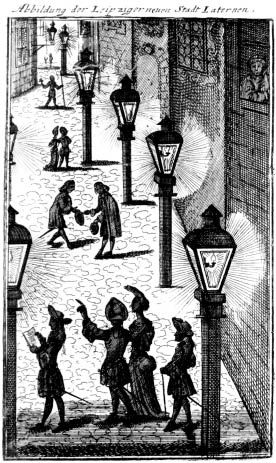
Figure 5.4 Leipzig street-lighting scene, 1702, print from Aufgefangene Brieffe, welche Zwischen etzlichen curieusen Personen über den ietzigen Zustand der Staats und gelehrten Welt gewechselt worden (Wahrenberg [actually Leipzig], 1701).
The engraving is not a realistic representation of Leipzig’s street lighting: instead, it brings together security, elite sociability, and the night in a single compact scene. In the foreground, left, a man reads by lantern light; couples stroll and admire the city’s new baroque mansions, while two men, able to recognize each other despite the darkness, doff their hats. In the background a nightwatchman stands guard. The accompanying text emphasizes the convenience and security provided by the lanterns:
not only are we spared the private lanterns and torches, which everyone must otherwise use when going out at night, but also many sins against the Fifth, Sixth and Seventh Commandments [i.e., prohibitions of murder, adultery, and theft] are better prevented and avoided.87
A medal minted in 1702 to commemorate the introduction of street lighting repeats two of these scenes, showing a city watchman and a figure reading. The emphasis on reading in the print and in the medal should not be taken too literally: as Wolfgang Schivelbusch has pointed out, the symbolic value of lighting always supplements its visible effects.88 Reading by the light of the lanterns was hardly practical, but this exaggeration of their power suggests that the sphere of the literate was expanded by street lighting. The better sort were to benefit from it: the well-dressed men in the illustration, perhaps students, carry swords to indicate that they are not apprentices or servants. Leipzig’s prosperity and prestige depended on attracting merchants and students, and this illustration promised a safer and more genteel city.
Under Romanus the Leipzig city council issued several ordinances regulating night life. During his first year in office the council forbade the fashion of “walking about the streets at night in night-shirts, masks, night-caps and other unusual clothing.”89Repeating a 1697 ordinance, the council warned citizens and residents to “keep their own [family] at home in the evening,” and the ordinance reported that “late in the evening many apprentices, boys, maids and such unmarried folk are found idly in the streets, where they practice many improper things with shouts, running about and all such mischief.”90 Another ordinance denounced the coffeehouses of the city as sites of “sexual vice … luxurious ostentation and mischief from the early hours until late into the night.”91The street lanterns and city ordinances were meant to civilize the city’s streets and reduce this sort of “night life.”92 The verse pamphlet The Leipzig that Shines Forth by Night, printed to celebrate the new lanterns, also emphasizes security and order. Prostitutes “would have to shun the light”; thieves lurking would instead “go off to bed.”93 The pamphlet’s author went on to praise the benefits that the visitors to Leipzig’s great trade fairs would enjoy. “In security,” he commented, “they can recognize friend and foe / and can go up and down the street doing business,” making clear the value of street lighting for commercial uses of the night.94