
The debate over ghosts and spirits shaded into the more weighty issue of witchcraft. This is no surprise: for early modern people the ghost and the witch were “not merely allied beliefs, but intrinsic parts of the same system.”33 The Devil might appear in the form of a ghost, or directly to a witch; witches might summon the spirits of the dead (as the witch of Endor did) – all were manifestations of the same metaphysical order, sharing deep associations with the night.
Though closely associated in popular and learned belief, the stakes were higher when witchcraft was at issue. Ghost belief could have serious theological and political implications, but there were no major legal issues tied to it. Witchcraft, in contrast, was a crime described and denounced in every body of Western law. Its ties to the political order were explicit. By the middle of the seventeenth century, Protestants and Catholics alike had created a stable context for witchcraft that demanded its persecution, despite the publications of skeptics from several confessions. This context framed witches as the Devil’s servants on earth, with their maleficia, gatherings, and rituals recognized as inverted reflections of the legitimate servants and proper worship of God. Imagined nocturnal gatherings were a key part of this inversion. In these terms Stuart Clark has elucidated the political logic behind the persecution of witches, which helps account for the violence of both the persecutions and the flare-ups of debate over it. In response to criticism of the execution of several witches in Scotland in 1697, minister Robert Wylie argued that “unless a man hath so far renounced humanity as well as religion as to deny invisible Spirits, and the being of witches,” the actions of the Scots authorities were irreproachable.34 The legal and practical context of witchcraft persecution, as well as its theoretical underpinnings in learned demonology, all emphasized the night as the time of diabolical temptation and the witches’ sabbath. The tie between witchcraft and the night intensified at the end the sixteenth century as the learned demonization of the night made its way into popular culture through witch trials and publications.
After 1650, the stable framework of learned demonology and legal persecution was shaken by new challenges that went beyond the humane skepticism of Montaigne, Scot, Wier, or Spee. On an intellectual level, these challenges arose from Cartesian or materialist thought; on a quotidian level, increasing use of the night for respectable sociability undercut its demonization. Spinoza provides some of the most striking expressions, arguing in his Korte Verhandeling (c. 1660) that “devils cannot possibly exist” and refuting arguments about the existence of spirits in series of letters in 1674.35 Such authors challenged the possibility of witchcraft on an abstract level, and they presented their arguments as light overcoming the darkness of superstition.
In response to these new challenges, witchcraft took on new meanings in the law and learned discourse.36 More and more, stories about witches became assertions of the reality of witchcraft. As with ghosts and spirits, supporters of traditional, revealed Christianity saw witchcraft itself as evidence of the reality of their faith and their God. The nocturnal crimes and gatherings of witches were inverted testimony to the divine order preached by the established churches. To preface accounts of witchcraft and witch trials in New England and Sweden The Compleat Library, or, News for the Ingenious (December, 1692) explained the stakes:
As we are troubled in this Age by a great many Atheists, or pretenders to Atheism, so we are no less pestered with a multitude of Pretenders to Reason and Christianity both, which yet against both Reason and Scripture … do strangely Sadducise, and dogmatically, and confidently maintain, there are no witches.37
By publishing these accounts of sorcery, “being attested in the most Authentic manner that is possible,” the author hoped to “satisfy them [i.e., the skeptics] of the Reality of the Being of such wicked Creatures, and of the lamentable Effects of their horrid Confederacy with wicked Spirits.” Despite this author’s reference to “the lamentable Effects” of human alliance with evil spirits, these alliances served an important new purpose by generating accounts of witchcraft which could now be used in the name of established Christianity to support a system of beliefs that seemed (to traditional defenders at least) to be challenged on all sides. As a Scots author explained in a 1698 account of witchcraft, after “Seeing Devils take so much pains to contract for the Souls of Witches; the Saducee’s tho’ judicially blinded in their Reason, are hereby rendred inexcusable by very sense.”38
Conversations with free-thinkers confirmed the fear that denial of the reality of ghosts and witches was a slippery slope to graver errors. This was the conclusion of Ralph Thoresby, the nonconformist antiquary of Leeds, who noted in his diary on June 13, 1712 that he was “troubled.” Visiting London, he had spent that evening and the one before at a coffeehouse in the company of learned men like himself, including one Obadiah Oddy (a classicist), a “Mr. Gale,” and Edmond Halley, Savilian Professor at Oxford. Halley had a reputation as a free-thinker, but the trouble came from Oddy. Thoresby wrote that Oddy, who had been “very zealous in opposing even the best attested narratives of apparitions, witchcraft, etc.” on the previous evening, “now confessed he believed there was no Devil.” Thoresby responded in his diary: “the Lord enlighten him!”39 Could accounts of devils and witches counter this unbelief? In conversation with the free-thinker Oddy, Thoresby (and perhaps other interlocutors) presented “the best attested narratives of apparitions, witchcraft, etc.” as proof of the invisible world of God and spirits, but to no avail.
Apparently concerned by his nocturnal encounter with skepticism, Thoresby began the next day to read “Mr. Beaumont of Genii,” a reference to John Beaumont’s An historical, physiological and theological treatise of spirits, apparitions, witchcrafts, and other magical practices … With a refutation of Dr. Bekker’s World bewitch’d; and other authors that have opposed the belief of them of 1705.40 Ten days later he noted that he had “Finished the perusal of Mr. Beaumont’s History of Genii, or spirits, presented to me, and recommended by the pious Bishop of Gloucester, from whom I had also an account of that very remarkable apparition mentioned in the postscript. His Lordship says this curious treatise has done much good in this skeptical age.”41
Beaumont’s treatise began with an engraving of divination by night (Figure 8.3, “Jews Going Out in the Moonshine to Know their Fortune” by Michael van der Gucht) which reinforced the traditional association of the night with the reality of magic and divination. Here Beaumont cited a Jewish tradition of nocturnal divination during Sukkoth after repeating accounts of contemporary “second-sighted persons” about whom he had been “credibly informed.”42 Thoresby would have found in Beaumont many accounts of spirits and witches, including detailed reports of the Essex witch trials of 1645. The treatise spoke in the empirical tone of the time with many well-attested narratives, including an account of the author’s own experience with spirits and a report from the bishop of Gloucester, with whom Thoresby had spoken personally about “that very remarkable apparition mentioned in the postscript.”
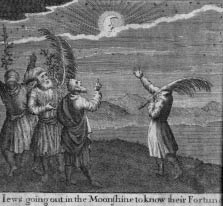
Figure 8.3 Illustration of “Jews going out in the Moonshine to know their Fortune” in John Beaumont, An historical, physiological and theological treatise of spirits, apparitions, witchcrafts, and other magical practices … With a refutation of Dr. Bekker’s World bewitch’d; and other authors that have opposed the belief of them (London, 1705), frontispiece. University of Illinois, Urbana-Champaign, Rare Books and Manuscripts Library.
Accounts like these were nothing new, but now they bore the additional function of affirming an entire system of belief in spirits, witches, the Devil, and God. Thoresby’s conversation with Oddy suggests that these nocturnal accounts would never persuade Cartesians or materialists, however. As Jean Le Clerc explained in the first French review of Bekker’s World Bewitched, several scholars were preparing to answer Bekker, but “one would wish that in order to refute him, they would not adopt all the stories that have been made and are made every day regarding Sorcerers & Magicians … They will not persuade our Esprits forts by this path.”43 Instead, Le Clerc argued that “to answer Mr. Becker solidly, they must … prove that the nature of a spirit is such, that it necessarily has a certain power over bodies, though limited; or that, at least, God has established, with regard to pure spirits and their relation to the body, a law much like that of the human spirit’s relationship to the body with which it is united.”44 This was a tall order.
As in the debate over ghosts and spirits, supporters and deniers of witchcraft reflected fundamental changes in everyday life. The intellectual conquest of the night defined darkness and witchcraft alike as nonentities, and no amount of empirical evidence could change this definition. Supporters of traditional Christianity turned to the terrors of the night for “proofs” of their understanding of God and the invisible world, but the landscape of darkness was beginning to shift beneath them.