
Nocturnalization promoted the expression of key concepts of the early Enlightenment. Many of these ideas could be traced back to the New Philosophy of Descartes, Hobbes, or Spinoza. But the abstract, complex, and contradictory arguments of these authors could challenge just about everything in the traditional learned culture of their time. Why did issues such as ghosts, witches, and Hell emerge, among others, as key controversies?70 A specific aspect of Hell’s “dark foundations,” resting on an ancient bedrock of fear, looked a little less frightening to all who experienced nocturnalization – a significant minority of Europeans in 1700. A primordial feature of daily life was now pushed back, however slightly, by the new street lighting and by improved domestic lighting. In this new era of the history of the night, women accused of witchcraft evoked pity rather than Satan’s dark powers, and one could now “laugh at spirits.”71 The “esprits forts,” libertines, and skeptics who challenged the reality of ghosts, witches, Hell, and the Devil were at home in the night when these conversations flourished.
Contemporaries understood the effects of nocturnalization on the religious and philosophical debates of the time. As Lewis Theobald, editor of the London journal the Censor complained in 1717:
It is too frequent a provocation to a Man of my Gravity … to be obliged to sit up with a Mixture of Company, who, when the Watchman has gone his Round, and the Sparks are entering on their Third Bottle, will trouble the Board with Debates of Religion, and the Power of Faith.
At this late hour serious topics arose: “How unfit a Time is it, when either Reason nods, or is bewildered, to launch out into Subjects of such a Nature; and play the Skeptics, when Notions must be so confused.” Theobald saw the clear effects of these conversations:
I doubt not but this Custom of trifling with Immortality and Themes above the Sphere of common Reason, when the Powers of Wine have made the Tongue licentious, has been the Cause of many a Free-thinker among the alert and sanguine.72
He did not, however, suggest reversing the nocturnalization of London’s cultured life: he goes on to explain that late hours per se are not the issue. Instead the late-night conversations on “themes above the sphere of common reason” have helped change the intellectual tone of the times, creating free-thinkers and “bigots” alike: the former are too emboldened, and the latter too frightened, by late-night “trifling with Immortality.”73 His French contemporary, the abbé Jean Terrasson (1670–1750), claimed that street lighting had led to the decline of letters: “Before this age … everyone returned home early for fear of being murdered on the street, which redounded in favor of one’s work. Now, one stays out at night and works no more.”74 Social banter was replacing solitary reflection in the learned night.
The association of the night with free-thinking was widespread. The guide to Paris published in 1718 by the German Nemeitz advised young men to visit the city’s “infinite number of cafés” in the afternoon or evening.75 In particular, he noted that “the widow Lawrence in the rue Dauphine keeps a café, called the ‘café des beaux esprits’ where assemble certain persons who discuss all sorts of curious and spiritual matters.”76 A police report of August 1729 described such café conversations in a more alarmed tone:
There are in Paris self-proclaimed wits who talk in cafés and elsewhere of religion as a chimera … and if order is not restored, the number of atheists or deists will increase, and many people will make a religion according to their own fashion, as in England.77
Like the night print from the Secret Letters and the accounts of Morris and Thoresby examined above, these authors testify to effects of nocturnalization on the form and content of the debates of the early Enlightenment.
The magnitude of this change is revealed by comparison with a 1629 sermon of John Donne (cited in chapter 3). Preaching “in the evening” at St. Paul’s in London, Donne called on the power of midnight, solitary and profound, to strip away the vanity of the day. Addressing an “atheist,” Donne asked him to look ahead “but a few hours, but six hours, but until midnight.” Donne assumed that at midnight his listener would be asleep, “dark and alone” in an ascetic or penitential night. Donne taunted: “Wake then; and then dark and alone, Hear God ask thee then, remember that I asked thee now, Is there a God? and if thou darest, say No.”78 By the end of the seventeenth century, nocturnalization had transformed the scene imagined by Donne. In London midnight was precisely the time when the society of gallants, free-thinkers, and “atheists” thrived. They confronted not God, but one another in drink and conversation. Worldly banter replaced sacred introspection as a key nocturnal activity, and the late hour was more likely to strengthen their free-thinking than to challenge it. For Donne and his listeners, it was “an occasional mercy” when “A man wakes at midnight full of unclean thoughts, and hears a passing bell.”79 But by the end of the century, the social din of the coffeehouse had drowned out the lonely sound of the passing bell.80
The imprint of nocturnalization upon the discussions of ghosts, witchcraft, and Hell also appears in the framing concepts and rhetorical strategies of important works of the early Enlightenment. Here I examine early Enlightenment thought in terms of nocturnalization through two popular texts, Bernard Le Bovier de Fontenelle’s Entretiens sur la pluralité des mondes (Conversations on the Plurality of Worlds) of 1686 and Balthasar Bekker’s De betoverde weereld (The World Bewitched, 1691–94). These works, which reached especially wide audiences, present the same tension between the two aspects of nocturnalization – the discourses and practices that dispelled or denied darkness and those that created, maintained, and manipulated it – seen in the discussions of witchcraft, ghosts, and Hell above. Fontenelle presents an intellectual seduction by night, lifting the veils of nature but counseling secrecy from “les esprits ordinaires.” To refute accounts of spirits, ghosts, and witches, Bekker emphasizes repeatedly that these encounters often take place “at night and in nightmares” when reason is obscured.81 Both authors created hierarchies of perception, understanding, and enlightenment that shifted the darkness of ignorance onto differences of region and race.
8.4.1 Nature: Fontenelle’s Conversations on the Plurality of Worlds
Bernard Le Bovier de Fontenelle (1657–1757) combined talents and connections in literature (he was the nephew of the brothers Corneille) with interests in astronomy, geometry, and physics. The Conversations on the Plurality of Worlds was his first major success when published in 1686. In 1691 he was elected to the Académie française and in 1697 appointed permanent secretary of the Académie des Sciences – a testament to his skill as an elucidator of science. He published widely as a moralist, advocate of les modernes, Cartesian, and biographer of science. Voltaire and Diderot hailed him as a true pioneer of the Enlightenment.
Fontenelle’s extraordinarily popular Conversations went through thirty-two editions during the author’s long lifetime; translations appeared in every major European language throughout the eighteenth century. In the year following its publication, the book was placed on the Index of Prohibited Books, and in this year Fontenelle added a sixth chapter that reinforced the book’s enlightened-aristocratic tone.82 This work and his other writings of the 1680s – some clandestine, some popular – marked “the gateway to the French Enlightenment.”83 Like the larger intellectual movement of which it is emblematic, Conversations engages with darkness, the night, and nocturnalization on several levels.
Consisting of six conversations at night between an unnamed marquise and a scientifically informed narrator, Fontenelle’s work teaches the fundamentals of a Copernican–Cartesian universe, infinite and dynamic. Fontenelle explained astronomy through his narrator’s intellectual seduction of the marquise, who is untutored in natural philosophy but possesses a keen intellect and ready curiosity. (Fontenelle’s narrator describes her as “a blond … the most beautiful woman I know.”) In his Preface Fontenelle explains that “the ideas of this book are less familiar to most women than those of The Princess of Cleves, but they’re no more obscure.” His narrator then leads the marquise from ignorance and disbelief to a clear understanding of the heliocentric solar system, the movement of the earth, geographic features on the moon, eclipses, the six known planets, and the possibility of life in other solar systems. Fontenelle’s conversations between the amiable narrator and his bright pupil reveal a clear parallel between the darkness deployed in the theater and the use of darkness in the presentation and transmission of natural philosophy in the Enlightenment. As in the theater and in court culture in general, the relationship between the creation of darkness and the illumination of darkness is central to the project, yet carefully hidden.
The text opens with a letter from the narrator to a “Monsieur L***” describing the narrator’s conversations with the marquise. “I’ll divide them for you by evenings,” the narrator explains, “because in fact we had these conversations only at night.”84 The nocturnal setting evokes the expansion of legitimate nocturnal activity in the period, as well as nightly pursuits ranging from astronomy and the theater to court life. The use of darkness – intellectual, metaphoric, and represented – to create the Conversationsshows the text to be an intellectual expression of both aspects of nocturnalization. Like the nocturnal spectacles of the opera or the court, Fontenelle’s nocturnal Conversations depict the triumph of light over darkness on one level, while on other levels fostering, maintaining, and manipulating darkness. Indeed, in the first of these nightly conversations, the narrator uses an analogy with theater to persuade the marquise to accept a new epistemology based on darkness and obscurity. Before he can explain anything about the movement of the earth or the position of the sun, he must convince the marquise to leave her “common-sense” views behind. He does this by comparing the natural world to the theater:
I have always thought that nature is very much like an opera house. From where you are at the opera you don’t see the stages exactly as they are; they’re arranged to give the most pleasing effect from a distance, and the wheels and counter-weights that make everything move are hidden out of sight. You don’t worry, either, about how they work. Only some engineer in the pit, perhaps, may be struck by some extraordinary effect and be determined to figure out for himself how it was done. That engineer is like the philosophers. But what makes it harder for the philosophers is that, in the machinery that Nature shows us, the wires are better hidden.85
Fontenelle summarizes the central insight that underwrites his text: “‘Whoever sees nature as it truly is simply sees the backstage area of the theater.’”86 His frame of reference is the baroque perspective stage, with its reliance on darkness and illusion.
With the help of Fontenelle’s narrator the young marquise comes to understand that there is more to nature than meets the eye. But the analogy “nature–theater” also incorporated a hierarchy of perception. As a guide to the opera published in Hamburg in 1702 explained:
Nowadays all persons of distinction seek entertainment from the opera, but among the thousands found in the boxes and seats one would scarcely meet ten who understand what happens there and how to evaluate it. Indeed, a great many in the audience do not understand one bit of it. The most important things to note at an opera are … the sets, which no one can rightly assess unless he understands painting and perspective … Above all the machines [must be] considered, as they are the best thing about the opera, filling the spirits of all members of the audience with wonder.87
One had to learn how to see the opera, just as Fontenelle’s narrator teaches the marquise (and his many readers) how to see the natural world.
But this learning is not meant to be shared widely. When the marquise reports on the sixth evening that two “men of wit” ridiculed her knowledge of astronomy, the narrator advises her to do as he does and keep their insights secret from the ignorant: “Let us content ourselves with being a little select party who believe and not divulge our mysteries to the common people.”88 The artificial illusions of the theater, dependent on darkness, become in the Conversations a model for nature in a discussion that dispels intellectual darkness for the marquise while maintaining it for “the vulgar.”
The hierarchy of perception presented by Fontenelle was perhaps most fully expressed in the darkness of the baroque theater. The influential guide to the baroque stage, Nicola Sabbatini’s Practica di Fabricar Scene e Machine ne’Teatri (Manual for Constructing Theatrical Scenes and Machines) of 1638 makes this hierarchy explicit in practical terms:
the common or less cultivated persons are set on the tiers and at the sides, since the machines give a less perfect appearance in these places, and because such people do not observe them minutely. The persons of culture and taste should be seated on the floor of the hall, as near the middle as possible, in the second or third rows. They will have the greatest pleasure there, since … all parts of the scenery and the machines are displayed in their perfection.89
Sabbatini’s advice maps a political and cultural hierarchy onto the perception of the stage or the world. The “cultured” see beyond the surface when they view the sets and special effects of the opera or theater. They appreciate what is concealed as well as what is visible. In the same terms, many scholars have noted Fontenelle’s oblique style, discretion, and use of irony. The author expected his proper audience of raisonneurs to be able to read between the lines. Those at the top of the hierarchy of perception would see the more radical scope of Fontenelle’s views.90 His clandestine philosophical writings of the 1680s reveal his anticlericalism and deep skepticism regarding all systems of metaphysical thought, including revealed Christianity.91
8.4.2 Scripture: Bekker’s The World Bewitched
The Amsterdam Reformed minister Balthasar Bekker (1634–98) unleashed an extraordinary controversy with the 1691–94 publication of his De betoverde weereld (The World Bewitched). Bekker, son of a Friesian village pastor, studied at the universities of Groningen and Franeker. He became a Cartesian but was also strongly influenced by the biblical philology of Cocceius. He earned a doctorate and served as pastor in Franeker before taking a position in Amsterdam in 1678.
When Bekker published the first two books of The World Bewitched in 1691, he was an experienced author with several catechisms and a work on comets to his credit. Nothing prepared him, however, for the extraordinary popularity or violent responses generated by The World Bewitched.92 Across the four books of The World Bewitched Bekker argued “upon the same foundation of Scripture and Reason” that “the Empire of the Devil is but a Chimera, and that he has neither such a Power, nor such an Administration as is ordinarily ascribed to him.”93 As Bekker’s work was translated into German, French, and English, dozens of refutations were published, as well as a few defenses of Bekker from authors more radical than he. Another edition published in England in 1700 as The world turn’d upside down, or, A plain detection of errors, in the common or vulgar belief, relating to spirits, spectres or ghosts, daemons, witches, &c. kept the controversy going, with an important response published by John Beaumont in1705 (the book to which Ralph Thoresby turned for reassurance in 1712).
In The World Bewitched Bekker sought to make “an exact enquiry after whatever is falsely believed in the World, and the Erroneous Opinions that are entertained without any other ground than that they are every day told and heard of.”94 Specifically, Bekker intended to deny the supposed effects of Satan and evil spirits in the world. He saw this work as a continuation of the Protestant Reformation, “a new and perhaps final phase in the perfection of Christianity.”95 As with the Conversations, Bekker’s World Bewitched engages with darkness, the night, and nocturnalization on several levels. Bekker proposes to illuminate “the frightful Darkness of Paganism” while creating darkness in new hierarchies of interpretation, perception, and revelation. His attitude toward the common people, his approach to Scripture, and his understanding of the night all reveal the imprint of nocturnalization, as does the place of “pagans” in this work.
Bekker’s challenge to belief in witchcraft, evil spirits, and the power of the Devil has been depicted as reflecting growing popular skepticism and disbelief in the Netherlands. But Bekker himself complained of the credulity of his congregants and the cases of supposed possession and bewitchment they brought to him. He made clear in World Bewitched that he was “rejecting the Opinion commonly received amongst the Vulgar, concerning the Craft and Power of the Devil.” In his survey of belief in witches and demons, past and present, he noted that “for as to the common People, either Papists, Jews, or Pagans, they know nothing for the most part, but a little by hear-say; so that there is no relying upon them.” Even among Protestants, “it is sure without mistake, that for the most part, what the most illiterate believe and practice, is contrary to the sense of Divines, and of all those that understand any thing in the Holy Scripture.” He sounds a resigned tone: “I will have nothing to do with them [the common people] upon this subject, having often tried my self how many follies our own People say and believe, upon this account.”96 Despite the popular response to World Bewitched, he sought an audience among the learned – as the four detailed volumes of his study suggest. He addressed “our Doctors and our Men of letters [among whom] … there are none so credulous as the Vulgar; however there is a very considerable difference to be seen in their Opinions, some believing almost every thing, and others almost nothing at all” about ghosts and witches.97 Even among the most free-thinking Christians in the Netherlands, the Collegiants, belief in spirits and diabolic possession was widespread and vigorously defended.98
Bekker’s frustration with the credulity of the common people echoes in his sense that his own tradition has utterly misunderstood the biblical testimony regarding spirits and the Devil: “But to our great shame, most ... of us, as well as of other Sects, that pretend a Veneration for the Holy Writ, search not in it after its Sense, being satisfied with the vulgar Interpretations, and such as they have received from others.” To correct this misinterpretation, Bekker proposed, like Fontenelle, to look beyond the deceptive surface of his object of study to a deeper understanding of Scripture heretofore obscured from view. This is the work of books II and III of World Bewitched.
From the first, Bekker’s critics noted that he used an extreme accomodationist hermeneutic associated with Spinoza or Cocceius to radically reinterpret all scriptural references to angels, the Devil, and evil spirits.99 It was this approach to Scripture, rather than his Cartesian pneumatology, that most provoked Bekker’s fellow divines. As Le Clerc noted in the first French review of Bekker, “to answer Mr. Bekker solidly, they must … prove … that according to the rules of criticism, and the spirit of the Hebrew and Greek Languages, it is impossible to give the Scripture the sense which our author gives it.”100 A battalion of theologians proceeded to do just that. The intensity and extent of their responses made Bekker a target of attack decades after his death in 1698. A satire of 1730–31 imagined a conversation with his ghost, illustrated with a visual lampoon showing what was wrong with Bekker’s approach to demons and Scripture. In Figure 8.4 Bekker is shown sieving or sifting demons out of the Christian Scriptures. Below the sieve are a series of terms used by Bekker to interpret away apparent references to evil spirits, possession, demons, etc. in the Bible: “frenzy,” “melancholy,” “lunacy,” “enthusiasm,” and “epilepsy” are among them. In this lampoon of Bekker, he is unaware that the real Devil and demons are hovering just above him. The caption reads “So Becker sorts out the devils by his art; / But the spirit of lies alone makes more doubt.” This remarkable representation of Bekker’s approach to Scripture directly challenges the accomodationist hermeneutic of Spinoza and Cocceius, denying the esoteric knowledge hidden from the vulgar and the hierarchy of perception on which it was based.
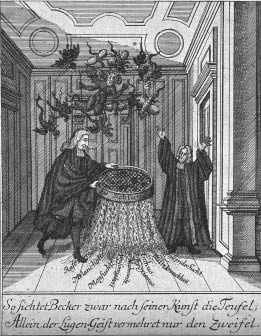
Figure 8.4 Balthasar Bekker sieving devils, from Curieuse Gespräche im Reiche derer Todten. Zweyte Unterredung oder Gespräche im Reiche derer Todten (Leipzig and Braunschweig: s.n., 1731), frontispiece to part 2. Wellcome Library, London.
More broadly, Bekker’s insistence on natural or physical explanations for all supposed encounters with spirits, angels, and devils led him to emphasize the power of the night and sleep to cloud the mind. Dark times and places became the antipode to the Cartesian rationality he took as his method. The accounts of Jacob wrestling with an angel (Genesis 32; Hosea 12) “occurred, as in every case before and after, in a divine night-vision,” Bekker explained.101 Likewise “the Devil … does not have the freedom to haunt the world or appear to people, except in sleep or in a dream.” In books II–IV of The World Bewitched he explains dozens of biblical, historical, and contemporary encounters with angels, devils, or spirits as nocturnal dreams, visions, or misperceptions. Examining an account from the early church, Bekker asks “At what time” did the Devil appear to Theodoretus? “At night. He was perhaps sleeping or dreaming.” One must consider the time of day when examining any account of a ghost or demon, Bekker insists.
In his refutation of dozens of ghost stories in book IV, Bekker articulates the role of the night in his analysis:
For example, when the will-o’-the-wisp sometimes pops and crackles and gives off a strange and unpleasant noise, like the whimpering or sighing of a person, it seems to some, because man’s fearfulness is greater at night than by day and hinders him from using his judgment and reason properly (so that the true cause is not recognized) that all these … are the antics of Satan.
Bekker follows this observation with a series of accounts concerning ghosts and specters, emphasizing that each occurred “in the evening, while lying in bed,” “in the evening hours,” “in the evening twilight,” or “at night in front of the bed.”102 Signaling a key theme in the later Enlightenment understanding of the night, Bekker demonstrates in example after example that the dreams and fears of the night check the use of reason. Night became the shadowy supplement to the light of reason, always dispelled but ever-present.