
The emphasis by Lavater, Nashe, Marlowe, and Shakespeare on the power of the “cunning fowler … [who] spreads his nets of temptation in the dark” was fundamental to the narratives of witchcraft which flourished in this period, especially in the understanding of the witch’s pact with the Devil and the nocturnal sabbath. When our perspective on witchcraft moves from the stage to the stake we are confronted with the grim reality of witch persecution in early modern Europe. In recent decades, scholars of early modern witchcraft have given some order to the bleak record of suspicion, accusation, torture, and confession that remains from the early modern witch persecutions.37 These scholars have identified several key aspects of early modern witchcraft, starting with witchcraft beliefs and practices in popular magic, and in rumors and accusations at the local level, where almost all trials for witchcraft began. They have also contextualized the legal sources created by the witch trials: witness testimony and the statements and confessions of defendants, coerced by torture or its threat. Demonological works and discussions of Satan and witchcraft in a broad range of other texts and images provide the intellectual and cultural background of the witch persecutions. In the crucible of the witch trials these aspects intersected to produce vivid scenes of nocturnal seduction by the Devil and shadowy gatherings in his service. Early modern theologians and jurists described the initial temptation by the Devil as leading to a pact or contract, often physically consummated, followed by participation in the witches’ sabbath. Suspended between the demonology of the learned and the confessions of the accused, accounts of nocturnal temptation by the Devil and descriptions of witches gathering at night were fundamental to early modernpopular culture, to the legal mechanisms of witch persecutions, and to learned demonology.
When we consider the night in each aspect of the early modern construction and persecution of witchcraft, we see some of its most distinctive contours. Here I will draw much of my evidence from the heartland of persecution for witchcraft, the area of eastern France and the Holy Roman Empire from the duchies of Luxemburg and Lorraine to the prince-bishoprics of Würzburg and Bamberg.38 Over half of all known trials for witchcraft in all of early modern Europe took place in this politically and confessional fragmented area.39 Influential demonological works of the period were written in the region or made reference to it, foremost Jean Bodin’s De la démonomanie des sorciers (1580), Peter Binsfeld’s Tractat von Bekantnuss der Zauberer und Hexen (1590), and theDémonolâtrie (1595) of Nicolas Remy. French, German, and English historians have published thorough local and regional studies of witchcraft in the area.40
The universal belief in magic and spirits was the foundation of all witch persecution. “Popular beliefs” about magic and maleficia were held by people of all ranks, even if they sometimes clashed with learned views on witchcraft. Witchcraft was real and threatening. From this point a key observation emerges: time and again we see peasants and other common people demonstrating both the knowledge and the desire to initiate a prosecution for witchcraft. Scholars have uncovered both a wide knowledge of demonology and demon lore and a pattern of initiative “from below” in the witch persecutions of the sixteenth and seventeenth centuries, and villagers often sought magical aid against witchcraft before turning to local authorities for help.41
In the witch persecutions common and learned views of witchcraft met, but they did not necessarily agree. Authorities inscribed “the witch of the church” over “the witch of the people”; the latter was dangerous but hardly diabolical.42 In popular beliefs about magic and witchcraft, the night played an ambiguous role, corresponding to the place of the night in folk beliefs in general. One cannot generalize about the extraordinary range of associations of the night found in the multi-volume German folklore guide, theHandwörterbuch des deutschen Aberglaubens, except to say that the night was not uniformly associated with evil, nor did the clear light of day guarantee any protection against the Devil or his agents. Certain spells and rituals were best performed by night, but these practices were usually intended to help, not harm.43 The extensive accounts of popular magic in Saxon witch trials show no particular correlation between maleficia, beneficial magic, night, and day.44
Specific studies in the history of folklore reveal several deep and positive associations with the night in early modern Europe. Strange references to “night journeys” in Alpine folklore and witchcraft trials give us glimpses of local popular belief in the “phantoms of the night” (Nachtschar), a nocturnal group of mysterious people who “danced joyously on remote meadows and mountain pastures, [and] met in certain houses for sumptuous dinners.”45 Those who saw the night phantoms and opened their homes to them received magical gifts: good luck, the ability to play music, or perhaps second sight. The idea of the phantoms of the night is not easily distinguished from other folk beliefs documented in northern Italy, the Alps, Germany, and France from the fifteenth to twentieth centuries, such as references to the Benandanti, “the good society” or “the blessed people.” In all of these cases the groups are described as nocturnal and beneficent. Indeed, as Carlo Ginzburg’s work on the Benandanti of Friuli and Wolfgang Behringer’s study of Chonrad Stoeckhlin, a village “shaman” in the Bavarian Alps, reveal, in their first encounters with church and state authorities, these “good people” of the night did not even think to hide their nocturnal associations, so sure were they of the legitimacy of their magical night companions and journeys.46
But what stood behind the magical beliefs of the common people? By the middle of the sixteenth century, intellectual, ecclesiastical, and political authorities worked hard to demonstrate that the Devil underwrote all magical practices, and that all “phantoms of the night” were witches. In his Guide to Grand-Jury Men (1627) Richard Bernard presented the diabolical covenant as the basis of all magic: “an expressed league is made with the Devil … that is, the Witch with spirits … Now what other can that be, with whom the Enchanter is in league, but the Devil? … The story of Faustus confirms it, and all the relations of Witches with us.”47 This view meant diabolizing nocturnal phantoms, practices, and symbols traditionally seen as benign or even beneficial. For scholars today, the best-known examples of this demonization appear in the work of Carlo Ginzburg and Wolfgang Behringer. Both have shown how rural folk described their roles as Benandanti or travelers with the Nachtschar, and how officials of the church and state forced these men and women into the framework of learned demonology, then condemned them.48
Whether Benandanti, flamboyant visionaries, or wise women of the village, all were aligned with the Devil in countless sermons, tracts, and ordinances.49 The Elizabethan pastor George Gifford, writing in 1593, decried all popular magic as witchcraft:
I might reckon up her that deals with the sieve and the shears, and a number of such trumperies, in all which the most holy name of God is polluted, and if any thing be done, it is done wholly by the effectual working of Satan. God hath given natural helps, and those we may use, as from his hand against natural diseases, but things besides nature he hath not appointed.
Across the confessions of early modern Europe, this diabolization of everyday magic and superstition recast popular and elite views of the night; Ginzburg and Behringer both provide revealing studies of common people caught in the authorities’ diabolization of the night. Gifford represented the diabolization as a foregone conclusion, asking: “Those which have their charms, and their night spells, what can they be but witches?”50 As we will see below in chapter 7, villagers maintained a rich nocturnal culture despite the authorities’ diabolization of the night.
Because most prosecutions for witchcraft began with local accusations, witness testimony appears frequently in trial records. In contrast with the testimony of the accused, extracted by torture or its threat, witnesses testified under less coercion and showed themselves more strategic. Their testimony often provides clear evidence of popular beliefs despite the leading questions they were asked.51 Bernard’s guide to the investigation of witchcraft advised the prosecutor to ask “the suspected witch’s whole family” whether “they have heard the suspected … speak of their power to hurt this or that, or of their transportation, to this or that place, or of their meetings in the night there?”52 This line of questioning sought to pair daytime maleficia with night-time gatherings. But witnesses often presented a more benign view of the night, seen for example in the 1603 witness testimony of the young Caspar Johann of Hüttersdorf.53 At the trial of 60-year-old Schneider Augustin, he testified that after his evening meal
he laid himself down to sleep on the hay in his master Meyer’s barn. He awakened after his first sleep and saw that it was quite light in the barn; soon a great dance broke out on the threshing floor of the barn: the people danced back-to-back. In this company he, the witness, actually saw and recognized among others Schneider Augustin of Honzrath; this Schneider Augustin was by a wagon, which had been loaded with hay and stood on the threshing floor, and sat on a windowsill and blew on a huge, hideous instrument, making a terrible sound. The company discussed whether to move the wagon out, but after discussion decided to let it stay there. The whole thing lasted almost an hour and then disappeared with a great whoosh, and then it was dark in the barn again. He the witness could neither move nor spoke during all this time.54
As Eva Labouvie has observed, the scene described here is hardly diabolical. The dancing back-to-back to hideous music resembles an inverted peasant dance rather than a black mass or witches’ sabbath. There is no reference to the Devil or tomaleficiapracticed or planned, and no emphasis on the late hour of this gathering (after the “first sleep”) as particularly wicked. The relatively tame nocturnal gathering in this testimony is reflected by an English woodcut of the mid-seventeenth century showing a witches’ dance by the light of the moon (Figure 2.1). This image, illustrating the chapbook tale of Robin the cobbler, “punish’d bad as Faustus with his devils” for making a diabolical pact, nonetheless resembles a peasant dance more than any diabolical witches’ sabbath.55
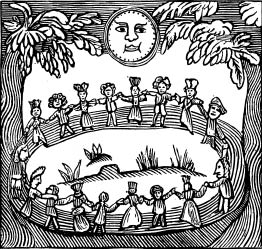
Figure 2.1 Woodcut showing a witches’ dance, from The Witch of the Woodlands; or the Cobler’s New Translation (London, n.d. [early eighteenth century]), p. 2.
However described or represented, the sabbath was key to witch trials. In Caspar Johann’s testimony we see incrimination through “participation” at the gathering, which was the focus of all discussions of the dance or sabbath in trial testimony. Witchcraft persecutions needed accounts of the Sabbath to extend the chain of accusation, and this witness obliged. The protocol records that he “actually saw and recognized” Schneider Augustin of Honzrath.
Confessions extracted through torture confirmed and consolidated the authorities’ view of witchcraft.56 These coerced accounts went beyond witnesses’ testimony to construct a description of witchcraft from within. The true crime of witchcraft was service to the prince of darkness, and so the questions posed to accused witches and the confessions elicited focused on two typically (though not necessarily) nocturnal events: the initial agreement with the Devil (often consummated sexually), and the witches’ sabbath. These confessions appear like palimpsests on which popular and legal views of witchcraft and the night overwrite one another. Their references to the night fuse the traditional sense that the Devil might appear at any time with the authorities’ belief in the ubiquitous power of the Devil. Attitudes toward the night appear more uniformly negative in the testimony of accused witches, reflecting the more structured demonological writings and interrogation manuals. The Westphalian jurist Heinrich von Schultheis provided in his1634 treatise on How to Proceed with Interrogations into the Gruesome Blasphemy of Witchcraft, a list of questions designed to elicit the whole nocturnal fantasy:
Questions for interrogating the witches regarding
their teacher
the body of the Devil
how they test their arts
maleficia
the place of dancing
the worship service
what they do after the dance
eating and drinking
honoring the Devil
praying to the Devil
blasphemy.
Schultheis also related several accounts of travelers and others who stumbled across nocturnal sabbaths.57 A manuscript interrogatory used in the prince-bishopric of Eichstätt in 1617 included questions on “strange gatherings,” asking of the accused witch “where she travelled to, and how they could get away in the dark night?” Interrogators were instructed to ask “whether and how they saw in the dark night; [and] what kind of light was present?” at the sabbath.58
The official narrative of witchcraft began at night. As Thomas Nashe asked in 1594: “When hath the devil commonly first appeared unto any man but in the night?” The expectation of a nocturnal encounter was ubiquitous but not rigid. Across Europe, confessed witches reported first meeting the Devil whenever they were alone, often at night but also by day.59 The account of the widow Feylen Suin, convicted of witchcraft in the jurisdiction of the imperial abbey of St. Maximin (near Trier) in 1587, can stand for many others. “Once upon a time,” her testimony began, “she was at home, sitting by the fire and her children were sleeping.” She thought back on her inability to buy grain to feed her family earlier that day when “suddenly the Devil, in the form of a young apprentice with a long black robe, came to her.” He consoled her and offered her money. She gave in to his temptations, denied God and “all his dear saints and the Mother of God” and had sexual relations with him (“Coitum exercuit membro frigidissimo etc.”) to consummate their agreement.60 Among the ninety-seven women and men from two villages (Longuisch and Kirsch) in the same region tried for witchcraft in the period 1587–1640, all but three confessed to first encountering the Devil alone, typically at night. Over half first met the Devil at home, including ten who encountered him in their beds at night. The interrogators of these accused witches focused relentlessly on the sexual consummation of their agreement with the Devil: all ninety-seven confessed witches in the Longuisch and Kirsch sample admitted to sexual relations with the Devil immediately upon their first encounter with him.61
The place of the night in these narratives varied. As the accused witch Niclas Fiedler, former mayor of Trier, confessed after repeated torture in 1591: “twelve years ago a black man came to him behind his house, between day and night, when his wife was suffering a long-lasting illness and he was very sad.”62 The accused witch was almost always described as being alone when first tempted by the Devil, and when the physical (usually sexual) consummation of the agreement between the Devil and the witch took place. This isolation, usually at night, supported narratives that confirmed the learned view of witchcraft and provided the evidence necessary for conviction, i.e., a confession of succumbing to the Devil’s temptation and entering physically into an agreement with him. Two confessions from Guernsey from 1617 reveal the relative unimportance of the night in the first encounter with the Devil: Collette Du Mont confessed that “she was quite young when the Devil, in the form of a cat, appeared to her in the Parish of Torteval as she was returning from her cattle, it being still daylight, and that he took occasion to lead her astray by inciting her to avenge herself on one of her neighbors.” Her co-defendant Isabel Becquet first met the Devil “in the form of a hare. [He] took occasion to tempt her, appearing to her in broad daylight in a road near her house.” Isabel Becquet then confessed that the Devil later sent Collette Du Mont to her house to fetch her for the sabbath “during the ensuing night.”63
Accounts of the witch’s first encounter with the Devil stressed the physical and spiritual isolation of the accused more than a specific time of day. In contrast, the other key element in the witch’s confession, the witches’ dance or sabbath, was almost universally described as a gathering by night. Again, the confession of the widow Feylen Suin is representative. “Not long after [her first encounter with the Devil], on a Thursday night” the Devil returned to her “as she sat by the fire to spin and the children were asleep.” Again he “had his way with her,” then Suin climbed on a black dog and rode to a field beside the Mosel where “many came together … including many important people. She danced there, leaping to the left into the air in the Devil’s name.”64 In her 1617 confession Isabel Becquet of Guernsey described repeated visits to “the usual place where the Devil kept his Sabbath,” but explained that “she never went to the Sabbath except when her husband remained all night fishing at sea.”65
One cannot easily distinguish between “popular” and “learned” elements in accounts of the sabbath elicited by torture. Confessions shift between descriptions of a full-fledged “black mass,” accounts of gatherings to harm crops through weather magic, and simpler accounts based on a rural dance seen in the witness testimony above. Within this range, accounts of a witches’ dance far outnumber the more demonocentric confessions.66 This suggests that despite the use of torture and leading questions designed to elicit accounts of a diabolical night, the more benign view of the night as a time for dance and sociability had deep roots. This is confirmed by the examination of rural night life below in chapter 7.
In the demonology and witch-lore of the sixteenth and seventeenth centuries, the diabolization of the night and its association with sin and temptation reached its peak. This was not a foregone conclusion, however. The influential Malleus maleficarum (i.e. “Hammer of sorceresses”) first published in 1486 by Heinrich Institoris with Jakob Sprenger put relatively little emphasis on the night. Although Institoris felt he was writing “as the evening of the world is now declining toward sunset and the evil of men increases,” the association of witchcraft with the night is quite limited in the Malleus.67 The authors argue for the reality of noctivagation and include examples of nocturnal encounters with demons, but they do not attempt to theorize the night within their exposition of witchcraft. They were concerned with long-standing folk belief in nocturnal female spirits identified in canon law with “Diana, goddess of the pagans, and an innumerable multitude of women, [who] ride on certain beasts and traverse great distances … in the silence of the dead of night,” as an eleventh-century confessors’ guide put it. Medieval authorities stressed that Diana and the nocturnal flight were an illusion of the Devil; Institoris argued that although
women who believe that they ride on horseback with Diana or Herodias during the night-time hours are censured … adherents of the error think that because it is stated that such things happen only fantastically in the imagination, this is the case with all other effects [of witchcraft].68
In this first phase of the development of early modern demonology, the authors of the Malleus and many of their fifteenth-century contemporaries argued for the reality of nocturnal travel by witches.69 But Institoris did not consider the night as such in the extended discussion of “incubi or succubi … [who] punish humans during the nighttime or contaminate them with the sin of debauchery” (part 1, questions 3–9), or in their review of the prosecution of witchcraft that forms part 3 of the work.70
It is important to note that the Malleus contains no discussion of the witches’ sabbath, but by the second half of the sixteenth century this vision of nocturnal conspiracy had become central to the discourse on witchcraft. Shakespeare’s Bolingbroke explained this in 2 Henry VI as he and his fellow conspirators gathered to summon a spirit:
Deep night, dark night, the silent of the night,
The time of night when Troy was set on fire,
The time when screech-owls cry and ban-dogs howl,
And spirits walk, and ghosts break up their graves;
That time best fits the work we have in hand.71
The fiction of the witches’ sabbath (for there is no evidence of any such actual gatherings) created real and devastating possibilities for incrimination, demonization, and denunciation, based on a night of evil and fear. By Shakespeare’s time the gravest crime of witchcraft was no longer conjuring or maleficia, but allegiance to the Devil, represented carnally by the pact, and ritualized by participation in the perverted order of the sabbath. In the twisted knot of early modern witchcraft persecution, it was surrender to nocturnal temptation and participation in the Devil’s nocturnal anti-society which warranted the sentence of death, carried out on tens of thousands of victims.72
Thus the question of the physical reality of the witches’ sabbath occupied all major demonological writers in the sixteenth and seventeenth centuries. Those who argued for the reality of the sabbath explained its secrecy by emphasizing the night in their accounts. In his Demon-Mania of Witches (1580) Jean Bodin addresses “Whether they [witches] are bodily transported by demons” and refers to five different cases involving witches who “had been transported many times at night to the witches’ assemblies.”73This leads Bodin to his larger point that witchcraft is exceptionally difficult to detect: “Since Satan and witches enact their mysteries at night, and witches’ works are hidden and concealed and they cannot easily be sighted, the investigation and proof are difficult.” Henri Boguet, judge in the county of Burgundy, agreed: “The crime of witchcraft is a crime apart, both on account of its enormity, and because it is usually committed at night and always in secret.”74 Writing in 1618 in a very different legal context, the English justice of the peace Michael Dalton also warned that “against these witches the Justices of peace may not always expect direct evidence, seeing all their works are the works of darkness, and no witnesses present with them to accuse them.”75 This emphasis on the obscurity of the crime marked it as exceptional, and Bodin and others argued that standard rules of evidence protecting the accused did not apply in witch trials.
The emphasis on the secrecy and the night also served to demonize folk beliefs. While the herdsman Chonrad Stoeckhlin and his fellow villagers distinguished carefully among good and evil forces in the night, learned authors insisted on the identity of the Devil and darkness.76 “It is no new or strange matter,” explained Henri Boguet, “that Satan should have his assemblies by night … Satan is the master of darkness and dwells in the darkness: moreover we find that he works chiefly by night, as when he slew the first-born of Egypt and the cattle at the stroke of midnight.” His experience as a judge bore this out: “François Secretain added that she used always to go the sabbath at about midnight … all the other witches whom I have had in my hands have said the same.”77The German theologian Peter Binsfeld summed up the theological and practical reasons for the identification of witchcraft and the night:
Why is sorcery done much more often at night and in places abandoned by all human traffic? There are two reasons … After the expulsion from Paradise, the Devil became dark and obscured, and so he does all his works in hidden places and at dark times. The second reason is that if the wizards worked their evil during the day, they might be seen by someone, and their wickedness more easily discovered.78
These connections appear in all major demonological works of the period. The influential work of the Jesuit Martin Del Rio, the Disquisitiones magicae (1599–1600), which appeared in at least twenty-four early modern editions, described witches in cities who “under licence of night and darkness … take pleasure in their wicked sports.”79 Del Rio cites extensively the Démonolâtrie of Nicolas Remy (1595), who provides from specific witchcraft trials in the duchy of Lorraine evidence for the reality of the witches’ sabbath, including descriptions of the food, music, dancing, masking, and homage to the Devil at “these nocturnal assemblies and synagogues.” “Just after midnight,” Remy concludes, “is the most opportune time for the activities of the Prince of Darkness.”80Pierre de Lancre’s graphic Tableau de l’inconstance des mauvais anges et démons (1612) explained that the Devil preferred the time when “the blackest curtains of the night are drawn.”81
Indeed, in the demonology of the age the nocturnal setting of the sabbaths described by confessed witches seems overdetermined, as the logic of contrariety and inversion examined so insightfully by Stuart Clark suggests: if the servants of the Lord assembled in the day, then the Devil’s own would gather by night.82 As Bernard presented in his Guide to Grand-Jury Men in parallel columns:
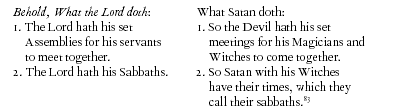
Clark’s study shows how early modern Europeans used the “Rule of Contraries” to understand the relationship between God and the Devil, and between the sovereign and the witch – incorporating, as Stuart notes, the inherently unstable logic of the supplement into their discourses on witchcraft and political authority.84 Monarch and witch held parallel positions as the earthly representatives of God and Devil respectively. As contraries, sovereign and witch affirmed one another’s existence. Clark has shown that this logic underpinned the endless re-creation of the sabbath (I would emphasize, the nocturnal sabbath) in the demonological treatises and witchcraft confessions of the sixteenth and seventeenth centuries. In chapter 8 I show how nocturnalization undermined the association of the night with witchcraft and spirits, transforming the theological and political authorities affirmed by these nocturnal forces.
For learned authors, the initial seduction of the witch by the Devil and the physical (typically sexual) consummation of their pact also followed this nocturnal logic. The French Catholic lawyer Pierre Le Loyer asked in the second (1605) edition of his monumental treatise on ghosts and specters, the Discours et histoires des spectres, visions et apparitions des esprits, anges, demons et ames … divisez en huict livres, “at what times and in which hours do devils appear?” Loyer responded: “The night and the darkness exist for their desires and pursuits, and Satan their prince as a title of honor is called the prince of darkness.” The night, he continues
is the time when men, their bodies well-fed, sleep and rest and are subject to the ambushes of devils, inclined to their temptations, and easily moved to sensualities and the desires of the flesh.85
The Elizabethan bestseller A Pensive Man’s Practice (first edn., 1584) warned that:
Mortal foes … endeavor by all means, to entrap us by some evil or other, which we hear or see, in this vale of vanity … whereunto we often yield, and that in the day time: much more in the dark and loathsome night, wherein all things are covered and hidden … in which time of darkness, such as intend to work wickedness, are most ready.86
Given the theological and quotidian associations of sexuality with the night, the sexual confirmation of the witch’s pact with the Devil would be expected at night. In the first edition of his IIII. livres des spectres, ou apparitions et visions d’esprits, anges et démons (1586), Loyer explained that “First of all, as the prince of darkness, he will have more force and power to make himself visible at night than by day.”87 Loyer reflected in his demonology the sense of nocturnal temptation seen above in Lavater, Nashe, Marlowe, and Shakespeare.
We see a similar association of witchcraft with the night in early modern images of witches and witchcraft. Jan Ziarnko’s complex engraving of wicked acts packed into one image illustrated Pierre De Lancre’s Tableau de l’inconstance des mauvais anges et démons (Figure 2.2, “Witches’ Sabbath,” 1612).88 The image follows De Lancre’s text closely and is accompanied by a guide to its grotesque details. Diurnal and nocturnal scenes overlap in the tableau, which includes two groups of men and women dancing, flying demons and witches, and the Devil enthroned as a goat (upper right). These demonological works took the nocturnal setting of the witches’ sabbath quite seriously: the key to the Ziarnko illustration explains that the Devil is crowned with five horns, “the fifth one lit on fire to light all the candles and fires of the sabbath.”89 This detail helped jurists understand how witches at the sabbath could identify and incriminate other participants despite the dark of night. The sophistication and force of images such as Ziarnko’s “Witches’ Sabbath” notwithstanding, popular views of the Devil, the sabbath, and the night are probably better represented by Figure 2.1, resembling a simple peasants’ dance.90
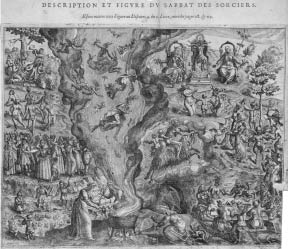
Figure 2.2 “Description et figure du sabbat des sorciers,” engraving by Jan Ziarnko in Pierre de Lancre, Tableau de l’inconstance des mauuais anges et demons, ou il est amplement traicté des sorciers & de la sorcellerie (Paris, 1612). By permission of the Folger Shakespeare Library.
Ultimately, neither the witch of the church nor the witch of the people was confined to the night-time. As belief in the “phantoms of the night” (Nachtschar) indicates, early modern folklore and magical practices could associate the night with beneficial forces as much as with human and supernatural evil. Conversely, one might encounter the Devil by day as easily as by night. In contrast to learned views, the night that emerges in peasant testimony about witchcraft is much less freighted with evil and danger. When forced to testify about a witches’ sabbath, peasants generally described a witches’ dance based on a view of the night as a time for socializing and leisure. The diabolical elements added as accused witches were tortured invert various aspects of a peasant dance by describing hideous music, preposterous dancing, and disgusting food and drink, but these accounts do not single out the time of the gathering per se as a sign of its diabolical nature.
Learned authors described a Devil whose power was nearly unlimited on earth. They argued that the Devil most often tempted and overcame women and that this most often happened at night, but just as the Devil could and did ensnare men to serve him on earth, so too might one encounter the prince of darkness during the daylight hours. In contrast to the folk view, however, intellectual, ecclesiastical, and political authorities tended to see all popular nocturnal events as diabolical. Thus a distinct contrast emerges: while the educated demonized nocturnal folk beliefs, evidence from the common people shows no automatic association of the night with evil or temptation. As we will see below in chapter 7, gatherings at night such as spinning bees were central to licit rural sociability. The reformation of popular culture beginning in the sixteenth century challenged the nuanced folk view of the night with an intensified linkage of the night with infernal evil, diabolical temptation, and human sin. On stage, in learned demonology, and in countless confessions of witchcraft, the night became the time when women and men made themselves culpable and became the Devil’s own.
Ultimately this all led to Hell. The darkness associated with Satan’s servants on earth was absolute in his realm below. As Teresa of Avila (1515–82) related: “I was at prayer one day when suddenly … I found myself, as I thought, plunged right into hell.” She is granted a preview of “the place which the devils had prepared for me there” and provides a vivid description of Hell:
There was no light and everything was in the blackest darkness. I do not understand how this can be, but, although there was no light, it was possible to see everything the sight of which can cause affliction.91
The Elizabethan Nashe speculated that nocturnal darkness was in fact created to be a symbol of Hell: “Some divines have had this concept, that God would have made all day and no night, if it had not been to put us in mind [that] there is a Hell as well as a Heaven.”92 Descriptions of Hell often began with the punishment of the senses, sight first. Jean-Pierre Camus (1584–1652), French pastoral writer and bishop of Bellay, wrote at length on the darkness of Hell in a treatise translated into English as A Draught of Eternity (1632):
Now Faith doth teach us, that the damned shall be in thicker obscurities than those of Egypt, and that the deepest of darkness shall possess them forever. And in the Holy Scripture Hell is marked out in these words, exterior darkness. For an eternity … light shall not be discovered therein.
This fundamental darkness required further explanation:
for although God be there [in Hell], as it were in every place; and though darkness cannot obscure his natural light, yet his will is that … darkness cover the face of the Abyss; and that the eyes of the damned, though otherwise capable of sight, see nothing but that which may trouble and torment them.93
Camus went on to repeat a gloss dating back to Basil of Caesarea that the flames of Hell give heat but no light (inspired by Job 10:22, “the land of gloom and chaos, where light is as darkness”). Of course, the best-known anglophone description of the darkness of Hell appears in the first book of Paradise Lost:
The dismal situation waste and wild,
A dungeon horrible, on all sides round
As one great furnace flamed, yet from those flames
No light, but rather darkness visible
Served to discover sights of woe,
Later Milton’s Raphael describes the fate of the fallen angels to Adam and Eve: “Nameless in dark oblivion let them dwell.”94
In the fallen world around them, did the men and women of this era see darkness and the night everywhere? When Marlowe’s Faustus asks Mephistopheles “How comes it then, that thou art out of hell?” the spirit answers “Why, this is hell, nor am I out of it,” asking in return:
Think’st thou that I, who saw the face of God,
And tasted the eternal joys of heaven,
Am not tormented with ten thousand hells,
In being depriv’d of everlasting bliss?95
For early modern Europeans, the night could indeed represent hell on earth. The night and its darkness expressed fundamental truths about witchcraft, spirits, Hell, and the Devil. In chapter 8 I examine the illumination of these dark features of the European mental landscape by new quotidian and metaphorical uses of the night, darkness, and light in the second half of the seventeenth century. The new truths of the resulting Enlightenment would redefine “night’s black agents” for the modern world.