
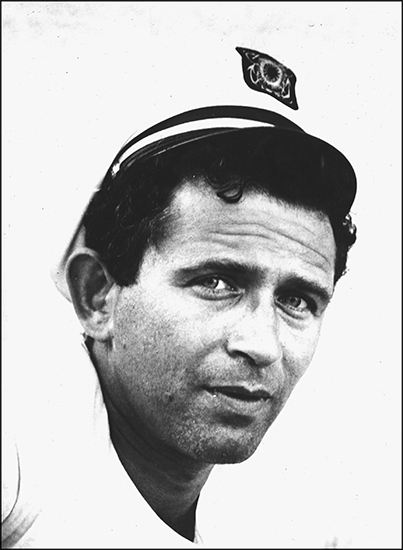
Norman Mailer, cover image for Advertisements for Myself (© Photofest)
{ 9 }
A few hours into the morning of Sunday, November 19, 1960, novelist Norman Mailer stabbed his second wife, Adele, repeatedly in the chest and back with a penknife. They had been hosting a big bash in their spacious apartment on the Upper West Side of Manhattan. The party was supposed to celebrate the birthday of Mailer’s friend Roger Donahue, a former boxer who had once played a bit part in On the Waterfront. It was also intended to kick off Mailer’s quixotic campaign for mayor of New York City.1
The apartment was “packed wall to wall, mobbed with the wildest, most heterogeneous group imaginable,” recalled stage director Frank Corsaro. At various points in the long evening, George Plimpton, society pianist Peter Duchin, sociologist C. Wright Mills, poet Allen Ginsberg, critic Norman Podhoretz, and actor Tony Franciosa mingled uncomfortably with street thugs and various oddballs. The booze flowed too freely, and Corsaro wondered “What the fuck am I doing here?” He and many others departed early from a party that stank of impending disaster.
Mailer had been in a dark, drunk, manic mood throughout the day. Around four in the morning, after most had fled the party, Mailer and Adele were in the kitchen. She, too, was drunk, and they had been raging at one another, with skill and anger, for months. It came to a head when Adele taunted him, as a bullfighter to a bull: “Come on you little faggot, where’s your cojones, did your ugly whore of a mistress cut them off, you son of a bitch?” Perhaps it was then that Mailer pulled a penknife from his pocket. Bull-like, he charged at Adele, goring her repeatedly with his three-inch knife until she was bloody and he was spent.
Two days later, Mailer was arrested and confined to Bellevue Mental Hospital for seventeen days. One psychiatric report stated that he had experienced “an acute paranoid breakdown with delusional thinking”; he was diagnosed as “both homicidal and suicidal.” Pictures of Mailer splashed in the daily newspapers, showing him at the time of his arrest neatly dressed but with a zombie-like look. Adele had been rushed to a hospital for emergency surgery the morning of the stabbing. She recovered from her severe injuries, but the nine-year relationship with Mailer died. Luckily for Mailer, she declined to press charges, and the imbroglio became yet another entry in the list of Mailer’s outrageous acts over the previous five years.
The year 1960 should have been a very good one for Mailer. His new book, Advertisements for Myself, had been published in the late fall of 1959. Reviews were mixed but engaged. One reviewer reveled in its liveliness, humor, and versatility. Reviewing Advertisements in The Nation, fellow writer Gore Vidal found himself tired of Mailer’s “forever shouting at us” with “swelling throbbing rhetoric.” Yet he respected Mailer’s reaching for a new style, finding “virtue in his failures.” The book’s sales, according to his editor William Minton, “proved to be pretty much of a bomb.”2
Advertisements nonetheless perfectly displayed Mailer’s monumental ego and talent. With typical bravado he announced at the outset of the volume, “I am imprisoned with a perception which will settle for nothing less than making a revolution in the consciousness of our time.” In order to achieve this, Mailer searched for a new style and sensibility—at once revelatory and revolutionary but, above all else, hip.3 This notion of hip, in Mailer’s own calculation, would “introduce a new idea into America.”4
The front and back covers of the book overflowed with self-regard. A photograph of Mailer, young and healthy looking with some sort of sailing cap atop his curly-haired dome, filled the front cover. The back cover featured four smaller pictures of the author—each one next to favorable snippets from reviews of his novels. Somehow Mailer had managed to be photographed wearing the same checkered shirt in 1955 and in 1958. In the latter picture, he sported a beatnik goatee. The checkered shirt served as a perfect metaphor for the last decade of his life—at once creative and destructive, daring and frustrating, but above all excessive and extreme.
His last two novels had been less than successful. Barbary Shore (“murky, bad and badly plotted”) had not sold well, and The Deer Park, according to one reviewer, was “a thoroughly nasty book and a dull one.”5 Mailer’s promise as novelist had once seemed unlimited. His first effort, The Naked and Dead, published in 1948, captured the absurdity of the Pacific campaign of World War II. Orville Prescott, reviewing for the New York Times, called it “overwhelming.” Mailer was “as certain to become famous as any fledgling novelist can be.”6 The pressure, however, nailed Mailer to a cross of expectations. Drink, drugs, and failure had by 1960 turned him from the wunderkind of fiction into a laughingstock, more “an actor instead of a writer,” Philip Roth remarked condescendingly.7
It is hard to say precisely when Mailer’s downward spiral began. He had always craved escape from his cloistered, middle-class Jewish background. Asserting his manhood became a pose and a necessity for him. No sooner had he graduated from Harvard (studying engineering but excelling in literature) than he signed up to fight in the Second World War. His patriotism and heroism probably played less of a role than his desire to experience the event of his era and to write about it at firsthand. Three years after his stint in the Pacific—where he saw a bit of action firing his rifle at phantoms in the jungle but mostly endured heat and boredom—Mailer had published his war novel. What lifted it from run-of-the-mill war novels then proliferating (although its employment of ethnic stereotypes in portraying soldiers was standard fare) was its ambition (modeled in many ways on Moby-Dick), its deeper intentions (to reveal the totalitarian nature of institutions, such as the US Army), and its existential intonations about the absurdity of life.
The novel catapulted Mailer to instant stardom, although by 1955 some of the burnish was gone. Mailer reeled from bad habits, which he cultivated enthusiastically. Like his sometime hero Hemingway, he drank to excess, bourbon being his drink of preference. For years he smoked two packs of cigarettes a day and popped Benzedrine and Seconal. According to a friend, Mailer “deliberately got wild with drugs—marijuana, then peyote and mescal[ine].” The drugs, along with the commercial failure of his novels, fueled his anger and violence—throwing him into some sort of “primitivism.”8 He befriended boxers, took boxing lessons, and boasted of his own pugilistic skills. He managed to find trouble. One night, walking his poodles in New York City, a passing sailor apparently made a remark about Mailer being queer for having such well-groomed, fancy dogs. Mailer jumped at the challenge. After the fight, one of Mailer’s eyes was badly damaged.9
When not fighting, Mailer was on a quest to find himself, to open himself up to experience, not only by fisticuffs but with the aid of an orgone accumulator that he had set up in his apartment. The orgone accumulator was a large box, an invention of Wilhelm Reich, a onetime revolutionary Marxist psychologist, that was supposed to release positive energy; if so, the energy emanating from Mailer continued to flow in violent sprees and bouts of drinking. After “only four drinks” at a Provincetown bar, Mailer was walking with his wife Adele back to their summer home when he hailed a police car—later claiming that he had mistaken it for a taxi. At one point in what ensued, Mailer shoved one of the officers to the ground. The other police officer, William Sylvia, nicknamed “Cobra,” retaliated with a baton blow to Mailer’s skull. Mailer found himself in the local jail with a wound on the back of his head requiring about fifteen stitches. According to Sylvia, “Some of these guys,” like Mailer, “you’d like to punch ’em in the mouth.”10 In this period, Mailer later admitted, “I had more than a bit of violence in me.”11
Drink and violence riled his marriage, too. With a good sense for historic periodization, Mailer later called these years a time of “dull drifting” and “the Trouble.”12
Mailer realized that the only way to overcome “the Trouble” was to sit at his desk and write, whether sober or not. He was often drunk, depressed, and raging, and his fiction suffered, growing stilted, disorganized, and mockingly ambitious. He worried in advance about “the nightmare of wondering what would happen if all the reviews were bad.”13 Such real and imagined adversity, however, pushed Mailer to explore new possibilities—writing that was self-analytic and confessional, raw and honest, pugnacious and portentous. He had always maintained that the personality of the writer was woven into the text and necessary for public attention, citing Hemingway as exemplary. Had a writer of American fiction ever attempted anything quite so audacious?
The content of Advertisements for Myself was varied in the extreme. In it were fictional pieces that dated back to Mailer’s days as an undergraduate at Harvard, as well as selections from his published novels. One section was devoted to columns that he had contributed in the mid-1950s to help inaugurate the weekly newspaper the Village Voice, an association that soon foundered. Some pieces were works in progress. Indeed, Mailer offered a taste of what he proclaimed would be a massive novel. Included in Advertisements were poems of dubious distinction, articles attacking the cancer of conformity and mass culture, and a reprint of his most infamous piece, “The White Negro.” There was something appealingly slapdash and engaging to it all. Nevertheless, as biographer Mary Dearborn notes, in Advertisements Mailer had imagined “a new sensibility on the horizon and wisely aligned himself with it by writing, in fact, its first polemic.”14
This New Sensibility, as realized by Mailer, was performative—Mailer was a character in, as well as a commentator upon, his life and work. Mailer’s personality stalked every page of the volume. It was a rant against middle-class conformity. Mailer was in pursuit of pleasures (often problematic ones) in violence, drugs, and sex. Spontaneity and freedom were opposed to the constraints of the old sensibility that had deranged American culture and politics. Advertisements for Myself featured what Mailer called “advertisements,” italicized interludes of his opinions about himself and his work. Sometimes boastfully, often insightfully and honestly, Mailer commented on the pieces in the collection. He realized that such advertisements were often “more readable than the rest” of the book. In them he displayed his “personality as the armature of this book.” It was a public performance, like a confession before an audience of priests, except in this case, rather than requesting forgiveness, what he wanted was attention. Mailer made his quest for “self-discovering” and “self-watching” into a public performance, to use critic Richard Poirier’s term. For Mailer, this performance was many things: “an exercise in power,” a form of narcissism, and a bid for publicity (whether good or bad mattered little) and sign of his need to be at the center of the historical moment.15
Mailer understood this explicitly—any publicity was better than no publicity. After Deer Park had been savaged by critics, Mailer took out an advertisement in the Village Voice, where he printed snippets from the harshest reviews, introducing them with blustery irony: “All over America ‘The Deer Park’ is getting nothing bur RAVES.” Here are some of the “RAVES”: “sordid,” “crummy,” “the year’s worst snakepit in fiction.” His columns in the Voice often drew spirited ripostes, and Mailer included them in Advertisements with the same glee, apparently happy that critics at least had spelled his name correctly. One reader wrote: “The very obvious trouble with you is you really suffer from illusion of grandeur.” Another wrote, “This guy Mailer. He’s a hostile, narcissistic pest. Lose him.” Finally, reflecting on Mailer’s use of the first-person in his columns, someone wrote: “You take up 98 per cent of your column talking about yourself. Very wrong… . Anyone who did not know what a swell guy you are might think that you were in love with yourself.”16
Authors had long employed their personality—translated into celebrity status—to drive book sales. Mark Twain sold himself as much as he did his prose; ditto for Ernest Hemingway. In “The Crack Up,” which F. Scott Fitzgerald published in Esquire in 1936, he confessed his excesses: “I suddenly was living hard” until “I suddenly realized I had prematurely cracked.” But no one had been as forthright, almost to the point of boastfulness, about such maneuvers as Mailer: “The way to save your work and reach more readers is to advertise yourself.” His advertisements and craving for celebrity status, at turns dark with despair and airy with ambition, were on full display in Advertisements.17 It was a gutsy gamble.
He was frank and confessional about the “years of trouble.” He had been “barren of new ideas,” guilty of “dull drifting” in his life while admitting, “Self-pity is one of my vices.” He wrote openly about how booze and drugs had been his closest companions; he looked back on the years from 1954 to 1959 as a time of pain, perhaps even witnessing a diminution of his powers: “There may have been too many fights … too much sex, liquor, marijuana, benzedrine and seconal, much too much ridiculous and brain-blasting rage at the miniscule frustrations of a most loathsome literary world, necrophilic to the core—they murder their writers, and then decorate their graves.”18
Mailer seemed to be digging his own grave with advertisements that were excessive in their self-regard and bellyaching. In the opening advertisement, Mailer announced, “I have been running for President these last ten years in the privacy of my mind.” His life was swirling about, and “anger has brought me to the edge of the brutal.” To survive he must direct this “brutal” sensibility toward its proper targets. Thus, he warred against the “cancer” of his age—the conformity that was killing him and his fellow citizens. He summed up the politics and culture of the 1950s with brutal simplicity: “The shits are killing us.”19
Mailer was a committed leftist. He supported Henry A. Wallace’s doomed bid for the presidency in 1948, and he remained convinced that a bureaucratic totalitarianism was in the offing. The “air of our time,” he reflected, was marked by “authority and nihilism stalking one another in the orgiastic hollow of this century.”20 That air was putrid with decay, a theme that he had tried to reflect through the claustrophobic atmosphere of a rooming house in his novel Barbary Shore. Increasingly, however, he came to believe that the threat came as much from the steady accumulation of middle-class comfort and complacency as it did from the government.
In 1952, as noted earlier, the Partisan Review, the journal of regard for intellectuals, polled various intellectuals and writers on the topic of “Our Country and Our Culture.” The essential question was whether America’s intellectuals had reconciled with their nation. In the 1930s and 1940s, they had opposed capitalism and been aghast at the national culture. Had the revival of capitalism, victory in the Second World War, the success of mass culture, and the entry of intellectuals into institutions of higher learning and national prominence effected a change in their attitudes about life in America?
Most of the respondents were overwhelmingly affirmative. Old antagonisms between intellectual and mainstream culture seemed to have dissipated in postwar America. Newton Arvin, a biographer of fine sensibility, echoing Emerson, announced that American intellectuals needed to distance themselves from Europe and embrace their native heritage. Lionel Trilling positively glowed about how the cultural situation in America was improving daily. This onetime parlor radical went so far as to proclaim, “Wealth shows a tendency to submit itself to the rule of mind and imagination, to refine itself, and to apologize for its existence by a show of taste and sensitivity.” Intellect and power, Trilling observed, had begun to dance together enjoyably. Even the threat of mass culture, the particular bugaboo of intellectuals since the 1930s, might be tamed and directed into efficacious channels.21
None of the intellectuals polled responded with Mailer’s vehement disdain. He chafed at the presumption that reconciliation between writer and nation was a positive thing. There is no need to repeat his thorny complaints here. He concluded with the simple view that “the great artists—certainly the moderns—are almost always in opposition to their society, and that integration, acceptance, non-alienation, etc. etc., have been more conducive to propaganda than to art.”22
What was to be done? A new sensibility—which Mailer designated as the “philosophy of hip”—must battle the forces of conformity. Mailer craved hipness. Some, like James Baldwin, found him pathetic in this regard, an essentially square fellow striving with middle-class dedication to be cool. He struggled mightily to define and live hip, even compiling a list of qualities associated with it and juxtaposed with qualities attributed to square. The comparisons ranged from the pretentious to the silly, from the insightful to the absurd—a typical Mailer performance, probably jotted down while he skyed on marijuana. Under the heading “Hip,” Mailer included “sex,” “Negro,” “Thelonious Monk,” existentialists such as Heidegger and Dostoevsky, and various terms: “wild” and “barbarians”—sort of like a dog marking the territory of the New Sensibility. He scorned, naturally, everything that he considered “square” or traditional, ranging from jazz musician Dave Brubeck, to “religion,” to “Sartre.” Mailer included Sartre in the square category only because he saw him as a rival for the honor of being the leading existentialist thinker.23
In 1957, Mailer issued his notorious manifesto of hip, “The White Negro: Superficial Reflections on the Hipster.” He had first lit upon the idea in 1954, jotting down: “Wild thought. The atomic bomb may have kicked off hipsterism.”24 The notion of the hipster, however, was not original to Mailer. A fellow New York writer, Anatole Broyard, had as early as 1948 mused about the hipster as a coolly passionate connoisseur of “jive music” and marijuana. Affinities existed between this hipsterism and the beat sensibility of Kerouac and Ginsberg, although the latter rejected any association with violent behavior as unhip, part of the problem of their era rather than the solution to it.25
The essay appeared in the journal Dissent, a surprising venue. Edited by Irving Howe, Dissent was a social democratic periodical, devoted to reason as an agent of change. The only discernable explanation for Howe’s accepting Mailer’s torrential essay was its critique of conformity. As already noted, in 1954 Howe had penned “This Age of Conformity,” complaining about the numbing effects of mass culture on the intellect, the ineffectiveness of alienation at producing political change, and the dangers in conformity and institutional power. In sum, “Every current of the Zeitgeist, every imprint of social power, every assumption of contemporary American life favors the safe and comforting patterns of middlebrow feeling.”26 Perhaps, then, Mailer’s essay represented for Howe a powder-keg piece that would, if nothing else, stir up controversy.
It did.
Much of Mailer’s essay was predictable—respouting criticisms of mass culture that had been common coin for intellectuals such as Clement Greenberg, Dwight Macdonald, and Howe. America was cringing under conformity, inching closer toward totalitarianism. Mediocrity reigned and courage to defy it seemed weak. If this diagnosis seemed insufficiently bleak, then Mailer upped the ante by returning to his 1954 postulate about a nuclear holocaust. “A stench of fear,” Mailer opined, “has come out of every pore of American life, and we suffer from a collective failure of nerve.”27
New possibilities, however, were emerging. In inner cities African Americans, in particular, were birthing a new character type marked by rebellion and violence. The hipster, or existential man, according to Mailer, recognized the contingency of existence in the Atomic Age. He was aghast at the cancer of conformity. Shrugging off both, the hipster courageously jived in a different key. He skated along the thin line of responsibility, digging the beat of his emotions and inner urgings (even, or perhaps especially, when they tilted in a psychopathic direction). Like a jazz musician, he improvised a tune of love, danger, and freedom. Modern men (and men were clearly Mailer’s main audience) must “set out on that unchartered journey into the rebellious imperatives of the self.” If such a journey led to criminal behavior or an expression of psychopathology, then so be it. Better to face the world with the “courage” of the outlaw than with the dignity of the middle-class conformist.28
Much of this was the common jargon of existentialism. Between 1945 and the early 1950s, and again in the early 1960s, existentialism was popular in the United States. At first it was the excited property of intellectuals and writers. Glance at Ralph Ellison’s Invisible Man (1952) and Richard Wright’s The Outsider (1953) on the fiction front, or the theology of Will Herberg, or in the psychology of Rollo May, to get a sense of existentialism’s sway. By 1960, the leading works of existentialism—from Sartre’s Being and Nothingness to Heidegger’s Being and Time—had been published in translation. Walter Kaufmann’s anthology of existentialism, however much it was biased toward emphasizing a German fount for the tradition, was treasured by a generation of college students. These same students devoured Camus’s The Stranger in French language classes or encountered The Rebel in introductory philosophy and political science classes.29
Mailer was coy about the sources of his existentialism. He rarely addressed Sartre, Camus, or Beauvoir. His knowledge of Heidegger was minimal, probably cadged from reading an essay in Partisan Review by Hannah Arendt, or by skimming New York intellectual William Barrett’s relatively breezy contribution, Irrational Man. The current crop of existentialists turned Mailer off because of their atheism; he preferred a religious perspective that found God wounded but made stronger by our own courageous efforts against evil.30 The existentialist that he actually read and understood somewhat was Søren Kierkegaard. Mailer liked Kierkegaard’s edgy religious quality, his sense of the absurd and tragic, and, perhaps most importantly, that he was dead—hence Kierkegaard was no competitor with Mailer for being the king of the intellectuals, the consciousness of his time.
By the early 1960s, and already in “The White Negro,” Mailer was feverishly waving his existential flag. He appropriated existentialism as his own, skipping over those parts that challenged his own perspective. It was a mania of sorts, his favored adjective, as in “existential President” and “existential filmmaking.” It appeared as if every nonfiction sentence he wrote had some derivative of the word existential in it. He titled a collection of essays Existential Errands (1972), and he made an “existential film” called Wild 90 in 1968. In sum, existentialism was “a situation where we cannot foretell the end.” But armed with such uncertain vision, we plunged ahead.31
Mailer suggested strongly that negroes (the designation of the period) were especially open to hip existentialism because of racism. For generations they had suffered from white violence. This made them acutely aware of the dangers of existence and opened them up to the rhythm of their own emotions. When your entire existence depended upon the whim of racist power and privilege, then you developed existential sensibilities. Had Mailer stopped at this point, he would have mirrored the views of such distinguished black commentators on the blues and jazz sensibility as Ellison and Alfred Murray and agreed with the commentary implicit in Frank’s images.
Such was not Mailer’s style; he had to push things. He referred to the negro as a “wise primitive.” Such primitivism was found in black sexuality, supposedly untainted by the dullness of middle-class proprieties. Without fretting about how his remarks on black sexual freedom complemented white racist views about black male sexuality, Mailer piled on the craziness, disguised as compliments. He failed to discern existentialism, as had Ellison and Murray, in the blues-gospel laments in black churches or in daily existence or in how black folks overcame indignities with quiet intensity. Instead, his roster of hipster heroes was populated by black pimps, or dope-injecting jazzmen. Indeed, he thrilled at the existential freedom of the murderer, who, when faced with a moment of choice, decided to plunge a knife into the heart of a victim. “Apocalyptic orgasm,” he called it.32
He discussed such an “apocalyptic orgasm” in some detail, imagining the existential or psychopathic delights of murder: “The psychopath murders—if he has the courage—out of the necessity to purge his violence.” And, then, dripping with controversial spleen, Mailer imagines “two strong eighteen-year old hoodlums,” who “beat in the brains of a candy-store keeper,” are still courageous. They are murdering not just a defenseless man, but “an institution as well.” And by doing so, by trashing the value of “private property,” these psychopathic hoodlums becomes “daring,” and “the brutal the act, is not altogether cowardly.”33
This drivel proved prescient for Mailer. Between 1955 and 1960, he tried, with schoolboy enthusiasm and discipline, to be a hipster. He hung out at jazz clubs, consumed huge quantities of liquor, marijuana, and other drugs. “The White Negro” was intended as a manifesto of hip, but Ginsberg pronounced it “very square.”34 Critic Alfred Kazin wrote Mailer, “You are the Rabbi of screwing, the writer who has managed to be so solemn about sex as to make it grim.”35
Baldwin responded with a long piece in Esquire. He detailed his fraught friendship with Mailer—and their obvious differences of race and class. Mailer was simply incapable of dropping silly notions about male Negro sexual potency—it was a form of romantic longing on Mailer’s part. He chided Mailer, telling him to grow up and take responsibility for the implications of his writing. This was the burden, and the responsibility, of the artist, hip or otherwise.36
In 1960 Mailer was a taut wire, ready to brawl and head-butt at the slightest provocation. He boasted about being able to withstand a hammer blow to the head without losing consciousness. Perhaps, then, on that foul early morning in the kitchen, Mailer had succumbed to the call of his inner hipster psychopath. Good thing that Mailer was armed with a pocketknife rather than a switchblade.
“The White Negro” should not be dismissed out of hand for its excess, obsessiveness, inanity, racism, and violence. It sounded in an unkempt manner key themes that would emerge as central for the New Sensibility.37 It exemplified a style that was based on an economy of emotional excess (though expressed in a cool way). The essay stressed that liberation was linked to a form of madness, orgasm, and the allure of violence, were paraded at least for readers with sufficient fortitude to stomach Mailer. Indeed, in its sensibility and concerns, the essay anticipated the 1960s and the fascination of white rebels with black revolutionary movements, celebrated violence as the means to liberation, swooned at the freedom presumed to inhere in excessive drug use, and paraded the ideal that the truly sane are those condemned as mad by mainstream society.
Some of the fights Mailer picked in Advertisements were personal and literary. In one piece, he pugnaciously evaluated his literary contemporaries. He publicly dismissed many writers (some of whom he claimed as friends) and praised a few. It was a sort of madly inspired piece, better left to the confines of the asylum that he had occupied for two weeks after his stabbing of Adele. But Mailer was in a macho phase, challenging everyone with his own prodigious and undirected talent, no matter how much it had failed him of late in fiction. He was, in effect, sizing up the room so that he could prove with his next novel that he had bested the competition.
He cut to the quick. “The only one of my contemporaries who I felt had more talent than myself was James Jones. And he has also been the one writer of my time for whom I felt any love.” Alas, Jones suffered from too much drink; he had “imprisoned his anger, and dwindled without it.”38
And this for a man and writer he loved and respected. Suffice it to say, the evaluation ended their friendship.
Mailer badly missed the mark when he pronounced that while his onetime pal William Styron had talent, he lacked courage to write a really important book. In Kerouac Mailer found “a large talent,” but without “discipline, intelligence, honesty and a sense of the novel.” Truman Capote was a “ballsy little guy, and he is the most perfect writer of my generation, he writes the best sentences word for word, rhythm upon rhythm”; unfortunately, he settled for surface rather than depth. Evaluations of Saul Bellow, Nelson Algren, J. D. Salinger, Paul Bowles, James Baldwin (“too charming a writer to be major”), Ralph Ellison (“a mistake to write prescriptions for a novelist as gifted as Ellison”), and a handful of other male competitors followed.39
At the end of the polemic, Mailer contemptuously addressed women writers of his generation. They were “always fey, old-hat, Quaintsy Goysy, tiny, too dykily psychotic, crippled, creepish, fashionable, frigid, outer-Baroque, maquille in mannequin’s whimsy, or else bright and stillborn.” He admitted reluctantly that he had enjoyed “the early work of Mary McCarthy, Jean Stafford, and Carson McCullers.” There was, however, hope for a new dawn for women’s writing, Mailer prophesied, when “the first whore becomes a call girl and tells her tale.”40
Mailer’s madness, overwrought confessionalism, and feverish feistiness spread across the pages of Advertisements, making it an original work with a different feel, a new voice, a stunning sensibility, no matter how many its miscues. He felt that he had been honest and brave in the volume. Those smarting under his lash found him boorish and narrow. He had, as he predicted, acquired “a dozen devoted enemies for life” with his evaluations. Styron wrote to Jim Jones that Mailer had “flipped his lid, or is gradually flipping it.”41
Mailer had tossed down the gauntlet. It was time for him to put up or shut up. Advertisements in its style was brilliant and jaunty, a presentiment of the New Sensibility. But it was not a work of fiction—and that was the shelf upon which Mailer wanted his reputation to rest.
A month before Mailer assaulted Adele, his essay on John F. Kennedy and the Democratic National Convention splashed onto newsstands in the magazine Esquire. Clay Felker, one of its editors, had admired Mailer’s Advertisements and commissioned him (paying him $3,500) to write about the convention.42 He further promised to introduce Mailer to various politicos in the campaign. In addition, Mailer twice visited Kennedy’s compound at Hyannis Port to interview the candidate.
“Superman Comes to the Marketplace” was vintage Mailer. It was also an early expression of the “New Journalism.” In this mode, the writer presented himself forthrightly as a character in the reportage. In “Superman,” this was done with some restraint, as Mailer referred to himself as he intruded into the story. Eight years later, in The Armies of the Night, his masterful narrative account of a demonstration against the Vietnam War at the Pentagon, Mailer would refer to himself in the text by his own name and various third-person pronouns. He had elevated himself to the role of an actor in history, thus jumping into the waters of the New Sensibility by making reportage into performance and by blurring the lines between history and fiction. Recognizing this fully, Mailer subtitled his book History as a Novel / The Novel as History.43
In the Kennedy piece, his prose cut cleanly. James J. Farley, onetime postmaster general and an eminence within the Democratic Party, was described this way: “Huge. Cold as a bishop. The hell he would consign you to was cold as ice.” The Biltmore Hotel convention site appeared to Mailer as “one of the ugliest hotels in the world. Patterned after the flat roofs of an Italian Renaissance palace, it is eighty-eight times as large, and one-millionth as valuable to the continuation of man.” Once inside, Mailer confronted a “hill of cigar smoke,” finding the convention delegates dull, depressed, and driven.44
The essay offered minimal political analysis or context. Mailer steamed only when dwelling on his own pet peeves (shared by most adherents of the New Sensibility)—that mass culture, the mediocrity of the Eisenhower administration, and McCarthyism had sapped America of the collective strength displayed during the 1930s and early 1940s. The ship of the American state and society was adrift, threatening to run aground or sink in deep waters.
The solution, Mailer decided, was a new American hero. This hero would have movie star qualities and appeal. He would be expected to “fight well, kill well (if always with honor), love well and love many, be cool, be daring, be dashing, be wild, be wily, be resourceful, be a brave gun.” He would be untamed by those representing the status quo, with its tepid sanity and perfervid and empty moralism.45
What America craved was a Mailerian hipster hero with “a patina of that other life, the second American life, the long electric night with the fires of neon leading down the highway to the murmur of jazz.”46
Mailer anointed Kennedy for this mythical role. It was not so much Kennedy’s positions on political issues that enthused him. Mailer, in fact, seemed relatively uninterested in Kennedy’s views of domestic and foreign policy—something he would later come to regret. No, it was Kennedy’s movie star, celebrity qualities, hitched to wartime heroism, that made Mailer (and other Americans) swoon. And make no mistake about it, Mailer fell hard for Kennedy.
In part, Kennedy learned that the quickest route to Mailer’s heart was through his monumental ego. Kennedy’s handlers knew that Mailer’s article—due out just before the election—might receive big play, so they advised Kennedy about how to deal with Mailer. Upon being introduced to Mailer, the candidate Kennedy remarked that he had read Mailer’s novels. Mailer expected Kennedy to cite The Naked and the Dead. It was a response that always sent Mailer into a tailspin of depression, dredging up as it did the relative failure and obscurity of his subsequent novels. But Kennedy stunned him when he praised The Deer Park. Mailer was charmed and thrilled, even to the point of rejecting the likely scenario that Kennedy had made the remark simply to seduce Mailer.47
Mailer gushed over Kennedy’s vigor and good looks, his “excellent, even artful” manners. The candidate possessed “the eyes of a mountaineer,” whatever that meant. Kennedy’s ability to show a range of appearances without changing expression reminded Mailer of Brando (another apostle of the New Sensibility). Like Brando, Kennedy could not be easily contained, refusing reduction to a singular image. Mood, which Brando made into an icon of his acting, was something that Kennedy shared and allowed to express itself. Both seemed to comport themselves with the power and pleasure of the New Sensibility, the ability to defy convention. Noting that Kennedy’s middle name was Fitzgerald, Mailer riffed on the F. Scott Fitzgerald connection. Kennedy’s style evoked for Mailer images of Fitzgerald in the 1920s, a style that was elegant, youthful, and bursting with hope. Indeed, should Kennedy be elected, he might awaken the arts and open up a new “life of drama.”48
Kennedy was a natural existential hero. In a section with the italic headings “The Hipster as President Hero,” Mailer beat the drum for Kennedy. Mailer even reported that a fellow writer at the convention had compared Kennedy with one of the hipsters in his novel The Deer Park—a comparison that Mailer found on the mark. The glow of Kennedy was enhanced, in Mailer’s existential terminology, by his brushes with tragedy and death. He quoted from an account of how Kennedy, after his PT boat had been wrecked by the Japanese in the Second World War, had acted with endurance and heroism. Despite a badly injured back, Kennedy swam three miles to an island, towing along another sailor, via a life belt that Kennedy held between his teeth. Out of such experiences came an existential awareness that led to a tragic sensibility: he was “a man who has traversed some lonely terrain of experience, of loss and gain, of nearness to death, which leaves him isolated from the mass of others.” This also opened the individual up to taking risks, to gambling, to clutching at greatness.49
Reflecting back on his paean to Kennedy after the election and various debacles in the administration, Mailer was more circumspect in his views. But he maintained, not without a soupçon of pride, that his essay “had more effect than any other single work of mine… . I was forcing a reality… . I took to myself some of the critical credit for his victory. Whether I was right or wrong in fact may not have been so important as its psychological reality in my own mind.”50
Unfortunately, Mailer’s own mind in the chilly days of November was overflowing with anger, sloppy with drink and drugs. But such a mind, in its own manner, proved strong enough to endure, maybe even to grow. Within the next few years, following divorce from Adele, Mailer married twice, with two children resulting. He worked on a new novel, An American Dream, published in 1965, his first in ten years. It featured a character named Rojack, a war hero who had served in Congress at one point with Jack Kennedy. The novel featured murder, a detailed anal rape scene, mysticism, and mania. Following along the path laid by Patricia Highsmith, Mailer allowed his hero to get away with murder.51
In its way, An American Dream was an exemplification of the New Sensibility, its excesses parading with a vengeance, bleeding from each and every page. It was daring, crossing boundaries of politeness, especially in its explicit depictions of sex.
Mailer was back from the edge of the abyss where he had stood in 1960. He had managed to channel his mania back into his fiction.