
{ PART II }
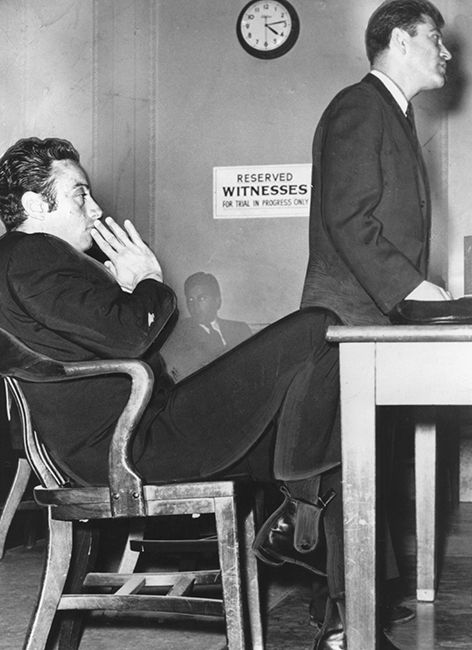
Lenny Bruce and lawyer in court (© Photofest)
{ 10 }
Looking like a carpet of cocaine, twenty inches of snow covered New York City on February 4, 1961. At midnight comedian Lenny Bruce bopped onto the stage at Carnegie Hall. Avid fans of the comedian had refused to allow inclement weather to prevent them from digging their idol at his moment of triumph—the joint was packed.1 Carnegie Hall represented the highbrow, the epitome of class. Who hadn’t at some time recited the old joke: “Excuse me, sir, how do I get to Carnegie Hall?” “Practice, kid, practice.” Bruce was going big time tonight.
He had been practicing his shtick for years, in grim, slimy strip clubs, in cheap gin joints, and, in the last few years, in clubs that catered to sophisticated, hip audiences. For those too embarrassed or too poor to catch Bruce live at some venue, his comedy albums were hot sellers. On occasion, he had appeared on Steve Allen’s network television show, offering a sanitized version of his regular act.
A little over a month before the concert, a fellow comedian had taken a public potshot at Bruce. Jack Carter, in the New York Sunday Daily News, complained that comedians such as Bruce were “embarrassing to the business.” Carter continued: “He gets up there mouthing four-letter words of filth as if no one had ever heard them before… . His act is nothing more than unprofessional rambling.”
Three days before Carnegie Hall, Bruce sarcastically responded: Do you “mean to tell me you’ve heard those words before?” If so, then Lenny Bruce worried that he might have overpaid a joke writer for curse words. Bruce closed by wondering if Jack Carter knew what was meant when he offered his fellow comic the words “Fuck you.”2
At Carnegie Hall from midnight until 2:00 a.m., Bruce’s audience was at once raucous and embarrassingly self-conscious; guilty pleasure mixed with satisfaction.3 At any moment, much to the delight of the aficionados in the crowd, Bruce might cross the lines of common decency. This was why, in Time magazine’s view, he was the reigning king of the sick comedians (Mort Sahl, Don Adams, and Shelley Berman were part of the fraternity), thanks to his full-throttled taking of comedy to its “extremes.”4 Or, according to Billboard, he was “a vulgar tasteless boor.” Columnist Walter Winchell dubbed him “America’s No. 1 Vomic.”5
He was the Norman Mailer of comedy—outrageous, ballsy, combative, and bright. One commentator dubbed him the “sick white negro of comedy.” Both of them connected with black culture; they were white hipsters that disdained conventionality. Bruce and Mailer were uninhibited in their use of drugs and booze, searching for rhythms that would evoke a new sensibility that would open up possibilities, both for themselves and for their audiences. If Mailer was a performance artist on the page (blurring the lines between the literary and the personal advertisement), then Bruce was active in bringing the language of the street and sex into the comedy club.6
Bruce, no less than Mailer, chafed at limits. Normally, there were some gags comedians shared among themselves, often when stoned or soused, away from audiences. One evening, Buddy Hackett tried to lift Bruce’s sagging spirits at a club by telling him a joke too dirty to be bandied about onstage. Or at least it was for Hackett. But Lenny went onstage that night in 1958 and spit it out: “Kid looks up at father … and says, ‘Daddy, what’s a degenerate?’” The father answers: “Shut up, kid, and keep sucking!” The audience responded with shocked silence. Bruce gave them the finger, turned around, wiggled his ass, and then exited the stage.7
The Carnegie Hall material was edgy without being obscene. He opened with tame fare, a joke about the sagging fortunes of Miami Beach. Things had gotten so depressed there that elderly Jewish women were mugging Cuban exiles. Homosexual jokes almost always assured a good laugh. Mothers, he said, are “never hip” to their children being “faggots.” When the son brings home sailors and marines to spend the night, the mother sighs lovingly, “Such a sweet kid to give them a place to stay for the night.” Men, he announced, are “carnal creatures”; after fifteen years in prison, they’ll “schtupp anything.”
Bruce segued rapidly into more serious material. Morals were relative, a matter of power, he announced with mock-Nietzschean familiarity. He illustrated this “philosophical” position by noting that Christians had once been viewed as immoral, and hence were fed to the lions in ancient Rome—a fate, he remarked, far worse than being “schlubbed” from a lunch counter—as had happened the previous year to young African Americans protesting segregation in Greensboro, North Carolina. Next, he launched into a routine about a Ku Klux Klansman, touching on one of racists’ central fears (and perhaps of his liberal auditors that evening as well): What would you do if your sister wanted to marry one of “them”? Presented in such general terms, of course, the Klansman would vehemently reply: “Never!” Ah, wondered Bruce, let’s particularize the problem. What if you had the choice of marrying a white woman, say matronly singer Kate Smith, or a black woman, sultry Lena Horne. Would the answer be quite so resounding?
Lenny wowed that evening. He employed a combination of Yiddish and hipster patois, zany impressions, improvisation, and lewd riffs. He contemplated with horror the notion of former president Dwight D. Eisenhower kissing his wife, Mamie, on the mouth. He made clever comments as he struggled with a recalcitrant microphone.
The new year for Bruce had started with a bang. Alas, by the end of the year, his unbridled humor and choice of words would land him into a legal sinkhole from which he would never really emerge.
Two weeks prior to Bruce’s Carnegie Hall triumph, America had celebrated the inauguration of a new president. For many Americans, John F. Kennedy entered office as a representative of a dynamic era dawning—a realization, in Mailer’s view, of the emerging New Sensibility. He was young, the first president to have been born in the twentieth century. His wife, Jacqueline Bouvier Kennedy, was elegant and sophisticated. He was a war hero, famous for his exploits as skipper of PT 109 during the Second World War. He had published (even if he did not quite compose it) a bestselling book, Profiles in Courage, which caught politicians at critical moments, faced with difficult choices and acting with valor. His youth and possibility seemed boundless.
In comparison, the Eisenhower administration appeared crusty, boring to the point of narcolepsy—at least to liberals. Mailer proclaimed that Eisenhower represented “the needs of the timid, the petrified, the sanctimonious, and the sluggish.”8 The Eisenhower administration had been a meal ticket for satirist Mort Sahl, who poked fun at a president seemingly more energetic on the golf course than in the briefing room—“Eisenhower proved that we don’t need a President.”9
Kennedy seemed to be a breath of fresh air on cultural matters, promising to unleash pent-up energies. He was at least willing to sit through a Pablo Casals cello performance, invite Robert Frost to read an inaugural poem, and feign interest in novels such as Mailer’s The Deer Park.10
Within a couple of years, the Kennedy luster would diminish. Even more than Eisenhower, Kennedy was a Cold Warrior, engaging the Soviets on all fronts, hot and cold. Fearful of appearing weak in the face of Communist threats, he built up America’s already bulging nuclear arsenal, challenged the Soviets over Berlin, initiated a half-baked invasion of Cuba, and almost sleepwalked the world into a nuclear holocaust during the Cuban Missile Crisis. As the fight for civil rights began to spark, with African Americans in the South demanding equality and pushing hard against the indignities of Jim Crow segregation laws, his administration moved with a lethargy that seemed at odds with the course of history and its presumed liberal inclinations. With so much change in the air, comedians were blessed with increasingly provocative possibilities.
Bruce hit the big time when comedy was king. Top-flight comedians, headlining in Vegas or at classy nightclubs, garnered big bucks and national exposure. While comedy had long been a feature of radio and vaudeville houses, it was now a staple of television. An appearance on the Sunday night Ed Sullivan Show epitomized success. But acts performing on that show had to labor within the strict confines of good taste, as Sullivan vigilantly scrutinized any potential violators of his taste code. Lenny Bruce never appeared on the program. The popularity of comic records helped lift comedy income higher. Albums such as Vaughn Meader’s The First Family (1962) gently poked fun at the Kennedys, while Allen Sherman’s My Son, the Nut (1963) featured the hit song “Hello Muddah, Hello Faddah,” which humorously skewered children’s summer camp experiences.
The most successful comics aimed jokes at the particular tastes of their audiences. When on television, Bob Hope, Jack Carter, Joey Bishop, Totie Fields, and Henny Youngman performed one-liners or told crisp and clean stories, although they could get raunchy when performing in other outlets. Satire sneaked increasingly into the picture. In addition to Mort Sahl, the sophistication of Mike Nichols and Elaine May, Bob Newhart, and Shelley Berman appealed to more refined tastes. They were of the New Sensibility, to be sure, but without Bruce’s rush to the extreme. Ditto cartoons that dealt with existential angst and the absurdity of life by Jules Feiffer and Walt Kelly. Youngsters—and their hip elders—gobbled up copies of Mad magazine, which shotgunned all aspects of American life.11
Lenny Bruce was born Leonard Alfred Schneider on October 13, 1925, and grew up on Long Island, the child of mismatched parents.12 The mother vibrated with personality, more of a pal than a caregiver. She wanted desperately to be in show biz but was “funniest offstage.”13 The father was a shoe salesman with larger ambitions and the discipline to achieve them. The parents divorced when Lenny was six, and he shuttled between them and a variety of aunts, uncles, and grandparents until his high school years. He was smart and talkative, the latter to the point of being disruptive in classes. Lenny later claimed that he was lonely and neglected as a child, although his biographer disputes this, finding him “spoiled rotten.” For whatever reasons, at age fifteen he fled from home to live and work on a family-owned farm, forming what he felt was a close attachment with the hardworking family.
Less than a week after Bruce turned seventeen, all of 5’2’’ in height and a wisp at 120 pounds, he signed up for military service. A gunner’s mate second class on the USS Brooklyn, he saw plenty of action off the coast of Italy. Bruce recalled glimpsing “pitiful, fresh dead bodies” floating on the water.14 Two years of combat convinced him to leave the navy. He reasoned that since he had joined the service voluntarily, they should release him from duty without much rigmarole. Such was not the case, of course. His solution was to don woman’s attire and opt for a Section Eight discharge. Under questioning by authorities, he denied being a homosexual. When next asked if he liked wearing women’s clothes, Bruce responded, “When they fit.”15 He got his discharge, but it was a dishonorable one, later reversed, and he returned to the states not long before the war ended.
By 1947 Bruce had become a professional entertainer, sometimes working under the stage name Lenny Marseille. He started performing at burlesque houses, where he introduced the strippers and did a few impressions. It was frustrating, since he knew the audiences wanted strippers, not fledgling comedians. One night, early in his career, a couple of guys accompanied by two garishly made-up women heckled him, yelling, “Bring on the broads.” He felt more naked onstage than the strippers. What was he going to do? The foursome, Bruce recalled, “shrieked with ecstasy,” again, “Bring on the broads.” Finally, he rose to the challenge: “I’d like to, but then you wouldn’t have any company at the bar.” It was his first laugh, and he was “hooked” on comedy, feeling the same “warm sensual blanket that comes” with an injection of morphine.16
Sex and drugs became Bruce’s constant partners as he pursued his career in comedy. He traveled with a veritable drugstore of narcotics, and was especially enamored of heroin and Methedrine. When he was high, he imagined that he was “kissing God.” Although he would never forsake casual sex, in 1951 he realized his fondest wet dream when he met and married Honey Harlow, a beautiful stripper who he described as “a composite of the Virgin Mary and a $500-a-night whore.” She was an enthusiastic devotee of drugs and sex, and until their marriage unraveled in 1959 they delighted and tortured one another.17
As a “clean” comic, he had won on Arthur Godfrey’s Talent Scouts on television. Bruce played anywhere he could get a booking—in small Brooklyn clubs (at one he earned twelve bucks a night, along with a spaghetti dinner), in the Catskills, in dingy burlesque parlors. He headlined the Strand Theatre in New York City in 1949 but bombed. Frustrated by his sagging career and tired of stale jokes, he evolved into a “dirty” comic. Initially, this simply meant that he told off-color jokes and used dirty words. One key to his success was an ability to connect with audiences. He was both a likable fellow and a con artist. But the comedy routine was serious. According to his biographer Albert Goldman, “The deeper Lenny sank into the schmutz, the higher he rose as an artist. The grosser and cruder the environment, the more ironic, imaginative, and brilliant became the art.” He was cagey enough also to realize that “controversy makes money.”18 On his national television show, Steve Allen—who steadfastly supported Bruce’s career—introduced him as “a comedian who will offend everybody … the most shocking comedian of our time.”19
For many in the audience, “sick” humor was not kosher fare. A mountain slide of complaints arrived, which Allen dismissed by announcing on television his plan to have one controversial comedian like Bruce appear on his show each month. Although reporter Arthur Gelb liked Bruce’s comedy, he warned readers: “He is not for your Aunt Lydia from Peoria or your Uncle Phil from Oshkosh—so leave them at home and take Tallulah Bankhead or Brendan Behan.”20
No comic challenged American hypocrisy—the distance between ideals and reality, the contradictions of belief, the obscenity of politics, warfare, and racism—with more of an edge than Bruce.21 The sensibility that he brought to the stage had aspects of the nihilism popularized by Mad magazine. In Mad, popular with adolescent rebels, the humor was sharp, but directed at everything—from politicians to teen idols, even to the prospect of atomic annihilation. Its typical refrain, uttered in each issue by its figurehead, Alfred E. Neuman, was “What, me worry?” In contrast, there was a moral edge to Bruce’s jibes. His style, no less than the content, that was something quite new. He was once called “the earl of angst.”22
Bruce was a hyperkinetic presence onstage—a quicksilver mind and speech with inspired pauses. In part, drugs contributed to his energy onstage—he regularly injected himself with speed, procuring prescriptions from a host of conned physicians. Yet he was naturally fidgety, with a mind “always in double time.”23 He long maintained a lean, agile build; he was typically dressed in black, hair bristled and greased, eyes darting and dragging at the same time. Cigarette in hand, no props (other than the microphone), Lenny was a serious comic. He had strong views about who was a comic and who wasn’t. Anyone with acting talent could tell jokes effectively, he remarked. With good material and training, even the phlegmatic and wooden John Wayne might crack up an audience. But a true comic—and Bruce applied the designation to himself without hesitation—wrote the material himself and performed it onstage.
Hip phrases and Yiddish expressions dominated his act. The use of such language marked Bruce as an outsider, a marginal man. Dick Schaap, a sportswriter who was in Pittsburgh covering the 1960 World Series, heard that Bruce was performing in town. A native New Yorker and Jew, Schaap easily identified with Bruce’s language, as did many others. But in Pittsburgh, it seemed, most of the audience snored in their beer. Even a critic in the New York Times admitted, “Most of his comments on jazz, modern art and other topics were in the tedious idiom of the chin-whisker crowd.”24
Bruce drifted into a reverie about how being Jewish and hip was a conjoined cultural style, perhaps key ingredients of the New Sensibility. After all, in literature and the arts, Jews were emerging as key and controversial figures. Bruce was part of that same historical stream:
I neologize Jewish and goyish. Dig: I’m Jewish. Count Basie’s Jewish. Ray Charles is Jewish. Eddie Cantor’s goyish. B’nai Brith is goyish; Hadassah, Jewish. Marine corps—heavy goyim, dangerous. Koolaid is goyish, … Pumpernickel is Jewish, and, as you know, white bread is very goyish. Instant potatoes—goyish. Black cherry soda’s very Jewish… . Titties are Jewish. Mouths are Jewish. All Italians are Jewish.25
Bruce’s comedic style was improvisational and spontaneous—proudly beholden to a jazz sensibility, akin to Kerouac and Ginsberg. He told an interviewer, “Jazz musicians dig me.”26 He had a jazzman’s soul, shared drugs with them, and kept similar late-night hours. According to a eulogy in Downbeat, Bruce could tackle a traditional subject and, by changing chords with his words, make it into something cool.27
Ralph Gleason, a music critic and fan, in the album liner notes for The Sick Humor of Lenny Bruce (1959), called Bruce a “jazz-oriented comic.”28 Jazz critic and civil libertarian Nat Hentoff agreed, detecting a “beat” in Bruce’s performances that was pure “bop.” Gleason explained that “the accented kicked in unexpectedly—but coherently;” Bruce “sometimes became a jazz combo—each character’s individual textures and ways of shaping time fused into a whole.”29
Bruce had certain themes in mind before he stepped onto the stage, bits of ideas and musings. But he refused to be contained by them. If something happened—perhaps a chance to rib someone in the audience, a technical burp from the sound system, or a miscue in the wings—he riffed on it. A microphone screech led to a quick reference to vampire bats and a Bela Lugosi imitation.
Bruce charged forth with spontaneity and hyperbole, chuckling at the outrageousness of something that he had just uttered. It was, after all, improvised and new to him.30 He had, like any comedian, favored bits of material, but he tweaked them constantly, refusing to let the bits, or himself, grow tired. “I don’t actually sit down and write out a routine,” Bruce noted; “I’ll ad-lib it on the floor, but line by line, and eventually, it’ll snowball into a bit. I’ll never actually do the same routine twice. I’ll do a routine awhile, then I’ll get bored with it.”31
Like many artists in various media in this period and earlier, Bruce equated spontaneity with authenticity—an unleashing of energy, depth of emotion, and freedom of thought.32 Paul Krassner, who worked with Bruce on his autobiography, described Bruce’s style as “stream-of-consciousness.” This meant that he made leaps from one topic to another, sometimes weaving them together, sometimes leaving them scattered, sometimes pausing for a moment, as if to enjoy his verbal foray. Material emerged unedited, unscrutinized by the super-ego.33
Not all of Bruce’s work was improvisational or stream of consciousness. Indeed, one of his best bits was a collaborative routine with Eric Miller, an African American friend and musician. Bruce played an offensive drunk at an integrated party. Striking up a conversation with Miller, slurring his words somewhat, he began to make the most inappropriate comments—capturing the awkwardness of race relations at a tense historical moment. In a few minutes, the drunk had brought up Aunt Jemima, fried chicken, watermelon, penis size, Mau Maus, almost every cliché associated with a racist mentality. But this cascade of offensive clichés was not presented in an off-putting manner. One sensed the drunk was trying to connect with this black stranger at the party. Touching on dangerous stereotypes was a tool in Bruce’s trade, and his compatriot Miller played his character brilliantly—calm and wryly accepting. The drunk even invited the black man to his house, but warned him that he did not want “no coon doing it to my sister,” just as Miller presumably would not want his own sister to make it with any heeb. The drunk punctuated the conversation by repeatedly telling the black man, “You’re alright.” And thereby he satirized white prejudice and humanized the black man (and his plight), all in a routine lasting a few minutes.34
Repetition of words and phrases served him well—and got him into trouble. Bruce would take a word considered to be obscene and then he would repeat it, scream it, and sometimes caress it in gentle parody. This shocked audiences, but it allowed him to segue into a familiar theme: that meaning was what we put onto things rather than inherent in them.
Bruce refused to define himself as a political comic. “I don’t dig communism,” he announced at Carnegie Hall. “It’s one big phone company.” To take a firm political stance was to foreclose possibilities and become predictable. But he could, on occasion, get preachy. Jumping off from his disdain for Communism, “since it upholds the philosophy of violence,” Bruce touched on current political topics: American neo-Nazi leader George Lincoln Rockwell, bomb shelters, and Richard Nixon (a “megalomaniac”). He was, however, sympathetic to the civil rights movement. He said, “As a good American it would certainly feel hypocritical if, in my own country, sixth-generation Americans cannot sit at lunch counters or have trouble going to school. It is my country, I love it, I will fight for it, but when it is wrong, I will admit it.”35
The “colored friend” skit succeeded in part because it depicted racism with a familiar face for his audiences. Instead of an easy-to-skewer southern cracker, Bruce took on liberal sanctimony. Moreover, he admitted, “I am part of everything I indict.”36 This allowed Bruce to satirize all sorts—from racists to liberals. He could get away, too, with bad-taste jokes about minorities in this fashion. In theory, at least, he promised to “never cram anything down anyone’s throat.”37
If there was a single theme resonant in Bruce’s comedy, it was disdain for hypocrisy: “I want hypocrisy to stop, once and for all.”38 One pal said, “Lenny’s problem was that he wanted to talk onstage with the same freedom he exercised in his living room.”39 Honesty, he claimed, was absent in America. Everywhere Bruce cast his sharp eye (in a fashion similar to Robert Frank) hypocrisy reigned, and he devoted himself to revealing it—in the end at great cost to himself and his career. As Ronald Sukenick, a self-professed bohemian writer, put it about Bruce: “If you play with shit, you get your hands dirty,” and you “get hounded to death for saying ‘fuck,’ not for fucking.”40
One day in 1961, Bruce overheard a story that shocked him. He was having breakfast with Paul Krassner, editor of the Realist, a magazine of humor and anarchist sensibilities. At another table, a fellow was saying that he had slapped his daughter because she had wanted to see Hitchcock’s new film, Psycho. The father’s objection to the film was that it depicted a partially clothed couple passionately kissing. For other Americans, however, the film was shocking because it successfully challenged Hollywood production codes with its famous shower scene when Tony Perkins stabs Janet Leigh repeatedly through the shower curtain, her blood running down the drain. That the father would protest a couple’s kiss rather than the violence stunned Bruce. He incorporated this story into his performance that evening.41
Organized religion was a favorite Bruce target. In the early 1960s well over 95 percent of Americans believed in God. In the postwar years, just before the rise of evangelical Christianity, American religion had become comfortable and nonsectarian. In 1955 Will Herberg had demonstrated that Americans went to churches and synagogues more for a sense of community than for doctrinal truth; easy salvation had replaced strenuous self-examination and doubt. Ecumenicalism, it seemed, had triumphed with the election of the Catholic John F. Kennedy to the White House.
Religion had, at one point, been a Bruce scam. He was living with Honey in Miami and desperate for money. Bruce impersonated a priest from the Brother Mathias Foundation, of which he was the sole proprietor. He went around to wealthy neighborhoods raising money for the support of a leper colony in British Guiana. “Of course it was dishonest and corrupt.” But he claimed that he had given some of the money to fight leprosy and rationalized that he had gainfully earned the rest by listening to the problems of donors for hours on end, acting as a priestly-analyst. Things got hot in Miami with the authorities, and although he beat the rap, he forever thought of organized religion as a con game, based in part on his own personal nefarious deeds.42
Bruce had no problem with faith as such, but he was aghast at the corruption that he espied at the center of organized religion. Its leaders were interested in power and profits; they scammed faith as a means to this end. “Every man who professes to be a ‘Man of God’ and owns more than one suit is a hustler,” Bruce proclaimed, “so long as there are people in the world who don’t have any.”43
Rather than speaking in general terms about religious hypocrisy, Bruce named names. And he did so, in Hentoff’s view, with “nakedly honest moral rage.”44 Although their names have faded from recognition, in the early 1960s Cardinal Spellman was more than a religious leader; he was a powerhouse, with deep political connections; and Fulton Sheen was a regular presence on television. In “Religions Inc.” (1959), Bruce presented religious leaders as businessmen, concerned only with profits. Billy Graham, a well-known evangelical, tells his religious pals that membership in Catholicism is up nine points; Judaism is surging at fifteen points. A “religious novelty store in Chicago” was making a killing on combination crosses and stars of David; another good seller was a cocktail napkin that reads “Another Martini for Mother Cabrini.” Oral Roberts, a Pentecostal minister, reported that he had found the “heavenly land,” ripe for investment, in the vicinity of Chavez Ravine, new home of the Dodgers baseball team. Some of his fellow members in Religions, Inc., Roberts announces, might think him a dumb hick, but he retorts: “I got two Lincoln Continentals; that’s how dumb I am.” Their conference was interrupted by a collect call from the Vatican, from recently installed Pope John. He and Graham bemoan that too many folks are taking literally such Biblical admonitions as “Thou Shalt Not Kill” and universal brotherhood. Ending the conversation, Graham thanks Pope John for the pepperoni he recently sent and requests “a deal on one of those Dago sports cars.” Such religious leaders, with grandiose visions of earthly profits, Bruce related in another routine, would certainly disdain the Second Coming. Word gets out that Jesus has reappeared in a Catholic church; Bishop Fulton Sheen and Cardinal Spellman wonder where he is seated: “The [pew] in the back… . The one that’s glowing.” In the spirit of Dostoevsky’s Grand Inquisitor, they decide that Jesus is a problem, encroaching on their territory—both fiscal and spiritual.45
How do you define a Jew, Bruce asked his audience? The dictionary offered a precise definition of them as descendants of a tribe originating in Judea. But the real definition, which Bruce claimed that both he and his audience recognized, was more common: “A Jew is—One Who Killed Our Lord.” Bruce accepted collective responsibility for Jews killing Christ—no foisting it on the Romans. Nor had a Jewish party “got out of hand”—perhaps because of too much Manischewitz wine had been consumed. No, the truth of the matter was: “We killed him because he didn’t want to become a doctor.”46
After riffing on how civil rights leaders Martin Luther King and Bayard Rustin were “geniuses,” he shouted to the audience: “By the way, are there any niggers here tonight?”
He continued: “I know one nigger who works here, I see him in the back. Oh, there’s two niggers, customers, and, ah, aha! Between those two niggers sits one kike—man, thank God for the kike!” By the end of the routine, he has counted off “three kikes, one guinea, one greaseball … one hunky funky lace-curtain Irish mick.”47
The audience, according to Hentoff, was stunned into silence and embarrassment. In a moment, he reeled them in, as he played with the power of words, on how we endow them with meaning. Words, like political power, must not paralyze us; they need to have their “covers off” so that we can get past them and deal with pressing issues. “The word’s suppression gives it the power, the violence, the viciousness.” The bit ended with him musing about President Kennedy going on national television to introduce African American members of his cabinet with a yell of “niggerniggerniggerniggerniggerniggerniggernigger.” Then, as if by magic, the word would lose its power to offend. But the word, certainly in the early 1960s, was double-edged, at least. Was it neutered by being uttered in such an extreme fashion?
Bruce went too far on Wednesday night, October 9, 1961, during a gig at the Jazz Workshop in the bohemian North Beach area of San Francisco. Not everyone, certainly not the San Francisco police, were prepared to let words be.
Bruce had experienced some tough times since his Carnegie Hall smash early in the year. He had fallen deathly ill, probably with some sort of staph infection caused by his manic use of narcotics. His temperature peaked at 107°. Bruce survived, and he seemed intent on no longer using drugs. But he adored his heroin high, and he thrived on the criminal swagger of the drug world. On September 29, he was busted in Philadelphia. Charging into Bruce’s hotel room, cops confiscated a cornucopia of drugs and paraphernalia:
20 plastic and 5 glass syringes
4 hypodermic needles
36 ampules of Methedrine
11 tablets in a plastic vial
A glass bottle containing a clear liquid with a prescription number indicating that it was a narcotic
6 orange-colored capsules
13 white tablets, etc.48
A hearing was scheduled for October 9, which allowed Bruce to jet to the coast for his Jazz Workshop performance.
With unintended irony, the San Francisco Chronicle on the day after Bruce’s gig had published an article with the title “A Handy Guide to Inoffensive Speech.” Readers were lectured to avoid such phrases as “smart as a Jew” and “some of my best friends” and symbols such as watermelons in references to negroes, even if they were intended to be kindly. Camouflaged prejudice, the paper warned, was common. Another page featured a review of Bruce’s act the previous night. He reportedly had candidly discussed his recent drug bust in Philadelphia and “talked about sex, bigotry, and America.” According to the reporter, “The audience dug.”49
Unfortunately, Officer James Ryan was in the audience for the show the following night—and he did not dig it. Bruce began his first set that night by reminiscing about one of his early gigs in North Beach at Ann’s 440 Club. He had been unfamiliar with the venue and inquired about the joint. He was told that the place had offered a “damn fag show,” frequented by “a bunch of cocksuckers.” But Ann’s wanted to change its image, acts, and clientele, so Bruce took the booking.
A few minutes into his act, he switched to one of his familiar routines, “The Dirty Toilet,” a riff about those afflicted with “dirty word” problems. There was, he proclaimed, no such thing as a dirty word—“Obscenity is a human manifestation.” Another monologue that evening continued in this vein, a discourse about the words “to come.” The words were nothing more, he lectured, than a preposition and a transitive verb. Then he offered some sentences. “Didja come good?”—repeated over and over, drawing out the sexual innuendo to the point of boredom and titillation. He closed the routine with the punchline: “If you think I’m rank for saying it to you, you, the beholder, think it’s rank for listening to it, you probably can’t come!”50
Following his first set, Bruce was informed of his pending arrest. “You’re putting me on,” he remarked in response to the jarring news.51 The police sergeant told Bruce, “I took exception… . I’m offended because you broke the law. I mean it sincerely.” The police wanted to “clean up” the area. Bruce, in all seriousness, tried to convince the officer that the best way to get rid of obscenity was to talk about it. He asked the officer: Is clap a dirty word? The officer responded, as if a straight man in a comedy routine: “Well, ‘clap’ is a better word than ‘cocksucker.’ ” Of course, Bruce could not refrain from the obvious riposte: “Not if you get the clap from a cocksucker.”
Hauled off to the police station for booking, Bruce was soon freed—thanks to the eager intercession of the club owner’s lawyer and $357.60 in bail. They needed Bruce back onstage for his second set that evening. To add insult to injury, after reading about the arrest in the morning edition of the San Francisco Chronicle, the management of the hotel where he was staying banged on his door and woke Bruce up from his much-needed sleep. “We don’t want people like you here.” He managed to remain at the hotel and to finish his gig. The next night at the Jazz Workshop, however, Bruce kept it clean, even if he was as “miffed as a burned cat,” according to a reporter. His routine was “so clean” that “people walked out in the middle.” Bruce then flew back to Philadelphia to face the drug charges.52
Lenny Bruce eventually beat the raps, though not without tremendous emotional investment, legal fees, and court hearings. For the San Francisco trial, which began on November 17, 1961, he was charged with three violations of the penal code: for using the word “cocksuckers,” for saying that “the man in the front booth is going to kiss it,” and for the line “don’t come in me, don’t come in me.” The judge at the municipal court level was clearly outraged by Bruce and his humor. Luckily for Bruce, he could appeal his conviction to a higher court, run by Judge Clayton Horn, who, as we have seen, had five years earlier dismissed similar obscenity charges against Ginsberg’s Howl. But Bruce nearly undid his chances when he upset Judge Horn by sending him an “illiterate letter.” “The monstrous rumor Judge Horn feels the defendant takes the matter lightly motivates this letter,” Bruce wrote. “Odious is the matter, my arrest for obscenity has enfilmed my career with a leperous [sic] stigma that St. Francis could not kiss away at ethereal peak.”53
Before the trial, Bruce’s attorney had warned him: “You can’t win a case based on ‘cocksucker.’ ” Various witnesses attested to the relevant and artistic context of the words that Bruce had used at the Jazz Workshop. Victory seemed likely when Horn issued instructions to the jury. As he had with the Ginsberg trial, he showed himself perfectly attuned to the subtleties of the Brennan decision about the material having to be without redeeming social value and considered in its entirety, rather than being obscene by dint of particular offensive words. Given such a precedent, the jury had little choice but to acquit, no matter how unhappy they were with the verdict, as they later revealed. In addition to legal and other fees, Bruce had to face his contempt of court citation from the letter incident. Although he could have been sentenced to five days in jail, Horn fined him a hundred bucks, which a friend paid for him.54
Although the Ginsberg case should have established the precedent that the use of an “obscene” word must be considered within the context of the overall work, it was not applied forcefully or seriously to the work of a nightclub comedian such as Bruce, even if he had a reputation as a satirist. No doubt, too, his scathing criticism of religious leaders placed him high on the list of disliked comedians among police officers and prosecutors around the country. Although the Supreme Court had opened up free speech, it had left room for zealous prosecutors who considered certain comedy to lack redeeming social value. The freedom of the 1960s, the notion that anything goes, had yet to blossom fully.
Over the next few years, Bruce would be arrested repeatedly, for possession of narcotics and for obscenity in Chicago, New York, and Los Angeles. Richard H. Kuh, who prosecuted Bruce in New York City on obscenity charges, dismissed him as a mere pornographer. He claimed that while Bruce had once been an “effective panjandrum of social protest,” he had become a spewing cyst of “obscenity and the evermore perverse shock of his club routines.” Bruce’s first arrest in New York City followed hard on the heels of the bust of Jonas Mekas, the avant-garde filmmaker, for showing Jack Smith’s Flaming Creatures. That film was certainly odd—with nudity and sex, accompanied by a riot of a soundtrack. Today, the film would be considered naive; back then it was held by Kuh to be obscene.55
By 1965, after additional arrests for drugs and obscenity, Bruce was financially and spiritually bankrupt. Relief was granted courtesy of an excess of drugs injected on August 3, 1966.
The shockwaves that Bruce was producing in 1961 were being felt across the country. By 1962, in a host of different arenas, the New Sensibility, with its excess, openness to pleasure, and willingness to think about the unthinkable, was set to blossom. The main thing standing in the way of this new flowering, however, was an old problem, that of the threat of nuclear annihilation.