
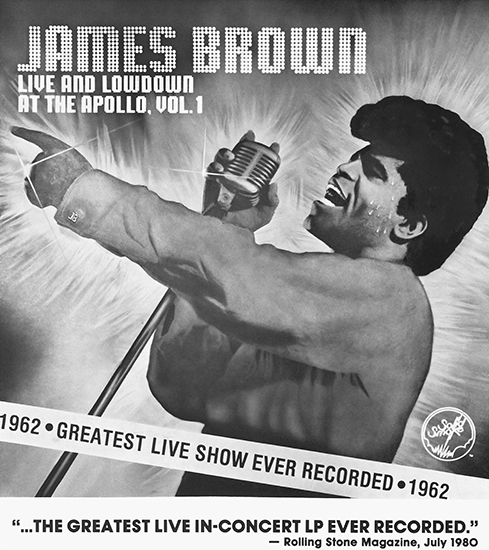
Album cover for James Brown, Live and Lowdown at the Apollo (© Photofest)
{ 11 }
New York City, late October 1962. The overcast days are heavy with clouds and grim anticipation. The previously unthinkable now seemed all too real and raw. Soviet ballistic missiles, easily capable of hitting American targets, had been discovered in Cuba. President Kennedy has announced the establishment of a “quarantine” to prevent additional missiles from entering Cuban ports. Existing missiles in Cuba must be dismantled. Life considers the quarantine a “trip-wire for World War III.”1 Americans track the movement of Soviet freighters on the evening news or daily newspapers as the ships came closer and closer to the point of confrontation. It is the “most dangerous moment in human history,” according to historian and presidential adviser Arthur M. Schlesinger Jr.2
Returning from school or work, New Yorkers cast lingering glances at the fallout shelter signs. Advisories are issued that citizens should maintain two weeks’ worth of provisions. The deafening whir of air-raid sirens threatens to sound at any moment. Would Soviet premier Nikita Khrushchev be so foolhardy as to unleash a nuclear holocaust simply to have a military presence in Cuba and the Western Hemisphere? Might youthful President Kennedy, still smarting from the Bay of Pigs fiasco, be unwilling to back down or to compromise that he would let loose the dogs of nuclear war? Children around the country intone their bedtime prayers with particular devotion. “Time was deformed,” recalled Todd Gitlin, “everyday life suddenly dwarfed and illuminated, as if by the glare of an explosion that had not yet taken place.”3
Secretary of State Dean Rusk noted how the United States and the Soviet Union were “eyeball to eyeball,” each side calculating, posturing, and waiting for the other’s next move. At the United Nations, Ambassador Adlai E. Stevenson eloquently demanded that Soviet Ambassador Valerian Zorin confirm or deny whether his nation “has placed, and is placing medium and intermediate range missile sites in Cuba.” Stevenson proclaimed boldly: “I am prepared to wait for my answer until hell freezes over.” A nuclear hell on earth seemed at the moment a more likely possibility.
Twenty-one-year-old Bob Dylan is sitting late at night at Le Figaro Café in Greenwich Village, “waiting for the world to end.” “The Russian ships were getting closer to Cuba,” he wrote forlornly to his girlfriend, Suze Rotolo, who was in Perugia, Italy. Trying to put on a brave face, he admitted, “I honest to God thought it was all over—Not that I gave a shit any more then the next guy (that’s a lie I guess).” It was “interesting” contemplating total destruction; he simply hoped that he might “die quick and not have to put up with radiation.” He wisely concluded on a romantic note: “If the world did end that nite, all I wanted was to be with you.”4
Legend has it, supported sometimes by Dylan himself, that he composed the song “A Hard Rain’s a-Gonna Fall” in response to the Cuban Missile Crisis. But he had performed it at a hootenanny organized by Peter Seeger at Carnegie Hall a full month before the crisis, and again on October 5 at Town Hall. Truth be told, Dylan had been worrying about nuclear destruction over the past year, penning, for example, “Let Me Die in My Footsteps” about fallout shelters. He was hardly alone in his fears and in an openness to think in a livelier fashion about excess—in death and in music.
Thinking outside of the box, a willingness to entertain extreme scenarios, became the stock in trade of Herman Kahn and others in these years. He coined an apt term for this tendency, “thinking the unthinkable” (the title of a book he published in 1962). Forty years old, the tall and rotund Kahn was a combination of Lenny Bruce (he liked to joke, in rat-a-tat-tat fashion) and Bela Lugosi (feasting on “bloody hypotheticals”). Life magazine in 1959 had referred to his “valuable batch of brains.”5 Talking about the “war games” Kahn and his associates at the Hudson Institute were playing, a reporter stated: “The world of military analysis is bizarre and unsettling, where the unthinkable is thought about, sometimes with gusto.”6 Norman Podhoretz noted that Kahn “does seem to take a visible delight in thinking about the unthinkable.”7
Those valuable brains fantasized about a relatively inexpensive “doomsday machine.” It was a device that would be triggered after one country had attacked another with nuclear bombs. The result would be the destruction of the entire world. Kahn imagined that no nation would attack another armed with its own nuclear weapons knowing that such aggression would result in its mutual annihilation. An extreme solution, to be sure. But not absurd, so long as one presumed that nations act rationally. Nor was it removed from actual policy, in a sense. American and Soviet policy at the time was predicated on the doctrine of mutually assured destruction (MAD, a distasteful but perfect acronym). Both sides were restrained from using nuclear weapons against the other because it would result in an unleashing of massive arsenals of destruction that would signal the end of the world.
Kahn embraced catastrophe and apocalypse as an abstract and practical problem. Already the author of a massive work, On Thermonuclear War (1960), Kahn was paid to think about lots of stuff, such as: Was a nuclear war survivable, and what did it mean to win such a conflagration? At least he acknowledged that defeat would be an “unprecedented catastrophe.”8
“In our time,” wrote Kahn, “thermonuclear war may seem unthinkably immoral, insane, hideous or highly unlikely, but it is not impossible.” Hence in Thinking about the Unthinkable he decided that it was possible to have a nuclear confrontation that flirted with, but did not go to the point of, total holocaust. Kahn laid out, in simple, direct language, how, despite perhaps sixty million dead Americans, proper planning might allow life to continue. With sufficient time, preparation, and ingenuity, survivors might come to thrive. Damned or blessed with a mordant sense of humor, Kahn became a poster child for mad logic and insane reason that seemed to sanction extremes of violence. Kahn became an obvious model for the deluded Dr. Strangelove in the 1964 Stanley Kubrick film.9
By 1962, a willingness to think in fresh ways was becoming common—in varied venues. Thomas S. Kuhn, like Kahn, was a forty-year-old genius with a background in physics. A professor at the University of California at Berkeley, with thinning hair and a face framed by black glasses, Kuhn possessed impeccable academic credentials. Unlike Kahn, his work was directed toward the past rather than the present. He published a new book in October called The Structure of Scientific Revolutions. Although he was restrained in his conclusions, many readers over the years took his essential concepts further than he had intended. His thesis was relatively simple. Under conditions of normal science, the community of scientists work under a shared paradigm, a way of seeing and interpreting the world. Problems to be investigated were considered minor kinks that needed to be fitted better into the ruling paradigm. Over time, however, anomalies may multiply—sometimes as a result of better technologies of investigation or failures of applied science—and lead to a crisis in the ruling paradigm. As if by magic, a counter paradigm emerges (sometimes it may have previously been shunted to the periphery of science as an absurd hypothesis) that better explained problems and which in turn becomes the new ruling paradigm. When this occurs, you have a scientific revolution.10
The “unthinkable” for Kuhn was that science might not function as a pure pursuit of truth. While Kuhn retained faith in scientific communities, his book suggested that scientists were straightjacketed by their ruling paradigm, unable to see other possibilities, narrowed by their presumptions, even blind to facts. Science was compromised. For example, the Ptolemaic-Aristotelian view was no different in its logic and function than the heliocentric one that followed.
As the philosopher Richard Rorty remarked years later, Kuhn’s thesis was a “new map of culture.”11 Within a handful of years, the notion of a community working under a constraining paradigm had been extended in all directions—certainly far from the insular and theoretical worlds that Kuhn had focused upon, not on messy entities such as culture. Culture is best conceived in plural terms rather than as some absolute or Platonic ideal. True, at different moments, culture may lean more in one direction or another.
In 1962 culture seemed about to pop. The experimental and often extreme chipping away at conventions and expectations, as we have seen in previous chapters, was gathering momentum. Like a paradigm (loosely speaking), mounting cultural anomalies were moving culture into new directions. This was, in part, in the nature of accumulation. The music of Cage, the amoralism of Highsmith, the strutting of Mailer, and the lethal wit of Bruce were all contributing factors. Culture, to employ a sometimes overused phrase, had reached a tipping point. This is why in this chapter the focus widens, moving away from individual creators to a somewhat larger cast of characters and works that were, in a variety of ways, bringing the New Sensibility to a boiling point by focusing on madness, sexuality, and liberation.
The shift to a New Sensibility was fueled, too, by possibility and perplexity. Consumer culture and seemingly unstoppable economic growth (despite lingering inequalities of wealth distribution) blessed Americans with a sense of prosperity and promise. At the same time, the specter of nuclear annihilation cast a vast and terrifying shadow that suggested, in some ways, that sitting comfortably in cultural conformity made no sense at all.
The postwar period in the United States featured phenomenal economic growth. Between 1947 and 1960, the gross national product (GNP) had increased 56 percent, with occasional dips, the most recent occurring in 1960–1961. But in 1962, the economy was humming along. President Kennedy’s “Economic Report to Congress,” issued at the beginning of the year, proudly announced that the GNP was growing at a record rate, plant capacity had increased, unemployment had dropped, and prices were stable. American corporations, it should be noted, were making immense profits as well. Thanks to the Sputnik crisis of 1957, government money was pumped into universities, and by 1960, college enrollment figures had climbed 57 percent over what they were in 1950.12
Culture, too, seemed to be gaining in confidence. First Lady Jacqueline Kennedy brought to the White House a whiff of sophistication. Major figures in the arts performed there on a regular basis. As historian William Rorabaugh put it, a new “tone” of hope emerged.13 The term “Camelot” was applied to that aura. Cellist Pablo Casals succumbed to its allure, giving up his boycott of the United States for its support of Franco’s government in Spain to give a bravura performance at the White House in 1961. In April 1962 Kennedy dined with American Nobel Prize winners. In December, thanks to Jacqueline Kennedy’s connection with Andre Malraux, the Mona Lisa voyaged to America, to be viewed by close to two million people. Another hopeful note was sounded in February 1962, when President Kennedy announced August Heckscher’s appointment to a part-time position as coordinator of cultural affairs. Many read this as a sign of increasing attention to the role of the arts in American life.14
More Americans graduated from college than ever before. They may not have majored in the liberal arts, but they had been lectured about the importance of culture, or at the very least learned to feign an interest in the higher aspects of life. Wanting to be sophisticated and cosmopolitan, they flocked to art museums and gallery shows (which increasingly accommodated them with blockbuster shows and more accessible artworks), consumed cultural products (on- and off-Broadway shows boomed, ranging from Edward Albee’s Who’s Afraid of Virginia Woolf? to A Funny Thing Happened on the Way to the Forum), and discussion of film rose to greater heights. In 1962, for instance, critic Andrew Sarris added to this widening stream of sophistication with the essay “Notes on the Auteur Theory.” It was a controversial argument that posited film directors must be evaluated in terms of their “signature” style, “technical competence,” and “interior meaning.” Films were the creative work of directors, expressing their unified vision on film. Sarris worked to establish—as was common with literature or music—a pantheon of important directors and their creations. This demanded a more serious group of critics and consumers, fully aware of the history of film. The year 1962 was a ripe time for such an argument. Foreign films and revivals of American classics were screened regularly in urban centers and on college campuses. Going to see a film, rather than a movie, was a sign of sophistication, of cultural renewal. Looking back on this period, Phillip Lopate called it “the heroic age of movie going.”15
At this moment, madness and mental illness, central to the New Sensibility, gained ever greater and more controversial attention. “Is there such a thing as mental illness?” Thomas Szasz had asked in 1960. His shocking answer: “There was not.” Szasz showed how mental illness was a grab-bag designation, a means of controlling the rebellious, and a dangerous fiction. The solution upheld by the medical establishment was part of the problem. Suddenly, the power of psychiatric institutions came under attack with increasing frequency. Renegade thinkers R. D. Laing in Britain and Michel Foucault in France, along with Szasz, Herbert Marcuse, and Norman O. Brown in the United States, led the charge. This diverse group, with fine credentials in the academic establishment, proposed that rationality was overrated, becoming itself an illness and a mechanism for social control. To his question “Who is mentally ill?” Szasz replied, “Those who are confined in mental hospitals or who consult psychiatrists in their private offices.” In language not unlike Kuhn’s, Szasz wrote about the need to “scrap” the dominant “conceptual model” of psychiatry. Some theorists went so far as to equate madness a sort of divine liberation. In this vein, Brown had proclaimed, of course, “What the great world needs, of course, is a little more Eros and less strife.” To achieve this goal, repression (“The Disease Called Man”) needed to be cast off in favor of Dionysian freedom (sexual and otherwise). “Dionysius does not observe the limit, but overflows,” Brown announced, by way of William Blake; “for him the road of excess leads to the palace of wisdom.”16
Joseph Heller’s Catch-22 (1961) and Ken Kesey’s One Flew Over the Cuckoo’s Nest (1962) joined in the engagement with repression and madness. Both novels railed against the logistics of power that stomped out life. Yossarian, a bombardier on a B-25, faces a bureaucracy which seems more insane than war itself. Military “logic” ensnares the individual in impossible paradoxes; even when you play by its rules, you find that the rules can change instantly. The only hope is to break free, and, if possible, to escape. A similar theme runs through Kesey’s novel, which takes place in the seemingly therapeutic domain of an insane asylum. Maintaining order more than treating patients, however, is the essential function of the place. The main character, Randle McMurphy, rebels against the bureaucracy in the name of freedom. Slowly, the other residents, most of them afraid of liberation, come to live vicariously through him and his tales of “kid fun and drinking buddies and loving women and barroom battles over meager honors—for all of us to dream ourselves into.”17 But out of such dreams come real rebellions, with real costs. McMurphy leads an uprising, and he pays the terrible price of being lobotomized. Chief Bromden, a huge, mute Native American, also comprehends the reality of the hellhole; by staying silent, by faking madness, he maintains his sanity. And he escapes to tell his tale.
Poets, too, were exploring insanity—especially their own, in a confessional manner. Sylvia Plath began in 1961 to write a harrowing fictional account of a young woman, Esther Greenwood, who was consigned to a mental asylum. The novel follows many aspects of Plath’s own life: in 1953, she had attempted suicide and spent a period in a mental asylum. As had occurred with Plath, shock therapy is administered to Esther—“Whee-ee-ee-ee-ee, it shrilled, through an air crackling with blue light… . A great jolt drubbed me till I thought my bones would break and the sap fly out of me like a split plant.”18
In the fall of 1962, just after being deserted by her husband, the poet Ted Hughes, living in rural England, caring for two young children, and weakened from two serious bouts of flu over a period of a few months, Plath manically composed the bulk of her poetry collection Ariel. It was about treachery but also about madness, without hidden contrivances or references. In the face of pain, suicide becomes poetic and real, as in “Cut,” finished on October 24, “Homunculus, I am ill / I have taken a pill to kill.” Or, most painfully in “Lady Lazarus” (written between October 23 and 29): “Dying / Is an art, like everything else. / I do it exceptionally well.”19
No poet in these years confronted her demons of madness and suicide with greater openness than Anne Sexton (chapter 15). Relatively speaking, the fall of 1962 was a good time for Sexton. She had just completed a year’s fellowship at a newly inaugurated Radcliffe Institute seminar, and she had been featured in stories in both Time and Newsweek magazines. She had righted herself a bit after a relapse into anxiety and suicidal depression the previous June, which had landed her back in a mental hospital.20
One week before President Kennedy’s address about missiles in Cuba, Sexton had consumed her usual three martinis before dinner and perhaps took some comfort in her newly minted book of poems, All My Pretty Ones. The collection featured confessional poetry taken to dizzying heights and brought back down to earth by artistic control. The poems chronicled the poet’s life—and her crawl toward death. With a frankness both shocking and refreshing, the artist stripped herself bare—detailing an operation, depression, alienation, a suicide attempt, and a bone-crushing alienation from suburban, married life that she could not escape.
In the end, the artistry and honesty of the poetry triumphed, although readers feared that Sexton was spiraling downward. Even Sexton recognized this, telling a priest friend, Brother Farrell: “I am given to excess. That’s all there is to it. I have found that I can control it best in a poem… . If a poem is good then it will have the excess under control.”21
The American racial landscape was as rutted as ever. Only a few weeks before the Cuban Missile Crisis intruded on the national consciousness, a young man named James H. Meredith had planned on entering the University of Mississippi as its first black student. Governor Ross Barnett did everything he could to prevent this. Whites rioted on campus, leaving two dead. Federal intervention proved necessary to allow Meredith’s admission. Court cases against segregation mounted and direct action increased, but there was still a sense of apathy among whites about the status of African Americans in both the South and North.
A white man from the South, John Howard Griffin, in the fall of 1961 went to extremes in order to challenge racial assumptions. He published a book that would receive widespread attention in 1962, and has ever since. Griffin had been terribly upset by racism. To make its harshness palpable to white readers, to evoke their empathy for the plight of African Americans, he decided to take extreme measures. In Black Like Me, Griffin recounted the weeks he had spent living as a black man traveling in the deep South. He had, via drugs (Oxsoralen), tanning machines, and cosmetics, transformed himself into a black version of his normal self. He reeled under constant threats. What made the experience so jarring for him and his readers was how Griffin’s racial masquerade demonstrated the overwhelming absurdity of white racism. Readers knew that Griffin was a family man, a moral fellow, but he suffered for no reason other than his darkened skin. While such a premise might strike us as gimmicky, the book was really about the moral necessity of white empathy and support for the black freedom struggle. Malcolm X, one of the more radical black leaders on the scene, remarked that if “it was a frightening experience for him … a make-believe Negro,” then imagine “what real Negroes in America have gone through for four hundred years.”22
A willingness to talk frankly about sex entered the mainstream. Helen Gurley Brown’s Sex and the Single Girl sold two million hardback copies three weeks after it was published at the end of May 1962. It was a retort of sorts to the masculine ideal and conventions of Playboy—an advice book, without a hint of feminist rhetoric. It was directed toward its stated audience—single, working women—complete with advice about money management, being independent, and working hard. Brown presented herself as an everywoman: “I am not beautiful, or even pretty… . I am not bosomy or brilliant… . I’m an introvert and I am sometimes mean and cranky.”23 Despite such deficiencies, she had married the “perfect man,” and had secured financial stability and happiness without compromising her own desires.
Brown presented sex—within or without marriage—as healthy and natural Even when a single girl was involved in an adulterous relationship, or “indulging her libido,” she could remain a “lady … [and] be highly respected and even envied if she is successful in her work.” Brown spoke from experience.
Anyway, Sex and the Single Girl was giddy in its embrace of sexual ardor, of women gaining a sense of confidence (sexual and otherwise), of using sexual allure (through dress, makeup, and exercise) to secure a man and to help nurture a career. Women were counseled by Brown to give in to their urges, even to an affair where the sexual frisson might result in “unadulterated, cliff-hanging sex.”24
In the view of the custodians of sexual conventionality, Brown had surrendered to the dangers of sexual excess and immorality. One reviewer called Sex and the Single Girl “about as tasteless a book as I have read this year.” Norman Vincent Peale, an influential minister and author of bestselling advice books, condemned Brown’s book as “one long flirtation of indiscriminate sex.” Peale wondered, “Where do you draw the line?”
A good question: Where does one draw the line, especially in a culture that has been growing more rebellious over the last decade? What had once been thought scandalous was now readily available, though still under attack. In 1961, thirty-three years after it had first been published in Europe, Henry Miller’s Tropic of Cancer was finally produced in an American edition. Yet he still complained in 1962 that “America is essentially against the artist, because he stands for individuality and creativeness.”25 In 1962, an American edition of Naked Lunch, William Burroughs’s wild novel, was hauled out of warehouses and finally released to the public.26 It made the once controversial Howl seem almost chaste in content and restrained in style. In language by turns clinical and fantastic, it narrated in nonlinear fashion the story of Bull Lee (essentially Burroughs). Lee’s paranoid reveries, sexual shenanigans, and kaleidoscopic dreamscapes signaled a new, liberated sensibility at play in America. Here is a typical passage:
Why so pale and wan, fair bugger? Smell of dead leeches in a rusty tin can latch onto that live wound, suck out the body and blood and bones of Jeeeeesus, leave him paralyzed from the waist down. Yield up thy forms, boy, to thy sugar daddy got the exam three years early and know all the answer books fix the World Series.27
But change rarely proceeds smoothly, nor is it absolute. Censorship, especially at a local level, sometimes at the behest of citizen groups, newspaper editorials, librarians, and others, continued. Aware of the spate of books that had previously been deemed unacceptable being published, an influential newspaper columnist coined a term for such books: “paperback pornography.” Reporting in the New York Times, civil libertarian Anthony Lewis stated in January 1962, “Tropic of Cancer has run into more massive opposition from censors across the United States than any other serious publishing venture in memory. Though 2,500,000 copies are in print, it is impossible to buy the book in most parts of the country.”28 By 1964, the book finally escaped from the net of censorship.
Fear lurked among the crowd of 1,500 people waiting to enter the Apollo Theater on the frigid night of October 24, 1962, for a concert by James Brown and His Fabulous Flames. Earlier that day, as Soviet vessels carrying armaments neared the American blockade, the Joint Chiefs of Staff had ordered the Strategic Air Command to go to level DEFCON 2 for the first time in history; this meant a high level of preparedness for war.
Around midnight, Lucas “Fats” Gonder, emcee and organist, introduced Brown in impeccable fashion. He recited rhythmically the names of Brown’s hit records, before calling Brown “Mr. Dynamite” and “the hardest working man in show business.”
Brown’s singing and stage presence combined the spontaneous and the orchestrated, raw power and sentimental mush—but always in rhythm. Short and muscular, angular in face, with the moves of boxer Sugar Ray Robinson, Brown was a fantastic performer. He had fronted $5,700 of his own funds to record his Apollo performances. That night he remembered a little old lady who “must have been seventy-five years old,” sitting right near one of the recording devices. She kept shouting: “Sing it mother … . .r, sing it!” Brown worried about his investment being lost while he brought the crowd to a state of ecstasy with his patented combination of upbeat and soulful numbers.29 His trademark was his scream, learned in black churches and honed by Brown to secular perfection.30 “There’s only one thing I can say,” and that was a scream of pain: “Aaaaarggghhhh!” Then, to the audience, “I want to hear you scream.” A cathartic group of voices then joined with Brown.
In the midst of the song “Lost Someone,” Brown remarked to the audience, “It’s getting’ a little cold outside.” This could have been a literal remark about the weather, but it may also have been directed at the historical moment and the potential of a nuclear holocaust. “I wonder if you know what I’m talkin’ about?” asked Brown. They knew. He then sang the perfect sentiment for this charged moment: “Everybody needs someone,” After another scream that was less blood-curdling than ecstatic, Brown sang, “Feel so good, I wanna scream.” And with each scream, with every dance move, Brown and the audience sweated through the potential of destruction by experiencing moments of exhilarating liberation.31
Thankfully, the crisis resolved itself. As Rusk put it, Khrushchev blinked first, deciding that a nuclear confrontation was too high a price to pay for having missiles remain in Cuba. Some had pressured Kennedy to act decisively, to either bomb the installations immediately or launch a massive invasion of the island. A small number of advisers took the view that a deal could easily be arranged to remove the missiles. Apparently, the president and his brother, Attorney General Robert Kennedy, had read a recent bestselling book by historian Barbara Tuchman, The Guns of August. There she had detailed how blunders and failure to consider complications brought about the horror of the First World War. Perhaps such historical perspective helped to moderate the warrior temperament of Kennedy. Although one could see the crisis as exemplary of the power of negotiation (the deal, kept secret, was for the United States to remove some missiles from Turkey and to promise not to invade Cuba, in return for the dismantling of the missiles in Cuba and the promise not to reinstall them). Or the crisis could be seen as unnecessary, more a function of Cold War hysteria and macho extremism.
Whatever the case, only the cultural world exploded while James Brown was onstage.
Flash forward exactly two years, to late October 1964 for the T.A.M.I. show in Los Angeles. The British invasion has begun. The Beatles are making teenage hearts throb; their records are the rage. Another English group, the Rolling Stones, is rising in popularity. They are booked for the show, along with James Brown. The old question arose—which act would close. The producers decided to give that honor to Mick Jagger and the Stones—or that horror, because they had to follow James Brown. The Stones, fresh and well-scrubbed, performed well, singing five rhythm and blues tunes and one rockabilly number. Jagger danced okay.
Brown danced with atomic explosiveness. Although his recollections are a bit fuzzy, he stated that Jagger had been watching him perform from the side of the stage, awed, transfixed, and anxious—going through an entire pack of cigarettes while Brown gave what one rock commentator said was “universally regarded as the most astonishing performance in the history of rock and roll.”32
“I hit the stage on fire,” Brown recalled, and he “torched” his songs.33 “I don’t think I ever danced so hard in my life.” With his hair pomaded to high altitude, wearing a double-breasted vest, Brown waltzed across the stage doing a seemingly impossible “shimmy on one leg.”34 During his classic “Please Don’t Go,” Brown repeated lines until they were drilled into the cement of everyone’s soul. He built up, in the words of one analyst, “suspense and anticipation.” Like a majestic lover, Brown was able to “manipulate, delay, renew, and finally shatter” the audience with his screams and repetitions.35
As was his practice, he then collapsed exhausted to his knees, so depleted by his songs about lovemaking or the need for love. One of the Flames helped him to his feet while Brown trembled; an aide rushed onstage to drape a plush white cape over his shoulders. Brown staggered off the stage, slowly and soulfully. But then, as if the Holy Ghost had entered him, he tossed off the cape and returned to sing anew. The routine was repeated three additional times. And he was still not finished, singing and dancing to his classic “Night Train.” He was a man possessed and exhausted, yet still capable of doing full splits before finally blowing kisses to the crowd and letting the Rolling Stones, pale imitations of him, take the stage.36
Brown’s music, with its finely toned perfectionism and elemental passion, was always in tension, stretched to the breaking point. His soulful embrace of excessive feelings was central to the New Sensibility. His music was at once a cry of grief and a scream of liberation. Onstage, he seemingly flirted with disaster—falling to his knees four times in a performance, slumping off the stage, but always returning triumphant, offering his audience a wonderful feast of excess.