
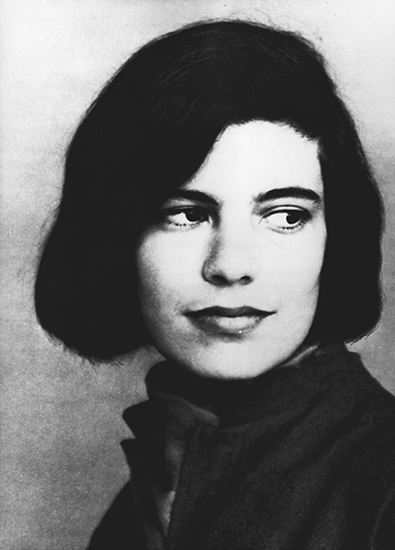
Susan Sontag, around the time of the publication of The New Sensibility. (Getty Images)
{ 13 }
At the end of 1964, Time magazine extolled thirty-one-year-old Susan Sontag as “one of Manhattan’s brightest young intellectuals.” Time readers learned how Sontag had called camp a sensibility of “exaggeration” and adoration of the vulgar and the artificial. The article briefly mentioned that camp was often associated with homosexuals. Camp outlandishness, Time quoted Sontag as saying, was intended to “dethrone the serious” and ennoble the frivolous—to be a sort of “playful aestheticism.”1
Less than six months after her splash in Time, Sontag was once again featured in a popular venue, in Mademoiselle, a magazine that aimed at “the smart young woman.” Sandwiched between an advertisement for girdles and one touting a European vacation package, Sontag’s article announced the stirring of something original, a new sensibility in American culture which
reflects a new, more open way of looking at the world. It reflects new standards of beauty and style and taste. The new sensibility is definitely pluralistic; it is dedicated both to an excruciating seriousness and to fun and wit and nostalgia. It is also extremely history-conscious, voracious; and the velocity of its enthusiasms is very high speed and hectic. From the vantage point of this new sensibility, the beauty of a machine or the solution to a mathematical problem, of a painting by Jasper Johns, or a film by Jean-Luc Godard, and of the personalities and music of the Beatles are equally accessible.2
Susan Sontag was a phenomenon. Strikingly tall and slim, she hunched over as if embarrassed by her stature. Her saturnine visage was framed by luxuriant black hair, and she often wore a black turtleneck. She was edgy and kinetically charged, perhaps an effect of the amphetamines that allowed her to labor without cease, sometimes for days at a stretch. The avant-garde cinema gave her immense pleasure, as she gulped down the latest foreign films at the Beekman, New Yorker, and Embassy Theaters in New York City. Often, she sat through two or three films in a day. Her prose consisted of elongated sentences, along with feints, dead ends, piles of ideas, and, quite often, piercing aphorisms.3
By 1962 Sontag was wending her way through New York’s cultural corridors. It had been a long time coming. An intellectual prodigy, she had been thrilled when her family moved from Tucson to Los Angeles in 1946, allowing her opportunity to read André Gide’s journals in a local bookstore or grab the latest issue of Partisan Review at a newsstand. At age fifteen she was ready for college, longing for the high intellectual seriousness she associated with the University of Chicago. But her parents persuaded her to attend the University of California at Berkeley; after a year she could transfer. Perhaps her most notable experience at Berkeley was falling in love with Harriet Sohmers; they met over a shared passion for Djuna Barnes’s novel Nightwood. Sontag now felt, she said, that “living is enormous.”4
The start of the 1949 school year found her happily ensconced at the University of Chicago. Loving its Gothic buildings, neighborhood bookstores, and enshrinement of intellectual life, she felt “reborn.”5 In her second year at the university, Sontag suddenly got married. She had decided to audit Social Science II, taught by a twenty-eight-year-old PhD student named Philip Rieff. He was immediately smitten by the seventeen-year-old Sontag, who came late to his class, dressed in her usual outfit of blue jeans, plaid shirt, and her stepfather’s army jacket. Against the shabbiness of the clothing, her beauty and intelligence shined. Rieff and Sontag were quickly engaged and married in December 1950. It is easy to imagine what Sontag saw in the young instructor. With a sharp, capacious mind, Rieff was writing a dissertation on Freud and moral theory. Most importantly, Sontag craved serious conversation about intellectual topics. Rieff supplied her fully with “the delirious amity of non-stop talking.”6
Sontag finished her undergraduate degree in two years, thanks to her acing various placement exams. With degree in hand, she accompanied her husband to Brandeis University, outside Boston, where he was an assistant professor. The year of 1952 dawned for her with a new reality—pregnancy. Susan was open to having a child; it was an experience that she did not want to miss. She continued with a wide range of intellectual interests, writing poetry and short stories. One short story dealt with a couple about to have a child. The woman was concerned about the child’s last name. The story reveals Susan’s own anxiety about her new identity as Susan Rieff. The dark shadow of the story is in the conclusion. As the couple is walking, a car speeds toward them, about to kill the mother-to-be and, in a sense, resolve the problem of the child’s name.7
The next five years found Sontag frustrated, hating her “feathered nest.” She increasingly felt uncreative, stifled by Philip and child.8 She had played a major role (researching, discussing, editing) in helping her husband publish his groundbreaking work, Freud: The Mind of a Moralist, published in 1959, which presented Freud as a necessary and conservative thinker. But she would receive no acknowledgment for her contributions.
Seeking escape, she won a fellowship to spend the 1957–58 academic year at St. Anne’s College, Oxford.9 Embarking by ocean liner for England on September 5, 1957, Sontag settled into life at Oxford. There she worked with such leading philosophers as A. J. Ayer and Iris Murdoch, the latter serving, no doubt, as the archetype of an intellectual that Sontag might emulate. Murdoch was both a novelist and an analytic philosopher. Sontag contemplated writing a dissertation on the “metaphysical presuppositions of ethics.” She felt freedom such as she had not experienced since that first year at Chicago. She called herself Susan Sontag once again. A fellow student at Oxford later recalled the enigmatic and appealing presence of twenty-four-year-old Sontag as an object of desire on the part of some of the students—and out of their reach.10
Sontag soon abandoned Oxford for Paris, luxuriating in a simple room on the rue Jacob in the Latin Quarter, close to the Sorbonne. In Paris she wanted “to find a voice. To speak,” and she would do so soon in fluent French. She read, as always, voraciously. She embraced the café life with gusto, meeting among others Allen Ginsberg and his partner, Peter Orlovsky; Alfred Chester, a sparkling writer and eminent character; and art critic Annette Michelson and her husband, Bernard Frechtman, who had translated into English some of Sartre’s works. She also renewed an earlier relationship with Harriet Sohmers, (“games of sex, love, friendship. Banter, melancholy” but also marked by tension), with whom she would tour Europe.11
But first she wanted to end her marriage and reclaim her son. She worried that (in words that might have appeared in Freud: The Mind of a Moralist): “Price of freedom is unhappiness. I must distort my soul to write, to be free.” Relationships with Harriett and Philip had compromised her own identity; loving involved “immolation of the self.” She concluded, toward the end of her European sojourn, that “I think I can live without H[arriet] after all” and certainly without Philip.12 She longed to be a novelist, out of “egotism” and because “there is something that I must say.”13
Back in the United States, Sontag and her son settled in New York City. Editorial work and teaching at various schools paid the rent while she plugged away on her first novel, The Benefactor (1963)—a dreamy, difficult work that revealed more promise than polish. She gained the backing and friendship of many influential folks, and the prestigious firm of Farrar, Straus, and Giroux was committed to publishing her novel. Yet, having just broken up with Maria Irene Fornes, a talented playwright and a regal drama queen in private life, Sontag announced she had to break free of the inhibitions and neuroses that had hindered her in love and life. “I must become active.” The agony of a volcanic romance gone sour haunted Sontag for the next two years.14
In August 1963 she asked herself, “How did everything go so wrong? How can I get myself out of this mess” (i.e., with Irene)? Her answer, jotted down three times was simple: “Do something.” In effect, what she was doing in 1964 was realizing that her ability to feel and think had been damaged by her relationship; the end of their sex life meant “unbearable pain.”15 Ruminating about her own sensibility at this time of personal suffering, she translated her inner needs into cultural imperatives—“to recover our senses. We must learn to see more, to hear more, to feel more.”16 Attracted to transgression, she ate up everything that she found alive in the New Sensibility.
By the late 1960s, the notion that the personal is the political became increasingly prevalent. One reason for dwelling on the private agonies of Sontag’s life is that they are connected with her public criticism. Feeling herself bereft of pleasure in her private world, she sought it in avant-garde culture. Castigating herself for a lack of emotion in her private life, she discovered it in the works of others. What she wanted, as she admitted in her journal, was “to go on pushing my sensibility further & further, honing my mind. Becoming more unique, more eccentric.”17
By 1964, the New Sensibility was in full bloom in New York City. Avant-garde works, inspired by Dada and John Cage were performed, often under the auspices of Fluxus, an eclectic group of artists dedicated to exposing the surreal in everyday life.18 Sculpture, dance, music, theater, and narration came together in happenings and performances. No longer would the artwork be entombed in museums. Art was to be an event, “concerts of everyday living,” as composer and poet Dick Higgins stated.19 A new notion of the body as a work of art was coming into view, the distance between audience and performer was lessening, sometimes to the point of obliteration. This is not to say that these works were no longer controversial. But they were becoming more common, and were soon to find expression in the culture at large.20
One piece almost made its mark. In a moment of madness or inspiration, Andy Warhol (along with nine other artists) was commissioned to do artwork for the façade of the New York State Pavilion at the upcoming world’s fair. Warhol, as we saw in the previous chapter, was the king of the pop sensibility. His contribution, however, shocked officials, who had it removed from the façade. It was a mural titled The 13 Most Wanted Men, on which Warhol had reproduced headshots from wanted posters of thirteen criminals. As with much of his work from this period, interpretations of the piece varied. Was it simply a reproduction of a popular culture icon, such as his soup cans? Was it intended to alert visitors to New York City of criminals hiding in plain sight? Was it a camp gesture—with “Most Wanted” bearing more of a sexual rather than a legal significance?21 Whatever it was, it fit in with the cool aesthetic that Sontag was beginning to explain to the public.
Yoko Ono, then a thirty-one-year-old artist associated with Fluxus, performed Cut Piece at Carnegie Hall in 1965. Dressed demurely in a black top (with buttons and long sleeves), black skirt, and fishnet stockings, Ono sat down onstage, Buddha-like. She generally stared ahead, placid, perhaps a bit wary at times. Like many in the New Sensibility, she wanted to undermine distance between artist and audience, so this piece depended as much on audience participation as on the artist. Audience members, one by one, ascended to the stage and picked up a pair of scissors lying next to Ono. One snip followed another, until Ono had been largely shorn of her clothing, although her white brassiere remained intact. Compared to later work by performance artists Marina Abramović or Chris Burden (see chapter 23), it was rather tame stuff. But in the early 1960s it dazzled. Like so much of the art of this moment, its meaning remained unclear. Was it about violence and objectification of women? Was it about Buddhist serenity in the face of violence (perhaps a nod in the direction of Vietnamese monks who had been self-immolating to protest against their government)? Was it about the audience as critics cutting away at the artist’s work? All of the above? After all, as Sontag would remark, the new spirit in art was pluralistic, less concerned with interpretation than with pleasure and experiment.22
Robert Morris, who had already established a reputation for his minimalist sculpture, created Site—a “dance duet” that he performed with painter and performance artist Carolee Schneemann—at the Surplus Theater. It was both satire and homage to Manet’s classic painting Olympia, where a nude model (who was also an artist of talent) reclines on a divan while the artist paints her. That work had shocked its nineteenth-century viewers by elevating a nude prostitute into a model of purity. Audiences saw Morris, wearing a mask of his own face (playing with his own identity), construction gloves, and a white outfit, with cut-off arms to flaunt his muscles. He then proceeded to remove a large plywood sheet, revealing Schneemann. For the remainder of the work, the audience’s attention was riveted on Morris, who basically made himself and the plywood into a kinetic sculpture, moving around the stage, trying to balance a plywood sheet only to have it drop, then finally bringing the plywood back to its original position, thus reobscuring Schneemann. Morris then stepped back, folded his arm, and contemplated his handiwork.23
Schneemann staged a new piece of her own in November in New York City. It opened with four women in bikinis, doing a sort of Busby Berkeley number. They were soon joined by four men clad only in briefs. All cavorted about, sometimes hugging or tumbling, while a narrator read from a text composed by Schneemann; popular tunes (“My Boy Lollipop,” for instance) played. A woman in a servant’s outfit dropped raw chickens, fish, and sausages onto the performers, who employed the props in various ways—as aids to masturbatory fantasies, or as if fondling a baby. Schneemann described Meat Joy:
Excessive, indulgent; a celebration of flesh as material: raw fish, chickens, sausages, wet paint, transparent plastic, rope, brushes, paper scraps. Its propulsion is toward the ecstatic, shifting and turning between tenderness, wildness, precision, abandon—qualities that could at any moment be sensual, comic, joyous, repellent … in which the layered elements mesh and gain intensity by the energy complement of the audience… . Our proximity heightened the sense of communality, transgressing the polarity between performer and audience.24
A total artwork, performed with delight—the audience, as per Schneemann’s instructions, situated as close to the action as possible—the piece took joy in movement and pleasure in perversity.
So much was happening in the city. Cellist Charlotte Moorman organized the Festival of the Avant-Garde. She would later gain fame for playing her cello in the nude. One of her contributions was a collaboration with Cage. She played a piece of Cage’s while he sat beside her; at one point he held a kazoo to her mouth for her to use. Schneemann, along with her husband, James Tenney, performed a piece for the festival with “bodies completely encased in metal debris.” She also directed, with Nam June Paik, a piece by Allan Kaprow, Push and Pull. It resulted, said Schneemann, in the “utter destruction of the environment we built: old ladies, collared hairless businessmen astride cracked two by fours, beating each other and the remains of the environment with objects I had asked them to go into the streets close by and bring back soft materials, scraps, waste” to furnish the environment. But the audience, in her words, went “berserk.”25
Pure pleasure and rebellion. It issued forth from earlier experimental work and happenings without impetus from the hubbub of the Beatles’ arrival in New York in February 1964.26 Indeed, one might wonder if the success of The Beatles and the freedom that became associated with them in general had been brewing since the earliest days of the New Sensibility.
Critics acknowledged the sea change in culture. Writing in 1962, the art critic Leo Steinberg remarked that the nature of avant-garde art was to “shock or discomfort,” to cause “bewilderment,” “anger,” or “boredom” on the part of its audience. Years earlier, he had felt anxiety when encountering the work of Jasper Johns, whose work for example included a painting of a flag or a Ballantine Ale can rendered in bronze. Now he appreciated Johns and hypothesized about the process: avant-garde works were “outrageous for a season” before “undergoing rapid domestication.”27 Another art critic, Harold Rosenberg, worried about how art in the 1960s suddenly seemed less concerned with tradition and the art object (painting or sculpture) and more “self-conscious about being new and radical.” What even constituted a work of art (and made it good or bad) seemed to be under siege. It made not only the art object but Rosenberg anxious.28
While art critic Barbara Rose wrote in 1965 that “a new sensibility in the arts had announced itself, ” she was unsure of what it was exactly. A new, minimalist style had emerged: cool, self-consciously boring, and daunting. Artists of the New Sensibility wanted to erase content from their work, in effect, to express emptiness and vacuum. The New Sensibility was “a negative art of denial and renunciation,” of such “protracted asceticism” that it was “almost as hard to talk about as it is to have around” because of its “most ambivalent and … most elusive” nature.29
Two young script writers, David Newman and Robert Benton, took a stab at definition in the hip magazine Esquire in 1964. They were perfectly poised for the task. They were fiddling around with a script that would eventually become the film Bonnie and Clyde (1967)—an apotheosis of the violence, part of what they called the New Sentimentality (a term largely analogous with the New Sensibility). They agreed that self-indulgence—the artist as performer in public life—had become the in thing, a “virtue.” The new poetry, encapsulated in the work of Robert Lowell, was about the “beauty of destruction, with the sanitarium as a favorite setting for a poem.” Newman and Benton noted the “order of chaos” and the power of confession as central to the New Sentimentality. This vision brought together apparent opposites, cool and heat, excess and detachment: imagine Groucho Marx and Humphrey Bogart melded together.30
Tom Wolfe, the man in the white suit and fedora, recognized a new pizzazz in American culture. His focus, however, generally was outside of the world of avant-garde performance. Instead, he trumpeted the pleasures to be found in the lush colors used by automotive detailers, in the grit and grime of stock car racing tracks, and in the neon-lit avenues of Las Vegas. This came to a froth in his 1965 collection of essays, The Kandy-Kolored Tangerine-Flake Streamline Baby. As noted in the introduction, his “free-form” gaudy prose was designed to bury any notion of reportorial restraint or stylistic cramp. He named the phenomenon the “new sensibility,” although that designation gets lost in the following paragraph:
America’s first unconscious avant-garde! The hell with Mondrian, whoever the hell he is… . Artists for the new age, sculptors for the new style… The new sensibility—Baby baby baby where did our love go—the new world, submerged so long, invisible, and now arising, slippy, shiny, electric—Super Scuba-man!—out of the vinyl deeps.31
So many aspects of the pulsating New Sensibility had by 1964 become apparent that one critic pronounced it “the era of overkill.” Prose became overheated; metaphors multiplied—words took on new colors and exuded energy. Confessional prose, too, became an expressive coin of this realm. Self-revelation replaced effacement as a mode of presentation, a way of being. Often, it was too much.32
Critic Richard Gilman emphasized “the confusion of realms” central to the New Sensibility. Purity of form had been replaced by manic mixing of styles. With equal aplomb and seriousness, he ranged from analysis of Sontag and Marshal McLuhan (with his original and odd take on how technology fashions consciousness) to the minimalist fiction of Donald Barthelme, to the Living Theatre and the near pornographic prose of John Rechy—celebrating the new experiences in theater, art, happenings, and literature ushered in by the New Sensibility.33
Sontag was determined to wrap her mind around this New Sensibility. She found what was happening in American culture exciting and revolutionary.34 In the end, the New Sensibility proved, perhaps appropriately in Sontag’s view, to be largely “ineffable.” Like any sensibility, she held, to define it was “to betray it.”35
The New Sensibility for Sontag was mainly about pushing the boundaries of attention and dismissing content in favor of purity of images. This cultural turn departed from an earlier generation’s adoration of a tragic sensibility and employment of Marxian or psychoanalytic interpretations. She was, in effect, lecturing an older generation of cultural critics (who worshipped the ideal of maturity and sanity) about a new culture, which was drawn toward madness and excess. “I’m attracted to demons,” Sontag proclaimed; “maybe art has to be boring, now.”36
She began to examine the New Sensibility via camp. While a sensibility was a predilection for a certain style, for a particular manner of organizing perceptions of the world, it remained somewhat mysterious, something without “system” or “proofs.” Sontag’s discussion of camp, then, took the odd but brilliant form of fifty-eight notes, overflowing with aperçu and insight speeding ahead in a hit-and-run manner. Such an approach, she claimed, had the advantage of being “tentative and nimble,” a stylistic analogue of sorts to her subject matter, the “fugitive” but “powerful” presence of a sensibility.37
Sontag announced herself both drawn to and repelled by camp. Through “exaggeration” camp followers venerated objects which were commonly viewed as tasteless by the establishment.38 Camp was, of necessity, over the top—joyously so. Although she failed to emphasize the centrality of camp to homosexual identity and culture, that subtext was clear in the article and highlighted in the piece that appeared in Time magazine. Sontag adored camp’s vigor, vitality, style, experience, and aesthetic approach. “For Camp art is often decorative art, emphasizing texture, sensuous surface, and style at the expense of music.” Camp was fun.39
With the appearance of an essay collection titled Against Interpretation in 1966, Sontag commenced her reign as queen of the New Sensibility. A reluctant monarch, she disdained categorization or limitation—preferring to be “promiscuous” and “pugnacious” in her tastes.40 The essays, despite their daunting prose, were a sort of Baedeker guidebook of avant-garde literature, theater, and cinema (mostly European), with excursions into happenings and even science fiction films. Sontag’s celebration of a New Sensibility made her an immediate cultural superstar, an “evangelist of the new,” as one early reviewer phrased it. A year after publication, Against Interpretation had sold over ten thousand copies in hardback, with impressive numbers to follow paperback release in 1969. A Guggenheim Fellowship in 1966 attested further to Sontag’s presence.41 Her photo appeared regularly in the popular press. She had made it.
As the title emphasized, Sontag was against interpretation—a puzzling assertion for a volume of criticism. Sontag danced around the apparent contradiction by presenting herself as an enthusiast or connoisseur rather than critic of the New Sensibility. Her antagonism to traditional interpretation was genuine, although it was more strategic than doctrinal. She bemoaned the modern tendency to diminish the work of art by fitting it into rigid interpretive schema. Such modes of criticism focused on content, context, and the intention of the author. What did the book mean? How was it a reflection of the author’s biography or time period? How might the language and form of the work be brushed away to reveal a presumably more essential nugget of truth? Such “incrustations of meaning” seemed “reactionary, impertinent, cowardly, [and] stifling” ways of approaching works of art.42
She craved a more immediate and pleasurable relationship with text, painting, film, or stage production. She discovered value not in the “deep” meaning of the works—which were invariably hostile to summation, as in the befuddling film Last Year at Marienbad—but in the “pure, untranslatable, sensuous immediacy of some of its images.”43 Film had come of age, with its directors now demonstrating an awareness of its history tied to an ability to address by stylistic innovation problems peculiar to its own form. Such films were the “most interesting works of art” because they were “not political or didactic”; instead, they were “experimental, adventures in sensation, new sensory mixes.”44
If this struck readers as a bit esoteric, Sontag offered other enticements. She observed that the Maginot Line between works of high and low culture had been transgressed—without ill effects. In contrast, throughout the 1950s and into the 1960s, critics had railed against the pabulum of popular and middlebrow culture. While the former was rather harmless and easily ignored, the latter was a venal specter threatening the purity of high art. Middlebrow, in the common formulation proffered by critic Dwight Macdonald, diminished depths and sentimentalized tragedy in great works of art by making them accessible to an audience unwilling to grapple with complexity and difficulty. Middlebrow dragged great art down to a level of insipidity.45
Openness to the plurality of possibility and pleasure in culture was now the order of the day. “The purpose of art is always, ultimately, to give pleasure—though our sensibilities may take time to catch up with the forms of pleasure that art in any given time may offer,” she stated.46
Sontag revealed a capacity for pleasure and camp in an essay on Flaming Creatures. An independent film by Jack Smith, the film had achieved notoriety and been banned, as already noted, when it was shown in 1963 at the Bleecker Street Cinema. Hazy, often out of focus, the film depicted various nude or semiclad individuals cavorting about, sometimes engaging in what looked to be orgies of pleasure and pathos. A penis appeared here, a drag queen appeared there. A New York court declared the work obscene.
Despite being amateurish and devoid of storyline, Flaming Creatures belonged for Sontag to the tradition of “the poetic cinema of shock.” Its childish display of sexual shenanigans struck her as “witty.” If pornography was designed to excite sexual desire, then Flaming Creatures was clearly in another genre. To a film aficionado, and a cosmopolite such as Sontag, the film was daring in its offbeat subject matter, inventive in its technique, and “a treat for the senses.” Indeed, the film served as evidence in her battle against interpretation, since it proudly had “no ideas, no symbols, no commentary on or critique of anything.” It simply was what it was, something to be enjoyed, like pop art. In sum, “a triumphant example of an aesthetic vision of the world” that opened up “the space of pleasure.” In its celebration of excess and exaggeration, Flaming Creatures was an apotheosis, of sorts, of the New Sensibility; it had realized Sontag’s goal of “an erotics of art.”47
In an essay published in 1967, Sontag continued her examination of the key components of the New Sensibility. She was drawn to artists, mainly European, who shared her saturnine disposition—and who danced with madness.48 More so, she believed that “the exemplary modern artist is a broker in madness.” In her journals, she mused: “Madness as a defense against terror / Madness as a defense against grief.” Freedom seemed to dwell in a mind that had become unhinged—“the ‘value’ in what is evil or lunatic.” Finally, “art,” she wrote in July 1964, is “a way of getting in touch with one’s own insanity.” One presumes that her “against interpretation” style offered a similar route.49
Theatrical expressions of madness Sontag found thrilling, as in the harrowing play Marat/Sade by the German playwright Peter Weiss. The play, which takes place in an insane asylum, was exemplary of “the desire to go beyond psychology,” with mad characters almost rendering speech unnecessary. The use of its language as “incantation” linked it to the concern with ritual that was becoming central in the work of the Living Theatre.50 The point of such art was to unhinge moral certitude and to overcome the passivity of expectations, to challenge the very ideal of sanity. Through a theater of shock, a culture of transgression, and an erotic aesthetic, the New Sensibility consumed Sontag.51
Sontag rarely wrote about the political situation blazing in 1964. It was as if she was so focused on cataloging and appreciating new effusions of culture (or ones that had been previously unknown to her) that she refused to board the train of politics. It was, however, the quiet before her storm. It was an extraordinary moment in American history, although in Tom Wolfe’s view less for its events (war in Vietnam, student protests, civil rights struggles, and political assassinations) than for its revolution in manners or attitudes. Of particular import for Wolfe were “ ‘the generation gap,’ ‘the counter-culture,’ ‘black consciousness,’ ‘sexual permissiveness,’ [and] ‘the death of God’ ”52
Sontag agreed with Warhol’s announcement: “Everything went young in ’64.” In cooler terms, Sontag noted, “Every age has its representative group—ours is youth.”53 However, the demographic explanation of a youth explosion as the motor of change confused the order of things. The development of a New Sensibility, experimental and transgressive, prone to push limits, as we have seen, had begun years earlier. It was only reaching fruition in 1964. Many of its youthful protagonists were jumping on a bandwagon that had already traveled some difficult roads. Sontag refused to weigh down her enthusiasm and prose with historical precursors or explanations of how this New Sensibility might be powered in part by an expansive, new sense of self, by a sense of potential atomic annihilation, or by an economy that was pumping out all sorts of goods for consumption. She just wanted to dance to its music.
In the article on the New Sensibility, Sontag had offered a laundry list of aesthetic forbearers: Nietzsche and Wittgenstein, Artaud, Breton, and Cage, among others. She failed, however, to examine the connection of the old with the new sensibility, or to historicize it as rooted in the 1950s. She felt herself caught up in a revolution of transgression—and it delighted her. “The only transformation that interests me is a total transformation,” she declared in her journal in 1965.54
Such proclamations increasingly abounded in American culture. Critic Leslie Fiedler initially responded to them with dismay in the Partisan Review (the same issue included Sontag’s “On Style”). The present generation, he argued, had lost its historical consciousness. “Drop-outs from history,” he called them.55 The “new irrationalists,” or “new mutants,” as Fiedler maintained, celebrated “prolonged adolescence to the grave” over reason and maturity. LSD had become “the radicalism of the young.” Porno-politics (using a phrase from sociologist Lewis Feuer) and “porno-esthetics” (Fiedler’s own coinage) were on parade, in film, theater, and music. Everything seemed reduced to sexual stimulation and immediate gratification, with confused gender roles (camp was making men effeminate) and celebration of insanity. The oft-anticipated atomic apocalypse had not happened, but Fiedler found that a new sensibility was creating “mutants.” Fiedler considered these mutants of the radioactive New Sensibility to be barbarians at the gates, and in 1965 he was repelled by them. Ironically, Fiedler would soon drop his opposition and become a leading light of a new sensibility, writing about freaks and even getting busted for drug use.56
Fiedler’s concern about the surrender of politics to esthetics, irrationalism, drugs, and self-indulgence was both right and wrong. Nothing in the New Sensibility militated against political commitment—as indicated by the work of Malina in the Living Theatre or Ginsberg or Mailer. But the New Sensibility, born of extremes, did fit well with a new style of politics emerging in the 1960s, one that could twine moral outrage with outrageous performance—a heady combination of Cage and Abbie Hoffman, as actualized by the Yippies.
Sontag was often a cheerleader for the New Sensibility. Yet, even in Against Interpretation, she expressed qualms. For example, she chafed at camp’s failure (which, in fact, was part of its raison d’être) to confront political issues, reducing everything to style. As the violent pace of the war in Vietnam accelerated, Sontag became an avid protestor, convinced that the role of the avant-garde intellectual was to fight injustice. By 1966, while Sontag’s taste in literature and art remained consistent with the New Sensibility, her tone harshened. She famously proclaimed: “America was founded on genocide,” and “The white race is the cancer of human history.” In 1968 she traveled to North Vietnam, working hard to establish her sympathy but also put off by their rather limited avant-garde sensibility.57
The flag of the New Sensibility waved by Sontag was marked by contradiction and paradox. This is unsurprising, since the New Sensibility was powerfully pluralistic, even promiscuous. But did that mean lack of coherence? The unity of the New Sensibility was wrought with tension, akin to how “a first-rate intelligence,” according to F. Scott Fitzgerald, was “able to hold two opposed ideas in mind, at the same time and still retain the ability to function.”58 Indeed, this tension was what made the New Sensibility vibrant and exciting.
The core of the New Sensibility, to sum up, was excess, whether in the direction of minimalism or maximalism, captured equally by the musical bursts of Jerry Lee Lewis or the silences of John Cage. Apostles of the New Sensibility generally welcomed the sagging of the middle ground, which in politics meant the decline of postwar liberalism, predicated upon support for the Cold War. The content of the New Sensibility, as we’ll see, delved deeper into violence, madness, and sexuality in the years to come. The lines that divided high and low culture or audience and performer would be dismissed as cultural creators reveled in a newfound freedom to wander in new directions, to explore without the fetters of censorship and good taste.
Like it or not, the New Sensibility had become by the mid-1960s the dominant cultural style in the United States.59 In time, its excesses would grow and be codified, along with its content, allowing it to continue to be both outrageous and outstanding—as well as commonplace.
Looking back in 1996 on her days as a proponent of the New Sensibility, Sontag believed that she had gone overboard with her enthusiasm. During the 1960s, a time “filled with evangelical zeal,” she had seen herself “as a newly minted warrior in a very old battle: against philistinism, against ethical and aesthetic shallowness and indifference.” Then she had exulted as new, experimental works tumbled from presses and stages. Although she had championed popular culture, she refused to equate “the Doors and Dostoyevsky.” Some authors that she had claimed to adore for their ability to stimulate through repetition had become boring. “I thought I liked William Burroughs and Nathalie Sarraute and Robbe-Grillet,” she recalled, “but I didn’t. I actually didn’t.”60
Although she remained convinced of the aesthetic power of this new sensibility, it had failed to dethrone capitalism; the transgressive nature of the New Sensibility had been a stylistic breakthrough injecting pleasure, excess, fantasy (often perverse), spontaneity, and choice into culture. All of this had been only quietly percolating in the 1950s (in part because of Cold War repression and nuclear anxiety). By the 1960s, these values had become predominant in American culture. None of these values, however, constituted an essential challenge to capitalism; indeed, as Thomas Frank has argued, a hip style or sensibility proved liberating to the advertising industry. Hip values, in some ways, mirrored the logic of capital expansion, albeit in new phantasmagoric worlds.61 Sontag had recognized this as early as 1966: “I live in an unethical society that coarsens the sensibilities and thwarts the capacities for goodness of most people but makes available for minority consumption an astonishing array of intellectual and aesthetic pleasures.”62
What might once have been limited for consumption by an elite minority would by the next century become available for mass consumption—thanks to the arrival of cable television and satellite dishes, not to mention the Internet. Now, almost anyone can partake of “an astonishing array of intellectual and aesthetic pleasures.” There are worse sins.