
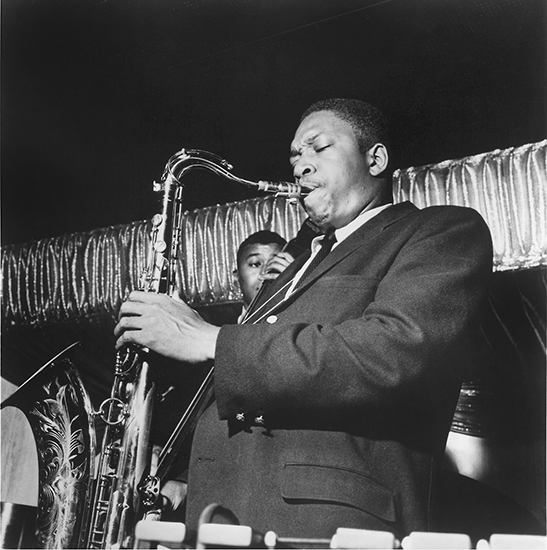
John Coltrane (© Photofest)
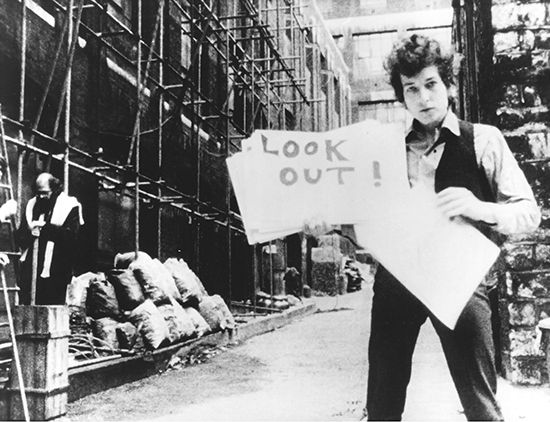
Bob Dylan in 1965, from the film by D. A. Pennebaker Don’t Look Back (© Photofest)
{ 14 }
How does it feel to be booed while performing?
It happened to both Bob Dylan and John Coltrane in the summer of 1965. Dylan was onstage at the Newport Folk Festival in July and Coltrane at the Down Beat Jazz Festival in Chicago that August. Memories of both performances are foggy and often contradictory, but many attending recall rigorous booing: “You could hear it,” Dylan remarked, “all over the place.” Some in the audience, open to Dylan’s electric turn, felt gypped by the brevity of his set. Al Kooper, playing keyboards, claimed that the “booing” arose because Dylan had “only played three songs.”1 Folk traditionalists were offended by Dylan’s amped up music, with the help of the Paul Butterfield Blues Band, and by his refusal to perform protest songs. He seemed to have abandoned his friends for rock-and-roll bluster. “You couldn’t understand a goddam word of what they were singing,” Pete Seeger later complained (although he was upset about the poor sound system).2 Some in the audience screamed “We want the old Bob Dylan,” while others shouted “Traitor” or “Sell Out.”3 According to Dylan’s pal Paul Nelson, the audience yelled, “Get rid of the electric guitar.”4 Another account, by singer Maria Muldaur, who was also there, found folk purists booing and chanting, “Are you with us?”5 The answer to their question was obvious—Dylan was staking out new territory.
Dylan, by all accounts, was “shaken and disappointed” after the concert, yet determined to push his musical turn farther: “I know in my own mind what I’m doing.”6
Harsh notes screamed from Coltrane’s alto saxophone in Chicago. Bandmate Archie Shepp raved with lengthy explorations into the possibility of sounds on his own sax. Coltrane’s liberation should have been anticipated by the audience at Soldier Field. His opening number that day, “Nature Boy,” had been available on the album The John Coltrane Quartet Plays. While the initial batch of bars echoed the familiar tune (it had been recorded first in 1947 with Middle Eastern inflections), Coltrane’s version was from another galaxy.7 When he was enthusiastic about a particular musical route, he kept going, without concern about length. “Well, if you like something for ten minutes,” Coltrane stated, “why shouldn’t you like it for 45 minutes?”8
To some ears, it sounded like noise, like musicians improvising madly, at impossible length. Interviewed a few weeks before the Chicago concert, after experiencing audience dissatisfaction during a performance in France, Coltrane acknowledged that his music tested the limits of his band—and audience. He was dedicated, however, to “playing it until you get it together.”9 Another time he remarked that chords were an “obsession” with him. Sometimes, in his pursuit of their potential, he seemed to be “approaching music by the wrong end of a telescope.”10 One youth present at Soldier Field did not boo, but recalled, “I was not able to understand what he was doing, other than it was ferocious and full out.”11 After sitting comfortably through hours of easy-listening jazz, the audience found Coltrane’s music too dissonant and obsessive for their tastes; many walked out in disgust.12
Such complaints soon became commonplace. A year later, at Lincoln Center in New York City, Coltrane performed in a show billed as “Titans of the Tenor.” The audience responded with some boos to his experimental, extreme jazz renditions. Traditionalist jazz critic Dan Morgenstern wondered, “Has he lost all musical judgment? Or is he putting on his audience? Whatever the answer, it was saddening to contemplate this spectacle, unworthy of a great musician.”13 That same year, McCoy Tyner, Coltrane’s longtime pianist, left the band, finding the chaos onstage too much: “All I could hear was a lot of noise.”14
Only those exiled to Siberia would have been surprised about the musical shifts of young Mr. Dylan and mature Mr. Coltrane. About half the numbers on Dylan’s new album, Bringing It All Back Home (released in March), had been electric. He had already made clear in various interviews his disdain for “boring” protest songs—“finger-pointing” songs, he called them.15 And by 1964 he had told a friend that rock was “where it’s at for me.”16 He had always been chameleon-like, moving from a teenage rocker (idolizing Little Richard, briefly playing with Bobby Vee’s band) to young folk musician. In 1964 he had been impressed with the energy of the Beatles’ songs, then exploding on the American consciousness. He was determined to expand possibilities, not just with instrumentation but with content. Henceforth, he would incorporate poetic reflections, mysteriously confessional lyrics, and ramblings of visionary dreamscapes, into his music, as in the rollicking “Bob Dylan’s 115th Dream” and “Subterranean Homesick Blues” and the beauty of “Love Minus Zero/No Limit.”17
For many years, Coltrane, too, had been famous (or infamous, according to one’s disposition) for musical style shifting. He had apprenticed in many bands, showing himself adaptable to the different styles demanded by Eddie “Cleanhead” Vinson, Thelonious Monk, and Miles Davis. He was always thinking about music, studying its theory and listening to all of its manifestations (Indian, Arabic, Brazilian). Now he was moving in the direction of “the New Thing,” as it was called early on before becoming known as “free jazz.” He would bound into it with abandon. As he admitted, “I am given to extremes.”18
Born in part as a reaction to the commercialization of jazz and the rigidity of certain styles, “free jazz was wildly improvisational and experimental. Politically, it was presumed to reject European musical influence and to be rooted in the African American experience. The music, as developed by Cecil Taylor, Albert Ayler, and Ornette Coleman, was challenging, difficult to grasp. One jazz aficionado after hearing Coleman blow, admitted “He’s out—real far-out … but I don’t have any idea of what he is doing.”19 Shepp had once been a member of the heroin-fueled Living Theatre production The Connection. He played with Cecil Taylor around that time, too, but at first failed, he said, to “know what the cat was doing.” Soon he “felt” the music and found himself. Shepp’s playing was about rhythm, which he considered African in origin and was “liberated from thinking about chords.” Shepp argued in 1965 that his music was “a reflection of the Negro people as a social and cultural phenomenon.” Its “purpose ought to be to liberate America aesthetically and socially from its inhumanity.”20
Both Dylan and Coltrane were rolling stones that gathered no moss. Yet they were in many ways disparate figures. Coltrane was thirty-eight and Dylan just twenty-four in the summer of 1965. From a poor but respectable black family in North Carolina, Coltrane had migrated north to Philadelphia and then, in 1945, entered the Navy, soon playing in the band the Melody Masters.21 Deeply intelligent and well read, a bit self-contained, Coltrane was obsessed with mastering the saxophone, beginning with alto then moving to tenor. His playing initially was sketchy, but through practice, hour after hour, always aware of what others were doing on the instrument, he became something special.
Dylan, born to a middle-class Jewish family in Hibbing, Minnesota, was from an early age a maker of myths, imagining himself as a vagabond, a country rebel, and more. He was described, at the moment he was becoming famous, as an amalgam of possibilities, a combination of “Harpo Marx, Carol Burnett, and the young Beethoven”; in “appearance, the Ultimate Beatnik; cowboy boots, jeans, wrinkled work shirts and dark glasses, plus frizzy, unkempt hair and a lean, pale and haggard face.” A fair description, but by the time the piece appeared in the New York Times in 1965, he had already dropped the beat look for the style of a rebel in motorcycle jacket.22
Details of biography matter little with Dylan and only a bit more with Coltrane. Both were sui generis. Dylan the weaver of tall tales, mask and myth maker; to track down the truth about Dylan, his wild claims and shuffling of facts, is a fool’s errand. Coltrane, saintly in his dedication to sound, was a man who spoke his soul in his music, the rest of him was effaced.
Both of them, however, were sponges, absorbing influences aplenty. It has been widely suggested that each of them filched material or borrowed style too readily from others.23 But part of their genius was their openness to new possibilities, their unwillingness to rest comfortably with what they had already mastered. When asked in the summer of 1965 about the next direction his music might take, Coltrane replied: “I don’t know yet. I’m looking for new ground to explore.” Realizing that change is of the essence, Coltrane stated, “We have to keep on cleaning the mirror.”24 Dylan wanted escape from the stranglehold of protest songs. It was second nature for Dylan to rebel against expectations. Critic Anthony DeCurtis wrote that Dylan had an “inherent discomfort with absolute positions,” hence his rather cagey and confusing responses to generations of interviewers about his political, religious, and philosophical views. Dylan treasured few things more than his autonomy.25
It was creative necessity rather than opportunism that forced them down new, sometimes extreme paths. Ornette Coleman and Albert Ayler may have pioneered the Free Jazz style before Coltrane, but he made it his own form, expanding its borders—sometimes to ear-shattering extents. He pushed their ideas. Critic Ira Gitler once referred to Coltrane’s music as constituting in and of itself “a sheet of sound.” It “could have powered a spaceship.”26 Dylan borrowed melodies and styles of folksinging from Lead Belly, Woody Guthrie, Robert Johnson, Chuck Berry, and Dave Van Ronk, but he transformed material, thanks to his odd phrasing and emotional bite.
According to a distinguished historian, 1965 was “the inaugural year of the 1960s.” A bold statement, certainly. It possesses a grain of truth, especially in terms of politics and race. In that busy year, hope wagged a happy tail. The economy was booming. In October the Dow Industrial Index peaked at the highest level in its eighty-year history, and gross national product shot upward. Unemployment at the close of 1965 was a scant 4.1 percent. For those caught in poverty, change seemed in the offing through President Johnson’s Great Society programs. Having won a landslide election in 1964 over Republican Barry Goldwater, and with a hefty Democratic majority in both the Senate and Congress, Johnson was delighted to sign off on Medicare and Medicaid, the Office of Economic Opportunity, and much more. Anything seemed possible.
Even on the torturous terrain of race, progress appeared to be forthcoming. At Johnson’s behest the Voting Rights Act passed—promising to guarantee the right to vote for African Americans in the South. But progress was opposed by reaction. White police in Selma, Alabama, on “Bloody Sunday” brutally beat civil rights marchers. A few weeks later, however, a march to Montgomery, Alabama, twenty-five thousand strong, was peaceful and attracted wide support. The government, with Johnson under pressure, was moving in the direction of greater racial equality, but it was a tough push.
The war in Vietnam, however, cast a foreboding shadow. With each passing month, its tentacles tightened around Johnson and his foreign policy advisors. By February, bombing of areas in North Vietnam had begun, soon morphing into the program called Operation Rolling Thunder. Agent Orange (a highly toxic defoliant) and napalm were authorized—and employed in copious amounts. American troop levels jumped upward: 40,000 more in April, another 21,000 in June, 50,000 more in late July, ballooning by the end of the year to a presence of 184,000. US casualties inched toward two thousand, with Vietnamese deaths staggering. The ideal of the Great Society, predicated on government spending, came into conflict with the costs of the war in Vietnam, and the deficit rose accordingly.
Protests against the Vietnam War quickened. By the fall of 1965, nationwide events had become common, and, beginning at the University of Michigan, teach-ins educated a generation of college students about the problematic history of the war and our ally South Vietnam (which had undergone a military coup in June).
More startling to many Americans was the mid-August explosion of violence in Watts, a black ghetto in Los Angeles. Years of discrimination, unemployment, and heavy-handed police tactics (almost all the police in the area were white) exploded out of a mundane arrest into a riot. Over the next five days, a total of thirty-four people were killed, thousands were arrested, and many businesses and homes burned to the ground. For white Americans, the road to racial progress became hazy in the smoke of Watts. For white Americans antagonistic to black rights and protest, the Watts riots made segregationist governor of Alabama George C. Wallace popular as a maintainer of law and order—taken by many to be a code term for clamping down on African Americans.27
In a pluralistic culture, hope and anxiety, sweetness and anger, received cultural expression in 1965. The film The Sound of Music, based on a Rodgers and Hammerstein Broadway hit musical from 1959, was a story of hope—about the triumph of love and music over evil. It featured seven adorable children. And the sound of music emanating from their mouths was sufficient (along with the allure of actress Julie Andrews) to unknit even the tightly furrowed brow of Captain Von Trapp. Critic Pauline Kael dismissed the film: “It’s the big lie, the sugarcoated lie that people seem to want to eat,” especially in America, where sentimentalism reigned supreme. American audiences were unfazed. The film grossed more than any other in the history of Hollywood (more than Gone With the Wind), and it won five Academy Awards. The soundtrack of the film was also an immense success.28
In a very different vein, the song “Eve of Destruction,” a song beholden to Dylan in content and singing style, was a big hit in 1965. Sung with gruff sincerity by Barry McGuire, the tune was a cri de cœur. The song spoke to the historical moment—from the anxiety of the Cuban Missile Crisis to the paranoia about madmen with an itchy trigger finger on atomic weapons. McGuire bemoaned the violence “flarin’ ” all around him: “Can’t you feel the fear that I’m feelin’ today?” He even referenced the hatred in Selma, concluding: “And you tell me over and over and over and over again, my friend / You don’t believe we’re on the eve of destruction.”
The Sound of Music and “Eve of Destruction” were symptomatic of the tensions and contradictions of the historical moment. But they were not the works from 1965 that sung out with creative force. They were anchored in the past. This was the moment for the New Sensibility, with its hard-driving experimentalism and sharpened poetry, to explode on the musical scene, thanks to Dylan and Coltrane.
Both Dylan and Coltrane were concerned with civil rights and human destruction. Coltrane’s “Alabama” commemorated the four black schoolchildren killed by a bomb in Birmingham planted by members of the Ku Klux Klan in September 1963. Coltrane’s main melody was based on the rhythms that he discerned in Martin Luther King Jr. ’s speech about the murder. From auspicious silence to explosive tempo, over and over again, Coltrane and his band made sound into musical oration. One critic remarked that Coltrane’s music expressed “all the emotions and expressions of the human being.” Coltrane “tells a story,” as he “laughs, screams, whispers, cries, dances, groans, caresses begs, demands.”29
The Black Arts Movement, led by Amiri Baraka, Larry Neal, and Archie Shepp, arose in tandem with the civil rights and black liberation movements. They believed in something called a black aesthetic, a sort of consciousness rooted in the shared heritage and experience of African Americans. Cultural creation, done in this manner, would raise African Americans to a nationalist and perhaps revolutionary consciousness. Problems arose, however, when black artists depended upon white culture and a white audience. This led to inauthentic and polluted art. Music, according to some in the Black Arts Movement, was the purest expression of a black aesthetic. Free jazz appeared to be the newest manifestation of black identity, a music consisting of shouts and improvisational anarchy, pain and honesty that would lead to black liberation. Just how this was to be accomplished by a sound that was perhaps unintelligible to most listeners remained something of a mystery.30
Ralph Ellison and Albert Murray ridiculed the black aesthetic, claiming that African American and white experiences were historically intertwined, incapable of separation. Great art had to be receptive to the best and most vibrant in any cultural milieu, to practice a sort of amalgamation, shunning cultural exclusivity. The black aesthetic for them was merely a haughty term for a nonexistent and dispiriting artistic ideal—the attempt of political radicals “to impose ideology upon” the complexity of cultural creation.31
In 1965 Coltrane was performing in a free jazz style, often collaborating with its leading practitioners. But there is little indication that he bought into the ideology that surrounded it. Instead, as with so much of his work, his interest was musical more than political—it was a mode of playing that enthused him. Coltrane’s music increasingly challenged traditional jazz categories, confounding his critics and audiences alike. All Coltrane wanted was to keep moving in unexplored dimensions of sound.32
Dylan had gained fame for his protest songs.33 “Blowin’ in the Wind” became a civil rights anthem of sorts, especially when he performed it at the March on Washington in 1963. Another song from that period, “The Lonesome Death of Hattie Carroll,” told the story of a black hotel worker killed by a savage blow from the cane of William Zantzinger. The white murderer received a slap-on-the-wrist six-month jail sentence. This outraged Dylan, so he penned the haunting refrain:
And you who philosophize disgrace
And criticize all fears
Take the rag away from your face
Now ain’t the time for your tears.
As Andrew Sarris observed, the song “is the only memorial Hattie Carroll is ever likely to have.”34 Other Dylan songs had targeted American militarism and fanaticism, as in “Masters of War,” “Only a Pawn in Their Game,” or “Talkin’ John Birch Paranoid Blues.”
And yet, in the midst of the social turmoil and change—perhaps because of it—Coltrane and Dylan embarked on inward musical journeys. Dylan, as biographer Ian Bell put it, entered his “apolitical phase.”35
Coltrane, by 1965, was following an increasingly spiritual path, reaching out for transcendence, for acknowledgement of some sort of divinity. He had in the 1950s been a heroin addict and alcoholic, finally quitting heroin cold turkey in 1957. By the mid-1960s, he started using LSD, which impelled him more deeply into mysticism in music and philosophy. He wanted his music to possess “strong emotional content”—to reflect the times and his desire to be at one with the universe.
Dylan’s songs became more personal and pointed, filled with poetic reverie and undiluted anger. Their lyrics were confessional but without easy markers for the audience to engage. He was now backed by rock musicians, making his music even more jarring and extreme. “You got a lotta nerve to say you are my friend,” he sang harshly. He strove to be his own man. As his girlfriend from his early years in the Village put it, “Bob always did as he saw fit.”36 But he did so in a masked manner, so that the particulars of his confessional style were transformed into something more formidable, something more universal.
The year 1965 was a crucial and busy one for both artists as they moved in new directions. Coltrane’s A Love Supreme (recorded in December 1964) was released. In that year alone, in addition to The John Coltrane Quartet Plays, released in June, he recorded three other works, Kulu Sé Mama (recorded in May and June), Ascension (recorded in late June), and Meditations (recorded in October). Dylan opened the year by recording Bringing It All Back Home (released in March), followed by Highway 61 Revisited (released in late August), with the hit single “Like A Rolling Stone.” After a world tour, and taking time off from a US tour, Dylan recorded his haunting “Visions of Johanna,” which would be part of his next work, Blonde on Blonde (released in 1966).
The idea for A Love Supreme came to Coltrane around four in the morning on a fall day after he had completed his daily meditation. He felt God’s presence more fully than ever before and believed that God commanded him to compose a work of commemoration. According to his wife, Coltrane went into seclusion for four or five days, finally emerging “like Moses coming down from the mountain.” He seemed beatific and enthusiastic: “This is the first time that I have received all the music for what I want to record, in a suite. This is the first time I have everything, everything ready.”37 Transposed onto paper, the score called for nine musicians, their instruments to sound out that “all paths lead to God.” With the final notes, as he wrote on the score, the bass players were to “say Amen symbolically.”38
A Love Supreme appeared in February 1965. Coltrane contributed the liner notes, which revealed his state of mind to be in perfect consonance with the music. He acknowledged that in 1957 he had “experienced, by the grace of God, a spiritual awakening” that had granted him “a richer, fuller, more productive life.” As most jazz aficionados had grasped, for four years up until 1957, Coltrane’s life seemed to be on a downward spiral because of his use of heroin. Redemption had put him on “Straight Street.”39 He intended A Love Supreme to be an offering of thanks to God.40 Not only was he enjoying professional success (Down Beat magazine named him Jazzman of the Year for 1965), but he and his wife had greeted a second son in August. The recording, about a half an hour in length, consisted of four parts, “Acknowledgements,” “Resolution,” “Pursuance,” and “Psalm”—in effect, Coltrane’s version of a pilgrim’s progress.41
The liner notes were accompanied by a poem that Coltrane had composed, appropriately titled “A Love Supreme.” Coltrane’s visions were ecumenical, suffused throughout nature and the self, in “thought waves—heat waves—all vibrations—all paths lead to God.” And, most importantly for Coltrane, God in any guise—Christian, Jewish, Buddhist, or some other representation—was “gracious and merciful.” Jazz music, with its pulse and vibrations—dropping down to a blues register or soaring as high as a note could climb—seemed to Coltrane the perfect vehicle to praise God and to express “ELATION—ELEGANCE—EXALTATION.”42
Homage to God had certainly long been central to the African American experience, especially in gospel and, in some cases, the blues. It had only recently begun to assert itself in the jazz repertoire. In 1961 Grant Green had recorded a mellow album, Sunday Morning, and Duke Ellington had been composing for a few years in the early 1960s a series of works called Sacred Concerts, the first of which was finished in 1965. There was also Albert Ayler’s Spiritual Unity, which was roughly contemporaneous with A Love Supreme.43 Ayler, along with bassist Gary Peacock and percussionist Sunny Murray, offered an explosion of divine sound. Sections of the work were titled “The Wizard,” “Spirits” and “Ghosts,” with the latter two offered in different variations. What made the squeals of Ayler’s sax and the band’s unhinged rhythms holy were the brilliant pauses. It seemed as if, in the midst of chaos, God had breathed perfect calmness into the lifeblood of the music.
Coltrane knew exactly what he wanted from the score for A Love Supreme. It was to offer listeners a tale of his own journey to transcendence and belief, and, perhaps just as importantly, to suggest that “all paths lead to God,” which he equated with “Ultimate Reality.”44 This Kierkegaardian and mystical perception was consistent with Coltrane’s own spiritual inclination. Although he came from Baptist roots, his reading regimen was voracious and eclectic. He read about African religion and delved into the Kabbalah, as well as Buddhism. Astrology, scientology, Kahlil Gibran, and Edgar Cayce—he dug into all of them. At first, the diverse emanations of the Divine “screwed up” his head—could there, then, be but one God? After much soul searching, he concluded that all religions were essentially the same, however different their rituals and theology. Religion was simply about faith and redemption. In A Love Supreme, as Coltrane stated, “I just wanted to express something that I felt; I had to write it.”45
The musical brilliance of A Love Supreme was in its ability to build a mood, a sense of security in the raucous banter of the various instruments, rollicking extremes of experimentation (pushing notes to their limits), and abrupt shifts in chords. Saxophonist Joshua Redman’s characterization of jazz in general as being built around “tension and release” applies perfectly to the spiritual journey in A Love Supreme.46 The tension that day in December, when all of the musicians were working on the album, must have been immense; perhaps because of this, and because of the need for release, they completed the work in a single, long session—a departure from Coltrane’s common practice of recording sessions extending for days.47
The lights in the recording studio were turned down low to create the proper atmosphere for an album that chronicles movement from the darkness of a lost soul to the light of transcendence. Coltrane had written only a sketch of the score, and he offered the musicians little guidance, preferring to rely on their familiarity with one another’s styles and “keeping the form in mind.” Drummer Elvin Jones approached the music as he normally did—willing to “just follow” Coltrane’s lead.48
Reminiscing almost four decades after the recording, Jones acknowledged that while “the quartet never really talked about the spiritual aspect,” it lurked in the music and the camaraderie of the musicians. The result was an album Jones felt was “not even jazz. It broadened the concept of what music was. It’s totally spiritual.”49
The recording begins in unusual fashion, with Jones hitting a Chinese gong. As the tingle faded, Coltrane enters with tenor saxophone, playing the notes as if reciting a prayer. The opening passages are of great beauty and magnificent syncopation—as if he is taking listeners to church. As he intended in his score, the music riffs on the blues and features typical Coltrane touches. In the words of Ashley Kahn, Coltrane “starts to hang on phrases, playing long tones, nudging the music into a more meditative pocket.”50 There is the repetition of the piece. As Kahn further explains, “Coltrane blows the four-note pattern thirty-seven times in methodic succession.” In the section “Acknowledgment,” Coltrane does something striking. He begins to chant “A Love Supreme” away from the microphone. Luckily, producer Bob Van Gelder had changed the microphone level so that the words could be recorded in full. Nineteen times Coltrane utters the phrase, but on the fifteenth repetition, his “voice drops a whole step from F minor to E-flat minor.”51 He had achieved a work that blurred the lines between jazz improvisation and spiritual salvation, one that took notes to extremes as the only manner in which to pay homage to spiritual truth. It is a holy record.
Dylan was repeating phrases, but less transcendentally than Coltrane. He spit out “How does it feel?” with rage in his hit song “Like a Rolling Stone,” which exploded on the radio airwaves in the summer of 1965.52 It was unlike anything previously done in rock and roll. The voice was strident, raspy, and limited in range. No matter. Rock had often dealt with failed love or teen disappointment, but in formulaic and tender terms. This song bit into its subject matter, gnawing past tired adages to the beating heart of things. Rock, in Dylan’s hands, had become a vehicle to express rage, to serve as a put-down. And the song tested the attention span of listeners, becoming one of the longest singles ever to play on Top 40 stations, going on for more than six minutes.53
The song had been a tough one to record. Dylan had to condense twenty-pages of lyrics—“this long piece of vomit,” he called it.54 He succeeded, but in the recording session problems arose. Dylan usually nailed most of his songs in one or two takes, but “Like a Rolling Stone” just didn’t sound right. Two days in the middle of June had been wasted trying to refine the tune and try out different angles. Things came together, in part, by pure happenstance. The presence of a great guitarist Mike Bloomfield on the session rendered Al Kooper’s guitar work superfluous. In the midst of increasing frustration in the studio, Kooper wandered over to the organ and began playing, hitting upon the opening for the song. Bloomfield joined in, the band cranked up, and Dylan then put down on vinyl a great song.55
From the introductory organ lines, the song drew listeners into its world. With Dylan’s “Like a Rolling Stone,” new vistas opened. He had managed to take the energy of some doo-wop (common to inane but energizing tunes like “Rama Lama Ding Dong”) and wed it to something more real and poetic.
The initial words were sublime in being so out of place: “Once upon a time,” sounding familiar to a generation reared on children’s fables.56 Dylan sings about a young woman, once haughty and regal, who is now adrift, reduced in stature, stripped of the power to beguile. She had been warned of a fall (“People call, say ‘Beware, doll, you’re bound to fall’ ”), but failed to take heed. She has fallen from grace thanks to her unchecked hubris, only to be left alone and friendless. The song offers no sense of lessons learned or hubris overcome, or redemption—only the haunting, mean-spirited bark of the chorus:
How does it feel
How does it feel
To be on your own
With no direction home
Like a complete unknown
Like a rolling stone?
“Like a Rolling Stone” hit a nerve with listeners, even if its particulars sometimes seemed mysterious to the point of obfuscation. One journalist remarked to Dylan at the end of 1965, “I don’t understand one of your songs.” Dylan’s jaunty response was that if you don’t get it, then the song was not meant for you. To a similar question, Dylan replied, “If I told you what our music is really about, we’d probably all get arrested.”57 Against those looking for deep meaning in his work, Dylan quipped that he was nothing more than an entertainer, “a song and dance man.”58 The song, and increasingly Dylan himself, resisted easy interpretation, perhaps exemplary of what Sontag had recently heralded as central to the New Sensibility, being “against interpretation.”
Certainly many ignored this imperative to grasp deeper meaning, preferring to link the lyrics with the “facts” of Dylan’s life. Most suspected that the song exacted revenge on a woman who had offended Dylan, scorning him when he was a scruffy nobody. Others wondered if it was about Edie Sedgwick, whose moneyed background and elfin beauty had failed to protect her from the seduction of drugs and the Warhol circle’s narcissism. Some thought Dylan had been in love with her, or she with him; others that he had felt pity as a result of what was happening to her.59 Might it be a riposte against the hedge of hypocrisy grown high in the 1950s and still obscuring the reality of a harsh, unfair world? Or might it be an existential lament, a recognition of our being thrown into the world, tossed about by contingency, and forced to navigate by dint of the courage to exist?60
Anger—laden with surrealistic imagery—became central for Dylan in this period. In “Ballad of a Thin Man,” Dylan trained his sights on an eponymous figure, “Mr. Jones.” As in “Like a Rolling Stone,” the issues are illusion, ignorance, and fear of being alone:
You hand in your ticket
And you go watch the geek
Who immediately walks up to you
When he hears you speak
And says, “How does it feel
To be such a freak?”
And you say, “Impossible”
As he hands you a bone
The words are powerful and nicely confusing. What ticket is being handed in? In what manner is Mr. Jones a freak and why is he being given a bone? This song sounds like a critique of conformity, of stepping ever too gently out of one’s normalcy, ever ready to retreat from the new and challenging. But the refrain of the song is what beckons, “Because something is happening here / But you don’t know what it is / Do you, Mr. Jones?”
Some of the rage Dylan directed was against those who had dismissed and abandoned him when he took his electric turn away from folk music or those who seemed to cling to his fame. This became apparent in “Positively 4th Street,” composed four days after the debacle at Newport.61 It is a diatribe of hurt feelings and revenge against those who pricked his sensitive skin: “You got a lotta nerve to say you are my friend / When I was down, you just stood there grinning.” The put-down concludes with Dylan explaining to this erstwhile friend that it is “a drag … to see you.”
Thankfully, Dylan’s prolific songwriting pen drifted beyond anger. He was experimenting with poetic dreamscapes, with stringing together images in a surrealistic fashion that would be beyond interpretation. This was common fare for serious poetry but rare in the idiom of rock music. He had gobbled up Rimbaud, Apollinaire, Blake, Ginsberg, and Eliot—drawn especially to their abrupt juxtapositions of images. That Dylan should identify with the outlaw poet Rimbaud is hardly surprising. Rimbaud, too, was an identity shifter, a wild palimpsest. Dylan recalled reading Rimbaud’s words “I is someone else.” As he put it, “When I read those words a bell went off. It made perfect sense.” The persona of the Other dominated his poetry as he created an original dreamscape.62 In one song, “Desolation Row,” the lyrics create an atmosphere of mystery and the absurd: “They’re painting the passports brown / The beauty parlor is filled with sailors / The circus is in town.” A seemingly endless mix of fictional, historical, and biblical characters populate the over-eleven-minute song, from “Dr. Filth” and Einstein to Cain and Abel.63
Dylan in 1965 found a way to combine the raucous energy of rock with poetic rambles into the absurd. One magazine nominated Dylan “the American Yevtushenko,” after the then-popular Soviet poet.64 But Dylan rejected most labels, including poet. “I don’t call myself a poet,” he said in 1965, “because I don’t like the word. I’m a trapeze artist.”65
Dylan’s images hit hard and fast. In “Subterranean Homesick Blues,” memorable lines became part of the vocabulary of politics and sensibility in the 1960s. The radical wing of Students for a Democratic Society, which turned to violence in 1969, took their name from a line in the song, “You don’t need a weatherman to know which way the wind blows.” Others found a more peaceable anarchism in the line “Don’t follow leaders / Watch the parkin’ meters.” Finally, in perhaps his strongest song of the year, along with “Like a Rolling Stone,” Dylan devoted himself to the elusiveness of love and identity, trying to capture a love now vanished. “Visions of Johanna” (which would be released in 1966) is beautiful in its lyrics and wrenching in its content and floating surfaces of meaning. Charles Nicholl called it “an hour-of-the wolf song. It comes out of some back-room of the soul.” The lyrics of the song would even be printed in Glamour magazine.66 The song beckons with mysterious ruminations about Louise rather than Johanna, as Dylan takes us into the nightscape of New York City: from a beautifully mundane apartment where “the heat pipes just cough” to scenes of hookers riding the subway and night watchmen on patrol. Dylan is on familiar turf with his surrealist imagery: “Inside the museums, Infinity goes up on trial/ Voices echo this is what salvation must be like after a while.” Yet, what remains and tugs at the memory of loves gone are the mentions of Johanna that conclude every stanza.
From the initial electricity of his guitar and backup band’s reception at Newport in 1965 to the release of the double album Blonde on Blonde a year later—Dylan had brought a poetic energy into the realm of rock, a new sensibility that would soon force others (from Lou Reed to Patti Smith) to venture into the dangerous but fascinating seas of creativity.67
By the end of June, when he recorded Ascension, with seven musicians (including tenor saxophonists Pharoah Sanders and Archie Shepp and trumpeters Freddie Hubbard and Dewey Johnson) joining his regular quartet, Coltrane had convincingly embraced free jazz. Being a man given to extremes, Coltrane was establishing himself, according to jazz historian Ted Gioia, as “the most radical of this new school.”68 Some wondered if Coltrane had shifted anew, opting for chaos over the transcendental order of A Love Supreme.69
The album was forty minutes of music that traditionalist jazz fan and poet Philip Larkin would describe as “ugly on purpose.”70 Others in the jazz world, according to a New York Times columnist, would “squawk and shriek and bleat” about a work that was beyond their level of appreciation.71 Certainly there was much that was shrill, circus-like cacophony of instruments blaring out their improvisations, a duel of sorts in which the logic of the piece shattered like a broken vase. At times, it sounded like modernity condensed into instrumental form, rushing about, blaring, and curdling the milk of serenity. The first seven minutes of the album were chaotic and edgy, somewhat like a Cage piece. It was nothing more, perhaps, than a group of musicians warming up, playing a wide array of scales, unaware of anyone else’s presence or peace of mind. Suddenly, the first of the tenor sax solos lofts sweetly, nicely joined by steady drum beats from Elvin Jones, then beautiful piano from McCoy Tyner.
All of the solos—from the tenor saxophones, trumpets, drums, and piano—were testaments to the musicians’ virtuosity, taking listeners to a higher plane of consciousness. There was a sort of organic wholeness to the work, a sensibility that was shared by eleven musicians for just about forty minutes of recording time. Soon, however, as the band members jump in, a trumpet solo of supreme beauty, its staccato notes ringing and lifting into a joyous scream, is tossed to the side, and we are back to group improvisation.72 Coltrane was cognizant of the furor that he kicked up in Ascension, but with typical understatement, he reported that he enjoyed recording the album: “I enjoyed all of the individual contributions on that.”73 As always, time to move on.
Coltrane could move forward without abandoning familiar themes. The spirituality of A Love Supreme reappeared in Meditations, recorded in October. Again, he augmented his usual quartet with an extra drummer and pianist, and even added a percussionist from Africa. The opening number is called “The Father and the Son and the Holy Ghost.” The feel in this number is apocalyptic, as if the Holy Trinity were engaged in a battle royal. The harsh tenor opening is quite different from the sweetly religious intonations that graced A Love Supreme. There is little chance that Coltrane intended to criticize Christianity in any fashion; he was quoted by Nat Hentoff on the album’s liner notes as saying, “I believe in all religions.” The other sections of the album continue with the religious theme, being titled “Compassion,” “Love,” “Consequences,” and “Serenity.”
While “Compassion” is toned down a bit, especially by a lovely piano solo, the reverie is interrupted by the entry of saxophone whirlwinds, about four minutes in. Only when the piano returns later is there anything that might feel like musical compassion. In “Love” the saxophones are often tender and exploring, and bassist Jimmy Garrison is magnificent with his plucking to evoke the depths of love. But love does not triumph as in the long section “Consequences.” This is surprising, because Coltrane consistently argued in interviews for the power of love, as expressed in music, to uplift the individual. Perhaps in the aftermath of the Watts Riots and the escalation of the war in Vietnam, both of which weighed heavily on him, Coltrane decided that love was, to a degree, often misplaced, a function of trying to impose one’s will upon another. This is speculation. We do find peace in the final section, “Serenity,” as the saxophones repeat phrases in a meditative and soothing manner. Maybe, in a world of violence, the offer of moments of serenity was a significant achievement for Coltrane and his music.74
The times they were a-changing, especially for Coltrane. His longtime friends and associates in the quartet, Elvin Jones and McCoy Tyner, announced their departure from the band following Meditations. In part, they did not like playing with and against other drummers and pianists in the band. Nor did they agree with what Coltrane “wanted to do in music.”75 The new players that he added to the band presented him with new energy and spirit, and that was what he needed at the moment. As he explained in the fall, 1966, he had “to keep going all the way, as deep as you can. You keep trying to get right down to the crux.”76
Disaster soon arrived for both Coltrane and Dylan. In 1967, before he turned forty-one, Coltrane died from a quickly developing cancer. Coltrane liked to say, “Life is change”—and that had defined his life and music.77 At the end of July 1966, Dylan was injured in a motorcycle accident near his home in Woodstock, New York. Even if incapacitated, Dylan transformed necessity into opportunity, retreating and reinventing himself. He moved away from the raucous diversity of his double-album Blonde on Blonde to the more subdued acoustic sound of John Wesley Harding in 1967. The music was pared down, the content drifting between an ode to classic outlaws and to the harshness of the Old Testament.
Dylan and Coltrane, a pair of magical performers, shape-shifters. With their willingness to sup at the table of new possibilities already laid in the mid-1960s, they embraced the pluralism and possibility of the New Sensibility. It would never contain them—no cultural force could—but they would push its boundaries both in style and content.