
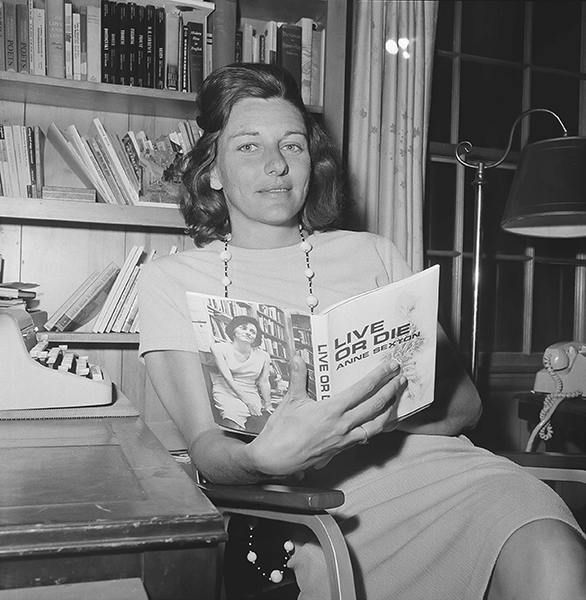
Anne Sexton after winning the Pulitzer Prize for poetry (1966) (AP Images)
{ 15 }
The darkening of the house in November dusk was held in abeyance by the flicker of candlelight. It was Anne Sexton’s thirty-eighth birthday, and it should have been a happy moment. Her book of poems, Live or Die, had been published in late September and would go on to win the Pulitzer Prize. Sexton was at the top of the staircase, probably holding a burning cigarette in one hand. If true to form, she grasped in the other hand a half-empty cocktail glass. Perhaps she had already taken some of her many prescription medications to dull the mania and control the depression. On the way down, one of her high heels caught on “the gold carpeted stairs.”1 Then, “sailing queerly like Icarus,” she fell down the stairs, breaking her hip and spending ten days in the hospital.2
Icarus, who flew on waxen wings crafted by his father, Daedalus, ventured too close to the sun. The wax melted and Icarus plunged to his death. Sexton often turned to the figure of Icarus in her poetry. Like him, she wanted to escape, and she was drawn to the sun. Perhaps, too, she identified with his hubris, his desire to soar creatively. Alas, as with Icarus, the higher she lofted, the greater her fall back to earth.
In October, one of Sexton’s many absurd, desperate love affairs had ended abruptly. Always craving affection, she had become involved with her psychiatrist—Dr. Frederick Duhl. On the couch in his office, they had sex, which was a therapy of sorts for her. Her husband, Alfred (known as Kayo from childhood) dutifully paid the bills, aware of, and frustrated by, what was transpiring. Once the affair had been discovered by Mrs. Duhl, it ended quickly.3 Sexton was searching for a rock, something solid to hold onto. But she rarely found the proper object to satisfy her need for protection and love. Sexton chose to describe herself thusly: “I am watercolor. / I wash off.”4 But such affairs were both necessary and painful for her. Kayo realized this, writing to her: “I love you, want to make everything OK, but it’s beyond my power.” The wittiest commentary on this came from Sexton’s friend poet Maxine Kumin, who wrote: “Imagine paying to get laid twice a week!”5
Sexton’s poetry did not “wash off.” It was indelible—a creative palimpsest of her torrid personal life. If Mailer was the king of unbound egotism, Ginsberg drenched with outrage and emotion, Sexton was the queen of relentless self-revelation. All shared an unhinged amount of “self-absorption,” as poet Mona Van Duyn observed in 1970.6 Sexton became famous as the “confessional” poet par excellence (she preferred the term “personal poetry” for her work). Against the dictum issued in 1927 by T. S. Eliot that poets should strive for “continual extinction of personality,” Sexton stocked each page with the daily rhythms of her life and the deposits of her depressed mind. As one of her daughters put it, Sexton “made her illness into a career.”7
This is not to suggest that she simply vented her personal feelings, letting her excess spill out onto the page. The honesty and artistry of the poetry triumphed. As Sexton told a correspondent, “I am given to excess. That’s all there is to it. I have found that I can control it best in a poem… . If a poem is good then it will have the excess under control.”8
Illness stalked nearly all of her poems, but she was not confined by it. She pushed the envelope of poetic content to include issues that had heretofore been hidden: menstruation, abortion, cancer, and childbirth. And, of course, the glory and failure of love. Sexton wrote with honesty, but as a creative artist she was fully capable of massaging and manufacturing facts to fit a mood, to capture an emotion, to render a poetic point. There had, of course, been many poets who trafficked in confession, from Donne to Whitman. And she had learned from her contemporaries W. D. Snodgrass and Robert Lowell. But as male poets their experiences were often confused with the universal, while Sexton’s were better kept, in the mind of some critics, in the bathroom cabinet of her home. Lowell, her early mentor, who had assumed a confessional voice in Life Studies, judged that Sexton had taken the confessional form to extremes; she had become “meager and exaggerated,” sometimes downright “embarrassing.”9 Another critic, comparing her to the mainstays of confessional poetry—Lowell, John Berryman, and Sylvia Plath—concluded that her work “carried to greater extremes” the imperative to confess, to display one’s life upon the page.10 Even Sexton’s eldest daughter worried about her mom’s “tendency to disrobe verbally in public.”11
The New Sensibility focused on confession, madness, and rejecting a sharp distinction between the personal and the poetical. It was also about making art into performance. On the last issue, Sexton was an uncapped performative oil well; she was always acting out. Again, her daughter’s remark is informative: she had an “inability to set limits for herself, to refrain from acting out nearly every impulse.”12 She demanded attention, thrived on it. “I am nothing,” she recognized as early as 1958, “if not an actress off the stage.”13 There was, of course, a strong dose of narcissism in confessional poetry, especially in Sexton’s. But her range was more broadly encompassing, more than a cataloguing of internal turmoil.14 She was addressing, in many ways, the general plight of women in America. And she was forging an identity—that of poet—and juggling the reality of her madness with an attempt for some semblance of order in her work and life; she was, after all, married with two children when she came to national prominence as a poet.15
Sexton properly presented herself as the tormented poet. Her mania was neither self-induced nor caused by drink and drugs—she was mentally ill. The drink and drugs that she consumed in profound qualities only added to the tumult. For most of her adult life, she harbored with sad consistency a death wish. After her first suicide attempt in 1955, many others would follow or be roadblocked by sudden commitments to psychiatric hospitals.16
Death was her muse and her demon. Poetry may well have helped keep her alive. Again, Kumin on Sexton: “She lived her poetry, poetry was her life… . It had saved her life… . She was on loan to poetry, as it were. We always knew it would end. We just didn’t know when or exactly how.”17
Growing up as an indifferent student, unpampered by familial love, and in a house where liquor consumption was abundant, Sexton lacked direction and options. She later claimed to have been depressed as a teenager. She compensated for innate shyness by being flirtatious and witty—and she was strikingly attractive in a tall and willowy way. She had shown poetic promise in high school but laid aside her notebooks and became “boy crazy.” Like so many young women growing up in the 1940s, marriage seemed laid out as her natural path. Although she was engaged to another boy, she fell hard for Alfred Sexton in May 1948. A few months later, after presumably missing a period and becoming convinced that she was pregnant, the youthful pair drove to North Carolina to marry. Her period arrived, but it failed to deter their love-struck plan to be married.18
Over the next eight years, their lives resembled that of many other young couples—military service for the man, occasional work for the woman, birth of girls in 1953 and 1955. But for Sexton depression was increasingly her constant companion. By 1956 depression had led to attempted suicide. In one of those remarkable moments, Sexton’s psychiatrist Martin Orne, recognizing her need for a creative outlet and verbal talent, recommended that she begin writing poetry. She did, with enthusiasm, dedication, and self-exploration. The poetic turn constituted for her “rebirth at twenty-nine.”19
Her talent and original voice were apparent from the outset, but she lacked much in the way of technique and a sense of the poetic canon. She started attending a poetry workshop at Boston University, where she became fast friends with Kumin. As each of them grew to fame as poets, they supported one another (although Sexton was generous as a critic and listener, she was the one that needed extra care, unable to deal with simple household chores, being alone, or navigating a trip to the supermarket). They often talked on the phone for an hour each day, reading lines of poetry to one another. Within a short time, Sexton was a dedicated presence in the lively field of Boston-area poetry—taking a graduate seminar with Lowell, hanging with fellow poets Sylvia Plath and George Starbuck. What she needed from these figures, she later acknowledged, was “taste”—the ability to separate the dreck from the diamonds. Her concern with proper form in these days was exacting and obsessive. Sometimes she would revise and redraft a piece hundreds of time, looking for the proper line, image, and rhythm.20
Poems flowed ceaselessly. Soon they were being published and fellowships were being awarded. By 1959, only a handful of years after taking up poetry, her first collection, To Bedlam and Part Way Back, was under contract with the prestigious publisher Houghton Mifflin.
Sexton’s story—at least until she gained fame as a poet—could be viewed in the terms popularized in Betty Friedan’s bestseller The Feminine Mystique (1963). The pace of liberation in all sectors of America was quickening. Examining “the problem without a name” through the lens of sociology and her own experiences, Friedan decried how women were denied liberation, shunted into suburban emptiness. It was a book that breathed with rage—at one point, she equated being a woman with the shocking metaphor of being in a Nazi concentration camp. The suburbs bred despair and loneliness. Women needed to liberate themselves, to find the “courage” to make hard choices and change their situation.21 The book had an immediate impact. Activist Sheila Tobias recalled, “Almost every woman of my generation can remember where she was the day she first came upon” The Feminine Mystique. Her own “sense of life’s possibilities changed” after reading the book.22
Turned on to the book by Kumin, Sexton read it enthusiastically, scribbling assents in her marginalia.23 A year before Friedan’s manifesto, Sexton had published her second collection of poetry, All My Pretty Ones, which dealt with her family history, loneliness, abortion, and various hospital rooms, all saturated with her pained death wish. The emptiness of suburban living was depicted in the poem “Housewife” (“The walls are permanent and pink”).24
In many ways, Sexton had been a prisoner of domestic life, at least in the period before she engaged her poetic muse. Her poetry can be read as feminist, in its striving for a liberated voice and its recurrent themes, many of which were particular to women. According to poet Louise Brogan, Sexton “usually [wrote] from the center of feminine experience.”25 But to frame Sexton as a frustrated homemaker seeking creative outlet tells only part of the story. Although she often presented herself as a victim—of various forces, including her status as a woman dependent upon a man—she viewed herself, as critic Robert Boyers wisely observed, as both victim and tormentor.26
In the 1950s Sexton’s mental illness roiled, and poetry failed to calm her. She exulted, however, in the fame and challenges that it brought. She continued to flirt with suicide and shuttle back and forth between staggering depression and manic excitement. She had many ruinous affairs—some carried out in correspondence, others in cheap motels. Her family life was combustible. When her husband was away on one of his many business trips, she trembled with loneliness and fear. Her mother-in-law and hired help managed the children and domestic chores while Sexton perched on her chair, engulfed in cigarette smoke and piles of books, in a trancelike state, and wrote poems. When Alfred was working locally, he would return home around five, and he and Anne began their lengthy ritual of cocktails, followed by banter that turned ugly—as Anne stuck her stiletto of criticism deep into her husband’s hide. Unable to respond as an equal with verbal fisticuffs, Alfred would slap and punch Anne into silence. Her screams would sometimes bring the children rushing down from hiding upstairs to separate the combatants. Rather than being repulsed by her husband’s physical punishment, she accepted it, especially when he was contrite, showering her with now guilt-ridden love. Her daughters, at tender ages, were forced to become caregivers for their mother, whose self-absorption was at once impressive and debilitating.27
The problem facing Sexton in 1966 was simple. She had a new book of poems under contract, which she intended to title Live or Die. As she glanced through the sheaf of poems ready for inclusion, it became apparent that nearly all of them dealt with her familiar subject of death. Where was the imperative to live? After all, as she noted in a New Year letter to the writer Tillie Olsen, “My work, at present, is [in] a dreadful slump,” much like her marriage, which was “as fragile as a cracked egg.” Such a “blue mood”28 was evident in a poem she composed on February 1, called “The Addict.”
Given Sexton’s penchant for self-revelation in her poetry, it is difficult not to read the poem as largely autobiographical. For someone often fingering the sharply appealing edge of death but also connected with family, various lovers, and her creative world, Sexton’s medications were her lifeline, coming out of “sweet pharmaceutical bottles.” Her nightly dose of “eight chemical kisses” grants her existence but also serves as a “diet from death.” Like everything else in her life, the medications are beloved and belabored, part of a “war” that promises no clear victory, other than a final dance with death.29
An answer of sorts to her “blue mood” and the dangerous drama of pill consumption arrived later in January. The family’s Dalmatian, Penny, gave birth to eight puppies, as the Sexton family gathered round to celebrate the moment. The poem “Live” allowed a slant of bright light to lessen her generalized pain. It began, however, with typical Sexton lacerating honesty: “Well, death’s been here / for a long time.” Her suffering, couched in the imagery of religious desire, poured forth. She might clothe her body stylishly, but it failed to hide her desire to choke the life out of that very object. She realized that her own sickness troubled others, who often had to stand helplessly by as she wrestled with mental illness. But in the third stanza, a shift occurs away from the focus on gloom and death. First, she celebrates the sun. The dependable sun, giving warmth and life—“her yolk moving feverishly.” Sexton was a lover of sunlight, but since 1964, when she had begun taking the drug Thorazine, she had become severely photosensitive.30 But the metaphorical light of the sun had illumined—even if only temporarily—all that was worth cherishing: “a husband straight as a redwood,” her daughters, and more. Instead of a powerless, heavily medicated victim, Sexton reframed the narrative, celebrating her role as an artist and homemaker: “an empress/I wear an apron/My typewriter writes … Even crazy, I’m as nice/ as a chocolate bar.”31
Enter the Dalmatians as further affirmation of life. Each puppy emerges from their mother’s womb to be held and nurtured. Sexton claims in the poem that she had been told by others that some of the puppies should be killed. “Pails of water” for drowning stood by but went unused. There was beauty in this birthing, and it warmed Sexton, making her think that she could push to the side her demons of death.
Ten days after completing “Live,” Brice Howard and Richard Moore showed up at Sexton’s house in Weston to film her for a National Education Television program, USA: Poetry. Sexton was spectacularly alluring and animated, seductive and playful. She performed brilliantly for the camera—although she maintained that “they could never get the real Anne Sexton with their camera eye and their sound box.” How could they, since she was always theatrical on the page and stage, shifting her identity from romantic hijinks to dark shadows of depression and death?32
She began reading from “Menstruation at Forty,” cigarette in hand, comfortable in the presence of the camera. The scene is interrupted by one of the Dalmatians; later Alfred is caught lurking in the background. Anne coaxes him into full view, despite his uneasiness—“Don’t be camera shy,” she says. At another point, she jokes with one of her daughters, hugging her manically, proclaiming, “We hate each other” while also shouting that they love each other dearly.
These domestic interruptions cannot blunt the piercing nature of the poem. As she continues with “Menstruation,” she intones the line “I feel the November / of the body, as well as of the calendar,” which records the coming of her birthday. At such times, Sexton is bewitched with suicidal thoughts, with a “hunt for death.” However, the poem is revealing beyond its language of blood and death. It also captures a sense of loss, of the being that might have been which is washed away by the menstrual flow. It is about an unborn son whose presence would somehow redeem her. She reads it with her raspy voice, plaintive and powerful—a performance that somehow makes the blood seem both more and less real.
At one point during the filming, she sits listening in rapture to a piece of music. Her commentary is clearly pointed, a performance that proves daring and emotional. “This song is like making love,” she states. If that were not a sufficiently shocking overture for a public television audience, she reveals to her interviewer, “I wouldn’t want to have an orgasm in front of you.” Her words, however, were edited out of the program.33
The fleeting nature of the orgasm, that spasm of raptured delight, segues into her reading of another poem, “Wanting to Die,” which dwells on suicide and mortality. The poem makes clear that death’s “sad bone … waits for me, year after year.”34
The spring and summer of 1966 proved, as usual, both troubling and exhilarating for Sexton. She filled her lungs with love. She and the poet-novelist James Dickey were engaged in epistolary flirtation—she wanted a poetic soul to rely upon. He had been critical of her early works, finding All My Pretty Ones “a curious compound of self-deprecatory cynicism and sentimentality.” Dickey also worried that the confessional mode had emerged as a “new orthodoxy”—“tedious” with success, little more than an “outspoken soap-opera,” mostly of interest, he implied, to housewives. Such harsh comments, paradoxically, made him more alluring to Sexton. She felt that he recognized, and perhaps identified with, her “deep, painful” life.35 They grew closer in 1966, and she was pulling off “her female con” on him.36 As she contemplated a series of readings, which would take her near Dickey’s domicile, she wondered if they should rendezvous: “I could meet you in the afternoon, perhaps early, or for dinner, cocktails yum yum and dinner.” This was followed by a line, crossed out by Sexton, “And then go on from there.” But she warned off Dickey, too. “I am more child than a woman. I am afraid of the dark. I am afraid of buildings.”37
She was also afraid of traveling and being alone. Thirteen-year-old daughter Linda accompanied her on a reading tour to Pennsylvania, Maryland, and Virginia, with the heavy responsibility of acting as her mother’s companion and caretaker. Despite feeling that her clothing was shabby and unsophisticated, Linda was at first exhilarated, staying in her first hotel and chatting with professors about Kafka. At the Baltimore airport, when her mother met with Dickey, Linda recalled being “an uncomfortable observer,” as the poets drank plenty and left their food untouched. Her mother, she felt, flirted outrageously, without concern for her husband or for her daughter’s presence. But this was only the start of the complicated journey.
As with most things, Sexton was ambivalent about reading her poetry. She needed the adulation of an audience, and she worked hard to achieve it. Yet she feared their rejection, so she needed to prime herself with plenty of booze prior to a reading. The key was for Sexton to have enough drink to lift her spirits and make her charming, but not so much as to incapacitate her—sometimes a difficult balancing act. Once onstage she shined, drawing on her emotions (some of her own poems, she admitted, caused “a lump in my throat”), casting a spell out of her pain and her glamour. During one reading she began sobbing; “embarrassed by the incident,” she wondered about her relationship to audiences. Were they titillated by her emotion, or did they identify with her turmoil?38
Sexton gave a reading at Sweetbriar College in Virginia, where she met poet Philip Legler. At a reception, Sexton drank heavily and flirted outrageously, again seemingly unaware of, or unconcerned about, the near presence of her daughter. Linda Gray Sexton wrote, “Her obvious sexual invitation [to Legler] and her inebriation brought me great shame.” Linda managed to convince Legler to take them back to their “seedy hotel,” which he did. He carried Sexton from the car to the hotel bed. Linda fretted throughout the night that Sexton’s strong combination of liquor and medications might be fatal, however, Linda wrote, “We made it through the long night.”39
Back home in Weston, Sexton and Legler embarked upon a steamy correspondence. She gave him pointed comments both about his poetry and the dangers of madness. She warned him to keep their correspondence secret, at least from his wife. They shared a spiritual and creative kinship: “We’re both mad mad mad.” She recommended Thorazine, which “really calms me down and has more or less saved my life when it needed saving.”40
By the end of spring, platonic affection for other men had turned into sexual affairs. These sexual relationships were important for Sexton, for they helped her to escape from a Thorazine-induced poetic silence (she had been pecking away at a novel which remained unpublished) and break forth in June, and again in October, with a bunch of poems about love and desire. Alas, by the end of the year a sense of betrayal and demise would bring forth different sorts of poems.
In June, however, she was happily encamped at a conference in East Hampton, on Long Island. Never wanting to travel alone or be uncared for, she had asked Bob Clawson, a teacher friend, to accompany her. As they were pulling away from her Weston home, Kayo and the kids implored Clawson: “Now, take care of Mom.” The conference was exciting, attended by big-name poets such as Muriel Rukeyser, Denise Levertov, and John Hollander. But the real sparks came when Sexton and Clawson began a week-long tryst. On the last night of the conference, according to Diane Wood Middlebrook’s account, Sexton professed her love for Clawson; she wanted a divorce from her husband so that she and Clawson could escape to Mexico, “marry, and live there, and write.” She presented Clawson with drafts of love poems, presumably sparked by their romance. He read them and cried; “It was,” he said, “the most romantic moment of my life.”41
With good reason. The poems he read were “The Touch,” “The Kiss,” and “The Breast.” Each tingled with fragility and romance, anger and salvation. She had felt “vulnerable” and sad. Even the dog, she claimed, considered her little more than “a case of dog food.” She recounted how she had been “wronged all year” by “tedious nights,” referring to her heavy menstrual bleeding, which she had feared signaled cancer. Her blood flow and cancer concern were quelled when she was prescribed birth control pills. Her body, she wrote in “The Kiss,” was now “shot full of … electric bolts … Zing! / A resurrection.” More than the pills, love had rejuvenated her.
Although Clawson may have delighted in the poems and believed himself to be the object of Sexton’s affection, the poems had been composed with another person in mind. They captured her budding, and forbidden, romance with her psychiatrist, Frederick Duhl, as was evident in the poem “For My Lover, Returning to His Wife.”42
It is ever so easy to dwell on the pain of Sexton’s existence, her addiction to love, her mountain of fears, real and imagined. Suicide, even in budding moments of joy, always shadowed her. In July, she raided her “little nightly factory” of sleeping pills and overdosed, landing anew in a hospital to have her stomach pumped.43 Writing to a friend soon after this brush with death, Sexton summoned forth the title of her book to express her frustrations. “Live or die, you fool, but don’t mess with Mr. in-between.”44 She recovered quickly to face a new set of challenges that summer.45
Clouds of murder and madness shadowed the American landscape that summer. In Truman Capote’s bestselling “non-fiction novel,” In Cold Blood, he described with clinical detail how two ex-cons descended upon a farmhouse in western Kansas to rob a presumably rich family—and left no witnesses. It was a gruesome tale of murder: the lives of the four members of the Clutter family were brutally extinguished. When pushed for an explanation of the murders, Perry Smith recounted a life of being mistreated, tossed away as garbage. Although the Clutters had never done him any harm, he acknowledged, “Maybe it’s just that the Clutters were the ones who had to pay for it.”46
On July 14, twenty-four-year-old Richard Speck, a drifter with a long history of criminality and alcoholism, committed “one of the most savage multiple murders in the history of crime.” He forced his way, with gun and knife, into a dormitory housing young nurses in Chicago. He corralled the women into a single room, then bound and gagged them. Methodically, he stabbed and strangled each nurse (raping some of them) in another room. One of the bound nurses managed to roll under a bed, finally freeing herself after the murder of her eight friends, to call for help: “They’re all dead! … Oh, God, I’m the only one alive!”
She was able to give an accurate description of the assailant, but he eluded a massive dragnet for a time. In a cheap rooming house, knowing that his freedom was about to expire, he gulped down all that remained in a cheap bottle of wine. He then broke the bottle and with its shards slashed his wrists. The suicide attempt failed. After a trial, Speck was sentenced to death, but he escaped that fate on a legal technicality; he remained imprisoned until his death in 1991.47
Less than a month later, in Austin, Texas, a young man often described as “an all-American boy,” a former Marine, now studying architectural engineering at the University of Texas, went berserk. He had long seemed tightly wound, taking on a heavy class schedule, working part time, and devotedly studying. Perhaps, too, amphetamine use had sparked paranoia in him. Unlike Speck, Whitman was from a middle-class background, married for a few years, and living near his mother. On a steamy hot Sunday, he decided that he wanted out from life—“Life is not worth living,” he wrote. But for reasons that will never be clear, rather than simply killing himself, he decided that others, too, must be eliminated.
Although he claimed that he loved his wife and mother dearly, they were the first to perish at his hands on Sunday night and early Monday morning. He dispatched his mother with a bullet to the head, and he stabbed his wife to death. Then, on Monday morning, with meticulous care and planning, he prepared for more bloodshed. After shopping for another weapon—a shotgun that he then sawed off—he rented a lift for his Marine Corps footlocker and loaded it onto his black Chevrolet, heading to campus. In the footlocker were three rifles, a shotgun, two pistols, and provisions to last for days. He rolled his footlocker into the Administration and Library Building, finally making his way to the observation deck, with clear views of the campus, at a height of over 230 feet. After using the shotgun to kill some and wound others from a family that had been taking in the view, he barricaded himself and began sniping. He was, unfortunately, rated a “sharp shooter” by the Marine Corps. After two hours of violence, with a toll of sixteen dead and thirty-two wounded, a police officer managed to bring an end to it by killing Whitman. The horror lasted for ninety-six unendurable minutes.48
The mad summer violence did not end with the coming of fall. In November, an eighteen-year-old high school student in Mesa, Arizona, named Robert Benjamin Smith decided to use violence to gain fame. He had closely followed the blood orgies enacted by both Speck and Whitman. Benny Smith was described as an unimpressive kid, a young man without special qualities, a quintessential loner. He headed, armed, for a local beauty college, where he coldly gunned down five women. Upon arrest, Benny stated, “I wanted to kill about 40 people so I could make a name for myself.” His admission was delivered with a chuckle and a grin on his face.49
Sexton, even in the midst of her own bloody dreams and depression, never imagined killing wantonly. But during this summer of blood, she composed an achingly powerful poem about killing. It offered no solution to the problems that haunted those with psychosis or mental illness, although perhaps it helped Sexton to tamp down her own demons by putting them on the page, by filtering them through the sieve of art.
She was committed to joining her husband on an African hunting safari. Soon after leaving the hospital after her overdose, they took off to London and Nairobi. It was difficult from the start, because Anne had no appetite for the killing of wild animals. And she knew that she was not cut out for Africa: “I’m scared of bugs, animals, blazing sun (having upped my Thorazine so I will really burn), voices in my head.” She imagined the beauty of the “African skies,” but her mental state was clear: “I am all fears.”50
A “blood slaughter” was what she called the safari.51 In her poem “Loving the Killer,” she admitted her tortured love for her husband. She described him as armed with a gun and proud of his killing. The violence of the hunt and the mayhem of their marriage united them. She records how, upon returning home to Weston, the couple resumed the tedium of their arguments, each trying, according to Sexton, to prove “My loss is greater than yours! / My pain is more valuable!”
Yes, that summer in America the killer had “gotten out.”
The answer to the contested question of whose “need is more desperate” was won by Sexton. Her excesses, her need for love and tenderness exhausted most around her. She and Kayo divorced in 1973, and her daughters struggled for many years to understand and to avoid replicating the tortured life of their mother.
In September 1974 Sexton had reflected in a letter about her poetic style and legacy. She accepted the appellation “confessional” poet. She admitted, “I do not know how I feel about such an old poem as ‘Live.’ ” Such “poems stand for the moment they were written and make no promises to the future events and consciousness.”52 “So I say Live, Live because of the sun, the dream, the excitable gift.”53
Certainly, the upbeat tone that she had achieved in “Live” had vanished from her own consciousness by Friday, October 4. On that day she achieved her dream, with a minimum of fuss and a maximum of efficiency. She showed no especial warnings of suicidal depression, having lunched with her pal Kumin earlier in the day and spending time going over the galley sheets for a new poetry collection, The Awful Rowing Toward God. That evening, she went into her garage and settled into the bucket seat of her red Ford Mustang. She sipped from a vodka martini, turned on the ignition, and listened to music. Then, as the exhaust fumes engulfed her, one hopes, she finally found the peace she had long desired.54