
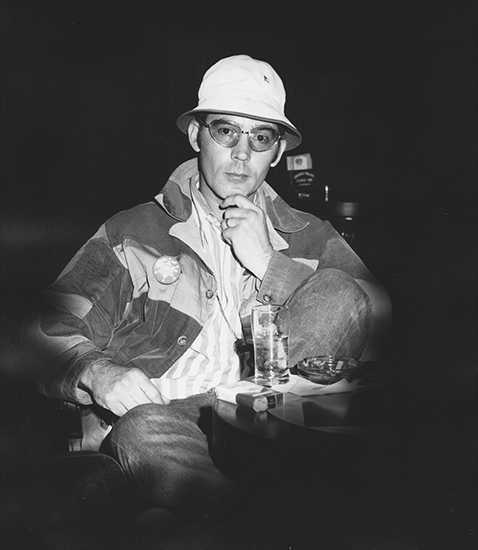
Hunter S. Thompson (© Photofest)
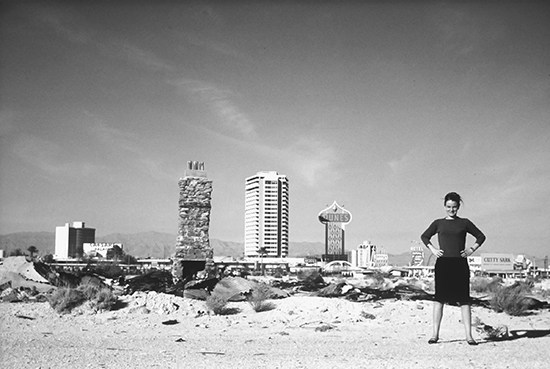
Denise Scott Brown (photo by Robert Venturi, Las Vegas, NV, 1966, courtesy of Venturi, Scott Brown and Associates)
{ 20 }
You were hooked by the first line: “We were somewhere around Barstow on the edge of the desert when the drugs began to take hold.” The November 11 issue of Rolling Stone announced that the author of these lines in the long piece “Fear and Loathing in Las Vegas” was one Raoul Duke, described as “a weapons consultant to our Sports Editor, Hunter S. Thompson.” This was clearly a joke, since readers of the magazine knew that Thompson was simply adopting a persona for his wild journey into the soul of America, as seen from Las Vegas. The cover, by artist Ralph Steadman, showed Mr. Duke, with blood-red goggles, looking like an alien atop a motorcycle, racing toward nothing but trouble. The only disappointment with the piece was that its length necessitated a two-week wait until its conclusion in the next issue. Readers were left hanging with the line “I was going back to Vegas. I had no choice.”1 After the second installment had run, a prisoner from San Quentin wrote: “Raoul Duke, whew,” with a postscript: “And to think I may hafta parole to Las Vegas.”2
That fall, at the Whitney Museum in New York City, architects Robert Venturi and Denise Scott Brown were honored with a major exhibition. Reviewers spoke of them as practicing “Pop” or “protest” architecture. They were fascinated with neon signs and billboards, with the “dumb and ordinary.” Ada Louise Huxtable, the eminent art critic, remarked that they should have constructed a billboard bearing the revolutionary motto “To the Barricades.”3 The Whitney Museum was simply a warm-up for the battle, which would be waged, unsurprisingly, in a book published a few months later which detailed their sensibility as realized in the signs and streets of Las Vegas.
Tom Wolfe, with his ear always attuned to new murmurs in the American sensibility, had preceded Thompson, Venturi, and Scott Brown to Vegas. And they learned from him. When Wolfe first began stalking the New Sensibility in 1964, he naturally lit upon Las Vegas. His essay “Las Vegas (What?) Las Vegas (Can’t Hear You! Too Noisy) Las Vegas!!!!” opened the collection The Kandy-Kolored Tangerine-Flake Streamline Baby. The essay began in typical Wolfe style—“Hernia, hernia, hernia” in various forms, repeated well over forty times. Then the question, from some guy named Raymond, who was hopped up on drugs and the sensory beat of a Vegas casino at 3:45 a.m. on a Sunday morning: “What is all this hernia, hernia stuff?” Turns out that the hum of hernia is nothing more than the “accumulated sound” of craps dealers’ “running singsong” and the “baroque stimuli” that co-existed along with the cling and clang of an army of slot machines stationed in the casino. Raymond’s echoing of this drone while at the craps table gets him politely but firmly escorted from the casino.4
Wolfe relates how the noise of Vegas recalls “one of those random-sound radio symphonies by John Cage.” Noise and stimulation are pervasive, nonstop. Even where quiet might be obtained, near a hotel swimming pool or in an elevator, Muzak is ever-present. The assault on the ears is equaled by a constant all-you-can-handle buffet for the eyes and mind. “Las Vegas has succeeded in writing an entire city,” Wolfe remarks, with “electronic stimulation, day and night.” In his rented car “the radio could not be turned off,” so he must endure Dion’s “Donna the Prima Donna.” Here is pure Wolfe prose, which, as Denise Scott Brown noted, captures the jingle-jangle of Vegas: “The wheeps, beeps, freeps, electronic lulus, Boomerang Modern and Flash Gordon sunbursts soar on through the night over the billowing hernia-hernia sounds.”5 Oh, yeah.
The town was a gigantic gaggle of signs. You noticed neither buildings nor trees, he announced; your attention fixed on the ubiquity of signs, glowing neon at night and yet hardy by day. “They … oscillate, soaring into shapes before which the existing vocabulary of art history is helpless.” The larger, gaudier, more enticing the sign, the better. In the midst of what seemed to be chaos, however, the effect of the signs and architecture in Las Vegas were strangely cohesive, and the “style was Late American Rich.”6
Wolfe was a pygmy amid a forest of signs, which called out a tune of liberation and fantasy—and sex. In the cocktail lounge of one of the hotels, he watched waitresses “bobbing on their high heels, bare legs and décolletage-bare backsides set off by pelvis-length lingerie of an uncertain denomination.” The same type of uniform was found on the streets—women with “their bouffant hair high above,” perhaps mimicking the height of Las Vegas’s signs.7
Ever distanced, what Wolfe giveth as praise he taketh away as madness. Excess, at the craps table or slot machines, staying up all night, absorbing the sheer narcotic energy, exacted its toll. People felt cheated, venereal disease ran rampant, a tidal wave of drugs rushed in, and the mental wards were as busy as the casinos. Wolfe had seen the future, lit up in the dark desert.8
In the spring of 1971, Hunter S. Thompson made two trips to Vegas.9 In March he covered the Mint 400 race for Sports Illustrated. In April, the guru of drugs arrived for an even more brilliantly absurd assignment, to report on the National District Attorneys Association’s Conference on Narcotics and Dangerous Drugs. Sending Thompson on either assignment was a recipe for disaster. He was “loose and crazy with a good credit card in a time when it was possible to run totally wild in Las Vegas … and then get paid for writing a book about it.”10 Somehow, things insanely fell into place for Thompson.
The Mint 400 was a race for off-road vehicles and motorcycles in the desert, sponsored by a local Vegas casino for the last four years. Early in the morning of the event Thompson is drinking at a hotel bar. Later, the motorcycles take off in an “incredible dustcloud” so intense that Thompson realizes that he cannot see the race. He follows in a “press Bronco” into the heart and heat of the desert, but this bravado proves futile. Dropping any pretense of covering the race, he retreats “to drink heavily, think heavily, and make many heavy notes.”11 Sports Illustrated, unsurprisingly, rejected his submission. But the piece was soon transformed into something quite different, first for Rolling Stone magazine and then published as a book in 1972.
In a red Cadillac convertible (“the Great Red Shark”) Thompson, along with his “attorney,” a wild three-hundred-pound “Samoan” (actually a radical Chicano lawyer named Oscar Acosta) armed with a .357 magnum, is speeding to Vegas—literally and figuratively.12 They have packed well for the trip, at least when it came to drugs, which included marijuana, mescaline, acid, amphetamines, and alcohol, among several others.13
Thompson had a well-earned reputation for breaking rules and dancing with danger. Standing six foot three, with an athlete’s graceful body, he had a menacing glare and often acted eccentrically. A troublemaker as a young man, hardly fodder for conformity or college, Thompson went into the military, working as a journalist and causing so much trouble that he was mercifully given an honorable discharge.14 By dint of incessant reading and natural talent, he slowly established himself as a reporter. Fame came to him when he insinuated himself into a Hell’s Angels chapter in Oakland. A single article in The Nation blossomed into a highly successful book.
Hell’s Angels: A Strange and Terrible Saga is a shocking book. It opens by carefully critiquing mainstream press coverage of the Angels, finding that the press had often convicted the group of crimes for which they were innocent. Thompson was no apologist, however. His portrait of the Angels was tough in its own manner—detailing their extreme sense of community (an attack on one of them is met with a response by all), their aura of violence and alcoholism and the reality behind it, and their love affairs with their Harleys. He narrated the work in the voice of an insider while indicating that his status was unstable and insecure. By the end of the book, he has made his distance from the gang clear by absences taken to write his account. At a party he gets into an argument with one Angel, and he is cold-cocked and severely stomped by members of the gang. He was lucky to survive.15
The book also deals graphically with other distasteful aspects of the gang (rapes, initiation rituals, sheer meanness, and violence) while managing to depict various Angels as individuals. Ralph “Sonny” Barger comes across as a cool customer, capable of dealing with authorities without ever surrendering his air of dangerous allure. While Thompson clearly admires Barger and feels a camaraderie with some of the other Angels, he refers to them as “losers,” men who were essentially peripheral to society, underemployed, undereducated, undersocialized. He calls them, perhaps picking up on Leslie Fiedler’s term, “mutants,” because they were “urban outlaws with a rural ethic and a new, improvised style of self-preservation.”16
Hell’s Angels lifted Thompson out of poverty and brought him many reporting jobs. But for years Thompson had been noodling around with an idea for a book about the American dream. He had a hard time defining the precise nature of the dream. Sometimes he associated it with the Horatio Alger ideal that anyone by dint of hard work and luck could rise in society—but at what cost?—or he connected it with the ideal of Jay Gatsby, F. Scott Fitzgerald’s character who was able to reinvent himself.17 At other times he seemed to define the dream as the hassle-free consumption of drugs and the liberation of sexuality. In his own mind, his book on the American dream was linked with another project on American violence; he was, in his prose and life, splashing around in the New Sensibility.
By 1969 Thompson was fretful. Nixon had been elected president and, along with his anticrime cronies, wanted to wage a virulent campaign against drugs. The war in Vietnam continued to take a toll on the American psyche, beyond the violence that it unleashed. Covering the Chicago Democratic National Convention’s bedlam in the streets, Thompson had a Chicago cop’s baton jabbed in his stomach. The scene in Chicago depressed Thompson deeply, but it fitted perfectly with his book project “The Death of the American Dream.”18
He had accumulated many pages of notes, and sometimes the book was imagined as an ironic elegy to the 1960s. Although he tried to keep that project separate from Fear and Loathing, the two became intertwined, as indicated by the published book’s subtitle, A Savage Journey to the Heart of America. “I’ve decided to write the first Fictional Documentary Novel,” he joked to newsman Hughes Rudd in the fall of 1968, with a title of “Hey Rube! The Memoirs of Raoul Duke.” At the very least, this was premature exuberance, but Mr. Duke would become the alter ego that Thompson employed in Fear and Loathing. Yet that book remained dim in the future; his project on the American dream, as he assessed it in December 1969, was “about 400 pages … and it’s all bullshit.”19
Finally, everything came together with the trips to Vegas in the spring of 1969. What better venue, after all, for analysis of the American dream? A place to imagine escape from the mundane, a fantasy world, bubbling with contingency—with most pilgrims losing money. And, of course, located close to the atomic test sites—in essence, on the sharp edge of apocalypse.20
Thompson traveled there with plenty of drugs and a perfect partner in Acosta, who was perhaps even more of a maniac than Thompson himself. The topics that Thompson was purportedly to write about—the Mint 400 and the district attorney’s drug conference—proved to be insubstantial or peripheral to his hunt after the great American dream. But in Las Vegas the fiction and the reality were able to create a sort of parallel universe for Thompson’s adrenaline prose and allowed him to stick a fork into the rump of the American dream. It was done.
Following in the footsteps of Wolfe, Capote, and Mailer, Thompson raised the pace to frenetic levels. He was proud to have been included in Wolfe’s anthology The New Journalism, but his book on Vegas did not strive for documentary or objective precision. His editor for the book was uncertain whether it should appear on the fiction or nonfiction list. Genre distinctions were of little interest to Thompson. Years later he was willing to label his book “a fantasy.” Yet he also claimed, “I didn’t really make up anything.”21 Perhaps Douglas Brinkley, who edited Thompson’s letters, expressed it best: Thompson had the “gift of making his exaggeration seem more realistic than cold truth.” And more interesting. Does it matter that no human being could survive the amount of drugs Thompson reported taking in Vegas? Exaggeration of his normal drug intake helped to create scenes that felt right and that mimicked the neon-lit head-trip that was Las Vegas. And such shenanigans, perhaps, appealed to the dangerous belief of his readers that drug excess need not prove fatal. The style of the book was pure gonzo, a term that had been used to characterize the first-person, drug-clouded, hypercomedic, and jolting prose style. It was also, as James E. Caron has pointed out, in the American tradition of the yarn, of spinning an outrageous tale.22 Thompson had hit the jackpot in Vegas, precisely because it offered him a large canvas: “Free Enterprise. The American Dream. Horatio Alger gone mad on drugs in Las Vegas. Do it now: pure Gonzo journalism.”23
The story was about Thompson’s wanting to be high but needing to assuage the concomitant paranoia, all while reporting on two events and searching for the American dream: a perfect set of conditions for a comedic and tragic storm. People ventured to Vegas for escape, for the chance of winning big, for the opportunity to sin without being judged.24 Thompson reported that Vegas was “a town full of bedrock crazies,” a place where “nobody even notices an acid freak.” But distinctions must be made. Las Vegas “is not a good town for” some types of drugs, such as psychedelics. “Reality is too twisted.”25
Everything about Thompson’s Vegas sojourn screamed excess. But with Thompson, presumably addled by drugs much of the time that he is in Vegas, it is hard to know what was fact and what fantasy. He reportedly had wanted to take notes while things happened, but that was obviously impossible, since he often seemed unable to stand up. Two days after rocking around Vegas, he spent a day and a half locked in a room at the Mint Hotel in Vegas writing copious notes.26 A true account was, of course, impossible, but capturing a feel for the place and his adventures was doable. He claimed that an underage girl that Acosta has picked up and had sex with is now crazed by drugs. Ensconced and paranoid in their room, she has with her forty to fifty portraits, which she has created à la Warhol, of Barbra Streisand, who she wants to meet. Nothing is too strange. Neon signs are so “gigantic”—“millions of colored balls running around a very complicated track”—that they block his view of the mountains. Nothing in Vegas, not even the crime, is understated. Charles Manson would thrive in this city, Thompson opines, so long as he was a good tipper.27
The narrator imagines at one point that he has discovered the “vortex,” or the “main nerve,” of the American dream in the casino Circus Circus. Built in 1968, at a cost of fifteen million dollars, the hotel/casino was topped by what looked to be a circus-tent crown, in pink and white. Something always seemed to be happening at the place, jugglers, high wire performers, and more. It attracted both gamblers and families with children, making it even more surreal.28 Thompson or Raoul Duke—it is impossible to distinguish between the author and his fictional persona—experiences the place the first time high on ether, which makes him appear stumbling drunk. He concludes, “The Circus-Circus is what the whole hep world would be doing on a Saturday night if the Nazis had won the war. This is the Sixth Reich.” It is pure spectacle, like the Nazi Olympics of 1936.29
Thompson’s drug-induced madness is demeaning and delightful, by turns, never more so than when he manages to haul his mescaline-sodden body to the meeting of district attorneys and does not get busted. He goes beyond solipsism by looking at the bigger picture—the alluring madness that is Vegas is the American reality of the present moment. After all, what could be more insane than district attorneys who know nothing about drugs scheming to control them? Or an America where paranoid Richard Nixon occupies the White House? Or a nation where Lieutenant William Calley has become a hero despite (or for some fanatics because of) his mass murdering of unarmed civilians in Vietnam? Or the naiveté of the young who “thought they could buy Peace and Understanding for three bucks a hit”? This is Thompson at his most cynical and jarring, linking his account with what is happening in America in the early 1970s. His conclusion is especially sobering: “Their loss and failure is ours, too.”30 It is a collective failure; indeed, it is the failure of the American dream.
Writing Fear and Loathing in Las Vegas proved difficult for Thompson. The first part came easily (six or seven days of intense work, he claimed, relying on the notes that he had jotted down heatedly at the Mint Hotel), but the second part proved resistant to his desire for a “speed-writing project.” Thompson wrote the book under a relatively benign drink-and-drug regime of Wild Turkey and speed to keep going. His problem with the material was simple—and typical for him—“I need some framework for this thing.” The American dream, in all of its gaudy illusiveness and contradictions, became the theme that unified the book’s excesses to a degree. Locked in a hotel room with an editor, under a strict deadline, Thompson finished the book, although the ending appears a bit arbitrary, as if the pages had been plucked from the typewriter for express delivery to the printer.31 Just as the book was about to be published, Thompson accepted a commission from Rolling Stone to cover the upcoming presidential primaries. Spending time with Richard M. Nixon, Hubert Horatio Humphrey, Edmund Muskie, and other pols would furnish Thompson with a hyperreality equal to Vegas while also permitting him to continue his examination of the vanished American dream.32
Architects Robert Venturi and Denise Scott Brown also journeyed to Las Vegas, if not precisely in search of the American dream, then to examine how that city—with its stylistic eclecticism and bounty of signs—might be a tonic for architects lost in their own desert of modernist thinking.
The first edition of their book Learning from Las Vegas was controversial in form and content. It was outsized—fourteen by eleven inches—like its subject. It had two covers. The hardcover was sufficiently enticing: very dark (blue/green), with the title in upper-case gold letters. Above the striking title was a rectangular image of iconographic bluster—a billboard featuring a woman in a bikini advertising suntan oil; it stands to the side of a roadway with a taxi heading away from the image’s frame. In the background looms the Vegas Strip, dominated by signs and buildings. But this is sheathed by a transparent dust jacket. On this is printed the chapter titles, in black print, which obscures but does not hide the hardback-cover image and print. The cover, like the subject itself, is nearly overwhelming. The authors of the book disdained the crazy yet effective juxtaposition of the cover. Nor did they like the “white page aesthetic” inside, which presumably jumbled their illustrations and undermined their analysis. When the book was reissued in 1972, the dust jacket was gone: less proved to be more.33
Venturi and Scott Brown’s response to the book’s design was surprising. The cover had none of the sleek design common to modernist style, but that should not have been a problem. Venturi had ruffled the purist feathers of his modernist architectural brethren with an earlier book, Complexity and Contradiction in Architecture (1966), with claims that “less is a bore,” and “more is not less.”34 On both these counts, the cover succeeded royally. Nor were the architects against outrageousness, in statement or design. Venturi and Scott Brown maintained that “Las Vegas is to the Strip what Rome is to the Piazza,” and “Amiens [Cathedral] is a billboard with a beautiful building behind it.”35 One of Venturi’s most famous works, the Guild House, a facility for the elderly in Philadelphia, was a simple-looking building, although its proportions and windows were a bit odd. The building, in pop art style, sported its name in large letters on the façade. Atop the roof was a very large gilded television antenna that served no function other than a symbolic one. Venturi said the structure was “like the big, distorted Campbell Soup can in Andy Warhol’s painting.”36 For a competition to design the National Collegiate Hall of Fame in New Jersey (1967), Venturi included, as David B. Brownlee describes it, “a stupendous signboard, proportioned like a football field, with 200,000 programmable lights that could recreate the great moments of historic games.”37 If anything, the cover was understated in comparison.
Brown and Venturi exemplified in their writing and architecture many of the tenets of the New Sensibility as Susan Sontag had explained them only a handful of years earlier. They were self-professed pluralists and populists. While much of their criticism was aimed at high modernism, also known as the International Style, they did not reject it out of hand. Rather, they felt that it had grown predictable and moribund. And they never hesitated to praise the energy of early modernism. Vitality in thought and architecture was central to their vision, a form of liberation. Rather than viewing the architect as hero or the building as a monument for the ages, they preferred the architect to be a jester figure and the building to wink with irony. The modernist structure would be better off if, horror of horrors, it boasted atop the sign, “I AM A MONUMENT.” If the International Style strove for purity, Venturi and Scott Brown celebrated exaggeration, ugliness (albeit of a certain sort), and the goofiness of a pop sensibility. Buildings should bridge the divide between high and low culture, “Viva Ordinary rather than Extraordinary.”38 Chaos, complexity, contradiction—these were the ideals that Scott Brown and Venturi proclaimed, while also claiming that a new sort of order might emerge from such an inclusive framework.39
As with Sontag and camp, Venturi and Scott Brown admitted to ambivalence. In part, this was the logical outcome of a pluralistic, open perspective. On what epistemological basis could one achieve objective perspective sufficient to condemn anything without putting it to the pragmatic test—did it work, and for what reasons? The starting point for them was to understand, to be open to possibility, to come at it with a “non-chip-on-the-shoulder” approach. The architect must be anchored in the history of architecture and open to new possibilities.40
“We have always said we didn’t know whether we hated or loved what we saw.”41 As Venturi put it in 2007, Las Vegas “horrified and fascinated us.” Venturi made a religion out of wanting things both ways—“closed yet open.”42 He loved “ambiguous manifestations of both-and,” which resulted in paradox and complexity. The aim of Learning from Las Vegas was to think about that city, its signs and symbolism, as a case study of how chaos can slide into a different type of order. If forced to render a “judgment,” which meant foreclosing another option or possibility, Scott Brown preferred to do it with a sigh of regret.43
Scott Brown recalled that she had felt an “aesthetic shiver” the first time she laid eyes on Vegas in April 1965. Nearly fifty years later, she still thrilled to “the Strip against a very clear blue sky.” The space “shrieked of chaos.” During her first visit, she had stayed at the Dunes Hotel, for “eight dollars a night.” She was then driving west, heading to a teaching position at UCLA. In November 1966, she took Venturi to Las Vegas, and they began collaborating on an essay about A&P grocery store parking lots. A couple of years later, Scott Brown and Venturi, now married and teaching at Yale, decided to organize a seminar with Vegas as the “object of study.” Along with their students, they went to Las Vegas for “ten intense days” in October 1968—making films, taking pictures, recording sounds, mapping, gathering all sorts of information. “We visited the Young Electric Sign Co. plant, interviewed people there, and got from the Aladdin a detailed description of [Venturi’s] design philosophy.”44 Students enjoyed free room and board at the Stardust Hotel, and the entire crew attended the opening of Circus Circus—later, as we have seen, it served as the nightmare vortex for Thompson’s American dream. At the end of the seminar, they exhibited their work. It was a chaos of images and meanings, a sort of pop epic, presented in “deadpan” style, according to Venturi. Tom Wolfe even attended.45
The revolution being led by Venturi and Scott Brown was apparent in Learning from Las Vegas. They wanted to show how the “extreme” and “exaggerated” visual landscape of the city was nonetheless oddly unified and full of vitality.46 Signs dotted the landscape and communicated meaning. “Symbol dominates space,” they wrote, and exists along with a pervasive sense of movement, of speed. The signs were also exemplary of the “commercial vernacular” common to Main Streets across the United States, albeit in more monumental proportions in Vegas. They approvingly quoted Tom Wolfe on the signs: “They soar in shapes before which the existing vocabulary of art history is helpless.”47
For many architects and urban planners this was precisely the nature of the problem—they found such signage gross, kitschy, and disordered. Venturi had upset many planning commissions seeking to regulate signage along America’s boulevards by asking in 1966, “Is not Main Street almost all right?”48 The Vegas Strip, too, was “almost all right.” But the phrasing, as with Sontag, revealed ambivalence. When attacked for such statements, Scott Brown coolly replied on his behalf, well, he did say “almost.”49
When Venturi and Scott Brown turned to signs, they were struck by their communicative zest and power. But they did little analysis of this form of communication. There was no attempt, for example, to consider Las Vegas signs in terms of Marshall McLuhan’s theories about how media technology creates new environments, nor did they employ semiotics. Las Vegas was, in a sense, an “electric” speeded-up environment, with instantaneous reaction times (the toss of the dice, the jangle and flash of a slot-machine jackpot). It could, in McLuhan’s terms, be seen as a form in and of itself and a “cool” medium, in his idiosyncratic terminology.50
They were also, of course, interested in the architecture of Vegas. First, however, they needed to discuss two types of buildings. One they called duck buildings. A famous photograph in a book by architect and critic Peter Blake showed a Long Island building from 1931 which was shaped like a duck, which signaled to all its function as a store selling ducks and eggs. A similar example would be a hamburger joint shaped like the object that it sold. They found such structures banal and boring. Second, they dismissed the huge, often glass-façaded modernist structures that were elegant, without a fault. These buildings were nothing more than “silly.” Modern architects “have been designing dead ducks,” in one way or another.51
Instead, Venturi and Scott Brown appreciated what they called “decorated sheds.” Buildings of this type were common in Las Vegas. The decorated shed, they averred, employed “systems of space and structure” in “the service of program, and ornament [which] is applied independently of them.”52 This was what Venturi had done with the Guild House. Keep in mind that the Vegas that they were examining in the late 1960s had yet to sprout the monumental structures and Disneyland features that dominate the Strip today.
They admired the gargantuan, pulsating neon signs, revolving sculptures, and kitschy oddments. Unlike Thompson, they took them in without the deleterious effects of drugs on their consciousness. The signs themselves were sufficiently psychedelic. They beckoned drivers from the highway, and they were visible from miles away. They promised visitors pleasure and possibility, among other things. In their chaotic manner, they worked. The signs exhibited “vitality,” showing the “value of symbolism and illusion in an architecture of vast space.” And, perhaps most important of all, they were “fun.”53
Venturi and Scott Brown examined some of the hotels, such as Caesars Palace. They delighted in its eclectic nature. It made the “ugly and ordinary” into something spectacular, with its various architectural styles mixed with humor and impunity. Many viewed the statues of Venus and David as pure kitsch—in bad taste. No, claimed Scott Brown and Venturi; the sculptures “grace the area around the porte cochere.” Even the Palace’s sign was “enriched” by the presence of sculptures of “Roman Centurions” at its base, “lacquered like Oldenburg hamburgers, who peer over the acres of cars and across their desert empire to the mountains beyond.” Everything about Caesars was merrily “off-center” or teeming with a “combination of styles.” Indeed, they concluded, “the agglomeration of Caesars Palace and of the Strip as a whole approaches the spirit if not the style of the late Roman Forum with its eclectic accumulations.”54
The Vegas Strip captured the “messy vitality” that Venturi had celebrated in Complexity and Contradiction. The “iconography and mixed media of the roadside commercial architecture,” Venturi and Scott Brown contended, “will point the way, if we look.” The Flamingo Hotel sign was striking—the casino’s name stretched out horizontally in neon, cursive script, above a colonnade (lighted, of course) that connected with the Strip. The Flamingo Hotel was essentially a silo structure with letters spelling out its name at its upper reaches. This architectural creation, for Venturi and Scott Brown, served as a “model to shock our sensibilities towards a new architecture.”55
Scott Brown and Venturi appreciated the role of pop art in opening up new ways of seeing and thinking. They had read Wolfe on Vegas, appreciating not only his focus but his means of expression, his ability to employ “a prose style suitable to the description of Las Vegas.”56 In Complexity and Contradiction, Venturi wrote of the “vivid lessons” offered by pop art. Pop rejected false dreams of “pure order” in favor of appreciation for the chaos of the everyday and “contradictions of scale and context.” He ended the main text of the volume with an invocation of the power of pop and its subject matter and style: “And it is perhaps from the everyday landscape, vulgar and disdained, that we can draw the complex and contradictory order that is valid and vital for our architecture as an urbanistic whole.”57 Pop further offered “new meaning to the immediate objects of our daily lives, often by changing their contexts.”58
In her essay on the pop sensibility, published in 1969, Scott Brown praised pop’s nonjudgmental approach and openness to plurality.59 The work of such artists as Robert Rauschenberg and Roy Lichtenstein, as well as the Beatles and Dylan, was now established and taken seriously. In Learning from Las Vegas, the authors celebrated “Pop artists,” such as Warhol, who “have shown the value of the old cliché used in a new context to achieve a new meaning—the soup can in the art gallery—to make the common uncommon.”
This was liberating, to be sure, but Venturi and Scott Brown were sufficiently well-versed in literary history to know that such juxtapositions and shifts were also part of the living legacy of modernism. Borrowing a term from literary critic Richard Poirier, which they had come upon in an issue of the New Republic, they celebrated the “decreative impulse” in T. S. Eliot and in the “multitudinous styles” and openness to the sound and sense of everyday life that defined the genius of James Joyce’s Ulysses.60 This was the lively legacy of modernism before it had become ossified. In Learning from Las Vegas, Venturi and Scott Brown saw pop art as revivifying that older imperative—and they were thrilled.61 As noted earlier, in many ways the New Sensibility was a new wave of modernism but also a wave of the postmodern—depending on how one chose to view it. In either case, it was surely part of the New Sensibility then regnant.
The insights and style drawn from pop and early modernism—mixed media, vitality, rejection of the staid, and more—could infuse architecture with new relevance and energy. Indeed, such innovations were already apparent in the “billboard aesthetic” that was the focus of Learning from Las Vegas. Scott Brown and Venturi were especially impressed with the work of artist Ed Ruscha. Along with their students, they visited his Los Angeles studio as part of their Las Vegas trip. Ruscha had a Robert Frank sort of aesthetic, an unwillingness to dwell on a scene, preferring to capture it quickly on his camera. With deadpan humor, Ruscha became in the early 1960s a chronicler of Los Angeles signage, architecture, and automobile culture. Using a small camera, he collected images of gas stations (always adorned with signage) and apartments. He also photographed every building on the Sunset Strip (Every Building on the Sunset Strip, 1966), this time using a 35 mm camera mounted atop an automobile that cruised the street at a slow speed. It was a type of Andy Warhol project; whereas Warhol filmed someone sleeping, Ruscha made a long sheet of photographs of one building next to another. This technique would be featured in Learning from Las Vegas, as the students tried to document, in Ruscha style, every structure that lined the fabled Strip.62
“In the fine arts a new horror-giving energy source has been discovered: the popular,” announced Scott Brown, much to the consternation of some architects. Critic Kenneth Frampton responded to this pop mania with incredulity, well before publication of Learning from Las Vegas.63 The vision that Scott Brown and Venturi celebrated, in his view, was of “instant institutionalized vandalism,” represented by kitsch objects and stupid parking lots. They seemed unable to realize that they were supporting “an industrially brutalized folk culture” that was ersatz; it was devastating the visual and physical environment rather than simply glittering benignly. Like pop artists (writers for the New York Times labeled Venturi and Scott Brown as “Pop Architects”), they refused value judgments; nor did they acknowledge the wealth and power behind the facades and signs.64 They had surrendered, without a real fight, to an “urban society … organized towards self-defeating ends, on a sociopolitical basis that is totally invalid.” Rather than transcending the numbing nature of kitsch, Scott Brown had offered a “perverse exultation” of it.65 And, in comments that many would echo over the years, they showed a singular disregard for power, for the purpose of the signs—to create consumers, market commodity objects, and secure profits for business. On this score, Scott Brown protested meekly that she and Venturi were “analyzing Las Vegas for its physical form and not for its social or economic values.” They were focused on “one variable” in their research—the “physical form” of the city, as expressed in its signage.66
One thing that drew them to Ruscha, and to pop in general, was his “dead-pan style.” According to Venturi, “We just wanted to look at Las Vegas in a dead-pan way which is a more poetic way of long standing.”67 In fact, in her reply to Frampton, Scott Brown argued strangely that Ruscha’s work, like their own, was “not nonjudgmental.” It was simply “deadpan.”68 Such a style, with its ironic distance, furnished Venturi and Scott Brown with ammunition to attack high modernism and to use language that was increasingly coming to be associated with postmodernism. But without burning bridges, in keeping with their celebration of plurality and openness.
Were Scott Brown and Venturi, then, connoisseurs of pop chaos, cheerleaders for the energy of early modernism, and exemplars of an emerging postmodernism? The architect Charles Jencks, who chronicled the decimation of the dream of modernism (pure in style and conception, rational, and orderly), also enumerated the streams of what he called “Post-Modern Architecture.” The new architecture dealt with fragments (what better way to undermine imposed and lifeless order?), “ambiguity and jokes,” mixing of style and metaphor, and suspension of “normal categories of time and space, social and rational categories … to become ‘irrational’ or quite literally impossible to figure out.” The famous example employed later to illustrate this phenomenon appeared in Fredric Jameson’s analysis of the Bonaventure Hotel in downtown Los Angeles, a structure that had no apparent central point, so that one was constantly disordered. The aim of all this was to “develop a stronger more radical variety” of building.69
Such desires jibed well with imperatives of the New Sensibility and the views of Scott Brown and Venturi. Nevertheless, perhaps because of their “deadpan” propensities, they distanced themselves from the postmodernist designation. They identified more with the “revolutionary zeal” of early modernism than with the “classicism” that they oddly associated with postmodernism.70 In 1978 Venturi stated, “I shall talk as an architect, not as a theoretician, but a Modern architect—not a Postmodern or neo-Beaux-Arts architect.”71 “Stylish postmodernism has picked up the image but not the substance of our quest.”72 In a 1997 interview, Scott Brown was more precise. Their historical sensitivity and desire for social planning distanced them from much of postmodernism. But perhaps she stated this in a deadpan manner, thus rendering the statement at once revelatory and concealing.73
A coda. The destruction of modernist notions of social planning and architecture became apparent, for some, a few months after publication of Learning from Las Vegas. On March 18, 1972, the first buildings of the Pruitt-Igoe public housing development in Saint Louis were razed. Only twenty-years old, once an ideal of perfection in urban planning, the project had become, in the words of a Saint Louis housing official, a “blot on the city,” an incubator for crime and desolation. Thirty grim orange buildings, each eleven story tall, covering fifty-seven acres, displayed facades of broken windows and graffiti. The first blasts sounded from close to the ground. In a moment, explosives in two adjacent buildings ignited, and all three structures collapsing into themselves, clouded by a miasma of smoke. What remained, after the smoke had dissipated, was “the haunting eeriness of a bombed city … as if the holocaust had occurred the night before.”74
What some saw as destruction of an old, false dream of order, others heralded as the birth of new possibilities. In a famous analysis, Jencks, with no small amount of hyperbole, announced that destruction of the Pruitt-Igoe projects marked “the death of modern architecture.” Jencks refused to shed a tear. Instead, he pronounced a new development—postmodern architecture, which for him flirted with the “ ‘irrational’ or quite literally impossible to figure out.” It paraded an eclecticism without bounds, fragmentation, “non-recurrent motifs, ambiguities and jokes,” always moving in the direction of “the mysterious, ambiguous and sensual.” In many ways this was the type of ideals that Sontag had praised in the New Sensibility, and that would be central to the fiction of Thomas Pynchon and Samuel R. Delany.75