
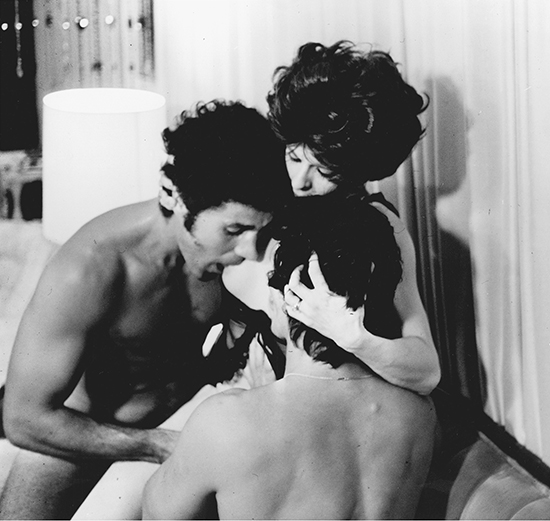
Scene from Deep Throat (1972) (© Photofest)

Divine in Pink Flamingos (1972) (© Photofest)
{ 21 }
By the early 1970s, the United States appeared headed for a collective nervous breakdown. Bestselling books detailed the nation’s “unraveling,” marred by “dislocation,” “disorientation,” and “frustration.” Many reasons were proffered for this descent into “misery, neurosis, and physical illness.” The usual culprits were trotted out—the war in Vietnam, urban unrest, shifting gender relations, materialism, and the wobbly conclusion of the 1960s—all this before the Watergate scandal had squelched any naïve faith in American political leadership. Social critic Alvin Toffler worried about the jarring reality of life in a time of intense acceleration. Technologies of varied sorts produced overstimulation and excess that the population was ill-prepared to handle. It seemed no one was immune. Recall that amid the neon glow and the clatter of slot machines in Vegas (along with a pharmacopeia of drugs), our erstwhile friend Raoul Duke appeared “to have broken down completely.”1
Nervous breakdown, a sense of “bewilderment,” fed into existing veins of paranoia and madness. For those suffering from the malady, drugs offered a double-edged razor of escape. Religion (homegrown fundamentalisms and mystical imports) promised answers for all problems. The appeal of conspiracy theories was intense: everything could be explained, all contradictions resolved, all facts connected, simply by assertion and shards of evidence. Rather than a solution for the wearying effect of excess on the psyche, conspiratorial visions and mystical reveries became manifestations of it.
Nowhere was this more apparent than in two great works of fiction that were coming to life in 1972. These books caught the historical moment and pushed fiction into new territory.2 Both realized the New Sensibility with exceptional brilliance. Genre distinctions in each book were dismissed. Ambiguity was enshrined. A passive reader was doomed. Sex saturated their pages. Ideals of liberation strutted alongside realities of control and destruction; cause and effect become confused. These huge novels—Gravity’s Rainbow was over 750 pages, while Dhalgren pushed past 800 pages—refused easy categorization or summary. Around four hundred named characters populated Gravity’s Rainbow; the novel was abuzz with references to films and popular culture; lyrics from perhaps forty songs dotted the pages. It included learned discussions of technology, of the history of the colonial destruction of the Herero tribe in southern Africa, Puritan theology, and too much to mention even in passing. Both books overflow and overwhelm with shifting narrative voices, more plots than a large cemetery, and prose that raced breathlessly or slowed to an aching crawl. The books were labyrinths of excess designed to entrap the reader in uncertainties.3
Here is science fiction writer William Gibson on Dhalgren: “I have never understood it… . That has never caused me the least discomfort, or interfered in any way with my pleasure in the text… . Dhalgren is not there to be finally understood. I believe its ‘riddle’ was never meant to be ‘solved.’ ” The work was “experimental,” “something else, something unprecedented.”4 Edward Mendelson famously referred to Gravity’s Rainbow as an “encyclopedic narrative”—nothing seemed to escape its ken. Added critic David Leverenz, “The book was an act of calculated hostility against my own need to find out what it was about. In fact, that was what it was about.”5
Thomas Pynchon delivered his manuscript to his publishers in January 1972. Then titled Mindless Pleasures, it would be published at the end of February 1973 as Gravity’s Rainbow.6 Although still not thirty-five years of age when he completed the manuscript, he was already famous for two novels, V. (1963) and The Crying of Lot 49 (1966). Pynchon had spent five years working on the new novel, living mostly in Manhattan Beach, California—always far from the New York publishing scene. His paranoia and desire for privacy were singularly intense. Hardly any pictures of him exist. We know that he is tall and slim. His undergraduate pal from Cornell University Richard Fariña may have had him in mind in describing a character as having “huge teeth jutting forward like a beaver’s.”7 Pynchon sometimes hung towels over windows for added privacy and quiet. Sometimes he remained in the apartment for weeks, working on his manuscript. But he was not a hermit. He ambled over to a café, the Fractured Cow, once reportedly bringing a steak with him to be cooked in their kitchen. While eating his dinner, he often wrote with intense concentration. He dated some women, including the daughter of Phyllis Coates, who had briefly portrayed Lois Lane on the Superman television show in the early 1950s and who lived across the street from him. Sometimes he had drinks with friends at the neighborhood bar. He never talked about his work, although most of his neighbors knew he was an author. All agreed that his knowledge was vast and his intelligence superior.8
Samuel R. Delany at this time was busy writing two novels simultaneously, Dhalgren (1974) and Hogg (not published until 1995); he also had a pornographic novel in the finished bin called The Tides of Lust (reissued as Equinox), which would come out in 1973. In contrast to Pynchon’s manic anonymity, Delany unveiled his life for examination. Born to a middle-class black family in Harlem (his father owned a mortuary), he revealed his genius early, and he attended the Bronx High School of Science. He dropped out of college, married his girlfriend, the poet Marilyn Hacker, and together they lived as bohemians on the Lower East Side. For about six months in the late 1960s, Delany was part of a communal living situation. He took full advantage of the local avant-garde scene; indeed, in the summer of 1960 he had attended Allan Kaprow’s Eighteen Happenings in Six Parts.9
Before he had turned twenty, Delany published his first work of science fiction, The Jewels of Aptor (1962). Over the next decade, he pumped out nine more volumes in that mode, including the Nebula Award–winning, Babel-17 (1966). Delany reeled under various strains—overwork led to a nervous breakdown, with a three-week stay in a mental hospital. Although he had married Hacker, he knew that he was homosexual. Nonetheless the two maintained their relationship for many years and would in 1974 have a child together. But Delany was regularly on the prowl for homosexual “instant sex” during evening scurries to the rough dock area on the west side of the city. On one of his romps, around 1964, his partner turned out to be Jack Smith, the director of the avant-garde classic Flaming Creatures. Delany was impressed, since he had read Sontag’s piece on it in when it had first appeared.10 He also traveled frequently, composing Dhalgren in twelve different cities from its inception in January 1969 to its completion in September 1973. It was, he admitted, a “strange, mysterious, highly sexual, and experimental novel.”11
Both novels featured befuddled protagonists in the midst of urban destruction. In Dhalgren, “the Kid” is in his late twenties but earned his nickname thanks to his baby face. He cannot remember his own name, although parts of his past are clear to him, and he knows that he is half Native American.12 He recalls with especial clarity a childhood memory, appropriately, of being lost for hours until his parents found him wandering the streets. For unknown reasons, the Kid has come to the ravaged city of Bellona (although it is possible that he has been there the entire time). Bellona was once a thriving midwestern metropolis, its population now reduced from two million to a mere one thousand souls. Shrouded in a permanent haze, parts of it ablaze, the city is cut off from the rest of the nation. Why all of this is the case remains unclarified. “It is a city of inner discordances and retinal distortions,” we are told. How this came about is left “opaque,” although hints are proffered.13
Delany was writing, of course, at the time of the urban race riots of the 1960s and in the midst of urban decline. The riots were a response to police harassment, lack of political power, a dearth of employment opportunities, poor housing, and more. All of this was exacerbated by a tanking economy in the early 1970s. Inflation was rising; the price of a gallon of milk had become disgraceful. An oil embargo in 1973 and 1974 made gasoline expensive and scarce (creating rationing and long lines waiting for the few pumps with gas available). By the mid-1970s a new phenomenon known as stagflation (inflation without economic growth) had bloomed ugly. Major cities by the mid-1970s were unable to keep up services; crime increased; job opportunities plummeted (by 40 percent in Detroit); whites fled to the suburbs and Sun Belt. The fiscal plight of New York City became untenable. Mayor Abraham Beame headed to Washington to plead for financial help. The New York Daily News summed up the president’s response as: “FORD TO CITY: DROP DEAD.”
The majority of those who continue to live in Bellona are blacks—and it is regularly remarked how the white population seems to have forgotten about their existence. Perhaps there has been a race war, or some type of natural disaster, given later oddities that appear in the novel. People manage to survive in Bellona, mostly by living off the canned food stuffs remaining in abandoned houses and stores. It is, as one character puts it, a “saprophytic” existence—living off dead matter.14 For all we know, the city may be nothing more than a fiction of desolation in the unstable mind of its main character. It is all very confusing. Some people—a poet (who may be a figment of the Kid’s imagination) and a former astronaut—visit Bellona. And some people leave.
The jolting opening line of Gravity’s Rainbow tosses readers into the London blitz: “A screaming comes across the sky.”15 In the midst of this terror, we are introduced to Lt. Tyrone Slothrop, a schlub with one peculiar attribute—he apparently has sexual intercourse in areas that are soon to be devastated by incoming V-2 rockets. Slothrop has a “talent for phallic rocket-dowsing,” as one critic phrased it.16 What makes this perplexing, and problematic, is that there is no easy explanation for this phenomenon, except for an amazing fact—a mad Pavlovian scientist had trained Slothrop’s penis, when he was an infant, to become erect when rather mysterious stimuli are present. But if this is the cause, then the nature of cause and effect is undermined, since Slothrop’s erections are predictive but often without any apparent stimulus. To further complicate matters, Pynchon’s characters are fascinated with the antireality of the rockets—they travel at the speed of sound, so that you can be killed by a rocket before hearing its scream of impending doom. “Them fucking rockets. You couldn’t adjust to the bastards.”17
Edward Pointsman, a behaviorist scientist, demands, at any cost, to understand the connection between Slothrop’s erections and the landing of V-2 rockets. Others from murky organizations are drawn to Slothrop as well, which leads to encounters both painful and comic. In his sallies around Europe, in the months around the end of the Second World War, Slothrop tries to elude his pursuers and learn more about a strange substance, Imipolex G, and about a potential rocket primed for mass destruction. He is also a man with a malleable identity. His roots reach deep into the soil of Puritan New England, with its repression, anxiety, and fevered distinctions between the elect and the damned. But in the course of the novel, he appears at various times as a zoot-suiter, the comic book figure Rocketman, a reporter named Ian Scuffling, a Russian soldier, and, during a celebration taking place in a small German village, Plechazunga, a pig hero. Spontoon and Muffage (S&M) are medical officers aiming to castrate Slothrop, under orders from Pointsman. With especially poor timing, Major Duane Marvy, another of Slothrop’s pursuers, puts on a pig costume, convinced that no MP will bother any “innocent funseeking pig.” He is mistaken for Slothrop and gets castrated.18
In a novel pulsating with paranoia, there are a few moments of transcendence—through the eventual disintegration of Slothrop. It is reminiscent of Emerson’s famous epiphany: “All mean egotism vanishes. I become a transparent eye-ball; I am nothing; I see all; the currents of the Universal Being circulate through me; I am part or particle of God.” Slothrop’s disintegration mirrors the increased fragmentation of the novel.19
The paranoia and conspiracy at the heart of Gravity’s Rainbow fit perfectly with the Watergate Scandal.
On February 16, 1971, presidential aide Alexander Butterfield explained to Nixon the functioning of a hidden taping system in the Oval Office. Even Nixon’s closest advisors were unaware of the system, which was the way Nixon wanted it. The tapes revealed Nixon intensely involved in foreign affairs (sometimes in a brilliantly insightful, albeit amoral manner) and as a foul-mouthed, anti-Semitic, racist, and paranoid figure. He trusted no one, a feeling which increased when Daniel Ellsberg, after photocopying seven thousand pages of text, leaked the Pentagon Papers to the New York Times. Publication revealed chicanery and deceit about the war in Vietnam at the highest levels of government, its role in the overthrow of the Diem regime, its initial justification for massively scaling up the war effort (an imagined or mistaken attack upon US warships in the Gulf of Tonkin in 1964), and much else.
In short order after publication of the papers, Nixon’s team of operatives, known as “the plumbers,” broke into the offices of Ellsberg’s psychiatrist in search of incriminating evidence to destroy Ellsberg’s credibility. They came up empty-handed, but within a year’s time some members of the group would break into the offices of the Democratic National Committee in the Watergate complex.20 Despite the efforts of Democrats, the Watergate fiasco played no role in the election of 1972, which saw Nixon romp over his opponent, Senator George McGovern from South Dakota. But Watergate refused to go away, thanks in large part to the investigative efforts of two reporters from the Washington Post. By 1974 it was clear that Nixon and his team were guilty of various crimes. The president was likely to be impeached by the House of Representatives, and with a certainty of conviction by the Senate, he resigned his office. Vice President Gerald R. Ford (Spiro T. Agnew had resigned the position for bribery, tax evasion, and other charges) became the new president, but only after he had agreed to grant Nixon a full pardon for his obstruction of justice.
The universe of Gravity’s Rainbow stinks with the heavy scent of conspiracy and paranoia.21 The excess central to the New Sensibility easily adjusted to this historical moment, bringing paranoia into its embrace. London is “the City Paranoiac.”22 And not just because of the V-weapons landing with a swish of deadly contingency; in London and Berlin, and other major urban centers, a “million bureaucrats are diligently plotting death” in various acronymic organizations and with industrial firms, such as I. G. Farben, General Electric, and other international cartels, together controlling everything from plastics to rockets.23 As Pynchon surmised, truth is stranger than even his fiction. Nixon’s reelection committee, which ended up knee-deep in the muck of Watergate, was named the Committee for the Re-Election of the President: CREEP.
In perhaps his best line in the novel, Pynchon quips: “What happens when paranoid meets paranoid? A crossing of solipsisms.”24 Late in the novel, one of the characters supplies a brief taxonomy of paranoiacs. According to Prentice, the humanist Roger Mexico is “a novice paranoid.” Such a person can only go so far by believing in “a well-developed They-system.” Alas, there’s another half to the story, as understood by those suffering from “creative paranoia,” which requires “developing at least as thorough a We-system as a They-System.” This only further confuses Mexico, as well it should.25 Nevertheless, along with Pig Bodine, in the name of anarchy and freedom, they crash a cartel dinner party. Their weapon is crude, alliterative language, which is all they have got: Mexico says, “I can’t seem to find any snot soup on the menu.” In response, Bodine jokes, “Yeah, I could’ve done with some of that pus pudding … with a side of—menstrual marmalade.”26 No victory is achieved, but they do manage to disappear from the novel—perhaps liberation in and of itself.
Despite the obsession with paranoia (and high number of deaths), Pynchon has enough humor and irony to leaven somewhat the density and despair of such themes. Consider the hilarious and disturbing section “The Story of Byron the Bulb.” Byron is an “immortal” light bulb, which upsets Phoebus (the international light bulb cartel headquartered in Switzerland). They fear Byron since he (it?) never burns out (thus upsetting the principle of planned obsolescence) nor does it use electricity (thus depriving the power companies of income). As usual, Pynchon displays his vast research about how these companies were historically in cahoots to control power and light. Byron is a revolutionary of sorts, another reason why he must be unplugged. What if “a few Bulbs, say a million, a mere 5% of our number” flamed out in a “Guerilla Strike”? Like Slothrop, Byron manages to escape, sometimes in the most awkward manner. In Hamburg, with the bulb snatchers on his trail, Byron is placed by a male prostitute up the ass of one of his johns. The man, “a cost-accountant who likes to have light bulbs screwed into his asshole,” who is also high on hashish, forgets the bulb up his anus. Later, Byron is plopped down in the toilet, floating for days “over the North Sea” before ending up in use at a hotel, with further adventures in the offing. Byron will, Pynchon informs us, “be screwed into mother (Mutter) after mother, as the female threads of German light-bulb sockets are known, for some reasons that escapes everybody.”27
The world occupied by the Kid in Dhalgren, in contrast, is marked by the decline of technology (electricity in Bellona is at best erratic), the absence of bureaucracy and its enforcing minions, and the demise of the traditional family unit. It is, in many ways, an arbitrary place—the newspaper is issued sporadically, with dates that have no logic. At the same time, or perhaps because of the freedom of contingency, Bellona is a vision of an anarchist paradise, marred, however, by the knowledge that there is no such place as paradise.
While Delany was working on Dhalgren, the crumbling ideal of the patriarchal American family was being displayed on network television. In January 1971, a new television show, All in the Family, debuted with wild success. It captured the divisions that rent American families, with Archie Bunker an exemplar of the “silent majority” (although he was rarely silent when it came to cracking wise about his dislikes) while managing to present him as more than simply a narrow bigot. His morals were rigid and contradictory, constantly challenged by the New Sensibility and liberation that he neither understood nor embraced.28 In 1971 the Public Broadcasting System spent weeks filming an American family living in Santa Barbara. Two years later, An American Family shocked audiences with its cinéma-vérité format, a peephole into the secret lives of the well-to-do but disintegrating Loud family. Before the show ended, Pat Loud had demanded a divorce from her husband, and Lance Loud, one of their children, had announced he was homosexual and determined to become a rock star.
In Bellona the traditional family became an illusion mirroring the apparent disintegration of family across the United States in the late 1960s and early 1970s. The Kid is hired by Mary Richards, a housewife madly striving to maintain an ideal family, to remove debris from an apartment in her building in preparation for the family relocating to presumably quieter confines. She is upset that the realty company in charge of the building has not responded to her complaints nor to her desire to move to the other apartment. Of course, as nearly everyone realizes, in Bellona the realty company is no more functional than everything else.
Mrs. Richards gallantly—and with a touch of madness—works to maintain order in a world run amok. She prepares dinner, sloshing together odds and ends from canned goods. Dinner is a formal occasion; the family awaits the return of Arthur Richards from work (but that, too, is a fiction, since he no longer has any employment). Daughter June, presumed to be the quintessence of virginal innocence, had, during the initial hours of the calamitous transformation of Bellona, engaged in violent sex in the streets with George Harrison, an especially well-endowed African American who she knew only by the heat of their mutual sexual desire. Since then he has become something of a superstar in the city, appearing naked in various poses on posters and even having a new moon that has mysteriously appeared named in his honor. In the midst of moving to the new apartment, June—perhaps by accident, perhaps not—pushes her younger brother Bobby to his death down an open elevator shaft. He had been threatening to tell their mom that June had secreted away a poster of Harrison. Another son lives in the city, under a new identity. The mother lives in severe denial, enabled by the rest of the family.
Alternative modes of community emerge to replace the traditional family. Anarchy, in Delany’s vision, fosters benign order rather than violent disorder. Certainly his relationship with his wife was unconventional, even according to the loosened standards of the 1960s. During the winter of 1967 and early spring of 1968, Delany had been a member of a band and a commune both named Heavenly Breakfast. Most of the money supporting the commune came from drug dealing. The place, as Delany makes clear, was neither a democracy nor a utopia. But it was a space where sexual freedom reigned: “Sex, for all practical purposes, was perpetual, seldom private and polymorphous if not perverse.”29
Upon arrival in Bellona, the Kid is greeted warmly by members of a hippie-like commune. Another early acquaintance is Tak, a former engineer who had spent time in prison for having sex with a minor. But Tak (who has a copy of Hunter S. Thompson’s Hell’s Angels in his bookcase) proves a generous host, sharing his provisions, offering the Kid a place for the night, and dispensing wisdom aplenty. He and the Kid will have consensual sex and become friends.
Much of the danger that presumably lurks in Bellona is attributed to a gang known as the Scorpions. Early in the novel, the Kid has a painful run-in with them. In time, however, he becomes a leader of the Scorpions, who live communally, look after one another, and prove to be rather tame in their outbursts. One of their main enjoyments is going on “runs,” entering abandoned buildings and causing damage. Scorpions are Hell’s Angel–like in that they have group solidarity and adorn themselves with chains. But they are also malleable in identity, sporting animal holograms.
At the outset of the novel, the Kid finds a loose-leaf notebook full of jottings. He keeps it and adds to it, creating a poetry that may or may not constitute revisions of what was already in the notebook—and which may have been in the possession of the Kid from the beginning, with all of the marks therein his own. (Delany had once lost a notebook with parts of Dhalgren in it.) Although the name Dhalgren appears among a list of names in the notebook, we also learn that there are at least four distinct handwritings gracing its pages. This could indicate multiple writers or the fragmented identity of its author.30 The fog of mystery only deepens—it will not lift.
The first line in the notebook is mysterious: “To wound the autumnal city. / So howled out for the world to give him a name.” The Kid admits that such stuff is “pretty weird.” He is soon preoccupied with the book, writing poetry, revising material already inscribed in it, almost always “puzzled at what he had done.”31 The Kid worries grievously, as many writers do, about whether or not a comma belongs in a certain spot—sometimes it seems to appear or disappear of its own will. When misplaced, like Kid’s memory, it causes him tremendous unease, a sort of “quaking” with anxiety. Delany had experienced a nervous breakdown under the pressure of writing for a living, and the Kid admits that he may not touch pen to paper again, because, he says, “It’s too hard… . I think it would kill me.”32
Like memory, writing and authorship are confused. On the page in the notebook before the one containing the list of names is written: “In an age glutted with information, this ‘storage method’ is, necessarily, popular. But these primitive … ” The remainder of the thought is missing.33 “Glutted with information” is a good way of describing Gravity’s Rainbow—and indeed one arm of the New Sensibility. Consider only the initial twenty pages of the book. We are introduced to well over ten characters by full name. And what names they are: Teddy Bloat, Osbie Feel, Maurice “Saxophone” Reed, Lord Blatherard Osmo, Bartleby Gobbitch, Corydon Throsp, and Joaquin Stick. In addition to the wonderfully funny and inventive names, Pynchon slips in puns and jokes. “Pirate” Prentice is driven to a destination “by his batman, a Corporal Wayne.” (For those unfamiliar with the original comic strip or television and film versions, Bruce Wayne is the superhero Batman.) A goodly part of these pages is given over to Prentice’s preparing an intricate banana breakfast (recipe included).
In the space of these initial pages, with his usual aplomb, Pynchon mixes high and mostly low cultural references, adopting the refusal of the New Sensibility to respect such divisions. Osbie Feel, in a masturbatory sort of moment, sings “Tell Miss Grable you’re not able, / Not till V-E Day, oh.” From pin up girl Betty Grable, she of the impossibly long legs, to W. C. Fields, Cary Grant, and Fuzzy-Wuzzies, the pop culture references fly. We are treated to a quote from physicist P. M. S. Blackett, perhaps mainly chosen for his initials: “You can’t run a war on gusts of emotion.”34 Mention is made of the Crystal Palace (a spectacle of architecture from the Victorian period), of “second sheep” (a reference to Puritan theology), of “the mark of Youthful Folly” (a reference to the I Ching), and much more. French and German words appear, as well as words that are onomatopoeic: “whoomp.” There is also a glorious reference to “bureaucratic smegma.”35 In Greek, smegma refers to soap, but in English it means “the secretion of a sebaceous gland; specifically: the cheesy sebaceous matter that collects between the glans penis and the foreskin or around the clitoris and labia minora”36—an apt conjoining of meanings, since the relationship between individuals in the novel is often mediated by shadowy bureaucracies and through sexual emissions—dirty meanings that soap cannot clean up.
Every page of Gravity’s Rainbow teems with excess and absurdity. What about the “giant Adenoid,” perhaps “as big as St. Paul’s” cathedral, that threatens London? “This lymphatic monster” is met with fear, “cheap perfume,” dancing chorus girls, and “observer balloons.” The Adenoid is reported by the balloonists to be sloshing about in Hampstead Heath at the moment, acting “like a stupendous nose sucking in snot.” The army comes to fight “the fiendish Adenoid,” which is described as having “a master plan.” But they fail:
The Adenoid is blasted, electric-shocked, poisoned, changes shape here and there… . A hideous green pseudopod crawls toward the cordon of troops and suddenly sshhlop! wipes out an entire observation post with a deluge of some disgusting orange mucus in which the unfortunate men are digested—not screaming but actually laughing, enjoying themselves.37
And this in only the first twenty pages of the novel.
Pornography, or at least works dealing explicitly with sex, had by 1972 gone mainstream. Modernist and experimental books once banned for explicit sexual content were now readily available in paperback editions. Enfolded within the plentiful pages of Gravity’s Rainbow and Dhalgren, and even more in Delany’s two other novels from these years, is plenty of hardcore sex and coprophilia. By this time the New Sensibility, with all of its excesses, faced relatively little censorship, although this is not to suggest that Nixon’s silent majority was pleased with its cultural blossoming.
Underground newspapers regularly printed comics and dialogue that were sexually graphic, to the extreme. Although a few years earlier, some films, usually Swedish or Italian imports, had depicted sex in a graphic manner, these films had been challenged in court and forced to show in limited venues and only during late-night hours. Deep Throat (1972), all sixty-two X-rated minutes of it, helped to change all of this. In the view of cultural critic Ellen Willis, it was “the first porn movie to become a cultural event.” It was also “a huge moneymaker.” Its allure, some tried to argue, was in its quasi-feminist agenda—unlike traditional porn, the film concerned a woman achieving orgasm after orgasm. But this premise was thinner than an ultra-thin condom. The star, named Linda Lovelace, is sexually hobbled by an anatomical oddity; her clitoris is located deep down in her throat. The only way she can achieve orgasm—well, you get the point. The film was, Willis concluded appropriately, “about as erotic as a tonsillectomy.”38 Middle-class couples, however, lined up to watch this film about a young woman enamored of, and exceedingly skillful in, fellatio. That same year, Behind the Green Door opened, with its all-American, beautiful star Marilyn Chambers cavorting around. For those desiring a wee bit of acting talent in a porn star, Georgina Spelvin sizzled in The Devil in Miss Jones (1973).39
Limits on grossness seemed to have evaporated overnight. Graced with a wonderful sense of humor and irony, which allowed him to get away with lots of excess, John Waters premiered his film Pink Flamingos in 1972. Its star was an overweight drag queen named Divine. Along with her mother, Divine lives in a pink trailer with, of course, pink flamingos in front. The storyline is unimportant, other than to note that there is spouting blood in the film when a bunch of cops get hacked to death and then consumed. The film concludes with Divine, accompanied by two pals, walking down a street. A dog shits nearby, and Divine greedily picks up the poop in her hands and puts it in her mouth, gagging a bit and then smiling.
There is plenty of hardcore sex in Dhalgren, including a ménage à trois between the Kid, Lorna, and Denny, an underage boy. Delany had pushed it when describing the controversial sexual encounter between George Harrison and young June Richards. The heat burns as hotly as the fires of the riot that surrounds the pair—although whether it was a rape or consensual remains (as do most things in Dhalgren) up for grabs.
But in novels The Tides of Lust and Hogg, Delany refused to sugarcoat or hide anything. This was in keeping with his own personal penchant for revelatory memoir—he details his own particular sexual tastes, ranging from men with stubby, unkempt fingers to various sadomasochistic practices. For Delany, the transgressive nature of sexual experience is its own reward, casting off bourgeois repression, and perhaps opening a royal road to liberation. But in the novels, the path is made difficult by unbalanced power relations and pure horribleness.
In a 2004 interview, Delany quoted William Blake’s familiar line “The road of excess leads to the palace of wisdom” in support of his pornographic compositions. The wisdom to be gained from Hogg, at best, appears to be that jealousy is an unnecessary emotion and contrary to liberation. An “active sexual life,” according to Delany, undermines jealousy. Certainly the sexual life of Mr. Hogg and his pals is fully activated. But is such violent transgression morally valid when it leads to suffering, according to the novel?40
Hogg is gross. He is drenched in his own urine and feces. He needs sex on an almost hourly basis. The narrator of the tale, a teen called the Cocksucker, joins him in various “adventures.” Hogg picks up money by engaging in professional “cunt bustin’. ” Hogg, along with Cocksucker and cronies Nigg and the Wop, is employed by men who have been humiliated by women to return the favor—a thousand times over. These “rape artists” assault one woman in the most vicious manner imaginable, while also having sex with one another during the romp. These sex scenes are offensive in their description and in their misogyny. They are joined by examples of horrific self-abuse, as when one character decides to drive a thick nail through his penis and then, using pliers, twists it around into a ring. He manages to survive, only to become a serial killer whose main refrain is “It’s All Right.”41
Hogg and The Tides of Lust seem to accept child sexual slavery, without any concern. At one point the Cocksucker is sold to a black fisherman named Big Sambo, who lives on a boat with his young daughter, Honey-Pie. She regularly services her father’s sexual appetite. In The Tides of Lust the protagonist, the Captain (his ship is named The Scorpion, a clear reference to the gang in Dhalgren), has bought siblings in Bombay; they travel with him as crew and sexual objects for his lust. As the novel opens, Kristen is fifteen and Gunner is thirteen; they are sexually omnivorous. While the story is dotted with occasional reflections on art, the story of Faust, and recondite references to sixteenth-century necromancy, it is really an explosion of pornography—with anal sex galore, gang rape, and drinking of urine.42
Let’s deal first with scatology. Slothrop, under the influence of sodium amyl (one of the euphoria-inducing drugs Hunter S. Thompson had packed for Vegas), relates a dream of sorts about the time he was at the Roseland State Ballroom, in an African American section of Boston. Appropriately, much of the account is a jazz riff, with references to a young Malcolm X (who actually worked at the joint) and to Charlie Parker. At some point, his harmonica goes “PLOP” into the “loathsome toilet!” Slothrop reaches into the toilet, inching deeper into its depths, “his virgin ass” exposed but unpenetrated. Shit surrounds him and he becomes “shit-sensitized,” able to “identify certain traces of shit as belonging to this or that Harvard fellow of his acquaintances.”43 Memories of this episode occur twice more in the novel, and eventually Slothrop and his harp will be reunited.44
Sadomasochism figures centrally in two episodes, although it is not presented as necessarily liberating.45 Nor is titillation the goal; it is more about the interplay between submission and freedom, weakness and domination. Brigadier General Ernest Pudding, who lost 70 percent of his men at the Battle of Ypres in the First World War, now atones for the death of those men by being dominated by the beautiful and mysterious Domina Nocturna. She tells Pudding, “You shall have your pain tonight … pain. The clearest poetry, the endearment of greatest worth.” And she humiliates him royally, pissing into his mouth, then defecating and making Pudding consume her turds, “bread that would have only floated in porcelain waters somewhere” (a reference back to Slothrop’s foray in the toilet).46
Katje is a sexually active young woman, to put it mildly. She is a sexual slave (of sorts), along with a young man named Gottfried, to the whims of Weissmann. Also known as Blicero (“White Death”), Weissmann looms as a figure of daunting evil and fanaticism that brings to mind Captain Ahab. Yet he has a poetic soul and is enamored of Rilke’s poetry.47 Humiliation of various sorts is the order of the day in Weissmann’s world. Sometimes Blicero tries to push his “weary, often impotent penis” into Gottfried’s meek mouth.48 Unlike Katje, who is free to escape this sexual triangle, Gottfried is utterly in thrall to Blicero’s sexual needs and to his larger plans. Critic Paul Fussell refers to the scene with this trio as “fantastic, ennobling, and touching, all at once.”49
Much of the sex, with its sadomasochism and erections, is related to power and domination and, of course, connected with the penis-shaped V-2 rockets that open the novel and with the strange substance Imipolex, which figures in the construction of a new, earth-shattering rocket. In one scene, a fellow named Drohne, “a plastics connoisseur,” is having an erection. A bit later he explains that Imipolex is “the material of the future.” Perhaps the substance is connected with Slothrop’s “hardon reflex.”50 Perhaps not. We do learn, however that Imipolex proves capable of causing intense sexual arousal and “is the first plastic that is actually erectile.” This must be the stuff that dreams and rockets are made of.51
How to end a dystopic novel like Dhalgren? With the same mystery that rumbles throughout the book. A new disaster—a crashing plane, something that “looks like lightning,” darkness invading the city, dust swirling, who the heck knows—but explosions may be happening. Under “slowly moiling clouds, the side came off a twenty-story building.” Almost all the characters highlighted in the novel are part of a chaotic mass exodus heading out of the city. Someone says to George Harrison, “Them white men gonna kill us all ’cause of what you done today to that poor little white girl.” Today? Wasn’t that supposed to have occurred before the novel’s timeline began? Is this a case of eternal recurrence? A glimpse of one character, Reverend Amy, seems to indicate her “rage,” but closer examination suggests that “the expression struggling with her features was nearer ecstasy.”52
“The burning city,” writes Delany, “squatted on weak, inverted images of its fires.” Those fleeing are met by a young woman who is heading to Bellona, just as the Kid had once done. Or is she a further figment of his own imagination, a sort of double for him? The girl is given an orchid, returning to the starting point of the novel. We learn that she writes with her left hand, furthering the connection between the destructive orchid and the power of writing. The Kid, we presume, is “too weak to write much.” The final words of the novel break off in midsentence: “I have come to”53
Gravity’s Rainbow concludes with poor Gottfried and the fate of our nation in the era of Richard M. Nixon. Gottfried is comfortably tight in the tail section of Rocket 00000, in an “Imipolex shroud,” or what could be viewed as a condom.54 He is something like a virgin ready to be sacrificed. The smell of the Imipolex that is “wrapping him absolutely” like a swathed baby brings back joyous childhood memories—no doubt sexual. Perhaps Gottfried, like Slothrop, has been conditioned as a baby to respond to certain stimuli.
The rocket—its “ascent will be betrayed by Gravity”—is headed for the Los Angeles area, specifically the Orpheus Theatre on Melrose Avenue.55 The night manager of the theater is one Richard M. Zhlubb, whose nasal condition earns him the moniker “the Adenoid.” Yes, we have returned to the early pages of the novel when a giant Adenoid threatened London. But it is now somewhat clear that this fellow Zhlubb is actually a stand-in for another adenoidally challenged figure, Richard M. Nixon!
Does all of this paranoia and absurdity in Pynchon’s tale now hit close to home?